What Are the 20 Examples of Computer Hardware?
You use computer hardware every single day. From the keyboard under your fingertips to the monitor right in front of you, hardware is everywhere. But can you actually name 20 different pieces of computer hardware? If that sounds tricky, you are in the right place. This guide walks you through 20 clear examples of computer hardware, explains what each one does, and shows you why every piece matters.
What Are the 20 Examples of Computer Hardware in Phoenix
Whether you are a student in Phoenix studying for an IT exam, a small business owner setting up a new office, or simply someone who wants to understand the machine sitting on your desk, knowing your hardware pays off. Computer hardware includes every physical part you can see and touch, from the processor hidden inside the case to the printer sitting next to it. In Phoenix, AZ, local tech shops, repair centers, and schools reference these same 20 components daily. Understanding them gives you the confidence to make smarter buying decisions, troubleshoot basic problems, and communicate clearly with technicians. Below, we break the full list into easy categories so you can learn each one step by step.
Overview of Computer Hardware
Computer hardware refers to every physical component that makes up a computer system. Think of it this way: if you can pick it up, plug it in, or physically touch it, it is hardware. The monitor you look at, the mouse you click, and the processor chip inside the case are all hardware. Software, on the other hand, is the set of instructions that tells hardware what to do. Hardware is the body of the computer, and software is its mind.
Understanding Computer Hardware in Phoenix, AZ
Before jumping into the full list, it helps to build a clear picture of what hardware really is and why it matters. A computer without hardware is like a recipe without ingredients. You can have all the instructions in the world, but nothing happens until you have the physical tools to carry them out. In Phoenix, whether you are building a gaming rig, upgrading an office workstation, or learning the basics in a classroom, understanding hardware is the foundation of every tech skill you will develop.
Overview of Computer Hardware
At its core, computer hardware is any part of a computer you can physically interact with. These parts work together to receive information, process it, store it, and display results. Every computer, from a basic laptop to a powerful server, relies on the same fundamental types of hardware working in harmony.
Definition of Computer Hardware
Computer hardware is defined as the collection of physical components that make up a computer system. This includes internal parts like the processor and memory chips, as well as external devices like the keyboard and monitor. For example, when you press a key on your keyboard, that physical action is made possible by hardware.
Importance of Hardware in a Computer System
Hardware is the foundation that makes everything else possible. Without hardware, software has nothing to run on, and your computer simply does not exist as a functional tool. Every task you perform, from browsing the web to editing a video, depends on multiple hardware components working together. A faster processor means quicker calculations, more RAM means smoother multitasking, and a larger hard drive means more space for your files. In short, the quality and condition of your hardware directly determines how well your computer performs.
Categories of Computer Hardware in Phoenix, AZ
Organizing hardware into categories makes it much easier to learn and remember. Instead of memorizing a random list of 20 items, you can group them by what they do. Each category has a clear purpose within the computer system. Once you understand the categories, every new piece of hardware you encounter will make immediate sense because you will know exactly where it fits.
Categories of Computer Hardware
Computer hardware falls into four main categories: input devices, output devices, processing devices, and storage devices. Input devices let you send data into the computer. Output devices show you the results. Processing devices handle all the thinking and calculations. Storage devices save your files and data for later use.
Input Devices
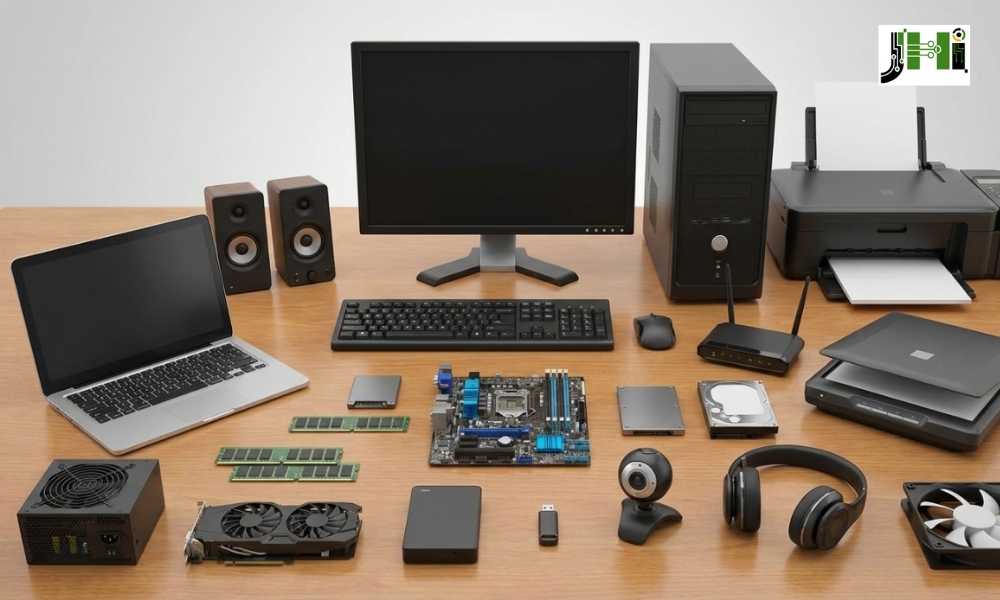
Input devices are the hardware components you use to feed information into a computer. Every time you type a sentence, click a button, or speak into a microphone, you are using an input device. These are the tools that translate your actions into data the computer can understand. Common examples include the keyboard, mouse, scanner, microphone, and webcam.
Output Devices
Output devices do the opposite of input devices. They take processed data from the computer and present it to you in a form you can see, hear, or touch. Your monitor displays images and text, your speakers play audio, and your printer produces paper copies. Without output devices, you would have no way of knowing what the computer has done with your data.
Storage Devices
Storage devices are like memory boxes for your computer. They hold all of your files, programs, photos, and documents so you can access them whenever you need to. Some storage devices live inside the computer, like hard drives and solid-state drives, while others are portable, like USB flash drives and external hard drives.
Processing Devices
Processing devices are the brain of the computer. They take the data you input, perform calculations and logical operations on it, and produce results. The two main processing devices are the Central Processing Unit, known as the CPU, and the Graphics Processing Unit, known as the GPU. The CPU handles general tasks, while the GPU specializes in rendering images and video.
Core Internal Computer Hardware Components in Phoenix
Now that you understand the categories, it is time to look inside the computer case. Internal components are the parts you do not normally see because they are housed inside the computer. These are the components that do the heavy lifting, from processing data to storing files to keeping everything cool. If the external devices are the parts you interact with, the internal components are the engine under the hood.
Core Internal Computer Hardware Components
The core internal components include the CPU, motherboard, RAM, hard disk drive, solid-state drive, GPU, power supply unit, sound card, network interface card, and cooling fan. Each one plays a specific role, and together they form the complete system that powers your computer.
Central Processing Unit (CPU)
The CPU is often called the brain of the computer, and for good reason. It executes instructions from software, performs calculations, and manages the flow of data throughout the system. Every action your computer takes, from opening a file to loading a website, passes through the CPU. Modern CPUs contain multiple cores, allowing them to handle several tasks at the same time.
Motherboard
The motherboard is the main circuit board that connects every component in the computer. Think of it as a road system that allows data to travel between the CPU, RAM, storage drives, and every other part. Without the motherboard, none of the internal components could communicate with each other, and the computer would be nothing more than a collection of unconnected parts.
Random Access Memory (RAM)
RAM is the short-term memory of your computer. It temporarily stores the data and instructions that the CPU needs right now, so the processor can access them quickly. When you open a program or a browser tab, that information gets loaded into RAM. The more RAM your computer has, the more tasks it can handle smoothly at the same time. When you turn the computer off, everything in RAM is erased.
Hard Disk Drive (HDD)
The hard disk drive is a traditional storage device that saves your files, programs, and operating system on spinning magnetic disks. Unlike RAM, an HDD retains data even when the computer is powered off. HDDs have been around for decades and offer large storage capacities at affordable prices, making them a reliable option for long-term data storage.
Solid-State Drive (SSD)
A solid-state drive performs the same job as an HDD but uses flash memory instead of spinning disks. This makes SSDs significantly faster at reading and writing data. Computers with SSDs boot up quicker, load programs faster, and transfer files in a fraction of the time. While SSDs tend to cost more per gigabyte than HDDs, their speed and durability make them increasingly popular.
Graphics Processing Unit (GPU)
The GPU is a specialized processor designed to handle graphics and visual data. Whether you are playing a video game, editing a high-resolution photo, or watching a 4K video, the GPU is doing the work to render those images on your screen. Modern GPUs are also used for tasks beyond graphics, including machine learning and scientific simulations.
Power Supply Unit (PSU)
The power supply unit converts the electricity from your wall outlet into the specific voltages that each computer component needs. Without a PSU, nothing in the computer turns on. It is the component that delivers life to every other part, distributing the right amount of power to the motherboard, drives, and fans.
Sound Card
A sound card processes audio data and sends it to your speakers or headphones. It converts digital audio signals into analog sound you can hear. While many modern motherboards include built-in audio, a dedicated sound card can provide higher quality audio output, which is important for music production, gaming, and professional audio work.
Network Interface Card (NIC)
The network interface card connects your computer to a network, whether it is a local network or the internet. It handles the data that flows between your computer and other devices on the network. Some NICs use a wired Ethernet connection, while others provide wireless Wi-Fi capability. Without a NIC, your computer would have no way to go online or communicate with other machines.
Cooling Fan / Heatsink
Cooling fans and heatsinks work together to prevent your computer from overheating. The CPU and GPU generate a lot of heat during operation, and without proper cooling, they could slow down or even suffer permanent damage. Heatsinks absorb heat from the processor, and fans blow that heat away from the components and out of the case.
Input Hardware Devices in Phoenix, AZ
Input devices are the hardware you interact with most directly. These are the tools you use every day to tell your computer what to do. From typing a search query to clicking a link, input devices translate your physical actions into digital signals the computer can process. In Phoenix offices, classrooms, and homes, input devices are the starting point of every computer interaction.
Input Hardware Devices
Input hardware devices are components that allow you to send data and commands into a computer. The word input simply means giving information to the system. These devices capture your actions, whether that is a keystroke, a voice command, or a hand movement, and convert them into data.
Keyboard
The keyboard is one of the most common input devices. It lets you type text, enter commands, and navigate your computer using physical keys. Every letter, number, and symbol you see on screen starts with a press on the keyboard. Keyboards come in many styles, including wired, wireless, and mechanical varieties.
Mouse
The mouse is a pointing device that lets you move a cursor on the screen, click buttons, select text, and interact with graphical elements. It translates the physical movement of your hand into precise on-screen navigation. Modern mice include scroll wheels, programmable buttons, and wireless connectivity.
Scanner
A scanner takes physical documents, photos, or artwork and converts them into digital files your computer can store and edit. It essentially turns paper into pixels. Scanners are commonly used in offices for digitizing records and in creative work for capturing hand-drawn images.
Microphone
A microphone captures sound and converts it into digital audio data. It allows you to record your voice, participate in video calls, use voice commands, and create audio content. Microphones range from simple built-in laptop mics to professional studio-quality models.
Webcam
A webcam is a small camera that captures video and still images for your computer. It is commonly used for video conferencing, live streaming, and online meetings. Many laptops have a webcam built into the screen bezel, while desktop users typically connect an external webcam via USB.
Output Hardware Devices in Phoenix
Once the computer has processed your data, output devices deliver the results to you. These are the components that let you see, hear, and hold the products of your computer work. You use output devices constantly, from reading this article on a monitor to listening to music through speakers. In Phoenix, output devices are essential in every setting, from corporate offices to home entertainment systems.
Output Hardware Devices
Output hardware devices take processed data from the computer and present it in a form you can perceive. The word output means the result that comes out of the system. Whether it is an image on a screen, sound from a speaker, or a printed page, output devices make computer results accessible to you.
Monitor
The monitor is the primary visual output device. It displays everything from your desktop icons to web pages, videos, and applications. Monitors come in a range of sizes and resolutions, and a higher quality monitor means sharper images and a more comfortable viewing experience.
Printer
A printer takes digital documents and images from your computer and produces physical copies on paper. Printers are used in homes, schools, and offices across Phoenix for everything from homework assignments to business reports. Common types include inkjet printers for general use and laser printers for high-volume printing.
Speakers
Speakers convert digital audio signals into sound waves you can hear. They allow you to listen to music, hear the audio in videos, and receive sound alerts from your computer. Speakers come in many forms, from small desktop units to powerful surround-sound systems.
Headphones
Headphones are personal audio output devices that deliver sound directly to your ears. They let you listen to music, watch videos, and take calls without disturbing others around you. Headphones are available in over-ear, on-ear, and in-ear styles, with options for wired and wireless connection.
Projector
A projector takes the visual output from your computer and displays it on a large surface like a wall or screen. Projectors are widely used in classrooms, conference rooms, and home theaters in Phoenix. They are ideal for presentations, training sessions, and movie nights where a bigger display is needed.
Processing Hardware in Phoenix, AZ
Processing hardware is the thinking part of your computer. These are the components that take raw data and transform it into meaningful results. Without processing hardware, your computer would have no way to calculate, interpret, or act on the information you provide. Understanding processing devices helps you appreciate what happens between the moment you click a button and the moment you see a result.
Processing Hardware
Processing hardware includes the devices responsible for executing instructions and performing calculations. These components decide what happens with the data you input. They are the decision-makers of the computer system, and their speed directly affects how fast your computer responds.
Central Processing Unit (CPU)
The CPU remains the primary processing device in every computer. It fetches instructions from memory, decodes them, and executes the required operations. Whether you are running a spreadsheet, browsing the internet, or compiling code, the CPU is the brain handling it all. Faster CPUs with more cores deliver better performance across every task.
Graphics Processing Unit (GPU)
The GPU specializes in processing visual and graphical data at high speed. While the CPU handles general tasks, the GPU excels at rendering images, videos, and animations. Gamers, video editors, and 3D designers rely heavily on powerful GPUs to get smooth, detailed visual output from their machines.
Storage and External Hardware Devices in Phoenix, AZ
Storage devices keep your data safe and accessible, whether they live inside your computer or travel with you in your pocket. Understanding the difference between internal and external storage helps you choose the right solution for backing up important files, expanding your capacity, and keeping your data portable. In Phoenix, where businesses and students rely on their data daily, knowing your storage options is a practical advantage.
Storage Hardware Devices
Storage hardware devices are designed to save data so you can access it later. They range from internal drives built into your computer to portable devices you can carry anywhere. The key role of every storage device is the same: store your files safely and let you retrieve them when needed.
Hard Disk Drive (HDD)
The HDD uses spinning magnetic platters to read and write data. It provides large amounts of storage space at a low cost, making it a popular choice for storing large media libraries, backups, and files that do not require the fastest access speeds.
Solid State Drive (SSD)
The SSD uses electronic flash memory with no moving parts, which makes it faster and more durable than an HDD. It is the preferred choice when speed matters most, such as for your operating system drive or frequently used applications.
USB Flash Drive
A USB flash drive is a small, portable storage device that plugs into a USB port. It is incredibly convenient for transferring files between computers, sharing documents, and keeping a backup of important data in your pocket. Flash drives come in a wide range of capacities, from a few gigabytes to several terabytes.
Optical Drive
An optical drive reads and writes data using laser technology on discs such as CDs, DVDs, and Blu-rays. While less common in modern laptops, optical drives are still used for installing software, playing media, and archiving data on physical discs.
Storage and External Hardware Devices
Beyond internal storage, external hardware devices extend your capacity and flexibility. These portable solutions connect to your computer through USB or other ports and let you expand your storage without opening the computer case.
USB Flash Drive
As mentioned, the USB flash drive remains one of the most popular external storage devices. Its small size and plug-and-play simplicity make it a go-to tool for quick file transfers and portable backups.
External Hard Drive
An external hard drive offers large storage capacity in a portable enclosure. It connects to your computer via USB and is ideal for backing up your entire system, storing large video projects, or keeping an archive of important files that you want to keep separate from your main computer.
Optical Disc Drive
An optical disc drive installed externally connects via USB and allows you to read or burn CDs, DVDs, and Blu-rays on computers that lack a built-in drive. It is a practical accessory for accessing legacy media or creating physical copies of important data.
Internal Hardware Components in Phoenix
By now, you have encountered the key internal components throughout this guide. This section brings them together for a focused recap, reinforcing your understanding of the parts that live inside the computer case. Confidence comes from repetition, and reviewing these components once more helps lock them into your memory.
Internal Hardware Components
Internal hardware components are the parts housed inside the computer case that work together to process, store, and manage data. They include the motherboard, RAM, PSU, CPU, GPU, and storage drives. Each one contributes an essential function to the overall system.
Motherboard
The motherboard continues to serve as the central hub that connects all internal components. Every piece of data moving between the CPU, RAM, storage, and expansion cards travels through the motherboard. Choosing a quality motherboard ensures reliable communication across your entire system.
Random Access Memory (RAM)
RAM provides the fast, temporary workspace your CPU needs. The more RAM installed, the more applications and data your computer can handle at once without slowing down. For most users in Phoenix, 8 to 16 gigabytes of RAM offers a smooth experience for everyday tasks.
Power Supply Unit (PSU)
The PSU is what keeps every component running by delivering stable, clean power. A reliable power supply protects your hardware from voltage fluctuations and ensures your system starts up consistently every time you press the power button.
Functions of Computer Hardware in Phoenix, AZ
Understanding the functions of hardware helps you see how all the pieces work together as a system. Every computer follows a simple flow: data comes in, gets processed, gets stored, and goes out. Each function maps directly to a category of hardware, creating a logical cycle that repeats with every task you perform.
Functions of Computer Hardware
Computer hardware performs four primary functions: data input, data processing, data storage, and data output. These four functions form a continuous cycle. Input devices collect data, processing devices analyze it, storage devices save it, and output devices present the results.
Data Input
The input function is where everything begins. Input devices like the keyboard, mouse, and microphone capture your commands and data, then send that information to the processor. Without input, the computer has nothing to work with.
Data Processing
Once data enters the system, the CPU and GPU take over. Processing is the function where raw data gets transformed into useful information through calculations, comparisons, and logical operations. This is the step where your computer actually does the work.
Data Storage
After processing, data needs a place to live. The storage function is handled by HDDs, SSDs, and other storage devices that save your files, programs, and system data. Storage ensures that your work is preserved even after you shut down the computer.
Data Output
The final function is output, where the results of processing are delivered to you. Monitors display images and text, speakers play audio, and printers produce paper copies. Output is the step where you actually see and use the results of your computer work.
Applications of Computer Hardware in Phoenix, AZ
Computer hardware is not just a topic for textbooks. It has real, practical applications in everyday life, professional settings, entertainment, and advanced industries. Knowing how hardware is applied helps you connect what you have learned to the world around you. In Phoenix, hardware drives everything from small business operations to cutting-edge research at local universities.
Applications of Computer Hardware
Hardware applications span four major areas: personal computing, business and office use, gaming and multimedia, and industrial and scientific use. Each area relies on specific combinations of hardware to accomplish its goals.
Personal Computing
At home, you use hardware every day for browsing the internet, checking email, streaming movies, and managing your personal files. A basic setup of a monitor, keyboard, mouse, and a computer with decent processing power and storage covers most personal needs.
Business and Office Use
In offices across Phoenix, hardware supports productivity tools like word processors, spreadsheets, email clients, and video conferencing platforms. Businesses rely on reliable computers, printers, scanners, and network equipment to keep operations running smoothly.
Gaming and Multimedia
Gaming and multimedia push hardware to its limits. High-performance GPUs, fast processors, ample RAM, and high-resolution monitors combine to deliver immersive gaming experiences and professional-quality video and audio production.
Industrial and Scientific Use
In industrial and scientific settings, specialized hardware powers automation systems, data collection instruments, research simulations, and high-performance computing clusters. These applications demand the most powerful and reliable hardware available.
Advanced Learning Topics for Computer Hardware in Phoenix, AZ
Now that you have a solid understanding of the 20 examples of computer hardware, you may want to explore more advanced topics. Deepening your knowledge opens doors to careers in IT, computer science, and engineering. The topics below give you a roadmap for continued learning.
Additional Learning Topics
Beyond the basics covered in this guide, several advanced topics can expand your understanding of how computers work at a deeper level. Each topic builds on the foundation you have already established.
Software vs Hardware
Software and hardware are two sides of the same coin. Hardware is the physical equipment, while software is the set of programs and instructions that tell hardware what to do. You cannot have a functioning computer without both. Understanding this relationship helps you troubleshoot problems and make smarter technology decisions.
Computer Architecture
Computer architecture is the study of how a computer system is designed and organized. It covers how the CPU, memory, storage, and input/output systems work together at a structural level. Learning architecture gives you a deeper understanding of why computers are built the way they are.
Peripheral Devices
Peripheral devices are external accessories that connect to your computer to add functionality. They include input devices like keyboards and mice, output devices like monitors and printers, and storage devices like external hard drives. Peripherals extend the capability of your base system and allow you to customize your setup for your specific needs.
Conclusion
Now you know the 20 essential examples of computer hardware, from the CPU and motherboard working quietly inside the case to the keyboard and monitor you interact with every day. Each component plays a specific role, and together they form the complete system that powers your personal, professional, and creative life. Whether you are upgrading your home setup, equipping a Phoenix office, or simply building your tech knowledge, understanding these hardware components gives you the confidence to make informed decisions.
At Jay Hoehl Inc., we have been helping businesses and individuals across Phoenix, AZ manage their IT assets, surplus electronics, and hardware needs since 1980. Whether you have excess computer hardware to recycle, need IT asset disposition services, or want expert guidance on managing your equipment, our team is here to help.
Ready to Manage Your Computer Hardware the Smart Way?
Contact Jay Hoehl Inc. today for expert IT asset disposition, electronics recycling, and
surplus hardware solutions in Phoenix, AZ.
Call Us:
(602) 272-4033
Email:
JayHoehlinc@gmail.com
Visit Us:
3334 W McDowell Rd Unit 17, Phoenix, AZ 85009-2414
Website:
https://jhiescrap.com/