Why do some Phoenix warehouses operate like clockwork while others struggle with delays? The answer often comes down to one system.
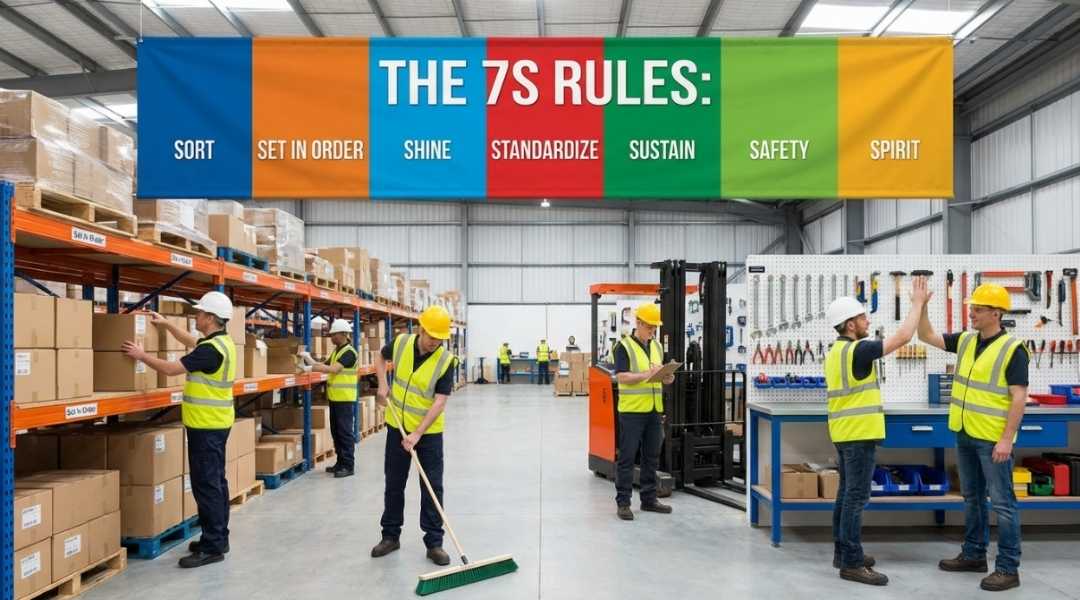
The 7S rules in warehouse management are a lean framework built on seven pillars: Sort, Set in Order, Shine, Standardize, Sustain, Safety, and Spirit. Together, they create a structured path to warehouse efficiency. These principles reduce waste, boost productivity, and build a culture of operational control. For Phoenix distribution centers, mastering the 7S framework is how you stay competitive.
Understanding the 7S Rules in Warehouse Management in Phoenix, AZ
Phoenix sits at the heart of one of the fastest-growing logistics corridors in the American Southwest. With major distribution centers expanding across the Valley, the demand for lean warehouse principles has never been higher. That growth brings pressure. More shipments. More SKUs. More room for error.
The 7S rules in warehouse management give Phoenix operations a clear system to handle that pressure. They go beyond simple organization. They build safer work environments, reduce fulfillment errors, and create repeatable processes your team can trust.
Think of 7S as the operating system behind every efficient warehouse. Without it, you’re just reacting to problems. With it, you’re preventing them.
As the old saying goes, “A place for everything and everything in its place.” The 7S framework turns that proverb into a measurable, scalable reality for Phoenix warehouses.
Overview of the 7S Framework
The 7S framework gives warehouse teams a structured system for continuous improvement. It builds on the original 5S lean methodology and adds two critical layers.
Here’s the full picture:
- Sort (Seiri): Remove what you don’t need.
- Set in Order (Seiton): Organize what stays.
- Shine (Seiso): Clean and inspect every area.
- Standardize (Seiketsu): Build consistent processes.
- Sustain (Shitsuke): Maintain discipline long term.
- Safety: Protect your people and your assets.
- Spirit: Foster a culture of pride and teamwork.
Without standardization, chaos creeps back. Without discipline, standards collapse. Can you really afford to skip any of these steps? The 7S framework reduces waste and improves compliance at the same time. That’s what makes it so powerful.
Relationship Between 7S and the 5S System
The original 5S system covers Sort, Set in Order, Shine, Standardize, and Sustain. It’s a proven lean methodology born from the Toyota Production System. The 7S framework takes it further.
By adding Safety and Spirit, 7S moves beyond physical organization into culture and risk management. Think of 5S as the foundation of a house. 7S adds the roof and the security system.
Safety ensures every process protects your team. Spirit builds the engagement that keeps the whole system alive. These two additions are what make 7S sustainable long term.
Structured workflow doesn’t happen by accident. It happens by design.
The Seven 7S Components for Efficient Phoenix, AZ Warehouses
Ready to see how each piece of the 7S system works in practice? Every component builds on the one before it. Skip a step and the whole framework weakens. Nail all seven and you’ll see measurable returns in speed, accuracy, and team morale.
What would your warehouse look like if every process ran at peak performance? Let’s walk through each component and find out.
Sort (Seiri)
Sort is your starting point. It’s the foundation of waste elimination in any warehouse. The goal is simple. Remove everything that doesn’t serve a purpose.
Walk your warehouse floor. Look at every tool, pallet, and piece of inventory. If it hasn’t been used in 90 days, it probably doesn’t belong. Dead stock clutters aisles. It slows pickers. It eats up valuable square footage.
Think of Sort like clearing the weeds from a garden. Nothing else grows until you remove what’s in the way.
Pro tip: Audit dead inventory quarterly. Tag items with red labels. If nobody claims them in 30 days, relocate or dispose of them. Phoenix warehouses that sort consistently recover 10 to 15 percent of usable floor space.
Set in Order (Seiton)
Once you’ve sorted, it’s time to organize what remains. Set in Order is about designing your warehouse layout for speed and flow.
Every item needs a designated home. Every zone needs clear labels. Your team shouldn’t spend time searching. They should spend time picking, packing, and shipping.
A disorganized warehouse looks busy. An organized one is productive. There’s a big difference.
Pro tip: Use visual zone labels with color coding. Floor markings, shadow boards, and labeled shelving cut search time dramatically. When everything has a place, new team members ramp up faster and errors drop.
Shine (Seiso)
Shine goes beyond basic cleaning. It’s about inspecting your warehouse while you clean it. Every sweep of the floor is a chance to catch problems early.
Dirty facilities hide hazards. Spills become slip risks. Dust buildup masks equipment wear. A clean warehouse is a safe warehouse. Your team deserves that protection.
Pro tip: Pair cleaning schedules with inspection logs. When a team member cleans a zone, they also check for damage, leaks, or safety risks. This turns routine maintenance into proactive risk management. Phoenix warehouses that tie cleaning to inspections report fewer equipment failures.
Standardize (Seiketsu)
Standardize locks in every improvement you’ve made. Without consistent processes, gains from Sort, Set in Order, and Shine fade fast.
This step means building standard operating procedures for every task. SOPs should be visual, simple, and posted where your team works. No one should have to guess how to do something.
What happens when every shift follows different rules? Errors multiply. Standardize stops that cycle.
Pro tip: Use visual SOP boards at each workstation. Include photos, step counts, and quality checkpoints. Keep them updated monthly. When your processes are visible, they’re followable. Predictability becomes the norm.
Sustain (Shitsuke)
Sustain is where discipline meets culture. It’s the hardest step because it never ends. You can build the perfect system. Without daily commitment, it unravels.
Sustain means regular audits. It means accountability. It means leadership walks the floor and reinforces the standards they set.
“Excellence is not an act. It’s a habit.” That truth hits hard in warehouse management. Your 7S system is only as strong as the discipline behind it.
Pro tip: Run monthly performance audits using a simple scoring checklist. Share results with teams. Recognize improvements publicly. Stability comes from routine, not from one-time events.
Safety
Safety isn’t an add-on. It’s a requirement. In Phoenix warehouses handling heavy equipment, temperature-sensitive goods, and high-volume fulfillment, safety protects people and profits.
This pillar means every process is reviewed for risk. Every aisle meets clearance standards. Every team member has proper training. Cutting corners on safety costs more than compliance ever will.
When your team feels safe, they perform better. When they don’t, turnover climbs and productivity falls. It’s that direct.
Pro tip: Tie safety metrics to your KPIs. Track incident rates, near-miss reports, and compliance scores alongside throughput. Phoenix operations that embed safety into performance reviews see measurable drops in workplace injuries.
Spirit
Spirit is the human engine of the 7S system. It’s the culture of pride, ownership, and belonging that keeps everything moving. Without it, your warehouse runs on rules alone. Rules without buy-in create resentment.
Spirit means recognizing good work. It means building a team identity. It means people care about the warehouse because the warehouse cares about them.
A motivated team doesn’t just follow procedures. They improve them. And nobody wants to organize a warehouse that feels like a dungeon.
Pro tip: Launch simple recognition programs. Spotlight team achievements weekly. Celebrate milestones. When people feel valued, retention improves and so does every other metric on your board.
Lean Manufacturing Authorities Supporting 7S Practices in Phoenix, AZ
The 7S rules in warehouse management didn’t appear out of thin air. They’re rooted in decades of lean manufacturing research and practice. The organizations behind this work are globally recognized. Their frameworks have transformed warehouses on every continent.
Some companies adopt lean principles by instinct. Others follow the blueprints that these institutions built. The difference between guessing and knowing is measured in downtime, returns, and lost revenue.
Operational excellence has a proven playbook. These are the authors.
Toyota Production System
The Toyota Production System is the origin point for every lean warehouse practice used today. TPS pioneered the philosophy that waste elimination and respect for people drive sustainable performance.
For Phoenix distribution centers, TPS principles translate directly. Standardized work, continuous flow, and built-in quality checks all align with the 7S framework. Toyota proved that culture and process are inseparable.
Pro tip: TPS doesn’t start with tools. It starts with mindset. Phoenix warehouses that adopt TPS thinking build systems their teams actually sustain. Proven reliability comes from proven methods.
Lean Enterprise Institute
The Lean Enterprise Institute has spent decades translating lean theory into practical resources. Their research, training programs, and publications help warehouse leaders apply frameworks like 7S with confidence.
LEI provides tools for value stream mapping, process improvement, and leadership development. These resources help Phoenix warehouse managers move from concept to execution.
Pro tip: LEI’s research library is a strong starting point for any warehouse leader exploring lean implementation. Professional trust is built on evidence, not assumptions.
Kaizen Institute
Kaizen means continuous improvement. The Kaizen Institute has built an entire methodology around small, incremental changes that compound into major gains.
For Phoenix warehouses, Kaizen aligns perfectly with the Sustain and Spirit pillars of 7S. It shifts the mindset from “fix it once” to “improve it always.” Teams trained in Kaizen don’t wait for problems. They look for opportunities.
Pro tip: Start with one Kaizen event per quarter focused on a single warehouse zone. Measure before and after. Growth happens one step at a time.
Supply Chain Organizations Promoting 7S Warehousing in Phoenix, AZ
The 7S rules in warehouse management gain even more weight when backed by the organizations that shape global supply chain standards. These institutions set benchmarks, publish research, and offer certifications that validate warehouse excellence.
Some warehouses operate on instinct. Others operate on standards. The ones that last operate on both.
Is your warehouse strategy backed by the same organizations that Fortune 500 companies trust? It should be. Certification pathways tied to these organizations elevate warehouse leadership from task management to strategic oversight.
Association for Supply Chain Management
ASCM, formerly known as APICS, is one of the most respected names in supply chain education. Their certifications set the professional benchmark for warehouse operations worldwide.
ASCM’s frameworks align with 7S warehouse standards. They emphasize process discipline, inventory accuracy, and performance measurement. For Phoenix warehouse leaders, an ASCM certification signals operational control and career readiness.
Pro tip: APICS lineage gives ASCM decades of historical authority in operations management. That credibility transfers directly to your warehouse team’s professional standing.
Council of Supply Chain Management Professionals
CSCMP connects supply chain professionals with research, networking, and best practice frameworks. Their annual reports are some of the most cited benchmarking resources in logistics.
For Phoenix warehouses, CSCMP provides the strategic insight needed to align 7S practices with broader supply chain goals. Their guidelines help operations scale without losing discipline.
Think of CSCMP as the compass that keeps your warehouse strategy pointed in the right direction. Are you benchmarking against the best, or just against last quarter?
Institute for Supply Management
ISM focuses on procurement and supply management. That might sound distant from warehouse operations. It’s not. Disciplined supplier management directly strengthens the Sustain and Standardize pillars of 7S.
When your inbound supply chain is stable, your warehouse runs smoother. ISM’s standards help Phoenix warehouses build reliable performance from the first delivery dock to the last outbound pallet.
A warehouse can be perfectly organized inside. If what comes through the door is chaos, none of it holds.
Educational Platforms Teaching 7S Warehouse Methods in Phoenix, AZ
You don’t need a graduate degree to master the 7S rules in warehouse management. Several trusted platforms break lean warehousing concepts into accessible, practical lessons. The knowledge is out there. The question is whether your team is using it.
Combining online learning with on-site audits produces the fastest results. Theory gives your team the “why.” Practice gives them the “how.” Together, they build confident compliance.
Investopedia
Investopedia offers clear, accessible explanations of lean operations and warehouse management concepts. Their articles break down complex frameworks into language anyone can follow.
For Phoenix warehouse teams new to 7S, Investopedia serves as a strong baseline. It provides the conceptual grounding needed before diving into advanced lean strategy. Start with the fundamentals. Build from there.
Understanding the basics is the first step toward mastering the system.
AccountingTools
AccountingTools bridges the gap between warehouse operations and financial accuracy. Their content connects inventory valuation methods to lean warehouse principles.
For Phoenix operations, this matters. Sort and Standardize directly impact inventory accuracy. Accurate inventory reduces write-offs and lowers operating costs. When your physical processes align with your accounting, financial control follows naturally.
A messy warehouse leads to messy books. A standardized one keeps both clean.
Corporate Finance Institute
CFI provides courses and resources that connect operational performance to financial outcomes. Their content helps warehouse leaders understand how lean practices translate to measurable returns.
For Phoenix warehouses evaluating 7S implementation, CFI’s frameworks tie ROI calculations to specific improvements. That’s the language executives need to hear. Sustainable growth starts with operational discipline.
When you can show the numbers, you earn the investment.
Operations Consulting Leaders Applying 7S in Phoenix, AZ Warehouses
The world’s top consulting firms don’t just advise on strategy. They build the operational frameworks that warehouses across Phoenix and beyond use every day. Their influence on the 7S rules in warehouse management is indirect but powerful.
Think of these firms as architects. They design the blueprints. Your warehouse team builds the structure. When your processes reflect the same thinking that drives global supply chain leaders, you’re not just keeping up. You’re competing at the highest level.
What would your warehouse performance look like with a Fortune 500 playbook behind it? The principles these firms champion are the same ones embedded in the 7S system.
McKinsey & Company
McKinsey’s supply chain practice focuses on operational excellence through data, analytics, and process redesign. Their frameworks emphasize measurable KPIs and scalable systems.
For Phoenix warehouses, McKinsey’s approach aligns with the Standardize and Sustain pillars. They push organizations to move past reactive management into predictive operations.
Good warehouses react fast. Great warehouses predict what’s coming next.
Pro tip: KPI-driven transformation is the backbone of McKinsey’s methodology. Apply that same rigor to your 7S audits and the results will speak for themselves.
Boston Consulting Group
BCG brings a data-driven, innovation-first perspective to supply chain consulting. Their research on digital transformation connects directly to how modern warehouses implement lean systems.
For Phoenix operations, BCG’s insights help align technology investments with 7S Standardize practices. Automation, real-time tracking, and digital SOPs all reinforce warehouse discipline at scale.
Pro tip: Digital transformation isn’t separate from lean. It’s how lean evolves. BCG’s frameworks show Phoenix warehouses how to modernize without losing the fundamentals.
Bain & Company
Bain is known for results. Their supply chain consulting focuses on measurable impact and operational efficiency. Every recommendation ties back to performance data.
For Phoenix warehouses, Bain’s approach reinforces the Sustain and Spirit pillars. They don’t just improve processes. They build the accountability systems that make improvements last.
Your warehouse doesn’t need more ideas. It needs more results. That’s the Bain philosophy in action.
When execution matches ambition, performance follows.
Warehouse Management Systems Supporting 7S Implementation in Phoenix, AZ
Discipline starts with people. Technology makes it scalable. The right warehouse management system turns your 7S framework from a manual effort into an automated, trackable process.
But here’s the truth. Software alone doesn’t create discipline. Technology amplifies 7S systems. It does not replace leadership. A WMS without trained people behind it is just expensive shelfware.
The best Phoenix warehouses combine strong 7S culture with smart technology. Can your current systems keep pace with your operational goals?
SAP
SAP’s Extended Warehouse Management module is built for enterprise-scale operations. It provides the visibility, tracking, and process control that larger Phoenix warehouses need. SAP supports the Standardize and Sustain pillars through real-time KPI dashboards, automated task assignments, and compliance reporting. When your data is live, your decisions are faster.
Scalable operations start with scalable systems. For Phoenix distribution centers processing high volumes, SAP provides the infrastructure to maintain 7S discipline without manual bottlenecks.
Oracle NetSuite
Oracle NetSuite offers cloud-based warehouse management designed for mid-sized operations. Its flexibility makes it a strong fit for growing Phoenix businesses. NetSuite’s real-time inventory visibility supports the Sort and Set in Order pillars. You see exactly what you have and where it sits. No guesswork. No wasted motion. Is your warehouse growing faster than your systems can handle? NetSuite scales with you. That growth readiness is what separates a warehouse that adapts from one that falls behind.
Microsoft Dynamics 365
Microsoft Dynamics 365 brings ERP and warehouse management into a single platform. For Phoenix operations that need consistency across departments, it delivers. The system supports automated compliance tracking. That directly reinforces the Safety pillar. Standardized workflows, integrated reporting, and cross-department visibility keep every team aligned. A disconnected warehouse creates disconnected results. An integrated one creates operational consistency across every touchpoint.
Odoo
Odoo offers an open-source, modular warehouse management system. For smaller Phoenix operations watching their budgets, it’s a smart entry point into structured warehouse technology. Odoo’s customization options support the Standardize pillar. You can build visual workflows, inventory rules, and reporting dashboards tailored to your operation. Think of it as a toolkit you shape to fit your warehouse.
Lean doesn’t require a massive budget. It requires the right system.
Academic References on Lean Warehousing and 7S for Phoenix, AZ
The 7S rules in warehouse management aren’t just practical guidelines. They’re grounded in decades of academic research and operational theory. Understanding the intellectual foundation behind 7S gives warehouse leaders a deeper level of confidence in the system. Theory without practice is idle. Practice without theory is blind. The strongest Phoenix warehouses combine both. They know what works and they know why it works.
Operations Management
Operations management as a discipline focuses on designing, controlling, and improving business processes. The 7S framework fits squarely within its core principles. Process mapping, workflow analysis, and capacity planning all connect to Standardize and Set in Order. For Phoenix warehouses, applying operations management theory means every decision is backed by a proven methodology.
What would your throughput look like if every process was mapped, measured, and optimized? That’s the promise of operations management applied to 7S.
Supply Chain Management
Supply chain management theory teaches that every link in the chain affects the whole. A disorganized warehouse doesn’t just slow fulfillment. It disrupts upstream suppliers and downstream customers. The 7S framework positions the warehouse as a controlled node within the larger supply chain. For Phoenix operations, that means your 7S discipline directly impacts partner confidence and customer satisfaction.
An efficient warehouse strengthens the entire chain. A chaotic one weakens every connection around it.
Lean Thinking
Lean Thinking as a philosophy centers on one principle. Eliminate waste in all its forms. The 7S framework is a direct application of that principle inside the warehouse. For Phoenix warehouses, Lean Thinking connects to the Spirit pillar. It’s not just about removing waste. It’s about building a team culture that sees waste as the enemy of progress.
“The journey of continuous improvement never ends.” Teams that embrace Lean Thinking don’t settle for “good enough.” They build a competitive advantage that compounds over time.
The Toyota Way
The Toyota Way outlines 14 management principles that have guided one of the most successful manufacturing companies in history. Its influence on the 7S system is direct and foundational. Toyota emphasizes culture before tools. That philosophy aligns perfectly with the Spirit and Sustain pillars. Process matters. But the people behind the process matter more.
For Phoenix warehouses, The Toyota Way provides a leadership roadmap. It teaches that lean is not a project. It’s a way of operating. The companies that treat it as a checklist lose. The ones that treat it as a culture win.
Build the culture first. The results will follow.
Take Control of Your Phoenix Warehouse with 7S
The 7S rules in warehouse management aren’t a theory. They’re a proven system that transforms how warehouses operate. From Sort to Spirit, each pillar builds on the last to create a facility that runs with precision, safety, and pride. Phoenix warehouses face growing demand, rising complexity, and tighter margins. The operations that thrive will be the ones built on structured, disciplined, and human-centered systems.
Are you ready to stop reacting and start optimizing? Your warehouse deserves a system that works as hard as your team does. Request a warehouse audit or consultation today. Let’s build a 7S system designed for your Phoenix operation. The first step toward operational excellence starts with one conversation.
Take Control of Your Phoenix Warehouse with Jay Hoehl Inc.
The 7S rules in warehouse management aren’t a theory. They’re a proven system that transforms how warehouses operate. From Sort to Spirit, each pillar builds on the last to create a facility that runs with precision, safety, and pride.
Phoenix warehouses face growing demand, rising complexity, and tighter margins. The operations that thrive will be the ones built on structured, disciplined, and human-centered systems. That’s exactly what the 7S framework delivers.
At Jay Hoehl Inc., we’ve helped Phoenix businesses manage surplus inventory, streamline warehouse operations, and build cleaner, more efficient facilities since 1980. With an A+ BBB rating and over four decades of hands-on experience, we understand what it takes to keep a warehouse running at its best.
Whether you need help clearing dead inventory, managing electronic surplus, or building a leaner operation from the ground up, our team is ready to help. We don’t just talk about warehouse efficiency. We live it every day at our Phoenix facility.
Are you ready to stop reacting and start optimizing? Your warehouse deserves a partner that works as hard as your team does.
| ★ GET YOUR FREE WAREHOUSE CONSULTATION ★
Jay Hoehl Inc. | Phoenix, AZ Warehouse & Surplus Experts Since 1980 📞 Call: (602) 272-4033 ✉ Email: JayHoehlinc@gmail.com 🏢 Visit: 3334 W McDowell Rd Unit 17, Phoenix, AZ 85009 🌐 Website: jhiescrap.com |