
What Is the ABC of Inventory Control?
Are you holding too much stock but still running out of your most important items? If so, you are not alone. Inventory mismanagement is one of the most common — and most costly — operational problems facing warehouses, retailers, and distributors across Phoenix, AZ. Inventory is cash sitting on shelves, and most businesses have no idea which shelves are costing them the most.
ABC inventory control is a classification system that organizes your entire stock into three tiers based on value contribution, not quantity. It is not about how many units you carry — it is about how much revenue and risk each item represents. Once you understand that distinction, everything about how you manage stock becomes clearer.
This guide breaks down exactly how ABC inventory analysis works, why Phoenix businesses use it, how to calculate it, and how to implement it effectively in your warehouse operations.
Understanding the ABC of Inventory Control for Phoenix, AZ Businesses
ABC inventory control is a method of classifying every SKU in your operation into one of three categories A, B, or C — based on its annual consumption value. Items that drive the most revenue receive the most attention, the tightest controls, and the most frequent reviews. Items that contribute the least get simplified management and bulk handling. As the old saying goes, don’t dig a well when you’re already thirsty — proactive classification prevents the reactive scrambles that drain time and capital.
For Phoenix-based businesses, this framework carries extra weight. Industries here deal with extreme seasonal demand swings, climate-sensitive supply chains, and premium storage costs for temperature-controlled inventory. Applying a uniform management approach to all SKUs in this environment is not just inefficient — it is expensive. Less guesswork. More precision.
Here is how the three categories are defined at a working level:
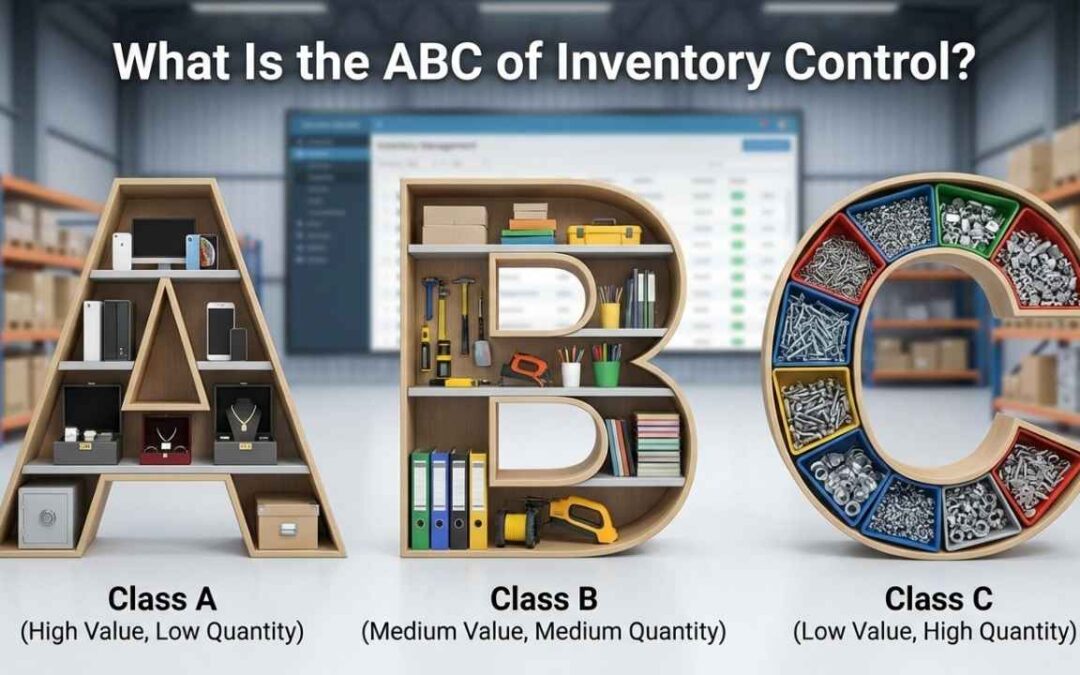
- Class A: High-value items representing roughly 10–20% of SKUs but generating 70–80% of total revenue. These require the strictest controls and most frequent reviews.
- Class B: Moderate-value items representing approximately 30% of SKUs and 15–20% of revenue. These require periodic oversight and automated alerts.
- Class C: Low-value, high-volume items making up the remaining SKUs but contributing only 5–10% of revenue. These benefit from simplified, bulk-oriented management.
The Pareto Principle (80/20 Rule) in Prioritization
The ABC method is built directly on the Pareto Principle — the well-established observation that roughly 20% of inputs produce 80% of outputs. Applied to inventory, this means a small fraction of your SKUs is driving the vast majority of your revenue. What if you focused only on the 20% that truly matters?
In practice, Phoenix warehouse data often skews further than the textbook ratio. It is not uncommon to find 15% of SKUs driving 80–85% of total revenue. If you carry 500 active SKUs, as few as 75 to 100 of them may be responsible for almost everything your business earns. That concentration is not a problem — it is leverage. ABC analysis turns that leverage into a management strategy.
Categorization Criteria: Cost, Demand, and Risk
You cannot treat every product the same — and you shouldn’t. Classification decisions are based on three core variables:
- Cost: The unit cost of each item, which directly affects its annual consumption value. Higher-cost items tend to fall into Class A because even moderate sales volume generates significant revenue exposure.
- Demand: The annual sales volume of each SKU. High-demand items drive large consumption values and typically warrant tighter inventory controls to prevent stockouts.
- Risk: The supply chain vulnerability of each item — supplier reliability, lead time variability, and substitutability. This is the hidden lever most companies ignore. A low-cost item sourced from a single overseas supplier with long, unpredictable lead times may need Class A treatment based on risk alone, even if its revenue contribution is modest.
Understanding the ABC Categories
Each classification tier carries a specific management standard. Think of it this way: Class A items are the VIP section of your warehouse — limited access, maximum attention, zero tolerance for stockouts.
- Class A — High Value: Typically 10–20% of SKUs, 70–80% of revenue. Requires weekly cycle counts, restricted access, reorder point monitoring, and active supplier relationship management.
- Class B — Moderate Value: Typically 30% of SKUs, 15–20% of revenue. Requires monthly reviews, automated reorder alerts, and accessible but non-prime warehouse positioning.
- Class C — Low Value: Typically 50% or more of SKUs, 5–10% of revenue. Requires quarterly reviews, bulk ordering strategies, and automated replenishment thresholds.
Review cadence is not optional — it is the operational backbone of the entire system. Weekly for A. Monthly for B. Quarterly for C.
Why Phoenix, AZ Companies Use ABC Inventory Analysis
ABC inventory analysis translates directly into financial performance. When you stop allocating equal resources to unequal items, carrying costs fall, cash flow improves, and the most important products in your operation receive the protection they deserve.
Phoenix operations face a specific set of pressures that make ABC particularly valuable. Summer heat creates real storage cost differences between climate-controlled and standard warehouse space. Seasonal demand in HVAC supply, construction materials, and cold-chain logistics can swing dramatically between quarters. Without a classification system, those swings produce either costly overstock or damaging stockouts — sometimes both simultaneously on different SKUs. Less waste. More profit. Lower risk. Higher confidence.
Beyond the local context, ABC analysis delivers measurable benefits across every Phoenix industry that carries physical inventory. It reduces the capital tied up in low-value overstock, prevents stockouts on revenue-critical items, improves pick efficiency through smarter slotting, and provides the data foundation needed for supplier negotiations and ERP automation.
Companies that implement ABC analysis consistently report improved purchasing decisions, more accurate inventory records, and a clearer picture of where working capital is being deployed. Small changes in classification can create massive financial clarity.
ABC Analysis Benefits at a Glance
- Reduces inventory carrying costs by focusing capital on high-turnover items
- Prevents stockouts on revenue-driving Class A SKUs
- Eliminates chronic overstock of low-value Class C items
- Improves warehouse pick efficiency through priority-based slotting
- Strengthens supplier negotiation leverage using consumption data
The Strategic Case for ABC Analysis
What happens when you stop treating every SKU equally? The answer, in most Phoenix warehouse operations, is a measurable improvement in both margins and service levels. When ABC classification is embedded in an ERP system, it stops being a periodic manual exercise and becomes a live operational intelligence layer — automatically triggering reorder alerts, adjusting safety stock levels, and flagging items whose consumption patterns have shifted their tier.
For businesses planning to scale, ABC analysis provides the structural foundation that makes growth manageable. Without it, inventory complexity grows faster than the systems designed to control it. With it, every operational decision — purchasing, staffing, slotting, auditing — is anchored in a consistent value framework.
Benefit 1 — Improved Inventory Control
Applying uniform tracking to every SKU wastes effort on items that rarely move while under-monitoring items that drive most of your revenue. ABC-based cycle counting — weekly for Class A, monthly for B, quarterly for C — dramatically improves inventory record accuracy without adding headcount. When you know which items to watch closely, nothing important goes unnoticed.
Benefit 2 — Cost Savings and Better Cash Flow
Annual inventory carrying costs typically run 20–30% of average inventory value when storage, insurance, obsolescence risk, and opportunity cost are fully counted. That means every $100,000 in excess Class C stock costs $20,000–$30,000 per year just to hold. Money sitting in the wrong inventory is not an asset — it is a liability wearing a disguise. ABC classification identifies exactly where that capital is trapped and gives you a clear path to releasing it.
Benefit 3 — Reduced Stockouts and Overstocking
Running out of your best seller and drowning in your slowest mover are two sides of the same planning failure. ABC analysis resolves both simultaneously — concentrating safety stock investment on Class A items while allowing Class C buffers to shrink. For Class A items with high demand variability, applying demand variability scoring within the tier further refines safety stock sizing to match actual risk rather than applying blanket buffers.
Benefit 4 — Increased Operational Efficiency
Efficiency is not about doing everything faster — it is about doing the right things first. When Class A items are slotted in prime pick locations closest to packing stations, and your most experienced warehouse associates are assigned to those zones, pick speed and accuracy both improve. ABC-based slotting can reduce average pick travel distance by 20–35% in mid-size Phoenix distribution operations, delivering a direct labor productivity gain that requires no capital investment.
Benefit 5 — Enhanced Customer Satisfaction
Customers do not care about your classification system — they care whether their order arrives on time and complete. ABC makes sure it does. Protecting a 99% fill rate on Class A items while accepting a 90% rate on Class C will satisfy more customers than maintaining a uniform 95% across all tiers. Prioritize Class A service levels first, and customer satisfaction metrics follow.
ABC Inventory Classifications Used by Phoenix, AZ Warehouses
Understanding the three classifications at a conceptual level is one thing. Knowing exactly how they function inside a Phoenix warehouse operation is what makes implementation successful. You cannot treat every SKU equally — and your warehouse costs prove it. More focus. Fewer mistakes.
Class A — Highest Value Items
Class A items are the revenue engine of your operation. They typically represent 10–20% of your total SKU count but generate 70–80% of your total revenue. In Phoenix warehouses, this tier frequently includes electronics components, premium HVAC equipment, pharmaceutical supplies, and high-value building materials. What happens if your top 10% fails? That question alone justifies the strictest possible controls.
- Weekly cycle counts at minimum — daily spot checks for the highest-volume items
- Restricted access storage zones to reduce shrinkage and misplacement
- Reorder point monitoring with dual-source supplier arrangements where possible
Class A — Strict Control and Frequent Review
Strict control for Class A means more than frequent counting — it means building redundancy into every supply chain decision that touches these items. Small mistakes here create large losses. Assign your best-performing warehouse associates to Class A zones. Maintain active supplier relationships, review lead times quarterly, and flag any Class A item whose single-source supply chain carries meaningful disruption risk. The cost of weekly counting is never greater than the cost of a stockout on your top revenue driver.
Category A — High-Value, High-Priority Items in Practice
In Phoenix operations, Class A items often include temperature-sensitive products that require climate-controlled storage — a premium space cost that must be factored into classification decisions. Limit physical access to Class A storage zones. Not every warehouse associate needs access to high-value inventory locations. Restricted access reduces both shrinkage and accidental misplacement — two silent profit killers. Few items. Major impact.
Class B — Moderate Value Items
Class B is your steady middle ground — less critical than A, more valuable than C, and easier to neglect than either. These items represent roughly 30% of SKUs and 15–20% of revenue. They do not demand the manual attention of Class A, but they should not be left entirely to bulk reorder logic. Monthly reviews and automated reorder alerts keep Class B items on track without consuming disproportionate management attention.
Class B — Middle-Ground Oversight Protocol
The primary risk with Class B is complacency. What if steady items slowly drain capital? Items that move predictably can quietly accumulate excess stock if reorder parameters are set and never revisited. Use automated alerts calibrated to current demand rather than historical averages, and position Class B items in accessible but non-prime warehouse locations — not the primary pick zone, but never the furthest storage racks either.
Category B — Moderate-Value, Moderate-Priority Items in Practice
Class B in Phoenix operations typically includes mid-range spare parts, secondary product lines, and supporting materials that complement Class A items. Place them near but not at prime warehouse positions. Not critical — but still important. The mistake is treating “not critical” as “not worth managing.” Monthly review cycles and automated alerts prevent the quiet drift toward overstock or stockout that affects unmonitored B items over time.
Class C — Lowest Value Items
High volume. Low value. Class C items make up the bulk of most SKU catalogs but contribute only 5–10% of total revenue. Packaging materials, generic fasteners, standard cleaning supplies, and consumable office items typically fall here. The goal with Class C is not precision management — it is cost-efficient replenishment. Bulk purchasing agreements reduce per-unit cost, and simplified tracking systems minimize the management overhead these items deserve.
Class C — Simple Controls and Bulk Management
Quarterly reviews are sufficient for most Class C items in stable Phoenix operations. Do not spend dollars protecting pennies. If an item is widely available, inexpensive to replace, and not time-sensitive, complex tracking protocols waste inventory management resources that should be directed at Class A. Set bulk reorder thresholds, automate replenishment where possible, and redirect the time saved to your highest-value tier.
Category C — Low-Value, High-Volume Items in Practice
You cannot afford to micromanage everything. Class C automation is how you stop trying. Setting automatic reorder points in your inventory system eliminates the need for periodic manual review entirely for these items — freeing significant management bandwidth for the decisions that actually move the needle. Automate replenishment thresholds, review them annually, and move on.
How ABC Inventory Analysis Is Calculated in Phoenix, AZ Operations
The calculation process is straightforward, but precision matters. Here is where most businesses miscalculate — they use average price instead of actual unit cost, or they omit return volumes and seasonal adjustments. Garbage inputs produce garbage classification. Here is the correct process:
- Gather accurate unit cost and annual demand data for every active SKU. Use actual unit cost — not average selling price. Use a rolling 12-month demand figure to smooth seasonal variation, particularly relevant in Phoenix’s high-seasonality environment.
- Calculate the Annual Consumption Value (ACV) for each SKU using the formula: ACV = Annual Demand × Unit Cost.
- Rank all SKUs from highest to lowest ACV. Sort descending before drawing any classification boundaries.
- Calculate cumulative ACV percentage as you move down the ranked list.
- Assign classifications: SKUs representing the top 70–80% of cumulative ACV = Class A. The next 15–20% = Class B. The remainder = Class C.
- Reclassify quarterly. Phoenix operations with high seasonality may need monthly reclassification for the top 20 SKUs during peak demand periods.
Determining Annual Consumption Value (ACV)
ACV is the mathematical foundation of the entire classification system. Numbers remove guesswork. The formula is simple: ACV = Annual Demand × Unit Cost. For example, a SKU with 2,000 units sold annually at $45 per unit carries an ACV of $90,000. That figure is then compared across all SKUs to determine relative value contribution. Use a rolling 13-week or 52-week demand figure rather than calendar year data to smooth out the seasonal demand swings common in Phoenix markets.
The Pareto Principle Applied to ACV Ranking
Once ACV is calculated for every SKU, sort in descending order and calculate the running cumulative percentage of total ACV. The Pareto threshold — where the top 20% of items accounts for 80% of total value — becomes visible immediately in this sorted list. What if 20% truly drives 80%? Sort the data first. Then let the numbers draw the lines. The exact percentage cutoffs should be calibrated to your specific business model rather than applied rigidly from a textbook. A highly concentrated SKU mix may justify a tighter Class A threshold; a diversified catalog may warrant a broader one.
Steps for Sorting and Categorizing SKUs
Rank first. Classify second. Implement third. The sequence matters as much as the method. Once your SKUs are ranked by ACV, assign classifications by working down the list: everything in the top 70–80% of cumulative value goes to Class A, the next 15–20% to Class B, and the remainder to Class C. Document the percentage thresholds you used. Review and reclassify at least quarterly — and build reclassification into your calendar as a standing operational review rather than an ad hoc project.
Practical Usage Examples of ABC Analysis in Phoenix, AZ Businesses
Your warehouse layout should read like your revenue report — highest value up front, lowest value furthest back. If your best-selling items are stored in the hardest-to-reach locations, what is that costing you daily? ABC analysis answers that question and gives you a framework to fix it. Focus energy where it pays back.
Procurement Prioritization Using ABC
ABC classification gives purchasing teams a data-backed hierarchy for supplier negotiations. Class A suppliers — those providing your highest-ACV items — justify the investment of annual contract reviews, volume commitment negotiations, and dual-sourcing arrangements. When you can present a supplier with data showing they represent 40% of your Class A spend, that creates immediate leverage for lead time guarantees and priority allocation during supply shortages. Class C suppliers rarely warrant the same negotiation investment. Direct procurement energy to where supply disruptions carry the heaviest financial consequences.
Inventory Auditing by ABC Tier
Traditional full physical inventory counts are time-consuming, disruptive, and treat every item with equal audit intensity regardless of value. ABC-based cycle counting replaces that approach with a tiered system that counts Class A items weekly, Class B monthly, and Class C quarterly. A Phoenix warehouse running this approach can reduce full physical count frequency from quarterly to annually while actually improving real-time accuracy for the items that matter most — a simultaneous gain in accuracy and labor efficiency.
Warehouse Organization and Slotting by ABC Class
Physical warehouse layout should reflect ABC classification directly. Class A items belong in prime pick locations closest to packing and shipping stations — shortest travel distance, easiest access, highest visibility. Class B items occupy accessible mid-warehouse positions. Class C items occupy the deepest, most remote storage zones. Slotting optimization based on ABC tiers can reduce average pick travel distance by 20–35% in mid-size Phoenix distribution operations with no capital investment required — only a disciplined reorganization of existing space.
Supplier Negotiation Strategy by Classification
ABC analysis transforms supplier conversations from relationship-based to data-driven. Knowing that three suppliers account for the top 60% of your Class A spend gives purchasing managers specific, quantified leverage that general spend data cannot provide. Use this concentration data to negotiate service level agreements, volume discounts, lead time commitments, and priority allocation arrangements — particularly valuable in Phoenix industries where supply chain disruptions carry climate-related risk factors. Every operational decision has a cost. ABC makes sure the expensive ones are the right ones.
Implementing ABC Inventory Control Effectively in Phoenix, AZ
You now understand it. The next step is execution. ABC inventory control delivers results only when the classification system is connected to real operational decisions — purchasing quantities, storage positioning, audit frequency, labor deployment, and software configuration. Start simple. Improve steadily. What happens when you finally align every resource in your operation with the value it protects?
Optimization of Working Capital
Inventory is frozen cash. ABC tells you which freezer to unplug first. When Class C overstock is identified through ACV ranking and reduced to appropriate levels, the capital released flows back into working capital — available for investment in Class A safety stock, supplier prepayments, or operational expansion. Annual carrying costs of 20–30% of average inventory value are common in Phoenix warehouse operations. Reducing Class C overstock by 30% in a $500,000 inventory operation can generate $30,000–$45,000 in annual carrying cost savings alone, without touching a single Class A item.
Priority-Based Resource Allocation
Not all shelves deserve equal attention. ABC tells you exactly which ones do. Assign your best-performing warehouse associates to Class A pick zones. Place Class A items in the most ergonomically efficient, highest-visibility locations. Route incoming Class A shipments to immediate verification and put-away rather than holding in receiving. Allocate labor scheduling to ensure Class A zones are fully staffed during peak pick periods. Every labor and space decision should reflect the tier structure — not just the classification spreadsheet.
Cycle Counting and Inventory Accuracy
Accuracy protects profit. Every miscounted Class A item is a decision made on false data. ABC-based cycle counting — weekly for A, monthly for B, quarterly for C — typically improves inventory record accuracy to 97–99% for Class A items while reducing total counting labor compared to uniform full-inventory approaches. Build the cycle counting schedule into your warehouse management system as a recurring task, and track accuracy rates by tier to identify systematic counting errors before they compound.
Software Integration for Automated ABC Analysis
Why calculate manually when software ranks instantly, updates automatically, and alerts you the moment a Class C item starts behaving like a Class A? The most effective ABC implementations use ERP or cloud inventory systems that auto-update classifications based on rolling 13-week or 52-week sales data — meaning reclassification happens continuously in the background. Pair live classification with real-time dashboards that surface reclassification alerts, reorder signals, and accuracy metrics by tier. For Phoenix operations with high demand seasonality, dynamic reclassification is not a luxury — it is an operational necessity.
Inventory Education and Learning Resources for Phoenix, AZ Professionals
Building internal competency in ABC inventory analysis accelerates implementation and reduces reliance on external consultants. The following resources provide credible, structured learning for warehouse supervisors, inventory analysts, and operations managers.
Investopedia
Investopedia provides accessible, plain-English explanations of ABC inventory analysis fundamentals — an excellent starting point for managers new to formal inventory classification or for team members who need a quick conceptual grounding before engaging with operational implementation materials.
AccountingTools
AccountingTools offers technically precise explanations of ACV calculation methodology and the accounting implications of inventory classification. Finance-oriented readers and controllers evaluating how ABC impacts financial reporting will find this resource particularly useful.
Corporate Finance Institute
The Corporate Finance Institute connects ABC inventory analysis to broader working capital management strategy — positioning classification as a financial decision, not just an operational one. CFOs and finance directors evaluating inventory policy changes will find the executive-level framing here directly applicable.
Educational Platforms and Finance Guides
Platforms such as Coursera and LinkedIn Learning offer structured supply chain fundamentals courses that include ABC analysis modules. These are well-suited to operations teams seeking self-paced learning with verifiable completion records. Many include downloadable templates and worked examples directly applicable to warehouse environments.
Practical Templates and Tools
APICS and similar professional organizations provide Excel-based ABC classification templates that allow teams to implement the methodology manually before investing in dedicated software. Use templates before investing in complex systems. Prove the process works in your specific SKU environment first — then automate it. Manual implementation also builds team familiarity with the classification logic that makes automated tools easier to configure and trust.
Professional Certifications and Textbooks
The APICS Certified in Planning and Inventory Management (CPIM) credential is the leading professional certification for operations professionals working with inventory classification systems. For deeper academic grounding, Vollmann’s Manufacturing Planning and Control Systems remains the standard reference text in the field. Both signal professional credibility and provide structured frameworks that extend well beyond basic ABC implementation.
Supply Chain Authorities Supporting ABC Inventory Control in Phoenix, AZ
ABC inventory analysis is not a proprietary methodology — it is an established best practice endorsed by the leading professional bodies in global supply chain management.
Association for Supply Chain Management (APICS)
APICS is the global standard-setting body for inventory and supply chain management education. Its CPIM curriculum formally includes ABC analysis as a core competency framework, and its Body of Knowledge defines the classification standards used by supply chain professionals across industries. Phoenix-area professionals can engage with the local APICS chapter for peer networking and region-specific implementation guidance.
Council of Supply Chain Management Professionals (CSCMP)
CSCMP is the leading research-backed authority in supply chain management, publishing the annual State of Logistics Report and supporting evidence-based supply chain practices across industries. CSCMP’s research consistently validates ABC-driven inventory prioritization as a measurable driver of working capital efficiency and operational performance improvement.
Inventory Software Providers Using ABC Analysis in Phoenix, AZ
Manual spreadsheet-based ABC analysis is a valid starting point, but it has a ceiling. Manual spreadsheets limit growth. Automation scales performance. The following platforms each offer native ABC analysis functionality suited to different scales of Phoenix warehouse operation. Prioritize systems that auto-update classification based on live sales data — the difference between static and dynamic classification compounds significantly over a 12-month period in high-velocity environments.
Oracle NetSuite
Oracle NetSuite is the preferred choice for mid-to-large Phoenix operations requiring fully integrated ERP functionality alongside ABC inventory classification. NetSuite’s inventory management module supports real-time ABC ranking, automated reorder management, and native dashboard visibility into classification-driven performance metrics — all within a single unified platform that eliminates the data gaps common in multi-system environments.
SAP
SAP is the enterprise standard for large Phoenix distribution centers and manufacturers requiring deep supply chain integration, advanced analytics, and compliance-grade inventory reporting. SAP’s materials management capabilities support sophisticated ABC classification models that can incorporate cost, demand, and risk variables simultaneously — making it well-suited to complex operations with diverse SKU profiles and multi-location inventory networks.
Zoho Inventory
Zoho Inventory is the right choice for growing Phoenix SMEs seeking cloud-based ABC analysis functionality without enterprise pricing or implementation complexity. Its accessible interface, straightforward classification tools, and integration with Zoho’s broader business suite make it particularly well-suited to operations with 500–5,000 active SKUs that are outgrowing manual spreadsheet management but not yet ready for full ERP investment.
Academic References on ABC Inventory Control for Phoenix, AZ Businesses
ABC inventory control is grounded in decades of peer-reviewed research in operations management, supply chain optimization, and inventory theory. The methodology draws from Vilfredo Pareto’s original work on wealth distribution, later formalized in operations management literature by H. Ford Dickie in the 1950s and developed extensively by researchers in manufacturing planning and control throughout the following decades.
Academic studies consistently demonstrate that ABC classification reduces inventory carrying costs by 15–25% in operations that implement it rigorously — particularly when combined with tier-specific safety stock policies and dynamic reclassification protocols. For warehouse managers seeking executive approval to implement a new classification system, peer-reviewed research on these outcomes provides the most defensible justification for the policy change.
Operations management textbooks — including Vollmann’s Manufacturing Planning and Control Systems and Chopra and Meindl’s Supply Chain Management — treat ABC analysis as a foundational inventory strategy. Measure twice. Cut once. In inventory management, the cutting is in carrying costs — and the measurement is ABC.
Conclusion
ABC inventory control is not a complicated system. It is a disciplined one. Classify your SKUs by value contribution, assign management intensity to match, and revisit the classifications regularly as your business evolves. The financial results — reduced carrying costs, improved cash flow, fewer stockouts on revenue-critical items, and a warehouse that runs with measurable efficiency — follow directly from that discipline.
For Phoenix businesses managing heat-sensitive stock, seasonal demand volatility, and premium storage costs, the case for ABC classification is especially strong. Every day your inventory operates without a classification system is a day your resources are allocated by accident rather than by design.
Your inventory should work for your business — not the other way around. If you are ready to implement ABC inventory control in your Phoenix warehouse operation, start with an ACV calculation on your current SKU mix. The data will tell you everything you need to know about where to begin.
ABC inventory control is not a complicated system. It is a disciplined one. Classify your SKUs by value contribution, assign management intensity to match, and revisit the classifications regularly as your business evolves. The financial results — reduced carrying costs, improved cash flow, fewer stockouts on revenue-critical items, and a warehouse that runs with measurable efficiency — follow directly from that discipline.
For Phoenix businesses managing heat-sensitive stock, seasonal demand volatility, and premium storage costs, the case for ABC classification is especially strong. Every day your inventory operates without a classification system is a day your resources are allocated by accident rather than by design.
Your inventory should work for your business — not the other way around. If you are ready to implement ABC inventory control in your Phoenix warehouse operation, the team at Jay Hohel Inc is here to help you build a system that fits your operation from day one.
Ready to Optimize Your Inventory? Contact Jay Hohel Inc Today.
Jay Hohel Inc helps Phoenix, AZ businesses implement smarter inventory systems — from ABC classification to full warehouse optimization. Get in touch with our team to start saving time, cutting costs, and protecting what matters most in your operation.
📍 3334 W McDowell Rd, Unit 17, Phoenix, AZ 85009
📞 (602) 272-4033
📧 JayHoehlinc@gmail.com
🌐 jhiescrap.com