
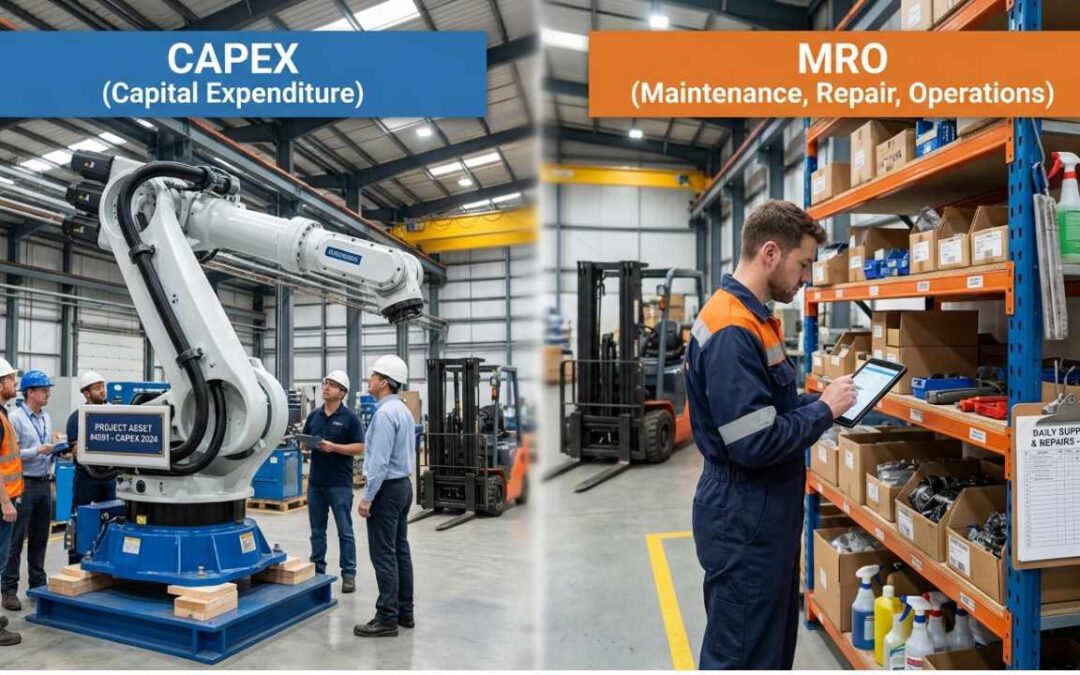
Ever feel like CapEx and MRO get mixed up in budget meetings? You’re not alone. Most finance teams know the terms. Few can explain the difference clearly.
Here’s the short version: CapEx builds assets. MRO keeps them running.
One is an investment in your company’s future. The other is what keeps today’s operations alive. Both matter. Both hit your budget differently. And for Phoenix, AZ businesses, getting this wrong has real consequences.
Let’s break it down clearly so your next budget conversation is easier.
Understanding CapEx and MRO for Phoenix, AZ Businesses
Before comparing them, you need to know what each one actually means. They’re not interchangeable. They don’t work the same way. And they don’t show up on your financial statements in the same place.
Think of it this way: CapEx plants the tree. MRO waters it.
Capital expenditures are planned investments. They create long-term value. Maintenance, repair, and operations spending keeps your existing assets functional. It’s ongoing. It’s operational. It rarely makes headlines until something breaks.
Phoenix businesses face a unique pressure here. The desert heat accelerates equipment wear. Supply chain delays hit harder in fast-growth markets. And the line between a smart capital investment and a reactive maintenance spend can blur fast when you’re moving quickly.
Understanding both categories gives you control. It also helps you avoid one of the most common financial classification errors in Arizona’s manufacturing and industrial sectors.
Key Characteristics of CapEx
Capital expenditures are major purchases that extend beyond a single fiscal year. They increase your company’s productive capacity or extend the life of an existing asset.
Here’s what defines a CapEx purchase:
- Long useful life. Typically more than one year.
- High dollar threshold. Usually above a company-defined capitalization limit.
- Depreciated over time. Not expensed all at once.
- Requires formal approval. Often goes through multi-level sign-off.
- Appears on the balance sheet. Not the income statement.
One hidden cost driver most companies overlook: the approval process itself. Capital requests move slowly through finance, operations, and executive leadership. That lag has a real cost.
“Don’t dig a well when you’re already thirsty.” Plan your CapEx before urgency forces your hand.
Common CapEx Examples
What does a capital expenditure actually look like in the real world? Here are examples that Phoenix businesses deal with regularly:
- Warehouse automation upgrades. New conveyor systems or robotic picking equipment.
- HVAC unit replacement. Swapping out aged rooftop units across a facility.
- Fleet vehicle purchases. Adding delivery trucks or service vehicles to your operation.
- Manufacturing equipment. CNC machines, industrial presses, or production line upgrades.
- Facility construction or expansion. Building out a new distribution center or adding floor space.
Where does your next equipment upgrade fall? If it adds long-term value and meets your capitalization threshold, it’s probably CapEx.
These aren’t day-to-day purchases. They’re decisions that shape your company’s capacity for years.
Key Characteristics of MRO
You never think about maintenance until something breaks. That’s exactly the problem.
MRO spending covers everything needed to keep your operations running without creating a new long-term asset. It’s reactive and proactive. It’s also unpredictable if you don’t plan for it.
Here’s what defines MRO spending:
- Short-term in nature. Consumed or used within a single operating period.
- Operationally necessary. Without it, production slows or stops.
- Expensed immediately. Hits your income statement right away.
- Lower individual dollar value. But high volume adds up fast.
- Harder to forecast. Equipment failure doesn’t follow your budget calendar.
The unpredictability factor is the real danger. Companies that underfund MRO end up with emergency spending that wrecks quarterly numbers and forces reactive CapEx before they’re ready.
Common MRO Examples
MRO is more than spare parts. It’s everything your team needs to maintain uptime across your facility:
- Replacement bearings, belts, and filters. High-turnover industrial components.
- Lubricants and hydraulic fluids. Essential for machinery health.
- Electrical components. Fuses, switches, and control panels.
- Safety supplies. Gloves, harnesses, and protective gear.
- HVAC servicing. In Phoenix, quarterly cooling system maintenance is non-negotiable.
- Janitorial and facility supplies. Often overlooked, always recurring.
Good MRO planning means you already have what you need before something fails. That kind of preparedness protects your margins and keeps your team moving.
Core Differences Between CapEx and MRO in Phoenix, AZ
Now that you know what each term means, let’s look at how they actually differ. This is where financial clarity becomes a competitive advantage.
The simplest framing: CapEx is an investment. MRO is an expense.
One shows up as an asset. One reduces your profit. One requires board approval. The other can be handled at the department level. They interact in your financials, but they operate in completely different lanes.
Phoenix companies that treat MRO like CapEx misclassify expenses and distort their financial reporting. Those that treat CapEx like routine maintenance miss depreciation benefits and inflate short-term costs.
Getting this right protects cash flow, simplifies audits, and sharpens your financial reporting.
Purpose and Time Horizon
CapEx and MRO exist for different reasons. They also operate on very different timelines.
CapEx is a long-term investment. You’re acquiring or improving an asset that will generate value over multiple years. The payback horizon is typically 3 to 10 years. Decisions take time because the stakes are high.
MRO is a short-term operational cost. You’re maintaining existing capacity, not building new capacity. Most MRO spending is consumed within weeks or months. Decisions happen fast because downtime is expensive.
Lifecycle costing is the bridge between the two. When you buy a new piece of equipment (CapEx), you should already be estimating what it will cost to maintain over its useful life (MRO). Companies that skip that step end up surprised by ongoing costs that erode their original ROI.
Accounting Treatment
This is where the two categories split most sharply.
CapEx is capitalized. That means the cost is recorded as an asset on the balance sheet. It’s then depreciated over the asset’s useful life. You don’t expense the full cost in year one.
MRO is expensed. The full cost hits the income statement in the period it’s incurred. There’s no depreciation schedule. It reduces your operating profit immediately.
Under GAAP standards, the distinction matters for accurate financial reporting. Misclassifying a capital expenditure as a maintenance expense inflates your operating costs. Misclassifying MRO as CapEx overstates your assets.
Both errors create audit exposure. Both distort your company’s true financial position. Classification discipline isn’t just accounting housekeeping. It’s financial integrity.
Financial Statement Impact
Where these costs land on your financial statements tells a clear story.
CapEx lands on the balance sheet as a fixed asset. Over time, depreciation moves a portion of that cost to the income statement each year. It also appears in the cash flow statement under investing activities.
MRO lands on the income statement as an operating expense. It reduces EBITDA in the period it’s spent. It shows up in the cash flow statement under operating activities.
That distinction matters for Phoenix companies raising capital or reporting to investors. High MRO costs compress EBITDA margins. Heavy CapEx years show large investing outflows but preserve operational profitability.
CapEx improves your assets. MRO protects your margins. Both show up differently to anyone reading your financials.
Approval and Decision-Making Process
CapEx and MRO don’t move through your organization at the same speed.
CapEx approval is formal and structured. Most companies require executive sign-off, finance review, and sometimes board approval for purchases above a set threshold. Cross-department coordination adds time. Projects can take weeks or months to get green-lit.
MRO procurement is faster and more decentralized. Department managers often have authority to approve routine maintenance purchases within their budget. Speed matters more than process here.
The risk with CapEx delays: missed opportunity windows and reactive purchasing that inflates cost. The risk with uncontrolled MRO: budget overruns and inconsistent vendor relationships.
Smart companies plan ahead. The rest react.
Practical Comparison of CapEx vs MRO for Phoenix, AZ Operations
Theory is useful. But what actually matters is how these two categories play out in your facility.
Where does your next equipment upgrade fall? That’s not always an easy question. The line between a capital investment and a maintenance cost can blur when you’re in the middle of a busy production quarter.
This section breaks it down in plain, operational terms. Think of it as the difference between investment and continuity. You invest to grow. You maintain to survive.
Both matter. Both require planning. And in Phoenix’s industrial and manufacturing environment, both carry higher stakes than most markets. Heat degrades equipment faster. Lead times for industrial parts run long. And operational disruption costs more when your competitors are moving just as fast.
Purpose
CapEx is about adding capacity or capability. You’re making a deliberate, long-term decision to grow what your operation can do.
MRO is about protecting what you already have. You’re ensuring that your existing assets keep performing at the level you need.
CapEx builds the engine. MRO keeps it running.
Here’s the strategic insight most operations teams miss: your CapEx decisions should factor in 5 to 10 years of MRO implications. A cheaper machine might look attractive on a capital budget. But if it requires twice the maintenance cost annually, the total lifecycle cost tells a very different story.
Build both into your planning process and your investment decisions get sharper.
Usage Examples
Seeing the difference in real scenarios makes it easier to classify correctly. Here are Phoenix-specific examples:
CapEx examples:
- Replacing rooftop HVAC units across a 50,000 sq. ft. warehouse
- Purchasing a new fleet of electric forklifts
- Installing automated picking systems in a distribution center
- Building out a new production wing
MRO examples:
- Quarterly HVAC servicing to handle Phoenix summer heat loads
- Replacing worn conveyor belts and drive motors
- Stocking lubricants and filters for scheduled preventive maintenance
- Restocking safety supplies and PPE
You don’t notice maintenance until something fails. That’s why proactive MRO planning is a performance strategy, not just a cost center.
Decision-Making Process
How a purchase gets approved tells you a lot about which category it falls into.
CapEx decisions:
- Require multi-level approval (operations, finance, sometimes executive or board)
- Follow a formal capital request process
- Include ROI projections and payback period analysis
- Move slowly by design
MRO decisions:
- Often delegated to department or facility managers
- Approved within existing operational budgets
- Prioritized by urgency and availability
- Move quickly by necessity
CapEx moves slowly by design. MRO moves quickly by necessity.
Knowing this helps you route requests correctly from day one. It also prevents bottlenecks that stall critical maintenance purchases waiting in a CapEx approval queue where they don’t belong.
Business Impact of CapEx and MRO in Phoenix, AZ Companies
Getting the definitions right is step one. Understanding what happens when you get the allocation wrong is step two.
Both types of spending directly affect your growth, your cash flow, and your ability to keep operations stable. Mismanage either one and the consequences stack up fast.
What happens if you get this wrong? Misallocated CapEx drains cash without delivering expected returns. Neglected MRO leads to equipment failures that force emergency spending and production shutdowns. Neither outcome is acceptable in a competitive Phoenix market.
“An ounce of prevention is worth a pound of cure.” That applies directly here. Proactive planning in both categories costs less than reactive recovery.
CapEx funds your growth. MRO protects it. Treat either one as an afterthought and you’ll feel it.
CapEx Impact on Growth and Cash Flow
Capital expenditures reshape your company’s capacity. They also reshape your cash position in the short term.
When you make a large CapEx purchase, cash leaves immediately. But the asset you acquire creates long-term value that builds over years. Depreciation spreads that cost across multiple periods, which helps smooth your income statement impact.
Cash leaves today. Value builds tomorrow.
For Phoenix companies planning expansion, CapEx decisions shape EBITDA visibility for investors and lenders. A heavy CapEx year can look like a cash flow problem if you don’t tell the story correctly. But it can also signal growth ambition to the right audience.
The key is disciplined capital allocation. Invest where the long-term ROI justifies the cash outflow. Build depreciation schedules that reflect real asset useful life. And never let CapEx decisions happen without understanding the MRO costs that follow them.
MRO Impact on Operational Efficiency
Downtime rarely announces itself. It arrives at the worst possible moment.
Consistent MRO investment is what prevents that moment from happening. When your maintenance supplies are stocked, your service schedules are current, and your team has what they need, your equipment runs at designed capacity.
In Phoenix, where summer temperatures push industrial HVAC and cooling systems to their limits, MRO isn’t optional. It’s survival.
Maintenance is the insurance policy your equipment actually uses.
Here’s the strategic connection most operations leaders miss: consistent MRO spending reduces emergency CapEx spikes. When you maintain equipment properly, it lasts longer. That means you defer costly capital replacements and protect cash for planned investments instead of forced ones.
Downtime doesn’t just cost you production hours. It costs you customer confidence, team morale, and sometimes contracts.
CapEx, MRO, and OpEx in Phoenix, AZ Financial Planning
Are you categorizing your expenses correctly? It’s a simple question with serious financial consequences.
Most finance teams know CapEx and OpEx as distinct categories. Fewer understand exactly where MRO fits within that structure. And that confusion leads to misclassification, distorted reporting, and planning gaps.
Here’s the clarifying framework: CapEx builds. OpEx operates. MRO preserves.
Capital expenditures create long-term assets. Operating expenses cover the day-to-day cost of running the business. MRO sits within the OpEx category in most accounting structures, but it’s not the same as all OpEx.
Understanding the overlap, and the distinction, prevents costly classification errors. It also helps Phoenix business leaders build budgets that reflect operational reality rather than accounting guesswork.
Which Is Better: CapEx or OpEx?
Neither is inherently better. They serve different purposes. The right answer depends on your business model, your growth stage, and your tax strategy.
Is growth more important than flexibility? That question drives a lot of CapEx vs. OpEx decisions.
Choose CapEx when you’re acquiring long-lived assets that create measurable returns over time. Manufacturing equipment, facilities, and major infrastructure are typically CapEx decisions.
Choose OpEx when you need flexibility or when the cost is recurring and doesn’t create a lasting asset. Subscriptions, salaries, utilities, and most MRO fall here.
One strategic nuance: CapEx costs are deducted over time through depreciation. OpEx is deducted immediately. That timing difference has real tax implications, especially in high-investment growth years. Talk to your CFO or tax advisor before making large classification calls.
What Is an Example of OpEx?
Operating expenses are the recurring costs of running your business day to day. They hit your income statement immediately and don’t create long-term assets.
Common OpEx examples for Phoenix businesses:
- Facility utilities. Electricity, water, and gas for your operations
- Payroll and benefits. Your workforce costs in every department
- Office and administrative supplies. Recurring consumables
- Software subscriptions. SaaS tools and licensing fees
- Routine MRO spending. Maintenance supplies and repair parts
One distinction worth knowing: some OpEx is recurring and predictable. Some is irregular. Knowing which expenses are fixed versus variable helps you build more accurate operating budgets.
What Is an Example of CapEx?
Capital expenditure examples are typically large, planned purchases with long useful lives. Most companies set a dollar threshold to define what qualifies.
Common CapEx examples for Phoenix operations:
- Industrial machinery. CNC equipment, presses, and production line systems
- Commercial real estate. Purchasing or significantly improving a facility
- Fleet vehicles. Delivery trucks or service vehicles added to your asset register
- Technology infrastructure. Server hardware and enterprise-level systems
- Warehouse automation. Robotic or mechanized material handling systems
CapEx is the foundation. OpEx is the daily operation.
One practical note: most companies set a capitalization threshold (for example, purchases above $2,500 or $5,000). Anything below that threshold gets expensed as OpEx even if it has a multi-year life.
How Are CapEx and OpEx Reported?
Each spending category flows through your financial statements differently. Here’s where each one lands:
Balance Sheet: CapEx is recorded here as a fixed asset. It grows your asset base and is reduced over time through depreciation.
Income Statement: OpEx (including MRO) is recorded here in the period it’s incurred. It reduces operating profit immediately. Depreciation from CapEx also flows here each year, but spread over the asset’s useful life.
Cash Flow Statement: CapEx shows up under investing activities. That’s an important distinction for analysts and lenders reading your financials. OpEx flows through operating activities.
CapEx appears as an asset. OpEx appears as an expense.
One tip for audit readiness: document the rationale for capitalization decisions. Clear records make financial reviews faster and cleaner.
Synonyms and Terminology for CapEx and MRO in Phoenix, AZ
Different industries use different words for the same financial concepts. That’s especially true in Phoenix, where manufacturing, construction, logistics, and tech all operate in the same market.
Knowing the terminology used across sectors helps you communicate clearly with vendors, auditors, and leadership teams who may come from different backgrounds.
It also helps search and sourcing. If you’re looking for industrial procurement support in Arizona, knowing the right terms gets you to the right partners faster.
Here’s a quick reference for the most common CapEx and MRO terminology in use across Phoenix industries.
CapEx Synonyms
Capital expenditures go by several names depending on the context:
- Capital investment. The broad term for long-term asset spending
- Fixed asset spending. Refers specifically to tangible, long-lived assets
- Capital asset acquisition. Used frequently in accounting and legal contexts
- Long-term infrastructure investment. Common in construction and real estate sectors
- Capital project budgeting. Refers to the planning process for major expenditures
One note for Phoenix specifically: construction companies tend to use “capital project” language. Manufacturing firms lean toward “capital equipment” or “fixed asset.” Knowing which term your counterpart uses avoids communication friction in sourcing and procurement conversations.
MRO Synonyms
Maintenance, repair, and operations spending also carries several aliases:
- Maintenance operations. General term used in facility management
- Repair and maintenance spending. Common in financial reporting contexts
- Operational supply expenses. Broader accounting classification
- Industrial upkeep costs. Used in heavy industrial and manufacturing settings
- Facility maintenance expenses. Typical in commercial real estate and logistics
One important distinction: MRO and inventory procurement overlap but aren’t the same. MRO covers consumables and maintenance supplies. Inventory procurement covers raw materials and goods for sale. Confusing the two creates classification errors and procurement inefficiencies.
Strategic Sourcing for CapEx and MRO in Phoenix, AZ
Education gets you clarity. Sourcing strategy gets you results.
Understanding the difference between CapEx and MRO is step one. Building a sourcing approach that handles both efficiently is where Phoenix companies gain real competitive advantage.
Smart sourcing protects margins. It also prevents the reactive, last-minute purchasing that inflates costs and disrupts operations. The companies that treat sourcing as a strategic function, not a transactional one, consistently outperform those that don’t.
Plan sourcing before prices rise. In Phoenix’s fast-growing industrial market, supply constraints hit without warning. Having vendor relationships and procurement frameworks in place before you need them is the difference between controlled costs and emergency premiums.
Bundled vendor agreements are one of the most effective tools for MRO cost stability. When you consolidate suppliers and negotiate volume commitments, you reduce price volatility and improve lead times across your maintenance supply chain.
Solve Complexities for CapEx and MRO Sourcing
Sourcing shouldn’t slow your growth. But for many Phoenix businesses, it does.
Managing CapEx purchases and MRO procurement through separate, disconnected processes creates duplication, missed savings, and vendor management overhead. A unified sourcing strategy removes that friction.
Forecasting-based sourcing models are the most effective approach for stabilizing both budget categories. When you model anticipated capital investments alongside projected MRO spend, you can negotiate better contracts, consolidate vendors, and eliminate the cost spikes that come from reactive purchasing.
The companies that plan ahead control their costs. The rest scramble when supply chains tighten or equipment fails unexpectedly.
If you’re ready to build a more strategic approach to CapEx and MRO sourcing in Phoenix, the right procurement partner makes that process faster and more effective. Let’s talk about what that looks like for your operation.