
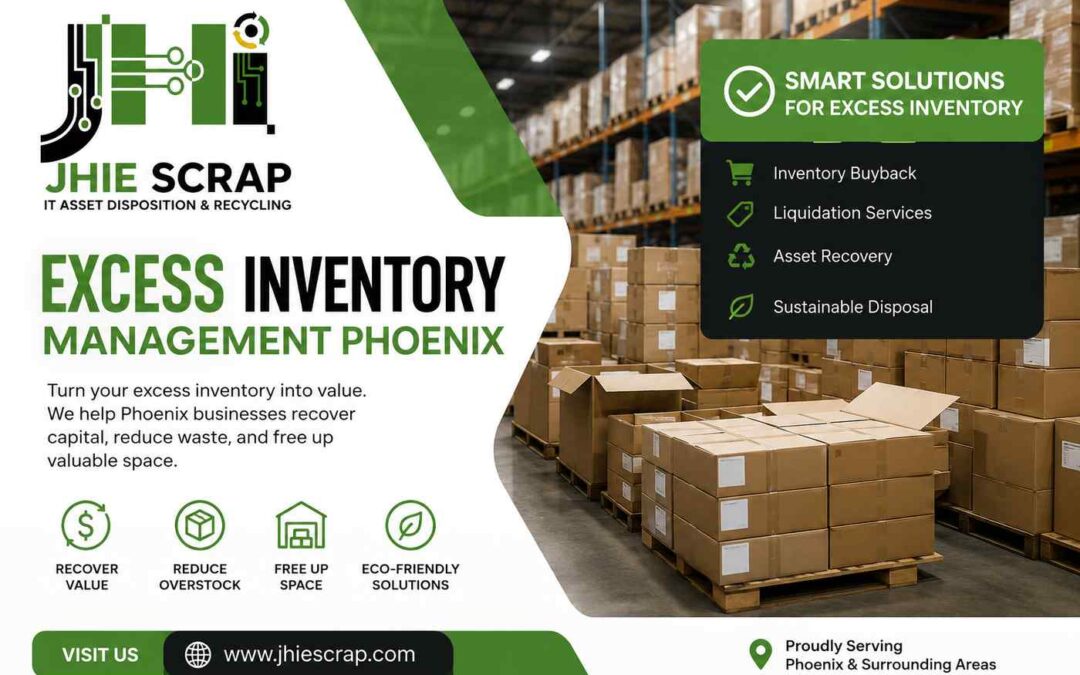
Excess Inventory Management How Phoenix Manufacturers Turn Surplus Into Cash
If your facility has shelves of obsolete ICs, drums of populated circuit boards, pallets of end-of-life test equipment, or a steady stream of e-scrap building up between production runs — you are sitting on a problem and a hidden asset at the same time. Excess inventory ties up capital, eats warehouse space, complicates audits, and eventually has to go somewhere. The question is where, and how much you recover when it does.
Jay Hoehl Inc. (JHI) has been the answer to that question for Arizona manufacturers, defense contractors, and electronics producers since 1980. We buy excess electronic components, industrial surplus, end-of-life IT assets, and precious-metal-bearing e-scrap — and we handle it through reuse, resale, and responsible recycling rather than the landfill. This guide explains what excess inventory actually is, what it costs you, and the eight ways manufacturers in Phoenix and across Arizona recover value from it.
Need a quote on what you have right now? Call (602) 272-4033 or schedule a pickup.
1. Understanding Excess Inventory
Excess inventory is any stock — raw components, work-in-progress, or finished goods — that exceeds what your operation will consume or sell within a reasonable planning horizon. For an electronics manufacturer, that usually means ICs, semiconductors, processors, SMD capacitors, connectors, modules, or board-level assemblies that were over-ordered, displaced by a design change, or stranded when a program ended.
There is a difference between excess and obsolete. Excess inventory is still usable and still has buyers — it just isn’t moving fast enough for you. Obsolete inventory has aged or been superseded to the point that the original use case is gone, though it often still has value in secondary markets, in spare-parts channels, or as precious-metal-bearing scrap. Both categories show up in the same corner of the same warehouse, and both can be monetized.
Read the full breakdown: What is Excess Inventory? Definition, Types & Business Impact →
2. Why Excess Inventory Accumulates
In four and a half decades buying surplus from Phoenix-area manufacturers, we see the same root causes repeat — across semiconductor fabs, defense primes, contract manufacturers, and industrial OEMs:
- Demand forecasting errors — sales projections that didn’t materialize
- Minimum order quantities that forced you to buy a reel when you needed a strip
- Engineering change orders that obsoleted part numbers mid-program
- Cancelled customer orders that leave finished goods stranded
- Supply chain hedging — buffer stock bought during shortages that arrived after demand cooled
- Quality holds and component recalls that take material out of production permanently
- Product end-of-life and program closeouts
- Acquired inventory from facility moves, mergers, or shutdowns
None of these are management failures — they are the normal byproduct of running a real manufacturing operation. The failure is leaving the material on the shelf instead of converting it to cash.
Deep dive: Root Causes of Excess Inventory →
3. Solutions: Eight Ways to Recover Value
Not every solution fits every situation. A 2,000-piece reel of active-production ICs goes to a very different home than three pallets of populated motherboards from a decommissioned product line. JHI handles the full spectrum — what matters is matching the material to the right channel.
Direct purchase (most common)
We buy outright. You get a quote, we arrange logistics, you get paid. This works for excess electronic components, surplus ICs and semiconductors, SMD capacitors and passives, test equipment, industrial controls, and end-of-life IT assets.
Scheduled recurring pickups
If your facility generates surplus continuously — production scrap, returned material, ongoing e-waste — we schedule regular drops so the material never has time to accumulate. Many of our long-term customers operate this way.
Precious metal recovery
Populated circuit cards, gold-plated connectors, processors, and gold wire bonding all contain recoverable precious metals. We process this material directly and pay based on assayed content rather than scrap weight.
Partner network referral
On the rare occasion a category falls outside our direct processing, we route it through our partner network. You still deal with one point of contact — us — and the material still gets handled properly.
See all options: Excess Inventory Solutions: Strategies to Reduce & Recover Value →
4. Inventory Liquidation
Liquidation is what most manufacturers actually need when excess stock has to move quickly — facility consolidations, year-end cleanouts, program shutdowns, lease expirations. The right liquidation partner does three things: pays a fair price up front, removes the material on a schedule that works for you, and gives you the paperwork your accounting team needs to write the inventory off cleanly.
JHI handles single-event liquidations and recurring disposition with the same process. We come to your facility, evaluate the material on site when volume justifies it, quote, and arrange pickup. Payment is prompt — one of the things our long-term customers cite most often.
Full guide: Inventory Liquidation: Complete Guide to Selling Excess Stock →
5. Electronics Surplus Management
Electronics surplus is its own discipline. The valuation depends on part number, manufacturer, date code, packaging condition (sealed reels and trays are worth more), and current demand in secondary markets that shift week to week. A part that was scrap last quarter can be in shortage this quarter. JHI tracks those markets because that is the entire business.
We handle finished electronics, board-level assemblies, populated PCBs, semiconductor manufacturing equipment, industrial controls, programmable logic controllers, test lab equipment, and complete IT systems — both functional and end-of-life. For data-bearing equipment, we handle data destruction as part of the process so you never have to worry about a hard drive walking out with usable data on it.
More: Electronics Surplus Management → • IT Asset Disposition →
6. Excess Electronic Components
Active and passive components — ICs, semiconductors, processors, microcontrollers, memory, SMD capacitors, resistors, connectors, modules — are where the highest per-unit recovery values live. They are also where condition documentation matters most. We work with manufacturers who have anything from a few sealed reels to entire warehouses of inherited component stock, including material acquired through facility shutdowns or program closeouts.
If you have part numbers and quantities in a spreadsheet, send it over. If you have unmarked totes that need to be sorted, we can do that too — at our facility or yours.
Component-specific: Excess Electronic Components Solutions → • SMD Components →
7. Understanding What Your Inventory Is Worth
The two most common mistakes manufacturers make on valuation are at opposite extremes. The first is using original purchase price as the expected recovery — that number is irrelevant once the material has been sitting. The second is writing it off as worthless when it still has real secondary-market value or recoverable precious metal content.
Fair market value for excess inventory depends on six things: part number and manufacturer, age and date code, condition and packaging, quantity (larger lots can either help or hurt depending on category), current secondary-market demand, and any documentation you can provide on origin. A reputable buyer will walk you through how each of those affects your quote.
Learn more: Excess Inventory Valuation: How to Determine Fair Market Value →
8. Tax and Accounting Considerations
Moving excess inventory off the books cleanly is as important as the cash recovery itself. Depending on how the material is dispositioned — sold, donated, or scrapped — it shows up differently on your financials, and the documentation requirements are different.
JHI provides bills of sale, weight tickets, certificates of recycling, and certificates of data destruction where applicable. Your accounting and tax teams need this paperwork to support write-downs, write-offs, or charitable contribution deductions, and to satisfy auditors. We’re not your CPA — but we make sure you have what your CPA will ask for.
Reference: Tax & Accounting for Excess Inventory →
Why Phoenix Manufacturers Work With JHI
- Since 1980. Forty-five years buying and processing industrial electronic surplus in Arizona. We have seen every category, every market cycle, and every kind of inventory problem.
- BBB A+ rating. Long-standing member with a clean record.
- Prompt payment. We pay on schedule. Ask any of our long-term customers — it is the thing they bring up first.
- Real Phoenix presence. We are at 3334 W McDowell Rd, not a P.O. box. Local pickup, local team, local accountability.
- Environmental commitment. Reduce, recycle, reuse — applied to every load. Keeping electronic surplus and e-waste out of landfills is the point of what we do.
- Trusted by major manufacturers. Long-standing relationships with companies in the defense, aerospace, semiconductor, and industrial electronics sectors across Arizona.
Frequently Asked Questions
What kinds of excess inventory does JHI buy?
Excess electronic components (ICs, semiconductors, processors, SMD capacitors and passives, connectors, modules), surplus electronics, populated and bare circuit boards, test equipment, programmable logic controllers, industrial controls, semiconductor manufacturing equipment, end-of-life IT assets (servers, networking gear, computers), and precious-metal-bearing e-scrap. If you are not sure whether something fits, call and ask.
Do you only serve Phoenix?
Phoenix and the surrounding Arizona metro is our primary service area for on-site pickups. We work with customers across Arizona and beyond for shipped-in material — call to discuss logistics for your location.
How is pricing determined?
It depends on the material. For active components, we look at part number, date code, packaging, quantity, and current secondary-market demand. For e-scrap and precious-metal-bearing material, we look at assayed content. For IT assets, we look at functional condition and resale value. We give you a quote before anything moves.
What is the minimum quantity?
There is no rigid minimum. For very small quantities we may consolidate with other pickups; for large volumes we can arrange on-site evaluation. Call (602) 272-4033 and describe what you have.
Do you handle data destruction?
Yes — hard drives and other data-bearing media are either wiped to industry standard or physically destroyed, with certificates of destruction provided for your records. This is part of our IT Asset Disposition service.
How quickly can you pick up?
For local Phoenix pickups, we can usually schedule within a few business days. Urgent situations (facility move deadlines, lease expirations) — call and we will work with you.
Do you provide documentation for write-offs and audits?
Yes. Bills of sale, weight tickets, certificates of recycling, and certificates of data destruction as applicable. Tell us what your accounting or compliance team needs and we will make sure it is included.
Can you handle recurring pickups instead of one-time disposal?
Yes, and many of our manufacturing customers use us this way. We schedule regular pickups so surplus material and e-waste never have time to accumulate in your facility.
Ready to Clear Your Excess Inventory?
Tell us what you have. Email a parts list, send photos of what’s on the shelf, or just call and describe the situation. We will tell you what it is worth, what we can take, and how soon we can be there.
Call: (602) 272-4033
Email: JayHoehlinc@gmail.com
Visit: 3334 W McDowell Rd, Unit 17, Phoenix, AZ 85009
Online: Schedule a Pickup