
Are you unsure where your inventory money is tied up?
You’re not alone. Most Phoenix business owners struggle with this.
The four stages of inventory in Phoenix AZ break down your supply chain into clear steps. They show where cash flows. They reveal where waste hides. They give you control.
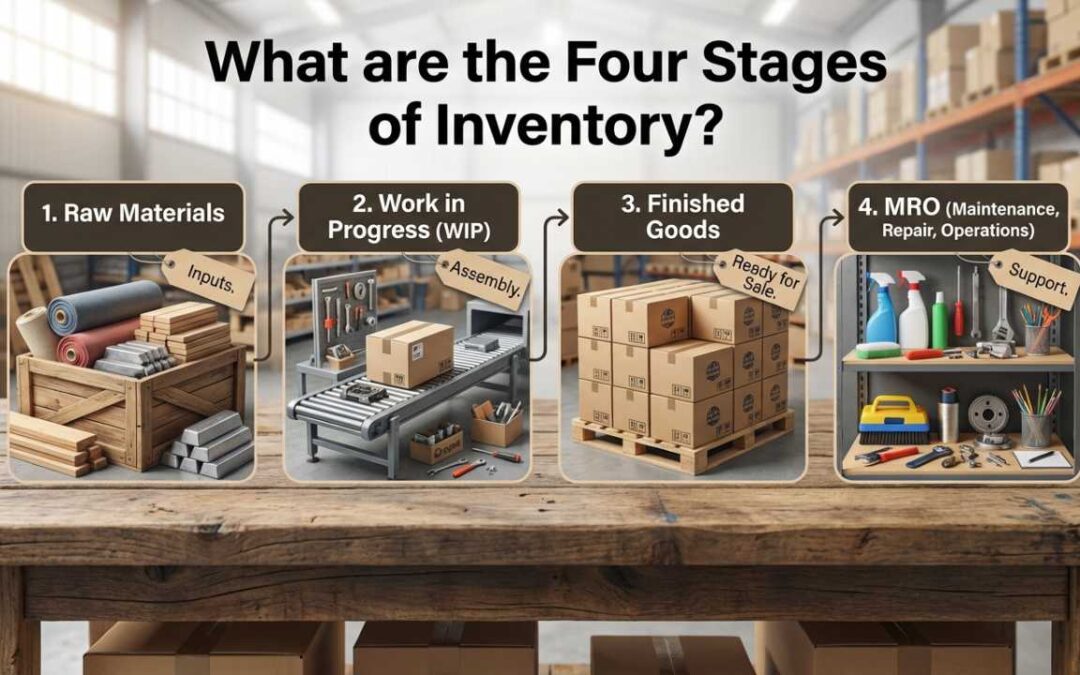
Every product moves through four stages. Raw materials arrive first. Then work-in-process happens during production. Next come finished goods ready to sell. Finally, MRO supplies keep operations running.
Don’t dig a well when you’re already thirsty. Understanding these inventory lifecycle stages now protects your cash flow later.
This guide walks Phoenix manufacturing companies and warehouse operations through each stage. You’ll learn what matters. You’ll spot red flags. You’ll improve cash flow and reduce inventory waste.
Understanding the Four Stages of Inventory for Phoenix, AZ Businesses
Inventory is not just stock.
It is capital. It is cash. It is control.
The supply chain inventory process moves your money through four distinct stages. Each stage has different risks. Each needs different strategies. Phoenix businesses that gain inventory clarity see better margins.
Think of inventory as a financial flow. Money enters as raw materials. It transforms during production. It exists when finished goods sell. And MRO supplies support the whole cycle.
Small business inventory Phoenix owners often focus on finished goods only. That’s a mistake. The real cash drains happen earlier. Work-in-process traps capital on the production floor. Raw materials stockpiles tie up credit lines.
Your warehouse inventory Phoenix operation touches all four stages daily. Understanding them helps you make smarter decisions. Better purchasing. Faster turnover. Lower holding costs.
Let’s break down each stage. We’ll show what happens. We’ll reveal common problems. We’ll share solutions that work for Phoenix companies.
Raw Materials
Raw materials are the fuel in your production engine.
These are items you buy to create products. Steel sheets for HVAC manufacturers. Plastic components for electronics assemblers. Food ingredients for distribution centers. All raw materials inventory starts here.
Phoenix manufacturing faces unique challenges. Summer heat affects storage. Supplier lead times vary wildly. The Mexico border creates opportunities but adds complexity.
Smart Phoenix businesses use safety stock strategy without overdoing it. Order too much and you burn cash. Order too little and production stops. The sweet spot depends on your supplier inventory process reliability.
Track lead time variability by supplier. Build safety stock only for critical items. Review consumption patterns monthly. This prevents overstocking while avoiding costly production delays.
Most inventory consulting Phoenix AZ experts recommend 15-30 days of raw materials on hand. But your actual need varies by industry. Aerospace parts? More buffer. High-turnover distribution? Less.
Work-in-Process (WIP)
How long is your cash sitting on the production floor?
WIP is inventory between raw and finished. Partially assembled products. Items waiting for the next production step. Components in quality testing. All work in process inventory represents trapped cash.
This stage matters more than most Phoenix owners realize. WIP doesn’t generate revenue. It can’t be sold. It just sits there consuming space and capital.
Your production cycle inventory speed determines WIP levels. Faster cycles mean less trapped cash. Bottlenecks create pileups. Batch sizes affect inventory cost analysis Phoenix calculations significantly.
Monitor WIP turnover weekly. Calculate days in WIP monthly. Compare against your production targets. High WIP signals process problems or poor batch planning.
Reduce batch sizes when possible. Balance setup costs against holding costs. The goal is smooth flow and improved cash flow through your operation.
Finished Goods
This is where cash becomes profit.
Finished goods inventory means products ready to ship. Completed assemblies. Packaged items. Stock waiting in your distribution center inventory for customer orders.
Unlike WIP, finished goods can actually sell. But they still carry risk. Markets change. Customer preferences shift. Products become obsolete. Seasonal patterns affect Phoenix businesses heavily.
Smart inventory optimization services focus here first. Why? Because small changes create big impacts. Better demand forecasting cuts excess stock. Faster turnover boosts profit margins immediately.
Calculate finished goods turnover ratio monthly. Compare it to industry benchmarks. Phoenix manufacturers should target 8-12 turns annually minimum. Distribution centers need higher rates.
Tie finished goods management to demand forecasting software. Historical sales patterns reveal future needs. Factor in Phoenix’s seasonal business cycles. Adjust safety stock levels accordingly.
Maintenance, Repair, and Operations (MRO)
MRO is the stuff nobody thinks about until it’s missing.
MRO inventory includes supplies that keep operations running. Machine parts. Cleaning supplies. Safety equipment. Office materials. Packaging tape. Forklift batteries. All the little things that aren’t in your products.
Phoenix businesses often overlook this category. It doesn’t create revenue directly. But operations supply inventory failures cause expensive shutdowns. Missing parts halt production. Safety gear shortages create compliance risks.
The hidden cost? MRO inventory typically grows 10-15% yearly without proper controls. Nobody monitors it closely. Departments order duplicates. Items expire unused.
Recommend quarterly MRO audits to reduce business stress and waste. Track high-value items separately. Implement min-max levels for critical supplies. Use cycle counts monthly.
An ERP inventory system Phoenix setup should include MRO tracking. Set reorder points. Monitor consumption patterns. Consolidate purchases to negotiate better pricing.
Four Stages of Inventory and Real-World Usage Examples in Phoenix, AZ
We’ll show you how one Phoenix company reduced inventory waste by 18%.
Theory means nothing without application. Phoenix businesses need real examples. Situations they recognize. Problems they face daily.
These Phoenix manufacturing inventory examples come from actual companies. Names changed for confidentiality. But the challenges and solutions are real.
Each example shows how understanding the four stages of inventory creates tangible results. Lower costs. Faster turnover. Stronger supply chain control. Better cash flow.
Look for patterns that match your operation. The specific industries differ. But the inventory principles stay constant. And the manufacturing inventory support Phoenix strategies work across sectors.
Raw Materials Usage Examples
A Phoenix HVAC manufacturer struggled with copper tube inventory. Summer demand spiked unpredictably. Winter brought slow periods. Their supplier lead times ranged from 2-8 weeks.
They were ordering six months ahead. Cash was trapped in raw materials. Storage costs climbed. Some copper oxidized before use.
The fix? Implement supplier lead-time planning by season. Track actual consumption weekly. Build a 30-day safety stock for peak season only. Use a basic inventory tracking system Arizona setup to avoid stockouts.
Result: 40% reduction in raw materials on hand. Zero stockouts. Better supplier relationships through consistent smaller orders.
Work-in-Process (WIP) Usage Examples
A Phoenix electronics assembler had $300K sitting in WIP. Their production floor looked busy. But nothing was finishing fast enough.
The problem? Massive batch sizes. They ran 500-unit lots to save on setup time. But market demand was 50-100 units weekly. WIP inventory examples like this are common.
They cut batch sizes to 100 units. Yes, setup happened more often. But WIP dropped 60%. Cash freed up immediately. Inventory audit services Phoenix analysis showed lower holding costs offset the setup time increase.
Better still: smaller batches meant faster response to customer changes. Quality problems got caught sooner. Waste decreased.
Finished Goods Usage Examples
A Phoenix food distributor faced a classic problem. Too much slow-moving inventory. Not enough of what actually sold.
Their buyer ordered based on gut feel. Some finished goods examples sat for months. Others ran out weekly. Customers got frustrated. Cash stayed trapped in wrong products.
They implemented basic demand forecasting software. Just tracking sales by SKU monthly. Setting min-max levels based on actual data. Using warehouse inventory solutions Phoenix standard practices.
Within three months, turnover improved 35%. Stockouts dropped 70%. They could scale business operations confidently. The system told them what to order and when.
MRO Goods Usage Examples
A Phoenix aerospace parts manufacturer thought they had MRO under control. Until an audit revealed $85K in duplicate supplies. Three warehouses ordering independently. No central tracking.
Safety gloves bought monthly because nobody checked existing stock. Obsolete machine parts taking up premium space. MRO examples in business often hide these issues.
They started cycle counting MRO bins monthly. Consolidated purchasing authority. Set up simple inventory management services Phoenix AZ controls using their existing system.
How much did proper MRO tracking save yearly to reduce inventory waste?
About $35K annually. Not huge individually. But that’s pure profit recovered from waste.
Synonyms and Supply Chain Classifications of Inventory Stages in Phoenix, AZ
Different industries use different words. But the money flow stays the same.
Accounting calls it one thing. Operations uses another term. Supply chain consulting Arizona professionals have their own vocabulary. This creates confusion for Phoenix business owners.
Understanding inventory terminology explained here helps you talk with everyone. Your accountant. Your warehouse manager. Your ERP vendor. Your banker.
The four stages of inventory classification stays consistent. But the names shift by context. Manufacturing talks differently than retail. Accounting differs from operations.
This section maps common synonyms. It shows how supply chain inventory categories align. You’ll gain inventory clarity across departments and systems.
Note: accounting classifications may differ slightly from operational terminology. That’s normal. What matters is understanding both perspectives.
Raw Materials Classifications
Raw materials. Inbound stock. Direct materials. Different names. Same financial impact.
Manufacturing companies say raw materials. Retailers call it inbound inventory. Accountants prefer direct materials classification when items go into products.
The distinction matters for Phoenix inventory consulting Phoenix AZ work. Direct materials become part of finished goods. Indirect materials support production but don’t appear in products.
Examples of direct materials: steel, plastic, fabric, food ingredients. Examples of indirect: lubricants, cleaning supplies, packaging materials used internally.
Your primary inventory classification for accounting includes only direct materials here. Indirect items often fall under MRO instead.
This affects costing significantly. Direct materials factor into cost of goods sold. Indirect materials hit operating expenses. Know the difference to strengthen supply chain control.
Work-in-Process Classifications
What’s the difference between WIP and semi-finished goods?
WIP classification covers anything between raw materials and finished products. Some industries call it work-in-progress. Others use processing stage inventory. Accountants stick with work-in-process.
Semi-finished goods are technically WIP. But they’re complete enough to sell to another manufacturer. Think partially assembled components sold to OEMs.
For Phoenix businesses, the key point: WIP appears on your balance sheet under current assets. It’s valued at cost including direct materials, direct labor, and overhead applied so far.
This matters for inventory cost analysis Phoenix reporting. Your banker looks at WIP levels. High WIP relative to sales signals production inefficiency. That affects credit decisions.
Track WIP days carefully. Calculate: WIP value divided by daily cost of goods sold. Lower numbers improve cash flow and impress lenders.
Finished Goods Classifications
Manufacturers call it finished goods. Retailers say merchandise inventory. Completed inventory classification. Outbound inventory stage. Same concept throughout.
This is inventory ready for sale in its current form. No more work needed. It’s packaged. Labeled. Quality approved. Sitting in your distribution center or warehouse inventory solutions Phoenix operation.
Supply chain professionals track this as the final stage before revenue recognition. Your finished goods turnover ratio drives profitability. Fast turnover means cash cycles quickly. Slow turnover traps capital.
Calculate it monthly: cost of goods sold divided by average finished goods inventory. Phoenix manufacturers should target 8+ turns yearly minimum. Higher is better to boost profit margins.
Different industries use different benchmarks. But the principle holds across all sectors.
MRO Classifications
MRO. Indirect materials. Operating supplies. Consumables. Even office supplies sometimes. All refer to inventory that supports operations without becoming part of products.
The indirect materials classification creates accounting confusion. Should MRO be capitalized as inventory or expensed immediately? It depends.
High-value items with long useful life? Capitalize as assets. Low-value consumables? Expense when purchased. Your accountant and ERP inventory system Phoenix setup should align on this.
Operating supplies classification typically hits expense accounts directly. This simplifies accounting. But you lose visibility into actual consumption patterns and reduce business stress from surprise costs.
Best practice: track all MRO in your inventory system even if you expense it immediately. You gain usage insights. You prevent duplicate ordering. You control costs better.
And occasionally? You catch someone ordering way too many staplers. True story from a Phoenix client.
Managing the Four Types of Inventory Effectively in Phoenix, AZ
When inventory is managed well, stress drops and margins rise.
Understanding the stages is step one. Managing them effectively is where results happen. Phoenix businesses need practical strategies. Systems that actually work. Controls that prevent waste.
This section shifts from theory to action. You’ll get specific tactics. Implementation steps. Real inventory control strategies that improve cash flow and reduce inventory waste.
The goal? Turn inventory from a cash drain into a competitive advantage. Make it work harder. Move it faster. Track it better.
Every Phoenix operation is different. But these principles apply across industries. Manufacturing. Distribution. Assembly. Wholesale. All benefit from better inventory optimization Phoenix practices.
Start with an inventory performance dashboard. Track WIP levels weekly. Monitor turnover monthly. Set safety stock targets. Review MRO consumption quarterly. These basics prevent most problems.
Ready to take control?
Understanding the Four Main Types of Inventory
Think of the four main inventory types as a cash transformation cycle.
Money becomes raw materials. Materials become work-in-process. WIP becomes finished goods. Finished goods become revenue. Meanwhile MRO keeps everything flowing.
Each stage has different velocity. Raw materials sit longest typically. WIP should move fastest. Finished goods speed varies by demand. MRO consumption stays relatively steady.
Your inventory management Phoenix AZ strategy needs different approaches for each stage. One-size-fits-all policies fail. What works for raw materials doesn’t work for MRO.
Gain inventory clarity by measuring each stage separately. Then optimize each individually. The compound effect is powerful.
Raw Materials
Control raw materials with these steps.
First, calculate lead time variability by supplier. Track minimum, maximum, and average delivery times over six months. This reveals which suppliers need bigger safety buffers.
Second, set reorder points based on actual consumption plus lead time variability. Add safety stock only for critical items. Don’t stockpile everything to prevent overstocking.
Third, review raw materials management monthly. Identify slow movers. Negotiate return agreements with suppliers. Adjust order quantities based on actual usage patterns.
Phoenix businesses face unique supplier challenges. Mexico border crossings add delays. Summer heat affects certain materials. Plan accordingly with your inventory consulting Phoenix AZ partners.
Work-in-Progress (WIP) Inventory
How much cash is trapped in your production process right now?
WIP inventory management starts with measuring days in WIP. Take total WIP value. Divide by daily cost of goods sold. Lower is better for lower holding costs.
Limit batch sizes to reduce WIP accumulation. Yes, setup costs go up. But holding costs and cash benefits usually outweigh them. Run the numbers for your operation.
Identify bottlenecks weekly. Where does WIP pile up? That’s your constraint. Fix it before optimizing elsewhere. This is basic inventory audit services Phoenix work.
Consider pull systems over push. Let customer demand trigger production. This naturally limits WIP buildup.
Finished Goods
Finished goods management is all about turnover speed and accuracy.
Integrate demand forecasting tools immediately. Even basic sales history analysis beats gut feel ordering. Track what sells. Track when it sells. Adjust stock levels accordingly.
Calculate turnover monthly. Compare to last year and industry benchmarks. Declining turnover signals problems. Rising turnover means you’re doing something right to boost profit margins.
Phoenix’s seasonal patterns affect most businesses. HVAC spikes summer. Pool supplies peak early spring. Construction materials follow development cycles. Your warehouse inventory solutions Phoenix system should accommodate these patterns.
Set min-max levels by SKU based on actual data. Review quarterly. Adjust for seasonality and trends.
Maintenance, Repair, and Operating (MRO) Supplies
MRO inventory management prevents hidden waste and surprise shutdowns.
Implement quarterly MRO cycle counts minimum. High-value items monthly. This catches duplicate orders. It reveals obsolete stock. It prevents the classic ‘buying what we already have’ problem.
Set min-max levels for critical MRO items. Machine parts that take weeks to ship? Keep spares. Commodity items available next-day? Order as needed to reduce business stress.
Consolidate MRO purchasing authority. One department. One approval process. One vendor relationship. This prevents the chaos of decentralized ordering.
Your ERP inventory system Phoenix should track MRO separately from production inventory. Different rules apply. Different metrics matter.
And please, really, track those staplers. You’d be amazed.
Inventory Amount – How to Calculate It?
How do you know what inventory you should have on hand?
The inventory amount calculation is straightforward. It follows this formula:
Ending Inventory = Beginning Inventory + Purchases − Cost of Goods Sold
Start with last month’s ending inventory. Add everything purchased this month. Subtract what sold or got used in production. What remains is your ending inventory.
This ending inventory formula works for all four stages. Track each separately for better insights. Your raw materials ending inventory differs from finished goods.
Phoenix businesses with seasonal demand should reconcile inventory monthly minimum. This catches shrinkage early. It reveals purchasing patterns. It helps build financial confidence in your numbers.
Your accountant uses this for financial statements. Your banker wants it for credit reviews. Your inventory cost analysis Phoenix depends on accurate calculations.
Automate this calculation if possible. Manual tracking creates errors. Your inventory system should run this daily or weekly. Review trends monthly. Investigate unexpected changes immediately.
Business and Operations Resources on Inventory Stages for Phoenix, AZ Companies
The right system does not just track inventory. It protects your margins.
Managing the four stages of inventory requires good tools. Software matters. Automation helps. But systems are just enablers. Your strategy drives results.
Phoenix companies have many inventory management tools options. From simple barcode scanners to full enterprise systems. Choose based on your complexity level and growth plans.
These resources support warehouse automation Phoenix operations. They strengthen supply chain control. They provide the data visibility you need for smart decisions.
Don’t treat inventory software as an expense. It’s a control system. It’s a financial safeguard. It’s how you prevent the costly mistakes that kill margins.
Here are proven inventory management services Phoenix AZ businesses actually use.
Lowry Solutions
Lowry Solutions specializes in barcode inventory systems and warehouse automation for mid-market companies.
Their strength is real-time tracking integration with existing ERP systems. Phoenix warehouse operations use them for receiving, putaway, picking, and shipping automation.
Barcode tracking eliminates manual entry errors. You scan items in. You scan items out. The system updates instantly. Your inventory tracking system Arizona accuracy jumps immediately.
Best for: Distribution centers and manufacturers needing better warehouse accuracy without replacing their entire ERP system.
Implementation takes 2-6 months typically. Training is straightforward. Most warehouse staff learn the basics in days.
Oracle NetSuite
Can your current system track inventory across multiple locations in real time?
NetSuite is a cloud inventory system with full ERP integration. It handles all four inventory stages in one platform. Raw materials. WIP. Finished goods. MRO. Everything connects.
Phoenix companies growing beyond single-location operations choose NetSuite for scalability. Multi-warehouse visibility matters when you’re expanding. So does real-time financial reporting.
The ERP inventory software tracks lot numbers, serial numbers, bins, and expiration dates. It handles complex manufacturing scenarios. It scales business operations confidently as you grow.
Ideal for: Growing manufacturers with $5M+ revenue, multiple locations, or complex inventory needs. The investment is substantial. But so is the control and visibility you gain.
Consider NetSuite when spreadsheets fail and your current ERP inventory system Phoenix can’t keep up.
Financial and Accounting Education Platforms for Phoenix, AZ Inventory Management
Inventory knowledge builds financial control.
Your warehouse manager understands physical flow. Your controller understands accounting flow. Both need to speak the same language about inventory accounting stages.
These educational platforms bridge that gap. They explain cost of goods sold guide principles. They clarify inventory valuation methods. They help your team build financial confidence.
Phoenix businesses benefit from cross-training. Let operations learn basic accounting. Let accounting understand warehouse realities. Better decisions happen when everyone shares the same foundation.
Encourage your team to use these accounting inventory education resources. The investment in knowledge always pays back.
Investopedia
Investopedia provides accessible inventory accounting explanation and financial definitions.
Use it as a glossary validation source. Quick definitions. Basic concepts. Inventory financial terms explained clearly without academic jargon.
Perfect for: New managers learning the basics. Quick reference during meetings. Explaining concepts to non-financial staff.
It won’t make anyone an expert. But it prevents the confusion that comes from not understanding basic terminology.
Phoenix accounting services for inventory Phoenix professionals often recommend it to clients.
Corporate Finance Institute
Corporate Finance Institute offers certification-level inventory valuation training and financial modeling courses.
This is professional-grade education. Inventory financial terms. Cost accounting. Valuation methods. All taught at a level that strengthens financial expertise.
Best for: Controllers, CFOs, and senior financial staff who need formal training. The certifications carry weight. The content is rigorous.
Phoenix companies investing in finance certification inventory training see better decision-making. Better reporting. Better investor communications.
Recommend it for anyone moving into financial leadership roles.
Enterprise Learning Resources on Inventory Stages for Phoenix, AZ Professionals
Knowledge is the foundation. Systems are the tools. Both matter.
Phoenix professionals need ongoing education. Inventory practices evolve. Technology changes. Best practices improve. Staying current makes you more valuable.
These enterprise inventory learning platforms provide broader perspectives. Global insights. Industry benchmarks. Supply chain certification options.
Consider blended operational plus financial education. Understanding both perspectives makes you indispensable. It helps you improve operational efficiency while protecting financial performance.
Bajaj Finserv
Bajaj Finserv offers inventory finance learning and business operations education resources.
Use this for broad financial literacy support. Understanding how inventory affects financing options. Learning about working capital management. Strengthening financial control knowledge.
Helpful for: Business owners evaluating inventory consulting Phoenix AZ options. Understanding how lenders view inventory. Making better borrowing decisions.
AccountingTools
AccountingTools provides in-depth inventory accounting methods reference material.
This is technical accounting content. FIFO vs LIFO. Weighted average costing. Lower of cost or market. All the financial reporting inventory details accountants need.
Recommend it for policy drafting and internal SOP development. When you need to document your inventory procedures formally. When auditors ask questions.
Phoenix inventory audit services Phoenix firms reference AccountingTools regularly. It builds financial confidence through authoritative guidance.
Academic References on Inventory Stages Used by Phoenix, AZ Accountants
Theory meets practice. Standards meet reality.
Academic accounting textbooks anchor inventory theory and practice in formal standards. Phoenix accountants reference these for GAAP compliance and professional guidance.
Understanding the academic foundation helps you communicate with auditors. It supports regulatory compliance. It ensures your accounting services for inventory Phoenix work meets professional standards.
These aren’t casual reading. But they matter when questions arise about proper treatment and reporting.
Intermediate Accounting
Intermediate Accounting textbooks cover GAAP inventory standards in detail.
They explain inventory reporting rules. Valuation methods. Disclosure requirements. All aligned with current accounting standards.
Reference this for: Balance sheet presentation. Inventory valuation disclosure. Cost flow assumptions. Anything requiring inventory cost analysis Phoenix aligned with GAAP.
Your CPA firm relies on these principles. Understanding them helps you build financial compliance confidence.
Financial Accounting
Financial Accounting textbooks explain how inventory affects financial statements.
The connection between inventory financial statements and reported profit is direct. Your inventory valuation method changes net income. Your ending inventory affects cost of goods sold.
Phoenix businesses using accounting principles inventory standards correctly report more accurately. They gain inventory clarity in financial communications. They answer banker questions confidently.
Remember: FIFO shows higher profits in rising cost environments. LIFO shows lower profits. Weighted average splits the difference. Choose the method that best reflects your business reality.
Conclusion
Don’t dig a well when you’re already thirsty.
The four stages of inventory control your cash flow. Raw materials lock up capital. WIP traps money on production floors. Finished goods wait to convert into revenue. MRO supports everything quietly.
Phoenix businesses that master these stages gain real advantages. Better margins. Faster turnover. Lower waste. Stronger financial confidence.
Start simple. Track each stage separately. Measure what matters. Set targets. Review monthly. Improve continuously.
You don’t need perfect systems immediately. You need forward progress. Small improvements compound over time.
Are you ready to take control of your inventory and build financial confidence?
Implement an inventory performance dashboard this month. Track WIP days. Monitor turnover ratios. Review MRO consumption. These basics prevent most problems.
Phoenix companies that understand their inventory stages make smarter decisions. They see problems earlier. They respond faster. They protect cash better.
Your inventory isn’t just stuff sitting in warehouses. It’s working capital. It’s an opportunity. It’s competitive advantage when managed well.
Partner with inventory consulting Phoenix AZ professionals if you need help. The investment pays back through better control and improved operations.
But start now. Don’t wait until cash problems force action. Build the foundation while you have breathing room.
Because inventory knowledge doesn’t just build financial control. It builds business resilience. And in Phoenix’s competitive market, that matters more than ever.
Partner with Jay Hohel Inc for Expert Inventory Management
At Jay Hohel Inc, we help Phoenix businesses optimize their inventory across all four stages.
We understand the unique challenges Phoenix manufacturers and distributors face. Summer storage issues. Seasonal demand swings. Supplier lead-time variability. Cross-border logistics complexity.
Our inventory consulting services focus on practical results. Not theoretical frameworks. Not one-size-fits-all solutions. Real strategies that work for your specific operation.
We’ve helped Phoenix companies reduce inventory waste by 18-40%. Improve turnover ratios by 25-60%. Free up trapped cash for growth. Strengthen supply chain control.
Whether you need help with raw materials planning, WIP reduction, finished goods optimization, or MRO controls—we have the expertise and local market knowledge to help.
Ready to Improve Your Inventory Management?
Contact Jay Hohel Inc today for a free inventory assessment.
📍 Location: 3334 W McDowell Rd Unit 17, Phoenix, AZ 85009-2414
📞 Phone: (602) 272-4033
✉️ Email: JayHoehlinc@gmail.com
🌐 Website: jhiescrap.com
📞 SCHEDULE YOUR FREE INVENTORY ASSESSMENT
Call (602) 272-4033 or Visit jhiescrap.com