
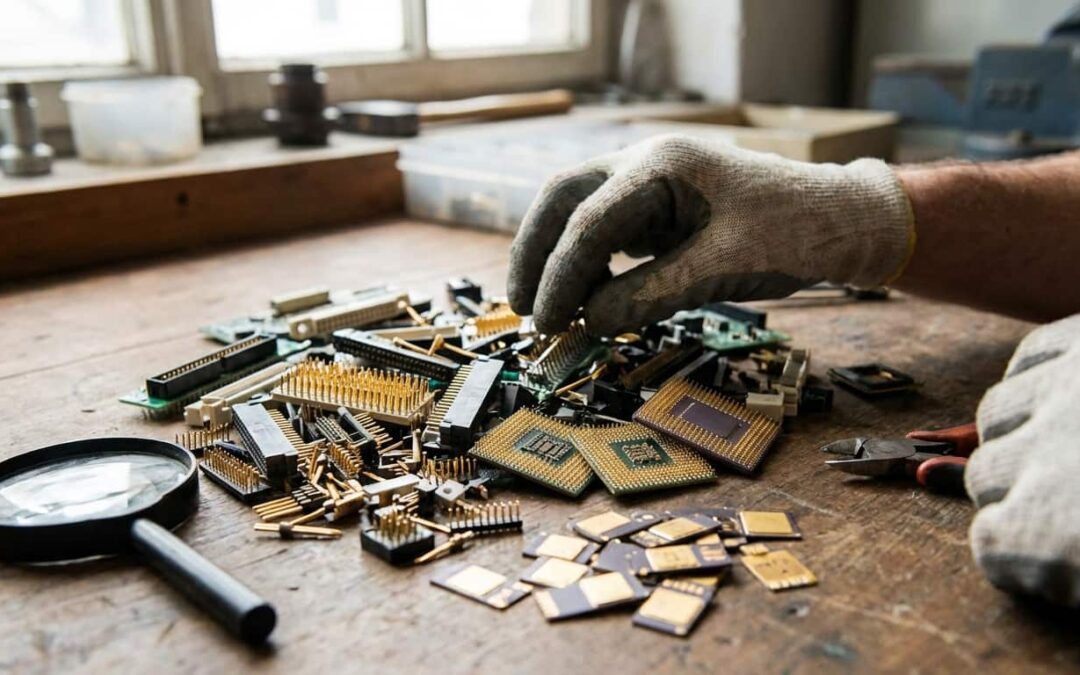
What Electronics Have the Most Gold Scrap?
You’ve probably tossed out an old laptop, a broken phone, or a dusty desktop without a second thought. But what if those devices had real gold inside them? It sounds strange, but it’s true. Many everyday electronics carry small amounts of gold — used for its ability to conduct electricity and resist corrosion. Over time, those small amounts add up.
Think of it like finding coins in old coat pockets. One by one, it’s nothing. But a pile of old electronics? That can turn into real money.
What Electronics Have the Most Gold Scrap in Phoenix, AZ
Phoenix has a strong resale and recycling market, which makes it one of the better places to turn scrap electronics into cash. Older devices — the kind often found in garage sales, office cleanouts, and estate lots around the valley — tend to hold more gold than newer models. That’s because manufacturers used thicker gold plating in earlier decades.
Here are the device types Phoenix scrappers usually focus on:
- Desktop computers and servers
- Older CPUs and processors
- RAM modules and memory sticks
- Telecom and networking equipment
- Industrial control boards
New devices look advanced. Older ones often hold more gold.
Overview of Gold Content in Electronics
Gold appears in electronics because it does two things almost no other metal can do as well: it conducts electricity without losing signal quality, and it doesn’t rust or tarnish. That combination matters in parts where reliability is critical.
You’ll typically find gold in:
- Circuit board connectors
- CPU pins and caps
- Edge connectors on memory modules
- Internal bonding wires inside chips
The thickness of the gold plating changes the value. Thicker plating — common in older or industrial gear — pays far more than the micro-thin layers used in modern consumer electronics. Think of gold as a shield against rust, keeping connections clean for years.
Understanding the Value of Gold Scrap Electronics in Phoenix, AZ
The value of scrap electronics comes down to one rule: volume beats individual pieces. A single smartphone might contain only a fraction of a gram of gold. But a hundred phones? That’s a different story. Phoenix buyers and refiners typically price scrap based on the type of component, its age, and the total weight you bring in.
Key factors that drive value:
- Type of device (servers and CPUs rank highest)
- Age of the equipment (older = thicker plating)
- Condition of the boards and connectors
- Total volume delivered
Don’t dig a well when you’re already thirsty — meaning, start collecting before you need the cash. Bulk is where real returns come from.
Key Data Points on Gold in Electronics
A few numbers help put this into perspective:
- One ton of discarded mobile phones can yield around 300 grams of gold — far more than a ton of gold ore
- A single desktop computer contains roughly 0.2 grams of gold on average
- Older ceramic CPUs can hold several times more gold per unit than modern plastic ones
- Circuit boards from servers and telecom gear are among the highest-yielding scrap categories
Phones are small. Their value adds up fast.
Gold Content in CPUs
CPUs are one of the richest sources of scrap gold in the entire electronics world. Processors use gold on their pins, caps, and internal bonding wires to guarantee clean signal flow at high speeds. Older CPUs — especially ceramic ones from the 1980s and 1990s — contain noticeably more gold than modern processors.
High-value CPU types include:
- Ceramic Intel and AMD processors from pre-2000
- Gold-cap Pentium Pro chips
- Older server-grade processors
Old CPUs can beat modern ones in gold value, even though they’re slower and outdated.
Gold Content in Smartphones
Smartphones contain gold, but not much per unit. Each phone holds small traces in its logic board, connectors, and SIM area. What makes phones interesting isn’t a single device — it’s the sheer number of them sitting in drawers across every household.
How many old phones do you have in a drawer right now? Most people have two or three. Multiply that across a neighborhood, and the math changes quickly. For individual sellers, one phone barely registers. For bulk collectors, phones become a steady source of recoverable gold.
Gold Yield from Bulk Smartphones
Individual phones yield tiny amounts. But once you reach hundreds or thousands of units, the picture shifts dramatically. Industry estimates suggest that one metric ton of smartphones can produce close to 300 grams of gold, plus silver, palladium, and copper.
That’s why professional recyclers focus on scale. One phone is small. Hundreds change the game.
Where Gold Is Found in Electronics
Gold isn’t scattered randomly across a device. It hides in specific places where electrical connections matter most. Knowing where to look saves time and helps you sort scrap by value.
Common gold-bearing areas:
- Edge connectors on RAM and expansion cards
- Pins on CPUs and processors
- IC chip bonding wires
- Gold-plated header pins on motherboards
- Connector fingers on PCI and graphics cards
Gold hides in the smallest corners — which is exactly why beginners overlook it.
Key Locations
To make sorting easier, focus on these specific spots:
- CPU pin arrays
- RAM gold fingers
- Card edge connectors
- IC chip leads
- Board-to-board connectors
Gold plating thickness varies by device, so two similar-looking parts can hold very different values. If it connects, it may contain gold.
Top Electronics for Gold Scrap in Phoenix, AZ
If you want real returns, you can’t treat all electronics the same. Some categories are genuine gold mines. Others barely justify the effort of hauling them. The smartest scrappers in Phoenix focus on older and industrial-grade electronics because they consistently hold more recoverable gold than newer consumer gear.
The top categories worth collecting include:
- Older CPUs from the 1980s to early 2000s
- RAM modules with gold fingers
- Desktop motherboards in bulk
- Telecom and server boards
- Industrial control electronics
Not all electronics are equal. Some are gold mines. Others barely matter. So which ones actually deserve your time?
Top Electronics for Gold Scrap
Here’s the quick reference list, ordered by gold concentration rather than popularity:
- Ceramic CPUs (highest)
- Gold-finger RAM modules
- Telecom and server circuit boards
- Motherboards and daughter cards
- Industrial and military-grade electronics
If it has boards, pins, and connectors, it has value.
Older CPUs (1980s–Early 2000s)
Older CPUs sit at the very top of the gold scrap ladder. Ceramic processors from the 1980s and 1990s were built with thick gold layers on their pins, caps, and internal wiring. Manufacturers weren’t trying to save gold back then — they were trying to build chips that lasted.
Compare that to modern CPUs, which use micro-thin gold layers to cut costs. The result? A single ceramic Pentium Pro can hold more gold than a stack of modern consumer processors.
Older chips look outdated. But they often carry more gold than new ones.
RAM Modules
RAM sticks are another strong category. The value sits in the “gold fingers” — the thin strips of gold plating along the edge connector that slides into the motherboard.
Key points about RAM scrap:
- Older DDR and SDRAM modules often have thicker plating
- Server-grade ECC RAM tends to rank higher
- Gold fingers are easy to identify and sort
Those thin gold strips? They are the real money.
Desktop Motherboards
Motherboards don’t hold huge amounts of gold in any single spot, but they spread small amounts across many points — CPU sockets, RAM slots, PCI connectors, header pins, and IC chips. Individually, it’s modest. In bulk, it becomes serious value.
Key gold areas on a motherboard:
- CPU socket pins
- RAM slot contacts
- PCI and expansion slot fingers
- Header and jumper pins
- BIOS chip leads
One board seems small. A pile of boards becomes profit.
Telecommunications & Server Equipment
Enterprise equipment — servers, telecom switches, routers, and data center gear — uses more gold than consumer electronics. Why? Because downtime costs businesses money, and gold guarantees reliable connections over long periods.
Examples worth collecting:
- Rack-mount server boards
- Telecom switch cards
- Fiber optic transceivers
- Backplane connectors
The more critical the system, the more gold it uses.
Industrial Electronics
Industrial electronics are the hidden gem of gold scrap. Factory control boards, PLC systems, and industrial sensors use thicker gold plating because they operate in harsh environments — heat, vibration, dust, and chemicals. That protection translates directly into higher recoverable gold.
Examples:
- PLC (programmable logic controller) boards
- Industrial sensor modules
- Motor control units
- Mining and oilfield electronics
Most people ignore these. Smart scrappers don’t.
High-Gold Content Electronics Categories in Phoenix, AZ
Once you understand that gold concentration depends on function, categorizing electronics becomes much easier. Devices that need precision, reliability, and long service life use more gold. Devices built for low cost and short lifespans use almost none. That single rule explains why some categories dominate the scrap market and others barely register.
Here’s how the main categories break down by gold content:
- Computers and servers: highest
- CPUs and processors: highest
- Networking and telecom equipment: high
- Mobile phones: moderate (bulk-dependent)
- Gaming consoles: moderate
- Printers and office gear: low to moderate
- TVs and monitors: low
- Industrial and medical equipment: very high
Not every device holds gold equally. Function decides value.
Computers and Servers (Highest Gold Content)
Computers and servers sit at the top for a reason. Servers run around the clock, handling critical data, so manufacturers use gold generously to guarantee stable connections. Desktops and workstations follow closely behind, especially older models with more generous plating.
Examples worth collecting:
- Rack-mount enterprise servers
- Workstation motherboards
- Pre-2005 desktop computers
- Network-attached storage boards
The more critical the system, the more gold it carries.
High-Value Parts
Inside these machines, the real value sits in specific components:
- CPUs and processors
- RAM modules
- Motherboards and daughter boards
- PCI and expansion cards
- Power supply connectors
Parts matter more than the device they came from.
Why They’re Valuable
Gold is used in these parts for two main reasons: it conducts electricity extremely well, and it resists corrosion almost completely. In a server that runs for five or ten years straight, you can’t afford a connection to tarnish or fail. Gold solves that problem, which is why engineers specify it for critical points.
Gold acts like a shield for connections — keeping data flowing year after year.
CPUs and Processors (Gold-Rich Components)
CPUs deserve their own category because they’re the single most gold-dense component in most electronics. A processor uses gold on its pins, its cap, and inside the package itself. Older ceramic CPUs are especially rich because manufacturers used gold layers thick enough to actually see.
Newer is faster. Older is richer in gold.
Most Valuable Types
Not all processors pay the same. The top-paying types include:
- Ceramic Intel Pentium Pro chips
- Gold-cap 486 and 386 CPUs
- Older AMD ceramic processors
- Server-grade Xeon and Opteron (older generations)
Modern plastic CPUs pay far less per unit.
Gold Locations
Inside a CPU, gold appears in several specific spots:
- Pin arrays on the underside
- Gold cap on the top (ceramic models)
- Internal bonding wires
- Die attach layers
The smallest parts hold the most value.
Mobile Phones and Smartphones
Smartphones are the most relatable example of gold in electronics. Nearly everyone owns one, and nearly everyone has an old one sitting in a drawer. The gold inside is real, though the amount per phone is small.
How many old phones sit unused in your home right now? That drawer is worth more than most people realize — not as one phone, but as a growing collection.
Gold Sources
Inside a phone, gold is found in:
- Logic board connectors
- SIM card contacts
- Camera module leads
- Battery connectors
Gold hides where signals connect.
Value Insight
Let’s be honest about the math. A single phone yields a tiny fraction of a gram of gold. On its own, that’s barely worth anything. But collected in the hundreds — especially older models — phones become a legitimate source of recoverable gold for bulk scrappers.
One phone is small. Many create value.
Networking Equipment
Networking gear is quietly one of the better gold sources. Routers, switches, and especially enterprise-grade network equipment use gold heavily because data reliability depends on clean, corrosion-free connections. Consumer routers pay modestly. Business and data center equipment pays much more.
Data never sleeps. Neither does the gold inside these systems.
Examples
Good networking scrap targets include:
- Enterprise routers and switches
- Fiber optic line cards
- Telecom backplanes
- Rack-mount network appliances
Focus on enterprise-grade gear whenever possible.
Why Valuable
Networking equipment runs continuously. A failed connection in a data center can cost thousands of dollars per minute. That’s why engineers use gold — it doesn’t corrode, doesn’t degrade, and doesn’t fail. Failure is not an option — that’s why gold is used.
TVs and Monitors
TVs and monitors are a disappointment for most scrappers. Despite their size, they contain very little gold. Flat-panel displays use mostly aluminum, copper, and plastic. The small amount of gold that does exist sits on the main control board and a few connectors.
Big size doesn’t mean big value.
Gold Locations
Limited gold-bearing areas include:
- Main control board connectors
- Tuner module pins
- Input/output jacks
Most of the device is not worth processing.
Value Level
For most scrappers, TVs and monitors aren’t worth the effort unless you’re processing them alongside other e-waste in volume. The gold yield per unit is simply too low to justify the labor. Low effort, low return — unless you have a lot of them.
Gaming Consoles
Gaming consoles fall in the middle. They contain motherboards, CPUs, GPUs, and connectors similar to PCs, but in a more compact and cost-optimized form. Older consoles yield modestly, while newer ones yield even less.
Fun to use, modest in gold value.
Examples (Consoles)
Examples include:
- Original Xbox and Xbox 360 boards
- PlayStation 2 and 3 motherboards
- Older Nintendo console boards
Value Insight
Consoles pay moderately, and only in bulk. They’re worth collecting if you have several, but processing a single console rarely covers the time involved.
Printers and Office Equipment
Printers and office electronics are mostly plastic, metal frames, and low-grade boards. Some gold appears on connectors and control boards, but the yield is modest.
Gold Sources
Focus areas:
- Main control boards
- Network and USB connectors
- Internal ribbon cable headers
Value
Low ROI unless collected in bulk. Office equipment is usually better as a side category than a primary target.
Industrial and Medical Equipment (Hidden Gold Sources)
This is where most people miss the real value. Industrial control systems and medical devices use gold at rates that rival or exceed servers. Medical imaging boards, patient monitoring systems, and precision industrial controllers demand perfect reliability — and gold delivers it.
Examples include:
- Medical imaging control boards
- Patient monitor PCBs
- Industrial PLC and DCS boards
- Aerospace and defense electronics
This is where most people miss the real value.
Why They’re Valuable
These devices can’t fail. A medical device that loses a signal can harm a patient. An industrial controller that drops a connection can shut down a factory. That zero-tolerance requirement forces engineers to use thick gold plating at every critical point. Precision demands perfection. Gold delivers it.
Ranking Electronics by Gold Scrap Value in Phoenix, AZ
Not every scrap category deserves your time. Some electronics pay well, some pay modestly, and some simply waste effort. A clear tier system makes it easy to decide what to collect and what to skip. The ranking below is based on two factors: gold concentration and ease of recovery.
Some electronics pay well. Others waste your time.
Ranking: Electronics with the Most Gold
Ranking isn’t just about how much gold exists in a device — it’s also about how easy it is to get to. A processor with heavy gold plating that’s easy to remove will rank higher than an industrial board with buried gold that’s hard to access. Value is not just about gold — it’s about how easy it is to recover.
Highest Yield
Top-tier items worth prioritizing:
- Ceramic CPUs (pre-2000)
- Gold-cap processors
- Telecom and server circuit boards
- High-end RAM with thick gold fingers
- Industrial and military control boards
This is where the real money sits.
Medium Yield
Second-tier items — worth collecting in bulk:
- Desktop motherboards
- Standard RAM modules
- Networking switches and routers
- Gaming console boards
- Graphics and expansion cards
Not the best, but still worth your time.
Lower Yield
Items that usually aren’t worth processing alone:
- TVs and monitors
- Printers and scanners
- Low-end consumer gadgets
- Plastic-housed appliances
Low-value items cost time more than they pay.
Monetization Strategies for Gold Scrap Electronics in Phoenix, AZ
Once you know what’s valuable, the next question is how to turn it into money. For most people, the answer isn’t to extract gold yourself — it’s to sell scrap smartly. Phoenix has active buyers, recyclers, and refineries that pay fair rates for sorted, bulk scrap. The smarter your sorting and timing, the better your returns.
You don’t need to refine gold to make money from it.
Is Gold Recovery Worth It?
This is the big question. DIY gold recovery sounds exciting, but it requires strong acids, proper ventilation, safety equipment, and real chemistry knowledge. For most people, the risks outweigh the rewards. Selling sorted scrap to a refinery is usually more profitable per hour of work.
Is it worth your time, or better to sell?
Pros
Benefits of gold recovery:
- High potential return at scale
- Full control over the process
- No middlemen cutting into profits
- Rewarding for those who enjoy the craft
Cons
Real drawbacks to consider:
- Hazardous chemicals involved
- Legal and environmental restrictions
- Steep learning curve
- Safety risks without proper equipment
Not all profit comes easy.
Tips for Maximizing Gold Scrap Value
A few simple habits can dramatically increase what you earn:
- Sort scrap by category before selling
- Remove obvious non-value items (plastic, steel)
- Group similar components together
- Keep high-value parts (CPUs, RAM) separate
- Build relationships with trusted buyers
Smart sorting equals better money.
Focus on Older Electronics
Older devices consistently outperform modern ones for gold content. Pre-2005 equipment, especially from the 1980s and 1990s, uses thicker gold plating and more gold overall. When you’re sourcing scrap, older often pays more.
Collect in Bulk
Volume is the single biggest driver of profit. Buyers pay better rates for sorted bulk loads than for small, mixed deliveries. Set up a steady collection routine, store scrap safely, and sell in larger batches. Small adds up fast when repeated.
Separate Components
Mixed scrap almost always sells for less than separated scrap. Refineries pay premium rates for clean, sorted categories — pure CPU lots, pure RAM, pure high-grade boards. The extra sorting time pays off directly. Mixed scrap loses value.
Environmental and Legal Considerations for Gold Scrap in Phoenix, AZ
Making money from scrap electronics is only worthwhile if it’s done legally and safely. Arizona has specific rules around e-waste handling, and improper disposal can lead to fines and environmental damage. Working with licensed recyclers protects you, your community, and the planet.
Profit should never come at environmental cost.
Environmental and Legal Considerations
E-waste contains valuable metals, but it also contains harmful substances. Responsible handling matters at every step — from collection to sorting to final disposal. Following local rules keeps your operation sustainable and reputable.
E-Waste Regulations
Arizona regulates e-waste through state and county rules. Phoenix residents and businesses should use certified recyclers, avoid landfill disposal of electronics, and keep records of bulk transactions. Commercial scrappers may need additional permits depending on volume.
Hazardous Materials
Electronics often contain:
- Lead in solder
- Mercury in older displays
- Cadmium in batteries
- Brominated flame retardants in plastics
Handle these materials carefully, use gloves when dismantling, and never burn electronics to recover metals.
Sustainable Recycling
Working with certified recyclers ensures that hazardous materials are properly processed and that recoverable metals — including gold — re-enter the supply chain. This keeps the system clean and profitable for everyone involved. Proper recycling protects both the environment and your profit.
Smart recycling helps you and the planet.
Gold may be hidden in small amounts inside everyday electronics, but when you understand where to look and what to collect, those small amounts can turn into real value. From high-yield ceramic CPUs to gold-finger RAM and industrial control boards, not all electronics are created equal.
The key is simple: focus on older, high-quality components and build volume over time. Whether you’re cleaning out a garage, handling office equipment, or sourcing bulk e-waste, knowing which items contain the most gold gives you a clear advantage.
Instead of letting outdated electronics collect dust or end up in landfills, you can turn them into a profitable opportunity while supporting responsible recycling in Phoenix.
📍 3334 W McDowell Rd Unit 17, Phoenix, AZ
📞 (602) 272-4033
📧 JayHoehlinc@gmail.com
🌐 https://jhiescrap.com/
👉 Bring your scrap in today or contact us for bulk pricing!