
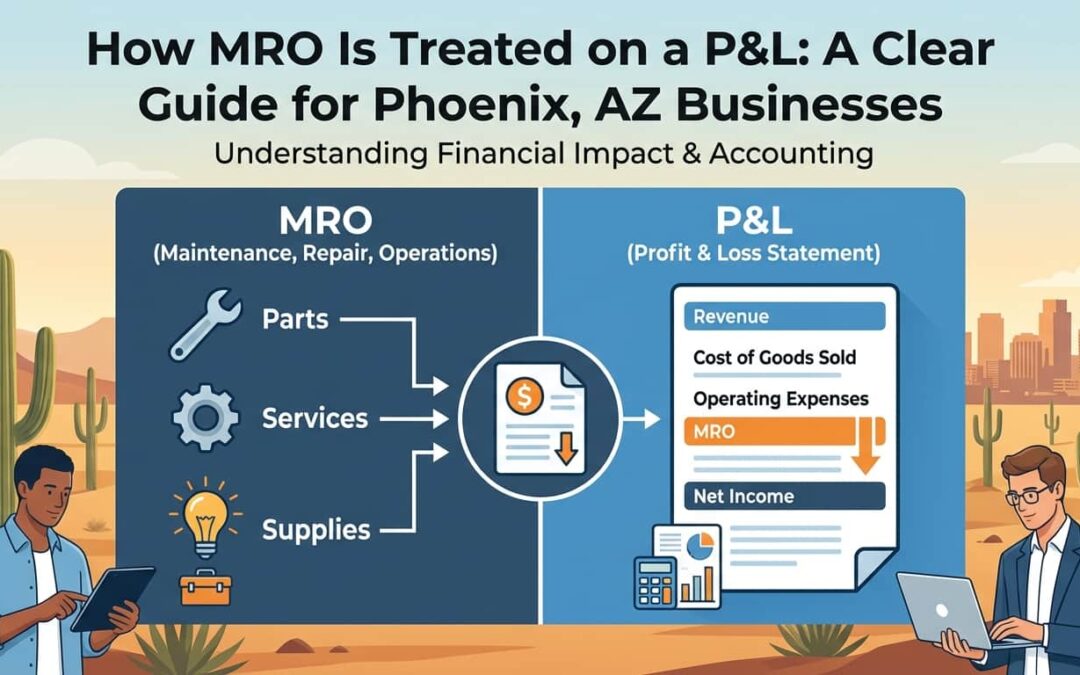
Are your maintenance costs quietly eating your margins? Most Phoenix manufacturers don’t know until it’s too late. MRO — Maintenance, Repair, and Operations — shows up on your P&L in ways that can shift your bottom line fast. Getting the classification right isn’t just good accounting. It’s profit protection.
Misclassify MRO between overhead and COGS, and you’re looking at distorted margins, audit risk, and bad decisions based on wrong numbers. Fix the roof before it rains.
Understanding Profit and Loss (P&L) Statements for Phoenix, AZ Businesses
Think of your P&L as your financial dashboard. It tells you what’s working, what’s bleeding, and where to focus. For Phoenix businesses in aerospace, manufacturing, and industrial supply, that dashboard needs to be accurate — not just close enough.
A P&L statement tracks your financial performance over a set period. It breaks down into a few key components:
- Revenue — total income before any deductions
- Cost of Goods Sold (COGS) — direct costs tied to production
- Gross Profit — revenue minus COGS
- Operating Expenses — overhead, maintenance, admin costs
- Net Income — what’s left after everything
Understanding each line gives you control. Without it, you’re flying blind.
What Is a Profit and Loss Statement Used For?
Your P&L isn’t just for tax season. Finance teams, lenders, and executives use it to:
- Track profitability trends over time
- Set realistic budgets and forecasts
- Identify cost overruns before they spiral
- Support loan applications and investor conversations in Arizona markets
- Make faster, smarter operational decisions
Revenue tells a story. Expenses tell the truth.
Basic P&L Formula
The structure is straightforward:
Revenue – COGS = Gross Profit Gross Profit – Operating Expenses = Operating Income Operating Income – Taxes & Interest = Net Income
When MRO costs shift between COGS and operating expenses, your operating income moves directly. That’s why classification matters more than most finance teams realize.
What the P&L Statement Shows
Your P&L reveals margin trends, expense patterns, and cost inefficiencies. It shows where your money goes — and where it disappears. Think of it as a heat map for your business health.
Want to know if a machine upgrade paid off? Check the P&L. Are labor costs creeping up faster than revenue? The P&L will show it. It’s not just a report. It’s a decision engine.
How MRO Is Recorded on the P&L in Phoenix, AZ Companies
Here’s where most companies get it wrong. MRO expenses don’t belong in one fixed spot on the P&L. Where they land depends on the nature of the expense, your accounting method, and your internal policy.
Get this right, and your EBITDA reflects reality. Get it wrong, and you’re reporting numbers that mislead your team, your lender, and yourself.
Are you confident every MRO line item sits in the right bucket? If you hesitated, keep reading.
Classification as Operating Expenses (OpEx)
Most MRO costs land in operating expenses. Routine maintenance — oil changes, filter replacements, minor repairs — is expensed in the period it’s incurred. It preserves function without extending asset life or improving output.
The key distinction: routine maintenance is OpEx. Extraordinary repairs that extend asset life follow a different path. Misreading this line is one of the most common errors in Phoenix manufacturing accounting.
Impact on Gross Margin vs. Operating Margin
Here’s the analytical split most CFOs care about:
- Gross margin = how efficiently you produce
- Operating margin = how efficiently you run the whole business
MRO tied directly to production belongs in COGS, pulling down gross margin. MRO tied to facilities or administration sits in operating expenses, hitting operating margin instead. Each placement tells a different story to your leadership team.
Gross margin measures production efficiency. Operating margin measures total business health.
The Impact on COGS vs. Overhead
Picture a Phoenix aerospace manufacturer. The lubricant used on the production line? That’s direct. It belongs in COGS. The cleaning supplies for the breakroom? Overhead.
The line isn’t always clean. But the rule is simple: if the MRO item touches the product or production process directly, it leans toward COGS. Everything else lands in overhead. Document your policy and stick to it consistently.
Timing of Recognition (Accrual vs. Cash)
The matching principle matters here. Under accrual accounting, you recognize MRO expenses in the period you use them — not when you pay for them. Under cash accounting, recognition happens at payment.
For Phoenix manufacturers with quarterly MRO contracts or bulk purchasing schedules, accrual timing can significantly affect monthly P&L comparisons. Which method are you using — and does your team know why?
Expensing vs. Capitalization
Not every MRO cost gets expensed immediately. If a repair extends an asset’s useful life or significantly improves its output, it may need to be capitalized and depreciated over time.
Your checklist for capitalization:
- Does it extend the asset’s useful life beyond its original estimate?
- Does it add new capability or meaningfully improve performance?
- Does it meet your company’s materiality threshold?
If the answer is yes to any of these, capitalize it. If not, expense it. A well-documented threshold policy is your best audit defense.
MRO vs. Capital Expenditure (CapEx)
MRO and CapEx sound similar. They’re not.
| MRO | CapEx | |
|---|---|---|
| Purpose | Maintain current function | Create future value |
| P&L Treatment | Expensed in period | Capitalized + depreciated |
| Balance Sheet | No long-term asset created | Asset recorded |
| EBITDA Impact | Reduces operating income | Affects depreciation only |
Misclassifying CapEx as MRO understates your asset base. Misclassifying MRO as CapEx inflates your assets. Both create problems.
Hidden Costs on the P&L
Some MRO costs don’t show up where you’d expect. Are you accounting for all of them?
- Emergency repair premiums — after-hours labor and rush parts cost more and often bypass approval workflows
- Expedited shipping fees — common when inventory isn’t managed proactively
- Downtime labor costs — idle workers during unplanned repairs don’t always hit the MRO line
- Vendor price variance — buying spot instead of contract inflates unit cost
- Storage and obsolescence — overstocked MRO inventory that expires or becomes irrelevant
These costs are real. They erode your margin quietly. Bringing them into clear view is the first step to controlling them.
MRO Inventory Versus Expense Recognition for Phoenix, AZ Businesses
Are you treating maintenance supplies like assets when they’re quietly draining cash? This is a question more Phoenix finance teams need to ask. Not every MRO purchase gets expensed immediately. Some items get stocked as inventory first — and that changes how they appear on your financial statements.
When you buy MRO items in bulk and store them for future use, they may sit on your balance sheet as a current asset. Only when they’re consumed do they flow to the P&L as an expense. Treat them incorrectly, and your operating expenses become noise — not signal.
Inventory vs. Immediate Expense: How to Decide
- Expense immediately if the item is low-value, consumed quickly, and purchased for a specific job
- Record as inventory if the item is purchased in bulk, held for future use, or exceeds your materiality threshold
- Consider your consumption timeline — items expected to last beyond the reporting period typically belong on the balance sheet first
Count what counts before it counts against you.
MRO Inventory as a Current Asset on the Balance Sheet
MRO items qualify as current assets when they meet specific criteria. Use this checklist to guide your classification:
- Frequency of use — items used regularly and replenished predictably
- Expected consumption timeline — will it be used within the operating cycle?
- Materiality threshold — does the value exceed your documented capitalization floor?
If yes, record the purchase as inventory. Expense it as it’s consumed. This approach smooths your P&L and prevents artificial spikes in operating expenses from bulk purchasing.
Document your materiality threshold policy in writing. It’s your first line of defense in an audit.
Accounting Standards That Govern MRO Expense Treatment in Phoenix, AZ
Knowing the rules isn’t optional — it’s how you stay protected. GAAP and IFRS set the framework for how MRO gets classified, recognized, and reported. Following these standards consistently is what separates defensible accounting from guesswork.
Is your MRO policy built on a written standard — or just habit? For Phoenix businesses, the answer to that question has real consequences.
Consistency isn’t just good practice. It’s a GAAP requirement.
Financial Accounting Standards Board (U.S. GAAP)
Under U.S. GAAP, MRO treatment follows clear principles:
- Routine maintenance — expensed as incurred; preserves existing function
- Betterments — capitalized if they add new capability or extend useful life
- Useful life extension — capitalized when the improvement pushes the asset beyond its original timeline
ASC 360 governs how companies evaluate property, plant, and equipment improvements. If your repair falls under betterment or extension criteria defined there, capitalize it. Otherwise, expense it in the current period.
Maintenance preserves value. Improvements create value. The accounting follows the same logic.
International Accounting Standards Board (IAS 2 & IAS 16)
For Phoenix companies with global operations or multinational reporting requirements, IFRS applies a parallel framework:
- IAS 2 governs inventory accounting — relevant when MRO items are stocked as current assets
- IAS 16 covers property, plant, and equipment — relevant when MRO costs meet capitalization criteria
Under IFRS, the core test is whether the expenditure generates probable future economic benefit beyond the current period. If it does, capitalize it. If not, expense it.
Are your IFRS policies documented in a way that would survive a cross-border audit?
Professional Guidance on MRO Accounting in Phoenix, AZ
The Big Four accounting firms have published extensive guidance on MRO treatment. Their frameworks reflect industry consensus — not opinion. Understanding their positions helps Phoenix finance teams align internal policies with global best practices.
Strong accounting isn’t just about compliance. It’s about clarity that drives better decisions.
Deloitte
Deloitte’s accounting guidance emphasizes consistent capitalization policy documentation. Their published alerts highlight the risk of applying different thresholds to similar assets — a common issue in multi-site Phoenix manufacturing operations. Their framework reinforces the need for written materiality policies reviewed annually.
PwC
PwC’s financial reporting insights focus on the distinction between maintenance and betterment. Their guidance is particularly useful for Phoenix aerospace companies managing high-value equipment. PwC stresses that judgment under GAAP must be applied consistently across reporting periods to avoid restatement risk.
EY
EY’s audit framework places significant weight on how MRO inventory flows between the balance sheet and the income statement. Their guidance supports a structured review of storeroom inventory against materiality thresholds — especially relevant for manufacturers with large MRO parts inventories in Phoenix facilities.
KPMG
KPMG’s GAAP interpretation publications provide detailed examples of expense versus capitalization decisions for industrial assets. Their guidance on useful life analysis is particularly relevant when evaluating whether a major repair qualifies for capitalization under ASC 360.
Financial Systems for Tracking MRO Expenses in Phoenix, AZ
Your ERP becomes your financial radar. Without the right system, MRO expenses get misclassified, duplicated, or missed entirely. The right platform connects purchasing, inventory, and finance — so every MRO transaction flows to the correct P&L line automatically.
Does your current system catch misclassifications before they hit your financial statements?
Oracle NetSuite
NetSuite offers real-time MRO expense tracking linked directly to your chart of accounts. Key features include:
- Automated expense categorization by department or cost center
- Inventory module integration for current asset recognition
- Built-in audit trails for capitalization decisions
Business outcome: Finance teams reduce manual reclassification errors and close the books faster.
SAP
SAP’s cost allocation framework is built for complex manufacturing environments. It handles:
- Plant maintenance module integration with financial accounting
- Automated COGS versus overhead cost splits
- Multi-site MRO expense consolidation
Business outcome: Phoenix manufacturers with multiple facilities gain consistent classification across all locations.
Microsoft Dynamics 365
Dynamics 365 connects purchasing workflows directly to the finance module. Benefits include:
- Purchase order approval tied to expense category rules
- Real-time P&L visibility for MRO spend
- Integration with existing Microsoft Office environments
Business outcome: Mid-sized Phoenix businesses get enterprise-level accuracy without enterprise-level complexity.
Odoo
Odoo provides open-source flexibility for growing Phoenix businesses. It supports:
- Inventory accounting with consumption-based expense recognition
- Customizable MRO cost categories
- Integration with purchasing and vendor management
Business outcome: Small manufacturers gain structured MRO tracking without the cost of legacy ERP systems.
Educational Resources on MRO Financial Treatment for Phoenix, AZ Professionals
Even experienced finance leaders revisit the basics when margins tighten. Staying sharp on MRO accounting isn’t a sign of weakness. It’s what separates reactive teams from strategic ones.
The best financial leaders don’t just know the rules. They know where to look when the rules get complicated.
Investopedia
Investopedia provides clear, accessible definitions for MRO accounting concepts — from operating expense classification to income statement structure. It’s the fastest way to align your team on terminology before deeper policy work begins. Use Investopedia definitions to simplify complex accounting discussions at the board level without losing precision.
AccountingTools
AccountingTools goes deeper than definitions. It offers practical examples, journal entry references, and scenario-based guidance for expense recognition and inventory capitalization. For Phoenix finance teams working through edge cases, this resource provides the technical specificity that general glossaries don’t.
Corporate Finance Institute
CFI’s financial modeling curriculum bridges the gap between accounting classification and business impact. Their training connects MRO expense treatment directly to EBITDA modeling and margin analysis. Want to see how a reclassification affects your valuation? CFI’s tools make that scenario visible and actionable.
Academic References on Expense Versus Capitalization in Phoenix, AZ
The textbooks that built modern accounting still matter. Academic frameworks support audit defense when your classification decisions are challenged. Theory and practice reinforce each other here.
Knowledge preserves policy. Policy protects margins.
Intermediate Accounting
Intermediate Accounting (Kieso, Weygandt, Warfield) covers asset improvement versus maintenance rules in detail. The useful life extension test outlined in this text is directly applicable to MRO capitalization decisions. Maintenance keeps an asset running. Betterment makes it run better — and that distinction drives the accounting.
Financial Accounting
Core financial accounting textbooks tie MRO classification directly to income statement fundamentals. The matching principle — recognizing expenses in the period they generate revenue — is the theoretical backbone of MRO expense timing. These texts reinforce why accrual-based recognition matters for Phoenix manufacturers managing monthly P&L performance.
Accounting Principles
Accounting principles texts reinforce the GAAP conceptual framework underlying every classification decision. The consistency principle — applying the same accounting treatment period to period — is especially relevant for MRO policies. Changing treatment without documented justification creates audit exposure.
Operations Management
Operations management literature bridges the gap between maintenance strategy and financial outcomes. Preventive maintenance programs reduce emergency repair costs and P&L volatility. Linking your MRO accounting policy to your operational maintenance strategy gives Phoenix businesses a competitive edge that shows up in the numbers.
Financial Regulation and Policy Perspectives on MRO Accounting in Phoenix, AZ
Regulatory scrutiny on capitalization decisions is real — and growing. For public companies and audit-ready private firms, how you classify MRO isn’t just an accounting choice. It’s a compliance decision.
Are your MRO classifications defensible under regulatory review?
Accuracy isn’t optional. Misclassification isn’t just an accounting error — it’s a disclosure risk.
Securities and Exchange Commission
The SEC expects public companies to apply consistent, documented expense classification policies. Material misstatements tied to improper capitalization of MRO costs have triggered restatements and enforcement actions. Phoenix companies planning public offerings or seeking institutional investment should treat MRO policy documentation as a pre-audit priority.
Congressional Research Service
The Congressional Research Service produces macro-level policy analysis that informs federal accounting oversight priorities. For Phoenix businesses tracking regulatory trends, CRS reports provide useful framing around expense recognition and capitalization policy debates at the federal level.
Core Accounting Knowledge Sources for Phoenix, AZ Businesses
Strong MRO accounting doesn’t happen by accident. It’s built on documented policies, consistent application, and teams that know what they’re doing. These foundational resources help Phoenix businesses build that foundation.
Document your policies before you need to defend them.
General Accounting Principles
GAAP fundamentals underpin every MRO classification decision. The consistency principle, the matching principle, and the materiality framework all apply. Phoenix businesses that document their GAAP-based policies — and review them annually — reduce misclassification risk and improve audit readiness.
Inventory Management Insights
MRO inventory management directly affects expense timing. Reorder point systems, par-level controls, and consumption tracking tools help finance teams match physical usage to expense recognition. Does your inventory system talk to your accounting system? If not, your P&L is missing real-time accuracy.
Industry Standard Whitepapers
Manufacturing and industrial associations publish whitepapers on MRO cost benchmarking, classification best practices, and ERP integration strategies. Reviewing peer benchmarking data helps Phoenix businesses identify whether their MRO cost structure is competitive — or quietly above industry norms.
Accurate MRO Accounting Protects Profit and Financial Clarity
MRO expenses may look small individually, but together they shape your margins, financial accuracy, and long-term profitability. For Phoenix manufacturers, industrial companies, and asset-heavy businesses, the way MRO is classified on the profit and loss statement directly impacts gross margin, operating income, and EBITDA.
When MRO is classified correctly, your P&L becomes a reliable decision-making tool. Leadership can trust the numbers. Finance teams can forecast accurately. Audits become smoother. Most importantly, you protect your margins from hidden erosion caused by misclassification, inventory mismanagement, or inconsistent accounting policies.
When it’s classified incorrectly, the consequences compound. Margins appear stronger or weaker than reality. Capital investments get misrepresented. Financial decisions are based on distorted data.
The solution is clear:
Document your accounting policies
Apply GAAP standards consistently
Track MRO inventory accurately
Separate maintenance from capital improvements
Review classification regularly
Financial clarity is not just accounting compliance. It is operational control.
For Phoenix businesses managing valuable equipment, electronics, and industrial assets, proper financial tracking and responsible asset disposition work together to protect both your balance sheet and your bottom line.
Call-to-Action Section (Jay Hohel Inc – Optimized for Leads)
Protect Your Business Assets and Financial Performance Today
If your Phoenix business is upgrading equipment, disposing of old electronics, or managing end-of-life IT assets, working with a trusted partner ensures both financial accuracy and data security.
Jay Hohel Inc helps Phoenix businesses responsibly manage, recycle, and dispose of electronic assets while supporting compliance, sustainability, and operational efficiency.
Whether you need electronics recycling, asset disposal, or guidance on handling outdated equipment, our team is ready to help.
📍 Jay Hohel Inc
3334 W McDowell Rd Unit 17
Phoenix, AZ 85009-2414
📞 (602) 272-4033
📧 JayHoehlinc@gmail.com
🌐 https://jhiescrap.com/
GET A FREE ELECTRONICS RECYCLING QUOTE
Request a Free Consultation