
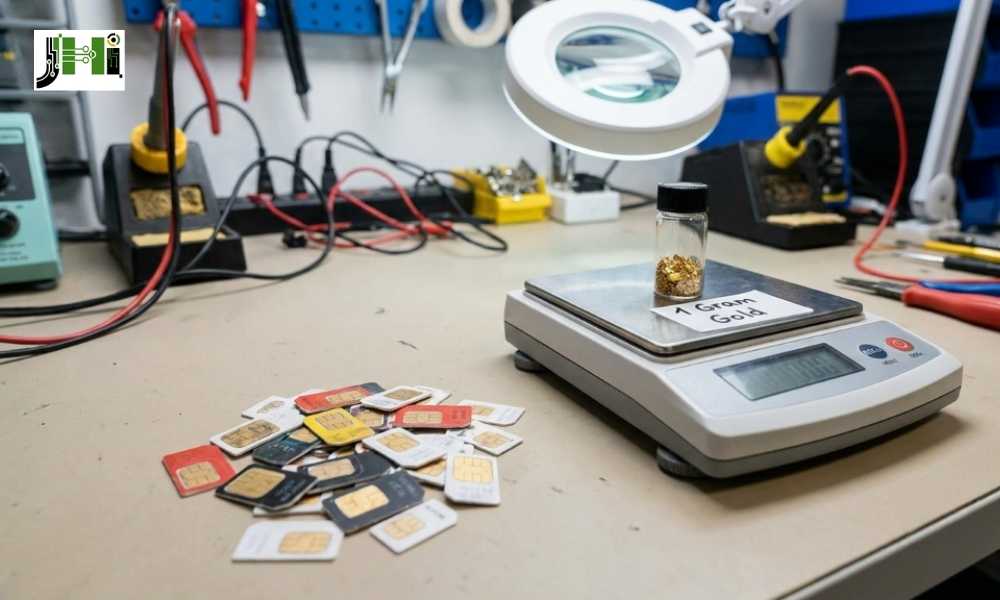
How Many SIM Cards Make 1 Gram of Gold?
You probably saw that viral video. Someone melts a pile of SIM cards. Shiny gold flakes appear like magic. The comments explode with “I’m collecting mine now!”
But here’s the truth most creators won’t tell you. The real number of SIM cards needed for 1 gram of gold is way higher than you think. And the math? It’s almost depressing.
So let’s break it down with real data. No hype. No clickbait. Just the honest answer most people never get.
Quick Answer: How Many SIM Cards Are Needed for 1 Gram of Gold?
You’ll need roughly 10,000 to 50,000 SIM cards to recover just 1 gram of gold.
Yes, you read that right. Tens of thousands. Not hundreds.
The exact number depends on a few key factors:
- SIM card age (older cards often hold more gold)
- Manufacturer plating thickness
- Card type (nano, micro, or standard)
- Recovery method efficiency
Most professional refiners estimate one modern SIM card contains about 0.02 to 0.1 milligrams of gold. So if you do the math, the numbers get massive fast.
Honestly, this shocks most people. They expect a few hundred cards to do the trick. Reality has other plans.
The Most Realistic Estimate
For everyday consumer SIM cards, plan for around 20,000 to 30,000 cards per gram. That’s the sweet spot most realistic estimates land on.
Modern manufacturers cut corners on precious metals. Why? To save costs. So newer SIM cards carry less gold than telecom hardware from the 1990s.
The gold layer is real. But it’s closer to dust on a mirror than treasure in a vault.
Simple Calculation
Here’s the basic formula. It’s easier than you’d guess.
Step 1: Convert milligrams to grams. 1 gram = 1,000 milligrams.
Step 2: Divide 1,000 by the gold per card.
Step 3: That’s your SIM card count.
Example: 1,000 mg ÷ 0.05 mg per card = 20,000 SIM cards.
Tiny numbers add up fast. But not fast enough to make this profitable.
Why the Number Can Vary
No single number works for every SIM card. Here’s why.
- Older SIM cards may contain thicker gold plating
- Newer cards use minimal gold to cut costs
- Damaged or burnt cards lose recoverable gold
- Refining losses cut yield by 10–30%
Even industrial refiners rarely hit 100% recovery. So real-world numbers always run higher than theoretical estimates. Anyone promising exact figures is probably guessing.
Is There Really Gold in SIM Cards?
Yes. The gold in SIM cards is real. Not paint. Not coating dye. Actual gold.
But it’s not solid gold. Not even close.
Most people assume the shiny color is fake. It’s actually a microscopic layer of real gold pressed onto metal contacts. Manufacturers use it because gold beats nearly every other metal at one job: staying conductive.
Why Gold Is Used in SIM Cards
Gold doesn’t rust. It doesn’t tarnish. It doesn’t break down over years of use.
That matters for SIM cards. Every time you slide one into a phone, the contacts touch metal pins. Without gold, those contacts would corrode fast. Your phone would lose signal, drop calls, or fail to read the card.
Gold acts like a clean highway for electronic signals. Even after years sitting in a drawer, the contacts still work.
Where the Gold Is Found on a SIM Card
Look at any SIM card. See those small metallic squares on one side?
That’s it. That’s the only place gold lives.
The gold sits as a microscopic plating layer over a base metal like copper or nickel. It’s thinner than a strand of hair. Most of the SIM card is just plastic and silicon.
So when you “see” gold, you’re really seeing a flash-thin coating. Not a chunk of metal.
Gold-Plated Contacts vs Solid Gold
This trips up almost everyone. Let’s clear it up fast.
| Feature | Gold-Plated Contacts | Solid Gold |
|---|---|---|
| Thickness | Microns (0.001 mm) | Several mm |
| Purpose | Conductivity | Value/jewelry |
| Total weight | Micrograms | Grams |
| Recoverable value | Very low | Very high |
Real gold? Yes. Solid gold? Absolutely not.
Electronics use just enough gold to do the job. Adding more would waste money. So manufacturers measure plating in microns, not millimeters.
How Much Gold Is in One SIM Card?
Here’s where reality hits hard. One single SIM card holds about 0.02 to 0.1 milligrams of gold.
That’s not a typo. Milligrams. Not grams. Milligrams.
To put it in perspective, a single grain of rice weighs around 30 milligrams. So one SIM card carries roughly 1/300th of a rice grain in gold. The visible shine fools your eyes. The actual weight is tiny beyond belief.
Professional refiners don’t even bother weighing individual cards. They process bulk telecom waste by the kilogram. That’s the only scale that makes sense for this kind of recovery.
Average Gold Content in a Modern SIM Card
Most modern SIM cards land somewhere around 0.02 to 0.05 milligrams of gold.
That’s the realistic average. Manufacturers minimize gold use to keep production cheap. Each gram of gold costs over $100 on the market. So shaving even tiny amounts saves real money at scale.
Think of the gold layer like a fingerprint coating. Present, functional, but barely there.
Gold Content in Nano-SIM, Micro-SIM, and Standard SIM Cards
Different SIM card sizes carry slightly different gold amounts. But the differences are smaller than you’d think.
| SIM Type | Approx. Size | Estimated Gold | Recovery Value |
|---|---|---|---|
| Standard SIM | 25 × 15 mm | 0.05–0.10 mg | Very low |
| Micro SIM | 15 × 12 mm | 0.03–0.07 mg | Very low |
| Nano SIM | 12.3 × 8.8 mm | 0.02–0.05 mg | Very low |
Bigger SIM cards have more contact area. But the gold layer thickness stays similar. So the differences in actual recovery value are minor.
The plastic shrinks. The gold roughly stays the same.
Why Older SIM Cards May Contain More Gold
Old telecom hardware often holds more gold per piece. Here’s why.
Decades ago, manufacturing standards were different:
- Lower precious metal prices allowed thicker plating
- Durability mattered more than miniaturization
- Industrial telecom cards used heavy gold contacts
- Cost-cutting wasn’t as aggressive as today
They don’t make them like they used to. Vintage telecom equipment from the 1980s and 1990s sometimes carries triple the gold content of modern SIM cards. But finding bulk quantities of those old cards is nearly impossible now.
SIM Card Gold Calculation: From Milligrams to 1 Gram
Let’s get into the actual math. This is where most viral claims fall apart.
The numbers feel meaningless at first. Tiny fractions of gold per card. But multiply those fractions thousands of times. Suddenly you understand why no one runs SIM-card-only recovery operations.
But the math changes dramatically depending on the SIM card type. So let’s walk through two examples.
Formula to Calculate SIM Cards Needed
Here’s the simple formula. Use it for any electronic component.
Step 1: Know your gold per card (in mg) Step 2: Convert 1 gram = 1,000 milligrams Step 3: Divide 1,000 by your per-card gold value Step 4: Result = SIM cards needed
Simple formula. Tiny numbers. Massive quantities.
Example: If One SIM Card Has 0.02 mg of Gold
This is the low-yield scenario. Common with modern consumer SIM cards.
Math: 1,000 mg ÷ 0.02 mg = 50,000 SIM cards
Yes, fifty thousand cards. For one single gram of gold worth roughly $80 to $100 at market rates.
And that’s before extraction losses. Real recovery would lose 10–30% of that gold to chemical inefficiency. So you’d actually need more cards to net 1 full gram.
So… would collecting tens of thousands of SIM cards really be worth it?
Example: If One SIM Card Has 0.1 mg of Gold
This is the high-yield scenario. Possible with older industrial SIM cards.
Math: 1,000 mg ÷ 0.1 mg = 10,000 SIM cards
Better, right? Still not great.
You’d need 10,000 cards. That’s a small storage unit packed with SIM cards. For one gram of gold. Higher gold content sounds impressive. Until you realize you still need thousands of SIM cards just for one gram.
Why Viral SIM Card Gold Videos Are Misleading
You probably watched someone melt a pile of SIM cards and pour shiny gold flakes into a dish. The video racked up millions of views. The comments were full of “I’m starting today!”
But what the camera doesn’t show matters more than what it does.
Most viral gold extraction videos secretly mix in other electronic scrap. Circuit boards. CPU pins. Connectors. Telecom waste. All of those carry far more gold per gram than SIM cards alone. The SIM cards are just for show.
If SIM cards were truly profitable gold mines, would recyclers throw millions of them away? They wouldn’t. The math doesn’t work.
The Viral 191-Gram Gold Extraction Story
You may have seen the video. Someone claims to have recovered 191 grams of gold from a stash of old SIM cards. The video went viral across TikTok and YouTube.
Let’s fact-check it.
- 191 grams = roughly 4–6 million SIM cards at average yield
- No proof of starting material was ever shown
- Recovery process took weeks but appeared as quick cuts
- Other electronic scrap was visible in some frames
Big claims attract views. Small details expose the truth. That video almost certainly used mixed e-waste, not SIM cards alone.
SIM Cards vs Mixed Electronic Waste
Not all e-waste is equal. Some scrap holds way more gold than SIM cards.
| Component | Gold per kg | Recovery Value |
|---|---|---|
| SIM cards | 0.02–0.5 g | Very low |
| Old CPU pins | 100–300 g | Very high |
| Circuit boards | 0.2–2 g | Low–medium |
| Telecom connectors | 5–50 g | Medium–high |
CPUs and industrial connectors crush SIM cards in gold density. Comparing SIM cards to industrial e-waste is like comparing loose change to a treasure chest.
That’s why professional refiners always work with mixed scrap. SIM cards alone simply don’t pay.
Why Social Media Claims Exaggerate the Value
Viral videos exist for one reason. Engagement.
Creators inflate gold recovery claims because:
- Bigger numbers = more clicks
- Dramatic visuals beat boring math
- Quick edits hide weeks of failed attempts
- Sponsored gear sales drive incentives
It looks profitable on screen because creators rarely show the time, chemicals, failures, or costs behind the process. The actual hours of dangerous chemical work get cut. The failures end up on the editing floor.
What you see is the highlight reel. Not the reality.
Is Extracting Gold from SIM Cards Profitable?
Short answer? No. Not for individuals.
Long answer? Only at industrial scale, and only with mixed e-waste streams. Solo SIM card recovery is one of the worst uses of your time and money in the recycling world.
Would you spend hundreds of dollars on chemicals to recover a few dollars of gold? That’s basically the trade.
High effort. High risk. Extremely low reward.
Why It Is Not Profitable for Individuals
The economics fall apart fast for hobbyists. Here’s why.
- You’d need 10,000+ SIM cards just to start
- Most people own 5–10 old cards at most
- Buying bulk SIM cards costs more than the gold recovered
- Time investment runs into hundreds of hours
- Equipment costs can exceed gold value
The idea sounds exciting at first. The math becomes much less exciting.
Even if you somehow collected 20,000 SIM cards for free, you’d still need expensive chemicals and weeks of work to extract maybe $80 worth of gold. Not exactly a get-rich plan.
Collection, Chemical, and Processing Costs
Here’s what most viral videos hide. The hidden costs.
| Expense | Estimated Cost |
|---|---|
| Nitric acid (1L) | $30–$60 |
| Hydrochloric acid (1L) | $20–$40 |
| Safety equipment | $100–$300 |
| Filtering supplies | $30–$80 |
| Waste disposal fees | $50–$200 |
Cheap SIM cards. Expensive chemicals. Dangerous process.
Waste disposal alone can wipe out your gold profit. Toxic chemical waste isn’t legal to pour down a drain. Proper disposal costs real money.
When Gold Recovery Becomes Profitable
Gold recovery only makes financial sense at industrial scale. Here’s when it works.
Professional refiners process tons of mixed e-waste at once. They recover multiple metals together:
- Gold from contacts and pins
- Silver from solder and plating
- Copper from wires and boards
- Palladium from capacitors
The combined value pays for the operation. Industrial recyclers win through mountains of material, not handfuls of SIM cards. They also use automated extraction systems that handle chemicals safely at volume.
That’s a different business entirely from DIY recovery.
Is It Safe to Extract Gold from SIM Cards at Home?
Short answer? Absolutely not.
Long answer? The chemicals used in gold recovery rank among the most dangerous substances a hobbyist can handle. We’re talking about acids that burn skin, release toxic fumes, and contaminate everything they touch.
YouTube videos make the process look simple. Real chemical exposure is anything but simple.
Tiny gold amounts. Massive chemical risks. Very poor tradeoff.
Better safe than sorry isn’t just a saying here. It’s life-saving advice.
Dangerous Chemicals Used in Gold Recovery
Most extraction methods rely on these chemicals:
- Nitric acid – burns skin and releases toxic vapors
- Hydrochloric acid – causes severe respiratory damage
- Aqua regia – a nitric and hydrochloric acid mix that releases nitrogen oxide gases
- Sodium metabisulfite – used to drop gold from solution
Aqua regia can release toxic nitrogen oxide gases that become extremely dangerous indoors. These fumes attack lung tissue. They can cause permanent damage in minutes.
Some extraction chemicals are less like cleaning products and more like industrial weapons against metal. They eat through skin, fabric, and even some metals.
Health and Environmental Risks
The dangers don’t stop at burns and fumes. Improper extraction harms the environment too.
Common health risks include:
- Chemical burns on skin and eyes
- Inhalation injuries from acid fumes
- Long-term respiratory damage
- Heavy metal poisoning from contaminated waste
Environmental damage runs even deeper. Improper acid disposal can contaminate drains, soil, and groundwater systems. One careless pour can poison a water supply for years.
Most people think about the gold. Very few think about the fumes left floating in the air afterward.
This is why every safety expert recommends professional recycling. The risks just don’t justify the reward.
Why Professional E-Waste Recycling Is Safer
Certified recyclers handle this work the right way. Here’s what they offer that DIY can’t.
- Proper ventilation systems
- Chemical neutralization equipment
- Trained technicians
- Regulated waste disposal
- Multi-metal recovery for better economics
For Phoenix AZ residents, several certified e-waste recycling centers accept old SIM cards safely. They follow EPA guidelines. They protect workers and the environment.
Professional equipment. Proper ventilation. Regulated disposal. Safer results.
You get peace of mind. The planet gets responsible recycling. Everyone wins.
What Should You Do With Old SIM Cards?
If SIM cards are not worth saving for gold, why keep drawers full of them?
Almost everyone has an old SIM card hiding somewhere in a desk drawer. They feel important. They might still have your contacts. So they sit. For years.
Here’s what to actually do with them.
Destroy Personal Data Before Disposal
Before tossing any SIM card, protect your data. Old SIM cards may still hold:
- Contact lists
- Saved text messages
- Network identifiers
- Sometimes, account credentials
Follow these steps to secure your info:
- Delete contacts using a phone or SIM tool
- Cut the chip area with scissors
- Break the gold contact strip in half
- Dispose of the pieces separately
Cutting the chip physically is often safer than simply deleting contacts. Software deletion isn’t always permanent.
Small card. Big privacy risk.
Use Certified E-Waste Recycling Centers
After destroying your data, drop the pieces at a certified e-waste recycling center. Phoenix AZ has several options that accept SIM cards as part of broader electronics streams.
Why certified centers matter:
- They separate materials safely
- They follow environmental regulations
- They prevent landfill contamination
- They recover usable materials properly
Waste not, want not. Certified recyclers turn your old SIM cards into something useful. Even if it’s not pure gold.
Why You Should Not Save SIM Cards for Gold
Let’s make this crystal clear. Don’t hoard SIM cards hoping for a future payday.
Saving SIM cards for gold is like collecting raindrops to fill a swimming pool. You’d need decades of saving just to break even on chemicals.
Practical reasons to skip the gold dream:
- Storage takes up real space
- Recovery requires industrial scale
- DIY extraction is dangerous and illegal in some areas
- Recycling delivers more value, faster
Your time and energy are worth more than the microscopic gold inside a stack of plastic cards. Recycle them. Move on.
Final Answer: How Many SIM Cards Make 1 Gram of Gold?
Yes, SIM cards contain gold. No, they are not a hidden treasure.
You’ll need somewhere between 10,000 and 50,000 SIM cards to recover 1 gram of gold. Most modern cards land closer to the 20,000–30,000 range. The math is brutal. The economy is worse.
Most people expect a shortcut to easy gold. The real value is understanding how electronic recycling actually works. All that glitters is not gold. Especially not the tiny shimmer on a SIM card contact.
Short Answer
You need roughly 20,000 to 30,000 modern SIM cards to recover 1 gram of gold. Older industrial cards may need fewer. Damaged or burnt cards may need many more.
Tens of thousands of SIM cards. Tiny amounts of gold. Very little profit.
Practical Answer
Don’t try to recover gold from SIM cards at home. The risks outweigh the rewards every single time.
Instead:
- Destroy personal data with scissors
- Drop cards at certified recyclers
- Skip viral DIY tutorials
- Trust the bulk recycling system
The smartest move is usually recycling the SIM card, not chasing the gold inside it. You save time, money, and your health.
Bottom Line
SIM cards contain real gold. But not enough to matter for individuals.
Industrial recyclers handle the bulk work safely and profitably. Your job is simpler. Destroy the data, drop the card at a certified recycler, and move on with your day.
SIM cards are better recycled as electronic waste than mined like tiny gold nuggets.
Frequently Asked Questions
How much gold is in one SIM card?
One modern SIM card contains about 0.02 to 0.1 milligrams of gold. That’s roughly 1/300th the weight of a grain of rice. Older SIM cards may carry slightly more due to thicker plating standards from past decades. The gold amount is closer to dust than jewelry.
How many SIM cards are needed for 1 gram of gold?
You need roughly 10,000 to 50,000 SIM cards to recover 1 gram of gold. Most modern consumer SIM cards land in the 20,000–30,000 range. The exact count varies based on card age, manufacturer, and recovery efficiency. Tiny gold content. Massive SIM card quantities.
Can I extract gold from SIM cards at home?
Technically yes, but it’s extremely dangerous and not recommended. The chemicals involved (nitric acid, hydrochloric acid, aqua regia) cause severe burns and release toxic fumes. Recovery yields are tiny compared to the risks. It may look easy online. It becomes much riskier in real life. Use a certified e-waste recycler instead.
Are SIM cards made of real gold?
Yes, SIM cards contain real gold as a thin plating layer over the metal contacts. But they’re not made of solid gold. The plating is microscopic, often just a few microns thick, designed for conductivity not value. Real gold plating. Very unreal expectations.
Is SIM card gold recovery worth it?
For individuals, no. The cost of chemicals, equipment, and time vastly exceeds the value of recovered gold. Industrial refiners only profit through bulk processing of mixed e-waste. Would most professionals ignore easy money if SIM cards were truly profitable? They wouldn’t.
Why do SIM cards have gold contacts?
Gold resists corrosion better than nearly any other metal. SIM card contacts touch metal pins thousands of times during normal use. Without gold plating, those contacts would tarnish, lose conductivity, and fail. Gold works like a clean bridge for electronic signals. Even after years in storage, the contacts stay reliable.
Recycle Your Old SIM Cards the Smart Way With Jay Hoehl Inc.
So now you know the truth. SIM cards hold real gold. But not enough to chase at home.
The smartest move? Recycle your old SIM cards safely with certified e-waste experts. That’s where we come in.
At Jay Hoehl Inc., we’ve helped Phoenix residents and businesses recycle electronics responsibly for years. We handle SIM cards, circuit boards, telecom scrap, and more. No risky chemicals. No backyard experiments. Just safe, certified, eco-friendly recycling.
Why choose Jay Hoehl Inc.?
- Certified e-waste recycling in Phoenix, AZ
- Secure data destruction for SIM cards and devices
- Bulk pickup options for businesses
- Honest, fair scrap evaluations
- Trusted local team with decades of experience
Stop hoarding old SIM cards in drawers. Stop watching viral videos that exaggerate the truth. Start recycling the safe, smart, and profitable way.
Visit us at: 📍 3334 W McDowell Rd Unit 17, Phoenix, AZ 85009-2414 📞 (602) 272-4033 📧 JayHoehlinc@gmail.com 🌐 jhiescrap.com