
Are you controlling your inventory – or is it controlling your cash flow?
In Phoenix, AZ, that question hits harder than most. Summer heat spikes demand. Seasonal shifts catch businesses off guard. And the wrong method can drain your working capital fast.
The right inventory management method keeps products moving, costs low, and customers happy. The wrong one leaves you buried in overstock or scrambling to reorder.
This guide breaks down every major inventory management method and model. You’ll learn which ones fit your operation, how the math behind them works, and what software supports them in the Phoenix market.
Better decisions start here.
Understanding Inventory Management Methods for Phoenix, AZ Businesses
Inventory works like desert water. Store too little and you run dry. Store too much and costs drown your margins.
Phoenix businesses face unique pressure. Heat-sensitive goods need faster turnover. Monsoon season reshuffles demand patterns. Storage costs in the Valley keep climbing. These aren’t generic challenges – they’re local ones.
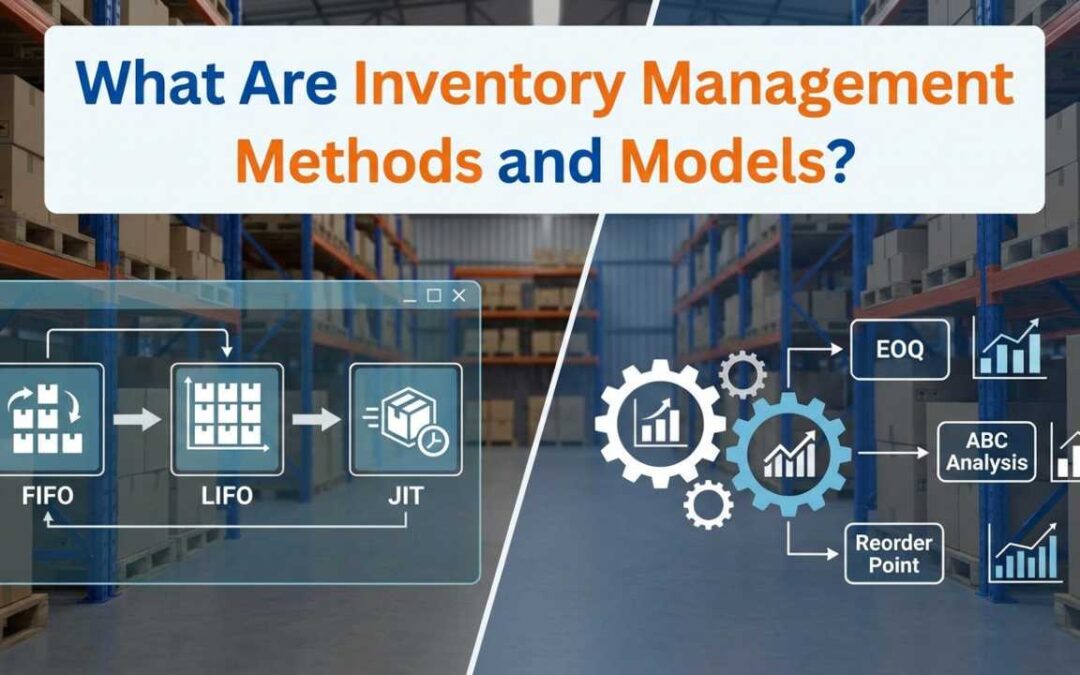
Inventory management methods are the frameworks you use to decide what to order, how much to hold, and when to restock. Each method fits a different business model. A Phoenix restaurant chain manages perishables differently than a Scottsdale electronics distributor.
The goal is the same, though: reduce costly stockouts, cut unnecessary carrying costs, and keep cash moving. Understanding which method aligns with your operation is the first step toward operational control.
Let’s break down the most widely used methods – and what each one can do for your Phoenix business.
Just-in-Time (JIT)
Just-in-Time is a lean inventory model. You order stock only when you need it. No excess sitting on shelves. No capital locked up in slow-moving goods.
JIT works best when your suppliers are fast and reliable. For Phoenix businesses near major distribution hubs, this can be a powerful strategy.
Key benefits of JIT:
- Reduces warehousing costs and overhead
- Frees up cash flow for other operations
- Keeps inventory fresh and relevant to current demand
| Expert Tip: JIT creates risk during supply chain disruptions. Build backup supplier relationships before committing to this model fully. |
Lean operations win on efficiency. But a single disrupted shipment can shut down production. Plan for it.
Just-in-Time Management (JIT)
JIT as a management strategy goes beyond ordering. It’s a demand-driven inventory model built on precision timing and supplier coordination.
The process works like this: customer demand triggers a production or purchase order. That order goes to a supplier with tight delivery windows. Goods arrive just as they’re needed – not weeks before.
A Phoenix auto parts manufacturer, for example, might use JIT to align component deliveries with daily assembly schedules. Precision replaces guesswork.
Are your suppliers reliable enough to support a JIT strategy? That’s the key question before committing.
| Expert Tip: Supplier reliability is everything in JIT. Vet lead times carefully. Set clear SLAs before going live. |
ABC Analysis
ABC analysis helps you prioritize your inventory by value. Not every product deserves equal attention. This method sorts your stock into three categories.
A items: High-value, low-volume. These need tight control and frequent review.
B items: Mid-range value and volume. Moderate attention required.
C items: Low-value, high-volume. Manage in bulk with lighter oversight.
A Phoenix wholesale distributor might find that 10% of their SKUs drive 70% of revenue. Those are your A items. Protect them.
Don’t dig a well when you’re already thirsty. Run your ABC analysis before a stockout crisis forces your hand.
| Expert Tip: Run a quarterly ABC review. Product demand shifts seasonally in Arizona. Your categories should shift with it. |
FIFO (First In, First Out)
FIFO means the oldest stock ships first. Think of it like a grocery shelf – new products go to the back. Customers grab from the front.
For Phoenix food distributors, restaurants, and pharmaceutical companies, FIFO isn’t just smart – it’s essential. Expiration dates and safety regulations depend on it.
In financial terms, FIFO also matches older, lower-cost inventory against current revenues. In a rising cost environment, that can mean higher reported profits.
| Expert Tip: FIFO is the gold standard for perishable goods and heat-sensitive inventory. Phoenix’s heat makes proper stock rotation even more critical. |
LIFO (Last In, First Out)
LIFO moves the newest inventory first. It’s less common in physical operations but widely used for accounting and tax planning.
FIFO reports higher profits in inflation. LIFO reports lower taxable income – which is why many U.S. businesses prefer it during inflationary periods.
When input costs are rising, LIFO matches recent higher-cost inventory against current revenues. That reduces your gross profit and your tax liability.
Note: LIFO is not permitted under IFRS. It’s a U.S.-only strategy. If you operate internationally, FIFO is your only option.
| Expert Tip: Consult a CPA before choosing LIFO. The tax benefits can be significant, but the method adds accounting complexity. |
Dropshipping
What if you could sell products without ever touching them?
Dropshipping is an asset-light model where you sell goods your supplier ships directly to the customer. You never hold inventory. You never manage a warehouse.
Pros:
- Zero warehouse costs
- Low startup risk
- Wide product range without capital investment
Cons:
- Thin margins compared to holding your own stock
- Less control over shipping times and quality
- High competition in popular product categories
Phoenix e-commerce businesses love dropshipping for testing new product lines. It’s low risk, but margin discipline is non-negotiable.
| Expert Tip: Dropshipping works best as a complement to owned inventory – not a replacement for it. |
Vendor-Managed Inventory (VMI)
In VMI, your supplier manages your stock levels for you. They monitor your inventory data, forecast demand, and replenish automatically.
This works through data sharing. You give your supplier visibility into your sales and stock levels. They take responsibility for keeping shelves stocked.
A Phoenix hardware retailer partnered with a major supplier on VMI saw a 20% reduction in stockouts within six months. The supplier knew the inventory better than the retailer did.
Does your supplier have the data tools to support VMI? That’s the trust factor to verify first.
| Expert Tip: VMI only works when data flows freely. Invest in the integration before launching the partnership. |
Periodic Inventory Method
The periodic method tracks inventory on a schedule – weekly, monthly, or quarterly. You count stock at set intervals and update your records.
How it works:
- Set a review schedule (weekly or monthly)
- Count all inventory at each interval
- Update records and calculate cost of goods sold
- Place reorders based on what’s depleted
Waiting too long between reviews is like checking your bank balance after vacation – not ideal. Small businesses often start here, but most outgrow it quickly.
| Expert Tip: Once your SKU count exceeds 50 products, switch to inventory management software. Manual counting doesn’t scale. |
Materials Requirement Planning (MRP)
MRP is a production-first inventory system. It works backward from a finished product schedule to calculate what materials you need and when.
A Phoenix furniture manufacturer, for example, uses MRP to determine how much wood, hardware, and fabric to order for next month’s production run. It’s all driven by the production plan.
MRP requires accurate bills of materials (BOM) and reliable lead time data. When both are solid, you get a powerful planning engine.
What would your operation look like if every material arrived exactly when production needed it?
| Expert Tip: MRP integrates seamlessly with ERP systems like SAP and NetSuite. These platforms automate MRP calculations in real time. |
Days Sales of Inventory (DSI)
DSI tells you how long it takes to sell your entire inventory. It’s a liquidity metric – and a critical one.
Formula: DSI = (Average Inventory / Cost of Goods Sold) x 365
A DSI of 30 means you sell through your stock every 30 days. A DSI of 90 means cash is tied up for three months.
For Phoenix retailers dealing with seasonal demand, a rising DSI is a warning sign. It means inventory is moving slower than your cash flow needs.
Are your inventory days increasing quarter over quarter? That’s worth investigating before it becomes a cash crisis.
| Expert Tip: Compare DSI against industry benchmarks. A high DSI in a fast-moving retail category signals overbuying or weak demand. |
Mathematical Inventory Models Used by Phoenix, AZ Companies
Operational methods tell you how to manage inventory. Mathematical models tell you exactly how much to order and when.
These aren’t academic formulas gathering dust in a textbook. They’re decision tools used by Phoenix warehouses, distributors, and manufacturers every day to optimize costs and reduce waste.
Data-driven decisions outperform gut decisions. Intuition got you this far. Models will take you further.
Here’s how the most widely used mathematical inventory models work in practice.
Economic Order Quantity (EOQ)
EOQ finds the sweet spot between ordering too much and ordering too little. It balances two competing costs: the cost of placing orders and the cost of holding inventory.
Formula: EOQ = sqrt((2 x Demand x Order Cost) / Holding Cost)
Example: A Phoenix distributor has annual demand of 10,000 units. Order cost is $50. Holding cost is $2 per unit per year. EOQ = sqrt((2 x 10,000 x 50) / 2) = 707 units per order.
EOQ is like finding the ideal tire pressure. Too low and you’re making constant trips to reorder. Too high and you’re burning cash on storage.
| Expert Tip: EOQ assumes stable demand. Pair it with safety stock to account for demand variability in seasonal Phoenix markets. |
Safety Stock Model
Safety stock is your buffer against uncertainty. It’s the extra inventory you hold to prevent stockouts when demand spikes or suppliers run late.
Imagine a Phoenix HVAC supplier in June. A heat wave hits. Demand doubles overnight. Without safety stock, they’re out of units in 48 hours.
Formula: Safety Stock = Z x sigma(lead time) x sqrt(lead time)
Where Z represents your desired service level. A 95% service level means you’re willing to stock out 5% of the time.
Safety stock isn’t waste – it’s insurance. And in Phoenix’s volatile summer demand cycles, it’s worth every square foot.
| Expert Tip: Recalculate safety stock quarterly. Demand variability changes with seasons, product lifecycles, and supplier performance. |
Reorder Point (ROP)
When should you place your next order? ROP answers that question automatically.
Formula: ROP = (Average Daily Usage x Lead Time) + Safety Stock
Example: Your average daily usage is 50 units. Lead time is 7 days. Safety stock is 100 units. ROP = (50 x 7) + 100 = 450 units. When stock drops to 450, reorder.
ROP eliminates guesswork and removes the manual monitoring burden. Your system triggers the reorder. You focus on strategy.
| Expert Tip: Link ROP directly to your inventory software so reorders trigger automatically. Manual monitoring creates lag and missed reorder windows. |
Safety Stock: What It Is and What It Isn’t
Safety stock and buffer stock get confused often. They serve different purposes.
Safety stock protects against demand variability and supply uncertainty. It’s a statistical buffer.
Buffer stock is inventory held to smooth production cycles. It addresses internal timing gaps, not external uncertainty.
Understanding the difference helps you calculate each correctly and avoid over-ordering on both.
Recommended Resources for Deeper Learning
These platforms will sharpen your understanding of inventory models and methods:
- Investopedia – DSI, FIFO, EOQ explained in plain language
- Corporate Finance Institute (CFI) – Financial modeling courses for inventory analysis
- AccountingTools – Deep dives into LIFO, FIFO, and cost accounting
- ASCM (formerly APICS) – CPIM certification for inventory and supply chain professionals
- CSCMP – Research reports and benchmarking data for supply chain leaders
The best inventory managers never stop learning. These resources will keep your strategy ahead of the curve.
Common Inventory Models Applied in Phoenix, AZ Operations
You may know the formulas – but are they aligned with how your Phoenix operation actually runs?
Knowing EOQ and safety stock is one thing. Knowing which model fits your demand pattern, risk tolerance, and product type is another.
Model selection isn’t one-size-fits-all. It depends on how predictable your demand is and how much uncertainty your operation can absorb.
Predictable demand calls for deterministic models. Unpredictable demand requires a different mindset entirely.
Here’s how the two core model families differ – and when each one fits a Phoenix operation.
Deterministic Models
Deterministic models assume demand is known and stable. They work best for businesses with consistent order patterns and predictable production schedules.
A Phoenix industrial manufacturer producing 500 units per week on a fixed contract is a perfect candidate. Demand doesn’t fluctuate. Lead times are consistent. EOQ and fixed reorder schedules work well here.
Stable demand creates stable planning. Unpredictable demand requires a different mindset.
The risk: deterministic models break down fast when conditions shift. A supply disruption or sudden demand spike exposes their rigidity.
| Expert Tip: Pair deterministic models with regular demand audits. Conditions change – your model assumptions should too. |
Stochastic Models
Stochastic models account for uncertainty. They’re built for businesses where demand fluctuates and supply timing isn’t guaranteed.
Planning inventory in uncertain demand is like predicting monsoon rain – you prepare for more than the forecast.
Phoenix retailers dealing with seasonal tourism spikes, back-to-school surges, and holiday shopping cycles benefit most from stochastic modeling. These models calculate optimal safety stock and ROP under variable conditions.
They’re more complex than deterministic models – but far more realistic for most businesses.
| Expert Tip: Link stochastic models to your safety stock and ROP calculations. They work best as a system, not in isolation. |
Periodic Review Model
The periodic review model checks inventory at fixed intervals and restores stock to a target level. It’s simple, scheduled, and easy to manage.
How it works:
- Set a review period – weekly, bi-weekly, or monthly
- Count current inventory at each review
- Calculate the gap between current stock and target level
- Place an order to fill that gap
Waiting too long between reviews is like checking your bank balance after vacation – not ideal. Keep intervals short during high-demand seasons.
| Expert Tip: Pair periodic review with forecasting software. Historical sales data improves your target stock calculations significantly. |
Key Considerations for Inventory Management in Phoenix, AZ
Inventory in Phoenix is not just about numbers – it is about climate, space, and speed.
The desert environment adds layers of complexity that generic inventory strategies ignore. Heat accelerates spoilage. Extreme summers compress demand windows. Warehouse costs in the metro area keep rising.
Any inventory strategy built for Phoenix needs to account for these local realities. Here’s what matters most.
Business Nature and Product Perishability
Your product type drives your inventory method. Perishable goods and heat-sensitive products demand faster turnover and tighter controls.
A Phoenix food distributor needs FIFO and tight expiration tracking. An electronics retailer needs climate-controlled storage and demand forecasting tied to product launch cycles. A pharmaceutical wholesaler needs both.
A bird in hand is worth two in the bush. Selling through existing stock beats holding outdated or expired inventory at a loss.
Manufacturing companies with stable BOM lists can afford deterministic models. Retail and food service operations need more dynamic approaches.
| Expert Tip: Use FIFO for any perishable or heat-sensitive inventory. Phoenix heat shortens shelf life faster than most regions. |
Demand Variability and Storage Capacity
How much does your demand shift month to month? And how much space do you actually have to absorb those swings?
Phoenix distribution centers face a double pressure. Demand spikes during major events, holidays, and seasonal peaks. But warehouse space is expensive and increasingly constrained in the metro area.
Overstocking costs money. Understocking loses sales. The balance depends on accurate historical data.
Data-based forecasting tied to your sales history gives you a real demand baseline. That baseline tells you how much safety stock to hold without wasting square footage.
| Expert Tip: Use 12-24 months of historical sales data as your forecasting baseline. Account for seasonal spikes unique to the Phoenix market. |
Integration with Inventory Management Software
The best inventory model in the world still needs execution. Software is how models move from spreadsheet to reality.
Manual tracking limits scale. Automated systems eliminate the stress of constant monitoring.
What good inventory software does for Phoenix businesses:
- Automates ROP triggers – reorders happen before you run out
- Calculates EOQ in real time based on current demand data
- Tracks FIFO rotation automatically across all SKUs
- Provides demand forecasting tied to historical sales patterns
- Integrates with accounting, ERP, and e-commerce platforms
Software doesn’t replace strategy. It executes strategy faster and more accurately than any manual process.
| Expert Tip: Prioritize platforms that automate ROP and EOQ calculations. These two models drive the most immediate ROI. |
Inventory Management Software Providers Serving Phoenix, AZ Businesses
The right software turns your chosen inventory model into a live operational system. It tracks, alerts, forecasts, and automates – so you spend time on strategy, not spreadsheets.
Phoenix businesses have access to world-class platforms built for every scale. Enterprise operations, mid-size distributors, and growing SMBs each have strong options.
Here’s what three leading platforms bring to the table.
Oracle NetSuite
Best for: Multi-location enterprises and fast-scaling operations
Key capabilities:
- Real-time inventory visibility across all warehouse locations
- Automated reorder point and safety stock calculations
- Demand forecasting with historical trend analysis
- Seamless integration with financial reporting and order management
- Cloud-based access – manage from anywhere in the Phoenix metro
NetSuite is built for complexity. Phoenix companies managing multiple distribution points will find it especially valuable.
| Expert Tip: NetSuite’s multi-location module is ideal for businesses with warehouses across the Greater Phoenix area. |
SAP
Best for: Large enterprises with complex supply chains
SAP dominates enterprise supply chain management globally. Its warehouse management system handles everything from goods receipt to outbound shipping.
SAP provides real-time analytics. Most competitors provide reports. SAP provides live decisions.
Key capabilities:
- Advanced warehouse management with real-time stock tracking
- MRP and production planning integration
- Supplier performance analytics and procurement automation
- Scalable from mid-market to global enterprise
| Expert Tip: SAP’s real-time analytics integration sets it apart for businesses needing live demand signals tied to inventory decisions. |
Zoho Inventory
Best for: Small to mid-size Phoenix businesses
Zoho Inventory brings enterprise-level thinking to a small-business-friendly interface. It’s affordable, intuitive, and deeply integrated with the broader Zoho ecosystem.
Key capabilities:
- Multi-channel order management across Shopify, Amazon, and direct sales
- Automatic reorder alerts and low stock notifications
- FIFO tracking built in for perishable and expiry-sensitive goods
- Native integration with Zoho Books for seamless accounting
Zoho grows with your business. Start lean and add modules as your Phoenix operation scales.
| Expert Tip: Connect Zoho Inventory to Zoho Books from day one. Unified financial and inventory data speeds up decision-making. |
Accounting and Operations Learning Platforms for Phoenix, AZ Professionals
You manage inventory daily – but are you sharpening the strategy behind it?
The best operators in Phoenix don’t just execute – they study. Understanding the financial mechanics behind inventory methods makes you a better decision-maker at every level.
These platforms offer the clearest, most practical education on inventory methods, models, and financial metrics.
Investopedia
Investopedia is the starting point for understanding inventory’s financial side. It explains DSI, FIFO, LIFO, EOQ, and dozens of related concepts in plain language.
Before applying a model, understand its financial implications. Investopedia bridges that gap faster than any textbook.
Best for:
- Quick definitions and concept overviews
- Understanding financial ratios like DSI and inventory turnover
- Building a foundation before moving to advanced modeling
Corporate Finance Institute (CFI)
CFI offers structured financial modeling courses that go deep on inventory valuation and operational metrics. It’s built for professionals who want credentials alongside knowledge.
Their inventory-specific content covers EOQ modeling, DSI analysis, and working capital optimization. It’s practical, structured, and career-advancing.
Best for:
- Financial modeling certifications with real analytical depth
- EOQ and DSI applications in corporate decision-making
- Professionals targeting CFO or senior operations roles
| Expert Tip: CFI’s Financial Modeling certification is respected across industries. It adds credibility for Phoenix professionals in operations and finance. |
AccountingTools
AccountingTools is a precise, technical reference for accounting-driven inventory decisions. It goes deeper than Investopedia on cost accounting mechanics.
Need a clear breakdown of LIFO reserve accounting? Tax implications of inventory valuation method changes? AccountingTools has it.
Best for:
- LIFO and FIFO tax implications
- Inventory valuation under different accounting standards
- Reducing financial errors in inventory reporting
Supply Chain Authorities Supporting Phoenix, AZ Inventory Strategy
Behind every strong inventory system stands a strong professional network.
Phoenix has an active supply chain community. Tapping into the right professional organizations gives you access to certifications, benchmarking data, and peers solving the same challenges you are.
Studying alone builds knowledge. Connecting with professionals builds resilience.
Association for Supply Chain Management (ASCM)
ASCM – formerly APICS – is the world’s leading supply chain professional organization. Their certifications are the gold standard for inventory and supply chain professionals.
Key certifications and programs:
- CPIM (Certified in Planning and Inventory Management) – gold standard for inventory professionals
- CSCP (Certified Supply Chain Professional) – broader supply chain credential
- Regional chapters in Phoenix with networking events and workshops
- Online training modules and exam prep resources
| Expert Tip: CPIM is the single most recognized credential for inventory professionals. Phoenix employers value it highly. |
Council of Supply Chain Management Professionals (CSCMP)
CSCMP focuses on research, benchmarking, and global best practices. Their annual State of Logistics Report is a go-to resource for supply chain benchmarking.
Membership provides access to research papers, industry surveys, and a global network of supply chain leaders.
Best for:
- Accessing cutting-edge supply chain research
- Benchmarking Phoenix operations against national and global standards
- Networking with senior logistics and inventory professionals
| Expert Tip: Use CSCMP’s benchmarking reports to measure your DSI, inventory turnover, and carrying costs against industry averages. |
Academic Resources on Inventory Models for Phoenix, AZ Businesses
Theory and practice meet in the best inventory strategies. Academic research provides the intellectual backbone that makes models reliable under real-world pressure.
Operations management is where inventory strategy lives at the academic level. Understanding the theory doesn’t mean getting lost in equations – it means making better decisions when markets get complicated.
Knowledge applied is like a compass. It doesn’t remove the obstacles – it keeps you oriented through them.
Operations Management
Operations management research gives inventory methods their theoretical foundation. EOQ, MRP, and deterministic models all originate in operations management frameworks.
For Phoenix manufacturing and distribution businesses, operations management principles connect directly to production scheduling, capacity planning, and lean operations.
Key frameworks relevant to Phoenix operations:
- Lot sizing and economic batch quantity models
- Production scheduling tied to inventory levels
- Lead time reduction and its impact on safety stock
| Expert Tip: Link operations management frameworks to your EOQ and deterministic model calculations. Academic theory makes the formulas more reliable. |
Supply Chain Management
Inventory doesn’t exist in isolation. It’s part of a connected system that runs from supplier to end customer.
Supply chain management research shows how inventory decisions ripple upstream and downstream. An overstock at your warehouse affects supplier production schedules. A stockout at your location affects your customer’s operation.
Optimizing your node matters. Understanding the full network makes you a stronger partner.
| Expert Tip: Upstream coordination with suppliers and downstream visibility to customers makes every inventory model more accurate and responsive. |
Inventory Control and Management
Academic inventory control research translates directly into warehouse optimization, stock positioning, and reorder system design.
Studies on inventory control explore topics like service level optimization, multi-echelon inventory systems, and the tradeoffs between holding costs and stockout risk.
Blending Phoenix-specific operational data with these frameworks creates strategies that are both locally grounded and academically sound.
We’ll keep exploring smarter inventory strategy – and you’re welcome to do the same.
Build a Smarter Inventory Strategy for Your Phoenix Business
The strongest inventory systems don’t rely on one method or one model. They combine an operational approach with mathematical precision.
Pair JIT with EOQ. Use ABC analysis to focus your safety stock investment. Apply FIFO to your perishables and ROP to your fast movers. Layer in software to automate what your models calculate.
Generic systems produce average results. Phoenix-specific strategy produces operational advantage.
You now have the full picture: every major inventory management method, every key mathematical model, and the software and professional networks that support them.
A river cuts through stone not by force but by persistence. The businesses winning in Phoenix aren’t necessarily the biggest – they’re the most consistent in their inventory discipline.
Start with one method. Test one model. Measure the results. Then build from there.
| Ready to optimize your Phoenix inventory strategy? Start with an ABC analysis of your current SKUs. It takes one afternoon – and it changes how you see your entire operation. |
Inventory management methods and inventory management models exist to serve one purpose: give you more control, less waste, and stronger cash flow. Everything in this guide points toward that goal.
Now go make it happen.
The right inventory management method doesn’t just organize your stock. It protects your cash flow, reduces costly waste, and keeps your Phoenix operation running at full speed.
You’ve now seen every major method and model. JIT keeps you lean. ABC analysis keeps you focused. EOQ and ROP take the guesswork out of ordering. And the right software ties it all together.
The businesses winning in Phoenix aren’t the ones with the most inventory. They’re the ones who manage it with precision.
A river cuts through stone not by force – but by persistence. Consistent inventory discipline compounds over time. Every smarter decision today builds a stronger operation tomorrow.
Don’t let overstock drain your margins or stockouts kill your sales. Choose your method. Apply your model. And build a system that works as hard as you do.
Jay Hohel Inc is here to support Phoenix businesses with reliable scrap and material solutions that keep your supply chain moving – efficiently and affordably.
Website: https://jhiescrap.com/
Google Maps — 3334 W McDowell Rd Unit 17, Phoenix, AZ 85009