
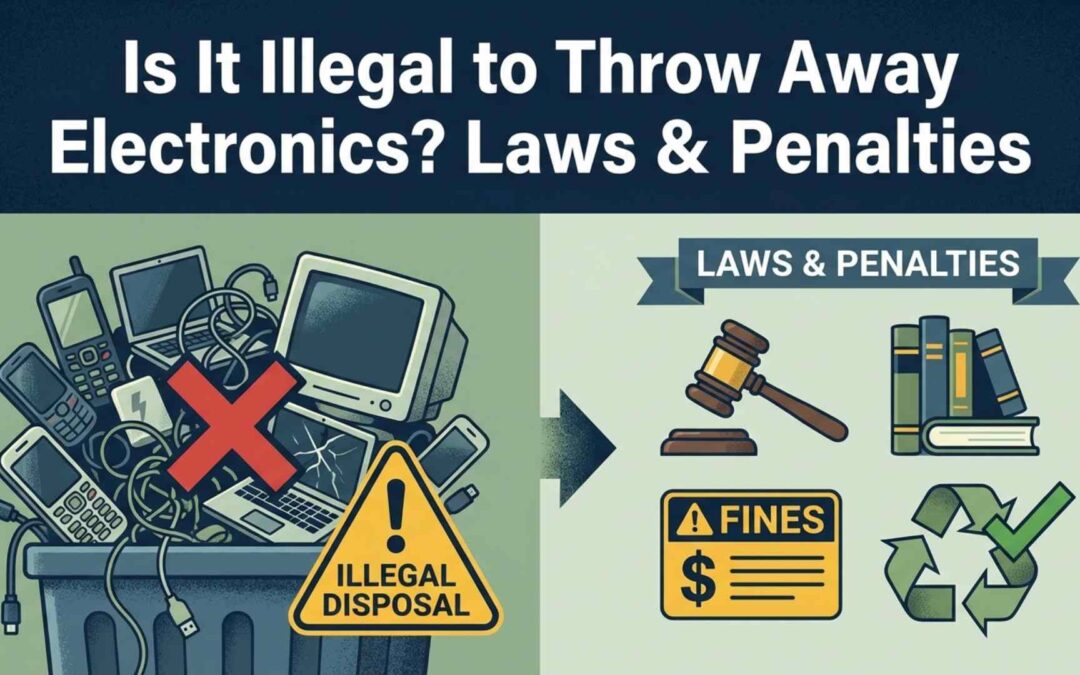
Got an old laptop collecting dust? A cracked phone in your junk drawer? That ancient TV from 2005?
You can’t just toss them in the trash anymore.
Americans generate 16 billion pounds of electronic waste every year. Most of it ends up contaminating our soil and water with toxic chemicals. The good news: you’ve got better options.
This guide breaks down what’s legal, what’s not, and how to dispose of electronics without breaking the law or hurting the planet.
Understanding E-Waste Laws in the United States
Federal E-Waste Regulations
The feds have been watching e-waste for decades.
Resource Conservation and Recovery Act (RCRA) sets the baseline. It classifies certain electronics as hazardous waste. If your device has lead, mercury, or cadmium, special rules apply.
The EPA enforces these regulations. They focus on businesses more than individuals. But everyone needs to follow proper disposal methods.
CRT Disposal Regulations are particularly strict. Those old tube TVs and monitors contain lead. The EPA requires them to go through certified recyclers. No exceptions.
Proposed Federal Legislation (RERA) might change everything. The Responsible Electronics Recycling Act is making its way through Congress. It would create nationwide standards. Right now, we’re stuck with a patchwork of state laws.
State-by-State E-Waste Laws
Here’s where it gets messy.
28 states have mandatory e-waste laws. Each one’s different. Some ban landfill disposal thoroughly. Others require manufacturers to fund recycling programs.
Two main models exist:
Extended Producer Responsibility (EPR) makes manufacturers pay. They collect and recycle their own products. You drop off electronics for free.
Advanced Recycling Fee (ARF) charges you upfront. You pay a small fee when buying new electronics. That money funds recycling programs later.
Here’s how penalties stack up across states:
| State | First Offense | Repeat Offense | Max Fine |
|---|---|---|---|
| California | $100–$5,000 | $500–$10,000 | Criminal charges |
| New York | $250–$2,500 | $500–$5,000 | 1 year jail |
| Illinois | $50–$500 | $500–$1,500 | Civil penalties |
| Washington | $1,000 | $5,000 | Daily fines |
| Minnesota | $25–$1,000 | $1,000–$5,000 | 90 days jail |
Arizona and Phoenix-Specific E-Waste Regulations
Arizona doesn’t have specific e-waste legislation yet.
That doesn’t mean anything goes.
General disposal regulations still apply. The Arizona Department of Environmental Quality oversees hazardous waste. Electronics with toxic materials fall under these rules.
Phoenix has municipal regulations worth knowing. The city offers free recycling services for residents. They prohibit electronics in regular trash pickup. You won’t get fined for one phone in your garbage. But repeat violations or large quantities trigger enforcement.
Maricopa County adds another layer. They regulate what goes into county landfills. Electronics are officially discouraged.
Future legislative expectations look promising. Arizona lawmakers have introduced e-waste bills before. They haven’t passed yet. But pressure’s building from environmental groups. Expect stricter laws within the next few years.
Why Electronic Waste Laws Exist
Environmental Contamination
Electronics are toxic time bombs.
Every device contains nasty chemicals. Lead in circuit boards and screens. Mercury in fluorescent backlights. Cadmium in batteries and chips. Arsenic in older semiconductors.
When electronics hit landfills, these chemicals leak.
Soil contamination spreads for decades. Toxic metals seep into the ground. They don’t break down. They accumulate.
Groundwater pollution follows. Rain carries chemicals deeper. They reach aquifers that supply drinking water. Communities downstream pay the price.
Air quality suffers when e-waste burns. Incinerators release toxic fumes. Illegal burning releases even worse compounds. Dioxins and furans float for miles.
The numbers are brutal. E-waste represents 70% of toxic materials in U.S. landfills. Yet it’s only 2% of total landfill volume. That’s a concentrated poison problem.
Health Risks from Toxic Chemicals
People near landfills face real danger.
Water contamination affects over 1 million Americans. Heavy metals from e-waste show up in well water. Lead damages developing brains. Mercury causes neurological problems.
Long-term health consequences include:
- Kidney damage from cadmium exposure
- Respiratory problems from burning plastics
- Cancer risks from arsenic and lead
- Developmental delays in children
- Immune system suppression
Exposure risks spike during improper disposal. Breaking open devices releases toxic dust. Burning cables creates poisonous smoke. Landfill workers face daily exposure.
Low-income communities suffer most. Landfills cluster in their neighborhoods. Environmental justice isn’t just a buzzword. It’s about protecting vulnerable populations.
Resource Depletion and the Value of Recycling
Your old phone is a tiny gold mine.
Seriously.
Precious metals recovery from e-waste includes:
- Gold in circuit boards and connectors
- Silver in switches and conductive traces
- Copper in wiring and heat sinks
- Palladium in capacitors
- Platinum in hard drives
One metric ton of circuit boards contains more gold than 17 tons of ore.
Energy savings from recycling beat mining by miles. Recycled aluminum uses 95% less energy than mining new. Recycled copper saves 85% of production energy. Recycled plastics cut energy use by 70%.
Circular economy benefits multiply. Recovered materials re-enter manufacturing. Companies reduce mining costs. Supply chains become more stable. Prices drop for consumers.
Remember those 16 billion pounds of annual U.S. e-waste? We recycle less than 25% of it. The rest rots in landfills or gets shipped overseas. That’s billions in lost resources every year.
What Electronics Are Illegal to Throw Away?
Common Electronic Devices Covered by Laws
Most states regulate these items:
Computers and related equipment:
- Desktop computers and towers
- Laptops and notebooks
- Tablets and e-readers
- Computer monitors (all types)
- Keyboards and mice
Mobile devices:
- Smartphones and feature phones
- Cell phone batteries
- Smartwatches and fitness trackers
- Bluetooth headsets
Display devices:
- Televisions (CRT, LCD, LED, plasma)
- Computer monitors
- Portable DVD players with screens
Office equipment:
- Printers and all-in-one devices
- Scanners and copiers
- Fax machines
- Projectors
Gaming and entertainment:
- Gaming consoles (Xbox, PlayStation, Nintendo)
- Handheld gaming devices
- VCRs and DVD players
- Cable and satellite boxes
Less Obvious Items People Overlook
These surprise most people:
Small electronic appliances:
- Digital alarm clocks and radios
- Electronic calculators
- Electric razors and toothbrushes
Measurement devices:
- Electronic bathroom scales
- Digital thermometers
- Fitness equipment with displays
Power tools with electronics:
- Cordless drills with battery packs
- Electronic measuring tools
- Laser levels
Medical devices:
- Blood pressure monitors
- Glucose meters
- TENS units and massagers
Automotive electronics:
- GPS navigation units
- Dash cameras
- Electronic toll transponders
- Car stereos and speakers
Smart home devices:
- Programmable thermostats
- Smart doorbells and cameras
- Voice assistants (Alexa, Google Home)
- Smart plugs and light switches
Special Handling Items
Some electronics need extra care:
Cathode Ray Tubes (CRTs) top the danger list. Old TVs and monitors contain 4 to 8 pounds of lead. The glass itself is toxic. Never break or dismantle CRTs yourself. Only certified recyclers can handle them safely.
Mercury-containing devices require special processing. Fluorescent backlights in old laptops. Some flat-screen TVs and monitors. Digital thermostats with mercury switches.
Lithium battery devices pose fire hazards. Damaged batteries can ignite. They cause fires in garbage trucks and landfills. Always remove batteries before disposal. Many devices have non-removable batteries now. Those need professional handling.
Circuit boards and components contain concentrated toxins. Desktop motherboards have the most valuable materials. They also have the most dangerous chemicals. Never burn or acid-wash boards at home. Leave extraction to professionals.
Penalties for Illegal Electronics Disposal
Individual Penalties by State
Breaking e-waste laws can hurt your wallet.
First-time violation fines range widely. California starts at $100 per device. New York charges $250 minimum. Some states go easy with warnings. Others hit hard right away.
Repeat offense escalations get serious fast. Second violations often double the fine. Third strikes can reach $10,000. Prosecutors look at your history.
Criminal charges and jail time happen more than you’d think. Illinois allows up to 1 year in county jail. New York permits 6 months for egregious violations. Minnesota includes 90 days for repeat offenders.
Most states reserve jail time for:
- Large-scale illegal dumping
- Businesses posing as individuals
- Intentional contamination
- Defying court orders
Specific penalties in surrounding states:
California (strict):
- $100 to $5,000 per violation
- Repeat offenders face criminal charges
- Up to 6 months of jail time is possible
Nevada (moderate):
- $500 to $2,000 first offense
- $1,000 to $5,000 repeat violations
- Civil penalties for businesses
New Mexico (developing):
- $50 to $500 current fines
- Stricter laws under consideration
- Focus on commercial violators
Utah (limited):
- No specific e-waste law yet
- General hazardous waste rules apply
- Fines under $1,000 are typical
Business Penalties and Legal Consequences
Companies face much steeper consequences.
Daily accumulating fines destroy budgets. The EPA can charge $37,500 per day for ongoing violations. That’s per violation, not per facility. One company racks up $1 million in a month.
Environmental cleanup costs dwarf initial fines. Contaminated soil removal costs $50 to $150 per cubic yard. Groundwater remediation runs $50,000 to $500,000. Some cleanup projects exceed $10 million.
Federal RCRA violations carry nuclear-level penalties. Knowing violations: up to $250,000 per day. Organizations face up to $1,000,000 per day. Criminal prosecution brings 5 to 15 years in federal prison.
These aren’t empty threats. The EPA prosecutes dozens of cases annually.
Criminal prosecution examples:
A Texas recycler got 18 months in federal prison. He exported hazardous e-waste to Hong Kong. Lied about following EPA regulations. Also paid $200,000 in restitution.
A California warehouse operator served 2 years. She illegally stored 10 million pounds of CRTs. Building collapsed from the weight. Caused massive toxic contamination.
Major Corporate E-Waste Violation Case Studies
Big names aren’t immune.
Comcast paid $25.95 million in 2019. They dumped electronics in California landfills for years. Employees threw away batteries, circuit boards, and cables. The settlement included improved training and compliance programs.
Target Corporation settled for $3.5 million in 2016. Stores across California illegally disposed of e-waste. Prosecutors found electronics in regular dumpsters. Target now maintains strict internal policies.
Big Lots paid $1.4 million in 2015. Similar violations across multiple California locations. Pattern of ignoring state regulations. Required to implement company-wide compliance training.
Dollar General settled for $1.06 million in 2017. Failed to properly dispose of damaged electronics. Threw lithium batteries in regular trash. Agreed to third-party audits for five years.
Executive Recycling executives went to prison. They claimed to recycle electronics properly. Actually shipped most to Hong Kong illegally. CEO got 15 months in federal prison. Company paid $5 million in penalties.
Hidden Costs Beyond Fines
Financial penalties are just the start.
Business reputation damage lasts for years. Customers lose trust fast. Environmental violations make headlines. Competitors use it against you.
Loss of customer trust and brand loyalty hits hard. Millennials and Gen Z care about sustainability. 73% of consumers say they’d switch brands over environmental practices. One violation can cost millions in lost sales.
Insurance and liability issues multiply. Premiums spike after violations. Some insurers drop coverage entirely. Future claims face intense scrutiny.
Impact on B2B relationships can be fatal. Many corporations require clean environmental records. Contract terms include compliance clauses. One violation kills partnerships.
Increased regulatory scrutiny never ends. Once you’re on the EPA’s radar, you stay there. Surprise inspections become routine. Every practice gets questioned.
Loss of market value hammers public companies. Stock prices drop on violation news. Institutional investors demand explanations. Executive compensation gets tied to compliance.
How to Dispose of Electronics Properly
Retailer Take-Back Programs
The easiest solution is often free.
Best Buy’s nationwide recycling program accepts almost everything. Drop off up to three items per household per day. No purchase required. They take TVs up to 50 inches for a $30 fee. Everything else is free.
Accepted items include:
- Computers and tablets
- Cell phones and cameras
- Gaming systems
- Small appliances
- Wires and cables
Apple product return initiatives focus on their ecosystem. Trade in old iPhones, iPads, Macs, and Apple Watches. Get credit toward new purchases. Devices without value get recycled free. Apple uses recovered materials in new products.
Staples office electronics recycling serves businesses well. Free for Staples Rewards members. $25 per box for non-members. Fill a box with any electronics. Ship it back using their prepaid label.
Cell phone carrier trade-in programs:
Verizon, AT&T, and T-Mobile all offer options. Trade working phones for bill credits. Broken phones still get recycled free. Drop off at any store location.
Manufacturer responsibility programs are expanding. Dell recycles any brand computer when you buy a new Dell. HP offers free recycling for HP products. Samsung takes back TVs and phones at select retailers.
Municipal Recycling Programs
Phoenix makes it surprisingly easy.
Phoenix City Household Hazardous Waste Collection runs year-round. Residents drop off electronics free. No appointment needed during operating hours.
North Gateway Transfer Station details:
- Address: 3830 N. 35th Avenue
- Hours: Tuesday–Saturday, 8 AM–4 PM
- Accepts all household electronics
- Free for Phoenix residents
- Show ID with Phoenix address
27th Avenue Transfer Station also accepts e-waste:
- Address: 1201 S. 27th Avenue
- Same hours as North Gateway
- Often less crowded
- Convenient for south Phoenix residents
Scheduled community collection events happen quarterly. The city sets up temporary drop-off sites in neighborhoods. Drive-through service available. Check Phoenix.gov for upcoming dates.
Free pickup services for residents exist. Schedule large item pickups through the city. They’ll grab electronics from your curb. Must be Phoenix resident with regular trash service. Book online or call customer service.
Dedicated E-Waste Recycling Centers
Certified recyclers offer the best data security.
EPA-certified recycling facilities meet strict standards. They track every device through the process. Materials get properly separated and processed. Nothing gets illegally exported.
R2 and e-Stewards certified recyclers follow gold-standard practices. These certifications mean:
- Proper worker safety procedures
- Environmental protection standards
- Downstream vendor verification
- Regular third-party audits
Phoenix area certified recyclers include:
Total Asset Disposal
- Location: 4645 S. 36th Place, Phoenix
- R2 certified
- Accepts all electronics
- Free drop-off for individuals
- Business services available
ERI
- Location: 750 S. 48th Street, Phoenix
- e-Stewards certified
- Secure data destruction
- Certificate of recycling provided
- Drop-off by appointment
Allied Waste Services
- Multiple Phoenix locations
- Accepts most electronics
- Some fees for CRTs
- Business accounts available
Accepted items and fees vary by facility. Most items are free. CRT TVs and monitors often cost $10 to $30. Call ahead to confirm.
Data destruction services provide peace of mind. Certified wiping meets DOD standards. Physical destruction available for sensitive data. You get a certificate proving destruction.
Repairing or Donating Usable Electronics
Working devices deserve a second life.
Goodwill of Central Arizona accepts functioning electronics. They resell items in their stores. Revenue funds job training programs. Broken items get sent to recyclers.
Donation locations:
- 30+ stores across Phoenix metro
- Drop-off hours match store hours
- Get a receipt for tax deduction
- Call ahead for large items
Local refurbishment programs extend device life. Phoenix ReUse Center takes working electronics. They refurbish and sell at low prices. Serves low-income families.
Community donation centers include:
- Churches and faith organizations
- Schools needing technology
- Senior centers
- Youth programs
- Homeless shelters
Tax deduction benefits add up. Donated electronics qualify for charitable deductions. Value based on fair market value. Keep your receipt and document condition. Consult your tax advisor for specifics.
Extending device lifespan is the greenest option. Repair instead of replace when possible. Upgrade RAM or storage on old computers. Replace phone batteries through authorized service. One extra year per device makes a real difference.
Business Compliance Guide for Phoenix Companies
Establishing E-Waste Management Policies
Smart companies prevent problems proactively.
Creating internal disposal procedures starts simple. Document every step from device retirement to final disposal. Include decision trees for different device types. Update procedures annually.
Sample procedure outline:
- Employee submits disposal request
- IT department wipes data
- Device gets tagged and logged
- Collection in designated area
- Quarterly pickup by certified recycler
- Documentation filed for audit trail
Designating e-waste collection areas prevents mistakes. Set up locked storage for retired electronics. Label clearly with signage. Keep separate from regular trash. Limit access to trained staff.
Documentation and record-keeping requirements protect you legally. Track every device from purchase to disposal. Keep manifests from recycling vendors. Maintain data destruction certificates. Store records for seven years minimum.
Compliance audit preparation should be routine. Quarterly internal checks catch problems early. Review vendor certifications annually. Test employee knowledge of procedures. Fix gaps before regulators find them.
Employee Training Requirements
Your staff makes or breaks compliance.
Staff education on disposal laws needs to be simple. Most employees aren’t lawyers. Focus on practical dos and don’ts. Use real examples from your industry.
Training topics to cover:
- Which electronics need special handling
- Where to take retired equipment
- Who to contact with questions
- Penalties for violations
- How proper disposal helps the company
Department-specific training targets different needs.
IT staff need detailed technical training. They handle most electronic equipment. Cover data security protocols extensively. Train on proper hard drive destruction.
Facilities teams manage physical collection. They need to recognize hazardous items. Train on safe handling and storage. Teach proper labeling procedures.
Procurement staff should understand purchasing implications. Consider disposal costs in buying decisions. Choose manufacturers with take-back programs. Build disposal plans into budgets.
Decision flowcharts simplify choices. Create one-page guides for quick reference. Post near collection areas. Include photos of common items.
Regular refresher courses maintain awareness. Annual training for all staff. Quarterly updates for key personnel. Cover new laws and procedure changes.
Working with Certified E-Waste Vendors
Your recycler’s compliance is your compliance.
Verifying R2 or e-Stewards certification is non-negotiable. Don’t accept “we’re certified” claims. Ask for certificate numbers. Verify online through certification bodies. Check expiration dates.
Red flags in vendor selection:
- Reluctance to provide documentation
- Prices way below competitors
- No physical facility to visit
- Can’t explain their processes
- No insurance or bonding
Documentation for compliance proof must be complete. Request these from every vendor:
Chain of custody forms track devices. Show where your equipment goes. Include serial numbers when possible. Get signatures at each transfer point.
Certificates of recycling prove proper disposal. Should list specific items and quantities. Include recycler’s certification numbers. Dated and signed by authorized representative.
Data destruction certificates protect sensitive information. Specify destruction method used. List device serial numbers. Confirm compliance with relevant standards.
Vendor compliance verification requires ongoing monitoring. Annual facility tours recommended. Review their downstream partners. Check for violations or complaints. Update your vendor list regularly.
Industry-Specific Compliance Considerations
Different sectors face unique challenges.
Healthcare facilities and medical devices need special care. HIPAA complicates electronic disposal. Patient data security is paramount. Some medical electronics require FDA disposal methods.
Partner with recyclers experienced in healthcare. They understand regulatory requirements. Can handle diagnostic equipment properly. Provide enhanced data destruction services.
Financial institutions and data security face extreme scrutiny. Customer financial data lives on every device. Regulators expect perfect security records. One breach destroys trust and triggers fines.
Require DOD 5220.22-M standard data wiping minimum. Consider physical destruction for high-risk devices. Maintain detailed destruction logs. Use vendors with financial industry experience.
Educational institutions and computer labs handle volume. Schools replace hundreds of devices annually. Limited budgets make free programs essential. Student privacy laws add complications.
Leverage manufacturer take-back programs. Schedule bulk pickups with certified recyclers. Train IT staff on student data protection. Document disposal for auditors.
Manufacturing with electronic components creates constant waste. Defective products need proper disposal. Prototype equipment piles up. Industrial controls contain hazardous materials.
Integrate e-waste into overall waste management. Train production staff on identification. Separate electronic waste at the source. Consider on-site secure storage before pickup.
Government agency requirements exceed private sector standards. Federal and state regulations overlap. Public records laws affect data destruction. Procurement rules limit vendor choices.
Follow GSA guidelines for federal agencies. State agencies check local procurement rules. Document everything exhaustively. Budget for higher disposal costs.
Preparing Electronics for Proper Disposal
Data Security and Privacy Protection
This step is absolutely critical.
Backing up important data comes first. Transfer files you need to keep. Test backups before wiping devices. Use multiple backup methods for important data. Cloud storage plus external drives is smart.
DOD-certified data wiping methods meet military standards. DOD 5220.22-M requires multiple overwrites. Software like DBAN or Eraser works for PCs. Macs have built-in secure erase functions. Smartphones have factory reset options.
Wiping isn’t enough for sensitive data. Determined hackers can sometimes recover wiped files. High-risk data deserves physical destruction.
Physical hard drive destruction provides certainty. Drilling holes through platters works. Degaussing destroys magnetic data. Shredding reduces drives to tiny pieces. Professional services provide certificates.
Preventing identity theft and data breaches protects everyone. Consider what’s stored on every device:
- Saved passwords and login credentials
- Financial account information
- Personal photos and documents
- Business trade secrets
- Customer or client data
One unwiped device can cause massive problems. Take time to do this right.
Device Preparation Steps
Make recycling easier for everyone.
Removing accessories and peripherals declutters devices. Take off cases and covers. Remove screen protectors. Disconnect cables and adapters. Keep cords separate or wrap them together.
Battery removal and separate disposal prevents fires. Removable batteries come out before recycling. Button cell batteries go to special collection. Rechargeable batteries need dedicated recycling. Many retailers accept loose batteries.
Never put loose lithium batteries in regular trash. They cause fires in trucks and facilities. Tape terminals before disposal. Use designated battery recycling bins.
Cleaning devices is courteous. Wipe down surfaces with microfiber cloth. Remove dirt and debris. Don’t use harsh chemicals. Recycler workers appreciate clean items.
Organizing electronics by type speeds processing. Group phones together. Stack laptops separately from desktops. Bag small accessories. Label boxes with contents.
What to Remove Before Recycling
Don’t recycle these by accident:
Personal information and accounts:
- Sign out of all accounts
- Remove email accounts from devices
- Disconnect from cloud services
- Deauthorize media apps (iTunes, Kindle)
- Remove device from Find My iPhone/Android
SIM cards and memory cards contain personal data. Check phones for SIM cards. Look for SD cards in cameras and tablets. Remove SIM trays completely. Destroy old SIM cards or keep for future use.
Proprietary software and licenses:
- Deactivate software keys
- Transfer licenses to new devices
- Uninstall licensed software
- Document software removal for records
Non-recyclable attachments:
- Leather cases and fabric covers
- Wood or metal stands
- Decorative additions
- Non-electronic accessories
The Environmental and Economic Impact of Proper E-Waste Disposal
Preventing Landfill Contamination
The stakes are higher than most realize.
70% of toxic landfill materials come from e-waste. Think about that ratio. E-waste is only 2% of landfill volume. But it accounts for most of the poison.
Protecting groundwater and ecosystems saves communities. Heavy metals migrate through soil. They eventually reach water tables. Once contaminated, aquifers take decades to clean. Some never fully recover.
Reducing air pollution helps everyone breathe easier. Burning electronics releases toxic compounds. Dioxins and furans cause cancer. Mercury vapor damages nervous systems. Proper recycling eliminates these emissions.
Resource Recovery and Conservation
Your trash is someone else’s treasure.
Material reclamation statistics are impressive:
- 95% of aluminum can be recovered and reused
- 85% of copper gets successfully recycled
- 80% of steel and iron returns to production
- 100% of precious metals can be extracted
One million recycled cell phones yield:
- 35,000 pounds of copper
- 772 pounds of silver
- 75 pounds of gold
- 33 pounds of palladium
Energy savings from recycling beat virgin production:
- Aluminum: 95% less energy than mining
- Copper: 85% less energy than smelting ore
- Plastic: 70% less energy than new production
- Glass: 30% less energy than manufacturing
Reducing need for new mining operations protects wilderness. Mining destroys ecosystems. Smelting pollutes air and water. Transportation burns fossil fuels. Recycling cuts environmental damage across the board.
Economic Benefits and Job Creation
Going green creates jobs.
The U.S. recycling industry employs 1.1 million people. That includes e-waste recycling workers. Average salary: $41,000 annually. These are good, stable jobs.
$236 billion in annual revenue flows through recycling. E-waste represents a growing segment. As electronics multiply, opportunities increase. New facilities open regularly.
Local economic opportunities in Phoenix are expanding. Multiple certified recyclers operate here. They hire technicians, drivers, and admin staff. Supporting local recyclers keeps money in Arizona.
Supporting circular economy initiatives builds sustainable systems. Materials loop back into production. Manufacturers reduce raw material costs. Prices stabilize for consumers. Everyone benefits from closed loops.
Common E-Waste Myths and Misconceptions
“Recycling Is Too Complicated”
This one’s outdated.
Simple drop-off process reality:
- Load electronics in your car
- Drive to collection site
- Hand over items
- Drive away
Total time: 15 minutes average.
Most locations don’t require appointments. No paperwork for individuals. Staff help you unload.
Free or low-cost options available everywhere. Phoenix residents recycle free at transfer stations. Retailers take items at no charge. Community events make it even easier.
“My Old Electronics Have No Value”
Wrong on multiple levels.
Precious metals content adds up fast. That old laptop contains $2 to $5 in recoverable materials. Your smartphone has about $1 in gold and silver. A desktop computer holds $5 to $10 in metals.
Refurbishment potential creates value. Working electronics help low-income families. Schools use donated computers in classrooms. Seniors need affordable devices for staying connected.
Opportunities for parts reuse extend beyond precious metals. Working screens get harvested. Memory chips find new life. Power supplies get tested and resold. Cables and adapters serve other devices.
“Small Quantities Don’t Matter”
Every device counts.
Collective impact statistics prove it. If every American recycled one phone:
- 35,000 pounds of copper recovered
- 772 pounds of silver extracted
- 75 pounds of gold reclaimed
That’s from just one device per person.
Individual responsibility importance drives change. Movements start with single actions. Your choice influences friends and family. Kids learn from watching parents. Communities shift through cumulative behavior.
“All Recycling Centers Accept Everything”
Not quite.
Facility-specific limitations are common. Some don’t take CRT monitors. Others refuse certain batteries. Size limits exist for televisions. Business quantities need special arrangements.
The importance of checking accepted items saves trips. Call ahead before loading your car. Check websites for specific lists. Ask about any fees before you go. Confirm hours of operation.
Future of E-Waste Legislation
Arizona Legislative Trends
Change is coming to the Grand Canyon State.
Expected future regulations mirror other states. Proposed bills surface every legislative session. Industry groups push for producer responsibility. Environmental organizations want stronger rules.
EPA recommendations for Arizona include:
- Statewide electronics recycling standards
- Ban on landfill disposal of certain items
- Manufacturer-funded collection programs
- Rural area collection support
- Business reporting requirements
Proposed state bills have come close to passing. HB 2744 in 2019 reached committee stage. It would’ve required manufacturer take-back programs. Died in committee due to industry opposition. Similar bills expected in upcoming sessions.
Political will is building. Phoenix and Tucson support stronger laws. Rural legislators remain cautious. Compromise legislation seems likely within five years.
National E-Waste Policy Developments
Federal action may preempt state laws.
Federal legislation pending in Congress includes several bills. The Responsible Electronics Recycling Act (RERA) leads the pack. It would ban export of toxic e-waste. Create national recycling standards. Provide funding for collection infrastructure.
Extended Producer Responsibility expansion gains momentum. More states adopt EPR models. Manufacturers accept the inevitable. Industry coalitions form to shape legislation. National standards become more appealing than 50 different state laws.
International e-waste standards pressure U.S. policy. European Union requires manufacturer responsibility. China banned imported e-waste. India strengthened disposal rules. American companies face global compliance already.
Corporate Social Responsibility Trends
Companies lead where governments lag.
Sustainability certifications become market differentiators. B Corp status requires e-waste policies. ISO 14001 includes electronics management. Industry-specific standards emerge.
Green business initiatives expand rapidly. Tech companies commit to zero waste. Retailers advertise recycling programs prominently. Sustainable practices influence purchasing decisions.
Consumer demand for responsible practices drives everything. 73% of consumers consider environmental impact. 88% of millennials expect corporate sustainability.