
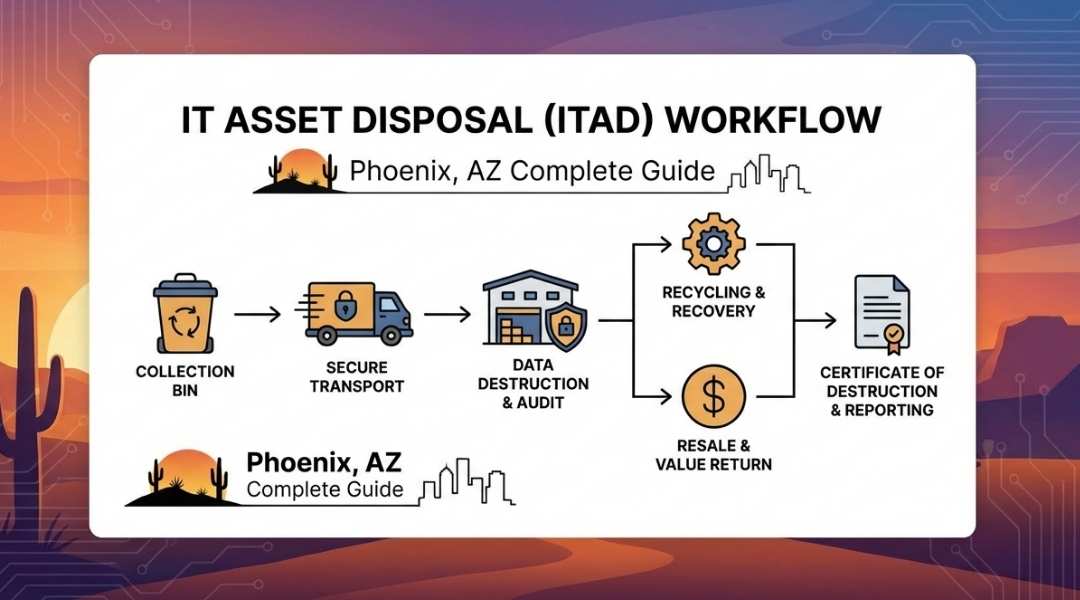
What Is the IT Asset Disposal (ITAD) Workflow in Phoenix, AZ?
Ever wonder what really happens to your old company laptops after decommissioning?
Most Phoenix organizations don’t think about IT asset disposal until something goes wrong. A data breach from a discarded drive. An audit flag. A compliance fine.
IT asset disposal isn’t just about tossing old tech in a bin. It’s a structured process that protects your data, recovers value, and keeps you compliant with federal and Arizona regulations.
The ITAD workflow covers everything from inventory tracking to secure data destruction to certified recycling. Done right, it turns a liability into an opportunity. Done wrong, it becomes a nightmare waiting in your e-waste pile.
Phoenix-based organizations face unique pressures. Healthcare providers must meet HIPAA standards. Financial firms answer to PCI-DSS. Schools and government agencies juggle tight budgets and public accountability.
Here’s the truth: Phoenix-based orgs often overlook chain of custody tracking until an audit hits. Build it into your process upfront.
The old proverb says it best: Don’t dig a well when you’re already thirsty. Plan your ITAD workflow before you need it. Your compliance team, your CFO, and your legal counsel will thank you.
Definition of the IT Asset Disposal Workflow
The IT asset disposal workflow is the end-to-end process organizations use to securely retire, sanitize, and dispose of IT equipment.
It’s not just about wiping drives. It includes logistics, resale evaluation, legal compliance, environmental responsibility, and financial reconciliation.
Think of ITAD as the final chapter in your hardware lifecycle. Every laptop, server, phone, and storage device gets tracked, evaluated, sanitized, and either resold, recycled, or destroyed.
It’s not just about wiping drives it’s about compliance, security, and sustainability too.
Definition and Scope of IT Asset Disposal
IT asset disposal covers more than just deletion.
The scope of ITAD includes:
- Inventory reconciliation tracking every device leaving service
- Data sanitization secure wiping or physical destruction
- Equipment recovery resale, reuse, or recycling
- E-waste logistics certified transport and processing
- Documentation audit-ready logs and certificates
When you include chain-of-custody and resale strategy, the process becomes far more valuable.
Many organizations assume erasing drives equals disposal. That’s only one step. Without proper logistics, documentation, and certified recycling, you’re still exposed to liability gaps.
Purpose of ITAD (Data Security, Compliance, and Environmental Responsibility)
Why does ITAD matter? Three big reasons.
Data Security
Every retired device holds sensitive information. Customer records. Financial data. Internal communications. If that data falls into the wrong hands, you face breaches, lawsuits, and reputation damage.
Compliance
Federal and state laws require proper data destruction. HIPAA. PCI-DSS. GLBA. Fail to comply, and you’re looking at fines, penalties, and audit failures.
Environmental Impact
E-waste contains toxic materials. Lead, mercury, cadmium. Certified recycling keeps these pollutants out of landfills and waterways. It also supports your organization’s sustainability goals.
Think of ITAD like locking every digital door behind you and recycling the key.
Purpose of IT Asset Disposal as a Risk Management Process
ITAD isn’t just an IT task. It’s a risk management strategy.Every device you skip is a potential compliance failure. A data breach waiting to happen. A lawsuit you didn’t see coming.
Consider this: what if a hacker recovered one file from your retired server? What would it cost you in legal fees, regulatory fines, and lost trust? Proper ITAD eliminates that risk. It creates defensible documentation. It ensures data can’t be recovered. It protects your organization from worst-case scenarios.
You’ve probably wondered what if that one drive slips through the cracks? ITAD answers that question with a resounding “it won’t.”
Build checks, not just checklists. Every device deserves the same level of scrutiny.
Types of Assets Covered in ITAD
ITAD applies to any device that stores, processes, or transmits data.
Common assets include:
- Desktop computers
- Laptops and tablets
- Servers and storage arrays
- Smartphones and mobile devices
- Printers and multifunction devices
- Network equipment (routers, switches)
- IoT devices and smart peripherals
Still tracking only desktops and laptops? That’s 2009 thinking.
Modern ITAD covers IoT devices, smart sensors, and connected equipment. These often carry just as much sensitive data as traditional computers.
Types of Hardware Covered in ITAD
Here’s a hardware checklist for your ITAD plan:
- Desktops workstations, all-in-ones
- Servers rack-mounted, blade, tower
- Mobile devices phones, tablets, wearables
- Printers laser, inkjet, multifunction
- Routers and switches network infrastructure
- Storage media hard drives, SSDs, tape drives
- Telephony gear VoIP phones, PBX systems
From routers to racks, from phones to printers it all adds up to risk.
Network and telephony gear often get overlooked. Yet they’re full of sensitive logs, configurations, and cached data.
Why the IT Asset Disposal Workflow Matters for Phoenix, AZ Organizations
Worried your IT disposal plan might be a liability waiting to happen? You’re not alone.
Phoenix organizations face growing pressure from regulators, auditors, and customers. One misstep in IT disposal can trigger data breaches, compliance violations, and financial losses.
Here’s the reality: most security failures happen after disposal, never before.
Let’s break down why ITAD matters across three critical areas.
Data Security
Would you throw your customer database in a dumpster?
Of course not. Yet improper IT disposal does exactly that.
Deleted files aren’t gone. Even formatted drives can be recovered using forensic tools. Only certified wiping or physical destruction is fail-proof.
A single unwiped laptop can expose thousands of customer records. Social Security numbers. Credit card data. Protected health information.
The fallout? Breach notification costs. Regulatory fines. Class-action lawsuits. Loss of customer trust.
ITAD creates a critical safeguard against data exposure. It ensures every device gets sanitized to industry standards. It protects your organization and your customers.
This isn’t optional. It’s a non-negotiable standard.
Finances
ITAD isn’t just a cost center. It’s a smart investment.
Retired IT equipment holds residual value. Laptops, servers, and networking gear can be resold or redeployed. Certified ITAD partners help you maximize asset value through remarketing programs.
You also unlock tax benefits. Proper disposal creates write-offs and depreciation claims. Certified ITAD partners can issue residual value reports that support your accounting team.
Think about it this way: retired laptops often resell for $80–$150 per unit. Multiply that by your fleet size. That’s real money returning to your IT budget.
Don’t leave money on the table or in the recycling bin.
Smart organizations treat ITAD as revenue recovery, not just expense management.
Environmental Compliance and Sustainability
E-waste is one of the fastest-growing waste streams globally. It contains hazardous materials that harm ecosystems and communities.
Arizona law restricts how organizations dispose of electronic waste. Federal regulations add another layer. Non-compliance means fines, penalties, and reputational damage.
Certified recycling partners follow R2v3 or e-Stewards standards. These certifications ensure responsible downstream handling. They prevent illegal export and landfill dumping.
Proper ITAD also supports your sustainability goals. Recycling recovers valuable materials. It reduces carbon footprint. It demonstrates corporate responsibility.
In public RFPs and corporate partnerships, environmental practices matter more than ever. Your ITAD choices reflect your brand values.
We do not inherit the Earth from our ancestors we borrow it from our children.
R2v3 or e-Stewards certification is a must to avoid illegal downstream handling.
Benefits of a Structured IT Asset Disposal Process in Phoenix, AZ
Ad hoc disposal creates chaos. Structured ITAD creates clarity, compliance, and cash back.
A formal ITAD process delivers three major benefits:
1. Audit readiness: Every device has a paper trail. Documentation proves compliance when regulators come knocking.
2. Asset optimization You recover more value through strategic resale and reuse programs.
3. Risk reduction Standardized workflows eliminate gaps where data breaches hide.
Organizations with structured ITAD processes spend less time scrambling during audits. They reclaim more budget from retired equipment. They sleep better knowing their data disposal is defensible.
Without structure, there’s chaos. With it, there’s clarity, compliance, and cash back.
Having structured logs reduces the time and cost of surprise IT audits. Build your framework once. Benefit from it every disposal cycle.
Protection Against Data Breaches
You’ve locked your network. But have you locked down your discarded devices?
Security doesn’t end when a device leaves production. It ends when data becomes unrecoverable.
A formal ITAD strategy ensures risk-proof, tamper-proof, fully secure disposal. Every device gets tracked through chain of custody. Every drive gets sanitized or destroyed. Every action gets logged.
Here’s the insider tip: always request serial number logs post-destruction. It’s your proof that the job was done right.
Without this protection, you’re one lazy disposal away from a breach headline.
Reduced Organizational Liability
Legal exposure. Privacy violations. Regulatory fines.
These risks multiply when IT disposal is unstructured or outsourced to non-certified vendors.
Formal ITAD cuts risk across the board. You’re protected, covered, compliant from the moment a device is decommissioned to the moment it’s destroyed or recycled.
When you take care of data at rest, you avoid fallout in court.
Include ITAD compliance in your incident response documentation. It earns audit points and reduces liability in the event of a data incident.
Maximizing Value From Retired IT Hardware
One org’s trash is another department’s budget buffer.
Retired hardware isn’t worthless. It’s an untapped revenue stream.
Devices under 5 years old retain significant resale value. Laptops, tablets, and networking gear find second lives in schools, nonprofits, or international markets.
Certified ITAD partners handle remarketing logistics. They assess condition, refurbish devices, and connect you with buyers. You get a residual value report to support your financials.
Even if a device can’t be resold, certified recycling recovers materials. Copper, gold, rare earth metals these have market value.
The bottom line? ITAD done right puts money back into your budget.
Core Objectives of an IT Asset Disposal Workflow in Phoenix, AZ
Every ITAD plan should achieve five core objectives:
Prevent. Stop data breaches and unauthorized recovery.
Maintain. Stay compliant with data protection and environmental laws.
Recover. Extract residual value through resale or remarketing.
Reduce. Minimize environmental impact through certified recycling.
Ensure. Create accurate financial and inventory records.
It’s not just a checklist it’s a strategy.
Tie every ITAD action to one of these objectives. This builds executive buy-in and operational discipline.
Prevent Data Breaches and Unauthorized Data Recovery
If a hacker recovered one file from your retired server, what would it cost you?
Data left behind equals real business risk. Customer information. Intellectual property. Login credentials. All sitting on a drive in a warehouse or resale market.
ITAD eliminates that risk through zero-access assurance. Certified wiping. Physical destruction. Verified sanitization logs.
Use the 3-pass sanitization protocol to ensure overwrite-based wipe compliance. This standard meets NIST requirements and provides defensible proof.
Consider this scenario: an employee laptop gets improperly wiped. It’s resold. The new owner recovers sensitive client files. Your organization faces breach notification, regulatory fines, and lawsuits.
Prevent it with rigorous ITAD.
Maintain Compliance With Data Protection and Environmental Regulations
When you comply before you’re asked, you stay audit-ready.
ITAD touches multiple regulatory frameworks:
- HIPAA Healthcare data disposal requirements
- PCI-DSS Payment card data sanitization
- NIST SP 800-88 Federal media sanitization standard
- R2v3 Responsible recycling certification
- Arizona e-waste laws State-level disposal restrictions
A signed destruction certificate may not cover you unless it includes asset serials and timestamps. Always verify your vendor provides complete documentation.
Compliance isn’t just about avoiding fines. It’s about building trust with customers, partners, and auditors.
Recover Residual Value Through Resale or Remarketing
Your idle laptops are a quiet stream of money if you tap it.
ITAD isn’t just about disposal. It’s about ROI, asset yield, and liquidation.
Two resale paths exist:
- Internal redeployment Move devices to lower-security departments or training environments.
- External remarketing Sell to refurbishment partners or secondary markets.
Devices under 5 years old retain the highest resale margin. Track them first. Prioritize them for remarketing programs.
Your CFO will appreciate the budget boost. Your IT team will appreciate the reduced waste.
Reduce Environmental Impact Through Certified Recycling
You break it, you buy it. You toss it, you own the fallout.
E-waste contains toxic materials. Improper disposal harms ecosystems and communities. It also damages your brand.
Certified recycling partners follow R2v3 or e-Stewards standards. These certifications guarantee responsible downstream processing.
Here’s the risk: non-certified recyclers may export e-waste illegally. Your company name stays on the device. Your liability follows it overseas.
Choose certified partners. Request downstream chain documentation. Protect the environment and your reputation.
Ensure Accurate Financial and Inventory Records
Without tracking, you lose dollars. With tracking, you gain data.
Good ITAD creates audit-ready records. Every retired asset matches your depreciation schedule. Every disposal gets logged with serial numbers, dates, and methods.
Your CFO will thank you if every retired asset aligns with financial records. Your IT auditors will thank you for complete documentation.
Build a mini-checklist:
- Asset tags and serial numbers
- Disposal dates and methods
- Chain of custody signatures
- Sanitization certificates
This documentation proves compliance. It defends against audit challenges. It supports insurance claims and legal proceedings.
IT Asset Disposal Workflow: Core Phases Used in Phoenix, AZ
Measure twice, dispose once.
A complete ITAD workflow includes six core phases. Skip any step, and your audit defense is at risk.
Here’s the standard process:
- Asset Identification and Audit
- Decommissioning
- Secure Logistics and Chain of Custody
- Data Sanitization and Destruction
- Value Recovery or Recycling
- Documentation and Reporting
Each phase builds on the last. Each phase protects against specific risks.
Asset Identification and Audit
If you can’t name it, you can’t protect it.
Start with complete visibility. Identify every device leaving service. Record serial numbers, asset tags, and configurations.
Use barcode or QR code systems to automate reporting. This eliminates manual errors and speeds up tracking.
Create an inventory log that includes:
- Device type and model
- Serial number and asset tag
- Last user and department
- Data sensitivity classification
This phase sets the foundation. Without accurate identification, every downstream step becomes guesswork.
Decommissioning
Out of service doesn’t mean out of risk.
Decommissioning removes devices from production systems. It’s a planned shutdown that protects continuity and data integrity.
Schedule decommissioning windows to avoid system gaps. Notify users. Archive critical data. Disable network access.
Document the decommissioning date and responsible party. This creates a clear audit trail.
Proper decommissioning prevents accidental data loss and unauthorized access during the transition period.
Secure Logistics and Chain of Custody
From desk to disposal without a single gap.
Chain of custody tracks every handoff. Who picked up the device? When? Where did it go next?
Always record handoff timestamps. Use sign-off logs at every transfer point. Verify identities and credentials.
One untracked handoff breaks the whole chain. It creates liability. It undermines your audit defense.
Secure logistics prevent tampering, loss, or swap during transport. Use tamper-proof packaging and GPS tracking for high-value or high-risk assets.
Data Sanitization and Destruction
When it’s gone, it’s gone for real.
This is the heart of ITAD. Data sanitization eliminates recovery risk.
Use certified methods aligned with NIST SP 800-88:
- Software wiping Overwrite data multiple times
- Crypto erasure Destroy encryption keys
- Degaussing Magnetic field disruption
- Physical destruction Shredding or crushing
Use certified 3-pass overwrite with reporting logs. For high-security assets, combine wiping with physical destruction.
Always verify completion. Request certificates that include serial numbers, sanitization method, and timestamps.
Value Recovery or Recycling
Cash in on what you already paid for.
Not every device goes straight to recycling. Many can be resold, refurbished, or redeployed.
Evaluate condition and market value. Prioritize resale for devices under 4 years old. Refurbish before recycling whenever possible.
Certified ITAD partners handle the logistics. They assess, refurbish, and market your equipment. You receive a settlement report detailing recovered value.
For devices without resale potential, certified recycling recovers materials and prevents environmental harm.
Documentation and Reporting
If you didn’t document it, it didn’t happen.
Documentation proves your ITAD process was followed. It defends against audits, lawsuits, and regulatory inquiries.
Automate log export into your accounting or asset management system. Timestamp and sign each record.
Essential documents include:
- Asset transfer forms
- Sanitization logs
- Destruction certificates
- Settlement reports
- Environmental impact summaries
Store these records for at least 7 years. Longer for regulated industries like healthcare and finance.
Key Stages in the IT Asset Disposal Workflow for Phoenix, AZ Businesses
Track it. Plan it. Clean it. Move it. Reuse it. Recycle it. Prove it.
Phoenix companies need a clear, step-by-step roadmap for retiring IT assets. This workflow ensures nothing falls through the cracks.
Revisit each stage annually to adapt to evolving compliance requirements and technology changes.
Asset Identification and Inventory
You can’t secure what you can’t see.
Start with complete asset visibility. Tag every device with QR codes or barcodes. Log serial numbers, models, and last users.
Use automated inventory systems to reduce manual errors. Sync with your asset management platform for real-time tracking.
This stage answers critical questions: What do we have? Where is it? Who used it? What data does it hold?
Risk Assessment and Disposition Planning
Plan disposal like you plan deployment intentionally.
Not every device requires the same treatment. Evaluate data sensitivity and disposal method.
Assign risk scores:
- High risk Contains PII, PHI, or financial data → Destruction required
- Medium risk Contains business data → Certified wiping
- Low risk Minimal data exposure → Basic sanitization
Choose your disposition strategy: wipe and resell, destroy, or recycle. Create a disposition matrix to standardize decisions.
Data Sanitization and Data Destruction
Don’t leave ghosts in the machine.
Eliminate data recovery risk across all media types. Use the clear–purge–destroy framework from NIST SP 800-88.
For SSDs, use manufacturer-specific sanitization tools. Standard overwrite methods don’t work on solid-state media.
Always verify completion. Request certificates with:
- Device serial numbers
- Sanitization method used
- Date and time of completion
- Technician signature
Physical destruction provides the highest certainty for high-risk assets.
Physical Handling and Secure Logistics
One untracked handoff breaks the whole chain.
Avoid tampering, loss, or device swap during transport. Use tamper-proof packaging and GPS tracking.
Track every transfer point with sign-off logs. Record dates, times, and handler identities.
Chain of custody documentation protects against liability. It proves devices were handled securely from decommission to disposal.
Asset Remarketing or Reuse
If it boots, it banks.
Maximize ROI through strategic resale and redeployment. Prioritize devices under 4 years old for remarketing.
Three options:
- Internal reuse Redeploy to training, labs, or lower-security environments
- External resale Sell through certified ITAD partners
- Donation Support nonprofits (and claim tax benefits)
Refurbish devices before resale. Clean, test, and certify functionality. This increases value and marketability.
Recycling and Environmental Processing
Toss it wrong, and it ends up haunting someone else’s river.
Ensure responsible e-waste handling. Choose partners certified under R2v3 or e-Stewards standards.
Vet downstream recycling chains before shipping. Non-certified partners may illegally export waste or dump in landfills.
Recycling recovers valuable materials. Copper, gold, aluminum, rare earth elements all can be reused in new products.
Request environmental impact reports. These quantify carbon savings, landfill diversion, and material recovery.
Documentation, Reporting, and Certification
No paperwork? Then it never happened.
Create defensible records for audits, insurance, and compliance validation. Timestamp and sign every log.
Essential documentation:
- Asset transfer forms
- Sanitization logs
- Certificates of destruction
- Settlement reports
- Environmental impact summaries
Store records securely for 7+ years. Longer for regulated industries.
Automated systems reduce errors and speed up reporting. Integrate with your financial and asset management platforms.
The Standard IT Asset Disposal Workflow in Phoenix, AZ
Wipe or wipe out. Recycle or risk fines. Document or disappear in court.
Top Phoenix ITAD providers follow a consistent workflow. This industry-recognized flow ensures security, compliance, and value recovery.
Break your process into three buckets: sanitize, move, report. This structure scales better and reduces operational complexity.
Phase 1: Assessment and Planning
- Inventory all retiring assets
- Classify data sensitivity
- Assign disposition methods
- Schedule pickup logistics
Phase 2: Secure Processing
- Transport with chain of custody tracking
- Sanitize data per NIST standards
- Physically destroy high-risk media
- Test and refurbish resalable devices
Phase 3: Final Disposition and Documentation
- Resell, donate, or recycle processed assets
- Generate certificates and reports
- Update asset and financial records
- Archive documentation for compliance
This workflow provides consistency. It eliminates guesswork. It creates audit-ready documentation.
Practical Steps to Include in Your ITAD Plan in Phoenix, AZ
Think of it like clearing out your digital garage one device at a time.
Your ITAD plan needs actionable steps. Not vague policies. Clear, executable tasks your team can follow.
Add “asset condition rating” during repair decisions. This helps you choose between resale and recycling later.
Here are five practical steps to build into your workflow:
1. Asset Repair
Sometimes, a second life just needs a screwdriver.
Before deciding on destruction or resale, evaluate repair potential. Fix reusable devices to maximize value.
Create a “repair threshold” value. For example: fix only if expected resale exceeds $100.
Document repair costs and outcomes. This data helps you refine your threshold over time.
2. Asset Retrieval
If it’s got your logo, it’s still your liability.
Collect all company-owned devices from staff and field locations. Don’t assume employees will return equipment voluntarily.
Automate retrieval alerts during employee offboarding. Integrate with HR systems to trigger device return workflows.
Track returns against issued inventory. Follow up on missing devices immediately.
3. Media Cleansing
Clean once, check twice.
Data wiping must follow NIST SP 800-88 protocols. Never skip SSD-specific wiping methods.
Use certified software that generates verification reports. Log every wipe with:
- Device serial number
- Sanitization method
- Date and technician ID
- Verification status
Store logs with asset records for audit defense.
4. Asset Disposal
One device. Four options. One right answer.
Finalize the end-of-life path for each asset. Use a simple tagging system:
- R Resale or remarketing
- D Physical destruction
- C Certified recycling
- I Internal redeployment
Document the final disposition. Update asset registers. Close out financial records.
5. Record and Report Updates
Paperwork proves you did it right.
Log all asset actions for compliance, insurance, and audit purposes. Use automated systems to reduce manual entry.
Essential fields:
- Asset ID and serial number
- Disposition method
- Date of completion
- Handler or vendor
- Certificate numbers
Timestamp every entry. Digital signatures add another layer of verification.
Compliance and Standards Associated With IT Asset Disposal in Phoenix, AZ
Would your IT disposal plan pass a surprise audit?
Phoenix companies must navigate complex regulatory requirements. Data protection laws. Environmental regulations. Industry frameworks. Audit standards.
Don’t just follow regulations. Document how you follow them. This creates defensible proof during audits.
Data Protection Regulations and Media Sanitization Requirements
Scrub like the auditors are watching.
Multiple laws govern data disposal:
- HIPAA Protected health information disposal
- PCI-DSS Payment card data sanitization
- GLBA Financial data protection
- NIST SP 800-88 Federal media sanitization standard
Align disposal methods to data classification levels. High-sensitivity data requires purge or destroy methods.
Always request vendor certifications. Verify they follow recognized standards.
Environmental Regulations for E-Waste Handling
It’s not trash it’s regulated tech waste.
E-waste contains hazardous materials. Lead, mercury, cadmium, flame retardants.
Arizona restricts e-waste disposal. Federal laws add additional requirements. Know which states ban e-waste in landfills.
Use certified recyclers who follow:
- EPA regulations Federal waste management
- Arizona DEQ guidelines State environmental rules
- Basel Convention International e-waste export restrictions
Non-compliance results in fines, cleanup costs, and reputational damage.
Industry Frameworks Defining ITAD Best Practices
When in doubt, follow the gold standard.
Several frameworks define ITAD excellence:
- R2v3 Responsible Recycling certification
- e-Stewards Ethical electronics recycling standard
- ISO 14001 Environmental management system
- NAID AAA Data destruction certification
Use R2-certified vendors to avoid downstream violations. Request proof of certification annually.
These frameworks provide structure, accountability, and legal defensibility.
Audit Trails and Compliance Validation
If you can’t show it, you didn’t do it.
Audits require proof. Documentation. Timestamps. Signatures. Chain of custody logs.
Build audit checkpoints into every workflow stage:
- Asset intake Sign-off and inventory verification
- Sanitization Method and completion certificates
- Disposition Final status and recipient confirmation
- Reporting Consolidated summaries and archive storage
Keep records for 7–10 years minimum. Healthcare and financial sectors may require longer retention.
Key Compliance Standards in IT Asset Disposal for Phoenix, AZ
One process. Three checkpoints. Do it right, prove it fast, sleep easy.
Map your internal ITAD steps directly to these standards. This creates instant audit defense.
Essential standards:
- NIST SP 800-88 Rev. 1 Data sanitization methods
- R2v3 Responsible electronics recycling
- e-Stewards Ethical recycling practices
- HIPAA Healthcare data disposal (if applicable)
- PCI-DSS Payment data destruction (if applicable)
Your ITAD vendor should provide compliance documentation for each standard. Request annual recertification proof.
Compliance and Standards Reference for IT Asset Disposal in Phoenix, AZ
Clear what you can. Purge what you must. Destroy what you fear.
Understanding specific frameworks helps you choose the right disposal methods.
Pair your ITAD vendor’s process flow directly to these standards. It makes audits painless.
NIST SP 800-88 Rev. 1 Data Sanitization Standards
Erase like your compliance depends on it because it does.
NIST SP 800-88 is the federal benchmark for secure media erasure. It defines three sanitization methods: Clear, Purge, and Destroy.
Always verify your vendor uses the Rev. 1 version. It includes updated guidance for SSDs, flash memory, and mobile devices.
This standard provides legal defensibility. Courts and regulators recognize NIST compliance as industry best practice.
Clear Method
A digital broom for non-sensitive rooms.
The Clear method uses software-based overwriting. It’s suitable for low-risk assets with non-sensitive data.
Standard tools include DBAN, Eraser, and manufacturer utilities. Verification reports prove completion.
Clear method satisfies basic sanitization requirements for general business data.
Purge Method
Data’s still there but now, no one has the key.
Purge uses advanced techniques: cryptographic erasure, degaussing, or enhanced overwriting.
Use for SSDs that don’t respond to traditional wipes. Crypto erase destroys encryption keys, rendering data unreadable.
Degaussing disrupts magnetic fields on hard drives. It’s irreversible and leaves the drive unusable.
Purge provides higher security for moderate-risk data.
Destroy Method
No pieces, no problems.
Destroy renders media physically unusable. Shredding, crushing, disintegration, and incineration. Require photographic proof for legal defense. Document particle size (typically <2mm for high security). Physical destruction provides absolute certainty for high-risk assets. It’s the only method that eliminates all recovery risk.
R2v3 Responsible Recycling Standard
Good recycling leaves no trail behind. R2v3 is the globally recognized IT recycling benchmark. It covers environmental protection, data security, and worker safety.
Ask vendors for downstream vendor transparency. Where does your e-waste end up? Who processes it? R2v3 certification requires annual audits and continuous compliance monitoring.
Choose R2v3 partners to ensure responsible, legal recycling.
e-Stewards Ethical Recycling Standard
It’s recycling without the guilt.
e-Stewards focuses on ethical electronics recycling. It prohibits prison labor, toxic exports, and landfill disposal. This standard appeals to organizations with ESG or social impact mandates. It demonstrates commitment to responsible business practices.
e-Stewards certification includes rigorous third-party audits and downstream tracking.
Critical Documentation Checklist for ITAD Compliance in Phoenix, AZ
If it’s not on file, it didn’t happen.
Paperwork protects you during audits, legal challenges, and insurance claims.Set a 72-hour window post-destruction for documentation entry. Fast logs equal better insurance coverage.
Here’s what you need:
Asset Transfer Form
Who had it last? This tells you.
Confirms device handoff between teams or vendors. Includes:
- Asset serial numbers
- Transfer date and time
- Sender and receiver signatures
- Chain of custody notes
Essential for tracking and accountability.
Sanitization Log
Wiped clean with proof.
Records wiping activity with timestamps and methods. Include:
- Serial number
- Sanitization method (NIST level)
- Completion date
- Staff ID of technician
- Verification status
This log proves NIST compliance during audits.
Settlement Report
Every penny tracked, every device accounted.
Summarizes asset value recovery and final status. Shows:
- Devices processed
- Resale revenue
- Recycling credits
- Final disposition
Use this report to support asset write-offs and budget planning.
Environmental Impact Report
Even your trash has a story.
Quantifies carbon savings, landfill diversion, and material recovery. Include:
- Total weight recycled
- Materials recovered
- CO2 emissions avoided
- Landfill waste prevented
Use these metrics in annual ESG or investor reports. They demonstrate environmental responsibility.
Educational Resources for IT Asset Disposal in Phoenix, AZ
Still curious about ITAD? Good smart people always are.
Want to go deeper? Here are trusted learning tools. Bookmark these when onboarding new IT team members. They provide foundational knowledge and ongoing reference.
NIST 800-88 Data Sanitization Explained
Finally government-speak in plain English.
NIST SP 800-88 is the federal standard for secure media disposal. It breaks down sanitization methods, risk assessment, and verification protocols.
The official guide is available free from the National Institute of Standards and Technology website.
Use it as a reference when building your ITAD policies.
Clear, Purge, Destroy Framework Overview
Three words. One secure plan.
This framework helps you choose the right disposal method based on data sensitivity and media type.
Use it like a flowchart:
- Low risk → Clear (software wipe)
- Medium risk → Purge (crypto erase or degauss)
- High risk → Destroy (physical destruction)
Align your internal policies to this framework for consistent decision-making.
Protect Your Phoenix Business With Professional ITAD Services
Your IT asset disposal workflow isn’t just about getting rid of old equipment. It’s about protecting sensitive data, maintaining compliance, and recovering hidden value.
Phoenix organizations can’t afford shortcuts. One improperly disposed device can trigger data breaches, regulatory fines, and reputational damage that costs far more than proper ITAD.
The good news? You don’t have to navigate this alone.
Jay Hoehl Inc provides certified IT asset disposal services throughout Phoenix and the greater Arizona area. We follow every step outlined in this guide—from secure chain of custody to NIST-compliant data sanitization to R2v3 certified recycling.
Here’s what sets us apart:
✓ Complete chain of custody tracking — Every device documented from pickup to final disposition
✓ NIST 800-88 certified data destruction — Software wiping and physical destruction options
✓ Value recovery services — Maximize ROI through asset remarketing
✓ R2v3 certified recycling — Environmentally responsible disposal
✓ Full compliance documentation — Audit-ready certificates and reports
✓ Local Phoenix service — Fast response times and personalized support
Whether you’re retiring 10 laptops or 1,000 servers, we handle every asset with the same level of security and professionalism.
Don’t leave your ITAD to chance. Don’t risk compliance violations or data breaches. Partner with Phoenix’s trusted IT asset disposal experts.
Your data deserves protection. Your business deserves peace of mind.