
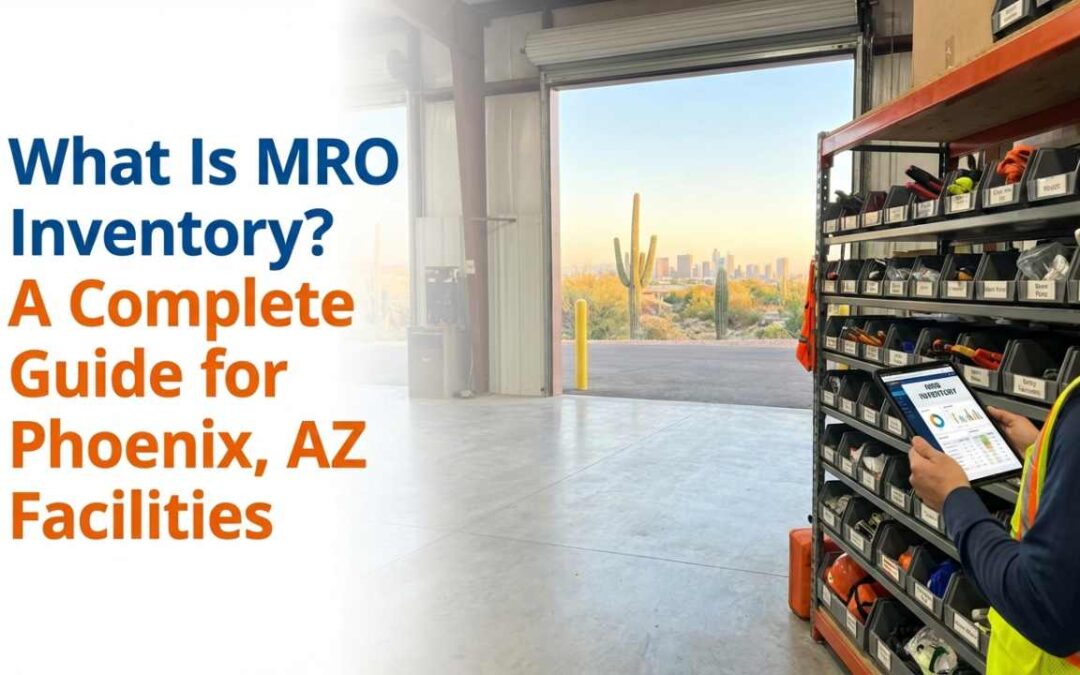
What Is MRO Inventory?
Ever lose a full production shift because one small part wasn’t on the shelf? That’s the MRO problem in real life.
MRO inventory stands for Maintenance, Repair, and Operations inventory. It covers every supply your facility needs to keep running, without directly touching your finished product. Think lubricants, safety gear, HVAC filters, and replacement motors.
In Phoenix, AZ, this matters even more. Extreme desert heat pushes equipment harder and burns through consumables faster than in most U.S. cities. Not just spare parts. Operational insurance.
Understanding MRO Inventory for Phoenix, AZ Facilities and Operations
MRO inventory is the backbone of any well-run facility. But most teams confuse it with direct inventory, and that mistake is costly.
Direct inventory goes into your product. MRO inventory keeps the machines making your product alive.
“MRO inventory is the oil in the engine of operations.”
It doesn’t generate revenue on its own. But without it, revenue stops fast. For Phoenix manufacturing facilities operating under intense thermal stress, MRO isn’t optional. It’s foundational.
Well-managed MRO inventory strengthens your entire supply chain. It keeps your team safe, your equipment running, and your operations predictable.
Purpose of MRO Inventory
Don’t dig a well when you’re already thirsty. That old proverb fits MRO inventory perfectly.
The purpose isn’t just to stockpile parts. It’s to shift your team from reactive firefighting to proactive protection. Every dollar spent on smart MRO management prevents five dollars in emergency repairs.
Here’s what MRO inventory is designed to do:
- Prevent unplanned downtime by keeping critical parts on hand before a breakdown happens
- Support preventive maintenance schedules with the right supplies at the right time
- Protect capital assets from accelerated wear, especially in high-heat Arizona environments
Industrial downtime costs can run $5,000 to $50,000 per hour, depending on your sector. MRO inventory is the buffer between smooth operations and that number hitting your P&L.
Synonyms and Related Terms
MRO inventory goes by several names across industries. Knowing them helps you communicate clearly across finance, procurement, and operations teams.
- MRO supplies – the physical items purchased and stored for maintenance use
- Indirect inventory – items not embedded in the finished product (often misclassified in accounting)
- Repair parts inventory – spare components kept ready for breakdown repairs
- Consumables inventory – items used regularly and replaced frequently, like gloves and lubricants
- Facility operations materials – broader term covering all indirect operational inputs
- Indirect procurement inventory – the purchasing category that covers MRO sourcing
Quick note: “indirect inventory” is one of the most misclassified categories in corporate accounting. Getting the label right protects your books.
The Business Value of MRO Inventory in Phoenix, AZ Operations
Smart operations leaders don’t just see MRO as a cost. They see it as a risk management tool.
When your MRO inventory is dialed in, three things happen. Breakdowns become rarer. Emergency spending drops. And your maintenance team stops reacting and starts planning.
Here’s where the real business value lives:
- Cost prevention, not just cost control. Stocking the right parts prevents $10,000 rush freight orders at 2 a.m.
- Asset protection. Routine maintenance supplies extend equipment life by years, protecting your capital base.
- Operational predictability. Facilities with optimized MRO inventory hit production targets more consistently.
One useful benchmark: MRO inventory spend typically runs between 1.5% and 3% of a facility’s Replacement Asset Value (RAV). If you’re well above that range, your system likely has inefficiencies worth fixing.
Not just cost control. Cost prevention.
Why Is MRO Inventory Management Important?
Here’s the question every ops manager should ask: what happens when you need a part and it isn’t there?
You stop production. You call a supplier. You pay premium rates for emergency delivery. And you explain the delay to leadership. That chain reaction costs far more than the part itself.
Good MRO management breaks that cycle. It gives you inventory accuracy, visibility into what’s on the shelf, and a system that flags shortages before they become crises.
Hidden costs of emergency procurement are real. Rush freight, overtime labor, and expediting fees add up fast. The solution isn’t buying more. It’s buying smarter.
Why MRO Inventory Management Is a Strategic Priority
MRO management isn’t just a maintenance department issue. It touches finance, procurement, and operations leadership at the same time.
When you gain full inventory visibility, you make better capital decisions. You stop over-ordering slow-moving parts and start forecasting based on real consumption data.
ABC classification is one of the most powerful levers here. It segments your inventory into high-value, high-frequency items (A), moderate items (B), and low-priority items (C). This lets your team focus energy where it matters most.
Strong MRO management builds supply chain resilience in Phoenix’s demanding industrial environment. Visibility isn’t a luxury. It’s the foundation of control.
Common Types and Examples of MRO Inventory Used in Phoenix, AZ
MRO inventory covers more ground than most people expect. It’s not just spare parts in a back room. It’s every category of supply that keeps your facility functional and safe.
Think of it like spare tires in a fleet yard. You don’t use them every day. But when you need one, nothing else will do.
In Phoenix specifically, high ambient temperatures accelerate wear on bearings, belts, seals, and HVAC components. Your MRO profile needs to reflect that reality.
Here’s how MRO inventory breaks down by category:
Mechanical: Bearings, belts, seals, gaskets, fasteners, couplings Electrical: Fuses, contactors, circuit breakers, sensors, wire connectors HVAC and Cooling: Filters, refrigerant, fan motors, belts (critical in Phoenix heat) Safety Equipment: PPE, gloves, hard hats, fire extinguishers, first aid supplies Consumables: Lubricants, cleaning agents, rags, cutting fluids, tape
Common Examples of MRO Inventory
Here’s a closer look at what shows up most often on Phoenix facility shelves, broken down by function:
Mechanical components:
- Bearings and bushings (high failure rate in heat-exposed machinery)
- Drive belts and V-belts
- Seals, O-rings, and gaskets
Electrical components:
- Fuses and circuit protection devices
- Motor starters and contactors
- Limit switches and proximity sensors
Safety supplies:
- Personal protective equipment (PPE)
- Eyewash stations and safety signage
- Fall protection gear
Consumables:
- Industrial lubricants and greases
- Hydraulic fluid
- Cleaning solvents and absorbents
Arizona’s heat environment puts extra stress on rubber seals, cooling components, and electrical insulation. Industrial MRO suppliers in Phoenix AZ should be stocking accordingly.
Real-World Usage of MRO Inventory in Phoenix, AZ Workplaces
You don’t notice MRO inventory when everything runs smoothly. You notice it when it doesn’t.
That’s the quiet truth most facilities learn the hard way. When the conveyor stops or the compressor fails, the first question is always the same: do we have the part?
Phoenix industrial operations face an added layer of pressure. Equipment here runs harder due to heat load, which means faster wear cycles and more frequent maintenance intervals. Smooth days mean invisible inventory. Broken days expose weak systems.
Maintenance
Preventive and predictive maintenance both depend on having the right MRO supplies on hand before anything breaks.
MRO inventory acts like preventive medicine for equipment. Just as you don’t wait until you’re sick to stock vitamins, you don’t wait for a breakdown to order filters and lubricants.
Common maintenance MRO items include:
- Filters (air, oil, hydraulic)
- Lubricants and greases
- Safety equipment for maintenance personnel
- Replacement belts and seals for scheduled servicing
Predictive analytics is changing this game fast. Facilities using sensor data and maintenance software are reducing emergency breakdowns by catching failure patterns early, and ordering MRO supplies before the alert fires.
Repair
Reactive repair is expensive. That’s just the truth.
When equipment fails without warning, your team scrambles. They search the storeroom. They call suppliers. They wait. Every hour of downtime on a Phoenix production floor has a dollar figure attached to it.
What’s the real cost of not having the right part on the shelf? Add up labor idle time, rush freight charges, and overnight procurement fees. Then add the production shortfall. The number might surprise you.
Repair-focused MRO items include:
- Spare motors and pumps
- Replacement valves and actuators
- Electrical spares for control panels
- Mechanical fasteners and coupling hardware
Having these on hand isn’t waste. It’s insurance with a known premium.
Operations
Daily operations consume MRO inventory steadily, even when nothing breaks.
Consumables, safety supplies, and facility materials keep your workforce safe and your environment functional. This category is easy to overlook until stock runs out at the wrong moment.
Key operational MRO categories:
- Consumables: Cutting fluids, lubricants, cleaning agents, rags
- Safety supplies: PPE, eyewash refills, first aid stock
- Facility supplies: Light bulbs, janitorial materials, signage
One tip specific to Phoenix: high-heat storage environments accelerate degradation in certain consumables, especially lubricants and adhesives. Build a stock rotation schedule that accounts for shelf life in 110-degree warehouse conditions.
Managing and Optimizing MRO Inventory in Phoenix, AZ
One metric changes everything. We’ll break it down below.
Moving from reactive MRO management to proactive control requires a structured approach. It’s not just about buying smarter. It’s about building a system that runs itself.
Here’s a practical four-step framework:
- Assess your current stock against actual consumption data
- Track every item with a real-time inventory system
- Optimize using ABC classification to prioritize high-value, high-frequency parts
- Audit with cycle counting to maintain accuracy without full shutdowns
Facilities that follow this cycle consistently see lower carrying costs, fewer stockouts, and better maintenance scheduling. That’s the compounding payoff of treating MRO inventory as a managed asset.
Tracking and Replenishment of MRO Items
Tracking MRO inventory manually is a slow path to stockouts and ghost inventory. Modern facilities need systems that work faster than spreadsheets.
Here’s what effective tracking looks like in practice:
- Barcode scanning for fast check-in and check-out of parts
- RFID asset tracking for high-value equipment and components
- Real-time inventory dashboards to see what’s on hand, what’s low, and what’s on order
- Automated replenishment triggers set at calculated reorder points
The reorder point formula matters here. It’s based on lead time variability plus safety stock. If your supplier takes five days to deliver, and you use three units per day, your reorder point should account for both average usage and worst-case delay.
ERP-integrated MRO tracking systems bring all of this together. Manual guessing gives you stockouts. Automated systems give you control.
Components of MRO Inventory Management
MRO inventory management isn’t one system. It’s four connected functions working in sync.
- Procurement – Sourcing the right parts from reliable suppliers at the right price
- Storage – Organizing the storeroom for fast retrieval and minimal damage
- Tracking – Monitoring usage, stock levels, and replenishment triggers in real time
- Audit – Validating physical stock against digital records through cycle counting
Aligning your CMMS (Computerized Maintenance Management System) with your ERP system is the most important integration move you can make. Without that connection, data silos form and inventory accuracy suffers fast.
Key Metrics to Track MRO Inventory
You can’t improve what you don’t measure. These are the KPIs that matter most:
- Inventory turnover rate – How often you cycle through your MRO stock. Low turnover means excess or obsolete inventory.
- Carrying cost percentage – The total cost of holding inventory, including storage, insurance, and depreciation.
- Stockout rate – How often a needed part isn’t available when requested. Even 2-3% stockout rates create meaningful downtime exposure.
- RAV ratio – MRO inventory value as a percentage of your Replacement Asset Value. Industry benchmarks: 0.5% to 2% for well-managed facilities.
Tie these KPIs to your annual maintenance budget forecasting. Tracking them quarterly turns reactive purchasing into predictive planning.
Cost Impact of MRO Inventory for Phoenix, AZ Businesses
MRO inventory isn’t a rounding error on the balance sheet. For most Phoenix industrial facilities, it represents a significant and often undermanaged expense.
Industry data suggests that MRO inventory costs typically account for 5% to 15% of a company’s total procurement spend. In asset-heavy industries like manufacturing and utilities, that percentage climbs higher.
The hidden costs compound fast. Carrying costs, emergency procurement premiums, and obsolete inventory write-offs add up to real budget pressure. Not just cost control. Cost prevention through systems.
Two levers drive the biggest savings: supplier consolidation (fewer vendors means better pricing and visibility) and demand-driven replenishment (ordering based on consumption data, not gut feel).
Typical Percentage of Replacement Asset Value (RAV)
RAV is the benchmark metric that separates well-run MRO programs from the rest.
Your Replacement Asset Value is the total cost to replace all your physical assets at current market prices. Your MRO inventory value expressed as a percentage of RAV tells you whether your storeroom is lean, balanced, or bloated.
Here’s what the benchmarks look like across industries:
- Best-in-class facilities: 0.5% to 1.0% of RAV
- Average industrial operations: 1.5% to 3.0% of RAV
- Facilities with known inefficiencies: 4.0% and above
If your RAV percentage is high, it usually signals over-purchasing, poor stock rotation, or obsolete parts accumulating on shelves. Tracking this metric annually gives your leadership team an honest view of inventory health
Accounting Standards Governing MRO Inventory in Phoenix, AZ
MRO inventory sits in an interesting accounting gray zone. Whether items are expensed immediately or capitalized as assets depends on their nature, cost, and accounting treatment under your applicable standards.
Getting this wrong creates compliance risk and distorts your financial reporting. The classification question matters whether you’re reporting under U.S. GAAP or IFRS.
Understanding the standards also helps during audits. When your MRO accounting aligns with recognized frameworks, you have a defensible, documented position rather than ad-hoc judgment calls.
Financial Accounting Standards Board (U.S. GAAP)
Under U.S. GAAP, MRO inventory classification depends primarily on how and when items are consumed.
Most MRO items are expensed when consumed rather than capitalized as long-term assets. Low-cost consumables like gloves, lubricants, and filters are typically expensed directly to maintenance cost in the period they’re used.
However, higher-value spare parts held for extended periods may qualify for capitalization as property, plant, and equipment, depending on their expected useful life and materiality threshold.
The Financial Accounting Standards Board doesn’t issue a single MRO-specific rule. Guidance is interpreted through broader inventory and PP&E standards. When in doubt, work with your controller to document the policy and apply it consistently.
International Accounting Standards Board (IFRS – IAS 2 Inventories)
Under IFRS, IAS 2 Inventories provides the primary guidance for MRO classification.
IAS 2 defines inventories as assets held for sale, in production, or in the form of materials and supplies to be consumed in the production process. Spare parts and servicing equipment that meet this definition are treated as inventory.
However, spare parts that qualify as property, plant, and equipment under IAS 16 are excluded from IAS 2 scope. This creates a classification decision point for major spare parts expected to be used over more than one period.
IAS 2 permits two inventory valuation methods: FIFO (First In, First Out) and weighted average cost. LIFO is not permitted under IFRS. Applying the right method consistently is essential for compliance and comparability.
Supply Chain Authorities on MRO Inventory Practices in Phoenix, AZ
Internal processes matter. But aligning them with industry-backed standards makes them defensible, scalable, and audit-ready.
Phoenix supply chain professionals operate in a nationally connected industrial economy. Knowing which frameworks and organizations set the standard helps you benchmark against the best, not just your local competitors.
Not just internal processes. Industry-backed standards.
Association for Supply Chain Management (ASCM)
The Association for Supply Chain Management is one of the most recognized bodies shaping inventory management practices globally.
ASCM, which absorbed APICS, provides the SCOR framework (Supply Chain Operations Reference), a globally recognized model for analyzing and improving supply chain performance. Their CPIM (Certified in Planning and Inventory Management) certification is directly relevant to MRO optimization.
For Phoenix operations leaders, ASCM-aligned teams bring structured thinking to replenishment, classification, and supplier performance. Facilities with APICS or CPIM-credentialed professionals tend to manage MRO inventory with greater consistency and lower cost variance.
Council of Supply Chain Management Professionals (CSCMP)
CSCMP is the leading global body for logistics and supply chain research and education.
Their annual State of Logistics Report and other benchmarking publications give supply chain teams real data for comparing performance against industry norms. For MRO management, their research on carrying costs, supplier lead times, and procurement efficiency provides a strong evidence base.
Phoenix-area supply chain professionals can leverage CSCMP membership for networking, education, and access to data-driven benchmarks that strengthen both strategy and budget justification with leadership.
Institute for Supply Management (ISM)
ISM sets the standard for procurement maturity across industrial sectors.
Their procurement maturity model helps organizations move from reactive purchasing (ordering parts when they run out) to strategic sourcing (building supplier relationships that reduce cost and improve reliability). For MRO specifically, this means consolidating vendors, negotiating blanket purchase orders, and building service-level agreements that protect supply continuity.
ISM’s CPSM (Certified Professional in Supply Management) credential is widely recognized for procurement leadership roles. Facilities that align MRO sourcing with ISM frameworks tend to capture meaningful savings without sacrificing parts availability.
Inventory and Asset Management Software for MRO in Phoenix, AZ
The right platform does more than track parts. It predicts risk.
Modern MRO management software connects procurement, maintenance, and finance into one system. That integration eliminates the data silos that cause phantom inventory, duplicate orders, and missed reorder triggers.
For Phoenix facilities evaluating platforms, the core question is this: does it integrate with your CMMS and your ERP? If those two systems don’t talk to each other, you’re managing blind.
Oracle NetSuite
Oracle NetSuite is a cloud-based ERP platform with strong inventory management capabilities built in.
For MRO operations, NetSuite provides real-time stock tracking, demand planning, and automated replenishment workflows. Its native financial integration means every MRO transaction flows directly into your general ledger without manual journal entries.
Phoenix businesses using NetSuite benefit from centralized visibility across locations. The platform scales well for mid-size to enterprise operations and supports multi-warehouse management, which matters when storerooms span multiple facilities
SAP
SAP’s PM (Plant Maintenance) module is purpose-built for industrial MRO environments.
It connects equipment records, maintenance work orders, and spare parts inventory in one integrated system. When a work order is created, SAP automatically checks parts availability and triggers purchasing when stock falls below threshold.
SAP’s integration between its Materials Management (MM) and Plant Maintenance (PM) modules is particularly powerful for high-asset facilities. For large Phoenix manufacturers, this level of integration reduces emergency procurement and improves maintenance schedule adherence.
IBM Maximo
IBM Maximo acts as a digital command center for enterprise asset management.
Maximo is designed specifically for asset-intensive industries. It manages the full lifecycle of physical assets alongside the MRO inventory needed to maintain them. Its work order, inventory, and procurement modules connect directly, so parts consumption is tracked against specific assets and maintenance jobs.
Maximo’s predictive maintenance integration is a key differentiator. When sensor data flags an anomaly, Maximo can automatically check parts availability and generate a purchase order before the failure occurs. For Phoenix industrial operations, that capability reduces reactive repair costs significantly.
Microsoft Dynamics 365
Microsoft Dynamics 365 Supply Chain Management brings flexibility to mid-market Phoenix businesses.
Its modular architecture lets companies start with core inventory and add capabilities over time, including asset management, demand forecasting, and vendor portal integration. The cloud-native platform connects naturally with Microsoft 365 productivity tools, which reduces adoption friction.
For Phoenix firms that aren’t ready for a full SAP or Oracle deployment, Dynamics 365 offers enterprise-grade MRO tracking capability at a more accessible scale. The system handles multi-location inventory, automated replenishment, and real-time cost reporting without requiring a massive IT footprint.
Professional Education Resources on MRO Inventory in Phoenix, AZ
Building a smarter MRO program starts with building smarter teams. These resources support cross-functional learning between finance, procurement, and maintenance, the three groups that need to agree on how MRO inventory works.
The most successful Phoenix operations teams don’t silo MRO knowledge. Finance understands the accounting treatment. Procurement understands sourcing strategy. Maintenance understands consumption patterns. Together, they manage MRO as a system.
Investopedia
Investopedia provides accessible definitions and financial context for MRO inventory terms.
It’s a strong starting point for finance team members who need to understand MRO from a working capital and balance sheet perspective. Use it to establish baseline financial literacy before diving into more technical procurement frameworks.
AccountingTools
AccountingTools offers detailed GAAP-specific guidance relevant to MRO inventory classification and expensing decisions.
It’s particularly useful for controllers and accounting staff navigating the capitalization vs. expensing question. The site addresses nuances like materiality thresholds and policy consistency, which matter during audit review.
Corporate Finance Institute (CFI)
CFI connects MRO inventory to broader financial modeling and working capital strategy.
Its content helps finance teams understand how MRO carrying costs and turnover rates affect cash flow and balance sheet metrics. Tying inventory management to working capital efficiency is a conversation that gains executive attention fast.
Academic References for MRO and Operations Management in Phoenix, AZ
Theoretical grounding matters for building systems that hold up at scale.
Operations management literature provides proven models for MRO inventory control. The Economic Order Quantity (EOQ) model calculates the optimal order size to minimize total ordering and carrying costs. Safety stock models determine the right buffer inventory level based on demand variability and lead time uncertainty.
Phoenix operations leaders using these models make procurement decisions grounded in math rather than instinct. These frameworks appear in foundational supply chain texts from academic publishers and are taught in operations management programs at Arizona State University and other regional institutions.
Pairing academic models with real-world data from your facility creates a feedback loop that continuously improves your MRO program.
Industrial and Maintenance Organizations Supporting MRO Best Practices in Phoenix, AZ
Industry membership isn’t just networking. It’s access to standards, benchmarks, and certification pathways that make your maintenance program measurably stronger.
Phoenix operations professionals have access to globally recognized organizations that set the bar for MRO and reliability management. Aligning with their frameworks signals commitment to operational excellence, internally and to partners.
Not just internal best practices. Industry-validated reliability standards.
Society for Maintenance and Reliability Professionals (SMRP)
SMRP is the leading professional organization for maintenance and reliability engineers in industrial settings.
Their CMRP (Certified Maintenance and Reliability Professional) credential validates expertise in asset management, work management, and MRO inventory control. SMRP also publishes standardized metrics for maintenance performance, including definitions for OEE, MTBF, and maintenance cost as a percentage of RAV.
For Phoenix maintenance managers, SMRP membership provides access to peer benchmarking data and professional development resources that directly improve MRO program performance.
International Society of Automation (ISA)
ISA sets the standards for industrial automation and control systems that directly affect MRO reliability requirements.
As Phoenix facilities adopt more automated and sensor-driven equipment, MRO programs must evolve alongside them. ISA’s standards around instrumentation, control systems, and safety instrumented systems define what spare parts and maintenance protocols industrial automation demands.
ISA-aligned facilities are better positioned to connect predictive maintenance technology with MRO inventory management, creating a system where equipment health data drives parts procurement decisions automatically.
MRO Inventory Management in Phoenix, AZ Starts With the Right Partner
You now know what MRO inventory is. You know why it matters. And you know what poor management costs your facility every single day.
The next step isn’t reading more. It’s acting on what you know.
Phoenix facilities face real pressure. Desert heat accelerates equipment wear. Production demands don’t slow down. And one missing part can trigger a chain reaction that costs thousands before lunch.
The facilities that win aren’t the ones with the biggest budgets. They’re the ones with the smartest systems. They track the right metrics. They stock the right parts. And they partner with suppliers who understand Phoenix industrial operations from the ground up.
At Jay Hohel Inc, we’ve worked with Phoenix area facilities that were drowning in reactive maintenance, bloated storerooms, and emergency procurement costs. We help teams build lean, reliable MRO inventory programs that actually work in Arizona’s demanding environment.
You don’t have to figure this out alone. The right MRO partner changes everything.
Ready to stop reacting and start controlling? Let’s build a smarter MRO system together.
📍 Contact Jay Hohel Inc
Jay Hohel Inc 3334 W McDowell Rd Unit 17 Phoenix, AZ 85009
📞 (602) 272-4033 📧 JayHoehlinc@gmail.com 🌐 jhiescrap.com