
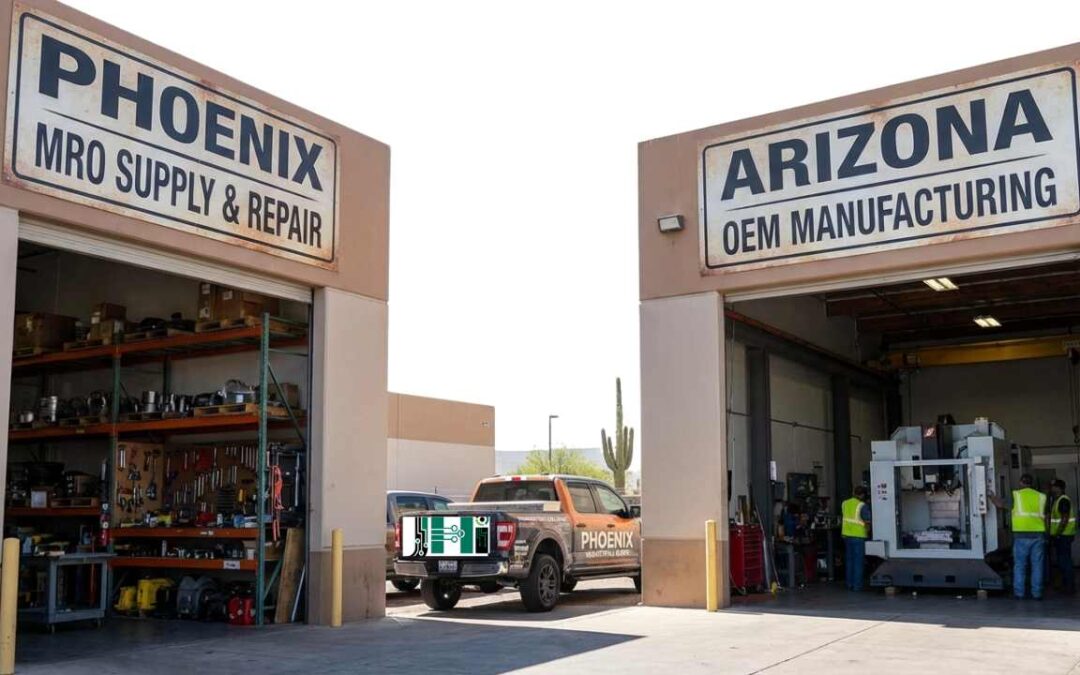
Many Phoenix manufacturers confuse MRO and OEM until downtime hits. By then, the cost is already real. Understanding the difference isn’t just an academic exercise. It’s a strategic move that protects your operations, your budget, and your equipment.
So, what actually separates these two terms? MRO keeps your assets running. OEM brings them to life.
This guide breaks it all down. You’ll walk away with clarity on definitions, lifecycle stages, cost structures, and supply chain strategy. All framed for Phoenix’s fast-moving industrial market.
Understanding MRO vs OEM for Phoenix, AZ Businesses
Phoenix isn’t just the desert Southwest. It’s a manufacturing and aerospace powerhouse. Companies near Sky Harbor and the East Valley corridor run complex operations every day. They need two very different supply strategies to stay competitive.
The problem? Most teams blur the line between MRO and OEM spending. That blurs budgets, distorts inventory, and slows procurement decisions.
Don’t fix the roof when it rains. Understand the distinction before a breakdown forces your hand.
OEM (Original Equipment Manufacturer) refers to companies that design and produce equipment or components. They focus on building the asset from scratch. Their world is engineering specs, production timelines, and proprietary technology.
MRO (Maintenance, Repair, and Operations) refers to the supplies and services that keep existing equipment functional. MRO kicks in after the asset is deployed. Think lubricants, spare parts, repair labor, and facility upkeep.
Together, they cover the full arc of an asset’s life. But they serve very different masters.
Definition and Core Purpose
OEM stands for Original Equipment Manufacturer. It covers companies that produce finished goods or major components used in another product. OEM activity happens at the pre-production stage. It’s about engineering, design, and building.
MRO stands for Maintenance, Repair, and Operations. It covers all the goods and services needed to maintain operational assets after they’re deployed. MRO activity happens post-deployment. It’s about sustaining performance and preventing failure.
OEM = pre-production. MRO = post-deployment.
These aren’t interchangeable terms. They represent different stages of an asset’s life and require different procurement strategies.
Role of OEM vs MRO
OEM suppliers engineer and manufacture the core asset. They hold the intellectual property. They define the specifications. In Phoenix’s aerospace cluster, OEM partners often supply proprietary airframe components or engine systems built to FAA-approved designs.
MRO suppliers step in after the asset is live. They provide the parts, labor, and services that keep it running. For a Phoenix-based semiconductor manufacturer, MRO might mean conveyor belts, HVAC filters, or CNC machine tooling.
OEM builds the asset. MRO protects the asset.
The responsibilities don’t overlap much. But both are critical to long-term operational success.
Focus of OEM vs MRO
| Category | OEM Focus | MRO Focus |
|---|---|---|
| Stage | Pre-production | Post-deployment |
| Goal | Build the asset | Sustain the asset |
| Budget type | CapEx | OpEx |
| Key metric | Production output | Uptime and reliability |
What does this mean for your budget? OEM spend is planned upfront. It ties to capital projects and asset acquisition. MRO spend is ongoing. It fluctuates with usage, age, and maintenance schedules.
How you allocate between the two shapes your total cost of ownership over years, not just quarters.
Key Strategic Differences Between MRO and OEM in Phoenix, AZ
Decision-makers in Phoenix need more than definitions. They need a clear lens for evaluating cost, risk, and lifecycle timing. We’ll explain why cost structures differ dramatically below.
OEM procurement is predictable. You design a product. You source components. You manufacture at scale. MRO procurement is reactive and variable. Equipment breaks unexpectedly. Parts go obsolete. Suppliers run short.
That difference alone changes how you plan, how you budget, and how you build vendor relationships.
Key Functional Differences
Day-to-day, OEM and MRO operations look very different:
- OEM teams focus on design validation, production scheduling, and bill-of-materials management
- MRO teams focus on spare parts availability, preventive maintenance schedules, and work order execution
- OEM success is measured by production output and quality yield
- MRO success is measured by uptime, mean time between failures, and repair cycle time
Downtime metrics matter enormously here. A single unplanned outage at a Phoenix auto parts manufacturer can cost tens of thousands per hour. MRO readiness directly prevents that loss.
Lifecycle Stage of OEM and MRO
Think of it as a timeline. OEM is birth. MRO is longevity.
OEM activity clusters at the front end of an asset’s life. Engineering, manufacturing, and delivery happen before the asset ever hits your floor. After that, OEM’s role shrinks.
MRO takes over from day one of deployment. As equipment ages, MRO demand grows. Wear increases. Parts need replacement. Maintenance cycles tighten.
Worth noting: asset depreciation also plays a role. As OEM assets lose book value, the cost of MRO relative to replacement becomes a key decision metric. That’s where total cost of ownership modeling becomes essential.
Intellectual Property Ownership
OEM companies own the design. They hold patents, engineering specs, and manufacturing rights. For Phoenix aerospace companies, this matters enormously. Proprietary components often can’t be sourced from alternative suppliers without voiding warranties or violating FAA compliance agreements.
MRO suppliers typically don’t hold IP in the same way. They supply generic or approved-equivalent parts. The risk here is compatibility. Using non-OEM approved parts in a regulated aerospace environment carries real legal and safety exposure.
Understand who owns the design before you make a sourcing decision.
Cost Differences
Are you tracking the hidden cost of reactive maintenance?
OEM spend hits as capital expenditure (CapEx). It’s a one-time or project-based investment. It appears on your balance sheet as an asset.
MRO spend runs as operational expenditure (OpEx). It’s ongoing. It flows through your income statement. It’s often underestimated because it’s fragmented across departments.
| Cost Type | OEM | MRO |
|---|---|---|
| Budget Category | CapEx | OpEx |
| Timing | Upfront, project-based | Ongoing, recurring |
| Predictability | High | Low to moderate |
| Impact on EBITDA | Depreciation over time | Direct expense |
Lifecycle cost modeling helps here. Track MRO spend over an asset’s life alongside its OEM acquisition cost. The ratio tells you when replacement beats repair.
Supply Chain and Inventory Management for MRO and OEM in Phoenix, AZ
Phoenix sits at the heart of a dynamic supply chain network. The Arizona aerospace cluster, semiconductor manufacturing corridor, and logistics infrastructure make this city a critical node in U.S. industrial supply chains.
Think of inventory as insurance. Run out of a critical MRO part and you’re not just behind. You’re stopped.
OEM supply chains run on precision and volume. MRO supply chains run on breadth and availability. Managing both under the same roof requires very different inventory strategies.
Procurement Strategies
How you source MRO vs OEM parts differs fundamentally.
OEM procurement typically involves long-term contracts with a small number of qualified suppliers. Volume drives cost. Spec compliance is non-negotiable.
MRO procurement is broader and more fragmented. Parts come from dozens of vendors. Vendor diversification matters because a single-source failure can halt operations.
Do you have a backup supplier for your three most critical MRO categories? If not, your supply chain has a vulnerability.
MRO best practices include blanket purchase orders, vendor-managed inventory programs, and consolidated distributor relationships. These reduce transaction cost and improve fill rates.
The Lifecycle Relationship
OEM and MRO aren’t opposites. They’re partners across time.
OEM delivers the asset. MRO sustains it. As assets age, OEM specifications define what MRO parts are compatible. That relationship shapes your approved vendor lists, your compliance obligations, and your maintenance budgets.
Long-term service agreements (LTSAs) often bridge the two. An OEM might offer an LTSA that covers both warranty support and scheduled MRO services. For Phoenix manufacturers running high-value aerospace equipment, LTSAs reduce procurement complexity and lock in pricing.
OEM defines the standard. MRO maintains it.
How to Manage MRO Inventory Effectively
Good inventory management is a competitive edge. Great inventory management prevents shutdowns.
A well-known proverb fits here: “An ounce of prevention is worth a pound of cure.” That’s true in medicine. It’s equally true in MRO.
- Classify your inventory using ABC analysis. A-class items are high-value and high-criticality. B-class items are moderate. C-class items are low-value and high-volume. Prioritize your A-class parts with tighter controls and higher safety stock.
- Set reorder points based on lead time, not gut feel. Know how long each critical part takes to arrive. Build buffer stock accordingly.
- Audit your inventory twice per year. Obsolete parts waste shelf space and capital. Remove them systematically.
- Consolidate your vendor list. Fewer suppliers with deeper relationships means better service levels and faster response during shortages.
- Integrate your inventory system with your ERP. Real-time visibility prevents stockouts and overbuying.
You’ve got more control over MRO spend than you think. Audit your inventory today.
Industry Applications of MRO vs OEM in Phoenix, AZ
Engines never sleep in Phoenix. Neither do the supply chains that support them.
Phoenix hosts one of the most concentrated aerospace and advanced manufacturing ecosystems in the country. That means MRO and OEM strategies aren’t abstract here. They’re daily operational decisions that affect safety, throughput, and profitability.
Which industry sounds most like yours?
OEM shapes production. MRO shapes performance.
Aviation and Aerospace
When an aircraft is grounded, every hour costs thousands. That reality makes MRO strategy a safety and financial imperative in aviation.
Phoenix-area aerospace companies operate under strict FAA compliance requirements. MRO in this sector isn’t optional. It’s regulated. Every maintenance action must be documented, approved, and performed by certified technicians using qualified parts.
OEM suppliers in aerospace provide proprietary airframes, avionics systems, and engine components. Their specifications govern what MRO parts are compatible and who can perform the work.
Key considerations for Phoenix aerospace operations:
- FAA-approved MRO providers only
- OEM-authorized parts sourcing to maintain airworthiness
- Documented maintenance tracking for regulatory compliance
- Predictive maintenance programs to reduce unscheduled downtime
Automotive and Manufacturing
OEM builds the line. MRO keeps the line moving.
In Phoenix’s automotive and advanced manufacturing sectors, OEM suppliers deliver the machinery, tooling, and production systems. Once those assets are running, every unplanned breakdown translates directly to lost production cycles and missed delivery windows.
MRO strategy in manufacturing focuses on uptime. Conveyor systems, hydraulic components, electrical panels, and pneumatic tools all require regular maintenance. Reactive maintenance is expensive. Planned maintenance is an investment.
Tie your MRO spend to production KPIs. When you can show that preventive maintenance reduced downtime by 15%, that’s a budget conversation that wins.
Real-World Usage Examples of OEM and MRO in Phoenix, AZ
Theory is useful. Real scenarios are better. Here’s how this plays out in real operations across Phoenix.
OEM Example
A Phoenix-based defense contractor wins a contract to manufacture UAV airframe components. Their OEM process starts with proprietary engineering blueprints. Every material, tolerance, and assembly step follows approved specifications.
From blueprint to reality, the OEM lifecycle covers design validation, supplier qualification, production tooling, and quality inspection. The finished components ship to the prime contractor for integration.
The OEM supplier holds the IP. They own the manufacturing process. Their value is in precision and repeatability at scale.
This is OEM in action. It’s high-stakes, spec-driven, and front-loaded in the asset lifecycle.
MRO Example
A Phoenix semiconductor fab runs 24/7. Their CNC machining centers process wafers nonstop. Then a spindle bearing fails at 2 AM.
What’s an hour of downtime worth in a high-output fab? Easily $50,000 or more.
An effective MRO strategy means that bearing is already on the shelf. The work order triggers automatically. A certified technician arrives within the hour. Production resumes before sunrise.
This is MRO in action. It’s reactive when it has to be. But the best MRO programs make it mostly proactive.
Supply Chain Example
Here’s a three-step model for how spare parts flow through an MRO supply chain in a Phoenix manufacturing operation:
Step 1 — Demand forecasting. Historical usage data drives reorder points. A-class parts maintain safety stock. C-class parts are ordered on demand.
Step 2 — Procurement and receiving. Approved vendors fulfill orders against blanket POs. Parts are received, inspected, and logged into the ERP system.
Step 3 — Inventory deployment. Parts are issued to work orders. Usage is tracked. Reorder signals trigger before stockout risk appears.
Inventory is silent insurance. You don’t notice it until you need it.
Synonyms and Terminology for MRO and OEM in Phoenix, AZ
Terminology varies across industries and accounting contexts. Knowing the synonyms helps you communicate across teams and align with vendors.
OEM Synonyms
- Original Equipment Manufacturer — the standard term
- Brand manufacturer — used in consumer and industrial contexts
- Prime contractor — common in defense and aerospace
- Design authority — used when IP ownership is the focus
- Tier-1 supplier — refers to direct supply to the assembler
Industry-specific variants matter. Aerospace uses “design authority.” Automotive uses “Tier-1.” Know your sector’s language.
MRO Synonyms
- Maintenance, Repair, and Operations — the full form
- Indirect materials — used in accounting and procurement
- Facilities maintenance supplies — common in plant operations
- Operational supplies — general business usage
- Non-production inventory — used to distinguish from OEM production stock
MRO differs from capital projects. A capital project creates a new asset. MRO sustains an existing one. That distinction matters when classifying expenses.
Business Importance of MRO and OEM Across Asset Lifecycles in Phoenix, AZ
Here’s a proverb worth remembering: “The bitterness of poor maintenance lasts longer than the sweetness of low price.”
For Phoenix executives managing long-lived industrial assets, this isn’t poetry. It’s financial reality. Total Cost of Ownership (TCO) captures both the OEM acquisition cost and the full run of MRO expenses over an asset’s operational life. When you model TCO properly, cheap equipment often becomes the most expensive decision you ever made.
Understanding both MRO and OEM through the lens of lifecycle value is how industrial leaders in Phoenix separate reactive spending from strategic investment.
Long-Term Asset Reliability and Performance
Strong MRO discipline doesn’t just prevent breakdowns. It compounds returns over time. Here’s how:
- Predictive maintenance shifts your team from reacting to failures to preventing them. Vibration analysis, thermal imaging, and oil sampling catch problems before they cascade.
- Preventive maintenance schedules extend asset life and reduce per-unit maintenance cost over time.
- Reliability-centered maintenance (RCM) aligns maintenance strategy to asset criticality. You spend more protecting what matters most.
Reactive maintenance reacts to failure. Strategic maintenance prevents it.
The ROI of MRO discipline shows up in uptime metrics, reduced overtime repair costs, and longer asset replacement cycles. That’s profit protection, not just cost avoidance.
Accounting Standards Affecting MRO and OEM in Phoenix, AZ
Are your inventory classifications costing you on your financial statements without you realizing it?
Misclassifying MRO vs OEM spend distorts your EBITDA, complicates audits, and creates cash flow surprises. Accounting standards exist to keep this straight. Phoenix companies with global operations need to navigate both U.S. GAAP and IFRS frameworks.
Capitalize what builds value. Expense what sustains it.
Financial Accounting Standards Board (FASB)
Under U.S. GAAP, OEM production inventory is capitalized as an asset on the balance sheet. It flows through cost of goods sold (COGS) when the product is sold. MRO supplies, by contrast, are typically expensed as incurred unless they extend the useful life of a capital asset.
Key FASB guidance points:
- OEM raw materials and work-in-progress: capitalized inventory
- MRO consumables and repair supplies: operational expense
- MRO spare parts that extend asset life or add capability: may be capitalized under ASC 360
- Improper classification creates audit risk and distorts gross margin reporting
Proper classification supports predictable budgeting and cleaner financial statements.
International Accounting Standards Board (IAS 2 and IAS 16)
Cross-border aerospace companies operating in Phoenix often follow IFRS. Two standards govern MRO and OEM classification under IFRS.
IAS 2 (Inventories) covers OEM production inventory and MRO spare parts held for sale or use. It requires inventory to be measured at the lower of cost and net realizable value.
IAS 16 (Property, Plant and Equipment) covers major spare parts and standby equipment. Under IAS 16, significant spare parts that are expected to be used over more than one period can be classified as PP&E rather than inventory.
Standards create the financial runway your operations take off from.
Supply Chain Authorities on MRO vs OEM Practices in Phoenix, AZ
Association for Supply Chain Management (ASCM)
ASCM sets the global standard for supply chain education and certification. Their APICS certifications, including CPIM (Certified in Production and Inventory Management) and CSCP (Certified Supply Chain Professional), are benchmarks for procurement and operations professionals.
For Phoenix MRO teams, APICS frameworks provide structured approaches to inventory classification, demand planning, and supplier management. These credentials signal professional credibility in a competitive market.
Council of Supply Chain Management Professionals (CSCMP)
CSCMP provides research, frameworks, and professional development for logistics and supply chain leaders. Their annual State of Logistics report is a key reference for understanding market conditions affecting MRO procurement costs.
CSCMP frameworks support inventory optimization by connecting logistics performance metrics to broader operational goals. Phoenix manufacturers can use these standards to benchmark their MRO supply chain performance against industry peers.
Institute for Supply Management (ISM)
ISM governs procurement governance and ethical sourcing standards. Their Certified Professional in Supply Management (CPSM) credential is widely recognized across industrial sectors.
ISM emphasizes ethical sourcing as a core procurement discipline. For Phoenix companies sourcing MRO from global vendors, this matters. Supply chain transparency and supplier auditing reduce risk across your vendor base.
Industrial Organizations Supporting MRO Best Practices in Phoenix, AZ
Reactive maintenance fixes problems. Proactive maintenance prevents them. These organizations lead the shift.
Society for Maintenance and Reliability Professionals (SMRP)
SMRP sets the benchmark for maintenance and reliability excellence. Their Certified Maintenance and Reliability Professional (CMRP) credential is the gold standard for industrial maintenance leaders.
SMRP’s five pillars of maintenance and reliability cover business and management, manufacturing process reliability, equipment reliability, organization and leadership, and work management. Phoenix-area manufacturers who align to these pillars operate more efficiently and experience fewer unplanned outages.
Relevant SMRP standards:
- Reliability-centered maintenance frameworks
- Work order management best practices
- Maintenance performance metric definitions
International Society of Automation (ISA)
Automation turns maintenance from reactive to predictive.
ISA develops global automation and control standards used across manufacturing, process industries, and aerospace. Their standards govern instrumentation, safety systems, and industrial network protocols.
For MRO teams, ISA standards matter because modern assets are increasingly sensor-equipped. Predictive maintenance programs depend on accurate, standardized data from instrumentation. ISA’s frameworks ensure that data is reliable and interoperable across systems.
As Phoenix manufacturers invest in Industry 4.0 technologies, ISA alignment becomes a prerequisite for smart maintenance programs.
ERP and Asset Management Software for MRO and OEM Operations in Phoenix, AZ
What happens when inventory data lives in spreadsheets instead of systems? Stockouts. Duplicate orders. Missed maintenance windows. Lost money.
Modern ERP and asset management platforms bring visibility and control to both MRO and OEM operations. The right system connects procurement, inventory, maintenance, and finance in one place.
You don’t have to guess what’s on the shelf anymore.
IBM Maximo
IBM Maximo is the enterprise standard for asset lifecycle management. It tracks assets from acquisition through retirement, connecting maintenance work orders to inventory consumption in real time.
Maximo’s predictive maintenance modules use IoT sensor data to trigger maintenance before failure occurs. For Phoenix aerospace and manufacturing companies managing high-value assets, Maximo reduces unplanned downtime and extends equipment life.
Key features relevant to MRO:
- Work order management
- Spare parts inventory integration
- Preventive and predictive maintenance scheduling
Oracle NetSuite
Oracle NetSuite delivers cloud-based ERP with strong inventory and supply chain modules. It’s well-suited for growing Phoenix manufacturers that need scalability without on-premise infrastructure complexity.
NetSuite connects procurement, warehouse management, and financial reporting. MRO buyers get real-time visibility into stock levels, vendor performance, and reorder status. As your operation scales, NetSuite scales with it.
SAP
SAP’s ERP platform is the backbone of many global manufacturing operations. Its Plant Maintenance (PM) module integrates directly with procurement, inventory, and finance. This creates a closed loop from maintenance request to parts replenishment to cost capture.
For Phoenix companies with global supply chains, SAP’s integration across procurement and maintenance delivers unmatched lifecycle visibility. SAP also supports multi-currency and multi-entity operations for complex industrial organizations.
Microsoft Dynamics 365
Microsoft Dynamics 365 brings ERP capability to mid-market Phoenix manufacturers without the complexity of enterprise-tier implementations. Its supply chain and asset management modules provide real-time inventory dashboards and maintenance tracking.
Dynamics 365 integrates natively with Microsoft 365 tools, making adoption faster for teams already in the Microsoft ecosystem. For MRO operations running on spreadsheets, Dynamics 365 is a practical upgrade path.
Key benefits:
- Real-time inventory visibility
- Maintenance work order tracking
- Supplier collaboration tools
Educational Resources on MRO and OEM for Phoenix, AZ Professionals
In fast-moving industries, knowledge ages quickly. Staying sharp on MRO and OEM strategy means more than reading one article. It means building a foundation of financial literacy, operations theory, and supply chain intelligence.
What separates a good procurement team from a great one? Often, it’s how well they understand the financial and operational context behind their decisions.
Investopedia
Investopedia provides accessible, authoritative definitions for financial and business terminology. Their explanations of OEM and MRO cut through jargon and help align language across finance and operations teams.
For Phoenix executives, this alignment matters. When procurement, finance, and operations use the same definitions, decisions move faster and classification errors drop. Start with Investopedia to build a shared vocabulary across your team.
AccountingTools
AccountingTools offers detailed guidance on inventory accounting, capitalization rules, and cost classification. For MRO vs OEM decisions, their explanations of CapEx vs OpEx classification and inventory write-down rules are particularly useful.
Good accounting measures cost. Strategic accounting manages it.
For Phoenix manufacturers navigating FASB or IFRS standards, AccountingTools provides plain-language explanations that reduce audit risk and improve financial clarity.
Corporate Finance Institute (CFI)
CFI delivers structured financial training through online courses covering lifecycle costing, operations management, and inventory valuation. Their modules on total cost of ownership and capital budgeting directly support OEM vs MRO decision analysis.
Financial literacy drives operational success. When your MRO team understands how their spending affects EBITDA, they make better sourcing decisions. CFI builds that competency systematically.
Academic References on MRO, OEM, and Operations Management in Phoenix, AZ
Operations strategy is the engine beneath the surface. Academic frameworks give it structure.
How do top-performing Phoenix manufacturers stay competitive long-term? Often, they ground their operational decisions in proven academic models. Research-backed frameworks reduce guesswork and improve consistency.
Operations Management
Operations management theory connects OEM production planning to MRO maintenance strategy at the systems level. Lean manufacturing principles, developed through decades of academic and applied research, reduce waste across both OEM production and MRO processes.
Six Sigma methodologies improve reliability and reduce defect rates in both production and maintenance contexts. For Phoenix manufacturers, applying Lean and Six Sigma to MRO programs reduces excess inventory, shortens repair cycles, and cuts downtime.
Production creates value. Maintenance protects value.
Supply Chain Management
Supply chain research highlights a critical difference between OEM and MRO demand patterns. OEM production inventory follows relatively predictable demand tied to production schedules. MRO demand is variable and hard to forecast.
Think of your supply chain as a circulatory system. OEM keeps the heart pumping. MRO keeps the arteries clear.
Academic supply chain frameworks address MRO’s variability through safety stock modeling, multi-echelon inventory theory, and vendor-managed inventory programs. Phoenix manufacturers who apply these frameworks experience fewer stockouts and lower inventory carrying costs.
Inventory Control and Management
Are you holding too much of the wrong inventory and too little of the right inventory?
Production inventory management follows Just-In-Time (JIT) principles. Low stock. High turnover. Demand-driven replenishment. MRO inventory management follows a different logic. Safety stock matters. Criticality drives classification. ABC analysis determines where you invest your inventory dollars.
The academic literature on inventory optimization gives Phoenix operations teams the models they need to balance service level against carrying cost. That balance is where profitability hides.
Production and Operations Management
Production and operations management research ties all of these threads together. Total Cost of Ownership models, lifecycle ROI frameworks, and reliability engineering theory all converge here.
Short-term savings look good on paper. Long-term performance builds real profit.
Phoenix industrial leaders who apply TCO thinking to both OEM acquisition decisions and MRO program investments make better capital allocation choices. They replace assets at the right time. They invest in preventive maintenance before the curve turns painful.
Conclusion: Protect Your Assets and Your Bottom Line
You now have a clear map. MRO and OEM are not competing priorities. They’re complementary strategies that cover different phases of your asset’s life.
OEM builds what you operate. MRO protects what you’ve built.
Phoenix manufacturers who understand that distinction make smarter procurement decisions, allocate budgets more accurately, and build supply chains that hold up under pressure. Those who blur the line pay for it in downtime, misclassified expenses, and preventable failures.
Are you treating MRO and OEM strategy with equal discipline?
If your operation is running on reactive maintenance, fragmented inventory, and spreadsheet-based procurement, there’s a better path. The frameworks, standards, and tools in this guide give you the foundation to build it.
Maximize your equipment lifespan. Strengthen your supply chain. Protect your margins.
We’ll be here when you’re ready to strengthen your operation. Connect with a Phoenix industrial MRO services partner who understands the full lifecycle.
The Bottom Line on MRO vs OEM in Phoenix, AZ
Now you know the difference. MRO sustains what you already run. OEM builds what you haven’t deployed yet. These two strategies cover your entire asset lifecycle from first bolt to final retirement.
Phoenix manufacturers who master both win on two fronts. They control uptime. They control cost.
The companies losing ground right now are the ones still treating MRO as an afterthought. They buy parts when things break. They scramble for vendors under pressure. They pay premium prices at the worst possible time.
You don’t have to operate that way.
Strategic MRO management means you stock the right parts. You maintain the right assets. You spend your OpEx dollars where they protect the most value. And you never let a missing bearing shut down a $50,000-per-hour operation.
At Jay Hohel Inc, we’ve worked with Phoenix-area industrial businesses for years. We understand the local supply chain. We know the aerospace corridor. We know what manufacturers here actually need when operations are on the line.
Your equipment works hard. Make sure your supply strategy works just as hard.
Ready to protect your operation and reduce downtime? Let’s talk.
📍 Jay Hohel Inc
3334 W McDowell Rd, Unit 17
Phoenix, AZ 85009
📞 (602) 272-4033
📧 JayHoehlinc@gmail.com
🌐 jhiescrap.com