
Are Old Electronics Worth Any Money?
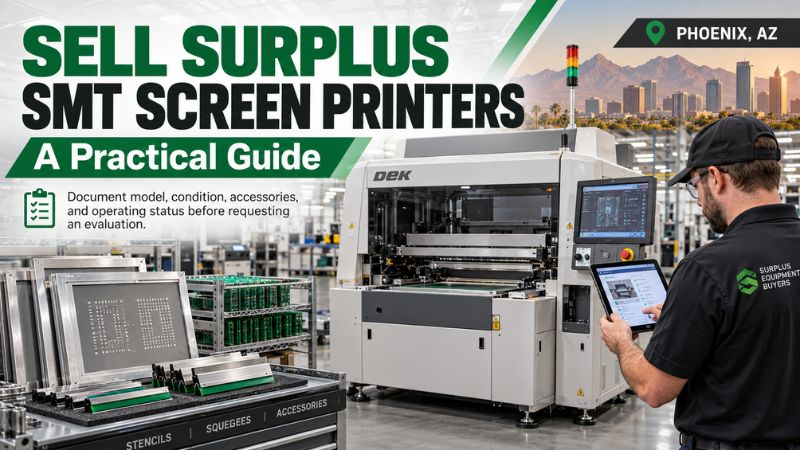
This guide focuses on selling surplus SMT screen printers in Phoenix, AZ.
These factory machines print solder paste onto circuit boards through a stencil.
SMT stands for surface mount technology.An idle printer could help another production line.
Its model, condition, features, and buyer demand shape that possibility.
Use this checklist to record what you own and support your asking price.
Are Surplus SMT Screen Printers Worth Money in Phoenix, AZ?
Some surplus printers still suit a buyer’s production needs.
Others may attract interest for usable parts.
Check the exact machine before treating it as scrap or expecting a particular offer.
Sell Your SMT Equipment
Start with the machine’s identification plate and current condition.
Gather clear photos before contacting used SMT equipment buyers.
Give each buyer the same details so you can compare their offers fairly.
- Copy the complete model and serial number.
- State the last confirmed operating date.
- Request written terms for the listed equipment.
Turn Your Surplus SMT Equipment Into Cash
Selling unused equipment can free floor space and recover money.
The outcome depends on finding a buyer and agreeing workable terms.
A direct offer may fit your deadline better than a longer listing process.
Confirm payment, inspection, and removal duties before accepting either route.
Assets and Equipment We Inventory
This checklist starts with the printer and its included parts.
Record nearby production equipment separately, even when you plan to sell everything together.
Give each machine its own entry so buyers can review the package clearly.
That also keeps printer accessories from getting mixed into another machine’s lot.
- SMT screen printers and stencil accessories
- Pick-and-place machines
- Reflow ovens
- Inspection systems
- Conveyors and support equipment
Why Sell Your Equipment to SMT Sales Group?
SMT Sales Group says it buys individual machines and complete SMT production lines.
The company requests the manufacturer, model, photos, and available machine details.
Send those records to start a discussion about your equipment.
It also describes help with shipping, rigging, and crating.
That support depends on the equipment and destination.
Confirm all costs and Phoenix pickup arrangements before accepting an offer.
How to Evaluate Surplus SMT Screen Printer Value in Phoenix, AZ
Start with comparable machines and evidence about your printer.
Then subtract the costs your business would pay.
One advertised price cannot show what your particular machine will sell for.
Compare Similar Models, Configurations, and Conditions
Match the exact model before comparing prices.
Check the installed options and included equipment next.
Keep working machines separate from incomplete or untested units in your comparison.
Check whether each offer includes inspection, packing, or transport.
| Comparison field | Details to match |
|---|---|
| Model | Manufacturer and full model name |
| Age | Verified manufacture year |
| Setup | Automation level and installed options |
| Condition | Working, partly working, untested, or non-working |
| Included items | Tooling, software, and accessories |
Distinguish Asking Prices from Completed Sale Prices
An asking price records the seller’s expectation.
A completed sale records an agreed price for a particular transaction.
Use verified sales where available and check what each deal included.
Label active listings as asking-price examples in your notes.
Check their dates and machine descriptions before drawing conclusions.
Listings for spare parts won’t provide a useful comparison for a complete printer.
Calculate Expected Net Sale Proceeds
Estimate what remains after the costs your business agrees to pay.
These could include fees, repairs, crating, loading, and transport.
Use actual quotes when comparing real offers.
| Illustrative calculation | Amount |
|---|---|
| Sale price | $10,000 |
| Seller-paid costs | $1,500 |
| Expected net proceeds | $8,500 |
These figures explain the calculation only.
They do not represent Phoenix market prices or a machine appraisal.
Your expected net proceeds equal the sale price minus seller-paid costs.
SMT Screen Printer Inventory Details to Collect in Phoenix, AZ
Build one equipment record for each printer.
Use documents and current photos to support the information.
Mark unknown details clearly so buyers know which questions still need answers.
This record gives every buyer the same starting point.
Manufacturer and Exact Model
Copy the maker’s name and full model from the identification plate.
Include every model suffix shown there.
Attach a clear photo and compare it with the equipment records.
Flag any mismatch instead of guessing from the machine’s appearance.
Year of Manufacture
Look for the build year on the identification plate or original records.
Record the source beside the date.
Keep purchase, installation, and refurbishment dates in separate fields.
Write “unknown” when you cannot confirm the manufacture year.
Machine Serial Number
Record the serial number exactly as the plate shows it.
Check letters and numbers against a clear photograph.
Link that number to your internal asset ID.
Share the detailed record with prospective buyers as needed.
Manufacturer, Model, Year, and Serial Number
Bring the identification details into one record.
Keep one row per machine, including matching models.
Use the same asset ID on its photos and supporting documents.
| Asset ID | Manufacturer | Full model | Build year | Serial number |
|---|---|---|---|---|
| Your internal ID | From plate | Complete name | Verified or unknown | From plate |
Operational Status
Describe what you can confirm today.
A past production run does not verify the printer’s present condition.
Record the date and scope of the latest check beside its status.
- Working: Listed functions passed dated tests
- Partly working: Functions tested and known faults
- Untested: Present operation not checked
- Non-working: Confirmed fault preventing operation
Ownership Status
Ask your asset or finance team to confirm authority to sell.
Record whether the business owns, leases, or finances the printer.
Identify any approvals they need before agreeing a sale.
Keep the responsible person’s contact details with the internal equipment record.
Operating History and Current Machine Condition
Record the last confirmed production date and available operating hours.
Identify whether those hours come from records, a counter, or an estimate.
Describe storage conditions and known repairs without guessing about missing history.
Name the person who can explain gaps in the maintenance record.
- Previous production use
- Recorded repairs and replaced parts
- Storage location and duration
- Current damage, faults, or missing items
Machine Dimensions, Weight, and Utility Requirements
Record the installed machine’s size and verified weight.
Use its documentation and specification plates as references.
List packed shipping dimensions separately because packaging changes the space needed.
| Field | Information to record |
|---|---|
| Machine size | Length, width, and height |
| Weight | Verified value and source |
| Electricity | Voltage, phase, frequency, and power demand |
| Compressed air | Pressure and consumption |
| Transport | Packed size and attached equipment |
PCB Dimensions and Conveyor Compatibility
PCB means printed circuit board.
Record the board sizes and thicknesses your installed setup supports.
Add conveyor height, travel direction, and connections to neighboring machines.
Check modifications against the original documentation before describing line compatibility.
Stencil Sizes and Mounting Systems
Record the supported stencil-frame sizes and current mounting method.
List the adapters that support each size.
Photograph the mounting area and flag missing brackets or hardware.
Keep brochure capabilities separate from the setup you can confirm on this printer.
Printhead, Squeegees, and Pressure Controls
Identify the installed printhead and its blade holders.
Record the squeegee arrangement, pressure controls, and available print-stroke settings.
Add close-up photos so buyers can review the actual parts.
Leave operational test results for the hardware evaluation record.
Vision, Inspection, and Board Support Systems
List the cameras, inspection features, board clamps, and support tooling present.
Mark each feature as confirmed, absent, or unknown.
Record software activation separately from visible hardware.
A photo of a camera cannot establish which inspection functions the machine supports.
Software, Licenses, and Machine Backups
Record the operating system and machine-control software version.
List license records, hardware license keys, and available configuration backups.
Ask the software provider which items can transfer with the sale.
Keep customer programs and confidential production files separate from the buyer’s package.
Included Tooling, Spare Parts, and Documentation
Count the accessories you intend to include.
Match loose parts to the printer using labels and part numbers.
Photograph each group beside its asset ID.
Mark excluded items clearly, including anything visible in older equipment photos.
| Item group | Details to record |
|---|---|
| Squeegees and holders | Quantity, condition, and size |
| Support tooling | Type, quantity, and compatibility |
| Stencil adapters | Supported frames and missing hardware |
| Spare parts | Part numbers and known condition |
| Documents | Titles, versions, and completeness |
Core SMT Screen Printer Hardware Evaluation in Phoenix, AZ
Your inventory lists the printer’s features.
Now check what those features can actually do.
Ask a qualified operator to follow the machine’s manual during every demonstration.
Keep guards and safety controls in place.
Verify Machine Identification and Configuration
Match the nameplate against the control screen and equipment records.
Check the exact model, serial number, and installed options.
Record upgrades and replacement parts without guessing their original specifications.
A DEK Horizon needs documentation for its own version and setup.
Photograph any labels that disagree with your records.
Ask the manufacturer or service provider to explain the difference.
Keep that answer with the printer’s identification photos.
Board Handling and Conveyor Transport
The conveyor moves circuit boards into and out of the printer.
Rails guide each board, while sensors track its position.
Board stops control where each board waits for printing.
Identify these parts before recording their condition or arranging a demonstration.
Test Board Transport and Clamping
Ask a trained operator to demonstrate transport with a suitable test board.
Record loading, stopping, clamping, release, and exit.
Note unusual movement, delays, and alarms during the full cycle.
Use Pass, Fail, or Not Tested for each check.
Vision and Fiducial Alignment System
Fiducials are reference marks on the circuit board or stencil.
The vision system uses these marks to guide alignment.
Record the installed camera, lighting, and related software options.
Save clear photos that show the equipment your buyer will receive.
Check Fiducial Recognition and Vision Alignment
Ask the operator to demonstrate recognition and alignment using an approved test setup.
Record the test date and any vision alarms.
Keep the results with your equipment record.
| Check | Result to record |
|---|---|
| Camera starts | Pass, Fail, or Not Tested |
| Marks detected | Pass, Fail, or Not Tested |
| Alignment completes | Pass, Fail, or Not Tested |
| Vision alarms | Exact message or none observed |
Printhead and Squeegee Mechanism
The printhead moves the squeegee across the stencil.
The blade pushes solder paste through the stencil openings.
Record the installed head type and its pressure controls.
ITW EAE describes automatic pressure control for its Momentum II platform.
Inspect Printhead Operation and Squeegee Condition
Have qualified staff check blades and holders under the approved safe inspection procedure.
Record chipped edges, bent blades, loose parts, and visible wear.
Ask the operator to demonstrate approved head movement and pressure settings.
Keep blade wear separate from faults within the printhead.
Understencil Cleaning System
Understencil cleaning removes buildup beneath the stencil.
Record the fitted wiping system and any solvent or vacuum features.
ASMPT describes several cleaning and support options across its printing products.
Check your machine before naming any option in the listing.
Verify Stencil Mounting and Understencil Cleaning
Ask a trained operator to check frame retention and demonstrate the approved cleaning cycle.
Record cleaning-unit movement and the results they observe.
List missing supplies, leaks, alarms, or functions they couldn’t test.
Save a separate cleaning video so buyers can review that evidence easily.
Evaluate Sample Prints and Inspection Results
Review sample prints with a qualified process technician.
Record misalignment, smearing, poor coverage, or paste joining nearby pads.
Include the board, stencil, paste, settings, and test date.
Save inspection reports with the process limits used for that test.
One good print doesn’t prove long-term performance or factory accuracy.
Explain the sample size and any tests you couldn’t complete.
Let the evidence set the claim.
SMT Screen Printer Accessories, Tooling, and Peripherals in Phoenix, AZ
Small parts deserve their own check.
Match each accessory to its printer and record its condition.
Your buyer should see exactly what comes with the machine.
Squeegee Blade Sizes, Materials, and Condition
Measure each blade and photograph its edge.
Record its material, holder, part number, and quantity.
Use ITW EAE’s blade guidance only for the listed printer platforms.
| Detail | What to record |
|---|---|
| Size | Blade length and relevant dimensions |
| Material | Verified material |
| Condition | Wear, damage, or unused |
| Fit | Matching holder and printer |
Stencil Adapters and Supported Frame Sizes
List supported frame sizes from the correct machine documentation.
Mark sizes that require an adapter.
Check that each included adapter has its matching brackets and mounting parts.
Photograph the complete set and name any missing pieces.
Underboard Support Tooling
Support tooling helps hold the board during printing.
Count the pins, blocks, and other supports included with your machine.
Record their sizes, condition, and confirmed fit.
Keep each set together so similar parts don’t drift into another printer’s package.
Installed Inspection and Automatic Paste Dispensing Features
Check the machine and its software before listing optional features.
Record whether each feature exists, runs, and has supporting evidence.
Ask the manufacturer about any unclear activation requirements.
| Feature | Evidence to collect |
|---|---|
| Paste dispenser | Installed hardware and operating video |
| Print inspection | Settings screen and results |
| Paste monitoring | Installed sensor and test record |
Included Spare Parts and Consumables
List spare blades, belts, sensors, filters, and cleaning rolls separately.
Include part numbers, quantities, and condition.
Check dates and storage details for materials with shelf limits.
Label unknown or untested items clearly before assigning them any value.
Technical Specifications to Verify Before Selling SMT Printers in Phoenix, AZ
Buyers need to know whether the printer fits their work.
Use documentation for the exact model and setup.
Keep published specifications separate from results measured on your used machine.
Machine Alignment Accuracy and Wet-Print Accuracy
Alignment accuracy measures how closely board and stencil positions match their targets.
Wet-print accuracy measures how closely paste deposits match their target positions.
ITW EAE reports alignment repeatability and wet-print accuracy separately.
Keep accuracy and repeatability labels separate when copying specifications.
Repeatability describes how closely repeated positions match each other.
Record the units, test conditions, and sample size beside each result.
Use a dated machine report to support claims about its current performance.
| Record | Evidence |
|---|---|
| Published specification | Matching manufacturer document |
| Current machine result | Dated inspection report |
| Test conditions | Method, setup, and sample size |
Core Cycle Time and Actual Production Throughput
Check which steps the maker includes in its published core-cycle figure.
Then measure completed boards over a stated production period.
Include cleaning, inspection, loading delays, and changeovers in that record.
Report actual output with its conditions so buyers can judge the result.
For example, 60 boards over 30 minutes equals 120 boards per hour.
These figures only explain the calculation.
They don’t describe a real printer or predict its future output.
Available Features and Installed Options
Use three labels: Available, Installed, and Tested.
A brochure can show what the product family offers.
Your machine record should show what this printer actually includes.
Attach photos or software records to support each installed option.
Printer Inspection and External SPI Integration
SPI means solder paste inspection.
An external inspection machine sits outside the printer.
ASMPT’s Process Lens measures paste position, height, volume, and other details.
Record the inspection machine model, interface, software version, and any working connection test.
Keep built-in inspection and external SPI as separate entries.
State whether the external machine comes with the sale.
Ask the manufacturers to confirm compatibility for the buyer’s planned setup.
SMT Screen Printer Software and Maintenance Records in Phoenix, AZ
A useful equipment package includes the records behind the machine.
Gather software details, service history, and manuals in one folder.
Name any gaps so buyers can plan their next checks.
Operating System and OEM Software Revision
OEM means the original equipment manufacturer.
Record the operating system, printer software version, and controller details.
Photograph the version screen without exposing passwords or license keys.
ITW EAE’s Benchmark guide shows one example from 2021.
Software License Transferability and Hardware Dongles
Ask the software provider to confirm the transfer terms.
A dongle is a physical key that enables licensed software.
Record included licenses and any transfer steps the provider confirms.
Get that answer before promising software rights to a buyer.
Have authorized staff review backups before transferring any files.
Separate private customer data from the approved equipment package.
Ask the manufacturer how to preserve required machine settings safely.
Preventive Maintenance and Calibration Records
Build a dated record of service, repairs, and replaced parts.
Include calibration reports where available.
Name the work completed and any unresolved findings.
Mark missing records as unavailable without guessing how the machine received care.
Check current support for the exact printer model.
ITW EAE’s support policy varies with each product’s life stage.
Ask which parts, training, and service options remain available.
Operator and Maintenance Manuals
Gather the operator guide, service instructions, electrical diagrams, and parts lists.
Check that each document matches the printer’s model and version.
Label incomplete copies and missing pages.
Ask the manufacturer about lawful access to any documents you lack.
Document Startup, Software Screens, and Active Alarms
Ask qualified staff to record a safe startup.
Capture the software screen, machine status, and complete alarm messages.
Keep the date visible in your records.
State whether each fault remains active, received repair, or needs further checks.
Review Maintenance Records and Missing Components
Compare the service folder with the equipment you plan to sell.
Check whether recorded repairs match the machine’s current condition.
List missing parts, unresolved faults, and tests still needed.
Send this issue list before the buyer makes a firm offer.
Where to Sell Surplus SMT Screen Printers in Phoenix, AZ
You can approach equipment buyers, brokers, marketplaces, or auction firms.
Each route gives you a different role in the sale.
Start with businesses that understand SMT printers and can review your machine’s condition.
Where to Sell Your Surplus SMT Screen Printer
Build a short buyer list before sharing your equipment package.
Ask each contact which models they currently consider and how their process works.
Use the table below to compare their role in your sale.
| Selling route | Who handles the sale? | What to check |
|---|---|---|
| Direct buyer | Buyer purchases your machine | Offer terms and removal |
| Broker | Broker helps find a buyer | Fees and responsibilities |
| Consignment | Selling partner markets your equipment | Storage and payment terms |
| Marketplace | You or your representative handles inquiries | Listing rules and costs |
| Auction | Auction firm runs bidding | Fees and collection rules |
Direct Liquidation and Industrial Equipment Buyers
A direct buyer reviews your machine and decides whether to make an offer.
Send the same equipment details to each buyer so comparisons stay fair.
Request written terms covering the printer, tooling, payment, and collection.
Check whether the buyer can change the amount after inspection.
SMT Equipment Brokerage and Consignment Services
A broker helps connect your equipment with potential buyers under an agreed arrangement.
A consignment partner handles selling under terms you both approve.
Check where the machine will stay and who can approve a final price.
Agree on fees, storage, insurance, and payment handling before work starts.
Industrial Machinery Marketplaces and Auction Platforms
Machinio’s SMT listings show equipment details and links for contacting sellers.
Marketplaces can help you present a machine to buyers beyond Phoenix.
An auction follows bidding rules and collection deadlines set by its organizer.
Ask about seller fees, reserve prices, and uncollected equipment before committing.
How to Choose the Right SMT Equipment Selling Option in Phoenix, AZ
Start with the outcome your business needs.
You might need clear floor space, fewer sales tasks, or more time to compare offers.
Choose a selling route that fits those needs and your machine’s condition.
How to Choose the Right Selling Option
Write down your deadline and lowest acceptable amount after seller costs.
Decide who will answer questions and arrange demonstrations.
Then compare each route against the same checklist below.
| Decision | Your answer |
|---|---|
| Required removal date | Actual deadline |
| Demonstration possible | Yes, no, or limited |
| Sales contact | Person responsible |
| Seller costs | Fees, preparation, and removal |
| Minimum net return | Amount your business accepts |
Quick Cash Buyout
A direct buyout may suit a tight clearance schedule.
The process can move faster when one buyer accepts the whole package.
A fast offer may differ from prices available through a longer sales process.
Confirm inspection conditions, payment clearance, and removal dates before releasing the machine.
Brokerage or Consignment Sale
Consider selling support when your team can’t manage regular buyer questions.
This route may also fit a flexible timeline and a well-documented machine.
Review the contract’s end date and any restrictions on accepting outside offers.
Ask what happens to fees and storage costs if the printer remains unsold.
Marketplace Listing or Industrial Auction
A marketplace listing suits sellers who can manage inquiries and inspections.
An auction may suit a planned clearance involving several assets.
Compare the workload and costs before choosing either route.
| Decision point | Marketplace listing | Industrial auction |
|---|---|---|
| Price process | Buyer and seller negotiate | Bidding follows auction rules |
| Timing | Depends on buyer interest | Follows scheduled dates |
| Minimum price | Seller sets expectations | Check reserve terms |
| Work required | Listing and buyer follow-up | Preparation and auction coordination |
| Final return | Sale amount minus seller costs | Accepted bid minus seller costs |
Information to Prepare Before Selling SMT Screen Printers in Phoenix, AZ
Now turn your inspection notes into one clear sales package.
Keep the information easy to find and match every photo to its machine.
Give buyers enough detail to decide what they need to check next.
Information to Prepare Before Selling
Put the main facts at the start of your equipment package.
Name one contact who can answer questions and approve access.
Use this checklist to catch gaps before sending your inquiry.
- Manufacturer, full model, and verified manufacture year
- Asset ID and serial number
- Phoenix location and inspection access
- Current condition and known faults
- Authority to sell the machine
- Included items and available records
- Sale contact and removal deadline
Machine Condition and Working Status
Choose a clear label such as working, partly working, untested, or non-working.
Add the last confirmed test date and describe any limits.
Use “untested” when nobody has checked the machine’s current performance.
State whether your evidence covers startup, board movement, or an actual print run.
Included Accessories, Tooling, and Spare Parts
List each included item with its quantity and condition.
Mark excluded items clearly, even when they appear in your photos.
Check spare-part numbers before claiming they fit the printer.
| Item group | Included or excluded | Quantity | Photo reference |
|---|---|---|---|
| Squeegees | State status | Enter count | Matching filename |
| Stencil adapters | State status | Enter count | Matching filename |
| Board supports | State status | Enter count | Matching filename |
| Spare parts | State status | Enter count | Matching filename |
| Manuals | State status | Enter count | Matching filename |
Power and Compressed Air Requirements
Attach a clear photo of the electrical plate.
Record the verified voltage, phase, frequency, and power requirements.
Add compressed-air pressure and supply requirements from the correct machine documentation.
Mark missing details as unknown so buyers can arrange checks before installation.
Equipment Photos and Demonstration Videos
Take clear photos from several angles in good light.
Show the nameplate, controls, printhead, conveyors, and included tooling.
Add close-ups of wear, missing parts, and visible damage.
Ask trained staff to demonstrate functions safely and hide private production details.
Create an Itemized Inventory and Photo Package
Give every machine one asset ID across its records and photos.
Keep accessories and test reports in clearly named folders.
Use a simple naming pattern such as the examples below.
| Example filename | What it identifies |
|---|---|
| PRINTER-01-nameplate.jpg | Machine identification |
| PRINTER-01-tooling.jpg | Included tooling |
| PRINTER-01-condition.pdf | Condition summary |
| PRINTER-01-test-date.mp4 | Dated operating evidence |
Provide Dated Operating Videos and Test Evidence
Label each test with its date, machine ID, and result.
Explain what the test covered and what remains unchecked.
Record available evidence before disconnection when safe and practical.
Keep original files so buyers can review details beyond the listing.
| Evidence | Record alongside it |
|---|---|
| Startup video | Date and visible alarms |
| Board transport test | Board size and observed result |
| Vision test | Alignment result and test conditions |
| Sample print | Setup details and inspection findings |
How to Prepare SMT Screen Printers for Buyer Collection in Phoenix, AZ
Plan collection before agreeing to a final removal date.
Your buyer needs access details, handling requirements, and a clear list of responsibilities.
Confirm who will supervise the move at your Phoenix facility.
Decommissioning Status and Transport Preparation
State whether the printer remains connected, disconnected, stored, or crated.
Use authorized staff and approved energy-control procedures before disconnection.
Follow the maker’s transport instructions and keep leftover chemicals separate.
Arrange parts recovery or suitable electronics recycling separately when reuse isn’t practical.
ADEQ recommends certified electronics recyclers for electronic waste.
Confirm that your chosen facility accepts industrial printers and any related materials.
Record recycling separately from equipment sold for reuse.
Confirm Machine Dimensions, Weight, and Loading Access
Confirm transport dimensions and weight before booking handling equipment.
Check the entire exit route, including tight turns and interior doors.
Share these details with the contractor responsible for moving the printer.
| Collection detail | Confirm before pickup |
|---|---|
| Machine and crate | Dimensions and verified weight |
| Exit route | Narrowest doors, turns, and height limits |
| Loading area | Dock or ground-level access |
| Handling equipment | Suitable capacity and approved lifting method |
| Pickup window | Site contact and agreed arrival time |
Define Included Accessories and Removal Responsibilities
Put removal duties in the same agreement as the equipment list.
Assign one responsible party to each task and record who pays.
Keep copies available for the seller, buyer, and moving contractor.
| Task | Record in the agreement |
|---|---|
| Disconnection | Authorized contractor and payment responsibility |
| Packing and crating | Method, supplies, and cost |
| Loading | Responsible crew and handling equipment |
| Transport | Carrier, collection date, and destination |
| Insurance | Responsible party and agreed coverage |
| Remaining materials | Separate removal or disposal arrangements |
Request an Appraisal for Your Surplus SMT Screen Printer in Phoenix, AZ
An appraisal estimates value using stated evidence and assumptions.
A buyer’s purchase offer sets out proposed transaction terms.
Ask whether an offer is binding and what conditions apply.
Check whether the amount depends on a later inspection.
Request an Appraisal for Your Surplus SMT Screen Printer
Ask your chosen provider what its review covers and whether it charges a fee.
Explain why you need the estimate and how you plan to use it.
Send your equipment package through its accepted submission route.
Request a written result that states assumptions, exclusions, and any further inspection needs.
Share Your Printer’s Brand, Model, and Condition
Enter the exact brand and model from the machine plate.
Include model suffixes, the verified year, and installed options.
Then add the current condition label and known faults.
A DEK, MPM, or EKRA brand name alone doesn’t identify a machine’s full configuration.
Confirm Whether the Machine Is Running or Crated
Describe the printer’s current location and whether a demonstration is possible.
Give the last test date and explain what staff checked.
For a crated machine, include available photos taken before packing.
Tell the reviewer whether opening the crate or reconnecting utilities would require extra arrangements.
Specify Your Preferred Selling Timeline
Give exact sale and removal dates instead of calling everything urgent.
Explain any factory closure, lease deadline, or planned line change.
Separate your preferred schedule from dates your business cannot move.
This helps buyers assess whether inspection, payment, and collection can fit your plans.
SMT Screen Printer Specification and Equipment Evaluation Resources for Phoenix, AZ
Use manufacturer documents to check model details and installed features.
Use buyer forms to prepare a clear equipment inquiry.
Neither resource establishes your printer’s current condition or a Phoenix selling price.
Manufacturer Documentation from ASMPT and ITW EAE
ASMPT’s DEK TQ information shows model-specific printer features and specifications.
ITW EAE’s Momentum II 100 information provides another manufacturer reference for MPM equipment.
Check the exact model, revision, and installed options before copying any specification.
Current model ratings don’t describe an older machine just because its brand matches.
Equipment Submission Requirements from IBE SMT
IBE SMT’s submission form requests make, model, vintage, and asking price as required machine fields.
It also includes serial number, hours or cycles, location, and condition.
Use these fields as a practical example for your equipment package.
Ask your chosen buyer about its own requirements before submitting.
Your surplus printer may still offer value to another production line.
Its model, condition, completeness, and buyer demand will shape the result.
Clear records help you explain what you have and compare realistic next steps.
You don’t need to guess your way through the sale.
Start with the nameplate and a truthful condition summary.
Build your evidence package and compare offers using the same included items and costs.
Agree on payment and collection before releasing the equipment.
That gives your team a clear handover plan and fewer loose ends.