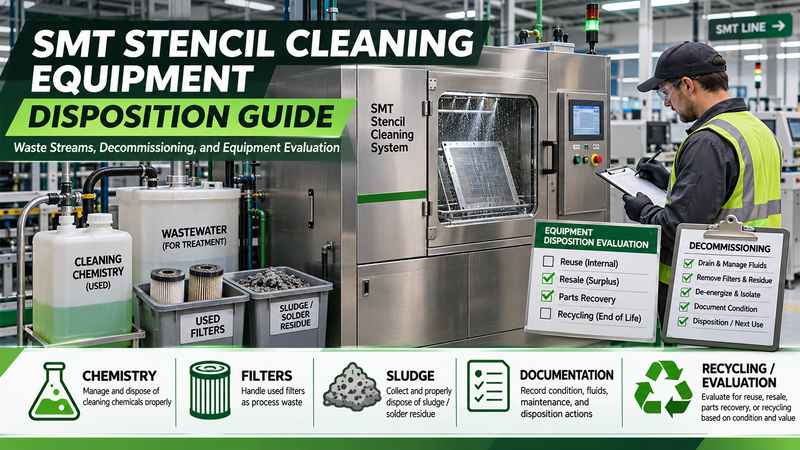
Retiring an SMT stencil cleaner takes more than unplugging it and calling a scrap hauler. The machine may still hold useful equipment, chemical residue, wastewater, solder particles, filters, and valuable controls.
The safest plan separates the machine from the waste inside it. First, identify every material and document the equipment. Next, determine which liquids and solids need regulated handling. Then, evaluate the cleaned machine for reuse, resale, parts recovery, or electronics recycling. For Phoenix manufacturers, Jay Hoehl Inc. can evaluate suitable industrial electronics and surplus equipment. Regulated liquids, sludge, or contaminated filters may need a separate qualified waste vendor.
This guide explains the full decision path. It covers waste streams, decommissioning, valuation, documentation, and Phoenix logistics. It also explains where an electronics recycler fits, and where that role ends.
What Does SMT Stencil Cleaning Equipment Disposition Include?
SMT stencil cleaning equipment disposition includes every step needed to retire the system responsibly. That includes the machine, its accessories, remaining chemistry, generated waste, documents, and removal plan.
The cleaner supports surface-mount technology production. It removes solder paste, flux residue, adhesives, and other soils from stencils or tools. Some systems also clean misprinted boards, squeegees, pallets, or maintenance parts.
Because of that work, the machine may contain several different material streams. One stream may have resale value. Another may need laboratory testing. A third may qualify for ordinary electronics recycling after proper cleaning.
The devil is in the details. Treating everything as one scrap load can destroy value and create compliance problems.
The equipment is only one part of the project
A complete project may include the cleaner, pumps, tanks, heaters, filters, controls, and exhaust parts. It may also include baskets, spray bars, ultrasonic generators, transducers, dryers, and wastewater accessories.
The project may also involve unused cleaning chemistry. Spent wash solution, rinse water, wipes, filters, sludge, and solder residue may remain. Each material needs its own review.
A buyer may want the machine but refuse the waste. A recycler may accept the electronics but not chemical liquids. A waste vendor may handle residues but have no interest in reusable equipment.
That split is normal. Good disposition planning sends each stream to the right destination.
Why an old stencil cleaner is not ordinary e-waste
An empty office printer is mostly an equipment decision. A used stencil cleaner can be an equipment and process-waste decision.
Solder paste may contain tin, silver, copper, bismuth, lead, or other metals. Cleaning chemistry may contain solvents, surfactants, alkaline ingredients, or other compounds. Filters can concentrate materials removed from many cleaning cycles.
A liquid can look clean and still contain dissolved contaminants. A dry filter can look harmless and still hold concentrated solder particles. Lead-free production also does not prove every waste stream is nonhazardous.
The right question is not, “Is this machine electronic?” The better question asks what touched the machine, and what remains inside it.
Choose the Right Disposition Route Before Shutdown
Choose the disposition route before shutdown, because the route controls documentation and cleaning. Do not put the cart before the horse.
A working machine may deserve a resale effort. A damaged machine may still provide useful parts. A heavily contaminated system may need more preparation before any buyer will consider it.
The main routes are reuse, resale, parts recovery, electronics recycling, and regulated waste management. Some projects use all five routes.
Reuse the machine inside your organization
Internal reuse often preserves the most value. Another line, plant, laboratory, or training area may need the cleaner.
Confirm that the unit matches the new process. Check stencil dimensions, chemistry compatibility, utilities, exhaust needs, and throughput. Review control software, recipes, and safety features.
Relocation still requires a clean shutdown. The machine should not travel with loose liquid, unsecured filters, or unknown residue. The receiving site also needs complete operating and maintenance records.
Sell the machine as working surplus
A functioning cleaner may have secondary-market value. Age alone does not decide that value.
Buyers usually care about operating condition, tank size, cycle type, controls, and included accessories. They also want the model, serial number, year, electrical requirements, dimensions, and weight.
A safe operating video can support the listing. Service records can reduce buyer uncertainty. Clear photos should show the chamber, tank, controls, pumps, filters, and nameplate.
The broader guide to selling surplus items explains why documentation matters. That same logic applies to specialized SMT support equipment.
Never hide contamination, leaks, or missing parts. Honest condition reporting protects both parties and supports a realistic offer.
Recover parts when the complete machine has limited value
Some machines have useful parts even when the complete system cannot sell. PLC hardware, touchscreens, pumps, motors, generators, and stainless assemblies may have reuse potential.
Parts recovery needs planning. Random dismantling can damage valuable components or mix clean metal with contaminated residue.
Record where each part came from. Label wiring and accessories. Protect control boards from impact and static damage.
Do not remove parts from a machine that still contains uncontrolled liquids. Cleanout and waste separation come first.
Recycle the cleaned equipment
Electronics recycling may be the best route for obsolete or uneconomical equipment. A recycler can separate metals, wiring, controls, and electronic assemblies.
The recycler still needs an accurate condition description. State whether tanks were drained, filters were removed, and residues were evaluated. Share any cleaning record or waste profile.
A recycler should not have to discover a chemical problem during unloading. That surprise can stop the project and increase costs.
Use a qualified waste vendor for regulated residues
An electronics recycler may not be permitted to accept hazardous liquids or process sludge. That limitation should be respected.
A qualified waste vendor can review profiles, packaging, labels, transport, and disposal options. The vendor may request laboratory results, safety data sheets, process details, or generator information.
The equipment and waste can leave through different channels. That often creates the cleanest, most defensible project.
Build an Equipment Inventory Before Anyone Drains It
Build the equipment inventory before draining or disconnecting the cleaner. Measure twice, cut once.
Early documentation protects value and supports waste decisions. It also prevents parts, records, or accessories from disappearing during shutdown.
Your inventory should describe what the machine is, what it did, and what remains inside. It should also identify the people responsible for safety, waste, equipment, and shipping.
Record the machine identity
Start with the manufacturer, model, serial number, and year. Photograph every nameplate and certification label.
Record the machine type. Common designs include ultrasonic, spray-in-air, single-chamber, multi-tank, semi-automatic, and fully automatic systems.
Note the largest stencil size and chamber dimensions. Record wash tank and rinse tank capacities when known.
Capture the electrical supply, phase, frequency, amperage, and connected load. Also note compressed air, water, drain, exhaust, gas, and network connections.
List the installed systems and accessories
Create a component list before disassembly. Include pumps, heaters, spray arms, nozzles, filters, sensors, dryers, and exhaust parts.
Record ultrasonic generators, transducers, baskets, racks, and fixtures. Include evaporators, gravity traps, ion-exchange systems, carbon units, and water treatment accessories.
List manuals, software, passwords, recipes, service tools, and spare parts. Photograph the control panel while the system remains intact.
A complete package is easier to evaluate. Missing accessories can reduce value and delay removal.
Capture condition without creating new risk
Document observed condition honestly. Note leaks, corrosion, damaged seals, failed heaters, pump noise, control faults, and missing guards.
Only qualified staff should operate the machine for testing. Do not energize damaged equipment for a sales video.
A functional test should use approved procedures. Avoid adding fresh chemistry only to prove operation. That can create more waste.
If the machine cannot be tested, describe it as untested. “Untested” is more credible than an unsupported claim.
Gather process and chemistry records
Collect cleaning-chemistry names, suppliers, product labels, and current safety data sheets. Identify solder paste types used on the line.
Record whether the line processed leaded or lead-free products. Note adhesives, fluxes, defluxing agents, and maintenance chemicals.
Describe how wash and rinse liquids were managed. Include filter changes, wastewater treatment, evaporator use, and drain connections.
These records help a buyer understand the machine. They also help environmental staff identify waste streams.
Connect the project to inventory control
An idle cleaner often appears beside other surplus assets. Those may include printers, conveyors, feeders, inspection equipment, and test systems.
Reviewing the complete area can reduce repeated rigging and pickup costs. It can also reveal forgotten accessories or spare parts.
The same review supports efforts to reduce excess inventory. A clean asset register helps the business act before equipment loses more value.
Map Every Waste Stream Inside and Around the Cleaner
Map each waste stream before pumping, wiping, or cleaning the machine. A place for everything, and everything in its place.
Stencil cleaners can create liquids, sludges, wipes, filters, resins, and metal-bearing residues. Mixing them can make testing harder and disposal more expensive.
Use separate containers and clear labels. Record the source, date, process, and known contents for each stream.
Spent wash solution
Spent wash solution may contain dissolved chemistry and suspended soils. Those soils can include solder particles, flux, adhesives, oils, and process debris.
The solution type matters. Aqueous, semi-aqueous, solvent-based, and specialty chemistries behave differently.
Do not rely only on the product label. The used solution has changed through contact with the process.
Process knowledge may support classification. Testing may still be needed when knowledge cannot provide an accurate determination.
Rinse water and final rinsate
Rinse water can carry contaminants from the wash stage. Clear appearance does not prove it meets discharge limits.
Single-chamber systems may transfer wash chemistry into the rinse stream. Carryover can increase with large internal surfaces or poor separation.
Final rinsate may also contain metal particles or dissolved materials. Keep it separate until its route is confirmed.
Never dilute a questionable stream to change its appearance. Dilution does not replace a proper determination.
Solder paste, sludge, and settled solids
Solder particles can settle in tanks, traps, sumps, or filter housings. Some systems collect them by gravity.
Remove these solids using the manufacturer’s approved method. Avoid dry sweeping or compressed air.
Store the material in a compatible, closed container. Label it with its source and suspected contents.
Metal-bearing solids may have recycling value. That possibility does not cancel hazardous waste duties.
Used filters and filter cartridges
Filters may hold concentrated solder particles and organic residue. Fine filters can capture material that remained invisible in the liquid.
Record each filter’s location and service history. Keep filters from different processes separate when practical.
Do not assume a dry cartridge belongs in ordinary trash. The captured material may control its classification.
Allowing an unknown filter to drain across the floor creates another waste stream. Use secondary containment during removal.
Carbon, ion-exchange resin, and treatment media
Treatment media can collect dissolved organics, ions, and metals. Spent carbon and resin may hold more concentrated contaminants than the original water.
Identify the media type and supplier. Record the volume, change date, and process served.
Do not mix spent carbon with resin or ordinary filters. Different media may need different profiles or destinations.
A treatment system moves contaminants. It does not make them disappear.
Wipes, rolls, absorbents, and personal protective equipment
Used stencil rolls and wipes can contain solder paste and cleaning chemistry. Spill absorbents may contain the same materials.
Segregate heavily contaminated materials from lightly used housekeeping waste. Follow facility rules for protective equipment disposal.
Keep wet solvent wipes in compatible closed containers. Fire prevention rules may also apply.
Document the waste source. A bag marked only “dirty rags” tells the next handler very little.
Unused or expired chemistry
Unused products may follow different rules than spent cleaning solution. Keep original labels and containers when safe.
Do not pour unused chemistry into the machine during cleanout. That creates more mixed waste.
Check supplier return options before disposal. Some unopened products may be returnable or transferable.
Damaged, leaking, or unknown containers need careful isolation. Do not combine them merely to save space.
Floor wash, sump water, and spill cleanup
Decommissioning can create secondary waste. Floor wash, sump water, and spill absorbents may contain the same contaminants.
Plan containment before opening tanks or hoses. Use drip pans, plugs, and compatible transfer equipment.
A small leak can spread across a large area. That turns a simple cleanout into a larger cleanup project.
Good preparation keeps the waste map accurate and the work area controlled.
Make the Hazardous Waste Determination First
The generator must determine whether each discarded material is hazardous. An ounce of prevention is worth a pound of cure.
This determination should happen at the point of generation. It should occur before dilution, mixing, or other changes.
Arizona guidance describes two main approaches. A generator may use reliable process knowledge or laboratory analysis.
Review the state’s guidance on an accurate hazardous waste determination. Your environmental professional should apply the current rules to your facility.
Process knowledge can support a determination
Process knowledge may include chemical inputs, production records, solder formulations, and cleaning methods. It may also include prior test results for the same controlled process.
The knowledge must be detailed and reliable. A general statement that the line was “lead-free” is not enough.
Lead-free solder can still contain metals. Cleaning chemistry can also create ignitability, corrosivity, toxicity, or other concerns.
Document how the conclusion was reached. Keep supporting records with the waste profile.
Safety data sheets do not tell the whole story
A safety data sheet describes the product before use. It does not fully describe the used waste.
The waste may contain solder metals, adhesives, oils, and materials from previous cycles. Its pH and concentration may also change.
Use safety data sheets as one information source. Combine them with process knowledge and testing when needed.
Treat unsupported assumptions like weak links in a chain. One weak link can undermine the whole record.
Laboratory analysis may be necessary
Testing may be needed when process knowledge cannot support an accurate decision. The laboratory should understand the waste and required methods.
Sampling must represent the actual stream. A poor sample can produce a misleading result.
Discuss containers, preservation, hold times, and test methods before collecting samples. Keep chain-of-custody records.
Arizona guidance notes that laboratories used for waste determinations must meet applicable certification requirements. Confirm that status before sending samples.
Manage unknown waste carefully while results are pending
Do not treat unknown material as ordinary waste while waiting for results. Store it in compatible containers with clear identification.
Use secondary containment where appropriate. Keep incompatible streams apart.
Restrict access and track quantities. Record every container movement.
Once results arrive, update labels and profiles. Keep the report with disposal and shipment records.
Generator category affects management duties
Hazardous waste rules vary by generator category. Monthly quantities and certain acute wastes affect that category.
Do not estimate category from one project alone. Review all counted hazardous waste generated during the month.
Accumulation time, labeling, inspections, training, and emergency planning may change by category. Current federal and Arizona rules should guide the facility.
This article offers planning information, not legal advice. Use qualified environmental and safety professionals for site-specific decisions.
Do Not Assume Filtered Wastewater Can Go Down the Drain
Filtered wastewater still needs approval before discharge. Better safe than sorry.
A filter may remove visible solder balls while dissolved metals remain. The water may also contain surfactants, solvents, chelating agents, salts, or abnormal pH.
Would you pour an unknown process liquid into a sink because it looks clear? Appearance cannot answer a compliance question.
Phoenix industrial users may need review from the city’s Industrial Pretreatment Program. Requirements can depend on the process, flow, pollutant levels, and treatment system.
Local sewer approval comes before discharge
The public sewer is not an unrestricted disposal route. Local limits protect workers, treatment systems, and receiving waters.
Contact the appropriate sewer authority before starting a new discharge. Also contact them before changing chemistry, equipment, volume, or treatment methods.
The authority may request process details, expected flow, analytical data, and treatment information. It may approve, condition, monitor, or prohibit the discharge.
Keep written decisions with the equipment and environmental records. Verbal assumptions are difficult to defend later.
Open-loop systems need special attention
An open-loop system sends wash or rinse water away after use. That design can create a regular industrial wastewater stream.
Review every drain connection during decommissioning. Trace hoses to their actual destination.
A hose entering a floor drain does not prove the discharge was approved. Older installations may have changed over time.
Cap or secure disconnected lines. Prevent accidental releases while the machine awaits removal.
Closed-loop systems reduce discharge, not responsibility
Closed-loop equipment can reuse wash or rinse liquid. It may use filtration, carbon, ion exchange, gravity separation, or evaporation.
Those systems still create concentrated waste. Filters, resin, carbon, sludge, and evaporator residue need evaluation.
A closed loop is like sweeping material into one corner. The floor looks cleaner, but the material remains.
Document where each contaminant goes. That answer controls the next handling step.
Evaporators require chemistry and permit review
Some stencil-cleaning systems use evaporators to reduce wastewater volume. Evaporation can leave concentrated solids behind.
Do not assume every chemistry can be evaporated safely. Volatile ingredients can create air emissions or worker exposure.
Arizona rules may also restrict treatment of hazardous waste. Confirm the waste status and applicable permissions before using an evaporator.
The remaining solids need their own determination. Reduced volume does not mean reduced responsibility.
Never use dilution as a treatment plan
Adding clean water to meet a number can hide the true stream. It may also violate applicable rules.
Treat the wastewater at its source when approved. Better options may include source reduction, closed-loop reuse, or off-site management.
Keep wash and rinse streams separate when that supports better control. Separation can reduce cost and improve testing accuracy.
Decommission the Machine in a Controlled Sequence
A controlled sequence protects people, records, equipment value, and the environment. Slow is smooth, and smooth is fast.
Create a written shutdown plan before work begins. Assign a project lead and identify qualified electrical, mechanical, environmental, and rigging staff.
The manufacturer’s manual should govern actual shutdown steps. Site safety procedures also remain mandatory.
Step 1: Confirm ownership and authorization
Confirm that your business owns the machine. Check lease, finance, vendor, and consignment records.
Obtain written approval for disposal or sale. Record the asset number and internal owner.
Do not remove customer property, loaned fixtures, or leased accessories. Separate them before cleanout.
This simple check prevents expensive disputes. Paperwork first saves headaches later.
Step 2: Back up approved records and remove access
Back up authorized recipes, maintenance logs, and configuration files. Follow company rules for intellectual property.
Remove network access and stored credentials. Reset remote support accounts when appropriate.
Do not erase records needed for environmental or maintenance documentation. Coordinate with IT, engineering, and compliance teams.
Record what was backed up, removed, or reset. Keep the approval with the asset file.
Step 3: Stop production and isolate utilities
Schedule a defined shutdown window. Notify affected production, facilities, safety, and waste teams.
Qualified staff should follow the facility’s lockout and tagout program. Isolate electricity, compressed air, water, gas, exhaust, and drains.
Verify stored energy has been controlled. Pumps, heaters, pneumatic parts, and hot surfaces may retain hazards.
Never rely only on a control-panel stop button. The machine needs proper isolation before service.
Step 4: Capture liquids without mixing streams
Identify each tank, sump, hose, filter housing, and trap. Prepare compatible labeled containers before opening anything.
Transfer wash liquid and rinse liquid separately. Capture low points and hose contents.
Use drip pans and secondary containment. Keep a spill kit suited to the chemistry nearby.
Record the source and estimated quantity of every container. Avoid topping off containers with unrelated waste.
Step 5: Remove consumables and treatment media
Remove filters, wipes, rolls, carbon, resins, traps, and collected sludge. Follow the manufacturer’s safe service instructions.
Place each waste type in its assigned container. Prevent dripping during transfer.
Label the machine location and date on every container. Link the container to the waste profile.
Do not leave used filters hidden inside the machine. A buyer or recycler needs a truly disclosed condition.
Step 6: Clean accessible surfaces using an approved method
Clean only after the waste streams are controlled. Use a compatible method approved by the manufacturer and facility.
Avoid creating unnecessary rinse water. Do not pressure wash the machine into a floor drain.
Collect cleaning residues and used absorbents. Add them to the correct waste stream when appropriate.
The goal is controlled residue removal. The goal is not a shiny appearance that hides uncertainty.
Step 7: Inspect and document the cleaned condition
Inspect tanks, housings, hoses, chambers, and trays. Photograph the cleaned interior and exterior.
Document staining, corrosion, cracks, leaks, and remaining residue. State any inaccessible areas.
A cleanout record should name the method, date, staff, and waste containers created. Attach supporting photos.
A buyer can then understand what “drained and cleaned” actually means.
Step 8: Disconnect the machine for removal
Qualified trades should disconnect utilities according to site standards. Cap and label open lines.
Secure doors, lids, arms, baskets, and loose accessories. Protect the control panel and nameplate.
Drain air lines and other trapped systems safely. Check the base for hidden liquid before moving.
Keep the machine level when its design requires that. Follow the rigging plan and rated lifting points.
Step 9: Package documents and accessories
Place manuals, service records, spare parts, and software media in a labeled package. Match every accessory to the machine.
Protect delicate sensors, transducers, and control boards. Use static-safe packaging where needed.
Create a final packing list. Have the receiving party confirm the list during pickup.
This last step can improve value. It also reduces arguments after delivery.
Separate Recoverable Equipment From Regulated Residues
Separate clean equipment from regulated residue before recycling or sale. Do not throw the baby out with the bathwater.
A machine may contain valuable stainless steel, motors, pumps, controls, and electronics. Those parts should not be buried inside a mixed waste load.
The clean equipment route and waste route can run in parallel. Good labels and records keep them connected without mixing them.
Stainless steel tanks and structural metal
Cleaner tanks, chambers, and frames often contain stainless steel or other metals. Clean metal may have recycling value.
Residue can reduce that value and limit acceptance. Tell the recycler about prior use and cleaning status.
Do not cut tanks that may contain residue or vapor. Cutting work needs proper hazard review and qualified personnel.
Keep alloys separate when practical. Mixed metal usually brings lower recovery value.
Pumps, motors, heaters, and blowers
Working pumps and motors may support resale or parts recovery. Record model numbers and electrical data.
Heaters, blowers, valves, and sensors can also have value. Condition and compatibility control demand.
Do not energize removed parts without safe test equipment. Describe them as tested or untested accurately.
Package small components so they remain identifiable. A loose bin of parts is hard to value.
PLCs, touchscreens, and electronic controls
Control hardware may include PLCs, HMIs, drives, relays, power supplies, and network devices. Some parts have active secondary markets.
Back up authorized settings before removal. Remove confidential recipes, credentials, and network details.
Preserve manufacturer labels and part numbers. Buyers often search by exact component number.
Damaged electronics can still enter responsible recycling. Keep them dry and protected during storage.
Ultrasonic generators and transducers
Ultrasonic systems depend on matched generators and transducers. Buyers may value them as a tested set.
Document operating frequency, power, tank association, and observed condition. Include service history when available.
Bonded transducers may be difficult to remove without damage. Avoid dismantling them without technical guidance.
A complete working assembly can be worth more than separated parts.
Filtration and wastewater accessories
Filter housings, pumps, and treatment frames may have reuse value after cleaning. Used media remains a separate waste decision.
Evaporators, carbon units, ion-exchange equipment, and gravity traps need full condition disclosure. Their contamination history matters.
Do not market a treatment accessory as ready for use without inspection. Seals, heaters, controls, and tanks may need service.
When a surplus electronics service fits
A specialized recycler can evaluate cleaned controls, wiring, industrial electronics, and suitable equipment. JHI’s surplus electronics service covers many industrial electronic materials.
Provide the inventory before pickup. Include photos and any known contamination history.
Ask what must be removed beforehand. Confirm accepted items, loading needs, and documentation.
No recycler wants a mystery load. Clear information helps the project move without surprises.
What Affects Resale or Recovery Value?
Resale value depends on usefulness, condition, demand, and removal cost. The proof is in the pudding.
A new-looking machine can have low value when parts are unsupported. An older machine can remain valuable when buyers need that exact process.
There is no universal percentage of original cost. Market demand can change by model, region, and production need.
Manufacturer, model, and production year
The nameplate is the machine’s passport. It lets buyers find manuals, parts, and technical support.
Known manufacturers may attract more interest. However, brand alone does not guarantee value.
The production year helps buyers estimate control age and parts availability. Serial numbers can support service research.
Missing identity information increases risk. Higher buyer risk usually reduces offers.
Cleaning method and supported applications
State whether the machine uses ultrasonic, spray-in-air, immersion, or another method. Note single-chamber or multi-stage design.
List supported applications. These may include metal stencils, pump-print stencils, squeegees, misprinted boards, or maintenance parts.
Describe the approved chemistry family. Buyers need compatibility with their process.
Do not claim broad applications without manual support. Unsupported claims can damage trust.
Working condition and test evidence
Working heaters, pumps, controls, sensors, dryers, and generators matter. A safe demonstration can reduce uncertainty.
Would you buy a cleaner with unknown residue and no service history? Most buyers would price that risk heavily.
Record fault codes and known repairs. Include dated videos when safe and authorized.
Never hide an intermittent fault. A disclosed issue can be priced. An undisclosed issue can kill the deal.
Size, capacity, and utility requirements
Record chamber dimensions, maximum stencil size, tank volume, cycle time, and machine footprint. Include operating weight when known.
Large capacity may attract industrial buyers. It can also increase freight and rigging costs.
Electrical voltage, phase, frequency, and connected load affect installation. Exhaust, water, air, and drain needs also matter.
A machine may fit the process but not the building. That limits its value.
Controls, software, and parts availability
Modern controls can improve demand. Obsolete PLCs or unsupported screens can reduce it.
List software versions, licenses, and included media. Confirm whether licenses can transfer.
Spare pumps, filters, sensors, and seals may add value. Random unrelated spares usually do not.
Organize parts by machine and part number. Clear packaging tells a better story than a mixed crate.
Cleanout status and contamination history
A documented cleanout can expand the buyer pool. Unknown residue can stop a sale.
State the chemistry used and materials processed. Share the waste determination separately when appropriate.
Do not promise “contamination free” without a defined standard. Describe the work performed and remaining limitations.
Trust grows from precise facts. Vague claims create more questions.
Freight, rigging, and timing
Removal cost can consume much of the equipment value. Heavy cleaners may need machinery movers, crating, and special freight.
Door size, aisle width, dock access, and forklift capacity affect the plan. So do stairs, mezzanines, and production schedules.
A short removal window may reduce buyer interest. Flexible access can improve options.
Estimate removal needs before accepting an offer. Net value matters more than the headline price.
Plan Phoenix Storage, Rigging, and Pickup
Phoenix storage and pickup planning should begin before the cleaner leaves production. Make hay while the sun shines, but protect equipment from the sun.
Arizona heat can punish seals, hoses, displays, batteries, adhesives, and stored chemistry. Outdoor storage can also expose equipment to dust, rain, and unauthorized access.
Keep the machine indoors when practical. Use secondary containment if any residual liquid remains.
Store the machine clean, dry, and stable
Dry the chamber and tanks after the approved cleanout. Leave access points configured according to the manufacturer.
Protect openings from dust and pests. Do not seal damp equipment so tightly that corrosion grows unnoticed.
Keep loose parts labeled and boxed. Store manuals and electronic controls in a dry area.
Use a visible status tag. State whether the machine is active, isolated, cleaned, tested, or awaiting waste results.
Plan the travel path through the facility
Measure the machine and every doorway, aisle, turn, and dock opening. Check overhead clearances and floor conditions.
Confirm the center of gravity and rated lifting points. Review the manufacturer’s moving instructions.
Remove only approved accessories needed for clearance. Photograph their locations before removal.
Protect floors, walls, utilities, and nearby production equipment. A rushed move can cost more than the machine is worth.
Confirm rigging and loading resources
Identify the required forklift, crane, pallet jack, skates, or machinery mover. Verify rated capacities.
Check whether the machine needs a custom skid or crate. Secure doors, lids, panels, and moving assemblies.
Confirm dock height and truck access. Phoenix industrial areas can have narrow yards or shared loading zones.
Schedule the crew and carrier together. Idle riggers and waiting trucks add avoidable cost.
Prepare accurate pickup information
Give the buyer or recycler dimensions, weight, photos, and access details. Mention stairs, dock limits, or appointment rules.
State whether the machine is disconnected and ready. Identify who loads and who supplies equipment.
Confirm whether accessories travel with the machine. Use a packing list and pickup receipt.
JHI’s public access is by appointment. Call before bringing industrial equipment to the Phoenix facility.
Keep regulated waste out of ordinary freight
Do not ship liquids, sludge, or contaminated media inside the machine without approval. Transport rules may apply.
A carrier expecting clean equipment may refuse the load. A leak can also create reporting and cleanup duties.
Package regulated waste through the approved waste channel. Keep its documents separate from the equipment bill of lading.
The machine can move only after its condition matches the receiving party’s agreement.
Keep a Complete Disposition Record
A complete record proves what left, where it went, and how it was handled. A good paper trail is worth its weight in gold.
Build one project folder for the machine and related waste. Use clear file names and dates.
The record should connect equipment, waste containers, vendors, shipments, and final documents. That connection matters during audits or later questions.
Equipment identity documents
Keep the asset number, manufacturer, model, serial number, and year. Include nameplate photos.
Add the equipment inventory, condition report, and accessory list. Include service and repair records.
Keep the operating test record or untested statement. Add dated interior and exterior photos.
Record ownership approval and the chosen disposition route.
Cleanout and decommissioning documents
Keep the shutdown plan and responsible staff list. Include lockout and utility-disconnection records required by your facility.
Add the liquid transfer log and container list. Record filter, media, sludge, and wipe removal.
Include the cleaning method, date, and photographs. State any inaccessible areas or known remaining residue.
Keep the final release or readiness checklist signed by the responsible team.
Waste characterization documents
Store safety data sheets, process descriptions, laboratory reports, and sampling records. Include chain-of-custody forms.
Keep the written waste determination for each stream. Record the generator category review when applicable.
Add waste profiles, approvals, labels, manifests, receipts, and certificates from downstream vendors.
Retention periods can vary. Follow current regulatory and company requirements.
Equipment sale or recycling documents
Keep quotes, purchase agreements, bills of sale, and bills of lading. Include the pickup receipt and packing list.
Record the final destination and receiving organization. Keep any recycling or recovery certificate provided.
Document excluded materials. A receipt saying “one machine” does not explain what was removed beforehand.
For broader context, review the site’s guide to the e-waste recycling process. Industrial equipment needs the same traceability, plus process-waste controls.
Internal closeout documents
Update the fixed-asset register and maintenance system. Remove the machine from inspection schedules.
Close purchase orders, utilities, and software support contracts. Update floor plans and emergency information.
Record lessons learned. Those notes can improve the next equipment replacement.
A project is not finished when the truck leaves. It ends when the records close the loop.
Avoid These Common Disposition Mistakes
Most costly mistakes happen before pickup day. Haste makes waste.
A little planning can prevent mixed waste, lost value, delayed trucks, and rejected loads. Use this list during the kickoff meeting.
Mistake 1: Calling the entire machine e-waste
The machine, liquids, filters, and sludge may need different routes. One label cannot replace proper separation.
Treat the project as several connected streams. Document each stream from start to finish.
Mistake 2: Assuming lead-free means harmless
Lead-free solder can contain other metals. The cleaning solution may also create separate hazards.
Use the actual process and materials. Do not base decisions on a marketing label.
Mistake 3: Sending wastewater to a drain without approval
Clear water can still contain dissolved pollutants. Filtration does not guarantee discharge compliance.
Confirm local sewer requirements before any release. Keep written approval.
Mistake 4: Mixing every liquid into one drum
Mixing can increase testing needs and disposal costs. It can also create incompatible combinations.
Keep wash, rinse, solvent, and spill streams separate when practical. Label them immediately.
Mistake 5: Leaving used filters inside the cleaner
Hidden filters create surprises for buyers and recyclers. They may also leak during transport.
Remove, containerize, and characterize them before equipment shipment.
Mistake 6: Cleaning before documenting the machine
Early cleaning can remove labels, evidence, or clues about the process. It can also damage valuable parts.
Photograph and inventory first. Then follow the approved cleanout plan.
Mistake 7: Claiming the machine works without proof
Unsupported claims create disputes. They can also encourage unsafe testing.
Provide a dated test record, or describe the machine as untested. Honest facts travel farther.
Mistake 8: Ignoring controls and stored data
HMIs and PLCs may hold recipes, usernames, network settings, or production information.
Coordinate backups and resets with authorized IT and engineering staff. Keep required environmental records.
Mistake 9: Forgetting removal costs
Rigging, crating, freight, and facility repairs can erase resale proceeds. Estimate them before accepting an offer.
Compare net recovery, not only the buyer’s headline number.
Mistake 10: Choosing one vendor for every stream
No single vendor must handle everything. A strong project may use an equipment buyer and waste vendor.
Choose each party for its permitted role and real capability. Clear boundaries protect everyone.
When Jay Hoehl Inc. May Fit the Project
JHI may fit when the cleaned project includes industrial electronics, surplus equipment, components, or recoverable materials. Honesty is the best policy.
The company serves Phoenix and the broader Maricopa County market. It evaluates electronic surplus, test equipment, components, circuit boards, and other industrial materials.
SMT stencil cleaners can contain equipment that fits those categories. Acceptance depends on the machine, condition, preparation, volume, and current market.
Information to send for an evaluation
Send clear photos of the full machine and nameplate. Include the manufacturer, model, serial number, and year.
Provide dimensions, weight, utilities, and location. Describe doorways, docks, forklifts, and removal limits.
State working condition and known faults. Include service records, operating videos, and accessory lists when available.
Describe the cleanout status accurately. Identify any liquid, filter, sludge, or chemical material still present.
What JHI can evaluate
JHI can review suitable surplus electronics and industrial electronic equipment. The team can consider reuse, resale, material recovery, or recycling routes.
Controls, wiring, electronic assemblies, and clean equipment may have recovery value. The final route depends on condition and demand.
An evaluation is not a promise to buy every item. Some machines may have only recycling value.
What may need another provider
Hazardous liquids, regulated sludge, spent solvents, and contaminated treatment media may need a permitted waste provider. JHI should not be presented as that provider without written confirmation.
Complete the waste determination before requesting ordinary equipment pickup. Remove excluded streams as agreed.
Ask both vendors where their responsibilities begin and end. Put those boundaries in writing.
A simple request process
Prepare the inventory and photos first. Call (602) 272-4033 or request an evaluation through the website.
Explain that the asset is an SMT stencil cleaning system. Share the process history and current condition.
Ask what preparation is required. Confirm pickup, loading, and documentation before scheduling.
Public access is by appointment, so call before visiting the Phoenix location.
Frequently Asked Questions About SMT Stencil Cleaner Disposal
These answers cover the most common planning questions. No smoke and mirrors, just practical boundaries.
Can I recycle an SMT stencil cleaner with liquid still inside?
Do not send the machine with liquid inside unless the receiver approves it in writing. The liquid may need separate characterization, packaging, and transport.
Drain and manage each stream through the approved process. Document the cleaned condition before shipment.
Is lead-free solder paste waste automatically nonhazardous?
No. Lead-free does not automatically mean nonhazardous.
Other metals or chemical properties may affect classification. Use reliable process knowledge or proper testing.
Can filtered stencil-cleaner wastewater go into a sanitary sewer?
Not automatically. Filters may remove particles while dissolved pollutants remain.
Contact the local sewer authority before discharge. Obtain any required approval, permit, or monitoring plan.
Are used wipes and stencil rolls ordinary trash?
That depends on their contamination and applicable rules. Wipes may contain solder paste, solvents, or cleaning chemistry.
Keep them separate and evaluate the waste. Fire-prevention requirements may also apply to solvent-contaminated wipes.
Should I leave filters and resin inside the machine for the buyer?
Usually, used media should be removed and handled separately. Confirm the buyer’s requirements first.
Unused spare filters can travel as accessories. Label them clearly so nobody confuses them with spent media.
Can an old stencil cleaning machine still have resale value?
Yes, it may. Value depends on condition, model, process, capacity, controls, support, accessories, and demand.
A complete inventory and safe test evidence can improve buyer confidence. Removal costs still affect net value.
What details should I send to an equipment buyer?
Send manufacturer, model, serial number, year, photos, dimensions, weight, utilities, and condition. Add manuals, service history, faults, and accessories.
Also state the chemistry history and cleanout status. Honest detail supports a faster evaluation.
Do I need to remove PLC or HMI data?
Review the system with authorized IT and engineering staff. Controllers may hold recipes, credentials, or network information.
Back up approved records and remove sensitive access. Do not delete documents needed for compliance or maintenance history.
Can one company handle equipment and waste together?
Sometimes, but never assume that. Verify permits, accepted materials, transport authority, and downstream destinations.
Many projects use one company for clean equipment and another for regulated waste. That split can be safer.
Does JHI accept every stencil cleaner?
Acceptance is not guaranteed. JHI needs the equipment details, condition, cleanout status, location, and volume.
Call before delivery or pickup. An evaluation can identify the most practical route.
Final Disposition Checklist
Use this checklist before releasing the machine. The last mile matters.
- Confirm ownership and written authorization.
- Record the manufacturer, model, serial number, and year.
- Photograph the machine, nameplate, chamber, tanks, and controls.
- List accessories, spares, manuals, and service records.
- Identify every liquid, solid, filter, wipe, and treatment medium.
- Complete accurate waste determinations for discarded materials.
- Confirm sewer, air, and waste requirements before treatment or discharge.
- Follow approved shutdown and lockout procedures.
- Drain and containerize waste streams without improper mixing.
- Remove spent filters, carbon, resin, sludge, and wipes.
- Clean the machine using an approved controlled method.
- Document the cleanout with photos and responsible staff.
- Back up approved files and remove sensitive access.
- Estimate resale, parts, recycling, rigging, and freight value.
- Confirm each receiving vendor’s accepted materials in writing.
- Prepare the packing list, bill of lading, and pickup receipt.
- Keep waste reports, manifests, recycling records, and sale documents.
- Update the asset register after final closeout.
Make the Machine Easier to Evaluate and Safer to Remove
SMT stencil cleaning equipment disposal works best when equipment and waste are separated early. That single decision protects value and reduces uncertainty.
Start with the inventory. Map every waste stream. Complete the waste determination before using a drain, evaporator, hauler, buyer, or recycler.
Then clean and document the machine. Evaluate reuse and resale before sending useful equipment directly to scrap.
JHI can review suitable industrial electronics and surplus equipment in Phoenix. A regulated waste specialist may be required for liquids, sludge, or contaminated media.