Asset disposition sounds complicated. But it’s just a fancy term for what happens when your company is done with something it owns.
Maybe it’s old laptops. Maybe it’s desks or servers. You can sell them, donate them, or destroy them. This guide breaks down the three types of asset disposition. You’ll learn which method fits your situation. And you’ll avoid the compliance mistakes that cost Phoenix businesses every year.
What Are the Three Types of Asset Disposition in Phoenix, AZ?
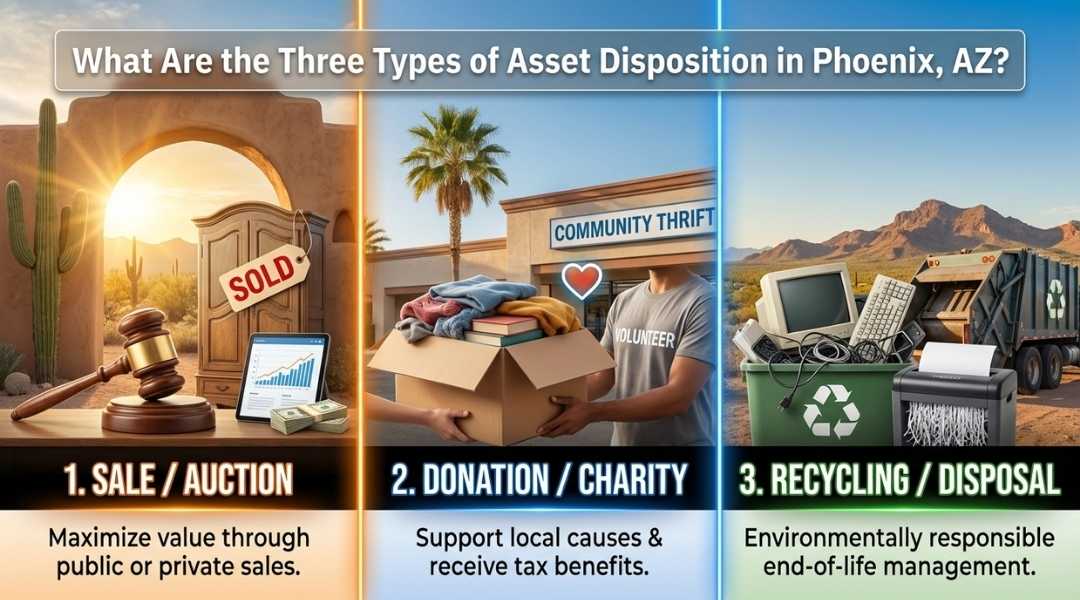
Asset disposition falls into three categories: sale, transfer or donation, and retirement or disposal. Each method handles end-of-life assets differently. Sale recovers value. Transfer moves assets to another entity. Retirement removes them permanently. The method you choose depends on asset condition, data sensitivity, compliance needs, and financial goals.
Phoenix businesses often mix methods. You might sell working equipment, donate older furniture, and destroy hard drives. The key is matching the right method to each asset type. Understanding these categories helps you recover value, stay compliant, and avoid liability. Let’s break down each one.
Definition of Asset Disposition in Business and IT Asset Management
Asset disposition is the end-of-use decision for company property. In business terms, it’s how you handle equipment, furniture, or inventory when it’s no longer needed. In IT asset management, disposition includes data sanitization, compliance tracking, and value recovery. Think of it as retirement planning for your stuff. You’re deciding: sell it, give it away, or destroy it. The goal is always the same. Remove the asset safely. Protect your data. Follow regulations. And recover money when possible.
What “Disposition” Means in Accounting, Legal, and ITAD Contexts
Accounting perspective: Disposition removes an asset from your books. You record any proceeds or losses. The asset stops depreciating.
Legal perspective: Disposition transfers ownership or terminates liability. You need documentation to prove compliance with environmental and privacy laws.
ITAD perspective: IT asset disposition focuses on data security. It includes erasure, destruction, and chain-of-custody tracking.
These definitions overlap. But they focus on different risks. Accounting cares about financials. Legal cares about liability. ITAD cares about data breaches.
Why Understanding Disposition Types Matters for Phoenix Organizations
Poor disposition creates three big problems: data breaches, compliance failures, and wasted money. Phoenix businesses face strict e-waste regulations. Arizona companies must follow federal data privacy rules. And improper disposal can trigger EPA fines. Which disposition method are you using today? If you don’t know, you’re at risk.
Choosing the right method protects your company. It reduces liability, recovers value, and keeps you audit-ready.
Sale Disposition of Assets in Phoenix, AZ
Sale disposition turns old assets into cash.
You sell working equipment to buyers, refurbishers, or liquidation partners. This recovers value and keeps items out of landfills.
Sale works best for functional assets with market demand. Think laptops, servers, vehicles, or furniture. The asset must be in good enough condition that someone will pay for it. But here’s the catch. Data-bearing devices need certified data destruction before sale. Selling a laptop with customer records still on it creates liability. Even wiped devices can expose you to risk if erasure isn’t documented.
Phoenix has active secondary markets for IT equipment. You’ll find local ITAD vendors, online marketplaces, and auction platforms. Choose partners who provide certificates of data destruction and chain-of-custody tracking.
When to Use Sale Disposition in Phoenix
Use sale disposition when the asset has resale value. Sell if the item is functional, in demand, and data-sanitized. Common examples: recent-model computers, working office furniture, surplus inventory, and operational vehicles.
Don’t sell if the asset contains sensitive data and you can’t prove erasure. Don’t sell if the resale value is lower than the disposal cost. Check Arizona e-waste rules before selling electronics. Some buyers aren’t certified for data destruction. That risk stays with you.
How to Maximize Value from Asset Sales
Start by tracking asset condition early. Well-maintained equipment sells faster and earns more.
Get multiple quotes. Phoenix has dozens of IT liquidators. Prices vary widely. Bundle similar assets. Selling 50 laptops together fetches better rates than selling them one by one. Use certified ITAD vendors for data-bearing devices. Certification protects you legally and boosts resale value. Document everything. Buyers want serial numbers, specs, and condition reports. Good records speed up sales and reduce disputes.
Data Security Risks in Sale Disposition
Selling devices without proper data erasure is the biggest risk.
Even deleted files can be recovered. Factory resets don’t guarantee data removal. You need certified erasure that meets NIST standards. Phoenix companies in healthcare and finance face HIPAA and PCI-DSS requirements. Those rules demand documented data destruction. Skipping this step can trigger fines and lawsuits. Work with vendors who provide certificates of erasure. Look for R2, e-Stewards, or NAID certification. These standards prove your data is gone.
Tax and Accounting Considerations for Asset Sales
Sold assets trigger tax reporting. You’ll record proceeds as income. If the sale price exceeds book value, you report a gain. If it’s lower, you report a loss. Keep receipts, invoices, and certificates. Your accountant needs these for tax filings. Some Phoenix businesses donate instead of selling. Donations can offer tax deductions. But only if you follow IRS rules and work with qualified nonprofits.
Transfer or Donation Disposition of Assets
A transfer moves assets to another entity without a sale.
This includes donations to nonprofits, employee giveaways, or internal transfers between departments. You’re changing ownership but not getting cash. Transfer works well for low-value items, outdated equipment, or surplus inventory. It’s also common for community goodwill projects. Phoenix nonprofits accept office furniture, computers, and medical equipment. Donations support schools, shelters, and community centers. You get a tax deduction and help the community.
But donation isn’t risk-free. You still need data destruction. And you need documentation to claim tax benefits.
When to Donate or Transfer Assets in Phoenix
Donate when resale value is low but the item is still useful. Examples: older furniture, working monitors, surplus supplies, and educational equipment. Nonprofits often accept items that commercial buyers won’t touch. Transfer internally when you’re upgrading departments. Moving desks from one office to another counts as disposition. You’re removing the asset from one cost center and assigning it to another.
Don’t donate data-bearing devices without erasure. Nonprofits aren’t responsible for your data security. That’s still on you.
Finding Qualified Nonprofits in Phoenix, AZ
Look for IRS-recognized 501(c)(3) organizations. Phoenix has active nonprofits focused on education, homelessness, and workforce development. Many accept office equipment and IT assets. Check if they’re equipped to handle e-waste. Some nonprofits refurbish computers for schools. Others lack the infrastructure to process electronics safely.
Ask for donation receipts. You need these for tax deductions. The receipt should list item descriptions and estimated fair market value.
Tax Deduction Rules for Donated Assets
The IRS allows deductions for donated business property. You can deduct the asset’s fair market value. But you need proper documentation: a donation receipt, item description, and condition notes. For high-value donations, you may need an appraisal. IRS rules vary based on asset type and value.
Consult your accountant. Donation deductions have specific thresholds and reporting requirements.
Data Destruction Requirements for Transferred IT Equipment
Transferred IT assets need the same data security as sold assets. Wipe hard drives. Destroy storage media. Document the process. Even internal transfers require data sanitization if devices change hands. An old laptop moving from finance to HR still contains sensitive files. Phoenix businesses in regulated industries must follow strict data-handling rules. Transfer doesn’t erase compliance requirements.
Retirement and Disposal Disposition of Assets
Retirement removes assets permanently. This includes recycling, shredding, and destruction. You’re not selling or donating. You’re ending the asset’s life completely. Retirement is the right choice for broken equipment, obsolete technology, and items with no resale value. It’s also mandatory for data-bearing devices when erasure isn’t enough. Phoenix businesses must follow Arizona e-waste regulations. Electronics can’t go in regular trash. You need certified recycling or destruction.
When to Retire or Dispose of Assets
Retire assets when they’re broken, obsolete, or too risky to resell. Examples: damaged computers, expired equipment, contaminated materials, and items with embedded sensitive data. Hard drives are the most common disposal case. Even wiped drives carry residual risk. Physical destruction is the only guarantee. Arizona bans certain electronics from landfills. CRT monitors, batteries, and mercury-containing devices require special disposal.
Environmentally Compliant Disposal in Phoenix, AZ
Phoenix follows Arizona Department of Environmental Quality rules. E-waste must go to certified recyclers. Look for R2 or e-Stewards certification. These programs ensure safe processing and prevent illegal dumping. Recyclers dismantle electronics, recover metals, and dispose of hazardous materials safely. You get certificates proving compliance.
Improper disposal can trigger EPA fines. Arizona enforces e-waste laws strictly. Don’t risk dumping electronics in regular trash.
Physical Destruction for Data-Bearing Devices
Physical destruction is the gold standard for data security. Shredding, crushing, or degaussing hard drives ensures data can’t be recovered. This is required for highly sensitive information. Phoenix ITAD vendors offer on-site destruction services. You can witness the process. This adds accountability and peace of mind.
Certificates of destruction document serial numbers, destruction method, and date. Keep these for compliance audits.
E-Waste Regulations and Compliance in Arizona
Arizona doesn’t have statewide e-waste bans. But Phoenix follows federal EPA guidelines.
Universal waste rules cover batteries, lamps, and mercury devices. Electronics with hazardous materials need certified disposal.
Healthcare and finance sectors face stricter rules. HIPAA requires documented destruction of devices storing patient data. PCI-DSS mandates secure disposal of payment systems.
Work with certified vendors. Compliance isn’t optional.
Special Disposition Scenarios in Phoenix
Some assets don’t fit the standard three categories.
Vehicles, real estate, and hazardous materials have unique rules. So do leased assets and items under warranty.
Disposition of Leased vs. Owned Assets
Leased assets aren’t yours to sell. You must return them to the lessor. Check your lease agreement for end-of-term requirements. Some leases allow buyouts. You can purchase the asset at residual value, then sell or dispose of it yourself. For IT leases, confirm who handles data destruction. Some lessors erase devices. Others don’t. Protect yourself by wiping data before return.
Handling Vehicles, Real Estate, and Specialized Equipment
Vehicles require title transfers and DMV filings. Sell through dealers, auctions, or private buyers. Arizona requires emissions testing for certain vehicles. Real estate disposition involves contracts, appraisals, and legal filings. This is beyond typical asset management. Specialized equipment (medical devices, lab gear) may have regulatory disposal requirements. Check industry-specific rules.
Multi-Location and Remote Asset Disposition Challenges
Managing disposition across multiple Phoenix locations adds complexity. You need centralized tracking. Asset tags, serial numbers, and location codes help maintain visibility. Remote workers create disposal challenges. Collecting laptops from off-site employees requires logistics planning. Use vendor pickup services. Many Phoenix ITAD providers offer collection for remote assets.
Decision Framework Choosing the Right Disposition Method
Not sure which method fits your situation? Use this framework.
Step 1: Assess asset condition. Is it functional, repairable, or broken?
Step 2: Check for data. Does it store sensitive information?
Step 3: Evaluate resale value. Will someone pay for it?
Step 4: Review compliance needs. Do regulations require specific disposal methods?
Step 5: Calculate costs. Compare sale proceeds, donation deductions, and disposal fees.
Match your answers to the right method. Functional + valuable = sale. Functional + low value = donation. Broken + data-bearing = retirement.
Factors to Consider: Value, Compliance, Risk, and Timing
Value: How much can you recover? Sale maximizes returns. Donation offers tax benefits. Disposal costs money.
Compliance: What do regulations require? Healthcare and finance have strict data rules. E-waste laws affect electronics.
Risk: What’s your liability exposure? Data breaches, environmental violations, and audit failures all carry penalties.
Timing: How fast do you need to act? Sales take time. Disposal is faster. Donation depends on nonprofit’s capacity.
Balance these factors. The right method protects you while recovering maximum value.
Common Mistakes Phoenix Businesses Make
Mistake 1: Skipping data destruction. This creates breach risk and compliance violations.
Mistake 2: Throwing electronics in the trash. Arizona e-waste rules prohibit this.
Mistake 3: Donating without receipts. You lose tax deduction opportunities.
Mistake 4: Selling assets without documentation. Audits require proof of disposition.
Mistake 5: Ignoring lease terms. Returning leased assets late triggers fees.
Avoid these mistakes. Plan disposition early. Document everything.
Documentation and Compliance Checklist for Asset Disposition
Good documentation protects you during audits.
Track every disposed asset. Record disposition method, date, vendor, and certificates.
Essential Records to Maintain
Asset inventory: Serial numbers, purchase dates, and current locations.
Disposition logs: Method used, date completed, and responsible party.
Vendor certificates: Data destruction, recycling compliance, and chain-of-custody.
Financial records: Sale proceeds, donation receipts, and disposal invoices.
Compliance proof: Certificates meeting NIST, R2, e-Stewards, or NAID standards.
Keep records for at least seven years. Some regulations require longer retention.
Working with Certified ITAD Vendors in Phoenix
Choose vendors with industry certifications.
R2 (Responsible Recycling): Ensures environmentally safe e-waste processing.
e-Stewards: Strict standards for data security and ethical recycling.
NAID (National Association for Information Destruction): Certifies data destruction services.
Ask for references. Check online reviews. Verify certifications directly.
Phoenix has reputable ITAD vendors. Don’t settle for uncertified haulers.
Audit Trail and Chain-of-Custody Best Practices
Create a paper trail for every asset.
Tag assets with unique identifiers. Log movements from department to vendor.
Get signed receipts at each handoff. Vendors should document pickup, processing, and final disposition.
For high-risk assets, use video documentation. Some vendors offer live-streamed destruction.
Strong audit trails prevent disputes. They also prove compliance during regulatory reviews.
Frequently Asked Questions About Asset Disposition in Phoenix
What’s the difference between asset disposition and asset disposal?
Disposition is broader. It includes sale, transfer, and disposal. Disposal is just one method—permanent removal.
Do I need to wipe data before donating old computers?
Yes. Donation doesn’t erase your data security responsibility. Use certified erasure or destruction.
Can I throw old monitors in the trash in Phoenix?
No. Arizona follows EPA e-waste guidelines. Electronics need certified recycling.
How do I claim tax deductions for donated assets?
Get a receipt from a qualified 501(c)(3) nonprofit. Document fair market value. Consult your accountant for filing requirements.
What happens if I don’t document asset disposition?
You risk audit failures, lost tax benefits, and compliance violations. Documentation is your proof of proper handling.
Are there Phoenix-based ITAD vendors?
Yes. Phoenix has multiple certified ITAD providers offering pickup, data destruction, and recycling services.
Choosing the Right Disposition Method in Phoenix, AZ
Asset disposition isn’t one-size-fits-all.
Sale recovers value. Transfer supports the community. Retirement protects your data and the environment.
The right method depends on asset condition, data sensitivity, compliance needs, and financial goals. Phoenix businesses must balance value recovery with regulatory requirements.
Start by building a disposition policy. Document every asset. Work with certified vendors. Track compliance proof.
Don’t leave this undocumented. A strong disposition process protects your business, recovers money, and keeps you audit-ready.
Need help choosing the right approach? Review your current assets. Identify risks. Match each item to the right disposition method.
Choosing the Right Disposition Method in Phoenix, AZ
Asset disposition isn’t one-size-fits-all.
Sale recovers value. Transfer supports the community. Retirement protects your data and the environment.
The right method depends on asset condition, data sensitivity, compliance needs, and financial goals. Phoenix businesses must balance value recovery with regulatory requirements.
Jay Hoehl Inc Scrap understands these challenges. We’ve helped hundreds of Phoenix businesses dispose of IT equipment, office furniture, and electronics safely and compliantly.
Our certified ITAD services include:
- Secure data destruction with NIST-compliant certificates
- E-waste recycling meets Arizona environmental standards
- Asset liquidation to maximize your recovery value
- Free pickup throughout the Phoenix metro area
- Full documentation for audit-ready compliance
Don’t leave asset disposition undocumented. Poor handling creates data breach risks, compliance violations, and wasted money.
Work With Phoenix’s Trusted ITAD Partner
Jay Hoehl Inc Scrap is located right here in Phoenix at 3334 W McDowell Rd Unit 17. We serve businesses across the Valley with fast, reliable, and certified asset disposition services.
Whether you’re retiring old servers, donating office furniture, or selling surplus equipment, we handle the entire process. You get certificates, proof of compliance, and peace of mind.
Your next step: Identify what assets you need to dispose of. Then let us show you how proper disposition protects your business and recovers maximum value.
Get your free consultation today:
📍 Visit us: 3334 W McDowell Rd Unit 17, Phoenix, AZ 85009
📞 Call now: (602) 272-4033
📧 Email: JayHoehlinc@gmail.com
🌐 Learn more: jhiescrap.com
Or request a free quote online — we’ll assess your assets, recommend the best disposition method, and provide a no-obligation proposal within 24 hours.