
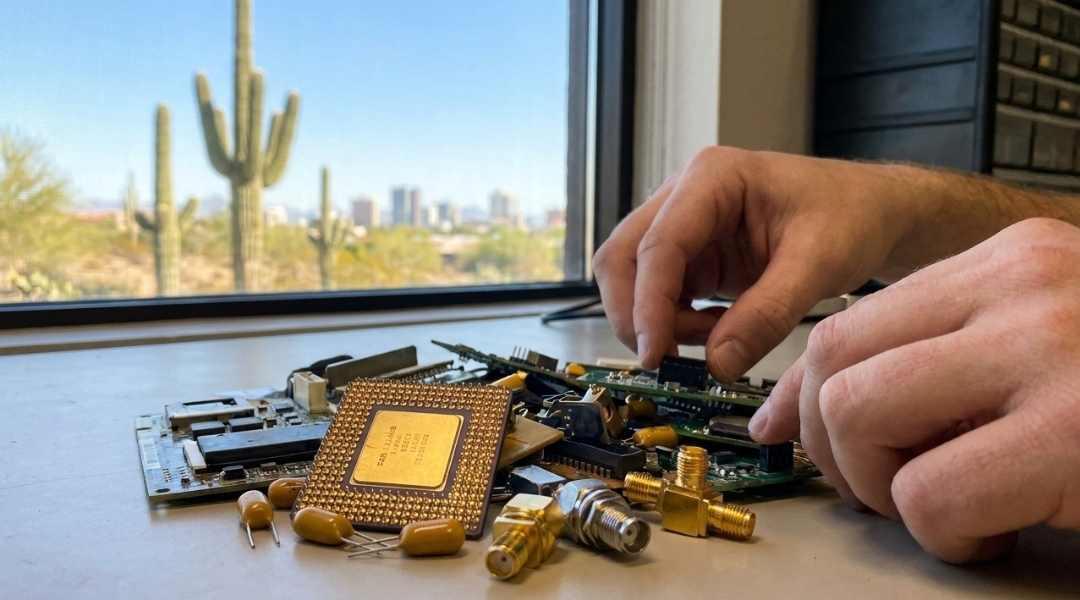
What Electronic Components Are Valuable in Phoenix, AZ?
Overview of Valuable Electronic Components
Old electronics aren’t just clutter. They’re often worth real money.
Computers, phones, servers — they’re all packed with parts that buyers want. Some hold precious metals. Others still work and can be resold. Either way, knowing what’s valuable can turn your e-waste into cash.
Ever looked at a pile of old tech and thought, “Is any of this worth anything?” Most of it is.
Understanding the Value of Electronic Components in Phoenix, AZ
Not all electronics are created equal. Some parts are worth a few cents. Others are worth hundreds.
Value comes from two things: what a part is made of and how much people need it. Phoenix has a growing tech scene, which means local demand for working components is real. Understanding this helps you sell smarter — not just faster.
Some parts look tiny. But they pay big.
Overview of Valuable Electronic Components
Electronic components fall into a few key categories. You’ve got processing parts, memory, power components, and connectors. Each category has its own value drivers. Some are worth recycling for metals. Others are worth more when resold as working parts.
Knowing the difference between reuse value and scrap value is the first step to making real money.
Definition of Valuable Components
A valuable component is any part that someone else is willing to pay for. That value comes from three things: the materials inside it, how well it works, and how hard it is to find.
Simple formula: value = demand + material + function. If a part checks all three boxes, it’s worth good money.
Why Some Components Have High Value
Demand drives everything. When a part is hard to get, buyers pay more to get it.
Two reasons components shoot up in value:
- Supply shortages — chip shortages pushed prices sky-high in recent years
- Discontinued production — old parts no one makes anymore become goldmines
What happens when supply drops and demand stays high? Prices climb fast.
Factors That Determine Component Value
Four main factors decide what a component is worth:
- Rarity and demand
- Condition and functionality
- Brand and manufacturer
- Current market trends
Each factor pulls the price up or down. Understanding all four puts you in control.
Rarity and Demand
Rare things cost more. That’s basic economics — and it’s very true in electronics.
Discontinued chips, older ICs, and hard-to-source parts command serious prices. Buyers searching for specific components will pay a premium when supply runs dry. The harder something is to find, the more leverage you have as a seller.
Phoenix’s expanding tech industry means local demand for rare parts is growing steadily.
Condition and Functionality
A working part is always worth more than a broken one.
Working component: higher resale value, faster sale, more buyers Non-working component: scrap value only, limited buyers
Before you sell anything, test it if you can. A functioning RAM stick might sell for ten times what it would fetch as scrap.
Brand and Manufacturer
Brand matters. A lot.
Components from trusted manufacturers carry premium resale value. Buyers in repair shops, labs, and data centers trust proven brands. They’ll pay more for components they recognize and rely on.
High-grade parts from top-tier manufacturers hold their value longer — even as they age.
Market Trends
The electronics market shifts fast. A component worth $10 today could be worth $50 next year.
The global chip shortage showed the world how fragile supply chains are. When semiconductor production slows, demand for existing components spikes. Keeping an eye on industry trends helps you time your sales smarter.
Key insight: Electronics recycling and component resale are growing markets. Phoenix is right in the middle of that wave.
Key Factors That Make Components Valuable
Quick recap of what drives value:
- Rarity — hard to find means high demand
- Condition — working beats broken every time
- Brand — trusted names bring premium prices
- Market timing — sell when demand is high
Precious Metal Content (Gold, Silver, Palladium)
This one surprises most people.
Electronics are packed with tiny amounts of precious metals. Gold lives in connectors and chip contacts. Silver hides in circuit traces. Palladium sits inside ceramic capacitors.
Key sources of precious metals in electronics:
- Gold: edge connectors, CPU pins, gold-plated contacts
- Silver: older circuit boards, switches
- Palladium: multilayer ceramic capacitors
Tiny parts, big money. Those little gold pins add up fast when you have volume.
High Demand Functional Components
Some parts are worth far more when they still work.
High-demand reusable components:
- CPUs (processors)
- GPUs (graphics cards)
- RAM modules
- SSDs and flash storage
- Power management chips
Check your old devices before you scrap them. A working GPU pulled from an old workstation could sell for real money on the right platform.
Now that you understand what makes components valuable, let’s look at the exact types that pay the most in Phoenix.
Types of Valuable Electronic Components in Phoenix, AZ
Not all parts are equal. Some are far more valuable than others.
Understanding the categories helps you focus on what actually matters. Pulling apart random electronics wastes time. Knowing which components to target saves it.
Here’s a breakdown of what holds the most value and why.
Types of Valuable Electronic Components
Here’s a quick overview of the main categories:
- Integrated circuits (ICs) — the core of most electronics
- Microprocessors (CPUs) — high resale and scrap value
- GPUs — driven by gaming and AI demand
- Memory (RAM, flash storage) — fast-moving resale market
- Power semiconductors — strong industrial demand
- Connectors and gold-plated parts — solid scrap value
Each one has its own market. Each one pays differently.
Integrated Circuits (ICs)
Think of ICs as the brain of any electronic device.
These tiny chips control nearly every function in modern electronics. They’re also one of the most traded components in both the resale and scrap markets.
Older ICs are especially valuable. Discontinued models are used in legacy industrial systems that can’t just “upgrade.” When those systems need repairs, engineers pay top dollar to find the exact chip.
Microprocessors (CPUs)
Small chip. Big payout.
CPUs are among the most valuable components you can pull from old computers. Working ones sell well on platforms like eBay. Older ones — especially ceramic-packaged CPUs from the 90s — can contain gold and fetch serious money from scrap buyers.
Phoenix has plenty of old office equipment flowing through recycling channels. CPUs are often overlooked inside those machines.
Graphics Processing Units (GPUs)
Demand for GPUs hasn’t slowed down.
Gaming, AI, crypto — all of these industries need graphics cards. That demand keeps resale prices high, even for older models. A functioning GPU pulled from a used workstation can sell for significantly more than its scrap value.
When GPUs are scarce, buyers get competitive. That drives prices up fast.
Memory Components (RAM, Flash Storage)
Memory is easy to test and easy to sell.
RAM modules from working computers often resell quickly. Flash storage — like SSDs and older NAND chips — also holds value. Here’s what matters most:
- Working RAM: higher resale price
- Matched pairs: even more valuable
- Bulk lots: attractive to repair shops and refurbishers
Working memory beats scrap every time.
Power Semiconductors
MOSFETs and IGBTs don’t get much attention — but they should.
These components control power flow in industrial equipment, inverters, and EV systems. They’re expensive to replace and hard to source. That makes working, tested units highly valuable in repair and manufacturing markets.
Phoenix’s industrial and commercial tech sector creates steady local demand for these parts.
Connectors and Gold-Plated Components
Tiny gold, real money.
Edge connectors, gold-plated pins, and older board connectors all carry recoverable gold. Older connectors often have thicker gold plating than modern ones — which means more extractable metal per unit.
What to target:
- ISA and PCI edge connectors — thick gold plating
- Processor socket pins — small but stackable
- Older server backplane connectors — high gold density
Volume is key. The more you collect, the more it adds up.
High-Value Components for Reuse and Harvesting in Phoenix, AZ
Before you scrap anything, check if it still works.
Reuse value almost always beats scrap value. A working component can sell for 5 to 20 times more than its metal weight. Harvesting parts from old devices — and selling them as tested, functional units — is one of the smartest moves in the electronics resale world.
Don’t throw it before you check it.
High-Value Components for Harvesting (Reuse)
Harvesting means pulling working parts from old or broken devices and selling them individually.
This works because repair shops, hobbyists, and small manufacturers all need affordable components. They’d rather buy a tested used part than pay full price for a new one.
The key? Focus on parts that are easy to test and commonly needed.
Processors (CPUs)
CPUs are one of the most rewarding parts to harvest.
Working processors sell well online and locally. Clean the thermal paste, check the pins, and list with full specs. Buyers want the exact model number — so keep the label or note it before removing.
Clean pins. Accurate listing. Better price.
RAM (Memory Modules)
RAM is one of the easiest components to pull, test, and sell.
It’s plug-and-play for testing. A quick run in a compatible system confirms it works. Matched pairs (two identical sticks of the same size and speed) are especially popular — buyers pay more to upgrade systems in pairs.
Working RAM moves fast. Priced right, it rarely sits unsold for long.
Power Components (MOSFETs/IGBTs)
These parts are goldmines in repair markets.
MOSFETs and IGBTs are used in motor drives, solar inverters, and industrial controllers. When they fail, engineers need exact replacements. Harvested, tested units are often the only affordable option.
Phoenix’s commercial and industrial sectors create consistent local demand for these parts.
Laser Diodes
You might miss this one entirely.
Laser diodes are found inside optical drives, old disc players, and some printers. They’re small, but they sell to electronics hobbyists, repair techs, and laser enthusiasts. Working units can fetch surprisingly good prices for something most people toss without a second thought.
High-Voltage Components
Found inside power supplies, CRT monitors, and older industrial gear.
High-voltage capacitors and transformers are still in demand for equipment repair. These parts are hard to find new — and buyers in maintenance and repair industries actively search for them.
Handle carefully. Value is real.
Rare Earth Magnets
Small magnet, strong value.
Neodymium magnets are packed inside hard drives, speakers, and some motors. They’re incredibly powerful for their size — and buyers love them. Hobbyists, engineers, and small manufacturers pay solid prices for clean, undamaged neodymium magnets.
Always check hard drives before scrapping them. The magnet inside might be worth more than the aluminum.
High-Value Components for Scrap and Precious Metals in Phoenix, AZ
Even broken parts can make money.
When a component no longer functions, it still holds value in its materials. Precious metals don’t care if a chip works or not. Dead devices still carry gold, silver, and palladium inside.
Scrap value is driven by metal weight and density — not functionality. The more metal you collect, the more it pays.
High-Value Components for Scrap (Precious Metals)
Here are the top components worth scrapping for precious metal content:
- Gold-plated connectors and pins
- Ceramic capacitors (palladium)
- IC chips (gold wire bonding)
- Hard drive platters (aluminum)
- Heat sinks (copper and aluminum)
- Circuit boards (gold, silver, copper)
Focus on density. High-grade boards from servers and telecom gear pay more than consumer-grade boards.
Gold-Plated Connectors and Pins
Looks small. Pays big.
Gold-plated connectors — especially older ones from servers and military-grade equipment — carry more gold per unit than most modern connectors. Manufacturers used thicker plating in older devices.
Key tip: Keep gold-plated connectors separate from other scrap. Mixed material lots always fetch lower prices than sorted, clean batches.
Ceramic Capacitors and IC Chips
You wouldn’t guess these hold value — but they do.
Ceramic capacitors often contain palladium, a precious metal worth more per ounce than gold at certain market points. IC chips use gold wire bonding internally to connect the die to the pins.
Both are worth collecting separately and selling to specialized refiners who know their true value.
Hard Drive Platters
Hard drive platters are made from aluminum — sometimes with a glass or ceramic substrate.
While the metal value per platter isn’t massive, bulk collection adds up. Aluminum scrap prices in Phoenix are competitive, and clean, separated aluminum always commands better rates.
Strip the platters, separate the materials, and sell by weight.
Heat Sinks
The metal type determines the payout.
Copper heat sinks pay significantly more than aluminum ones. Copper commands higher scrap prices and is always in demand. Pull copper heat sinks from servers and high-end workstations — they’re worth keeping separate.
Aluminum heat sinks still hold value but at lower rates. Clean material always sells higher.
Precious Metal Content in Electronic Components
Here’s a breakdown of where precious metals hide in electronics:
- Gold: edge connectors, CPU pins, gold-plated contacts, IC bond wires
- Silver: older PCB traces, switches, some solder joints
- Palladium: multilayer ceramic capacitors, some older IC packages
- Copper: wiring, PCB traces, heat sinks, motor windings
High-density boards — from servers, telecom equipment, and medical devices — contain the highest concentration of recoverable metals.
Gold in Connectors and Pins
Gold doesn’t corrode. That’s why manufacturers use it in high-reliability connectors. Gold-plated ISA slots, PCI connectors, and CPU socket pins all contain recoverable gold. The trick is sorting them properly. Mixing high-grade gold connectors with low-grade boards dilutes your payout. Keep it sorted. Keep it clean. Earn more.
Silver and Palladium in Circuits
Not just gold. Silver and palladium are hiding in your scrap too.
Silver appears in older PCB traces and certain solder formulations. Palladium — a platinum-group metal — is found in multilayer ceramic capacitors used in high-reliability electronics like telecom and military boards.
These metals are often overlooked. Specialized refiners pay well for identified, sorted material.
Copper in Wiring and Boards
Copper is the backbone of every electronic device. PCB traces, wiring harnesses, transformer windings — they’re all copper. It’s one of the most valuable bulk metals in e-waste. Clean copper (no insulation, no contaminants) always gets the best price. The cleaner and more sorted your material, the higher the payout per pound.
High-Value Obsolete and Rare Components in Phoenix, AZ
What is rare becomes valuable. Obsolete components are no longer in production — but they’re still needed. Industrial machines, legacy systems, and older military equipment still rely on parts that no one makes anymore. That gap between supply and demand is where real money lives. Rare parts often sell higher than anything you’d get from scrapping.
High-Value Obsolete and Rare Components
Obsolete doesn’t mean worthless. It often means the opposite. Niche buyers engineers maintaining older systems, specialty distributors, repair technicians — actively hunt for discontinued components. They’ll pay premium prices when they find the right part. The key is knowing what you have and who needs it.
Discontinued Integrated Circuits
Old industrial and medical systems often run on ICs that haven’t been manufactured in decades.
When those systems break, engineers need the exact chip to fix them. They can’t substitute. They can’t upgrade. They need that specific part. That creates intense demand for discontinued ICs — and sellers with the right chips name their price.
Cause: production stops. Effect: existing stock becomes precious.
Legacy Microcontrollers
Older embedded systems, factory equipment, medical devices, and older HVAC systems run on legacy microcontrollers that haven’t changed in 20 years.Finding working, verified legacy microcontrollers is genuinely difficult. Engineers who maintain older machinery are paid well because downtime is expensive. A $5 chip from 1995 can sell for $50 or more if it’s the right model.
Rare or Hard-to-Find Parts
What makes a part “rare” in practice? Low production volume, limited distribution, or high failure rates in the field all create scarcity. Before selling any component that looks unusual or specialized, check the part number. A quick search might reveal it’s worth 10x what you expected. Which vintage or industrial parts do you currently have sitting in storage?
Applications of Valuable Electronic Components in Phoenix, AZ
Components don’t exist in isolation. They power real industries. Understanding where components are used helps you understand who needs them — and who will pay for them. Demand flows from application. The more critical the application, the higher the price buyers will pay.
Applications of Valuable Electronic Components
Electronic components flow through nearly every industry. Knowing the end use helps you identify the right buyers and price your parts correctly.
Industries that drive component demand in Phoenix and beyond:
- Consumer electronics
- Industrial equipment
- Automotive systems
- Aerospace and defense
Consumer Electronics
Phones, tablets, laptops everyday devices are full of dense, valuable components. Smartphones in particular are packed with high-value parts in a tiny footprint. The processors, memory, RF modules, and cameras inside modern phones are worth more than most people realize. Consumer electronics generate massive e-waste volume, which means a steady supply for Phoenix sellers.
Industrial Equipment
Industrial machines run hard and fail hard. When industrial equipment breaks, downtime is expensive. That drives urgent demand for replacement components — especially older or specialized parts. Industrial electronics tend to use higher-grade, more durable components, which means higher value per unit. Phoenix’s growing manufacturing base creates consistent local demand.
Automotive Systems
Cars are computers now. Modern vehicles contain dozens of electronic control units (ECUs), sensors, and power management chips. The rise of electric vehicles has pushed demand for automotive-grade semiconductors even higher. Automotive components command premium pricing because reliability standards are extremely high. Only tested, certified parts make the cut — which means working components are worth significantly more.
Aerospace and Defense
High reliability. High standards. High value. Aerospace and defense electronics are built to last in extreme conditions. Components used in these applications must pass rigorous testing, which makes them expensive to produce and expensive to replace. Verified aerospace-grade components command the strongest prices in any category. Quality and traceability are everything in this market.
Best Sources of Valuable Electronic Components in Phoenix, AZ
The gold is where you dig. Value is everywhere in Phoenix — if you know where to look. Most people overlook the best sources because they focus on consumer devices. But the real volume and density of valuable components comes from commercial and industrial sources. Think bigger. Think bulk.
Best Sources of Valuable E-Waste
The best e-waste doesn’t come from homes. It comes from businesses. Offices, data centers, and industrial facilities cycle through electronics constantly. When they upgrade, they often discard large quantities of working or near-working equipment.
Top sourcing channels:
- Data centers and server farms
- Offices upgrading computers
- Telecom companies retiring equipment
- Industrial facilities replacing machinery
Look where others ignore. The volume is there.
Servers and Networking Equipment
Big machines. Bigger value. Servers contain dense circuit boards loaded with CPUs, RAM, power components, and gold-plated connectors. A single decommissioned server rack can yield hundreds of dollars in components. Data centers in Phoenix upgrade on regular cycles. When they do, large quantities of server hardware move out — often at low prices or for free to certified recyclers.
Computers (Desktop and Laptop)
Your old PC might be worth more than you think. Desktop computers are easy to disassemble and yield clear, identifiable components. Focus on the CPU, RAM, and storage drive. These three parts drive most of the resale value in a standard computer. Laptops yield smaller parts but often contain higher-grade components. Laptop CPUs, SSDs, and display components all have active resale markets.
Telecommunications Gear
You might overlook this one. Telecom equipment routers, switches, multiplexers, base station cards — often contains high-grade circuit boards with elevated metal content. These boards are denser than standard consumer boards. Telecom companies in Phoenix regularly retire equipment during network upgrades. Sourcing from these channels gives you access to consistently high-quality material.
Where to Sell Valuable Electronic Components in Phoenix, AZ
Now it’s time to turn parts into cash.
Knowing the value of your components is only half the equation. The other half is finding the right buyer. Different buyers pay differently — and matching your component type to the right sales channel makes a real difference in your payout.
Choose smart. Earn more.
Where to Sell Valuable Electronic Components
You’ve got a few clear options. Each one works best for a different type of component.
Match the component to the channel. A working GPU belongs on a different platform than a bag of gold-plated connectors.
Online Marketplaces
Better listing. Better price.
eBay, Amazon, and specialized electronics platforms give you access to buyers across the country. For working, tested components — CPUs, GPUs, RAM, rare ICs — online platforms typically pay the most.
Tips for higher prices online:
- Test everything before listing
- List the exact part number and specs
- Include clear photos of connectors and condition
A well-written listing with verified specs sells faster and for more money.
Electronics Distributors
Best for bulk lots and new or near-new components. Electronics distributors buy in volume. They’re less interested in single units and more interested in consistent supply. If you have large quantities of a specific component, distributors can move it quickly — and they pay fair prices for verified material. Professional, straightforward transactions. Good for building long-term business relationships.
Scrap and Recycling Companies
Mixed scrap pays less. Sorted scrap pays more. Phoenix has active scrap and recycling buyers who purchase e-waste by weight and material type. The key to maximizing your payout here is separation.
Before you sell to a scrapper:
- Separate copper heat sinks from aluminum
- Keep gold-plated connectors in their own bag
- Remove circuit boards from plastic housings
The more sorted your material, the stronger your rate.
Monetization Strategies for Electronic Components in Phoenix, AZ
Don’t sell cheap what can sell high. Knowing what components are worth is the starting point. But how you sell them — and how you prepare them — determines how much you actually walk away with. Selling smart beats selling fast every single time.
Tips for Maximizing Component Value
The right strategy depends on what you have:
- Reuse what works — resell functional parts before scrapping anything
- Sort your scrap — mixed material always pays less
- Test before listing — verified parts command premium prices
- Know your market — match components to the right buyers
Combine reuse and scrap strategies for maximum return.
Proper Storage
Poor storage destroys value before you ever sell anything. Electronic components are sensitive. Moisture causes corrosion. Static electricity damages chips. Heat degrades capacitors.
Basic storage rules:
- Keep parts in anti-static bags
- Store in a cool, dry location
- Avoid direct sunlight and humidity
Protect your inventory and your profits stay intact.
Bulk Selling
More volume. Better deals. Serious buyers distributors, recyclers, refurbishers — respond well to bulk lots. It saves them sourcing time, and they’ll often pay a better per-unit rate for consistent, organized supply. Selling individual components one at a time has its place. But bulk selling builds faster relationships and faster cash flow.
Testing and Certification
Tested parts sell faster and higher. Full stop. A component listed as “tested, working” commands more trust — and more money — than one listed as “untested, pulled from working equipment.” Buyers pay a premium for certainty. Basic testing tools like a multimeter, POST card, or diagnostic software let you verify components quickly. That small investment in verification pays back many times over.
Tips for Maximizing Value
Keep it simple. Keep it consistent:
- Store properly — prevent damage before it happens
- Test everything you can — verified sells higher
- Sort your scrap — clean, separated material earns more
- Sell in bulk when possible — volume attracts serious buyers
- Know your channels — reuse, resell, or scrap based on condition
Separating Materials for Higher Payouts
Mixed scrap reduces your payout. Always.
When you deliver sorted material — copper with copper, gold connectors separate, boards by grade — scrap buyers see exactly what they’re getting. They pay more because their processing costs are lower.
Sorting approach:
- Tier 1: Gold-plated connectors and pins (highest value per pound)
- Tier 2: Copper heat sinks and wiring
- Tier 3: Circuit boards, sorted by type
- Tier 4: Aluminum heat sinks and chassis
Sort first. Sell second. Earn more every time.
Recycling and Environmental Considerations for Electronics in Phoenix, AZ
Waste today. Problem tomorrow.
Responsible electronics recycling isn’t just good for the planet — it’s good for business. Certified recyclers often pay better. And building a reputation as a responsible seller opens doors with larger buyers and institutions.
Doing the right thing and earning more aren’t mutually exclusive here.
Recycling and Environmental Considerations
E-waste is one of the fastest-growing waste streams in the world.
Handling it responsibly matters — for the environment and for your business. Proper recycling keeps toxic materials out of landfills and recovers valuable resources. That benefits everyone, including you.
Tie recycling to profit and planet. Both matter.
E-Waste Recycling
Phoenix has certified e-waste recyclers who process electronics properly.
Certified recyclers follow EPA guidelines for handling hazardous materials like lead, mercury, and cadmium. They also extract precious metals in a controlled, efficient way.
Certified recyclers often pay better rates than uncertified buyers — because they can extract and sell the recovered materials at proper market rates.
Safe Disposal Practices
Not everything can be resold. Some parts need proper disposal.
Avoid sending electronics to landfills. Batteries, CRT monitors, and fluorescent backlights all contain toxic materials. Improper disposal creates liability and environmental harm.
Work with certified recyclers for anything you can’t sell. Most will accept material at drop-off locations across Phoenix.
Sustainable Resource Recovery
Every pound of metal recovered from electronics is a pound that doesn’t need to be mined.
Mining is resource-intensive and environmentally costly. Recovering gold, silver, copper, and rare earth metals from e-waste reduces that burden. It also keeps those materials in circulation — which helps stabilize supply chains over time.
Sustainable recovery is the future of the electronics materials industry. Phoenix is well-positioned to be part of it.
Advanced Learning Topics for Electronic Components in Phoenix, AZ
Want to go deeper?
The more you understand about electronics, the more money you make. Advanced knowledge helps you identify valuable parts faster, negotiate better prices, and build stronger buyer relationships.
Knowledge is leverage in this industry.
Additional Learning Topics
Ready to level up? Here’s where to focus:
- Semiconductor industry basics
- Electronics supply chain dynamics
- Component testing methods
- PCB design and assembly
Practical knowledge pays off in real dollars.
Semiconductor Industry Basics
Everything in electronics flows from semiconductors.
Understanding how chips are designed, manufactured, and distributed helps you predict value shifts. When fab capacity drops, prices rise. When new chip generations release, older inventory moves in waves.
Supply affects value. Knowing the basics helps you time your buying and selling better.
Electronics Supply Chain
Electronics travel through a complex global network before they reach you.
Design happens in one country. Manufacturing in another. Distribution across dozens more. When any part of that chain breaks — a factory shutdown, a port delay, a materials shortage — prices move fast.
Shortages increase prices. Understanding the supply chain helps you spot those shifts early.
Component Testing Methods
You don’t need expensive equipment to test most components.
A basic multimeter lets you check continuity, resistance, and voltage. A POST diagnostic card helps you test motherboards and memory. Learning these fundamentals separates hobbyists from serious sellers.
Tested parts earn more. Learning to test is one of the highest-ROI skills in this space.
PCB Design and Assembly
Understanding how circuit boards are designed changes how you look at electronics.
Component placement, trace routing, and layer count all affect the density of valuable materials in a board. High-layer-count boards from servers and telecom equipment pack more metal into less space.
Design knowledge helps you identify high-value boards at a glance — and skip the low-value ones.