
Electronics Guide · Phoenix, AZ
What Are Simple Electronic Equipment?
What if the devices you use daily are simpler than you think? A clear, friendly guide for everyone.
Table of Contents
What Are Simple Electronic Equipment in Phoenix, AZ?
Simple electronic equipment refers to devices that perform a single, clearly defined task using basic electrical components. In Phoenix, AZ — a city known for its fast-paced lifestyle, blazing heat, and growing tech-savvy population — these devices are part of everyday routines from morning to night.
Whether it’s the electric fan cooling your room on a 110°F summer day, the calculator on your desk, or the radio in your garage, simple electronics are everywhere. They don’t require a science degree to operate, and that’s precisely what makes them so valuable.
“You use these every day but maybe never notice them.”
Overview of Simple Electronic Equipment
Simple electronic equipment consists of devices built around a small number of basic components — resistors, capacitors, batteries, and switches — that work together to perform one primary function. Unlike complex systems, these devices are straightforward in design and use.
Think of them as quiet helpers in your home: the flashlight that guides you during a power outage, the remote control that switches your TV channel, or the basic phone that keeps you connected. These are simple electronics at work.
- Designed for single or limited tasks
- Built with minimal components
- Operated without technical knowledge
Understanding the Value of Simple Electronic Equipment in Phoenix, AZ
Simple electronics offer something that complex, feature-heavy devices often cannot: reliability without frustration. For Phoenix residents balancing demanding schedules and extreme temperatures, having dependable devices that just work makes a meaningful difference in daily life.
Small tools often do the biggest jobs. A basic electric fan keeps energy costs manageable in a city where air conditioning can push electricity bills sky-high. A reliable radio keeps you informed during dust storms when internet service can drop out.
Advantages of Simple Electronic Equipment
- Fewer points of failure — less to break, less to repair
- Affordable upfront and over time — no subscription, no upgrades needed
- Energy efficient — they sip power, they don’t drain it
- Accessible to all ages — from kids to seniors
- Low maintenance — no software updates, no complex settings
Easy to Use
One of the greatest strengths of simple electronic devices is that they require zero learning curve. You don’t need a manual to use a flashlight or a calculator. You press a button, and it works. Who wants a device that needs a manual every time?
For families, seniors, or anyone who just needs something reliable, this ease of use is not a small benefit — it’s the whole point.
Low Cost
Simple electronic devices are among the most affordable technology available. A basic digital alarm clock, a handheld radio, or an LED flashlight can be purchased for just a few dollars and last for years with minimal care. Spend less, get more. In the long run, the total cost of ownership for simple electronics is far lower than complex smart devices that need frequent updates or replacements.
Low Power Consumption
In Phoenix, where summer temperatures regularly exceed 110°F and air conditioning costs are already high, energy-efficient devices matter. Simple electronics are designed to use minimal electricity. A battery-powered radio, for instance, runs for weeks on a couple of AA batteries. Lower energy use means lower electricity bills — a real advantage in a hot-climate city like Phoenix.
Easy Maintenance
Simple electronics rarely need professional servicing. Cleaning a device with a dry cloth, replacing batteries, or keeping it away from moisture covers most maintenance needs. You don’t want repairs every week, and with simple electronics, you almost never will. Their durable, no-frills design means they hold up well over time.
Common Types of Simple Electronic Equipment in Phoenix, AZ
Simple electronic devices can be grouped into clear categories based on where and how they’re used. You might be using all of these already — they’re that common in everyday life.
Common Types of Simple Electronic Equipment
Basic Household Electronics
Fans, radios, alarm clocks, and remote controls used daily at home.
Personal Electronic Devices
Basic mobile phones, calculators, and portable music players.
Educational & DIY Electronics
Beginner kits, breadboard circuits, and sensor modules for learning.
Office & Utility Devices
Calculators, label printers, timers, and power strips.
Basic Household Electronics
You probably have these in your room right now. Household simple electronics include electric fans, digital alarm clocks, handheld radios, flashlights, and remote controls. These are devices that most Phoenix households own and use daily without a second thought.
Personal Electronic Devices
What do you carry every day? For many people in Phoenix, it’s a basic mobile phone, a portable radio, or a pocket calculator. These personal devices are lightweight, portable, and built to work reliably wherever you go — no Wi-Fi or charging dock required.
Educational and DIY Electronics
Learning by doing sticks longer. Educational electronics — like beginner circuit kits, LED boards, and small sensor modules — are widely available and perfect for students or curious adults. Phoenix has a growing maker and STEM community, making DIY electronics especially relevant for local learners.
Office and Utility Devices
Small devices, big productivity. In office settings, simple electronics like calculators, desktop fans, label makers, and power strips keep things running efficiently. They don’t need setup or IT support — plug in, switch on, and get to work.
Examples of Simple Electronic Equipment in Phoenix, AZ
The best way to understand simple electronics is through examples. You already use most of these without thinking about them.
Examples of Simple Electronic Equipment
Calculator
Quick math, zero complexity.
Flashlight
Light when you need it most.
Radio
Works even when the internet fails.
Electric Fan
Essential for Phoenix summers.
TV Remote
Small device, full control.
Basic Mobile Phone
Simple but always works.
Calculator
A small brain for quick math. Calculators are among the most widely used simple electronic devices in both schools and offices. They perform arithmetic operations using a small internal circuit, a battery, and a display screen. No internet, no charging cable — just reliable results, every time.
Flashlight
Light when you need it most. A flashlight is one of the simplest electronic devices in existence: a battery, a switch, and an LED or bulb. In Phoenix, where power outages can occur during intense monsoon storms, a reliable flashlight is a household essential. Keep one in every room and car.
Radio
Still works even when the internet fails, right? The radio is a classic communication device that receives AM/FM signals and converts them to sound. Its portability and independence from internet connectivity make it especially valuable during Phoenix dust storms and emergencies when other communication tools may go offline.
Electric Fan
You know how hot Phoenix gets. An electric fan is a straightforward device: a motor spins blades, moving air to cool a room. While not as powerful as air conditioning, fans consume far less electricity and are perfect for mild or indoor temperature management. A smart, affordable choice for Phoenix homes.
Television Remote Control
Small device, full control. The TV remote is a deceptively simple piece of electronics — it sends infrared signals to your television to control channels, volume, and settings. Despite containing only a handful of basic components, it provides complete hands-free control of your TV experience.
Basic Mobile Phones
Simple but always works. Unlike smartphones, basic mobile phones focus on calls and texts. With battery lives that can last days or even weeks, and no complex apps to manage, they remain the most reliable communication tool in low-signal or rural areas around Phoenix and Maricopa County.
Examples of Simple Electronic Devices and Circuits
Beyond consumer products, simple electronics include foundational circuit-level devices used in education and electronics work. These are the building blocks behind bigger devices.
Multimeter
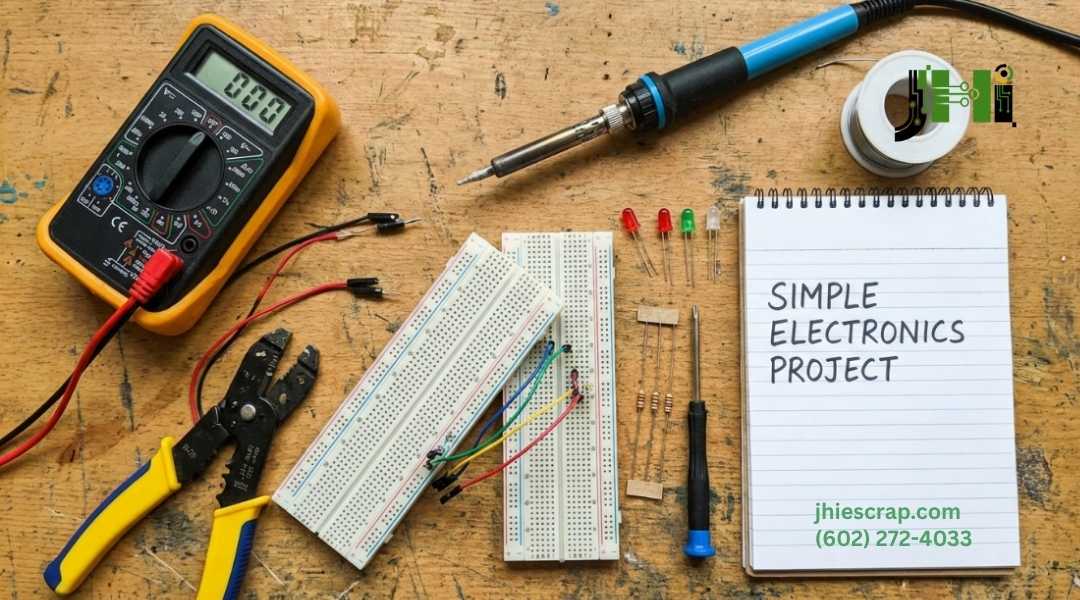
Think of a multimeter as the doctor for electronic circuits. It measures voltage, current, and resistance, making it an essential tool for anyone working with or troubleshooting circuits. Basic, handheld multimeters are affordable, widely available, and beginner-friendly.
Simple Power Supply
The heart of the circuit. A simple power supply converts AC wall power into regulated DC power for electronic circuits. It is one of the most fundamental components in electronics labs, DIY projects, and educational kits.
Passive Filters
What if you could remove noise from signals? Passive filters — built from resistors, capacitors, and inductors — do exactly that. They allow certain frequencies of electrical signals to pass while blocking others, and are used in audio equipment, radio receivers, and basic signal processing applications.
Sensors
These devices react before you even notice. Sensors detect physical changes — motion, light, heat, sound — and convert them into electrical signals. Common examples include light-dependent resistors (LDRs), motion sensors, and temperature sensors, all used in simple circuits for home automation and education.
Key Components Used in Simple Electronic Equipment in Phoenix, AZ
Every device you use has these hidden inside. Simple electronic equipment may look plain on the outside, but inside, a small collection of components does all the work. Understanding these parts helps you appreciate exactly how your everyday devices function.
Key Components Used in Simple Electronic Equipment
Tiny parts, big impact. The most common components found inside simple electronic devices include resistors, capacitors, diodes, transistors, batteries, inductors, LEDs, and switches. Each has a specific job, and together they make a device work reliably.
| Component | Primary Function | Found In |
|---|---|---|
| Resistor | Controls current flow | Almost every circuit |
| Capacitor | Stores & releases energy | Radios, fans, power supplies |
| Diode | Allows one-way current | Power supplies, LED lights |
| Transistor | Switches / amplifies signals | Radios, phones, sensors |
| Battery | Provides portable power | Remotes, flashlights, phones |
| Inductor | Stores magnetic energy | Filters, power converters |
| LED | Emits visible light | Indicator lights, flashlights |
| Switch/Relay | Opens/closes circuits | Virtually every device |
Resistors
A traffic controller for electricity. Resistors limit the amount of current flowing through a circuit, preventing components from receiving more electricity than they can handle. Imagine water flowing through a pipe — a resistor is like a valve that controls the flow rate. They are found in virtually every simple electronic device.
Capacitors
A small energy tank. Capacitors store electrical energy and release it when needed. They smooth out voltage fluctuations in power supplies, filter audio signals in radios, and help circuits respond more stably to changes in power input. Their ability to charge quickly and release energy on demand makes them extremely versatile.
Diodes
A one-way gate. Diodes allow electric current to flow in only one direction, blocking it from going backward. This property is used in power supplies to convert alternating current (AC) to direct current (DC), and in protective circuits to prevent damage from reverse current. One-way street, always.
Transistors
Small part, massive power. Transistors can switch a circuit on or off or amplify a weak signal into a stronger one. Despite being microscopic in modern electronics, transistors are responsible for nearly all signal processing in devices like radios, phones, and sensors. They are arguably the most important component in modern electronics.
Batteries
Power in your pocket. Batteries convert stored chemical energy into electrical energy, making simple devices portable and independent of wall outlets. In Phoenix, where outdoor activities are common, battery-powered devices offer the freedom to use electronics anywhere — from hiking trails to outdoor markets.
Inductors
Energy stored in invisible fields. Inductors are coils of wire that store energy in a magnetic field when current passes through them. They are used in filters, power converters, and radio tuners. Though less visible than other components, inductors play a key role in controlling signal quality and power stability.
LEDs (Light Emitting Diodes)
You see them glowing everywhere. LEDs emit light when electric current flows through them, and they do so using very little power compared to traditional bulbs. From indicator lights on devices to the LED flashlights used during Phoenix monsoon season, LEDs combine low energy use with long lifespan and bright output.
Switches / Relays
One click, full control. Switches open or close a circuit, directly controlling whether a device is on or off. Relays are electrically operated switches that allow a small current to control a larger one. These components are the most fundamental control mechanism in all electronic equipment.
Functions of Simple Electronic Equipment and Components in Phoenix, AZ
What actually happens when you turn a device on? Understanding the functions of simple electronics helps you see how each part and device plays a role in getting a job done. Simple actions, smart results.
Functions of Simple Electronic Equipment
At the device level, simple electronics perform four core categories of functions: power conversion, signal processing, communication, and control. Each of these functions corresponds to a specific type of device and set of components working together.
Power Conversion
Changing power into usable form. Power conversion is the process of taking electrical energy from one form and converting it to another — most commonly from AC (alternating current, from the wall) to DC (direct current, usable by electronics). Simple power supplies and battery chargers perform this function every time you plug in a device.
Signal Processing
How does your device understand signals? Signal processing involves receiving, modifying, and outputting electrical signals. A radio, for instance, receives radio waves, filters and amplifies the desired frequency, and converts it into sound. This function relies on components like capacitors, inductors, and transistors working in combination.
Control and Operation
You press a button, and it responds instantly. Control functions allow a device to start, stop, adjust speed, or change settings based on user input. Switches, relays, and transistors all serve this role, enabling you to interact with devices in an immediate, intuitive way.
Communication
Silent signals, powerful connection. Communication electronics transmit and receive information over distances using electrical signals or radio waves. Basic mobile phones and radios are built around this function, converting voice or data into signals that travel wirelessly and are reconstructed at the other end.
Functions of Simple Electronic Components
Each component has a specific job. At the component level, the function of each part directly determines how the circuit and device behave. The following breakdown explains what each component actually does inside a circuit.
Current Limiting and Voltage Division
Like splitting water flow into streams. Resistors perform two main functions: they limit current to safe levels for sensitive components, and they divide voltage across a circuit to supply different parts with the right amount of electrical pressure. This is foundational to almost all circuit design.
Energy Storage (Electric and Magnetic Fields)
Energy saved for the right moment. Capacitors store energy in electric fields; inductors store it in magnetic fields. Both release that energy when the circuit needs it, enabling functions like timing circuits, signal smoothing, and oscillation — all critical to how radios, fans, and power supplies operate.
Direction Control of Current
Like a one-way road. Diodes enforce a single direction of current flow, which is essential for converting AC to DC, protecting sensitive components, and building rectifier circuits used in virtually every powered device.
Signal Amplification and Switching
Weak signals become strong. Transistors amplify faint electrical signals to usable levels and switch circuits on or off rapidly. This makes them essential in radios, sensors, and any circuit that needs precise on/off control.
Light Emission and Indication
You see it blink, and you know it works. LEDs emit visible light when current passes through them, serving as status indicators, warning lights, and primary light sources. Their low power draw and long lifespan make them the preferred choice in all modern simple electronic devices.
Circuit Control and Switching
One action controls the whole system. Switches and relays provide the mechanism to activate or deactivate an entire circuit or specific sections of it. From the simple ON/OFF switch on a flashlight to the relay in an automated irrigation system, these components are the user’s direct interface with the circuit.
Applications of Simple Electronic Equipment in Phoenix, AZ
You use these without even noticing. Simple electronic equipment shows up in nearly every environment — home, school, office, and beyond. Here’s how these devices are actually applied in real life across the Phoenix area.
Home Use
You probably rely on these every day. In the home, simple electronics provide comfort, safety, and communication. Electric fans manage heat, flashlights provide emergency lighting, radios keep families informed, and remote controls add convenience. In Phoenix — where power reliability can be challenged during monsoon season — having simple, battery-powered backups is especially smart.
Education and Learning
Practice makes learning stick. Calculators help students with math. DIY electronic kits teach circuit building. LED boards, sensor modules, and basic multimeters are used in Phoenix-area classrooms and makerspaces to introduce students to electronics hands-on. Learning electronics through simple projects builds real skills that carry into STEM careers.
Office Use
Small tools, big results. In offices, simple electronics improve productivity without adding IT complexity. Calculators speed up number work, desktop fans keep workspaces comfortable, label printers organize files, and power strips safely distribute electricity. None of these require configuration — they just work.
Industrial Basic Tasks
These simple tools support bigger systems. Even in industrial environments, basic electronics play a role. Sensors detect temperature, motion, or light. Simple relays trigger responses in automated processes. Basic power supplies provide stable voltage to control panels. These foundational devices underpin more complex industrial systems throughout the greater Phoenix metro.
Limitations of Simple Electronic Equipment in Phoenix, AZ
Simple is good, but not always enough. Honest evaluation of simple electronic equipment means acknowledging where these devices fall short, so you can make informed decisions about when to use them and when to upgrade.
Limited Functionality
Simple means fewer features. A basic mobile phone makes calls and sends texts — but it won’t run navigation apps or stream video. A handheld radio receives broadcasts but can’t connect to podcasts. For users who need advanced features, simple electronics are an insufficient replacement for more capable devices.
Lower Performance
Not built for heavy work. Simple electronics are designed for light, repetitive tasks. They lack the processing power, memory, or speed needed for complex operations. A basic calculator can’t run statistical modeling software. A desktop fan can’t replace central air conditioning in a Phoenix summer. These devices have a clear performance ceiling.
Minimal Automation
More manual, less automatic. Simple electronics generally require direct human input to operate. They don’t learn, adapt, or self-adjust. If you need a device that responds automatically to environmental changes — like a smart thermostat — simple electronics won’t meet that need without significant modification or added components.
Maintenance and Safety of Simple Electronic Equipment in Phoenix, AZ
Why risk damage when care is simple? With just a few basic habits, simple electronics can last for years — even decades — without needing professional service. Small care, long life.
Maintenance and Safety Tips
- Handle devices gently — avoid drops and impacts
- Keep devices dry and away from moisture
- Clean regularly with a dry or slightly damp cloth
- Never overload sockets or use damaged power cables
- Remove batteries from devices not in use for long periods
- Store devices in cool, dry environments away from direct sunlight
Proper Handling
You don’t want to break it by mistake. Most simple electronic devices are robust but not indestructible. Dropping a device can crack the casing, disconnect internal wires, or damage a display. Handle devices with care, especially when changing batteries or cleaning. A protective case or pouch adds extra safety during transport.
Regular Cleaning
Dust is a silent enemy. Particularly in Phoenix, where desert dust and sand are a constant presence, keeping simple electronics clean is essential. Dust can clog vents, interfere with buttons, and reduce the lifespan of motors (as in fans). A quick wipe-down once a week goes a long way.
Safe Power Usage
Too much power can damage everything. Always use the correct power adapter or battery type specified by the manufacturer. Avoid using power strips that are overloaded with high-draw devices. In Phoenix, where summer power demand is highest, keeping electrical loads manageable also reduces the risk of tripped breakers or overheating.
Battery Care
Take care of power, and it lasts longer. Remove batteries from devices stored for extended periods to prevent corrosion and leakage. Use quality batteries from reputable brands. Never mix old and new batteries, or different battery types, in the same device. Leaking batteries can permanently damage the device’s contacts and circuit.
Environmental Considerations for Electronics in Phoenix, AZ
We all share the same environment. As electronic devices become more common, responsible disposal and energy use become increasingly important for communities like Phoenix — one of the fastest-growing cities in the United States. Take care of what you use.
E-Waste Management
Throwing away is easy, managing is smarter. Electronic waste — or e-waste — contains hazardous materials like lead, mercury, and cadmium that can contaminate soil and groundwater if improperly discarded. Phoenix residents should take old electronics to certified e-waste collection centers rather than putting them in regular trash bins. Many local retailers and municipal programs offer free drop-off options.
Recycling Practices
Why waste what can be reused? Many components inside simple electronics — metals, plastics, circuit boards — can be recovered and reused when devices are properly recycled. The City of Phoenix operates electronics recycling programs, and several private companies in the metro area offer pick-up or drop-off recycling services for old devices.
Energy Efficiency
Use less, save more. Choosing simple, energy-efficient electronics is one of the most effective personal choices for reducing both electricity bills and environmental impact. Devices like LED flashlights, battery-operated radios, and low-wattage fans consume a fraction of the energy that older or more complex devices require. In a sun-drenched city like Phoenix, pairing efficient electronics with smart usage habits makes a measurable difference.
Conclusion: Simple Electronic Equipment Makes Everyday Life Easier
Simple electronic equipment is all around you — in your home, your office, your classroom, and your pocket. From the humble flashlight to the trusty calculator, these devices deliver reliable performance without complexity, high cost, or constant maintenance. In a demanding city like Phoenix, AZ, where heat, dust, and fast-paced living are facts of life, simple electronics are not just convenient — they are essential.
Understanding what simple electronics are, how their components work, and where they are applied gives you the knowledge to make smarter choices — whether you’re buying a new device, troubleshooting an old one, or disposing of it responsibly.
At Jay Hohel Inc, we specialize in scrap electronics and e-waste management right here in Phoenix, AZ. Whether you have old simple electronic equipment, circuit boards, or any electronic scrap, we make it easy to dispose of them safely and responsibly — and put money back in your pocket.
3334 W McDowell Rd Unit 17, Phoenix, AZ 85009-2414
📞 (602) 272-4033
✉️ JayHoehlinc@gmail.com
🌐 jhiescrap.com
Ready to recycle your old electronic equipment?
Serving Phoenix, AZ and the greater Maricopa County area.