You use electronics every single day. But do you actually know what’s inside them? Think of your phone’s circuit board like a tiny city — each part has one job, and together they keep everything running. Once you know the 5 basic electronic components, everything clicks into place.
What Are the 5 Basic Electronics in Phoenix, AZ?
Whether you’re fixing a gadget or building one from scratch, these five components are your starting point. Simple parts. Powerful results.
Overview of the 5 Basic Electronics
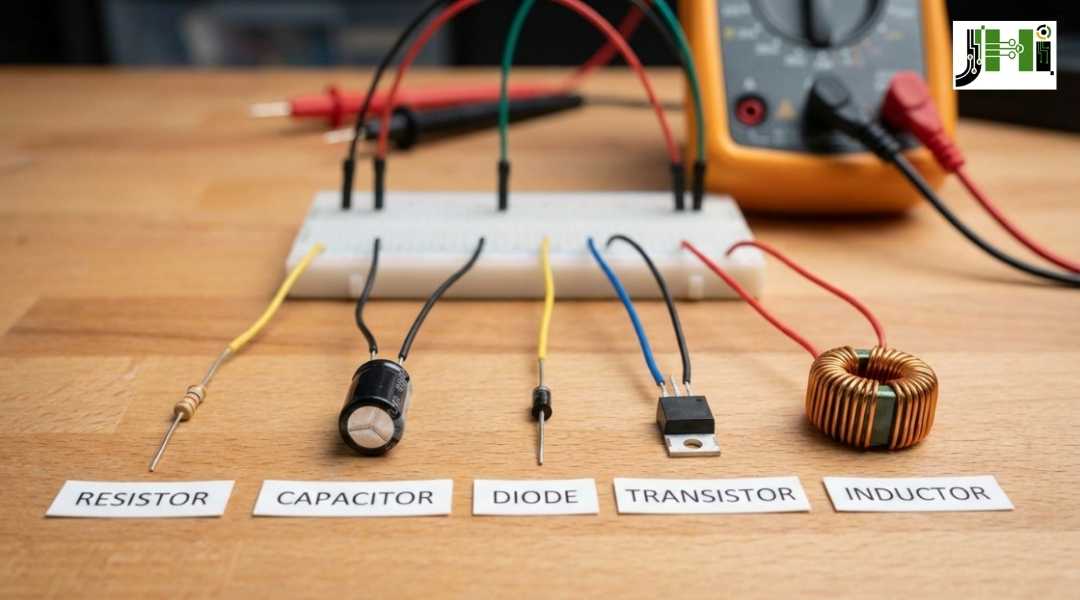
- Resistor — controls how much current flows through a circuit
- Capacitor — stores and releases electrical energy quickly
- Inductor — stores energy using a magnetic field
- Diode — lets current flow in one direction only
- Transistor — switches or amplifies electrical signals
QUICK REFERENCE
| Component | Core Role | Quick Metaphor |
| Resistor | Limits current flow | Speed breaker |
| Capacitor | Stores energy short-term | Small water tank |
| Inductor | Stores magnetic energy | Coil spring |
| Diode | Controls current direction | One-way gate |
| Transistor | Switches & amplifies signals | Tiny switch |
Understanding the Importance of Basic Electronics in Phoenix, AZ
Here’s the thing. Every device you touch — your TV, your charger, your laptop — runs on these five parts. They’re not just textbook theory. They’re inside the things you use before breakfast.
Small parts. Big impact. That’s electronics in a nutshell.
Importance of These Basic Electronics
Industries from aerospace to healthcare depend on these components every single day. You’re already using them — you just didn’t know their names yet. Understanding them puts you ahead of most people in the room.
Foundation of All Circuits
No circuit works without at least one of these parts. Think of them like bricks in a house. Remove one, and the structure fails. Together, they create something stable, reliable, and functional.
Building Blocks of Modern Technology
Your smartphone holds billions of transistors. Your computer’s chip has capacitors firing thousands of times per second. Tiny parts. Huge systems. That’s the magic of electronics.
Role of Basic Components in Electronic Design
Before anyone builds a circuit, they plan which components go where — and why. Every design decision starts with these five. Knowing them gives you real control over how electronics behave.
Building and Managing Electrical Signals
Signals travel through circuits like traffic on a road. Each component directs, slows, stores, or amplifies that flow. Voltage and current need guidance — and these parts provide it.
Controlling Circuit Behavior
Without control, circuits are chaos. The transistor acts as a gatekeeper — deciding when current flows and when it stops. Without it, your device would just be noise.
The 5 Basic Electronic Components Explained in Phoenix, AZ
Each part has a simple role. But together? They do something powerful. Here’s a clear breakdown of all five — no jargon, just the facts you need to know.
The 5 Basic Electronic Components
- Resistor — limits current flow
- Capacitor — stores charge temporarily
- Inductor — stores magnetic energy
- Diode — allows one-way current only
- Transistor — switches and amplifies
Simple names. Powerful roles.
Resistor
A resistor is like a speed breaker for electricity. It slows down current so other components don’t get overwhelmed.
Definition: A passive component that reduces current flow and lowers voltage in a circuit.
Key functions:
- Limits current to safe levels
- Protects sensitive components from damage
- Adjusts voltage levels throughout a circuit
Common applications:
- LED circuits — prevents burn-out
- Volume controls in audio devices
- Sensor circuits in thermostats and appliances
Capacitor
Think of a capacitor like a small rechargeable battery. It charges up fast and releases energy the moment the circuit needs it.
Definition: A component that stores electrical energy between two conductive plates separated by an insulator.
Key functions:
- Stores and releases charge quickly
- Filters out signal noise and interference
- Smooths voltage in power supplies
Common applications:
- Power supply smoothing circuits
- Audio signal filtering
- Camera flash units
Inductor
An inductor works like a coil spring for electricity. It stores energy in a magnetic field and resists sudden changes in current.
Definition: A coil of wire that stores energy magnetically when current flows through it.
Key functions:
- Stores energy in a magnetic field
- Filters high-frequency signals
- Regulates current in power circuits
Common applications:
- Radio frequency filters
- Power converters and regulators
- Motor control systems
Diode
A diode is a one-way gate for electricity. Current goes in — but it can’t come back out the same way.
Definition: A semiconductor component that allows current to flow in one direction only.
Key functions:
- Controls the direction of current flow
- Blocks reverse current from causing damage
- Converts AC to DC power (rectification)
Common applications:
- Power supply rectifiers
- LED lights in all modern devices
- Signal demodulation in radios
Transistor
A transistor is a tiny switch — and an amplifier. It’s the reason computers can process billions of operations per second.
Definition: A semiconductor device that amplifies electrical signals or switches them on and off.
Key functions:
- Switches circuits on and off instantly
- Amplifies weak electrical signals
- Enables binary logic in digital devices
Common applications:
- Computers and microprocessors
- Audio amplifiers and speakers
- Radio transmitters and receivers
The 5 Basic Electronic Components in Circuits in Phoenix, AZ
Knowing the parts is step one. But what happens when they connect together? That’s where the real magic starts.
The 5 Basic Electronic Components in Circuits
- Resistor — controls current, protects components downstream
- Capacitor — smooths out voltage spikes in the line
- Diode — keeps current moving in one safe direction
- Transistor — acts as a switch for signal control
- Integrated Circuit (IC) — combines many components into one chip
Same parts. New role. Bigger result.
Resistors in Circuits
In a circuit, a resistor is like a tap controlling water flow. It drops the voltage across itself so other components get just the right amount of current — not too much, not too little.
Capacitors in Circuits
A capacitor works like a water tank inside a circuit. It absorbs sudden bursts of energy and releases it steadily — smoothing out the signal so everything runs cleanly.
Diodes in Circuits
A diode is a one-way door in a circuit. It lets current pass forward but blocks it from going backward. This is how AC power gets converted to DC in your phone charger.
Transistors in Circuits
A tiny device with huge control. The transistor tells a circuit when to turn on and when to stop — making it the brain behind every logic operation in your electronic devices.
Integrated Circuits (ICs)
An IC is like a mini brain. It packs resistors, capacitors, diodes, and transistors all onto one tiny chip. Your phone’s processor? That’s an IC with billions of components working together as one.
Functions of Basic Electronic Components in Phoenix, AZ
Now you know the parts. Here’s exactly what each one does — and why it matters in every circuit you’ll ever work with.
Functions of the 5 Basic Electronic Components
- Resistor — limits current flow and protects components
- Capacitor — stores energy and smooths signals
- Diode — directs current and blocks reverse flow
- Transistor- switches and amplifies electrical signals
- Integrated Circuit — processes complex signals and logic
Current Limiting (Resistors)
A resistor acts like the brakes in a car. Too much current and your components burn out. The resistor steps in, absorbs the extra, and keeps everything operating safely at the right level.
Energy Storage (Capacitors)
A capacitor holds charge for a short time — like a small tank ready to release. When the circuit needs a quick burst of energy, the capacitor discharges instantly. Fast, reliable, and essential in power supplies.
Direction Control of Current (Diodes)
A diode keeps current on a one-way street. It blocks reverse flow and prevents damage from accidental polarity. In power circuits, it converts alternating current into smooth direct current.
Switching and Amplification (Transistors)
Small signal in. Big signal out. The transistor takes a weak electrical input and multiplies it into something powerful. In digital circuits, it switches between 0 and 1 — billions of times per second. Small signal. Big impact.
Complex Signal Processing (Integrated Circuits)
The IC is the brain of modern electronics. It handles everything — calculations, memory, communication. Your CPU, your phone chip, your smartwatch — all ICs, each packing the power of thousands of individual components.
How Basic Electronic Components Work Together in Phoenix, AZ
Individually simple. Together powerful. But how do they actually function as a team inside a real circuit?
How These 5 Components Work Together
- Power enters the circuit from a source
- Resistor limits the current to a safe level
- Capacitor smooths any voltage spikes in the line
- Diode directs current forward — no going back
- Transistor switches or amplifies the final signal
The result? A stable, controlled, fully functional electronic system.
Combined Functionality
No component works in isolation. A resistor without a capacitor lets a voltage spike. A diode without a transistor can’t process logic. Together they create synergy — alone simple, together powerful.
Example Circuit
Picture a basic LED circuit. Here’s how it works step by step:
- Step 1: Power flows from the battery into the circuit
- Step 2: The resistor limits current so the LED doesn’t blow out
- Step 3: The diode (LED) converts electrical energy into visible light
- Step 4: The transistor acts as the switch — turn it on, the light appears
Like turning on a small light. Simple concept. Real, practical result.
Additional Common Electronic Components in Phoenix, AZ
The core five are just the beginning. Electronics goes deeper — and the more you explore, the more you can build.
Inductors (Revisited)
You already know inductors store magnetic energy. In advanced circuits, they work as filters — blocking high-frequency noise while letting clean signals through. Critical in radio and power conversion circuits.
LEDs (Light Emitting Diodes)
LEDs are diodes that emit light. Simple concept, everywhere application. Your phone’s flashlight, your TV backlight, traffic signals — all LEDs. And they always pair with a resistor to stay within safe operating limits.
Advanced Learning Topics for Electronics in Phoenix, AZ
You’ve built the foundation. Now it’s time to go deeper. These topics are your next steps on the path from beginner to confident builder.
Ohm’s Law
Voltage equals current multiplied by resistance. That’s Ohm’s Law — the golden formula of electronics. Think of it like water pressure: more resistance, less flow. It’s the rule that ties every circuit decision together.
Circuit Design Basics
Before you build, you plan. Circuit design is about thinking through which components go where — and why. Good planning prevents failures before they happen and saves hours of troubleshooting later.
Analog vs Digital Electronics
Analog signals are continuous — like a dimmer switch that fades smoothly. Digital signals are binary — strictly on or off, 1 or 0. Your vinyl record is analog. Your streaming service is digital. Both use the same basic five components.
Semiconductor Physics
Diodes and transistors are made of semiconductors — materials that conduct electricity only under certain conditions. Silicon is the most common. Understanding why it conducts unlocks how every modern device actually works at the deepest level.
PCB (Printed Circuit Board) Design
A PCB is where all five components live and connect. It’s the physical board that links everything in a planned layout. Poor layout causes interference and failures. Good layout means a device that works reliably — every time you turn it on.
Now you know where to start.
Five components. One solid foundation. Everything in electronics builds from here. Pick one part, learn it deeply, and start building from there. You’re ready.
Your Electronics Journey Starts Here
Now you know the five basic electronic components: resistor, capacitor, inductor, diode, and transistor. These aren’t just textbook terms. They’re the building blocks behind every device you use every single day.
Whether you’re starting from scratch, fixing broken equipment, or exploring electronics for the very first time — understanding these fundamentals gives you real confidence. You’re not guessing anymore. You know how things work.
At Jay Hohel Inc, we believe knowledge leads to better decisions. If you’re dealing with scrap electronics, old equipment, or surplus components in Phoenix, AZ — we’re here to help you turn that into real value. Our team has the expertise, the experience, and the local roots to make the process simple and rewarding for you.
Serving Phoenix, AZ and surrounding areas — Jay Hohel Inc, your local electronics experts.