You see electronics every day. Your phone, your charger, your TV remote. But do you really know what makes them tick? Think of electronics like a small city. Each part has a job. And once you know the five basic ones, the whole world of gadgets starts to make sense.
What Are the 5 Basic Electronics in Phoenix, AZ?
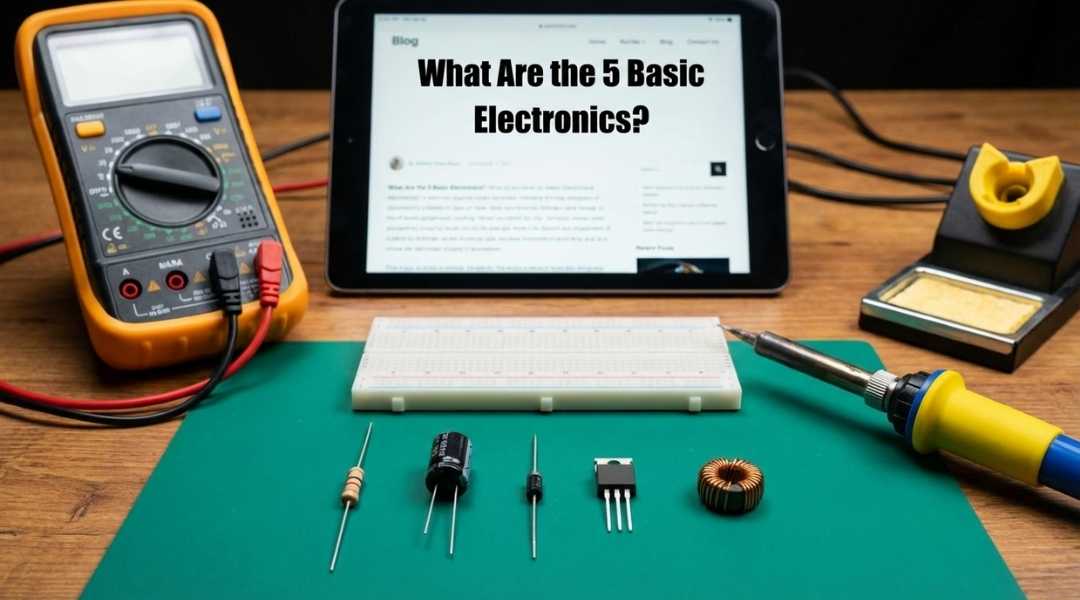
The 5 basic electronic components are the building blocks behind every device you own. They’re simple parts with powerful results. Most circuits in Phoenix homes, offices, and gadgets rely on just these five.
Here’s the quick list:
- Resistor – controls the flow of current
- Capacitor – stores electrical energy
- Inductor – manages magnetic energy
- Diode – lets current flow one way
- Transistor – switches and boosts signals
That’s it. Five small parts. Endless possibilities.
Overview of the 5 Basic Electronics
Let’s keep it simple. Here’s a quick snapshot of each one:
- Resistor – like a speed bump for electricity
- Capacitor – like a tiny rechargeable tank
- Inductor – like a coiled spring storing energy
- Diode – like a one-way gate
- Transistor – like a tiny switch that controls big things
You can learn this fast. Each one does one job well. Together, they run almost every device around you.
Understanding the Importance of Basic Electronics in Phoenix, AZ
These five parts matter more than you think. They’re inside your phone, your fridge, and your car. Small parts, big impact.
Without them, none of your daily tech would work. No music. No texts. No lights. They quietly power the world around you.
In Phoenix, every smart home, office setup, and EV charger leans on these basics. Learning them gives you a real edge. You stop seeing devices as magic. You start seeing how they actually work.
Importance of These Basic Electronics
You use them daily without knowing. Every charger, screen, and speaker needs them. Industries like healthcare, cars, and computers depend on these parts. Knowing the basics builds trust in how tech works.
Foundation of All Circuits
Every circuit starts with these five parts. They’re like bricks in a house. Take one away and the whole thing falls apart. A simple LED needs a resistor. A power supply needs a capacitor. No circuit works without this base layer.
Building Blocks of Modern Technology
Your smartphone holds billions of these tiny parts. So does your laptop. Tiny pieces, huge systems. From smartwatches to space rockets, it all starts here. Modern tech is just these five basics, scaled up smartly.
Role of Basic Components in Electronic Design
Ever wonder how engineers plan circuits? They start with these five. Each part plays a clear role in the design. Resistors protect. Capacitors store. Diodes guide. Transistors control. Good design means picking the right part for the right job.
Building and Managing Electrical Signals
Think of current like traffic flow. These parts direct, slow, and store it. Voltage pushes the current. Components shape its path. The result? Clean signals that make your gadgets work the way they should.
Controlling Circuit Behavior
Without control, you get chaos. These parts decide what a circuit does:
- Resistors limit power
- Capacitors smooth signals
- Transistors flip switches
Transistors are the real stars here. They make logic possible. That’s how computers think.
You now know where to start. These five basics open the door to everything else. Master them and you’ve got a real foundation. Next stop? Learning how full circuits come together.
The 5 Basic Electronic Components Explained in Phoenix, AZ
Now let’s go deeper. Each part has a simple role. But together, they do something powerful. We’ll break down all five in plain words. No heavy jargon. Just clear ideas you can use right away.
By the end, you’ll know what each part does and why it matters. Whether you’re a hobbyist in Phoenix or just curious, this guide makes it easy. Ready? Let’s start with the first one.
The 5 Basic Electronic Components
Here are the five you need to know:
- Resistor – limits current
- Capacitor – stores charge
- Inductor – stores magnetic energy
- Diode – directs current
- Transistor – switches and amplifies
Simple names. Powerful roles. Each one earns its spot in every circuit.
Resistor
A resistor is like a speed breaker on a road. It slows things down on purpose. In a circuit, it controls how much current flows through. Without it, parts could burn out fast.
Definition of Resistor
A resistor is a small part that limits electrical current. Think of it as a controlled block. It keeps current safe and steady for other parts.
Key Functions of a Resistor
Resistors do a few key jobs:
- Limit current flow
- Drop voltage to safe levels
- Protect sensitive parts
- Split signals in circuits
Their main job? Keeping current under control.
Common Applications of Resistor
You’ll find resistors almost everywhere:
- LED circuits (so the LED doesn’t burn out)
- Volume knobs on speakers
- Power supplies
- Sensor circuits
Anywhere current needs control, a resistor shows up.
Capacitor
A capacitor is like a tiny battery. It stores energy fast and releases it fast. You’ll find one in almost every gadget you own.
Definition of Capacitor
A capacitor is a part that stores electrical energy for short bursts. It holds charge between two plates. Then it gives that charge back when needed.
Key Functions of a Capacitor
Capacitors handle a few main jobs:
- Store electrical energy
- Filter out noise in signals
- Smooth out power supply
- Block direct current
They keep your devices steady and clean.
Common Applications of Capacitor
Capacitors show up in:
- Power supplies
- Camera flashes
- Audio systems
- Motor starters
Any time you need quick energy or clean power, capacitors do the work.
Inductor
An inductor is like a coiled spring for electricity. It stores energy in a magnetic field. When current changes, the inductor pushes back.
Definition of Inductor
An inductor is a coil of wire that stores energy as a magnetic field. It reacts when current changes around it.
Key Functions of Inductor
Inductors do important jobs:
- Store magnetic energy
- Block sudden current changes
- Filter signals
- Work in tuning circuits
They keep current steady and smooth.
Common Applications of Inductor
You’ll find inductors in:
- Radio tuners
- Power supplies
- Filters and chokes
- Wireless chargers
Anywhere signals need shaping, inductors help out.
Diode
A diode is like a one-way gate. Current can go through one direction only. Try the other way, and it blocks the flow.
Definition of Diode
A diode is a small part that lets current flow in just one direction. It acts like a check valve for electricity.
Key Functions of a Diode
Diodes have key roles:
- Direct current one-way
- Block reverse current
- Convert AC to DC
- Protect circuits
Direction control is their main game.
Common Applications of Diode
You’ll spot diodes in:
- Phone chargers (rectifiers)
- LED lights
- Solar panels
- Surge protectors
Any device that needs clean DC power uses them.
Transistor
A transistor is like a tiny switch with superpowers. It can turn signals on and off fast. It can also boost weak signals into strong ones.
Definition of Transistor
A transistor is a part that switches or amplifies electrical signals. It’s the building block of all modern computers.
Key Functions of a Transistor
Transistors handle two big jobs:
- Switch circuits on and off
- Amplify weak signals
- Control current flow
- Build logic gates
Small signal in, big impact out.
Common Applications of the Transistor
Transistors live inside:
- Computers and phones
- Radios and TVs
- Amplifiers
- Memory chips
Your smartphone has billions of them. Yes, billions.
The 5 Basic Electronic Components in Circuits in Phoenix, AZ
Theory is one thing. Real circuits are another. So how do these parts behave when you wire them up? Let’s see them in action. But what happens when these parts connect together?
The 5 Basic Electronic Components in Circuits
Same parts, new role. Here’s what each one does inside a working circuit:
- Resistor – sets safe current levels
- Capacitor – stores and smooths
- Diode – guides current direction
- Transistor – switches signals
- IC – ties it all together
Resistors
In a circuit, a resistor is like a tap on a water pipe. It controls how much flows through. It also drops the voltage to protect smaller parts. Pair one with an LED, and the LED lasts much longer.
Capacitors
A capacitor in a circuit acts like a small water tank. It fills up with charge, then releases it when needed. This keeps power steady. It also smooths out bumpy signals in audio and video gear.
Diodes
A diode in a circuit is like a one-way door. Current walks in but can’t walk back. That’s how your charger turns wall AC into clean DC. Without diodes, your phone wouldn’t charge.
Transistors
A transistor is a tiny device with huge control. It can flip on and off millions of times per second. That’s how your computer runs apps. Tiny part. Massive job.
Integrated Circuits (ICs)
An IC is like a mini brain. It packs thousands (or millions) of resistors, capacitors, and transistors onto one chip. Your phone’s processor is an IC. So is the chip in your car key. ICs make modern tech possible.
Functions of Basic Electronic Components in Phoenix, AZ
Each part has one main job. Once you know what each does, the rest clicks. Let’s group them by function. Clean. Clear. Easy to remember.
Functions of the 5 Basic Electronic Components
Quick recap of what each part does:
- Resistors limit current
- Capacitors store energy
- Diodes direct current
- Transistors switch and amplify
- ICs process signals
One job each. All work together.
Current Limiting (Resistors)
Resistors are like brakes in a car. They keep things from running wild. Without them, current would surge and fry your parts. They protect every circuit you build.
Energy Storage (Capacitors)
Capacitors store energy like a small tank stores water. They hold charge for a moment, then release it fast. This is great for camera flashes and power smoothing.
Direction Control of Current (Diodes)
Diodes work like a one-way street sign. Current flows one way only. Try to push it backward and the diode blocks it. That’s how your gadgets stay safe.
Switching and Amplification (Transistors)
A transistor takes a small signal and turns it into a big one. Or it flips on and off like a switch. Small signal, big impact. That’s the magic behind every chip.
Complex Signal Processing (Integrated Circuits)
ICs are the brain of electronics. They handle complex jobs like math, memory, and logic. Your CPU is just billions of tiny transistors packed onto one chip.
How Basic Electronic Components Work Together in Phoenix, AZ
Each part is simple on its own. But put them together and something cool happens. They start working as a team. Individually simple. Together powerful. But how?
How These 5 Components Work Together
Here’s the basic flow:
- Power enters the circuit
- A resistor controls the current
- A capacitor smooths it out
- A diode steers it the right way
- A transistor switches it on or off
Each part hands off to the next. Like a relay race for electricity.
Combined Functionality
Alone, each part does one thing. Together, they do everything. A resistor alone is just a brake. Add a capacitor and a transistor, and you’ve got a working amplifier. That’s the magic of synergy in circuits.
Example Circuit
Let’s build something simple. Take a battery, a resistor, and an LED. Wire the resistor to the LED. Connect to the battery. The resistor limits the current. The LED lights up safely. That’s it. A working circuit. Just like turning on a small light in your room. Add a transistor and you can control it with a button.
Additional Common Electronic Components in Phoenix, AZ
The five basics are just the start. There’s a whole world of other parts out there. Some you’ll meet often. Others only in special projects. Let’s peek at a few more you should know.
Additional Common Electronic Components
Beyond the core five, there are more parts to explore. Some are simple, others more advanced. You don’t need to learn them all at once. Just know they exist.
Inductors
We talked about inductors before. They store energy in a magnetic field. You’ll find them in radio tuners, filters, and wireless chargers. Like a coiled spring, they push back when current changes.
LEDs
An LED is a Light Emitting Diode. It glows when current flows through it. You see them in phone flashlights, TVs, and traffic signals. Pair one with a resistor and you’ve got a bright little circuit.
Advanced Learning Topics for Electronics in Phoenix, AZ
Ready to go deeper? Once you know the basics, a whole new world opens up. These topics help you build real projects. You’re ready for more.
Additional Learning Topics
Here’s where to go next:
- Ohm’s Law
- Circuit Design Basics
- Analog vs Digital Electronics
- Semiconductor Physics
- PCB Design
Pick one and start exploring.
Ohm’s Law
Ohm’s Law is the heart of electronics. It says voltage equals current times resistance. Or V = I × R. It’s like a recipe. Know two values and you can find the third. Simple but powerful.
Circuit Design Basics
Good circuits start with good plans. Before you build, you sketch. You pick parts. You check the math. Planning saves time and burnt components. Always design before you solder.
Analog vs Digital Electronics
Analog signals are smooth, like a wave. Digital signals are on or off, like a switch. A vinyl record is analog. A CD is digital. Both have their place in modern tech.
Semiconductor Physics
Semiconductors sit between conductors and insulators. Silicon is the most common one. It’s like a material that can act like both a wire and a wall. That’s what makes transistors and chips possible.
PCB (Printed Circuit Board) Design
A PCB is the green board inside your gadgets. It holds all the parts in place. Good layout means fewer bugs and better signals. It’s where your circuit goes from idea to real product.
Start Your Electronics Journey with Jay Hoehl Inc
So now you know the 5 basic electronics. Resistors, capacitors, inductors, diodes, and transistors. Five small parts that run the world around you.
You don’t need to be an engineer to get it. You just need a clear start. And now you have one.
At Jay Hoehl Inc, we’re proud to support Phoenix’s electronics community. Whether you’re a hobbyist, a student, or a pro, we’re here to help. We handle scrap electronics, components, and recycling with care. Got old boards, parts, or devices? We’ll take them off your hands the right way.
Visit us in Phoenix or give us a call. Let’s keep electronics smart, safe, and sustainable together.
📍 Get in Touch with Jay Hoehl Inc
- 📍 Address: 3334 W McDowell Rd Unit 17, Phoenix, AZ 85009-2414
- 📞 Phone: (602) 272-4033
- 📧 Email: JayHoehlinc@gmail.com
- 🌐 Website: jhiescrap.com