You use devices every day. But what actually powers them? The answer starts with SMD components. These tiny parts sit at the heart of every modern PCB. Understanding them is how you build better electronics faster.
What Are SMD Components in Phoenix, AZ?
Phoenix, AZ is a hub for aerospace, defense, and semiconductor manufacturing. Electronics here have to perform. SMD components make that possible. Surface mount technology drives most of the electronics manufacturing in Arizona. Local PCB assembly shops rely on SMD parts for everything from industrial control boards to avionics systems. The state’s semiconductor presence also means local engineers work with cutting-edge SMD designs daily.
SMD assembly services in Phoenix
Whether you build for aerospace or consumer electronics, the Phoenix electronics sector runs on surface mount technology. That’s not a trend. It’s the standard.
What Are Surface-Mount Device (SMD) Components?
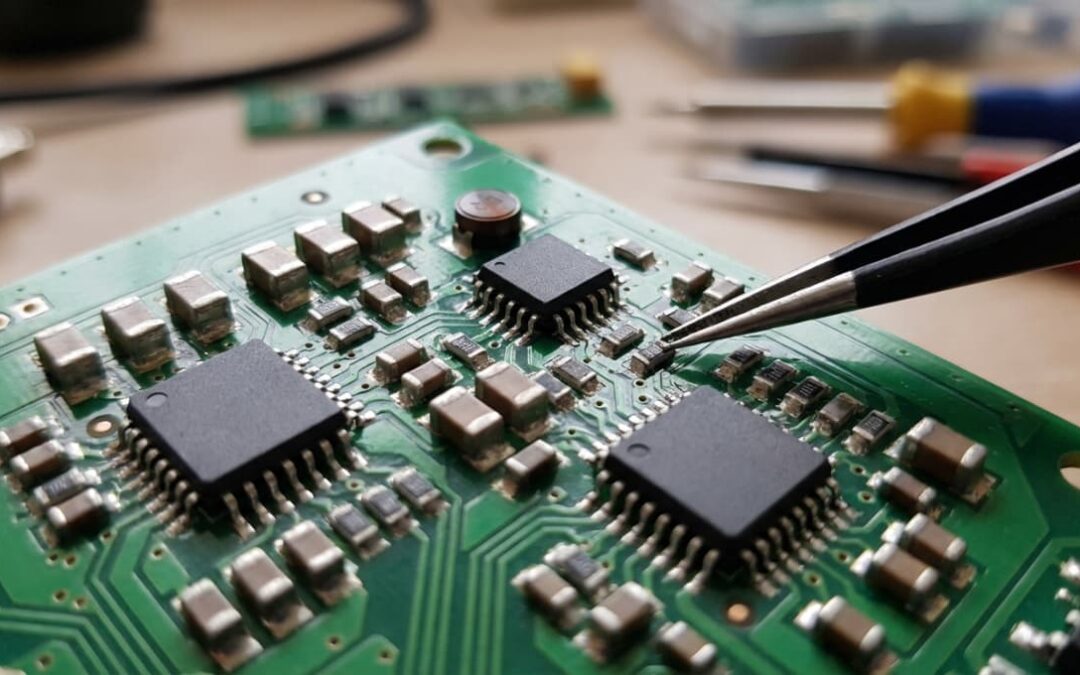
SMD components, short for surface-mount device components, mount directly onto the surface of a printed circuit board. No holes needed. No leads poking through the board. Traditional through-hole components require drilling. SMD parts skip that step entirely. You place them flat on the PCB, run them through a reflow oven, and they’re locked in place with solder.
Smaller footprint, faster assembly, lower cost.
SMT (surface mount technology) is the process. SMD is the part. Together, they’ve replaced most through-hole designs in modern electronics manufacturing. The result is a faster build, a denser board, and a more reliable product.
Advantages of SMD Components for Electronics in Phoenix, AZ
Phoenix engineers don’t pick SMD parts by accident. They pick them because they deliver. Like upgrading from a desktop to a microchip, SMD technology shrinks size while boosting performance. Automated assembly lines handle SMD parts with high speed and accuracy. That compatibility is key for scalable production. The moment you design for SMD, you design for efficiency.
Advantages of SMD Components
Compact size:
High-density mounting:
Low power consumption:
Faster production:
Improved product lifespan:
Production cost comparisons consistently favor SMD over through-hole. The numbers are clear: smaller parts, faster placement, lower total cost.
Disadvantages of SMD Components
SMD components come with real trade-offs. Honesty here builds trust. Repair is the biggest challenge. Ever tried soldering something the size of a grain of sand? SMD rework requires specialized tools and a steady hand. That makes field repairs harder and costlier than with through-hole parts.
SMD repair challenges
Inspection is also more complex. Visual checks don’t always catch hidden solder joints. That’s why automated optical inspection (AOI) systems are essential in SMD production lines. The tradeoff is real: production efficiency goes up, but repair complexity follows. For high-volume manufacturing, that’s a worthwhile exchange.
Common Types of SMD Components Used in Phoenix, AZ Electronics
SMD components aren’t all the same. Each type serves a distinct role. Let’s break them down. Phoenix electronics manufacturers work with a wide range of SMD parts. From passive resistors to complex integrated circuits, every component has a specific function on the board. Understanding the categories helps you design smarter and source faster.
Common Types of SMD Components
SMD parts split into two main groups: passive and active. Passive components don’t require power to operate. Active components do. Both are essential in any functional circuit.
Passive SMD parts:
Active SMD parts:
In manufacturing, passive components appear far more often by volume. Active components do the heavy lifting in signal processing and power management.
SMD Resistors
Resistors control current flow and voltage levels across a circuit. SMD resistors, also called chip resistors, come in tiny rectangular packages rated by resistance value and tolerance.
precision matters.
Common sizes like 0402 resistors are popular in compact designs. They’re accurate, reliable, and proven across millions of boards. A standard 0402 resistor measures just 1.0mm x 0.5mm.
SMD Capacitors
Capacitors store energy and smooth out signal fluctuations. They protect circuits from voltage spikes and filter noise from power lines. The most common type is the MLCC (multilayer ceramic capacitor). Tantalum capacitors are another option for higher capacitance values in tight spaces. Low ESR capacitors are critical in power supply circuits where efficiency is the priority.
Store energy fast, release energy clean.
One of the most common PCB failure sources is incorrect voltage rating selection. Always choose a capacitor rated above your circuit’s maximum operating voltage. Phoenix electronics manufacturing teams know this rule well.
SMD Inductors
What keeps voltage spikes in check? A well-placed SMD inductor. Inductors use magnetic fields to regulate current flow in power supply circuits. They’re essential in DC-DC converters and RF filter stages. Power SMD inductors handle higher current loads. RF inductors operate at much higher frequencies.
Shielded SMD inductors are important in high-frequency circuits. Shielding reduces electromagnetic interference with nearby components. Industrial electronics teams in Phoenix spec shielded inductors for exactly that reason.
Surface mount coils
Active SMD Components in Phoenix, AZ Electronic Devices
These components do more than carry current. They switch, amplify, process, and control signals across your entire board. Active SMD components are semiconductor devices. They require a power source to function. Their switching speeds and processing power make them the backbone of any intelligent electronic system. Phoenix electronics manufacturing uses these parts in everything from motor controllers to embedded computing platforms.
SMD Diodes
Diodes allow current to flow in one direction only. That makes them essential for circuit protection and signal rectification.
Protect the board.
Rectifier SMD diodes convert AC to DC in power supply circuits. Zener diodes regulate voltage. LED components produce light while also acting as indicators on control panels. Always check the reverse voltage rating when selecting a diode. Exceeding that rating destroys the component and can damage nearby parts on the board.
SMD Transistors
Transistors amplify signals and control switching in digital circuits. SMD transistors pack that power into a tiny footprint.
Switch faster, consume less.
SMD MOSFETs are popular in power management circuits. They control large current loads with minimal gate drive power. Switching components on PCBs must handle both the electrical load and the thermal load. In Phoenix, thermal dissipation is a real consideration. The desert climate pushes ambient temperatures higher. Power transistors on boards running in Arizona environments need proper thermal management to maintain reliability.
SMD Integrated Circuits (ICs)
The brain of the board. That’s what a surface mount IC is. Integrated circuits combine thousands or millions of transistors into a single package. Microcontroller SMDs handle logic, timing, and I/O functions. Semiconductor integrated circuits power everything from motor drivers to wireless communication modules.
Package choice matters here. BGA packages offer high density but require X-ray inspection to verify solder joints. QFN packages offer a compact thermal pad design that helps with heat dissipation. Each has its tradeoff. Choose based on your inspection capability and thermal requirements.
Electromechanical SMD Components for Phoenix, AZ Applications
Electronics don’t just process signals. They connect, switch, and relay power across systems. Electromechanical SMD components bridge the electrical and mechanical world on a single board. In Phoenix industrial systems, vibration resistance is a real specification. Electromechanical parts that hold up under mechanical stress keep production lines running reliably. These components are surprisingly critical to overall system durability.
SMD Connectors
PCB SMD connectors link boards to cables, other boards, or external systems. Board-to-board connectors stack PCBs in compact assemblies. Surface mount terminals handle wire connections directly on the board.
Contact plating quality determines long-term reliability. Gold-plated contacts resist corrosion and maintain low resistance over thousands of insertion cycles. For industrial Phoenix applications, that durability is non-negotiable.
SMD Switches
Switches let users or systems control circuits manually or through signal inputs. Tactile surface mount switches are common on control panels and user interfaces. PCB push button switches give a satisfying click and clear actuation feel. Lifecycle ratings tell you how many presses the switch can handle before failure. High-cycle switches are worth the investment in any product that users touch frequently. Choose the right switch for your use case. Consumer products need different ratings than industrial controls.
SMD Relays
SMD relays isolate high-power circuits from low-power control signals. You send a small signal to trigger the relay coil. The relay then switches a high-current load safely. Coil voltage matching is critical. Use the wrong coil voltage and the relay won’t actuate reliably. Surface mount relays come in 5V, 12V, and 24V coil options for most applications. Power relays on PCBs protect sensitive control circuits from load-side interference. In industrial and HVAC systems across Arizona, SMD relays handle real-world switching loads every day.
Other Important SMD Components in Phoenix, AZ Electronics
The list doesn’t stop at the basics. What about timing accuracy? Environmental sensing? Circuit protection? These niche components round out a complete SMD design. Phoenix electronics teams building IoT devices, advanced sensors, or precision instruments rely on these specialty SMD components daily. Each one fills a specific gap in the circuit.
SMD Crystal Oscillators
Timing matters in electronics. SMD crystal oscillators generate a precise clock signal that keeps every part of your circuit synchronized. Frequency control devices are rated in parts per million (ppm). A lower ppm tolerance means higher timing accuracy. For communication systems and data converters, tight ppm tolerance is essential.
Precise timing starts here.
SMD Sensors
What’s the environment doing to your circuit? SMD sensors tell you. Temperature sensors on PCBs monitor thermal conditions in real time. Motion sensors trigger responses in security and automation systems. IoT hardware components increasingly rely on SMD sensors for smart device functionality. Calibration factors directly affect sensor accuracy. Always calibrate sensors during final testing. A poorly calibrated sensor on a Phoenix industrial board can cause false readings and costly process errors.
SMD Fuses
Fuses protect circuits from overcurrent events. When too much current flows, the fuse opens the circuit before damage occurs. Resettable PCB fuses, also called polyfuses, return to normal after the fault clears. Standard SMD fuses require replacement. Both protect against overcurrent damage.
Safety built in.
Current rating margin strategy matters here. Select a fuse rated slightly above your normal operating current. That prevents nuisance trips while still protecting the board under fault conditions.
Common SMD Package Sizes in Phoenix, AZ
Size is everything in PCB design. SMD package sizes follow industry-standard codes that describe physical dimensions. Understanding these codes helps you design with confidence. Smaller size, tighter tolerance. Package size affects board density, assembly precision requirements, and component availability. Phoenix PCB design teams specify sizes based on space constraints, assembly equipment capabilities, and electrical requirements.
Common SMD Package Sizes
What does 0402 actually mean? The number code describes the component’s physical dimensions in imperial units. The first two digits are the length. The last two are the width. So 0402 means 0.04 inches long and 0.02 inches wide. Imperial and metric codes use different numbers for the same size. An 0402 imperial package is a 1005 metric package. Always confirm which system your datasheet uses before ordering.
0402
The 0402 package is ultra-small. It measures 1.0mm x 0.5mm. High-density PCB layouts use these parts to maximize component count in minimal space. Compact PCB layouts in wearables, hearing aids, and aerospace electronics depend on 0402 parts. High-speed placement equipment is required. Manual assembly of 0402 parts is not practical at volume.
0603
The 0603 package hits the sweet spot. It’s small enough for dense boards but manageable for prototyping and low-volume assembly. Many engineers start here.
0603 resistors and capacitors are widely available and easy to source. The 0603 package is common in development boards and early prototypes where some hand assembly may occur.
0805
The 0805 package offers more surface area for heat dissipation. That makes it a solid choice for components that carry more current or need to handle higher power.
Compared to 0603, the 0805 is easier to handle and inspect. 0805 capacitors handle higher voltage and capacitance ratings. Durability is the advantage here.
1206
The 1206 package is one of the larger standard SMD sizes. It handles higher current loads and higher power ratings than smaller packages.
Industrial boards running in high-power Phoenix applications often use 1206 resistors for their wattage capacity. If your circuit demands reliable performance at higher loads, 1206 components deliver.
Common SMD Package Types Used in Phoenix, AZ
Not all packages are built the same. Size tells you how big the part is. Package type tells you how it connects to the board. Different package types suit different applications. Thermal management, pin count, inspection requirements, and board density all influence which package type an engineer selects. Phoenix electronics manufacturing teams make this call on every new design.
Common Package Types
What separates one IC package from another? The connection structure. Leaded packages have pins that stick out from the sides. Leadless packages use pads on the bottom surface. Ball grid array packages use solder balls underneath. Each structure changes how the IC connects to the board and how heat escapes.
SOP / SOIC (Small Outline Package)
The SOIC package is a leaded IC format with pins along two sides. It’s been a reliable standard for decades. The small outline IC fits a lot of functionality into a compact leaded footprint. One clear advantage of SOIC over BGA is inspection. You can visually confirm solder joint quality on every pin. That makes the SOP package a trusted choice where quality assurance matters.
QFP (Quad Flat Package)
QFP packages have pins on all four sides. That increases pin count significantly. Multi-pin SMD packages like QFP are common in microcontrollers and FPGAs with many I/O connections. Fine-pitch QFP packages pack pins very closely together. Dense leads, precise placement. That increases solder bridging risk during assembly. Flux management and precise reflow profiles are essential for clean QFP soldering.
BGA (Ball Grid Array)
Hidden connections beneath the surface. That’s the BGA in one line. BGA packages use an array of solder balls on the underside of the component. That design allows far more connections in a smaller footprint than any leaded package. High-density IC packages like BGA enable today’s advanced processors and FPGAs.
X-ray inspection is necessary for BGA boards. Visual inspection can’t see the solder balls. X-ray confirms joint quality and catches cold joints or bridges that would otherwise fail in the field.
QFN (Quad Flat No-lead)
QFN packages are compact and thermally efficient. No leads hang off the sides. Instead, pads on the bottom edge connect to the PCB. A large thermal pad in the center pulls heat away from the die. Thermal pad soldering is critical for QFN. Poor thermal pad reflow leads to hot components and early failure. Done right, QFN packages run cool and perform reliably in demanding environments.
SMD Component Selection and Application in Phoenix, AZ
Measure twice, place once. That’s the mindset behind smart SMD component selection. Choosing the right SMD part goes beyond the datasheet. You need to match electrical specs, physical dimensions, and system compatibility. Phoenix engineers who design for manufacturability build this thinking into every step of the process.
Electrical Characteristics
Voltage rating:
Current rating:
Tolerance:
Power dissipation rating:
High performance, long life. That’s what correct electrical selection delivers.
Physical Dimensions
Does your component actually fit the board? SMD footprint dimensions must match the land pattern on the PCB exactly. PCB layout spacing between components affects both assembly and signal integrity. Component height clearance becomes critical when your board lives inside a tight enclosure. 3D clearance planning is often overlooked. Tall capacitors or inductors can interfere with enclosure lids or adjacent boards. Model your full assembly in 3D before releasing the design.
Compatibility with Other Components
Signal integrity depends on how components interact. An incompatible combination creates interference, noise, or unstable operation. SMT assembly compatibility means your component’s soldering profile matches the board’s reflow process. Not all parts survive the same peak temperatures. EMI (electromagnetic interference) is a major concern in high-frequency boards. PCB component compatibility includes shielding, trace routing, and decoupling strategy. Consider your full system, not just the individual part.
Examples of SMD Component Selection and Application
Here’s a real-world example from Phoenix aerospace electronics manufacturing. A team designing a compact flight controller board needed to balance density and thermal performance. They chose 0402 resistors and capacitors for signal path components. For power management ICs, they selected QFN packages for the thermal pad advantage. They used BGA for the main processor and invested in X-ray inspection capability.
The tradeoff decision: BGA over SOIC for the processor. Higher density, better performance, but more inspection overhead. The design shipped on time and passed thermal testing in a desert environment.
SMD Components Are the Foundation of Modern Electronics
SMD components power nearly every device in use today. From compact 0402 resistors to advanced BGA processors, surface mount technology makes modern electronics possible. You’ve seen how passive components stabilize circuits, how active components drive performance, and how package type affects both assembly and thermal management. Before your next PCB design, evaluate your board’s space constraints first. Choosing the right SMD package early prevents costly redesigns later.
Phoenix engineers building aerospace systems, industrial controls, and IoT devices all rely on SMD assembly services to bring their designs to life. The knowledge is here. The components are ready.
SMD assembly services in Phoenix, AZ
SMD Components Are the Foundation of Modern Electronics
Every device you rely on runs on SMD components. These tiny parts make modern electronics smaller, faster, and more reliable. Now you know exactly how they work and why they matter.
You’ve walked through passive components that stabilize circuits. You’ve seen active components that drive performance. You’ve learned how package type impacts assembly, heat management, and inspection.
Before your next PCB design, evaluate your space constraints first. Match your package size to your production capabilities. Pick components with electrical specs that leave room to breathe.
Phoenix engineers designing for aerospace, industrial controls, or IoT devices trust SMD assembly services to deliver boards that perform in the real world. The knowledge is now yours. The right partner makes the rest easy.
Jay Hohel Inc.
| Ready to Source Your SMD Components in Phoenix, AZ?
Jay Hohel Inc. delivers expert SMD assembly services right here in Phoenix. From passive components to complex ICs, we help your PCB designs come to life accurately and on time. GET A FREE QUOTE TODAY Call us: (602) 272-4033 Email: JayHoehlinc@gmail.com Visit: 3334 W McDowell Rd Unit 17, Phoenix, AZ 85009 Website: https://jhiescrap.com/ |