
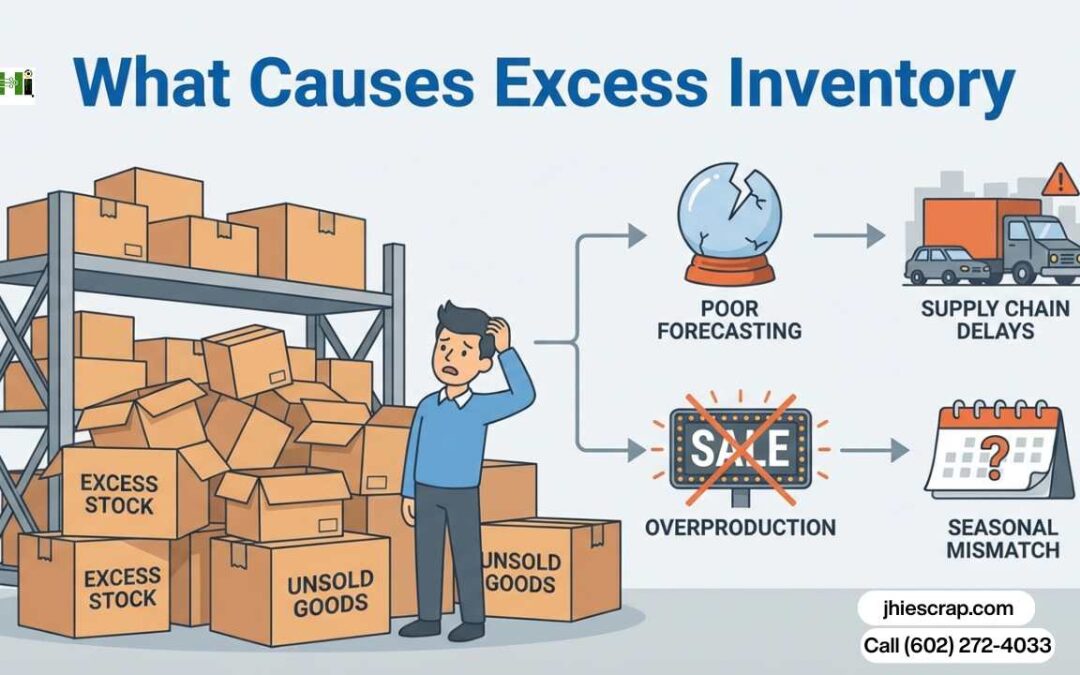
Ever walk into your warehouse and wonder why shelves are full but cash flow feels tight? You are not alone. Thousands of Phoenix businesses deal with this exact problem every day.
Full shelves, empty profits. That contrast is more common than you think.
Excess inventory is not just a storage headache. It ties up working capital, raises holding costs, and quietly drains your business. The good news? It is fixable.
Understanding what causes excess inventory in Phoenix AZ is the first step. Most businesses assume slow sales are the culprit. But excess stock almost always signals a deeper systems issue. Not just a sales failure.
In this guide, we break down every root cause. From forecasting errors to supplier delays to trend-based overstock. You will leave with a clear picture and a plan.
Expert Tip: Excess inventory often signals a systems issue, not just sales failure. Start with a full root-cause audit before making any changes.
Causes of Excess Inventory for Phoenix, AZ Businesses
Excess inventory is rarely a single crack. It is a chain reaction. One misstep in forecasting triggers an overorder. A delayed shipment causes panic buying. A missed trend leaves pallets unsold. It builds fast.
For Phoenix businesses, the challenge is real. The city mixes retail, manufacturing, logistics, and distribution. Each sector faces its own version of the overstock problem.
Here are the core causes we see most often:
- Inaccurate demand forecasting
- Poor inventory management and planning
- Supplier issues and long lead times
- Market shifts and trend volatility
- Bulk ordering for discounts
- Canceled orders and product returns
- Ineffective marketing and promotions
Most businesses deal with three to five of these at once. Fixing just one will not solve the problem. You need to see the full picture.
Expert Tip: Most businesses face 3-5 combined causes simultaneously. Prioritize the ones with the highest financial impact first.
Inaccurate Demand Forecasting
Are your projections based on data or hope? That question matters more than most businesses realize.
Demand forecasting errors are the single biggest driver of excess inventory. When you overestimate what customers will buy, you order too much. Product stacks up. Cash gets locked in.
In Phoenix AZ, seasonal demand swings make this worse. A forecast built in January may be completely wrong by April. Markets shift. Buying habits change. Static projections do not adapt.
The fix is not a bigger spreadsheet. It is a smarter forecasting process. Businesses that use a rolling 90-day forecast model consistently outperform those locked into annual plans.
Expert Tip: Switch to a rolling 90-day forecast model. Review it monthly and adjust based on real sales velocity, not projected goals.
Poor Inventory Management and Planning
Too much stock in the wrong place. Not enough visibility in the right place. That is the classic sign of poor inventory planning.
When your internal systems are not aligned, overstock is almost guaranteed. Sales teams push volume. Purchasing reorders without checking warehouse levels. Nobody has the full picture.
The three most common operational inefficiencies we see in Phoenix businesses:
- No system to track slow-moving inventory by SKU
- Reorder triggers based on fixed time intervals, not actual demand
- No classification of inventory by value or velocity
One practical fix is the ABC inventory classification method. It groups products into three tiers: high-value fast movers, mid-tier items, and slow-moving stock. Each tier gets a different reorder strategy.
Expert Tip: Implement ABC inventory classification. It helps you prioritize attention and purchasing where it counts most.
Supplier Issues and Long Lead Times
Lead times stretch like desert highways. The longer the wait, the harder it is to stay precise.
When suppliers are unpredictable, businesses over-order to protect themselves. That safety cushion feels smart in the short term. But it turns into excess inventory fast.
Here is a real scenario: a Phoenix distributor expects a 30-day lead time. Delays push it to 60 days. They order extra to cover the gap. The original shipment finally arrives. Now they have double the stock they need.
Supplier reliability directly drives inventory bloat. The less you can trust delivery windows, the more buffer stock you carry.
Expert Tip: Recalibrate your safety stock calculations every quarter. Base them on actual lead time variance, not worst-case assumptions.
Market Shifts and Trends
Yesterday’s bestseller becomes today’s dead stock. Trends move fast and warehouses do not.
Consumer preferences shift without warning. A product that dominated last summer may sit unsold this one. Phoenix buyers are particularly trend-sensitive given the city’s mix of demographics and seasonal buying cycles.
Businesses that lock in large orders around trend predictions carry the most risk. By the time product arrives, the trend may have already peaked.
The key is shorter commitment cycles and better trend tracking. Watch social signals, monitor competitor pricing, and pay attention to real-time search demand.
Expert Tip: Monitor quarterly demand spikes tied to Phoenix seasonal cycles. Track at least three years of seasonal data before committing to large trend-based orders.
Bulk Ordering for Discounts
Saving pennies can cost dollars. That old proverb hits hardest in inventory.
Bulk buying feels like smart business. Lower unit costs look great on paper. But the holding costs that follow can erase those savings and then some.
Every pallet sitting in your warehouse has a cost: storage fees, insurance, depreciation, and the opportunity cost of capital tied up in unsold stock. The bigger the order, the bigger those hidden costs.
Before you accept any bulk discount offer, calculate the full carrying cost per SKU. If storage and time erode the savings, the deal is not a deal.
Expert Tip: Calculate total carrying cost before approving bulk orders. Include insurance, depreciation, storage fees, and opportunity cost in your numbers.
Canceled Orders or Returns
Sold once. Returned twice. Stored forever. That is the pattern that crushes margin.
Returns are a growing challenge across retail and distribution in Arizona. When a customer returns a product, it re-enters your warehouse. If you have no secondary channel for that stock, it just sits there.
Canceled orders create the same problem. You ordered product for a buyer who backed out. Now you own inventory you did not plan to carry.
The solution is a secondary liquidation channel. Build one before you need it. It gives you an exit ramp for returned and canceled-order merchandise.
Expert Tip: Build a secondary liquidation channel for returns. Do not wait for returns to pile up before creating a process to move them.
Ineffective Marketing and Promotions
If customers are not buying, is the product wrong or the message? That question deserves an honest answer.
Weak marketing is a silent contributor to inventory surplus. When campaigns do not convert, products do not move. Stock ages. Holding costs rise.
The disconnect usually looks like this: marketing plans promotions around what is new. Meanwhile, aging inventory sits ignored. Nobody is running campaigns tied to what actually needs to move.
Aligning promotions with your inventory aging report changes that. Prioritize campaigns around older SKUs. Create urgency. Give customers a reason to act now.
Expert Tip: Align your ad budget and promotions directly with your inventory aging report. Start with the oldest, highest-volume stock first.
Inaccurate Demand Forecasting Challenges in Phoenix, AZ
You trusted the numbers. But did the numbers tell the full story?
Forecasting failures are the leading driver of excess inventory for Phoenix businesses. The problem is not that businesses forecast. It is how they do it. Most rely on annual projections that have no mechanism to adapt.
Projected growth. Actual slowdown. That gap is where inventory problems begin.
Demand planning models need to reflect real-world signals. Seasonality. Consumer shifts. Competitor pricing. A static annual plan misses all of that.
We recommend shifting to a rolling forecast system. Review demand signals every 30 to 60 days. Adjust orders before surplus builds, not after.
Expert Tip: Replace static annual forecasting with a rolling system. Review and adjust every 30-60 days based on actual sales velocity and market signals.
Overestimating Customer Demand
Hope is not a strategy. But too many sales forecasts are built on exactly that.
Inflated sales projections are one of the most common causes of excess inventory in Phoenix AZ. When teams set targets based on ambition rather than data, purchasing follows those numbers. Product arrives. Demand does not.
The financial impact is direct: capital locked in unsold stock, rising storage costs, and shrinking margins. For fast-growing businesses, this can stall momentum completely.
Compare your historical conversion rates to your forecast assumptions every quarter. If your projections consistently outpace actual sales, your model needs recalibration.
Expert Tip: Compare historical conversion rates against forecast assumptions every quarter. If there is a consistent gap, adjust your model before the next purchasing cycle.
Using Outdated or Incomplete Data
Old data is like driving with last year’s map. You will still hit dead ends.
Forecasting accuracy depends entirely on data quality. When businesses use incomplete sales data, outdated demand signals, or reports that lag by weeks, their projections are built on a flawed foundation.
Common data gaps we see include: disconnected POS systems, warehouse counts that lag sales records, and seasonal benchmarks based on years-old patterns.
The fix is integration. Connect your point-of-sale and warehouse data into a single stream. Review it weekly. Decisions should reflect what is happening now, not what happened six months ago.
Expert Tip: Integrate your POS and warehouse data streams. Review combined reports weekly to ensure forecasts reflect current demand patterns.
Ignoring Seasonality and Market Trends
Last year’s summer bestseller may not survive this one. Phoenix demand patterns shift more than most businesses account for.
Phoenix has distinct seasonal demand cycles tied to its climate, demographics, and holiday patterns. A product that sold out in October may barely move in March. Businesses that do not factor this into their forecasts consistently end up with seasonal overstock.
For example: a home goods retailer in Scottsdale ordered heavy winter merchandise based on national trends. Phoenix winters are mild. The product sat. Thousands of dollars in dead stock accumulated within weeks of delivery.
Monitor three-year seasonal performance averages for your core SKUs. Let real patterns guide your buys.
Expert Tip: Monitor 3-year seasonal performance averages before committing to seasonal orders. Phoenix-specific patterns often differ significantly from national benchmarks.
Poor Forecasting Models
Forecasts predict. But they must adapt. A model that cannot respond to change is not a forecast. It is a guess.
Many Phoenix businesses rely on single-variable linear models. They take last year’s sales, apply a growth rate, and call it a forecast. That works in stable markets. It breaks down in volatile ones.
When demand fluctuates due to competition, economic shifts, or trend volatility, single-variable models consistently overshoot or undershoot. The result is either excess stock or costly stockouts.
Avoid single-variable models for volatile product lines. Build in multiple inputs: seasonal indices, historical conversion rates, competitor activity, and current economic signals.
Expert Tip: Avoid single-variable linear models for volatile or trend-driven product lines. Build forecasts using multiple inputs including seasonal data, conversion rates, and market signals.
Inventory Management Inefficiencies in Phoenix, AZ Operations
A warehouse without visibility is like a ship without radar. You are moving, but you cannot see where you are going.
Internal operations drive more inventory problems than most businesses want to admit. Poor tracking, outdated systems, inaccurate records, and siloed departments all create conditions where overstock quietly builds.
In Phoenix, where warehouse costs are rising and competition is intense, operational efficiency is no longer optional. It is a competitive advantage.
Monthly reconciliation is one of the most underused tools in inventory management. It catches discrepancies early. It reduces the write-offs that accumulate over time when errors go undetected.
Expert Tip: Run monthly reconciliation of your inventory records. It prevents small discrepancies from becoming large write-offs.
Lack of Real-Time Inventory Tracking
If you cannot see your inventory, can you really control it? The answer is no.
Real-time tracking is the foundation of smart inventory management. Without it, businesses make purchasing decisions based on stale data. They reorder product they already have. They miss stockouts on fast movers. They carry dead weight for months.
For Phoenix operations, the practical impact is significant. A distribution center running on weekly manual counts will always lag behind demand reality.
Cycle counting is a proven fix. Instead of one big annual count, you count a small portion of your inventory daily or weekly. Over time, it gives you continuous accuracy without the disruption of a full physical count.
Expert Tip: Implement cycle counting on a rolling weekly schedule. It improves real-time accuracy far better than annual physical counts alone.
Inefficient Control Systems
Manual checks create manual mistakes. And in inventory management, mistakes are expensive.
Many Phoenix businesses still rely on outdated warehouse systems. Spreadsheets. Manual reorder triggers. Disconnected software. These systems cannot keep pace with real demand.
The consequence is predictable: teams over-rely on intuition. Purchasing decisions get made based on gut feel rather than data. Stock levels creep up. Carrying costs rise.
Automating reorder thresholds is one of the fastest wins available. When your system triggers a reorder automatically based on actual inventory levels and demand velocity, you eliminate the guesswork.
Expert Tip: Automate your reorder thresholds. Set triggers based on actual demand velocity rather than fixed time intervals or manual judgment.
Inaccurate Stock Records
Numbers that lie lead to shelves that overflow. Inaccurate records are one of the most underestimated drivers of excess inventory.
When your stock records do not match physical inventory, every decision built on those numbers is compromised. You may order product you already have. You may think you are low when you are not.
The financial implication is direct: double ordering, unnecessary write-offs, and inflated holding costs all flow from bad data.
Quarterly blind audits fix this. A blind audit means the counter does not see the expected number first. They count independently. The comparison reveals real discrepancies.
Expert Tip: Implement blind audits quarterly. Blind counting prevents confirmation bias and surfaces real discrepancies in your stock records.
Weak Coordination Between Departments
Sales celebrate. Warehouses accumulate. That gap is what happens when departments stop talking.
The silo effect in inventory management is real. Sales teams push a promotion. Purchasing reorders based on projected volume. The promotion underperforms. Warehouse holds excess product nobody planned for.
This pattern repeats when there is no structured alignment between sales, marketing, purchasing, and operations. Each team optimizes for its own goals. Nobody owns the full inventory picture.
A weekly Sales and Operations Planning meeting changes this. It creates a shared view of demand signals, purchasing plans, and inventory levels. Alignment reduces overstock before it builds.
Expert Tip: Run a weekly S&OP meeting across sales, purchasing, and operations. Shared visibility is the fastest way to reduce excess inventory buildup.
Overproduction Risks for Manufacturers in Phoenix, AZ
Build what sells, not what sits. That is the principle most Phoenix manufacturers already know. But operational pressure makes it hard to follow.
Overproduction is a unique form of excess inventory. Unlike retail overstock, manufactured surplus often has limited resale channels and higher sunk costs. Every unit overproduced represents labor, materials, and overhead that cannot be recovered easily.
Push production systems are the primary culprit. They build to a forecast and push product downstream regardless of actual demand. When demand slips, inventory accumulates fast.
Demand-driven manufacturing is the alternative. You produce in response to actual orders and real demand signals. Output aligns with pull, not projection. The result is leaner inventory and healthier cash flow.
Expert Tip: Adopt demand-driven manufacturing instead of push production. Align your production schedule with actual order data and real demand signals.
Supply Chain Lead Time Issues Affecting Phoenix, AZ Companies
When delivery feels unpredictable, ordering feels safer. But is it?
Extended lead times are one of the most reliable drivers of excess inventory. When businesses cannot trust when product will arrive, they compensate by ordering more. That buffer creates overstock.
Delayed shipments. Accelerated overstock. The relationship is that direct.
For Phoenix businesses that depend on national or international supply chains, lead time instability is a constant challenge. Port delays, freight backlogs, and vendor inconsistency all force defensive ordering behavior.
Quarterly lead time audits reduce panic ordering. When you understand your actual lead time variance, you can set safety stock levels based on data rather than fear.
Expert Tip: Conduct quarterly lead time audits. Track actual variance against promised lead times, then use that data to recalibrate safety stock.
Overstocking to Avoid Stockouts
Too much protection can create its own risk. Overstocking to avoid a stockout is a real and costly trap.
Fear of running out drives many businesses to carry more than they need. It feels responsible. But inflated safety stock ties up capital and raises holding costs month after month.
The financial consequence adds up fast. Storage fees, insurance, and the opportunity cost of locked capital are all hidden costs of overprotection.
The fix is precision, not more stock. Recalculate safety stock based on real demand variability. Look at your actual sales deviation, not worst-case assumptions. Right-sized safety stock protects you without burying you.
Expert Tip: Recalculate safety stock using real demand variability data. Replace worst-case assumptions with statistically grounded buffers.
Supplier Delays
Unreliable suppliers create reactive warehouses. That reaction is almost always overstock.
Vendor inconsistency in Phoenix supply chains forces businesses into defensive purchasing. When a supplier misses delivery windows regularly, buyers compensate by ordering earlier and ordering more.
The result: inventory arrives in waves. One late shipment triggers a reorder. Both shipments arrive within weeks of each other. Warehouse fills up fast.
Dual sourcing is the most effective structural fix. When you split orders between two qualified suppliers, you reduce your dependency on any single vendor. Disruptions become manageable, not catastrophic.
Expert Tip: Develop dual sourcing for your top-volume SKUs. It reduces dependency-driven overordering and gives you negotiating leverage.
Supply Chain Disruptions
Global disruption. Local accumulation. That is the pattern Phoenix businesses know well.
Macro-level supply chain breakdowns create local inventory problems. Freight delays, port congestion, and global logistics bottlenecks force businesses to order earlier and carry more buffer stock.
Arizona businesses tied to West Coast ports or cross-border manufacturing are especially exposed. A freight backup in Los Angeles translates directly into defensive ordering behavior in Phoenix warehouses.
Rolling reorder recalibration is the strategic response. During active disruption cycles, adjust your reorder points based on current lead time reality, not historical norms.
Expert Tip: Adopt rolling reorder recalibration during active disruption cycles. Update reorder points monthly when supply chain conditions are volatile.
Poor Sales Performance and Demand Issues in Phoenix, AZ
If products are not selling, is demand the problem or strategy? That question deserves more than a guess.
Weak sales performance is both a symptom and a cause of excess inventory. When products do not move, stock accumulates. As stock accumulates, cash flow tightens. Tighter cash flow limits your ability to respond.
For Phoenix businesses operating in a competitive retail and distribution market, sales gaps compound quickly. You need to know exactly where the breakdown is happening.
Inventory aging reports should run alongside your sales campaign calendar. If your oldest stock is not the focus of your next promotion, you are solving the wrong problem.
Expert Tip: Align inventory aging reports with sales campaign planning. Every promotional cycle should prioritize your oldest, highest-volume surplus first.
Weak Marketing Efforts
You launched the campaign. But did it move the stock?
Underperforming marketing is one of the quietest contributors to inventory buildup. When promotions do not convert, products do not move. The inventory ages while the campaign budget gets spent with nothing to show for it.
A common mismatch: marketing focuses on new arrivals and brand awareness while aging inventory sits ignored. There is no campaign driving urgency around the products that most need to sell.
Tying ad budget allocation to your inventory aging categories changes the outcome. Slow-moving stock gets prioritized. Promotions are built around what needs to move, not just what is new.
Expert Tip: Tie your ad budget allocation directly to inventory age categories. Build campaigns around slow-moving SKUs before they become dead stock.
High Competition
More competition. Less turnover. That relationship plays out daily in Phoenix’s retail market.
Phoenix is a highly competitive market. New entrants, national chains, and e-commerce giants all compete for the same buyer attention. When competition intensifies, individual businesses see slower sell-through rates.
Products that once moved in 30 days may now sit for 60 or 90. Reorder schedules built on old velocity assumptions create overstock in a tighter market.
Monitor competitor pricing weekly during high-volume seasons. If a competitor drops price significantly, your velocity assumptions need to adjust immediately.
Expert Tip: Monitor competitor pricing weekly during peak seasons. Use price changes as signals to adjust your own sell-through forecasts proactively.
Pricing Issues
The right product at the wrong price will not move. Pricing misalignment is a direct cause of inventory stall.
When prices are too high relative to perceived value or competitor positioning, demand drops. Product sits. Inventory builds. The cost of holding that stock erodes the margin you were trying to protect.
Demand elasticity matters here. Some products are highly price-sensitive. A 10 percent increase in price can produce a 30 percent drop in velocity. If you have not tested price sensitivity, you are guessing.
Test price elasticity before scaling production or ordering large volumes. Know how demand responds to price changes across your core SKUs.
Expert Tip: Test price elasticity before scaling production or committing to large orders. Understand how sensitive your key SKUs are to price changes.
Low Customer Demand
Demand changes quietly. Inventory grows loudly. That is the mismatch that catches businesses off guard.
Demand contraction can happen gradually. Consumer preferences shift. Economic confidence drops. A demographic changes in your market. The signals are there, but they are easy to miss until inventory is already stacking up.
In Phoenix, demographic shifts are real. The city’s population mix is changing. Buying habits for certain product categories have evolved significantly over the past several years.
Use customer feedback loops to stay ahead of demand shifts. Direct surveys, return reason codes, and real-time sales velocity are all early warning signals you can act on.
Expert Tip: Use customer feedback loops to detect early demand shifts. Return reason codes and velocity changes are leading indicators, not lagging ones.
Seasonal and Trend-Based Inventory Challenges in Phoenix, AZ
Trends move fast. Warehouses do not. That gap is where dead stock is born.
Seasonal and trend-based inventory risk is one of the most predictable causes of excess stock. Yet businesses consistently get caught by it. The reason is simple: commitments are made months in advance and demand rarely cooperates exactly.
For Phoenix retailers and distributors, the seasonal challenge is compounded by the city’s unique climate and demographic patterns. National seasonal benchmarks often do not apply.
The solution is pre-season liquidation windows. Plan your exit strategy before peak season ends. If something is not moving at full price by a defined date, move it before it becomes a carrying cost burden.
Expert Tip: Implement pre-season liquidation windows. Define a markdown trigger date before peak season ends and commit to it.
Outdated Fashion Items
Last season’s trend. This season’s burden. Fashion inventory moves fast and forgives nothing.
Apparel and fashion retailers face the sharpest trend risk. A style that dominated fall may be completely irrelevant by spring. Buyers who commit to large fashion orders well in advance carry the most exposure.
The problem compounds when reorder cycles are too long. By the time a Phoenix retailer receives a large fashion shipment, the trend window may already be closing.
Shorten your reorder cycle for fashion SKUs. Smaller, more frequent orders reduce trend exposure. You pay slightly more per unit. You avoid large write-offs on unsold seasonal clothing.
Expert Tip: Shorten reorder cycles for fashion SKUs. Smaller, more frequent orders reduce your exposure to trend-driven obsolescence.
Obsolete Technology Products
Technology ages in months. Inventory lasts for years. That mismatch is a major financial risk.
Electronics and technology products depreciate faster than almost any other category. A new product release can instantly reduce demand for existing stock. In Phoenix, where tech retail is competitive, this risk is amplified.
Businesses that hold large tech inventory through a product cycle change often face steep markdowns or complete write-offs. The velocity that existed before the release drops sharply after.
Align your tech stock levels with product release cycles. Monitor manufacturer roadmaps. Reduce orders as a product approaches the end of its cycle life.
Expert Tip: Align tech stock levels with manufacturer release cycles. Reduce reorder quantities as products approach end-of-cycle periods.
Unsold Holiday Merchandise
Holiday excitement fades. Inventory remains. Post-season accumulation is one of the most common and preventable causes of excess stock.
The pattern is familiar for Phoenix retailers. Heavy holiday merchandise orders hit in October and November. Sales peak in December. January arrives with leftover stock that has limited shelf life and declining value.
The longer you hold that inventory, the less it is worth. Post-holiday markdowns deepen monthly. What could have sold at 30 percent off in January may need 60 percent off by March.
Set a markdown schedule before peak season ends. Define your price reduction triggers and timing in advance. Pre-planned exits are always more profitable than reactive clearance.
Expert Tip: Set your markdown schedule before peak season ends. Define price reduction triggers in advance and stick to them, rather than waiting until desperation sets in.
Bulk Purchasing and Cost Pressures in Phoenix, AZ
It feels smart to buy more for less. Until it costs more to store.
Lower unit cost. Higher total cost. That is the bulk purchasing trap in four words.
Volume discounts are real savings on paper. But they come with hidden obligations: more warehouse space, longer holding periods, higher insurance, and capital tied up that cannot be deployed elsewhere.
For Phoenix businesses where warehouse costs are rising and capital is expensive, the bulk discount math often does not work. Calculate carrying cost per SKU before approving any bulk order.
Expert Tip: Calculate carrying cost per SKU before approving bulk orders. Include storage, insurance, depreciation, and opportunity cost in your analysis.
Large Volume Buying for Lower Costs
Buying more is not the same as selling more. That distinction matters enormously.
Discount-driven overordering is one of the most common purchasing mistakes in Phoenix distribution and retail. The unit economics look great. The full inventory economics often do not.
Here is how the trap plays out: a Phoenix wholesale buyer negotiates a significant discount on a large order. The product arrives. Demand is lower than expected. Carrying costs run for four to six months. The original savings are gone.
Negotiate staggered deliveries instead of single large shipments. You lock in the discount price but spread the inventory and cash flow risk across multiple delivery windows.
Expert Tip: Negotiate staggered delivery schedules instead of accepting one large shipment. Lock in the price discount while managing inventory flow risk.
Increased Holding Costs
Every unsold unit quietly drains cash. Holding costs are invisible until they are not.
The carrying cost of excess stock is typically underestimated. Most businesses only account for storage space. The real cost is broader.
Carrying cost components that are commonly missed include: insurance on stored inventory, product depreciation over time, warehouse labor for managing slow-moving stock, and the opportunity cost of capital that could be deployed elsewhere.
When you add all of those up, carrying excess inventory for six months can easily equal 20 to 30 percent of the product’s value. That changes the bulk discount calculation completely.
Expert Tip: Include insurance, depreciation, labor, and opportunity cost in your carrying cost calculations. The full number is usually 20-30% of inventory value annually.
Inefficient Supply Chain Coordination in Phoenix, AZ Businesses
Sales push. Purchasing reacts. Warehouses overflow. That three-part pattern is the signature of a broken supply chain coordination system.
Internal misalignment is a structural driver of excess inventory. When departments operate independently, purchasing decisions get made without full visibility of demand signals. Warehouses fill up while sales plans remain disconnected.
For Phoenix businesses managing complex supply chains, this coordination gap has real financial consequences. Dead stock builds. Cash flow suffers.
A structured Sales and Operations Planning cycle brings these teams into alignment. Monthly or bi-monthly S&OP creates a shared view of demand, supply, and inventory across all functions.
Expert Tip: Implement a structured S&OP cycle. Monthly cross-functional alignment on demand, supply, and inventory is the most direct fix for coordination-driven overstock.
Poor Communication
When teams stop talking, inventory keeps growing. Communication gaps between departments are a direct cause of excess stock.
Here is a scenario that plays out regularly in Phoenix businesses: marketing launches a campaign without telling purchasing. Purchasing sees a spike in orders and reorders product. The campaign ends. Demand normalizes. Excess inventory remains.
Every extra order placed without full cross-functional visibility creates risk. One conversation could have prevented it.
Standardize weekly demand update meetings between sales, marketing, purchasing, and warehouse teams. Brief, structured, data-driven. That discipline prevents the gaps that create overstock.
Expert Tip: Standardize weekly demand update meetings. Keep them brief and data-driven. Consistent communication is cheaper than carrying excess inventory.
Lack of System Integration
Disconnected systems create disconnected decisions. And disconnected decisions create excess inventory.
Many Phoenix businesses run separate systems for point-of-sale, warehouse management, and purchasing. Data sits in silos. Nobody has a complete picture without manually pulling reports from multiple sources.
The result: purchasing makes decisions based on partial information. Reorders happen without full visibility of what is already in the warehouse or what is already on order.
Integrating POS, warehouse, and purchasing data into a unified feed eliminates that gap. When all data flows into one system, decisions improve. Overordering drops.
Expert Tip: Integrate your POS, warehouse, and purchasing data into a single feed. Unified data is the foundation of accurate, overstock-free purchasing decisions.
Demand Misalignment
Demand slows. Orders continue. That disconnect is what demand misalignment looks like in practice.
When forecasting and purchasing are not directly linked to real-time demand signals, orders continue at pace while actual sell-through drops. The gap fills warehouses.
S&OP planning is the structural fix. Linking your marketing promotions directly to production forecasts ensures that purchasing decisions reflect actual pull, not projected push.
When demand drops, your purchasing cadence should adjust immediately. That only happens when your systems are connected and your teams are aligned around the same data.
Expert Tip: Link marketing promotions directly to production forecasts. When demand signals shift, purchasing should respond automatically, not manually.
Product Quality and Returns Impacting Phoenix, AZ Inventory Levels
Is your inventory coming back faster than it leaves? If so, you have a returns problem worth addressing.
Reverse logistics and quality failures create a specific kind of excess inventory that is harder to move than standard overstock. Returned items and defective goods sit in a grey zone. They are neither new nor written off.
For Phoenix businesses, building a clear secondary channel for this inventory is essential. Without one, it just accumulates.
The expert move is to establish a secondary resale or liquidation channel before you need it. Having that infrastructure in place means returned and defective inventory moves instead of stacking up.
Expert Tip: Establish a secondary resale or liquidation channel before returns start piling up. Having the infrastructure ready is the difference between recovery and write-off.
High Return Rates
Sold once. Returned twice. Stored indefinitely. High return rates are a direct driver of excess stock.
Returns inflate warehouse levels and erode margins in two directions at once. You lose the sale revenue. You gain a storage obligation. The net impact on working capital is significant.
For Phoenix retailers and distributors, returns management is an operational discipline that deserves its own attention. Every percentage point reduction in return rates improves both cash flow and warehouse capacity.
Analyze your return reason codes monthly. Patterns in why customers return products reveal fixable root causes: sizing issues, product description mismatches, quality gaps, or shipping damage.
Expert Tip: Analyze return reason codes monthly. Patterns in return data reveal fixable root causes that can reduce your overall return rate over time.
Defective or Damaged Goods
Damaged goods damage more than storage space. They damage supplier relationships, brand reputation, and cash flow.
Manufacturing defects and shipping damage create inventory that cannot be sold at full price. If you lack a process for handling defective stock, it accumulates in a warehouse holding area and quietly generates ongoing costs.
Supplier accountability is critical here. If a vendor consistently delivers damaged or defective product, that pattern needs to be documented and addressed in your contract terms.
Implement inbound quality inspections before any product enters your warehouse. Catch defects at the door, not after they are in your system and generating holding costs.
Expert Tip: Implement inbound quality inspections before stock enters your warehouse. Catching defects at receipt is far cheaper than writing them off after storage.
Market and Economic Changes Affecting Inventory in Phoenix, AZ
The market shifts quietly. Warehouses respond loudly. External economic forces are among the least controllable drivers of excess inventory.
Phoenix businesses operate in a dynamic economic environment. Consumer confidence, regulatory changes, and demographic shifts all affect demand. When those shifts happen faster than your purchasing cycle can adapt, overstock builds.
Forward-looking businesses track leading economic indicators alongside their inventory data. Quarterly reviews of retail confidence indexes, local employment trends, and consumer spending patterns provide early warning before surplus develops.
Expert Tip: Track leading consumer indicators and retail confidence indexes quarterly. Build them into your inventory review process so you can respond before overstock develops.
Economic Downturns
When spending slows, stock grows. Economic downturns translate directly into inventory surplus.
Recessions and economic slowdowns reduce consumer purchasing across nearly all categories. If your reorder schedules do not adjust, you will be sitting on growing surplus while sales volumes drop.
Phoenix has experienced its own economic cycles. The 2008 downturn hit the city’s real estate and retail sectors hard. Businesses that failed to adjust purchasing during the contraction phase accumulated inventory they could not move for years.
Reduce your reorder frequency during contraction cycles. Extend your review intervals. Let actual sales velocity guide purchasing rather than projections built during growth periods.
Expert Tip: Reduce reorder frequency during economic contraction cycles. Let actual sales velocity guide purchasing rather than forecasts built during stronger periods.
Regulatory Shifts
Policy changes. Inventory stays. Regulatory shifts can strand product almost overnight.
Compliance-driven overstock is a specific risk for businesses that import goods or operate in regulated categories. A change in labeling requirements, import tariffs, or product safety standards can make existing inventory unsellable or costly to modify.
Phoenix businesses involved in cross-border trade with Mexico or in food, health, and consumer products categories face this risk regularly.
Monitor policy changes that affect your imported goods categories. Build regulatory review into your quarterly purchasing approval process.
Expert Tip: Monitor policy changes affecting your imported goods categories. Include regulatory risk assessment in your quarterly purchasing approval process.
Changes in Consumer Preferences
Customer tastes evolve. Inventory does not. That misalignment is how preference-driven dead stock is born.
Demand behavior shifts are often gradual. A product category that sold well for three years may begin declining slowly. By the time the trend is clear in your sales data, you have already placed orders that are arriving into a cooling market.
In Phoenix, consumer preference shifts are tied to demographic change, economic confidence, and lifestyle trends. None of these are static.
Use real-time customer feedback loops alongside your sales data. Direct feedback and return reason codes often signal preference shifts months before they show up in aggregate sales velocity.
Expert Tip: Use customer feedback loops alongside sales data to detect preference shifts early. These signals often appear months before the impact shows in inventory velocity.
1. Inaccurate Demand Forecasting in Phoenix, AZ (AI Overview)
Forecasting errors rarely start in the warehouse. They start in the spreadsheet.
For Phoenix businesses, inaccurate demand forecasting is the most common root cause of excess inventory. When projections overestimate demand, purchasing follows. Product arrives. Customers do not.
Projected growth. Actual slowdown. That gap is where carrying costs begin.
The fix is not more sophisticated software. It is a better system. Rolling forecast adjustments every 30 to 60 days allow businesses to respond to real demand signals before surplus builds.
Expert Tip: Adopt rolling forecast adjustments every 30-60 days. Static annual plans cannot respond to the demand volatility Phoenix businesses face.
Overly Optimistic Sales Projections
Ambition should guide strategy, not replace data. Overly optimistic sales projections are a primary driver of inventory overstock in Phoenix AZ.
When growth bias enters the forecasting process, purchasing follows inflated targets. Product arrives based on what the sales team hoped to achieve. Actual conversion rates tell a different story.
The financial impact is direct: capital locked in unsold inventory, rising holding costs, and stalled cash flow.
Base projections on your actual conversion rate trends. Not your revenue goals. If the gap between target and conversion rate is consistent, your model needs recalibration.
Expert Tip: Base projections on actual conversion rate trends, not revenue targets. Consistent gaps between forecast and performance signal a model problem.
Ineffective Use of Historical Data
Old data reflects old demand. And old demand does not match today’s buyer behavior.
Many Phoenix businesses build forecasts using static year-over-year comparisons. Last year’s numbers become this year’s baseline. The problem: markets change. Competitors enter. Consumer preferences shift.
A forecast built on outdated assumptions produces outdated results.
Use weighted averages instead of direct year-over-year comparisons. Weight recent periods more heavily. Adjust for known market changes. Your historical data is an input, not a blueprint.
Expert Tip: Use weighted averages instead of static year-over-year comparisons. Assign more weight to recent periods to reflect current demand patterns.
Lack of Real-Time Market Analytics
If demand shifts today, will your forecast notice tomorrow? Without real-time analytics, the answer is no.
Phoenix businesses competing in fast-moving retail and distribution categories cannot afford to rely on reports that lag by weeks. By the time the data surfaces, the purchasing window has passed.
Blind spots in demand visibility lead directly to overstock. You place orders based on trends that no longer exist. Product arrives into a changed market.
Integrate POS analytics dashboards that update daily. Real-time visibility allows purchasing to respond to demand shifts before they become inventory problems.
Expert Tip: Integrate POS analytics dashboards that update daily. Real-time demand visibility is the fastest way to prevent forecast-driven overstock.
Supply Chain and Purchasing Challenges in Phoenix, AZ (AI Overview)
Small demand shift. Large supply reaction. That amplification is what makes supply chain purchasing one of the hardest excess inventory drivers to control.
Phoenix businesses connected to global or national supply chains face layered purchasing volatility. Lead time instability, MOQ constraints, and demand amplification all push ordering behavior toward excess.
The strategic response is alignment: purchasing frequency matched to actual demand variance, not historical averages or worst-case scenarios.
Expert Tip: Align purchasing frequency with your demand variance index. When demand is stable, extend reorder intervals. When demand is volatile, shorten them and reduce order sizes.
The Bullwhip Effect
A small ripple upstream becomes a wave downstream. That is the bullwhip effect in one sentence.
Demand amplification happens when small demand shifts at the consumer level create increasingly large reactions up the supply chain. A retailer sees a slight sales dip. They cut orders. The distributor panics and cuts more. The manufacturer overreacts and halts production.
When demand recovers, the reverse happens. Everyone rushes to reorder at once. Overstock piles up at every level.
Shortening replenishment cycles reduces amplification. When you order more frequently in smaller quantities, each order better reflects actual demand.
Expert Tip: Shorten replenishment cycles to reduce bullwhip amplification. More frequent, smaller orders track actual demand far better than periodic large orders.
Rigid Minimum Order Quantities (MOQs)
Buying more because you must is rarely strategic. Rigid MOQs force businesses into overstock.
Supplier-imposed minimum order quantities push Phoenix buyers to purchase more than demand requires. The unit economics look fine. The inventory consequence does not.
When an MOQ requires a 90-day supply but demand calls for 45 days, you are carrying excess inventory by structural obligation.
Negotiate mixed-SKU MOQs instead of volume-only thresholds. A supplier willing to let you combine multiple SKUs to hit an MOQ gives you inventory flexibility without sacrificing pricing.
Expert Tip: Negotiate mixed-SKU MOQs with key suppliers. This gives you pricing flexibility while reducing the risk of building excess in any single SKU.
Extended Lead Times and Global Logistics Delays
Global delay. Local accumulation. The connection is that direct for Phoenix businesses tied to international supply chains.
Extended lead times force defensive ordering. When buyers cannot trust delivery windows, they order earlier and in larger quantities. That buffer strategy creates overstock.
Phoenix freight flows through major West Coast ports and cross-border routes that experience regular disruption. Businesses reliant on those lanes carry real lead time risk.
Use dynamic reorder point calculations during delay spikes. Adjust your reorder triggers based on current lead time reality, not historical averages.
Expert Tip: Use dynamic reorder point calculations during lead time spikes. Static reorder points built on historical data are not safe when lead times are actively stretching.
Internal Operational Inefficiencies in Phoenix, AZ (AI Overview)
Inventory problems often start inside, not outside. Internal process failures are among the most controllable and most overlooked drivers of excess stock.
Poor visibility, siloed communication, and lifecycle mismanagement all create conditions where overstock builds quietly. By the time it shows up in financial reports, months of carrying costs have already accumulated.
Mapping your inventory workflow end-to-end is the starting point. You cannot fix what you have not clearly seen.
Expert Tip: Map your inventory workflow end-to-end quarterly. Identify each decision point where overstock can enter the system and build controls around them.
Poor Inventory Visibility and Tracking
If you cannot see it, can you manage it? Poor inventory visibility makes every purchasing decision a partial guess.
When tracking systems are incomplete or lag behind real-time conditions, businesses cannot act on accurate data. Overorders happen. Stockouts happen. Both are symptoms of the same visibility gap.
Phoenix warehouse operations that still rely on periodic manual counts are especially vulnerable. By the time counts are reconciled, the picture they reveal is already outdated.
Adopt a rolling cycle count schedule as your baseline. Count a portion of your inventory every week. Over time, this builds continuous accuracy without the disruption of full physical audits.
Expert Tip: Adopt a cycle count schedule. Weekly partial counts build continuous accuracy far more effectively than annual physical audits alone.
Siloed Departmental Communication
Teams work hard. Systems work apart. That is the siloed operation in one line.
When sales, purchasing, and operations do not share demand information, purchasing decisions get made in isolation. Sales promotions trigger demand spikes that purchasing did not anticipate. Or purchasing reorders product that sales has already slowed down.
The fix is standardized cross-functional KPI reporting. When all teams see the same demand and inventory metrics, alignment happens naturally.
Expert Tip: Standardize cross-functional KPI reporting. Give sales, purchasing, and operations visibility into the same inventory and demand metrics.
Inadequate Product Lifecycle Management
Every product has a season. Ignoring lifecycle stages is how dead stock accumulates.
When businesses do not actively manage the lifecycle of their SKUs, slow-moving products continue to occupy warehouse space and receive reorders they do not deserve. Obsolete inventory accumulates alongside active inventory.
Product stagnation happens in stages. Velocity drops. Reorders continue. By the time a SKU is classified as dead stock, months of avoidable carrying costs have passed.
Implement sunset timelines for low-performing SKUs. When a product hits a defined velocity threshold, trigger a review. Decide to discount, discontinue, or liquidate before it becomes a long-term burden.
Expert Tip: Implement sunset timelines for low-performing SKUs. Define velocity thresholds that trigger a review and potential discontinuation.
External Market Factors Impacting Phoenix, AZ Inventory (AI Overview)
You can control your systems. But can you control the market?
External shifts. Internal accumulation. That is how macro-level forces create local inventory problems.
Product obsolescence, consumer trend shifts, and economic downturns are not things Phoenix businesses can prevent. But they can prepare for them. Businesses with strong external monitoring programs respond faster and carry less excess.
Track leading consumer indicators and retail confidence indexes quarterly. Build those signals into your inventory planning process rather than reacting after the fact.
Expert Tip: Track leading consumer indicators and retail confidence indexes quarterly. Build external signal monitoring into your regular inventory planning cycle.
Rapid Product Obsolescence
What is new today depreciates tomorrow. Rapid product obsolescence is one of the fastest paths to dead stock.
In Phoenix’s competitive retail and tech distribution landscape, product lifecycles are compressing. Electronics, fashion, and trend-driven goods can lose significant value within months of a new release or seasonal shift.
Businesses holding large quantities of near-obsolete products face steep markdowns or complete write-offs. The longer the hold, the deeper the loss.
Shorten reorder cycles for fast-moving tech or trend-driven items. Smaller, more frequent orders reduce your exposure when a product hits end-of-life faster than expected.
Expert Tip: Shorten reorder cycles for tech and trend-driven items. Smaller, more frequent orders protect you when obsolescence accelerates.
Sudden Shifts in Consumer Trends
Customers move on quickly. Inventory does not. Sudden trend shifts are among the hardest causes of excess stock to predict or prevent.
Phoenix’s demographic diversity creates a particularly dynamic consumer landscape. Preferences in food, lifestyle products, fashion, and home goods can shift faster here than in more homogeneous markets.
When a trend reverses, businesses holding large quantities of trend-dependent inventory face real losses. Demand evaporates. Discounting is inevitable.
Use social listening tools to detect early preference changes. Monitor search volume trends and social media engagement for your key product categories. Early signals allow you to reduce reorders before surplus builds.
Expert Tip: Use social listening tools and search trend monitoring to detect preference changes early. These signals typically lead sales velocity changes by weeks.
Unforeseen Economic Downturns
When spending slows, stock grows. Economic downturns create inventory surplus across almost every product category.
The mechanism is simple: consumer spending contracts. Sell-through rates drop. Purchasing cycles that were calibrated for stronger demand suddenly produce excess inventory.
Arizona’s economy has experienced multiple contraction cycles. Businesses that adapted purchasing behavior early in those cycles weathered the downturn far better than those that continued ordering at pre-recession levels.
Reduce reorder frequency during economic contraction phases. Use current sales velocity as your guide rather than projections built in stronger economic periods.
Expert Tip: Reduce reorder frequency during economic contraction phases. Let current sales velocity guide purchasing rather than pre-recession projections.
Quality and Return Issues in Phoenix, AZ (AI Overview)
Is your inventory coming back faster than it sells? That is the question quality and returns management is designed to answer.
High return rates and manufacturing defects create a specific category of excess inventory: stock that cannot be sold as new, has not been written off, and sits in limbo generating holding costs.
For Phoenix businesses, this type of inventory is particularly costly because it occupies the same space as sellable stock. It competes for warehouse resources without contributing to revenue.
Expert Tip: Track return reason codes monthly and align findings with supplier audits. Root cause analysis on returns pays dividends far beyond inventory management.
High Product Return Rates
Sold once. Returned twice. Stored indefinitely. That cycle is a direct profit drain.
High return rates inflate warehouse stock while eroding revenue. Every returned item re-enters your warehouse and creates an obligation. If you lack a secondary channel for that stock, it accumulates alongside new inventory.
The compounding effect is significant. Returns reduce available cash flow while simultaneously increasing your holding cost burden.
Create secondary resale channels for returned items before returns become a problem. Refurbished sales programs, B-stock channels, and liquidation partnerships all provide exit ramps that protect your margin.
Expert Tip: Create secondary resale channels for returned items. Having that infrastructure ready before returns pile up is the difference between recovery and write-off.
Manufacturing Defects and Dead Stock Accumulation
Defects compound faster than profits. Manufacturing quality failures lead directly to dead stock accumulation.
Product that fails quality standards cannot be sold through primary channels. It sits. It depreciates. It generates holding costs without any revenue offset.
When defects originate with suppliers, accountability matters. Without documented inspection processes, businesses absorb the full cost of supplier quality failures.
Implement inbound inspection checkpoints before any stock enters your warehouse system. Catch defects at receipt. Reject or quarantine non-conforming product immediately. Do not let it enter your inventory and generate holding costs.
Expert Tip: Implement inbound inspection checkpoints before warehouse intake. Catching defects at receipt protects you from absorbing supplier quality costs.
Strategies for Avoiding Excess Inventory in Phoenix, AZ
An ounce of prevention is worth a warehouse of correction. That is the philosophy behind smart inventory management.
Understanding what causes excess inventory is only half the work. The other half is building systems that prevent it from recurring. The good news: most of the best strategies are process improvements, not technology investments.
Start with a quarterly inventory health assessment. It gives you a clear view of what is moving, what is aging, and where your risk is concentrated. From there, targeted fixes are far more effective than broad changes.
Expert Tip: Conduct quarterly inventory health assessments. A clear view of your inventory landscape is the foundation of every effective prevention strategy.
Supply Chain Disruption
Plan for disruption. Not perfection. The supply chains that survive volatility are the ones built to absorb it.
Supply chain disruption is a predictable reality for Phoenix businesses. The question is not whether it will happen but how well your system is prepared to respond.
Mitigation starts with supplier diversification. A single-source dependency for any critical SKU is a structural risk. When that supplier is disrupted, your only options are stockout or panic overorder.
Develop an alternate supplier matrix for your top-volume SKUs. Know who your backup options are before you need them. That preparation turns a potential crisis into a manageable transition.
Expert Tip: Develop an alternate supplier matrix for your top-volume SKUs. Know your backup options before you need them.
Poor Forecasting Methods
Are you predicting demand or guessing it? That distinction defines your inventory risk.
Poor forecasting methods are one of the most correctable causes of excess inventory. The tools and data required to improve forecasting accuracy are available to virtually every business. The gap is usually process, not technology.
Scenario-based forecasting is one of the most practical improvements available. Instead of a single projection, you build three: a base case, an optimistic case, and a conservative case. Purchasing decisions are calibrated against all three.
This approach reduces the overconfidence that leads to overstock and the underpreparedness that leads to stockouts.
Expert Tip: Adopt scenario-based forecasting. Build base, optimistic, and conservative cases. Make purchasing decisions that work across all three scenarios.
Problems in the Supply Chain
A slow supply chain creates fast accumulation. Operational alignment is the antidote.
When supply chain coordination breaks down, inventory builds at every friction point. Reorders happen without visibility. Shipments arrive without preparation. Warehouses fill while demand continues at a lower pace.
The fundamental fix is aligning reorder frequency with actual sales velocity. Not with projected velocity, not with historical norms. With what is selling right now.
Velocity-based reordering keeps your purchasing decisions grounded in reality. It prevents the lag between demand signals and purchasing response that creates excess stock.
Expert Tip: Align reorder frequency with actual current sales velocity. When velocity drops, reorder frequency should drop with it automatically.
Incorrect Inventory Policies
Rigid rules create flexible problems. Inventory policies that do not adapt to market conditions guarantee excess stock over time.
Policy-level misalignment is one of the most systemic causes of recurring overstock. When reorder thresholds, safety stock levels, and reorder quantities are set once and never reviewed, they become increasingly disconnected from reality.
Review your reorder points and safety stock levels every quarter. As demand patterns change, those parameters need to change with them. A safety stock level calculated during a high-demand period is wrong during a contraction.
Governance matters here too. Define who owns inventory policy review, how often it happens, and what triggers an emergency review outside of the regular cycle.
Expert Tip: Review reorder points and safety stock levels quarterly. Define clear governance around who owns policy review and what triggers an out-of-cycle update.
Conclusion
Your shelves should work for you, not against you.
Excess inventory in Phoenix AZ rarely comes from one mistake. It builds from a combination of forecasting errors, planning gaps, supplier issues, and missed market signals. Now you know what causes excess inventory and why it happens.
The next step is action. Start with a full inventory audit before year-end. Map your slow-moving stock. Identify which causes apply to your business. Then build a plan to fix them one by one.
The businesses that stay lean, agile, and data-driven are the ones that protect their cash flow and stay ahead. You can be one of them.
Ready to move your excess inventory and recover capital? Explore proven inventory reduction strategies for Phoenix businesses and start clearing your shelves today.
Expert Tip: Conduct a full inventory audit before year-end. Categorize stock by age, velocity, and margin. Use that data to drive your 2025 purchasing decisions.