
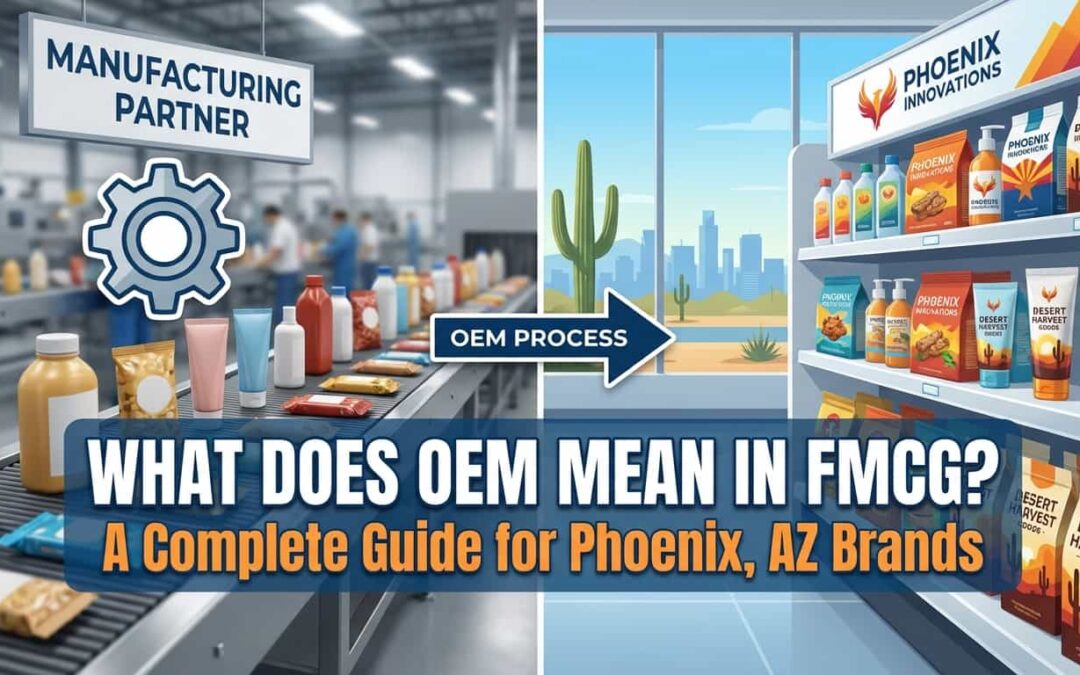
Ever wondered who actually manufactures your favorite FMCG brand products? You own the brand. They handle the production. That’s OEM in a nutshell.
OEM stands for Original Equipment Manufacturer. In FMCG, it’s a business model where a third-party factory produces goods under your brand name. You control the design, the formula, and the identity. They supply the production power.
Phoenix brands are using this model right now to scale faster and spend smarter.
Understanding What OEM Means in the FMCG Industry for Phoenix, AZ Brands
Managing manufacturing alone can stretch your resources thin. Most growing brands don’t realize there’s a smarter option available until they’re already burning cash on facilities they don’t need.
OEM acts like the engine behind your brand vehicle. You steer the direction. The manufacturer handles the build.
In FMCG, this model fits perfectly because consumer goods demand speed, consistency, and compliance. OEM gives you all three without the capital investment of owning a factory.
Here’s what OEM means for Phoenix brands specifically:
- You keep full brand ownership. The product goes out under your label.
- Your manufacturer handles regulated production. From formulation to packaging.
- You scale on demand. No fixed overhead. No underused floor space.
Phoenix is growing fast as a consumer goods hub. Brands here are already using OEM partners to compete with national players on product quality without matching their facility budgets.
Definition of OEM in FMCG
An OEM in FMCG is a manufacturer that produces finished consumer goods according to a brand’s specifications, which the brand then sells under its own name.
This isn’t just about cutting costs. It’s a deliberate business structure. The manufacturer brings production capability. The brand brings market strategy and consumer identity.
In FMCG categories like beverages, skincare, and packaged food, OEM production is the standard operating model for hundreds of successful labels. The brand you trust at the shelf likely never owned the facility that made it.
Role of the OEM Manufacturer
The OEM manufacturer carries the operational weight so you don’t have to. They build. You brand.
Here’s what a quality OEM manufacturer is responsible for:
- Manufacturing: Producing goods to your exact formula and specification
- Quality control: Running batch testing and consistency checks at every stage
- Compliance: Meeting GMP standards and relevant regulatory requirements
- Packaging: Applying labels, sealing, and preparing retail-ready units
- Logistics coordination: Managing dispatch timelines and inventory handoffs
GMP compliance isn’t optional for serious OEM partners. It signals that the facility operates to internationally recognized standards, which matters when you’re selling into retail channels.
Role of the Hiring Brand
You’re not giving up control when you use an OEM. You’re focusing it. You focus on growth. They focus on output.
As the hiring brand, your responsibilities include:
- Product design and formulation: You define what gets made
- Brand identity and packaging direction: You own the look and feel
- IP protection: Trademark your formulas, names, and designs before production begins
This structure gives you real competitive power. While your OEM partner runs the floor, you run the market. You invest in sales, marketing, and distribution instead of machinery and compliance audits.
Key Characteristics of OEM in FMCG Manufacturing in Phoenix, AZ
Don’t dig a well when you’re already thirsty. Understanding what makes OEM structurally different helps you use it at the right moment. For growth-stage Phoenix brands, that moment is usually earlier than expected.
OEM manufacturing has four core characteristics that make it powerful as a production strategy. Each one solves a real business problem.
Customization
Customization is your brand fingerprint. No two brands produce the same product, and OEM manufacturing respects that.
Your OEM partner works from your brief. You define the scent, the texture, the dosage, the flavor profile. They go through formulation testing cycles to match your specification before a single unit goes to market.
A Phoenix skincare brand might tweak an SPF formula three times before launch. An OEM partner makes that iteration process fast and cost-effective.
Brand Ownership
You own the product. Full stop.
Even though a third party manufactures it, the formula, the brand name, and the finished product belong to you. This is protected through contract agreements and, more importantly, through trademark registration.
Register your brand name and product formulas before production begins. Your OEM partner has no claim to your IP. The legal structure makes that clear from day one.
Outsourced Production
Why build a factory when you can use one that already exists?
Outsourcing production through OEM removes the need for capital expenditure on equipment, facilities, and staffing. You pay for production runs, not permanent infrastructure.
For Phoenix FMCG brands watching cash flow, this is the difference between launching in six months and waiting three years to break even on a facility investment.
High Control
Outsourced production. Not outsourced control.
This is the most common misconception about OEM. Brands assume that handing off manufacturing means losing visibility. It doesn’t. Your contract defines quality benchmarks, turnaround timelines, and service level agreements.
SLAs hold your OEM partner accountable at every stage. You approve samples before full runs begin. You audit outputs before distribution. Control lives in the contract, not the factory floor.
OEM Compared to Other FMCG Manufacturing Models in Phoenix, AZ
Choosing the wrong manufacturing model can delay growth and drain capital. So before you sign anything, understand what each model actually gives you.
You design it. They produce it. That’s OEM. But there are two other models Phoenix brands regularly consider, and each one serves a different business situation.
What’s the right fit for your stage of growth? The answer depends on how much design control you want to keep.
OEM (Original Equipment Manufacturer)
OEM gives you full brand control with shared production expertise.
You bring the product design. The manufacturer brings the facility, the compliance infrastructure, and the production capability. Your IP stays yours.
Key advantages of OEM:
- Complete control over formulation and design
- Brand owns all intellectual property
- Manufacturer operates under your specification
This model suits brands with a clear product vision who want to scale without building their own facility. IP ownership is the defining advantage here.
ODM (Original Design Manufacturer)
They design. You brand.
In an ODM model, the manufacturer already has a ready-made product. You select from their existing range, apply your branding, and bring it to market. R&D investment is minimal because the formula already exists.
Key ODM contrasts:
- Manufacturer owns the original design
- Faster launch timeline since formulation is done
- Less brand differentiation unless you customize heavily
ODM works well for brands entering a new category quickly or testing market demand before investing in a proprietary formula.
Contract Manufacturing
Do you need full product development or just production capacity?
Contract manufacturing is when you supply everything, including the formula and materials, and the manufacturer simply produces it. They add no design input. They operate purely as a production facility for hire.
This model suits brands with a locked formula who need extra capacity without building another line. It differs from OEM because the brand handles more of the development side independently.
If you need full development support alongside production, OEM is the stronger partnership model.
Business Benefits of Using OEM in FMCG for Phoenix, AZ Companies
Don’t build a factory when you need a launch. Phoenix FMCG brands using OEM are moving faster, spending smarter, and competing harder than brands still waiting on facility approvals.
The business case for OEM isn’t just about cost. It’s about strategic positioning. When you remove production complexity from your plate, you concentrate energy on the things that actually win markets: branding, distribution, and customer experience.
OEM partnerships directly affect your EBITDA margins by converting fixed production costs into variable ones. That shift gives you financial flexibility at exactly the stage when you need it most.
Cost Efficiency
OEM removes the biggest capital drain in product manufacturing. You don’t buy equipment. You don’t hire production staff. You don’t maintain a facility.
You pay for production runs based on volume. That converts a fixed cost structure into a variable one, which protects cash flow during low-demand periods and scales cleanly during growth surges. Reduced capital expenditure means more money available for launch, marketing, and distribution.
Faster Time-to-Market
Why spend 18 months building production infrastructure when your OEM partner already has it running?
With an established OEM facility, you move from approved formula to first production run in weeks, not months. That speed advantage compounds when competitors are still waiting on equipment installation and regulatory sign-offs.
Manufacturing Expertise
Your OEM partner has been running this facility for years. They understand GMP compliance, batch control, and regulatory documentation at a level that takes internal teams years to build.
You access that expertise from day one. Skilled production teams and technical support come built into the partnership. That’s not just convenient. It reduces costly production errors during critical early runs.
Scalability
Scale up without rebuilding your foundation.
OEM manufacturing grows with you. A partner with flexible production capacity adjusts your run volumes as demand increases. You don’t outgrow the model. You just order more.
That scalability is what lets a Phoenix startup compete on shelf space with a brand that’s been producing for a decade.
1. Cost Savings
Beyond efficiency, OEM delivers direct savings on lower capital investment. No machinery purchases. No facility maintenance budgets. No depreciation on equipment you barely use.
Those savings go directly into margin or growth investment, both of which matter more at launch stage than owning production assets.
2. Focus on Core Competencies
OEM lets you do what you’re actually good at. You’re a brand builder, not a factory operator.
When production runs itself through your OEM partner, your team focuses entirely on brand strategy, retail relationships, and customer acquisition. Operational efficiency improves because every resource points at growth, not logistics.
3. Access to New Technologies and Expertise
Your OEM partner invests in production technology so you don’t have to. Advanced manufacturing equipment, innovative formulation capabilities, and technical support come with the partnership.
This gives smaller Phoenix brands access to the same production standards as national players, without the investment required to build that capability internally.
Real-World FMCG OEM Applications in Phoenix, AZ
We’ll show you how local brands are using OEM to scale. The model works across categories, and Phoenix is home to brands in all of them.
OEM isn’t a niche solution. It’s the production backbone behind some of the most recognizable consumer goods on shelves today. Here’s where it shows up most in this market.
Skincare Product Manufacturing
Phoenix skincare brands are using OEM to bring innovative formulas to market without lab infrastructure. Your OEM partner handles active ingredient sourcing, formulation testing, stability checks, and regulatory labeling.
You focus on the brand story and the shelf position. The OEM partner makes the product you designed, to the standard you specified, at the scale you need.
Beverage Production
Speed to market matters in beverages. Consumer trends move fast, and a long production setup timeline kills momentum.
OEM beverage manufacturers in Phoenix carry existing FDA-registered facilities, co-packing lines, and flavor compliance expertise. You bring the concept and the branding. They turn it into a retail-ready product in weeks.
Food Product Manufacturing
Food OEM manufacturing demands compliance confidence. Labeling laws, allergen declarations, nutritional panels, and shelf-life testing are non-negotiable.
A qualified food OEM partner handles all of it. GMP-certified facilities, FSMA compliance, and batch traceability are already built into their process. You get a safe, compliant product without building a food-grade facility yourself.
Examples in FMCG
OEM is behind more products than most consumers realize. Private label grocery brands, mid-tier skincare lines, regional beverage launches, and supplement brands all commonly use OEM production models.
For Phoenix brands, this means the infrastructure already exists locally. Finding the right OEM partner is the real work, and it starts with knowing exactly what you’re looking for in a production relationship.
The Role of OEMs in FMCG Supply Chains in Phoenix, AZ
Production happens in one place. Distribution reaches everywhere.
OEM manufacturers don’t just make your product. They sit at a critical node in your supply chain. What happens on their floor directly affects what hits your retailer’s shelf, and when.
Understanding their supply chain role helps you manage the relationship more strategically.
Exploring the Role of OEMs in Supply Chains
Your OEM partner manages inventory flow, procurement timing, and production scheduling simultaneously. That operational coordination is what keeps your supply chain stable.
Key supply chain functions your OEM handles:
- Inventory management: Tracking raw materials and finished goods
- OEM procurement process: Sourcing compliant ingredients and packaging materials
When this runs well, you never face a stockout. When it breaks down, your retail relationships suffer. Choose an OEM partner with documented systems, not just production capacity.
Clarifying the Meaning of OEM in FMCG Production for Phoenix, AZ
Here’s a question worth asking: why does OEM still have “equipment” in the name when it’s clearly about consumer goods?
The term originated in industrial manufacturing, where OEMs produced component parts that other companies assembled into finished products. Over time, the model evolved. In FMCG, “equipment” refers to the production machinery and processes the manufacturer provides, not the consumer product itself.
The name stuck. The meaning expanded. Today, OEM in FMCG simply means a manufacturer producing a complete, finished product under your brand specification.
Meaning of “Equipment” in the FMCG Context
In FMCG, “equipment” refers to the production machinery, systems, and processes the OEM brings to the relationship. The terminology reflects the model’s industrial roots rather than its modern application.
Understanding this removes confusion when evaluating OEM contracts. The word “equipment” won’t appear in your product description. It refers to what the manufacturer operates on your behalf.
Industry Standards Shaping OEM Practices in FMCG for Phoenix, AZ
In regulated FMCG sectors, compliance mistakes can cost far more than production delays. Compliance protects your brand. Certification protects your reputation.
The OEM manufacturers worth working with don’t just meet minimum standards. They pursue certifications that signal operational maturity to retailers, auditors, and partners.
Knowing which standards govern OEM production helps you evaluate potential partners with precision.
International Organization for Standardization
ISO certification is a baseline trust signal for serious OEM facilities. ISO 9001 covers quality management systems across any industry. ISO 22000 is specific to food safety management, making it essential for beverage and food OEM production in Phoenix.
Major retailers increasingly require ISO compliance before listing new suppliers. Working with a certified OEM partner removes that barrier before it becomes a problem at the buyer meeting.
Consumer Brands Association
Standards build consistency. Consistency builds trust.
The Consumer Brands Association (CBA) sets best practice frameworks for consumer goods manufacturers across labeling, safety, and retail compliance. OEM partners aligned with CBA standards operate within industry-accepted norms.
This matters for long-term partnerships. Retail compliance standards evolve, and manufacturers who stay current with industry associations adapt faster.
GS1
How will retailers track your product without standardized coding?
GS1 manages the global barcode and product identification system. Every retail-ready product needs a GS1 GTIN code before a major retailer will put it on a shelf. Your OEM partner should already operate within GS1 standards for product labeling and supply chain tracking.
GS1 compliance enables real-time inventory tracking from the production floor to the store shelf. It’s not optional for serious retail distribution.
Supply Chain Authorities Guiding OEM Procurement in Phoenix, AZ
Smart procurement prevents expensive production errors. Choosing an OEM partner isn’t just an operational decision. It’s a strategic sourcing decision with long-term consequences.
The organizations below set the professional standards that govern how smart brands evaluate and manage OEM relationships. Their frameworks help you build procurement processes that protect against risk before it shows up in your supply chain.
Association for Supply Chain Management
ASCM defines professional discipline in supply chain operations. Their APICS certifications, particularly CPIM and CSCP, are recognized benchmarks for supply chain competency.
When your OEM partner’s supply chain team holds APICS credentials, it signals structured training in demand planning, inventory control, and production scheduling. That training reduces operational errors across your production relationship.
Council of Supply Chain Management Professionals
CSCMP sets global best practices for logistics and supply chain management. Their annual State of Logistics Report tracks macro-level shifts in transportation costs, distribution infrastructure, and supply chain resilience.
For Phoenix brands working with OEM partners on broader distribution, understanding CSCMP insights helps you anticipate supply chain disruptions before they affect your production schedule.
Institute for Supply Management
ISM governs procurement strategy and supplier evaluation frameworks. Their sourcing standards include structured RFP processes, supplier audit scoring, and risk assessment criteria.
When evaluating OEM partners, ISM-aligned procurement processes help you ask the right questions upfront. Supplier audits, financial stability checks, and production capacity verification all come from structured sourcing practice.
FMCG Market Research and Strategy Resources for Phoenix, AZ
Data reveals demand. Strategy converts demand.
Choosing an OEM partner without understanding your market is building on sand. The organizations below give Phoenix brands the intelligence to make production decisions that match real consumer demand, not assumptions.
NielsenIQ
NielsenIQ provides retail performance data and consumer purchase analytics across FMCG categories. Their point-of-sale data analysis shows you what’s actually selling at shelf, which categories are growing, and where consumer spending is shifting.
For Phoenix brands, NielsenIQ data can inform production volume decisions and help you align OEM run sizes with actual market demand patterns.
Kantar
Insight predicts demand. Demand drives production.
Kantar specializes in brand equity tracking and consumer perception research. Their panel-based consumer tracking shows how your target audience perceives your brand versus competitors across purchasing cycles.
This brand intelligence connects directly to OEM planning. If consumer data shows growing preference for your category, it signals the right moment to scale production volumes with your OEM partner.
McKinsey & Company
McKinsey’s consumer goods research covers supply chain digitalization, category transformation, and go-to-market strategy for FMCG brands at every scale.
Their reports on supply chain digitalization are particularly relevant for brands evaluating OEM partners. Modern production facilities invest in digital tracking and forecasting systems. McKinsey benchmarks help you assess whether your OEM partner is operationally future-ready.
Boston Consulting Group
Strategy without execution fails. Execution without strategy stalls.
BCG publishes FMCG market growth reports and competitive benchmarking analysis that help brands identify where category opportunities are emerging. Their digital supply chain transformation research shows where the industry is moving operationally.
For Phoenix brands, BCG insights support longer-range decisions about OEM partnerships, including when to scale, when to diversify production partners, and how to build a sustainable manufacturing strategy.
ERP and Manufacturing Software Supporting OEM Operations in Phoenix, AZ
Manual tracking and spreadsheets break under scale. Data drives decisions. Decisions drive growth.
The OEM partners worth working with don’t manage production on clipboards. They run enterprise-grade software systems that give you real-time visibility into your orders, inventory, and production timelines.
Understanding which systems your OEM partner uses tells you a lot about their operational maturity.
SAP
SAP is the enterprise standard for large-scale manufacturing operations. SAP S/4HANA delivers real-time production analytics, demand forecasting, and supply chain visibility across global operations.
An OEM facility running SAP can provide accurate lead time estimates, batch traceability, and quality audit documentation at the level major retailers require. Enterprise stability in your production partner reduces risk in your supply chain.
Oracle NetSuite
Cloud visibility prevents costly blind spots.
NetSuite gives mid-sized OEM facilities a flexible, cloud-based ERP that covers financials, production planning, and inventory management in one system. Multi-location production tracking means your orders stay visible across the full fulfillment process.
For Phoenix brands working with growing OEM partners, NetSuite signals a business ready to scale without losing operational control.
Microsoft Dynamics 365
Forecast demand accurately. Produce confidently.
Dynamics 365 combines CRM and ERP capability in a single platform. That integration means your OEM partner can align production scheduling with demand signals from their sales and order management data.
The forecasting module helps prevent overproduction and underproduction errors that create costly inventory imbalances for both parties.
Infor
Infor builds industry-specific ERP modules designed for the operational realities of food, beverage, and consumer goods production. Their food and beverage-specific modules handle lot traceability, recipe management, and compliance documentation natively.
For Phoenix brands in regulated FMCG categories, an OEM partner running Infor already has the systems infrastructure to meet your documentation and traceability requirements.
Educational and Academic Resources on OEM in FMCG for Phoenix, AZ
Knowledge compounds faster than capital. Informed decisions outperform instinct-driven ones.
Before you commit to an OEM partnership, understanding the business models, finance principles, and operational frameworks behind it puts you in a stronger negotiating position. These resources build that foundation.
Investopedia
Investopedia provides a clear baseline definition of OEM from a business and finance perspective. It’s a useful starting point for stakeholders who need a plain-language explanation before engaging with FMCG-specific detail.
The important distinction: Investopedia defines OEM in a general business context. The FMCG application has specific nuances around compliance, private label structure, and brand ownership that go beyond the generic definition.
Corporate Finance Institute
CFI covers manufacturing finance education including cost structure analysis, contribution margin modeling, and financial decision frameworks relevant to outsourced production.
Understanding contribution margin in OEM partnerships helps you evaluate whether a production run is financially viable before you commit. That modeling skill pays for itself in the first negotiation.
Supply Chain Management
Academic supply chain theory provides the structural vocabulary for managing OEM relationships professionally. The Bullwhip Effect, for example, explains how small demand fluctuations can cause large production swings upstream in your supply chain.
Understanding this dynamic helps you communicate production forecasts more accurately to your OEM partner, reducing costly over- and under-production cycles.
Operations Management
Lean and Six Sigma principles form the backbone of modern OEM facility management. Lean eliminates waste at every production stage. Six Sigma reduces defect rates through statistical process control.
OEM partners operating on these principles deliver more consistent product quality and more predictable turnaround times. Ask about their operational methodology when evaluating partners.
Marketing Management
Strong production supports strong branding.
OEM frees your marketing budget from production overhead. Every dollar you save on facility costs is a dollar available for campaign spend, retail placement fees, or influencer strategy.
FMCG marketing principles around category positioning, consumer psychology, and channel strategy all apply more powerfully when your production costs are predictable and controlled through a well-managed OEM relationship.
Ready to Work With a Trusted OEM Manufacturer in Phoenix, AZ?
Now you know exactly what OEM means in FMCG. It’s not just a manufacturing term. It’s a growth strategy.
You keep the brand. You own the IP. You control the direction. Your OEM partner handles the production, the compliance, and the quality checks.
That’s the model that lets small Phoenix brands compete on national shelves without building a factory first.
Jay Hohel Inc has been helping FMCG brands in Phoenix, AZ navigate OEM manufacturing the right way. We understand the standards, the supply chain, and the local market. We make sure your production runs clean, compliant, and on time.
You focus on building your brand. We focus on building your product.
The brands winning shelf space in Phoenix right now aren’t doing it alone. They’re doing it with the right production partner behind them.
That partner is closer than you think.
📍 Jay Hohel Inc 3334 W McDowell Rd Unit 17, Phoenix, AZ 85009