
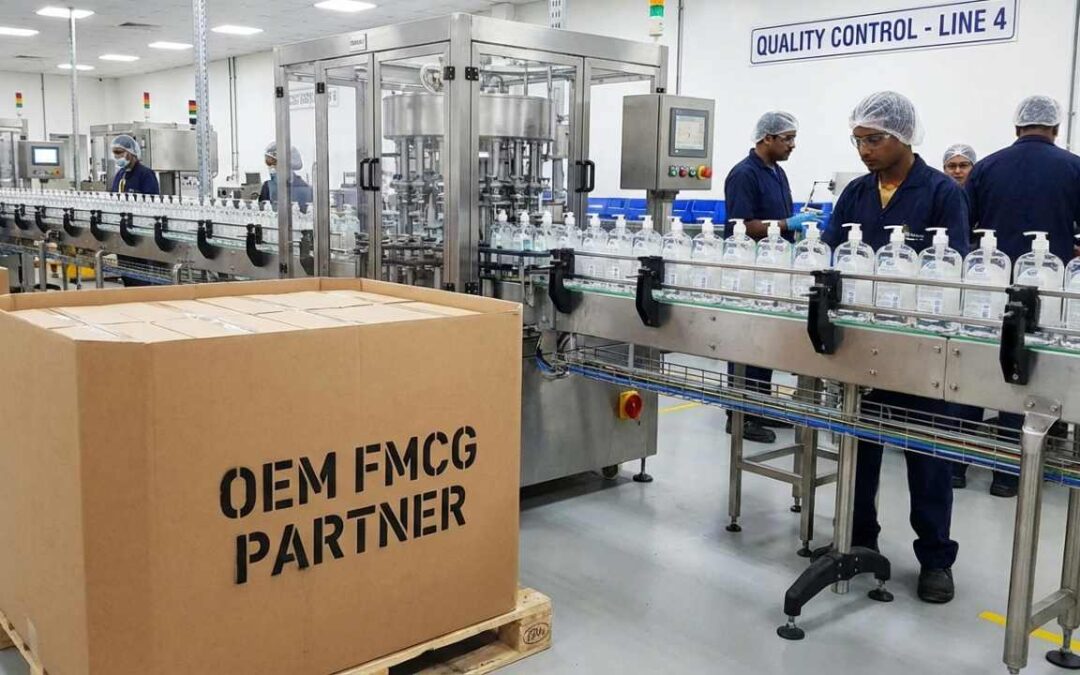
Ever wondered who actually manufactures your favorite FMCG brand products? Most consumer goods aren’t made by the brand you see on the label. Behind every great product is a manufacturing partner working quietly in the background.
OEM stands for Original Equipment Manufacturer. In FMCG, it’s a business model where a brand hires a specialist manufacturer to produce goods under the brand’s own name and identity.
You own the brand. They handle the production.
For Phoenix, AZ brands looking to scale without building a factory, OEM is the smartest move on the board.
Understanding What OEM Means in the FMCG Industry for Phoenix, AZ Brands
Managing manufacturing alone can stretch your resources thin. That’s why fast-moving consumer goods brands across Phoenix are turning to OEM partnerships to grow faster and compete smarter.
OEM acts like the engine behind your brand vehicle. You control the direction, the design, and the market positioning. Your OEM partner handles the heavy production lifting. As Phoenix’s manufacturing sector continues to grow, more local brands are using this model to enter new categories without the overhead.
- You bring the brand vision and product specifications.
- Your OEM partner handles production, compliance, and quality control.
- You go to market faster, with lower capital risk and more flexibility.
Definition of OEM in FMCG
An OEM in FMCG is a third-party manufacturer that produces consumer goods to a brand’s exact specifications, which the brand then sells under its own label.
Unlike generic contract factories, an OEM relationship is built on precision. The brand provides formulas, packaging specs, and quality standards. The OEM delivers compliant, shelf-ready products.
This applies directly to beverages, skincare, food products, and household goods. The OEM produces it. You brand it. Consumers buy it.
Role of the OEM Manufacturer
Your OEM partner carries the production weight so you don’t have to. Their responsibilities go far beyond simply making the product. A qualified OEM facility handles the full production cycle from start to finish.
- Manufacturing: Manufacturing:
- Raw material sourcing, blending, and production at GMP-compliant facilities.
- Quality Control: Quality Control:
- Batch testing, inspection protocols, and compliance documentation.
- Packaging: Packaging:
- Labeling, filling, sealing, and retail-ready presentation.
- Compliance: Compliance:
- Regulatory filings, certifications, and safety standards.
- Logistics Coordination: Logistics Coordination:
- Coordinating dispatch, inventory hand-off, and supply chain alignment.
They build. You brand.
Role of the Hiring Brand
You might outsource production. But you never outsource control. As the hiring brand, you hold every strategic lever that defines your product and your market position.
Your brand retains full intellectual property rights, including trademarks and formulation ownership. You set the standards. The OEM meets them.
- Define product specifications, formulations, and quality benchmarks.
- Protect intellectual property through trademark registration and contractual agreements.
- Drive marketing, distribution, and brand strategy without production distraction.
You focus on growth. They focus on output.
Key Characteristics of OEM in FMCG Manufacturing in Phoenix, AZ
The OEM model isn’t just about outsourcing. It’s a structured production strategy built on four core pillars. Each one gives growing Phoenix brands a serious competitive edge.
Don’t dig a well when you’re already thirsty. Smart brands set up their OEM structure before they need it at scale. Here’s what makes OEM manufacturing work so effectively.
Customization
Customization is your brand fingerprint. With OEM manufacturing, you don’t pick from a preset menu. You define the formula, the texture, the scent profile, the packaging format, and the batch size.
Your OEM partner runs formulation testing cycles to validate your spec before full production begins. That means fewer surprises, faster iterations, and a final product that’s 100% yours.
Brand Ownership
In an OEM model, everything produced belongs to you. The recipe, the label, the trademark, the market positioning. All of it is your intellectual property.
File your trademarks before production starts. This protects your formulation rights and prevents duplication. Your OEM partner produces under your brand. Your brand stays yours.
Your product. Your name. Your IP.
Outsourced Production
Why build a factory when you can access one? Outsourced production eliminates the capital expenditure of building, staffing, and maintaining your own manufacturing facility.
Instead of locking cash into plant and equipment, you invest it in brand growth, marketing, and distribution. The OEM carries the production infrastructure. You carry the brand forward.
The result is a leaner, faster, more profitable business model from day one.
High Control
A lot of brands worry that outsourcing means losing control. That’s a misconception worth clearing up fast. You set the specs. You define the SLAs. You approve every batch.
Your OEM contract spells out every quality standard, delivery timeline, and compliance requirement. Nothing ships without your sign-off.
Outsourced production. Not outsourced control.
OEM Compared to Other FMCG Manufacturing Models in Phoenix, AZ
Choosing the wrong manufacturing model can delay growth and drain capital. OEM, ODM, and contract manufacturing all serve different needs. You design it. They produce it. That’s the OEM promise.
Before you commit to a manufacturing partner in Phoenix, understand exactly which model fits your brand stage, your IP strategy, and your speed-to-market goals.
| Model | Who Designs | Who Produces | Brand Owns IP? |
| OEM | You (the brand) | OEM Partner | Yes |
| ODM | The Manufacturer | ODM Partner | Partial / No |
| Contract Mfg. | You (the brand) | Contract Factory | Yes |
OEM (Original Equipment Manufacturer)
OEM is the model of choice for brands that control their product design and want to own the IP. You bring the formula. Your OEM partner brings the facility, the expertise, and the production process.
- Full brand ownership of design and formulation.
- OEM partner handles all production and compliance.
- Best for brands with defined product specs and growth ambitions.
Full brand control. Shared production expertise.
ODM (Original Design Manufacturer)
ODM flips the design responsibility. The manufacturer develops the product formula and design. You select from their existing catalog and apply your branding to it.
This reduces R&D investment and cuts time to market. But you share the design with other brands who may license the same formula.
- Faster launch. Lower R&D cost.
- Less brand differentiation and limited IP ownership.
- Best for brands testing a new category without full development investment.
They design. You brand.
Contract Manufacturing
Contract manufacturing is production-only. You own the design. You own the formula. You simply hire a factory to execute the production to your specification.
Do you need full development or just production capacity? If it’s the latter, contract manufacturing might be the right fit. Some contract manufacturers handle packaging only, not full production.
- Clean separation of design and production.
- Good for brands scaling proven products into new markets.
- May have narrower service scope than a full OEM partnership.
Business Benefits of Using OEM in FMCG for Phoenix, AZ Companies
Don’t build a factory when you need a launch. OEM manufacturing gives Phoenix brands the competitive tools to move faster, spend smarter, and scale without the overhead drag.
The financial upside is real. OEM partnerships can directly improve EBITDA margins by converting fixed manufacturing costs into variable ones. Here’s what that looks like across the key benefit areas.
Cost Efficiency
Owning a manufacturing facility comes with enormous fixed costs. Equipment, staffing, compliance infrastructure, maintenance. OEM eliminates all of it.
You pay for production. Not for the plant behind it. Reduced capital expenditure means more cash in the business for brand-building, distribution, and growth.
Faster Time-to-Market
Your OEM partner already has the production lines, the certifications, and the compliance protocols in place. Why build from scratch when someone already built it for you?
What could take 12 to 18 months to build independently can move to shelf-ready in a fraction of the time through an established OEM relationship.
Manufacturing Expertise
GMP-compliant production isn’t easy to replicate. A qualified OEM team brings years of technical production knowledge, validated processes, and ISO-aligned quality systems.
You tap into that expertise without hiring it. Your product gets made by specialists who do this every single day.
Scalability
Scale up without rebuilding your foundation. When demand spikes, your OEM partner adjusts production volume to match. No new hires. No new equipment. No new facility leases.
Flexible production volume means you can respond to market demand fast. That agility is a real competitive advantage in the fast-moving consumer goods world.
1. Cost Savings
Lower capital investment means healthier margins from the start. OEM partners spread their facility costs across multiple clients. You benefit from those economies of scale without paying for them directly.
2. Focus on Core Competencies
Every hour your team spends on manufacturing logistics is an hour away from brand strategy. OEM frees your team to do what they do best: build, market, and grow the brand.
3. Access to New Technologies and Expertise
Top OEM facilities invest in advanced manufacturing technology to stay competitive. Your brand gets access to that innovation through the partnership.
Whether that’s precision filling equipment, advanced formulation labs, or automated QC systems, you benefit from ongoing investment you didn’t have to make yourself.
Real-World FMCG OEM Applications in Phoenix, AZ
Theory is useful. But real examples close the deal. Phoenix brands across multiple FMCG categories are already using OEM manufacturing to scale product lines and enter new markets.
Here’s how OEM plays out across the categories most relevant to local brands.
Skincare Product Manufacturing
Skincare is one of the fastest-growing OEM categories in Arizona. Brands bring their formulations, active ingredients, and packaging vision. The OEM facility handles batch production, stability testing, and compliance with FDA cosmetic standards.
From serums to moisturizers, OEM gives cosmetic brands a direct path from formula to shelf without building their own lab.
Beverage Production
Speed to market defines success in beverages. An OEM partner with established bottling lines, cold-fill capability, and flavor lab infrastructure can take a brand from concept to retail in weeks.
Energy drinks, functional waters, RTD teas. Phoenix brands are using OEM to launch and scale in this high-velocity category.
Food Product Manufacturing
Food OEM requires GMP compliance, HACCP protocols, and allergen management systems. A qualified Phoenix OEM partner brings all of that to the table.
Snack brands, supplement companies, and specialty food producers all use OEM to ensure compliance confidence alongside production efficiency.
Examples in FMCG
| Example: A Phoenix skincare startup partners with a GMP-certified OEM to produce 5,000 units of a new vitamin C serum for a retailer launch.Example: A local beverage brand uses an OEM facility to co-pack a new functional water line without building a bottling plant.Example: A food brand scales a new protein snack line using an OEM partner with existing nut-free facility certification. |
The Role of OEMs in FMCG Supply Chains in Phoenix, AZ
Production happens in one place. Distribution reaches everywhere. OEM partners aren’t just manufacturers. They’re a core node in your supply chain architecture.
A well-integrated OEM partner connects directly into your logistics flow, inventory systems, and compliance tracking. GS1 barcode compliance ensures your product is traceable at every point from factory floor to retail shelf.
Exploring the Role of OEMs in Supply Chains
Your OEM partner manages inventory hand-offs, production scheduling, and raw material procurement. This keeps your supply chain running without you managing every moving part.
OEM inventory management reduces stockout risk and gives your brand predictable lead times. Strong OEM procurement processes mean your product is always ready when your sales team needs it.
Clarifying the Meaning of OEM in FMCG Production for Phoenix, AZ
People get confused by the word “equipment” in OEM. It sounds like it should apply only to industrial machinery. So why does it describe beverage brands and skincare lines?
Historically, OEM referred to component manufacturers who produced parts used inside another company’s finished product. A parts supplier making engines for a car brand is the original usage.
In FMCG, the term evolved. Today it means any manufacturer that produces a complete, finished consumer good for a brand that sells it under its own label.
Meaning of “Equipment” in the FMCG Context
Think of “equipment” as meaning the production capability itself. The OEM provides the manufacturing infrastructure. The brand provides the identity and the market.
In modern FMCG usage, OEM simply means a manufacturer you hire to produce your branded product. The word is conventional. The model is practical. The business case is clear.
Industry Standards Shaping OEM Practices in FMCG for Phoenix, AZ
In regulated FMCG sectors, compliance mistakes can cost far more than production delays. Compliance protects your brand. Certification protects your reputation.
The best OEM partners in Phoenix align with global and national standards that major retailers and distributors demand. Before you sign with any OEM facility, check their compliance credentials carefully.
International Organization for Standardization (ISO)
ISO certification signals that a manufacturing facility meets globally recognized quality management standards. For FMCG OEM, two certifications matter most.
- ISO 9001 covers quality management systems across all production types.
- ISO 22000 covers food safety management, critical for beverage and food OEM.
Retail buyers often require ISO compliance before listing a product. Choosing an ISO certified OEM facility in Arizona protects your brand and speeds retail acceptance.
Consumer Brands Association
The Consumer Brands Association sets advocacy standards and best practices for FMCG manufacturers and brand owners across the United States.
Alignment with CBA guidelines helps OEM partners stay current with retail labeling compliance, ingredient disclosure standards, and packaging regulations. Standards build consistency. Consistency builds trust.
GS1
How will retailers track your product without standardized coding? GS1 provides the global barcode and product identification standards that make supply chain traceability possible.
Major retailers including large grocery chains require GS1 GTIN codes on every product. Your OEM partner must be GS1 compliant to ensure your product can be scanned, tracked, and restocked correctly across the distribution network.
Supply Chain Authorities Guiding OEM Procurement in Phoenix, AZ
Smart procurement prevents expensive production errors. Choosing an OEM partner isn’t just a production decision. It’s a sourcing decision that requires professional evaluation frameworks.
Three respected authorities guide best-practice OEM procurement. Their standards influence how serious brands evaluate, select, and manage manufacturing partners.
Association for Supply Chain Management (ASCM)
ASCM sets the global standard for supply chain education and certification. APICS-certified procurement professionals use structured frameworks to evaluate supplier capability, capacity, and risk.
When your OEM procurement process follows ASCM principles, you reduce the risk of costly supply chain disruptions and poor supplier selection.
Council of Supply Chain Management Professionals (CSCMP)
CSCMP publishes the annual State of Logistics Report, which benchmarks global distribution and supply chain performance. OEM brands that track these insights can anticipate cost shifts and capacity constraints before they hit.
Applying CSCMP frameworks to your OEM relationships builds long-term supply chain resilience.
Institute for Supply Management (ISM)
ISM provides structured procurement governance frameworks including supplier audit scoring and evaluation criteria. Using ISM standards when selecting an OEM partner in Phoenix ensures you choose based on evidence, not impressions.
Strong supplier evaluation criteria protect your brand from quality failures before they reach production.
FMCG Market Research and Strategy Resources for Phoenix, AZ
Data reveals demand. Strategy converts demand. The brands that win in FMCG pair smart manufacturing with sharp market intelligence.
Your OEM partner handles production. But your brand needs to stay ahead of consumer trends, category performance data, and competitor movement. These four resources give Phoenix brands the market intelligence to make smarter production decisions.
NielsenIQ
NielsenIQ provides retail market analytics that track product performance at the point of sale. By integrating POS data with your OEM production planning, you can align manufacturing volumes with real-time demand signals.
This prevents overproduction and keeps your supply chain responsive to market movement.
Kantar
Kantar’s panel-based consumer tracking gives brands a window into how consumers perceive their products relative to competitors. Insight predicts demand. Demand drives production.
For Phoenix brands scaling through OEM, Kantar data can guide new product development decisions before you commit to a production run.
McKinsey & Company
McKinsey’s FMCG strategy reports cover supply chain digitalization, cost transformation, and emerging category opportunities. Their research consistently highlights OEM-enabled scale as a lever for margin improvement.
Phoenix brands entering growth phases can use McKinsey frameworks to structure their OEM partnerships for long-term strategic advantage.
Boston Consulting Group
BCG’s FMCG research covers digital supply chain transformation and competitive benchmarking across consumer goods categories. Strategy without execution fails. Execution without strategy stalls.
BCG’s work on sustainable growth models reinforces the OEM advantage: outsource production complexity, invest in brand equity, and build a future-ready consumer goods business.
ERP and Manufacturing Software Supporting OEM Operations in Phoenix, AZ
Manual tracking and spreadsheets break under scale. Serious OEM operations in Phoenix run on enterprise-grade systems that give brands real-time visibility into production status, inventory levels, and compliance records.
Data drives decisions. Decisions drive growth. When you partner with a tech-enabled OEM facility, you get production transparency alongside production capacity.
SAP
SAP S/4HANA gives OEM facilities real-time production analytics, demand forecasting, and supply chain visibility at enterprise scale. When your OEM partner runs SAP, you gain confidence that production data is accurate, traceable, and aligned with your brand’s quality standards.
Oracle NetSuite
Cloud visibility prevents costly blind spots. NetSuite’s cloud-based ERP gives mid-sized OEM facilities multi-location production tracking, financial integration, and inventory management in a single system.
Phoenix brands partnering with NetSuite-enabled OEMs get flexibility and growth readiness baked into the production relationship.
Microsoft Dynamics 365
Dynamics 365 bridges CRM and production planning in one integrated platform. Forecast demand accurately. Produce confidently. When your OEM partner uses Dynamics, they can align production schedules with your brand’s sales forecasts in near real time.
Infor
Infor offers industry-specific ERP modules built for food, beverage, and consumer goods manufacturing. For Phoenix OEM facilities producing FMCG products, Infor’s specialized modules handle recipe management, allergen tracking, and regulatory reporting.
Educational and Academic Resources on OEM in FMCG for Phoenix, AZ
Knowledge compounds faster than capital. Informed decisions outperform instinct-driven choices every time. The following resources help Phoenix brand owners and procurement leaders understand the OEM model at a deeper level.
Each one connects academic or financial theory directly to practical OEM decision-making.
Investopedia
Investopedia provides a solid foundational definition of OEM in the context of business and finance. Note that their definition applies broadly across industries. The FMCG-specific application adds layers of compliance, formulation ownership, and supply chain integration that generic definitions don’t cover.
Corporate Finance Institute
CFI’s business model training materials cover cost structure analysis and contribution margin modeling. For FMCG brands evaluating OEM partnerships, understanding contribution margin helps quantify the financial benefit of outsourced production versus in-house manufacturing.
Supply Chain Management
Supply chain theory underpins every OEM relationship. One key concept worth understanding is the Bullwhip Effect. Small demand fluctuations can amplify into large production swings if your OEM partnership isn’t built on accurate forecasting and clear communication protocols.
Operations Management
Operations management principles including Lean manufacturing and Six Sigma apply directly to OEM production environments. Brands that understand these frameworks can ask better questions, set tighter SLAs, and drive continuous improvement with their production partners.
Marketing Management
OEM frees your marketing budget. When production overhead drops, more capital moves into brand investment. Strong production supports strong branding.
Marketing management principles tie directly into why OEM makes strategic sense. Lower production costs mean higher marketing investment per unit. That’s a competitive advantage built into the model itself.
Your Brand. Their Production. Your Growth.
Understanding OEM in FMCG isn’t just a matter of terminology. It’s a strategic decision that shapes how your brand scales, competes, and profits in today’s fast-moving consumer goods market.
Whether you’re launching a new skincare line, expanding a beverage brand, or entering the food manufacturing space right here in Phoenix, AZ, the OEM model gives you brand control without the production burden.
You focus on building your brand. A trusted OEM partner handles the rest. GMP-compliant manufacturing, quality assurance, supply chain coordination, and scalable production capacity. All of it delivered without you having to build a facility.
The result is faster time-to-market, reduced capital expenditure, and a leaner, more competitive business operation from day one.
Don’t build a factory when you need a launch. Partner with a team that’s already built for it.
| Ready to Scale Your FMCG Brand in Phoenix, AZ? Stop managing manufacturing alone. Start building your brand. Jay Hohel Inc is your trusted OEM manufacturing partner in Phoenix, AZ. GET A FREE OEM CONSULTATION Call: (602) 272-4033 | Email: JayHoehlinc@gmail.com Location- 3334 W McDowell Rd, Unit 17, Phoenix, AZ 85009 Website- jhiescrap.com |