
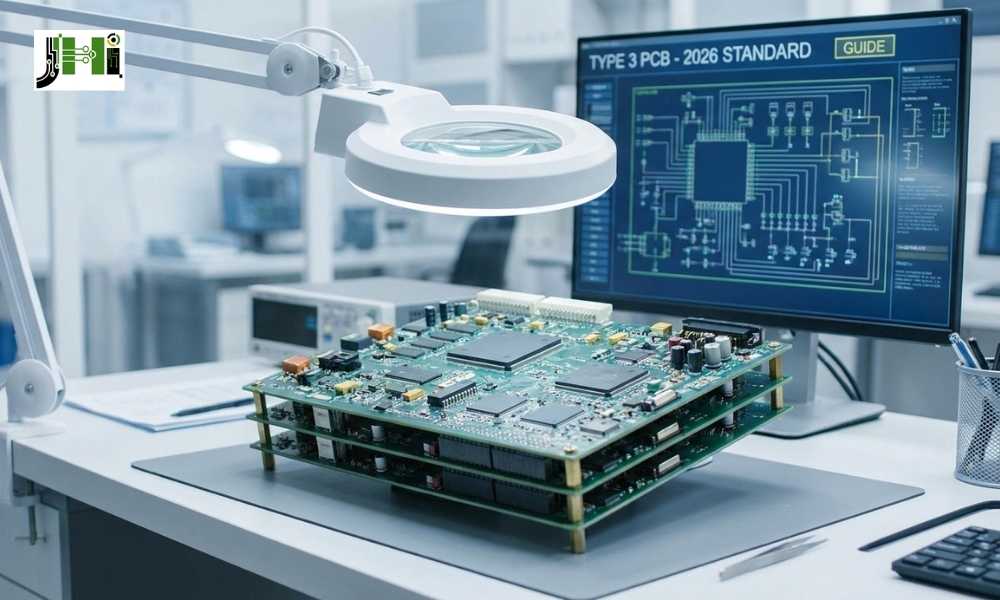
What Is a Type 3 PCB? The No-Fluff Guide for 2026
Some circuit boards can fail. A Type 3 PCB cannot.
This is the board inside your pacemaker. Inside the satellite. Inside the jet. When downtime means lives, missions, or millions, engineers reach for one thing.
A Type 3 PCB. Also called an IPC Class 3 PCB.
In this guide, we’ll break down what makes it special. You’ll learn the rules, the tests, and how to spec one right. No jargon. No filler. Just the stuff that matters.
The 30-Second Answer
A Type 3 PCB is the highest reliability tier set by IPC. That’s the global body that runs the rulebook for circuit boards.
These boards live in gear that can’t fail. Think medical implants. Think flight controllers. Think defense systems.
The trade-off is simple. Type 3 boards cost more. They take longer. But they don’t quit.
Class 1 belongs in a toy. Class 2 belongs in your laptop. Class 3 belongs in a heart defibrillator.
Who Made These Rules?
The rules come from IPC. The acronym used to mean Institute of Printed Circuits. Today it’s the Association Connecting Electronics Industries.
The name changed. The brand stuck.
IPC has over 4,000 member companies. They publish the standards every fab shop on earth follows.
Three documents matter most for our topic:
- IPC-6011 sets the class system itself
- IPC-6012 covers rigid PCB performance rules
- IPC-A-600 shows what a “good” board looks like by eye
When a drawing says “Build to IPC-6012 Class 3,” every shop knows the deal.
The Three Classes at a Glance
IPC sorts every PCB into one of three buckets. Each bucket maps to a use case.
Class 1: General Electronics
This is the budget tier. The board has to work. That’s about it.
Cosmetic flaws are fine. Short lifespan is fine. You’ll find Class 1 in cheap toys and musical greeting cards.
Most serious fab shops don’t even bother making them.
Class 2: Dedicated Service
This is where most of your gear lives. Phones. Laptops. TVs. Office tools.
These boards need to last. They need to perform. But if one dies early, you’re annoyed, not in danger.
Minor cosmetic defects pass inspection at Class 2.
Class 3: High Reliability
This is the top tier. Failure is not on the menu.
Class 3 boards must work the first time. Every time. For their full service life.
A flaw that passes Class 2 will get rejected at Class 3. There’s almost zero tolerance for visual or functional defects.
What Makes a Board “Type 3” on Paper?
Calling a board Class 3 isn’t a vibe. It’s a contract.
Each rule is measurable. Each rule is in IPC-6012. And here’s the kicker.
You can’t upgrade a board after the fact. A Class 2 bare board stays Class 2 forever. Even with perfect assembly later.
Let’s walk through the key rules.
Rule 1: Thicker Copper in the Holes
Every plated through-hole needs 25 µm of copper minimum inside the barrel. That’s 1 mil.
Class 2 only needs 20 µm. The extra copper fights barrel cracking under heat cycles.
Plating voids? Not allowed. Period.
Rule 2: No Drill Breakout
The annular ring is the copper donut around a drilled hole. For Class 3, the rules are tight.
External rings must be 2 mil minimum. Internal rings must be 1 mil minimum.
And breakout is banned. The drill must hit fully inside the pad on every layer. Class 2 lets you have 90° breakout. Class 3 does not.
Lifted rings, fractured rings, drill breakout. All grounds for rejection.
Rule 3: Dielectric Thickness
The dielectric is the insulation between copper layers. Class 3 needs 90 µm minimum.
But there’s a 2024 update worth knowing.
For HDI designs sent in after January 1, 2024, the floor dropped to 2.56 mil. This was a gift to fab shops working on dense modern boards.
Rule 4: Solder Fill in Through-Holes
Class 3 demands 75% vertical fill in the barrel for through-hole leads. Class 2 only asks for 50%.
More fill means more strength. It also slows down production.
Rule 5: Solder Mask
Solder mask thickness must sit between 15 and 35 µm. Adhesion to the copper has to be 100%.
No lifting. No flaking.
Rule 6: Conductor Spacing
You can shrink conductor spacing by up to 20% max for Class 3. Beyond that, you risk signal coupling.
Rule 7: Cosmetic Bar
Even tiny scratches matter. A scratch deeper than 0.025 mm can kill a board.
Hole sizes must land within ±0.002 inches. That’s a tight window.
Rule 8: Full Paper Trail
Class 3 boards ship with a binder of proof. Microsection coupons. Reflow logs. Inspection reports.
Every record ties to a serial number. Inner-layer repairs are banned.
You break it, you scrap it.
How Class 3 Boards Get Tested
Testing is where Class 3 really separates from the pack.
Most Class 2 testing is by sample. Class 3 testing is often 100% inline. Here’s what that looks like.
Visual inspection. Both manual and AOI. Multiple stages. After placement and after reflow.
Dimensional checks. Board thickness. Hole sizes. Feature placement. All against tight tolerance windows.
Electrical tests. Continuity. Insulation resistance. Dielectric withstand voltage.
Microsection analysis. Coupons get cut and polished. Inspectors check internal copper, lamination, and registration under a microscope.
Thermal stress testing. D coupons take 6 reflow cycles plus 100 thermal shocks. Resistance is logged the whole time. A 10% shift means failure.
X-ray inspection. For hidden joints and vias-in-pad.
Solderability and cleanliness tests. Surfaces must accept solder. No ionic residue allowed.
For HDI boards with blind or buried vias, Propagated D coupons come into play.
Where Type 3 Boards Show Up
Class 3 boards live in places where failure isn’t an option.
Aerospace and Defense
Avionics. Flight controllers. Satellites. Radar. Military comms.
These often need the IPC-6012ES addendum. It adds rules for vibration and thermal shock.
Medical Devices
Pacemakers. Defibrillators. MRI machines. Surgical robots.
The IPC-6012EM addendum handles medical specs. It even covers HDI implants with trace widths under 100 µm.
Automotive (EVs and ADAS)
Modern cars are full of safety-critical electronics. Airbag controllers. Battery management. Self-driving brains.
The IPC-6012FA addendum pairs with IATF 16949 for automotive quality.
Industrial and Energy
Nuclear plant controls. Offshore drilling rigs. Wind turbine inverters. Field failure here costs lives or millions.
The IPC-6012 Addendum Family
Different industries need different add-on rules. IPC handles this with addenda.
- IPC-6012ES / DS for space and military
- IPC-6012EM for medical
- IPC-6012EA / FA for automotive
Always call out the right addendum on your fab drawing.
Class 3 Design Best Practices
Want your board to pass Class 3? Start at the schematic. Don’t wait.
Here’s what veteran designers do every time:
- Pick high-Tg materials. Polyimide or high-Tg FR-4. They survive heat cycles.
- Keep stack-ups symmetric. Asymmetric boards warp during lamination.
- Use teardrops at via-trace junctions. They cut mechanical stress.
- Oversize annular rings on multi-lam stackups. Drift compounds across layers.
- Hold 10-mil drill-to-copper distance in multi-lam cycles.
- Use copper wrap plating for vias-in-pad per IPC-6012B.
- Write “Fabricate per IPC-6012 Class 3” on every drawing. Spell out the addendum too.
Talk to your fab shop early. Their input saves you a respin.
What Does Class 3 Cost You?
Let’s be real. Class 3 is expensive.
Why? Tighter tolerances. More inspection. Slower production. Lower yields. More paperwork.
Lead times stretch out. Some process steps can’t be rushed.
But here’s the math that matters.
If a single field failure costs more than the build premium, Class 3 wins. For a satellite or a pacemaker, that math is easy.
For a Bluetooth speaker, it’s not. Use Class 2 there.
How to Spec a Class 3 Board
Get this right and your boards come out clean. Get it wrong and you’re chasing rework.
Your fab drawing should call out:
- Base standard: IPC-6012F (current revision, October 2023)
- Class: Class 3, plus the right addendum
- Visual standard: IPC-A-600 current revision
- Assembly standard: IPC-A-610 Class 3
- Design rules: IPC-2221 / IPC-2222
- Test methods: IPC-TM-650
- Stack-up, copper weights, hole sizes, tolerances
- Required microsection coupons
Then check your shop. Not every fab can run Class 3.
Ask about AOI. Ask about X-ray. Ask about coupon testing. Ask about traceability.
Many shops only do Class 1 and 2. Their gear and people aren’t ready for the top tier.
Defects That Kill a Class 3 Board
The same flaws that pass at Class 2 fail here. Watch for these:
- Plating voids in through-holes
- Copper barrel under 25 µm
- Drill breakout
- Lifted or fractured annular rings
- Surface scratches over 0.025 mm
- Solder mask voids or lifting
- Laminate cracks over 80 µm
- Dielectric below spec
- Inner-layer repairs (banned outright)
- Solder fill under 75%
If you spot any of these, the board’s done.
The Bottom Line
A Type 3 PCB is what you build when failure isn’t allowed.
It costs more. It takes longer. It demands more from everyone in the chain.
In return? You get a board that lasts. A board that flies. A board that saves lives.
For the right job, that’s the only call worth making.
FAQ
Is a Type 3 PCB the same as an IPC Class 3 PCB?
Yes. The terms mean the same thing. Both point to the top reliability tier in IPC-6012.
Can a Class 2 board be upgraded to Class 3 later?
No. The class is baked in from day one. You can’t promote a Class 2 bare board after the fact.
What’s the current revision of IPC-6012?
IPC-6012F. It dropped in October 2023. It updated rules for microvias, cavities, and HDI dielectric thickness.
Which industries use Type 3 boards most?
Aerospace. Defense. Medical. Automotive safety. EVs. Satellites. Nuclear. Anywhere downtime hurts.
Is Class 3 always pricier?
Yes. Always. The premium pays for tolerance, testing, and traceability.
What’s the difference between IPC-6012 and IPC-A-600?
IPC-6012 sets the numbers. IPC-A-600 shows the photos. One says “annular ring must be 50 µm.” The other shows what 50 µm looks like under a microscope.
Ready to Build Type 3?
Pick a fab shop with real Class 3 chops. Ask the hard questions up front.
Get your drawing right. Spec the addendum. Plan for the lead time.
Your board will thank you. Your end users will too.
Final Thoughts
A Type 3 PCB isn’t just a tougher board. It’s a promise.
A promise that the satellite stays in orbit. The pacemaker keeps a heartbeat. That the brake controller fires on time, every time.
You pay more for that promise. You wait longer for it. But when lives or missions ride on your hardware, it’s the only call that makes sense.
Spec it right. Pick the right partner. Ship with confidence.
Need Class 3 Support? Talk to Jay Hoehl Inc.
We help engineers and buyers source the right PCB scrap, materials, and partners across Phoenix and beyond. Got questions about high-reliability boards or scrap recovery? We’re ready to help.
📍 3334 W McDowell Rd Unit 17, Phoenix, AZ 85009 📞 (602) 272-4033 📧 JayHoehlinc@gmail.com 🌐 jhiescrap.com