What are PCB and IC?
Ever wonder what makes your phone light up, your car start, or your smartwatch tick? Behind every modern device, two quiet heroes are doing the hard work: the PCB and the IC. Think of it this way — the PCB is like the roads of a city, and the IC is like the brain that decides where to go. In this guide, you’ll learn what they are, how they work together, and why they matter. Let’s break it down in the simplest way possible.
What Is PCB and IC in Phoenix, AZ Electronics Manufacturing?
Phoenix, AZ has quietly become one of America’s most important electronics manufacturing hubs. From semiconductor giants building new fabs to aerospace and medical device makers scaling production, the city runs on PCBs and ICs every single day.
So what does that mean for you? In Phoenix electronics manufacturing, PCBs and ICs are the foundation of nearly every product built here — phones, drones, sensors, aircraft systems, and hospital machines. Without PCB, there is no connection. Without IC, there is no thinking.
Here’s why it matters locally:
- Phoenix hosts major semiconductor fabrication plants and suppliers
- Aerospace companies rely on high-reliability PCB and IC designs
- Medical device manufacturers need precise, certified electronics
- Startups in the Valley use local assembly to move fast
Whether you’re a student, engineer, or business owner, understanding PCB and IC helps you connect with an industry that’s reshaping Arizona’s economy.
Overview of PCB and IC Relationship
PCB and IC are two different things, but they can’t really live without each other. The PCB is the flat board that holds everything in place and carries electrical signals from one component to another. The IC is a tiny chip that sits on top of the PCB and handles the “thinking” — processing signals, running logic, and controlling other parts.
Imagine your body. The PCB is like your nervous system, carrying messages everywhere. The IC is like your brain, making decisions. One without the other simply doesn’t work. Together, they form the heart of every electronic device you use.
What Is a PCB (Printed Circuit Board) in Phoenix, AZ?
Have you ever opened up an old remote or toy and seen that flat green board covered with shiny lines and tiny parts? That’s a PCB. In Phoenix’s growing electronics scene, PCBs are the starting point of almost every device built — from consumer gadgets to aerospace systems. Let’s look at what a PCB really is, what it does, and why it matters.
Definition of PCB
A PCB, or Printed Circuit Board, is a flat board with thin copper paths that connect electronic parts together. It holds components like resistors, capacitors, and chips in place and lets electricity flow between them through its printed paths. In short, a PCB is the base of every electronic device — a quiet, reliable foundation where the real action happens.
Key Functions of PCB
A PCB does more than just sit inside your device. It plays several key roles that make electronics possible:
- Connect — It links all components through copper pathways, replacing messy wires
- Support — It physically holds parts in place so they don’t move or break
- Route signals — It guides electrical signals exactly where they need to go
- Distribute power — It delivers the right voltage to each part of the circuit
- Protect — Its layers and coatings shield the circuit from heat, dust, and moisture
Without a PCB, building a reliable electronic device would be nearly impossible.
Types of PCB
Not all PCBs look or work the same. Different devices need different kinds of boards:
- Single-sided PCB — One layer of copper. Used in simple items like calculators and toys.
- Double-sided PCB — Copper on both sides. Common in power supplies and LED lighting.
- Multilayer PCB — Multiple layers stacked together. Used in phones, laptops, and medical devices.
- Rigid PCB — Hard and solid. Found in most everyday electronics.
- Flexible PCB — Bendable, used in cameras, wearables, and foldable phones.
- Rigid-Flex PCB — A mix of both. Common in aerospace and advanced medical gear.
The more complex the device, the more layers and flexibility it usually needs.
Common Materials Used in PCB
A PCB isn’t just a piece of plastic — it’s a carefully layered sandwich of materials:
- FR4 (fiberglass epoxy) — The most common base material. Strong, affordable, and heat-resistant.
- Copper — The star of the show. Copper traces carry electricity across the board.
- Solder mask — The green (or sometimes blue, red, black) coating that protects the copper.
- Silkscreen — The white printed labels that mark component positions.
- Metal core — Used in high-heat applications like LED and power electronics.
Copper is the most important of them all — without it, there’s no current, no signal, no circuit.
Purpose of PCB
The purpose of a PCB is simple but powerful: to organize an electronic circuit in a clean, reliable, and repeatable way. Before PCBs, engineers used messy point-to-point wiring that broke easily and was hard to mass-produce. A house needs a foundation — and electronics need a PCB. It makes devices smaller, stronger, cheaper, and easier to build in large numbers.
Appearance of PCB
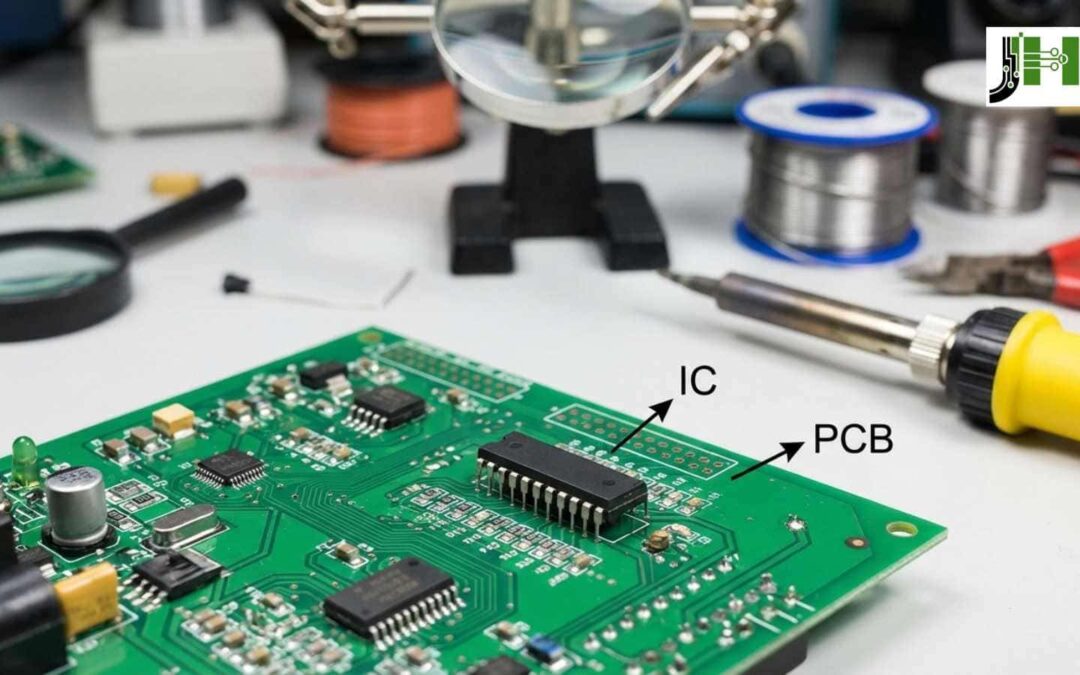
Most PCBs are instantly recognizable. They’re usually flat, thin, and green — though you’ll also see blue, red, or black ones. Across the surface, you’ll notice shiny copper lines called traces running in neat patterns, like a tiny city map. Small silver dots mark where components are soldered, and white text labels each part. It looks a bit like a miniature highway system, quietly carrying signals everywhere.
Functionality of PCB
A PCB works by guiding electricity through its copper traces. When power enters the board, it travels along these printed paths to reach each component. Signals move from one part to another in a specific order — from input, through processing, to output.
For example, in a remote control, pressing a button sends a signal through the PCB to a small chip, which then tells an LED to flash and transmit the command. The PCB makes sure every signal takes the right road, at the right time, without getting lost.
Maintenance of PCB
PCBs are tough, but they’re not invincible. A little care goes a long way:
- Keep boards away from dust and moisture
- Avoid overheating — good airflow matters
- Handle gently; bending a rigid board can crack traces
- Clean with isopropyl alcohol, never water
- Inspect solder joints if a device starts acting up
Heat and dust are the two silent killers of any PCB — treat your electronics kindly and they’ll last for years.
What Is an IC (Integrated Circuit) in Phoenix, AZ Electronics?
If the PCB is the city, the IC is the brain running everything inside it. An Integrated Circuit is a tiny chip packed with thousands — sometimes billions — of microscopic components working together. In Phoenix’s fast-growing semiconductor scene, ICs are the stars of the show. So what exactly is this little “brain,” and why is it such a big deal?
Definition of IC
An IC, or Integrated Circuit, is a tiny chip that contains many electronic components — like transistors, resistors, and capacitors — all built onto a single piece of semiconductor material, usually silicon. Instead of wiring hundreds of parts by hand, engineers shrink them down into one small package. That’s how a fingernail-sized chip can run an entire smartphone.
Key Functions of IC
An IC may be tiny, but it does some heavy lifting inside every device:
- Process — Runs calculations and logic at incredible speeds
- Store — Holds data in memory, from a few bytes to terabytes
- Control — Manages how other parts of the device behave
- Amplify — Boosts weak signals into stronger ones
- Convert — Changes signals between analog and digital forms
- Communicate — Sends and receives data between components
In short, if a device needs to think, remember, or decide — an IC is doing it.
Types of IC
ICs come in several flavors depending on what they’re built to do:
- Analog IC — Works with continuous signals. Used in audio amplifiers and radios.
- Digital IC — Works with 1s and 0s. Found in computers, phones, and logic circuits.
- Mixed-signal IC — Handles both analog and digital. Common in smartphones and sensors.
- Microprocessor IC — The “brain” of computers and devices.
- Memory IC — Stores data, like RAM and flash chips.
- Power management IC — Controls voltage and battery usage in portable devices.
Each type plays a specific role — together, they make modern electronics possible.
Common Examples of IC
You probably use dozens of ICs every single day without realizing it. A few common ones:
- Microprocessors — The chip running your laptop or phone
- Memory chips — RAM in your computer, storage in your SSD
- Audio ICs — Powering your earbuds and speakers
- Sensor ICs — Inside your smartwatch and car airbag system
- Power ICs — Managing the battery in your phone
From the moment you check your phone in the morning to the time you turn off the TV at night, ICs are working silently in the background. You use this every day.
Purpose of IC
The whole point of an IC is to do more in less space. Instead of building circuits the size of a room, engineers can now fit billions of transistors onto a chip smaller than your fingernail. This miniaturization made smartphones, laptops, pacemakers, and satellites possible. Small things do big jobs — and the IC is the perfect example. It’s the reason modern electronics are fast, cheap, and portable.
Appearance of IC
An IC usually looks like a small black rectangle or square with shiny metal pins sticking out from the sides or underneath. The black part is a protective casing that shields the delicate silicon inside. The pins are how the chip connects to the PCB — each one carries a specific signal, power, or ground. Some modern ICs are so small they look like tiny dots on the board, barely visible to the eye.
Functionality of IC
An IC works on a simple model: input → process → output. A signal comes in through one of the pins, travels through the chip’s internal transistors and logic gates, and exits as a new, processed signal.
For example, in a calculator, when you press “2 + 2,” the IC receives the button signals, processes the math internally using logic circuits, and sends the result “4” to the display. All of this happens in microseconds. It’s like a miniature factory — raw data goes in one door, and a finished answer comes out the other.
Maintenance of IC
ICs are delicate, and most of their care comes down to prevention:
- Keep devices cool — heat is the biggest enemy of any chip
- Avoid static electricity when handling bare ICs
- Use proper voltage; overvoltage can fry a chip instantly
- Don’t expose to moisture
- If a chip fails, replacement is usually easier than repair
The golden rule? Chips love cool, calm, and clean environments.
Key Differences Between PCB and IC in Phoenix, AZ
PCB and IC often get mentioned in the same breath, but they’re very different things. One is a board. The other is a brain. One connects. The other thinks. Understanding the difference helps you see how modern electronics really come together — whether you’re designing a drone in Tempe or building medical gear in downtown Phoenix.
Core Differences
Here’s a quick side-by-side look:
| Feature | PCB | IC |
|---|---|---|
| What it is | A flat board with copper paths | A tiny chip with built-in circuits |
| Main job | Connects and supports components | Processes signals and runs logic |
| Size | Larger, visible to the eye | Very small, often microscopic inside |
| Made of | Fiberglass, copper, solder mask | Silicon and semiconductor materials |
| Role | The “body” | The “brain” |
| Repair | Often repairable | Usually replaced, not repaired |
The PCB holds the team together. The IC makes the decisions.
Relationship Between PCB and IC
PCB and IC work like a body and a brain. The brain (IC) is powerful, but without a body (PCB) to carry its signals and supply it with power, it can’t do anything useful. The PCB gives the IC a place to sit, power to run, and pathways to communicate with other parts.
In every device — from a hearing aid to a jet engine controller — the IC is mounted on a PCB. They depend on each other completely. One designs the thinking, the other delivers it to the real world.
Manufacturing Differences
Making a PCB and making an IC are two very different journeys:
- PCB manufacturing — Involves printing copper layers, drilling holes, applying solder mask, and adding silkscreen. It can be done in medium-sized factories.
- IC fabrication — Happens in ultra-clean “fabs” where silicon wafers are etched with microscopic circuits using light and chemicals.
- Complexity — PCB production is measured in millimeters; IC production is measured in nanometers.
- Cost — Building a new PCB line costs millions. Building a new IC fab costs billions.
- Time — A PCB can be made in hours or days; an IC can take weeks.
One is precision engineering. The other is near-atomic-level science.
Role in Electronic Systems
In any electronic system, the PCB and IC play clear but different roles:
- PCB role — Physical foundation, signal highway, power distributor
- IC role — Data processor, logic controller, memory keeper
The PCB is the stage, and the IC is the performer. Together they create the full show. Remove either one, and the system falls apart. This system-level partnership is what makes all modern electronics possible.
How PCB and IC Work Together
Here’s how they team up in action:
- Power enters the PCB through its input connector
- The PCB distributes power to each component, including the IC
- A signal arrives — maybe from a button, sensor, or antenna
- The PCB routes the signal to the correct IC
- The IC processes the signal using its internal logic
- The IC sends an output back through the PCB traces
- The PCB delivers the result to a display, motor, speaker, or another component
It’s like a relay race. The PCB passes the baton, the IC does the thinking, and together they cross the finish line.
PCB Assembly and IC Integration Services in Phoenix, AZ
Knowing what PCBs and ICs are is one thing — turning them into a real, working product is another. That’s where assembly and integration services come in. Phoenix has a strong network of electronics assembly providers serving aerospace, medical, automotive, and consumer tech industries.
Design is the idea. Assembly is the reality. These services help turn a blueprint into a functioning device with:
- Precision component placement
- Strict quality control and testing
- RoHS and IPC compliance
- Fast turnaround for prototypes and production runs
- Support for both small batches and high-volume manufacturing
If you have an idea for an electronic product, Phoenix has the talent and facilities to make it real.
PCB Assembly (PCBA)
PCB Assembly, or PCBA, is the process of placing components onto a bare PCB and soldering them in place. It follows a clear flow:
- Solder paste application — A stencil lays down tiny amounts of paste where components will sit
- Component placement — Machines (or hands, for small runs) place parts on the board
- Reflow soldering — The board goes through an oven that melts the paste and bonds components
- Inspection — Automated optical inspection (AOI) checks for errors
- Testing — Functional tests make sure everything works
There are two main methods: SMT (Surface Mount Technology), where tiny parts sit directly on the surface, and THT (Through-Hole Technology), where parts have leads that go through holes. Place, solder, test, repeat — that’s the rhythm of PCBA.
IC Packaging Types
Before an IC can be used, it needs to be “packaged” — sealed inside a protective shell with pins or pads to connect to the outside world. Common types include:
- DIP (Dual In-line Package) — Classic two-row pin layout, great for hobbyists
- SOIC (Small Outline IC) — Smaller surface-mount version of DIP
- QFP (Quad Flat Package) — Pins on all four sides, used in microcontrollers
- BGA (Ball Grid Array) — Tiny solder balls under the chip, used in processors
- CSP (Chip Scale Package) — Nearly the same size as the chip itself
Just like a house protects a family, packaging protects the chip from heat, dust, and damage — while also helping it cool down during use.
Applications of PCB and IC in Phoenix, AZ Industries
From your phone to hospital machines, PCBs and ICs are everywhere. Phoenix is home to some of the strongest electronics-driven industries in the country — aerospace, semiconductors, medical devices, and automotive. Let’s look at where these tiny technologies show up in real life, and why they matter to industries right here in Arizona.
Consumer Electronics
This is where most people first meet PCBs and ICs — without even realizing it. Your smartphone, TV, laptop, smartwatch, gaming console, microwave, and even your electric toothbrush all rely on them. A single phone might contain dozens of ICs and several PCBs stacked inside.
Examples of daily consumer electronics powered by PCB and IC:
- Smartphones and tablets
- Laptops and desktops
- Smart TVs and streaming devices
- Home appliances like air conditioners and refrigerators
- Wearables like fitness bands
You use this every hour — and PCBs and ICs make it all possible.
Industrial Systems
Step into any modern factory and you’ll find PCBs and ICs running the show. They control robotic arms, conveyor belts, sensors, and automation systems that never sleep. In Phoenix, industrial electronics support manufacturing, logistics, and energy operations across the state.
You’ll find them in:
- Factory automation controllers
- Industrial sensors and monitoring systems
- Motor drives and power converters
- Robotic systems and CNC machines
Small chip, big machines — industrial PCBs and ICs are built tough to handle heat, vibration, and long hours of nonstop work.
Automotive Electronics
Modern cars are basically computers on wheels. Every vehicle built today contains dozens of PCBs and hundreds of ICs working together to keep you safe and comfortable. They handle engine control, braking, airbags, infotainment, and even self-parking features.
Common automotive uses include:
- Engine Control Units (ECUs)
- Airbag sensors
- Anti-lock braking systems (ABS)
- Dashboard displays and infotainment
- Driver-assist cameras and radar
Your safety depends on them. Every time your car makes a split-second decision to brake or adjust, a PCB and IC are working together behind the scenes.
Medical Devices
In healthcare, there’s no room for error — and that’s exactly why medical devices rely so heavily on high-quality PCBs and ICs. Phoenix has a growing medical device manufacturing scene, and the demand for precision electronics keeps climbing.
Medical applications include:
- Heart monitors and pacemakers
- MRI and CT scan machines
- Insulin pumps and glucose meters
- Ventilators and patient monitors
- Diagnostic lab equipment
Lives depend on these systems. That’s why medical PCBs and ICs go through some of the strictest testing standards in the entire industry.
Advantages of PCB and IC for Phoenix, AZ Electronics Projects
Why have PCBs and ICs taken over the world of electronics? Because they deliver real, measurable benefits — smaller size, bigger power, lower cost, and higher reliability. For Phoenix businesses building products in aerospace, medical, and consumer tech, the advantages are hard to ignore. Let’s break down what each brings to the table.
Advantages of PCB
PCBs bring a lot to the table, which is why they replaced hand-wired circuits decades ago:
- Compact design — Fits complex circuits into small spaces
- Reliability — Fixed copper paths mean fewer loose connections
- Cost-effective — Easy and cheap to mass-produce
- Scalability — Same board design can be produced in the thousands
- Durability — Stands up to heat, vibration, and everyday use
- Ease of testing — Standard layouts make troubleshooting simpler
Strong, stable, scalable — that’s the PCB advantage in a nutshell.
Advantages of IC
ICs changed electronics forever, and here’s why they’re so valuable:
- Miniaturization — Billions of components fit on a fingernail-sized chip
- Speed — Processes millions of operations per second
- Low power — Uses a fraction of the energy of older circuits
- Reliability — Sealed construction means fewer failures
- Cost efficiency — Mass production drives prices way down
- Consistency — Every chip behaves the same way
Small things do big work. Without ICs, there would be no smartphones, no laptops, no smartwatches — no modern world.
Limitations of PCB and IC in Phoenix, AZ Electronics Design
As powerful as they are, PCBs and ICs aren’t perfect. Every technology has limits, and being aware of them helps engineers design smarter, safer products. Powerful, but not perfect — that’s the honest truth about modern electronics. Let’s look at the real-world challenges designers face in Phoenix and beyond.
PCB Limitations
PCBs have a few weak points to watch out for:
- Heat buildup — Dense boards can overheat without proper cooling
- Limited flexibility — Rigid PCBs can’t bend or flex easily
- Repair difficulty — Fixing damaged traces is delicate work
- Space constraints — Very small devices challenge PCB layout
- Design errors are expensive — A mistake means remanufacturing
- Environmental sensitivity — Moisture and dust can cause failures
Not all boards are perfect, but good design and testing can work around most of these issues.
IC Limitations
ICs also come with their own set of challenges:
- Heat sensitivity — Too much heat can destroy a chip instantly
- Hard to repair — Once damaged, most ICs must be replaced
- Custom design cost — Designing a new IC can cost millions
- Static damage risk — A small static shock can ruin a chip
- Fixed function — Most ICs can’t be reprogrammed after manufacture
- Supply chain issues — Chip shortages can halt entire industries
Fast and small, but fragile — that’s the trade-off every engineer learns to respect.
Environmental and Lifecycle Considerations for PCB and IC in Phoenix, AZ
Electronics don’t just affect our devices — they affect our planet. Every PCB and IC has a lifecycle, from raw materials to recycling. As Phoenix grows as an electronics hub, sustainability is becoming just as important as performance. What we build today shapes tomorrow, and smart design choices can reduce waste while saving money.
E-Waste and Recycling
Every year, millions of tons of electronic waste pile up around the world. Old PCBs and ICs contain valuable metals — gold, copper, silver, and palladium — that can be recovered and reused. But they also contain harmful materials that need careful handling.
Where does your old device go? Ideally, to a certified recycler who can:
- Safely extract valuable metals
- Properly dispose of hazardous materials
- Refurbish working components for reuse
- Reduce the need for new mining
Phoenix has several certified e-waste recyclers helping the industry close the loop.
RoHS Compliance
RoHS stands for “Restriction of Hazardous Substances.” It’s a set of rules that limits dangerous materials in electronics, making them safer for people and the environment. Compliant PCBs and ICs avoid or minimize:
- Lead
- Mercury
- Cadmium
- Hexavalent chromium
- Certain flame retardants
Safe design beats harmful materials every time. Most professional Phoenix manufacturers now build fully RoHS-compliant products as standard practice.
Lifecycle Management
Good lifecycle management means thinking about a product from beginning to end — not just until it ships. The full cycle usually looks like this:
- Design — Choose materials and layouts with sustainability in mind
- Manufacture — Use efficient, low-waste production methods
- Use — Build for durability and easy repair
- Maintain — Support updates and replacement parts
- End-of-life — Plan for recycling and safe disposal
Plan early, avoid problems later. Companies that manage the full lifecycle save money, protect the environment, and build stronger brand trust.
Additional Learning Topics for PCB and IC in Phoenix, AZ
Want to go deeper? The world of PCBs and ICs is huge, and there’s always more to learn. Whether you’re a student, a curious beginner, or a business owner looking to understand your products better, these next-step topics will expand your knowledge and help you speak the language of modern electronics.
SMT vs THT Assembly
SMT (Surface Mount Technology) and THT (Through-Hole Technology) are two ways to attach components to a PCB:
- SMT — Components sit directly on the board surface. Smaller, faster, cheaper, and perfect for mass production. Used in phones, laptops, and most modern electronics.
- THT — Components have leads that pass through holes in the board and are soldered on the other side. Stronger, easier to repair, and better for parts under mechanical stress.
Small and fast vs strong and stable — most modern boards use a mix of both, picking the best method for each component.
Semiconductor Manufacturing
Making an IC is one of the most complex processes humans have ever invented. It happens in ultra-clean “fab” rooms where even a single speck of dust can ruin a chip. The basic steps are:
- Grow a pure silicon wafer
- Coat it with light-sensitive chemicals
- Use light to “print” circuit patterns (photolithography)
- Etch away unwanted material
- Add layers of metal and insulation
- Test, cut, and package the chips
It’s like building a city layer by layer — except the streets are thinner than a human hair. Phoenix is home to some of the world’s most advanced semiconductor fabs, making Arizona a key player in global chip production.
Circuit Design Basics
Before any PCB is made, someone has to design the circuit. The basics every beginner should know:
- Start with a schematic — A logical diagram of how parts connect
- Choose components — Match them to voltage, current, and function
- Lay out the board — Arrange parts for short, clean signal paths
- Check for errors — Use design rule checks (DRC)
- Prototype and test — Build a sample before full production
Schematic first, layout second — that’s the golden rule of circuit design.
Embedded Systems
An embedded system is a small computer built into a bigger product. It’s not a laptop or phone — it’s a specialized system that does one job really well. They’re powered by microcontroller ICs mounted on small PCBs.
You interact with embedded systems every single day:
- Your washing machine’s control panel
- Your car’s cruise control
- Your microwave’s timer
- Your smart thermostat
- Your digital camera
You might not notice them, but embedded systems quietly run a huge part of modern life — and PCBs and ICs are what bring them to life.