
I’ll create this comprehensive blog post following the detailed SEO strategy. Let me build it section by section with the right tone, structure, and keyword integration.
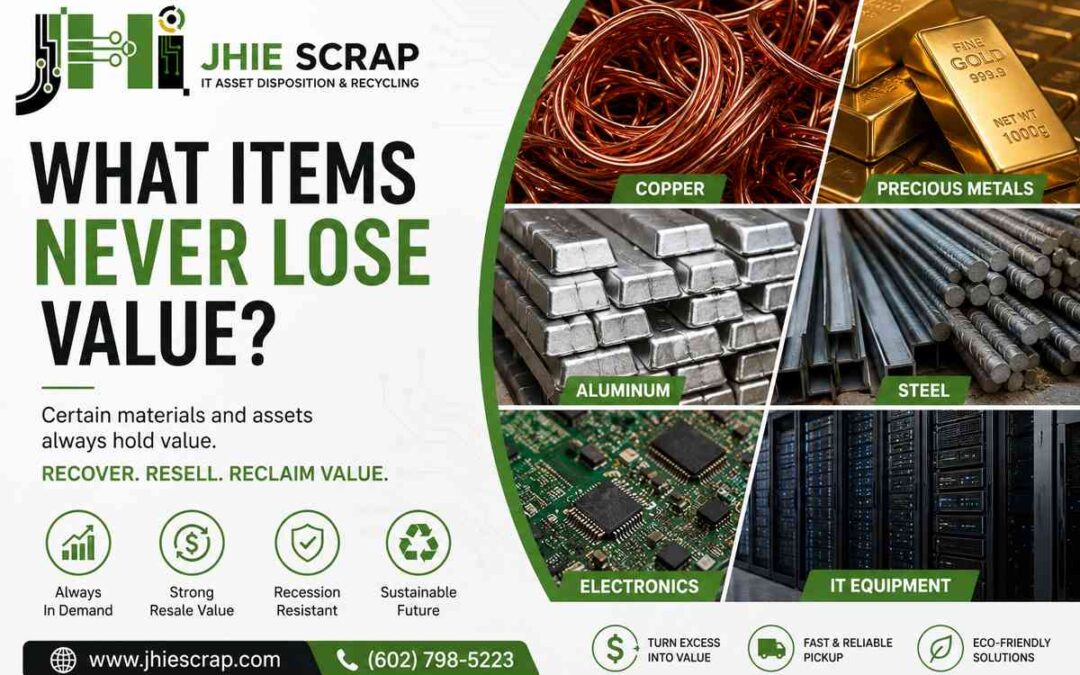
What Items Never Lose Value? Electronics, Metals & Assets That Still Hold Worth
Most people throw away value every week without knowing it.
That old server in your storage room. The pile of cables behind the IT closet. The dusty box of circuit boards from the last upgrade. They look like junk. They often aren’t.
Here’s the truth nobody tells Phoenix business owners. Some items hold their worth far better than others. Precious metals. Working electronics. Industrial surplus. Even broken equipment can carry hidden value through parts, copper, or recoverable materials.
This guide breaks down what items still have worth, why they hold up over time, and how your business can recover value from old electronics instead of paying to haul them off. We’ll cover metals, electronics, surplus inventory, collectibles, and the items that quietly drain money when they sit in your warehouse too long.
If your business has unused equipment in Phoenix, you’ll also learn how to spot recoverable value before it ends up in a dumpster.
Let’s get into it.
Do Any Items Truly Never Lose Value?
Short answer? No. Not completely.
Markets shift. Demand changes. Trends fade. But some items hold up far better than others because of what they’re made of, who needs them, and how scarce they are.
The better question isn’t “what never loses value?” It’s “what still has recoverable value after use, age, or damage?” That mindset opens up real opportunities most businesses miss.
The Honest Answer: Value Can Change, But Some Items Hold Up Better
Value isn’t fixed. A laptop worth $2,000 in 2020 might fetch $200 today. But that same laptop still contains copper, aluminum, plastic, and a circuit board with recoverable metals.
The sticker price drops. The material value often stays.
Precious metals, well-built electronics, and industrial surplus tend to weather time better than most consumer goods. They keep some form of worth even when they stop being “new.”
Why Some Items Retain Value Over Time
A few core factors decide whether an item holds value:
- Scarcity keeps demand higher than supply
- Material content like gold, silver, or copper carries baseline worth
- Active demand from buyers, manufacturers, or repair shops
- Brand reputation signals quality and reliability
- Condition that allows resale or reuse
Business electronics often hold value because of their components, not just the whole unit. A dead server might still have working drives, processors, and boards worth recovering.
Intrinsic Value vs Resale Value vs Scrap Value
Three types of value matter when you’re deciding what to keep, sell, or recycle:
| Value Type | What It Means | Example |
|---|---|---|
| Resale value | What a buyer will pay for the working item | A used laptop sold online |
| Parts value | Worth of individual components | RAM, processors, drives pulled from a dead PC |
| Scrap value | Recoverable material worth | Copper from cables, gold from boards |
Here’s the key insight. A non-working item may have zero resale value but still carry strong scrap or parts value. Three doors, not one.
What Makes an Item Hold Its Value?
Before you write something off as worthless, ask what part of it still has demand. That single question can save your business real money.
Value retention follows patterns. Once you know them, you can spot worth in places most people overlook.
Scarcity and Limited Supply
When supply shrinks and demand stays the same, value usually survives.
Discontinued parts. Obsolete components. Legacy equipment that supports older systems. These items often carry surprising worth because someone, somewhere, still needs them and can’t get them new.
A processor from a 10-year-old industrial machine might be worthless to most. To the company keeping that machine running, it’s gold.
Material Value, Especially Precious Metals
Raw material content protects value better than almost anything else.
Electronics often contain small amounts of:
- Gold on connectors and circuit boards
- Silver in switches and contacts
- Copper throughout cables and wiring
- Platinum and palladium in specialized components
The device may be outdated. The metals inside don’t expire. That’s why circuit boards, processors, and connectors hold recoverable worth even when the equipment no longer powers on.
Brand, Condition, and Demand
Two identical-looking items can carry very different values. The difference usually comes down to:
- Brand recognition that buyers trust
- Working condition that allows immediate use
- Active market demand for that specific model
For business electronics, original model numbers and proof of working status often decide whether resale is even possible. Documentation matters more than people think.
Repairability, Reusability, and Parts Value
Broken doesn’t always mean worthless.
A dead computer might still hand over working RAM, a usable power supply, a functional hard drive, or cables that another repair tech needs today. Non-working equipment deserves a real evaluation before disposal because boards, drives, and components often outlast the device itself.
This is where most businesses lose money. They see “broken” and think “trash.” The smarter move? See “broken” and think “what’s still useful inside?”
Market Timing and Commodity Prices
Metal markets move. Scrap prices shift. Demand for certain components rises and falls with manufacturing cycles.
Value isn’t frozen in time. It moves with the market. Businesses sitting on large quantities of electronics or surplus shouldn’t guess. The same pile of circuit boards might be worth more next quarter, or less, depending on commodity trends.
Professional evaluation matters because timing matters.
Precious Metals: The Classic Store of Value
Precious metals are the backbone of value retention. They’ve held worth across centuries, economies, and crises. And here’s what most people miss. They’re not just in vaults and jewelry boxes. They’re inside your old electronics.
Gold
Gold’s reputation as a store of value is well earned. It resists corrosion. It conducts electricity reliably. It’s been a trusted asset for thousands of years.
In electronics, gold appears in tiny amounts on connectors, contacts, and circuit board components. Quantities are small per device, but across hundreds or thousands of units, recovery adds up.
Gold’s value isn’t only in jewelry. It often sits quietly inside the electronics on your shelf.
Silver
Silver gets less attention than gold but plays a major role in electronics and industrial use.
Its high conductivity makes it valuable for switches, contacts, and electrical components. Silver also appears in solder, certain circuit boards, and specialized industrial gear. Less famous than gold, but still important in value recovery.
Platinum
Platinum is rare, dense, and heavily used in industrial applications.
You’ll find it in catalytic converters, lab equipment, certain electronics, and specialized industrial parts. Its value often comes from industrial demand as much as luxury demand. Some metals hold value because entire industries keep needing them.
Palladium
Palladium has become one of the more valuable precious metals in recent years, largely because of industrial demand.
It appears in electronics, automotive components, and specialized manufacturing. Pricing can swing more than gold or silver, so timing affects recovery value. Rare metals can hold strong worth, but market awareness matters.
Why Precious Metals Appear in Electronics
Most electronics contain at least small amounts of recoverable metals. Here’s where they typically show up:
- Circuit boards — gold, silver, palladium on connectors and components
- Processors and chips — gold in bonding wires and pins
- Connectors and pins — gold plating for corrosion resistance
- Switches and relays — silver contacts
- Cables and wiring — copper and aluminum
- Power supplies — copper transformers and components
The most valuable part of an old device is often the part most people never see. That’s why bulk electronics recycling can recover meaningful worth, especially from business-grade equipment with high component density.
Electronics That May Still Hold Value
Not all electronics depreciate equally. Some hold worth far longer than others. Business and industrial equipment often carries the strongest recovery potential because of component density, build quality, and material content.
That old equipment pile may not be clutter. It may be recoverable value waiting for the right evaluation.
Servers and Data Center Equipment
Servers are some of the most valuable business electronics for recovery.
They pack in processors, RAM, multiple hard drives, power supplies, network cards, and high-grade circuit boards. Even retired servers often have resale demand, parts demand, or strong material recovery value.
Before disposal, always check servers for:
- Drives that may carry data and resale value
- Memory modules with parts or scrap worth
- Processors that hold component value
- Power supplies with copper and components
- Boards rich in recoverable materials
Old servers may stop serving your business. They can still serve a recovery purpose.
Network Equipment, Routers, and Switches
Routers, switches, and network gear often retain more value than people expect.
Working equipment may have resale demand, especially business-grade gear from recognized brands. Non-working units still carry boards, metals, and components worth recovering. Outdated for your network doesn’t always mean worthless to the market.
Laptops, Computers, and Workstations
Common business computers hold value through multiple paths:
- Working units with resale potential based on age and brand
- Components like RAM, drives, processors, and screens
- Materials including copper, aluminum, and circuit board metals
One critical reminder. Always handle data-bearing devices through a secure process. The value is in the machine. The risk is in the data inside it.
Processors, Memory, and Circuit Boards
Internal components often carry more recoverable value than the device shell.
- Processors can have resale demand for repairs and legacy systems
- RAM modules often hold parts value
- Motherboards contain recoverable metals
- Graphics cards may have strong resale or component worth
The inside of the device usually tells the real value story. Pull components out, sort them, and you’ll often find more worth than the whole unit.
Cables, Connectors, and Copper Wiring
Cables get dismissed constantly. They shouldn’t be.
Bulk power cords, network cables, copper wiring, and connectors add up to meaningful recovery value when collected in volume. Copper is the quiet value running through old electronics. A single cable means little. A pallet of them? That’s a real number.
Test Equipment and Industrial Electronics
Specialized test equipment, lab gear, and industrial electronics can hold strong value through niche demand.
Older oscilloscopes, signal generators, power meters, and industrial controllers often support legacy systems or specialized manufacturing. Niche equipment can have niche buyers willing to pay real money for the right unit.
Sitting on old IT equipment, network gear, or test equipment? JHI helps Phoenix businesses evaluate and recycle electronics responsibly so value isn’t left in a dumpster.
Why Old Electronics Are Not Always Worthless
Here’s a hard truth for business owners. The mistake isn’t owning old electronics. The mistake is assuming they have no value.
Old electronics move through what you can think of as a value ladder. Working resale at the top. Parts reuse below that. Metal recovery next. Compliant recycling at the base. Almost every device fits somewhere on this ladder. Very few are truly worthless.
Resale Value from Working Equipment
Working electronics often have direct resale value.
Functionality, age, brand, model, and current market demand decide how strong that value is. Business-grade gear from known brands tends to hold up better than no-name consumer electronics. Working equipment deserves real evaluation before disposal, not assumptions.
Parts Value from Non-Working Equipment
A dead device can still have living parts.
Broken laptops give up working RAM. Failed servers offer healthy drives. Damaged routers contain reusable boards. Non-working doesn’t mean non-valuable. Component-level recovery often captures more worth than people expect, especially across multiple units.
Precious Metal Recovery from Circuit Boards
Circuit boards are often the treasure map inside old electronics.
They contain small amounts of gold, silver, palladium, and copper concentrated in connectors, contacts, and components. Recovery requires specialized processing, which is why boards should be separated from low-value scrap and handled through proper channels.
A single board has limited worth. A pallet of boards from retired business equipment? That’s a different conversation.
Copper Recovery from Cables and Power Supplies
Copper is one of the most consistently valuable recoverable materials in electronics.
Cables, power cords, power supplies, and internal wiring all contain copper that can be recovered through proper recycling. Businesses often underestimate the cumulative value of cables collected over years of IT upgrades.
Small pieces create meaningful value when collected at scale.
Business Value from Clearing Unused Inventory
Recycling and asset recovery do more than capture material value. They free up real operational benefits:
- Reclaim warehouse space for productive use
- Reduce clutter that creates handling costs
- Improve inventory accuracy by clearing unknowns
- Lower risk from data-bearing devices sitting in storage
- Recover capital locked in unused assets
Unused inventory costs money twice. Once when purchased. Again when it takes up space.
Industrial Surplus Items That Can Retain Value
For manufacturers, OEMs, and warehouses, surplus inventory often hides real value. Surplus isn’t always waste. Sometimes it’s value waiting for the right channel.
Excess Electronic Components
Unused electronic components from production runs, canceled projects, or overstocked orders can carry strong value.
Sealed, labeled, and traceable components are easier to evaluate than mixed or unidentified material. Organize by type, condition, and packaging to improve recovery outcomes. Unused parts may still solve someone else’s production problem.
SMD Components and IC Chips
Surface-mount components and IC chips are a major category for surplus recovery.
Sealed reels, original packaging, and clear labeling help with evaluation. Unmarked or mixed components are harder to assess. In surplus electronics, labels and organization can directly protect value.
Manufacturing Surplus
Factories, OEMs, and production facilities often accumulate surplus inventory that ties up space and capital.
Excess production runs. Discontinued product lines. Canceled order inventory. These should be sorted separately from general scrap to avoid losing higher-value materials. The way surplus is handled decides whether value is recovered or lost.
Obsolete But Usable Equipment
Obsolete to one business may be useful to another.
Older equipment that no longer fits your current operation might be exactly what another company needs to maintain legacy systems, perform repairs, or replace failing units. Don’t assume obsolete equals worthless without checking demand.
Backlogged Inventory Taking Up Warehouse Space
Sometimes the value isn’t in the inventory itself. It’s in the space that inventory is occupying.
Clearing backlogged stock can:
- Free warehouse capacity for new operations
- Reduce handling costs from constant rearranging
- Improve safety by removing clutter
- Lower inventory carrying costs
- Simplify operations for staff
Cluttered inventory creates hidden costs that show up on the bottom line.
Collectibles and Luxury Items That Often Hold Value
Beyond electronics and metals, certain collectibles and luxury items hold value over time. Worth a quick look for context, even though they work differently than industrial recovery.
Rare Coins and Bullion
Bullion follows metal markets. Rare coins follow both metal and story.
Gold and silver bullion carry baseline value tied to commodity prices. Rare coins add collectibility, condition, and historical demand on top of metal content. Both tend to hold up well across decades.
Fine Jewelry and Watches
Jewelry and luxury watches can hold strong value through brand, authenticity, condition, and metal content.
A watch may hold value through brand reputation. Jewelry often holds value through precious metal content plus craftsmanship. Authentic pieces from recognized makers usually retain worth better than mass-market alternatives.
Art and Antiques
Art and antiques can hold value, but pricing is less predictable.
Condition, provenance, authentication, and current demand all influence worth. With antiques, the story can matter as much as the object itself. Proper appraisal usually pays for itself.
Classic Cars and Memorabilia
Classic cars and rare memorabilia can appreciate significantly, but the market is sentiment-driven.
Maintenance, originality, rarity, and shifting collector interest decide value. Nostalgia creates demand. Demand also changes as generations move on.
Why Collectible Value Is Less Predictable Than Metal Value
Here’s the honest contrast. Metal value is measurable. Collectible value is emotional.
Metals trade on commodity markets with transparent pricing. Collectibles depend on buyer sentiment, trends, and discretionary spending. Both can hold value. One is much easier to predict than the other.
For businesses focused on practical asset recovery, metals and electronics offer more reliable value paths than collectibles.
Items That Usually Lose Value Quickly
Knowing what loses value fast helps you spot what still holds worth. Some items depreciate so quickly that resale isn’t realistic. Even then, recycling may still recover materials.
Mass-Produced Consumer Electronics
Consumer electronics often lose value fast.
New models arrive constantly. Software support drops. Buyer interest moves on. Phones, tablets, and consumer laptops can drop 50% or more in value within a year or two of release.
Even with low resale value, recycling can still recover materials from boards, batteries, cables, and metals. Fast-moving technology creates fast-moving depreciation, but recovery is still possible.
Fast Fashion and Trend-Based Products
Trend-driven products lose value as quickly as trends fade.
Seasonal clothing, fad accessories, and trending consumer goods rarely hold resale value. When demand is built on a trend, value usually fades with the trend.
Furniture and Mattresses
Used furniture and mattresses generally have poor resale value.
Condition concerns. Hygiene worries. Transport difficulty. Style changes. All of these reduce buyer interest. Some items lose value because they’re hard to move, hard to trust, or hard to reuse.
Outdated Office Equipment With No Parts Demand
Older office equipment without active parts often has limited value.
Old printers, basic phones, and outdated peripherals may not justify resale effort. Even so, proper recycling still beats throwing them away. Low resale value doesn’t remove disposal responsibility.
Damaged Items Without Recoverable Materials
Some items truly have minimal value.
Heavily damaged goods with no useful parts, no recoverable materials, and no buyer demand fall into this category. Value needs at least one path. Resale, reuse, parts, or material recovery. Without one of those, worth disappears.
How Businesses Can Identify Items That Still Have Value
Before clearing a storage room or scheduling a haul-away, check what may still have value. Here’s a simple process Phoenix businesses can use to avoid throwing money in a dumpster.
Check Whether the Equipment Still Works
Functionality is the first value filter.
Test equipment if possible. Document working condition with notes or photos. Working units almost always have more value paths than non-working units. This step alone can change how items get categorized and priced.
Separate Electronics by Category
Sorting protects value and simplifies recycling.
Avoid the “everything in one pile” mistake. Instead, separate items into clear groups:
- Servers and data center gear
- Computers, laptops, and workstations
- Network equipment
- Drives and storage devices
- Circuit boards and components
- Cables, cords, and power supplies
- Test equipment and industrial electronics
Sorting is the first step toward smarter recovery.
Look for Circuit Boards, Processors, and Copper
Component value often beats device value.
Watch for circuit boards, processors, memory modules, copper wiring, and connectors. These carry the strongest recovery potential. The value may be inside, not outside.
Avoid Throwing Away Data-Bearing Devices
This one’s critical. Hard drives, SSDs, phones, servers, and storage devices need secure handling.
Casual disposal of data-bearing equipment creates real risk. Data breach exposure. Compliance violations. Reputation damage. The biggest risk in old electronics often isn’t the equipment. It’s the data inside it.
Always work through a process that includes:
- Inventory of data-bearing devices
- Secure handling chain of custody
- Verified data destruction
- Documentation for compliance
Work With an E-Waste or ITAD Specialist
You don’t have to figure out value paths alone.
A specialist can help determine whether items should be:
- Resold if working and in demand
- Reused through refurbishment
- Harvested for valuable parts
- Recycled for material recovery
- Securely processed for data-bearing devices
You don’t have to guess what has value. Get it evaluated.
Before scheduling that dumpster pickup, request a professional evaluation. JHI helps Phoenix businesses identify what still has worth and handle the rest responsibly.
Why Recycling Can Recover Value From Items That Seem Worthless
Recycling isn’t the end of value. It’s often the beginning of recovery.
Done right, recycling captures worth from items that would otherwise become waste. It also protects data, supports compliance, and reduces environmental impact.
Reuse Keeps Equipment in Circulation
The highest form of recovery is often keeping useful equipment in use.
Refurbishment and resale extend product life, capture more value than scrap recovery, and reduce demand for new manufacturing. When equipment still works, reuse usually sits at the top of the value ladder.
Parts Harvesting Extends Product Life
One unusable device can help repair another.
Component recovery from broken equipment supports repair shops, manufacturers maintaining legacy systems, and businesses keeping older gear running. Parts harvesting creates value even when full devices aren’t worth reselling.
Metal Recovery Reduces Waste
Recovered metal is value that avoids becoming waste.
Recycling captures copper, aluminum, steel, gold, silver, and other materials that would otherwise require new mining. This keeps valuable metals in circulation and reduces environmental impact from raw material extraction.
For businesses, metal recovery also represents real captured value, especially across volume.
Responsible Recycling Keeps Electronics Out of Landfills
Electronics don’t belong in landfills.
Materials may be recoverable. Some components require responsible handling. Throwing electronics away wastes materials and creates avoidable risk. Responsible recycling addresses both problems at once.
Certified Handling Protects Data and Compliance
For business electronics, secure handling is as important as material recovery.
Certified recycling processes include:
- Chain of custody documentation
- Secure data destruction for storage devices
- Compliance reporting for regulatory requirements
- Proper material processing for environmental safety
- Verified downstream handling
Responsible recycling protects more than materials. It protects information and reputation.
What Items Should Businesses Never Throw Away?
If it plugs in, stores data, contains boards, or has copper, pause before throwing it away. Here’s a practical “do not discard” list for Phoenix businesses.
Servers
Servers should be evaluated, not dumped.
They contain drives, processors, memory, power supplies, and high-grade boards. Always remove or securely process storage drives before resale or recycling. Resale, parts, and material recovery options usually exist.
Computers and Laptops
A retired computer still carries value and data risk.
Group laptops, desktops, and workstations separately for cleaner evaluation. Document working condition where possible. Recycling beats trash, every time.
Hard Drives and Data Storage Devices
Old storage devices can carry old data.
Hard drives, SSDs, USB drives, and tape backups all need secure handling. Never treat data-bearing devices as ordinary scrap. The compliance and reputation risk far outweighs the convenience of casual disposal.
Circuit Boards
Boards often hold the value people overlook.
Keep circuit boards separate from general waste. They carry recoverable precious metals and require specialized processing. Mixed with low-value scrap, their worth often gets lost.
Routers and Switches
Network upgrades shouldn’t automatically create landfill waste.
Routers, switches, and network appliances may have resale demand or component value depending on model and condition. Worth a quick evaluation before disposal.
Cables and Power Supplies
Don’t underestimate the value of volume.
A single cable means little. A pallet of accumulated cables and power supplies can add real recovery value through copper content. Save them up and process in bulk.
Electronic Test Equipment
Specialized equipment deserves specialized evaluation.
Test gear, lab equipment, and industrial electronics often have niche resale or parts markets. Even older units can carry real worth if they support legacy systems or specialized applications.
Excess Components and Manufacturing Scrap
Manufacturing leftovers can still carry material or market value.
Keep labeled components, SMD parts, IC chips, and manufacturing scrap organized. Sealed and traceable inventory evaluates better than mixed or unidentified material.
How JHI Helps Businesses Recover Value From Old Electronics
The best way to know what still has value is to have it professionally evaluated. JHI works with Phoenix businesses to do exactly that, then handle whatever comes next.
Electronics and E-Waste Recycling in Phoenix
For Phoenix businesses, electronics recycling isn’t just cleanup. It’s responsible asset handling.
JHI provides e-waste recycling services for companies with outdated electronics, IT equipment, warehouse surplus, or manufacturing scrap. Whether you’re clearing a single storage room or planning a full IT refresh, the process starts with proper evaluation and ends with documented, responsible handling.
Excess Inventory Management
Old inventory shouldn’t quietly drain space and attention.
JHI helps businesses manage excess inventory, whether it’s overstocked components, canceled order inventory, or product lines that have been sitting too long. The goal is simple. Recover value where possible, clear space, and simplify operations.
Surplus Electronics Handling
Surplus needs a strategy, not a trash bin.
Proper surplus handling identifies resale, reuse, component, and recycling channels based on what your inventory actually contains. JHI sorts, evaluates, and routes surplus electronics through the right paths so value isn’t lost to default disposal.
SMD Components and IC Chip Recycling
Small components can represent serious value when handled correctly.
JHI works with SMD components, IC chips, and electronic component surplus from manufacturers, distributors, and businesses. Organized, labeled inventory evaluates more efficiently and recovers more value through specialized component recycling.
Business-Focused Pickup and Recycling Support
You don’t need to solve the entire inventory problem alone.
JHI provides business-focused pickup and recycling support across Phoenix. To make the process smoother, prepare a basic inventory list or photo set before reaching out. Quantities, equipment types, and general condition help speed up evaluation.
Contact JHI for electronics recycling, surplus handling, and business pickup support in Phoenix. Whether you have one pallet or a full warehouse, the process starts with a conversation.
Final Answer What Items Never Lose Value?
The real question isn’t whether an item is old. It’s whether it still has a path to value.
Items with three things usually hold up best. Precious materials. Active demand. Reusable components. When at least one of those exists, value usually exists too.
Here’s the quick breakdown.
Items With Precious Metals Tend to Retain Recoverable Value
Materials often outlast the product they came in.
Precious metals show up in jewelry, bullion, circuit boards, connectors, and industrial electronics. Even small amounts spread across many units can add up to meaningful recovery value. Metal worth is one of the most stable forms of value retention.
Working Electronics May Retain Resale Value
If it still works, it deserves a second look.
Working condition, brand recognition, model demand, and market timing decide resale strength. Business-grade equipment usually holds up better than consumer electronics. Test, document, and evaluate before assuming worth has disappeared.
Industrial Surplus May Still Have Buyer Demand
Surplus value often hides in the right buyer match.
Excess components, manufacturing scrap, SMD parts, and obsolete-but-usable equipment can all find demand through niche buyers, legacy system support, or specialized applications. Don’t assume surplus equals waste.
The Best Way to Know Is to Have Items Evaluated
When in doubt, evaluate before you eliminate.
Professional evaluation prevents two costly mistakes. Throwing away recoverable value. Mishandling data-bearing equipment. Both happen more often than businesses realize, and both are avoidable with the right process. A quick evaluation turns uncertainty into a clear next step.
Conclusion
No item is fully value-proof. But plenty of items hold up far better than people assume.
Precious metals stay valuable across decades. Business electronics often carry resale, parts, or material worth long after they stop being current. Industrial surplus can find buyers when handled through the right channels. Even broken equipment usually has a path to recovery.
The biggest mistake? Assuming old means worthless. That assumption sends real value to landfills every day.
Before clearing out old electronics or surplus inventory, take three steps. Sort by category. Protect data-bearing devices. Get business surplus evaluated before disposal. Those three habits alone can capture meaningful value and reduce real risk.
Don’t let value disappear into a dumpster.
If your business has old electronics, surplus components, or unused equipment sitting in storage, JHI can help you find the responsible next step. From e-waste recycling and surplus handling to secure data protection and business pickup support across Phoenix, the process is built for businesses that want clarity, compliance, and recovered value.
Reach out when you’re ready. The first conversation costs nothing and often uncovers more worth than expected.
FAQs About Items That Never Lose Value
What items never lose value completely?
Nothing is fully value-proof. But some items are value-resistant. Precious metals like gold, silver, platinum, and palladium tend to retain worth best because of material content and lasting demand. Certain business electronics, industrial surplus, and components hold recoverable value through resale, parts, or material recovery. The strongest value-retaining items usually combine scarcity, demand, and useful material content.
Do electronics lose all their value?
Not usually. Electronics often lose resale value quickly, but many still carry parts value or material value long after they stop being current. A broken laptop might have no resale worth but still contain a working hard drive, usable RAM, copper wiring, and a circuit board with recoverable metals. Resale value can fall while recovery value remains. Proper evaluation almost always finds at least one value path.
What old electronics are worth money?
The most valuable old electronics are usually business-grade, component-rich, or metal-rich items. That includes servers, business computers and laptops, routers and switches, circuit boards, processors, memory modules, hard drives, copper cables, power supplies, and specialized test or industrial equipment. Brand, condition, and demand affect resale value. Even non-working units often carry parts or material worth.
Why do circuit boards have value?
Circuit boards contain small amounts of precious and recoverable metals concentrated in connectors, contacts, and components. Gold, silver, palladium, and copper all show up in varying quantities depending on board type. Circuit boards are small, but they carry concentrated value. Boards from business equipment and industrial electronics typically recover more value than basic consumer device boards.
Should businesses throw away old electronics?
No. Throwing away electronics can mean throwing away value and creating real risk. Old electronics may carry resale potential, parts worth, recoverable materials, and sensitive data. Businesses should evaluate equipment for working condition, components, materials, and data-bearing devices before disposal. Responsible recycling captures value and addresses compliance, data security, and environmental responsibility at the same time.
How can I know if my old equipment is valuable?
Start with a quick check. Test working condition where possible. Note brand, model, and age. Identify circuit boards, processors, copper content, and data-bearing devices. Separate equipment by category instead of mixing everything together. Then contact an e-waste or ITAD specialist for proper evaluation. You don’t have to guess. Professional evaluation turns uncertainty into a clear next step and often recovers more value than expected.