
Which Parts of Electronics Have Gold in Them?
That old computer in your closet may hold more than plastic and wires. Many electronics contain real gold. The amounts are tiny. The places are very specific.
Most of the gold sits in connectors, contact points, and small parts inside chips. You will not find a gold bar inside your phone. You will find thin layers of gold doing important work.
This guide covers exactly where to find gold in electronics. We will walk through circuit boards, CPUs, RAM, ports, and SIM cards. We will also cover which devices are worth checking first.
A quick warning before you start. Gold color does not always mean real gold. Many shiny parts are brass, copper alloy, or nickel coatings. Color is a clue. It is not proof.
By the end, you will know where to look, what to skip, and how to handle old electronics safely. You will also learn why DIY gold recovery is rarely worth the risk.
Let’s get into it.
Why Is Gold Used in Electronics?
Gold is not used in electronics for looks. It is used where failure is expensive. A loose phone case is annoying. A failed contact in a server is a real problem.
Gold solves that problem in three ways. It does not corrode. It carries signals reliably. And it works well in very small parts. That mix is rare among metals.
Copper conducts better. Silver conducts better too. But both tarnish over time. Copper and silver tarnish quickly, whereas gold does not, making it more dependable for sensitive electronics. That is why gold wins in the parts that must keep working for years.
Gold Resists Corrosion
Gold does not rust. It does not tarnish. It does not oxidize the way most metals do. That makes it perfect for contact points that must stay clean.
This matters most in low-voltage signal connections. Even a tiny layer of corrosion can break the signal. Gold acts like a protective handshake between two parts.
That is why you see gold on connectors, ports, and pins. The body of the part can be cheaper metal. The contact surface is where reliability lives.
Gold Provides Reliable Electrical Connections
Gold carries signals smoothly. It also stays smooth over years of use. So engineers use it where stable contact really counts.
Think USB plugs. HDMI ports. Edge connectors on memory cards. Any place where two parts must touch and trade signals.
The gold is usually a thin layer on top of cheaper metal. The surface does the work, not the bulk. When the connection matters, the surface matters.
Gold Works Well in Tiny Electronic Components
Some of the most important gold sits inside chips. You cannot see it. But it is there.
Inside many older ceramic and plastic ICs, you’ll find thin gold bonding wires connecting the silicon die to the chip leads. These wires link the chip to the outside pins. They are thinner than a human hair.
Older chips often used pure gold wires. Newer ones may use copper or silver coated with gold. A gold layer of only a few atoms thick on the surface of a copper bonding wire ensures good corrosion resistance. So the most important gold in electronics is often the gold you cannot see.
Which Parts of Electronics Have Gold in Them?
Now to the main question. Which parts actually contain gold?
We will start with the parts you can see. Then move to the hidden parts inside chips. The visible ones are easier to spot. The hidden ones may be harder to access without proper tools.
Most gold-bearing parts fall into a short list. Gold – Connectors, CPUs, memory chips, bonding wires, edge fingers on circuit boards. That covers most of what you will find in a typical computer or phone.
Below, we break down each part. We explain what to look for and why it matters.
Circuit Boards and PCBs
Circuit boards are the main starting point. They hold most of the gold-bearing parts in any device.
Gold is used in printed circuit boards, cell phones, computer chips (CPU), connectors and fingers. The board itself is usually green. The gold sits on the contact pads, traces, and connector areas.
Not every board is equal. Some boards are low-grade scrap. Others are high-grade recovery material. Look for these high-value boards first:
- Server motherboards
- Telecom and networking boards
- Older computer motherboards
- Industrial control boards
- Medical equipment boards
Boards from cheap appliances often have very little gold. Boards from data centers and telecom gear usually have much more.
Gold-Plated Connectors and Ports
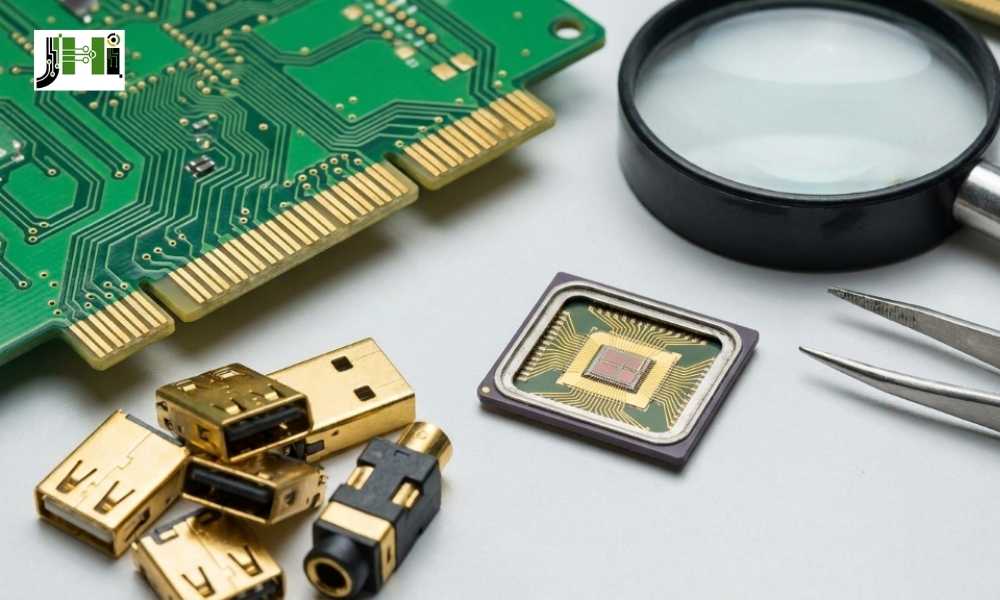
Connectors are the easiest places to spot gold. The plating is right there on the surface. You can often see it without opening anything.
Common gold-plated ports include:
- USB connectors
- HDMI ports
- Ethernet jacks
- Audio jacks
- Display connectors
The plating is usually very thin. Microns thick at most. So a shiny port does not mean a big payday. It means a reliable connection over time.
Easy to spot does not always mean highly profitable. Keep that in mind before you start cutting parts off.
Gold Fingers on RAM and Expansion Cards
Gold fingers are the bright strips along the edge of memory cards and expansion cards. The gold colored contacts on RAM sticks are known as gold fingers. These thin plated contacts help create reliable electrical connections with the motherboard.
You will find them on:
- RAM sticks
- Graphics cards
- PCI and PCIe expansion cards
- Sound cards and modems
- Network cards
Gold fingers are one of the easiest parts to spot for beginners. They are also one of the easiest to separate. That is why recyclers often trim and collect them by themselves.
Value still depends on volume. One stick is small. A pile of sticks adds up.
CPUs and Computer Processors
Processors are famous for their gold content. The truth is more mixed.
Older ceramic CPUs often hold real, visible gold. Many older processors contain small amounts of gold in the pins or internal bonding wires. Some older ceramic CPUs are known to contain more gold than modern chips. Think Intel 386, early Pentium, and similar vintage parts.
Modern CPUs use less gold. The pins may still be plated. The bonding wires inside may use copper coated with gold instead of pure gold. So the value per chip has dropped over the years.
You will find gold in:
- Edge pins on CPUs
- Internal bonding wires
- Top metal lid on some older chips
- Contact pads on the bottom
CPUs can contain gold. Not every processor is a jackpot. Old ceramic chips usually beat modern plastic ones.
Memory Chips and RAM Modules
RAM has gold in two places. The edge fingers we covered above. And sometimes the small chips on the board.
Each chip on a RAM stick may contain tiny gold bonding wires. The amount per chip is small. The amount across many sticks is more interesting.
Server RAM is often more attractive than desktop RAM. It tends to come from data centers in larger volumes. Recyclers like volume.
RAM is small on its own. In bulk, it becomes a real category of e-scrap.
Integrated Circuits and Semiconductor Chips
Integrated circuits, or ICs, are the small black or ceramic chips on a board. Many of them hide gold inside.
The gold sits as bonding wires between the silicon die and the outside pins. You cannot see it from the outside. It only shows up if the chip is opened in a lab.
Gold – Connectors, CPUs, memory chips, bonding wires, edge fingers on circuit boards. Bonding wires are a huge part of that list.
The board shows you the surface. The chips may hold the hidden layer. Pulling that gold out needs proper processing, not a hammer.
SIM Cards and Smart Cards
Look at the gold-colored contact pad on a SIM card. That pad is usually thin gold plating over a cheaper base metal.
You will find similar pads on:
- Bank chip cards
- Access cards
- Smart ID cards
- Some transit cards
The gold per card is tiny. One SIM is almost nothing. Thousands of SIMs become a real recycling stream.
Treat SIM cards as a volume game. They matter to refiners, not to home tinkerers.
Mobile Phone Components
Phones contain gold in several places. The logic board, the SIM slot, the camera connectors, and the charging port.
In mobile phones and computers, gold is primarily found on the circuit board or “motherboard.” This is the central hub where all of the device’s components connect and communicate. The phone version is just smaller.
Per device, the gold is small. The global picture is huge. Billions of phones exist. A single device contains thousandths of a milligram of gold – it is entirely unprofitable to process one or more phones. The phone in your drawer belongs to one of the largest e-waste streams on the planet.
Laptop and Desktop Computer Parts
Computers carry gold in several major parts. They are also the easiest devices to break down for sorting.
Watch for gold in:
- Motherboards and logic boards
- CPUs
- RAM sticks
- Graphics cards
- Expansion cards
- Connectors and ports
- Some hard drive boards
Desktops are usually easier to take apart. Laptops pack everything tightly. Both contain similar parts. Desktops just give you better access.
If you want to learn computer scrap, start there. Motherboard, CPU, RAM, and expansion cards.
Switches, Relays, and Contact Points
This is the less obvious category. Some industrial parts use gold on their contact surfaces. The reason is reliability, not luxury.
You will find gold contacts in:
- Industrial relays
- Telecom switches
- Aerospace and defense switches
- High-end audio gear
- Test and measurement tools
Consumer-grade switches usually have little or no gold. Industrial parts are a different story. Some valuable parts are not flashy. They are just functional.
Which Electronics Usually Contain the Most Gold?
Component-level matters. Device-level matters too. Some devices simply hold more gold per unit than others.
If you want to sort old electronics, start with the high-probability ones. Skip the categories where the gold content is too small to bother with.
Three things drive value. Age. Component quality. Volume. A pile of newer cheap gadgets may matter less than a few old server boards.
Below are the device categories worth checking first.
Older Computers and Servers
Older business and server gear is often the best starting point. The boards were built to higher standards. The connectors used more gold.
Old laptops and desktops – Big old desktop computers are about as useful as doorstops, but they still contain small quantities of gold. The same goes for tower servers and rack equipment.
Look for:
- Old desktop towers from offices
- Rack servers
- Server boards and backplanes
- Older workstation gear
That dusty office computer may have more recovery value than a newer low-cost gadget.
Laptops and Desktop PCs
Modern laptops and desktops carry gold in the usual places. Motherboard, CPU, RAM, and expansion cards.
Desktops give you easier access. You can pull the side panel and see everything. Laptops are tight and require careful disassembly.
Per device, the gold is modest. Per pile of devices, it becomes meaningful. Volume is the friend of recovery.
Laptops hide parts tightly. Desktops show them off.
Smartphones and Tablets
Phones and tablets contain gold in the logic board, the SIM tray, and the small connectors. Computers have even larger motherboards than phones, so they typically contain more gold.
So why do phones matter at all? Volume. The world makes billions of them. Even tiny per-device amounts add up at that scale.
For one or two phones, recovery is not worth it. For tens of thousands, it becomes a serious recycling stream.
Almost everyone has an old phone in a drawer. Few people realize it is also a tiny bundle of recoverable materials.
TVs and Monitors
TVs and monitors have gold-bearing boards inside. The control board and signal processing board often contain useful parts.
The rest of the device is a different story. Screens contain hazardous materials. Old CRT TVs especially. Handle them through certified recyclers.
The boards may be useful. The whole TV needs care.
Large electronics may look simple from the outside. Inside they need careful handling.
Networking and Telecom Equipment
This is where things get interesting for serious recyclers. Telecom gear often uses high-grade boards with better connectors.
Watch for:
- Routers and switches
- Telecom backplane boards
- PBX systems
- Cell tower equipment
- Old network cards
Reliability standards in telecom often demand better materials. That means more gold per board. In e-waste circles, telecom scrap is often a higher-grade category.
Cameras, Media Players, and Game Consoles
Older entertainment gear may also contain gold-bearing parts. Not as much as servers. Still worth knowing about.
TVs, older cameras, radios, media players and game consoles also contain gold. Old VCRs, laser disc players, and big Betamax units are known examples.
Old game cartridges often had gold-plated edge contacts too. So did vintage radios and stereo gear.
Gold-bearing parts are not limited to computers. Older entertainment devices can carry them too.
How to Identify Gold-Bearing Parts in Electronics
You do not need an engineering degree to spot likely gold-bearing parts. You just need to know where to look.
The trick is to sort by part type, not just color. Color is one clue. Part type, age, and source device matter more.
This section walks through the steps. Visual checks first. Then deeper inspection. Then professional testing for serious value.
A quick reminder. Spotting gold and recovering gold are two different things. Spotting is easy. Recovery is technical and risky.
Look for Gold-Colored Edge Contacts
Start with the obvious. Look for the bright gold strips on the edge of cards and modules.
You will see them on:
- RAM sticks
- Graphics cards
- Old expansion cards
- Some adapter boards
These are gold fingers. They are usually the easiest visual clue for beginners. They are also the parts recyclers often trim first.
This is a quick win. If the device has gold fingers, that is your starting point.
Check Ports, Pins, and Connectors
Next, look at every port and connector. Many of them have gold-plated contact areas.
Common spots:
- USB plugs and sockets
- HDMI connectors
- Ethernet ports
- Audio jacks
- Pin headers on boards
- Card slot contacts
The plating is usually very thin. Still, the count adds up across many devices.
Connector quality also tells you something about the board. Better connectors often mean a higher-grade board overall.
Inspect Circuit Boards
Now look at the board itself. Check the contact pads, the chip locations, and the small gold-colored traces.
A quick checklist:
- Are the contact pads bright and gold-colored?
- Are there many small chips with leads?
- Are there gold-edged connectors on the board?
- Is the board from a server, telecom, or industrial source?
Do not scrape the board. Do not burn it. Both destroy value and create hazards. Sort the board into the right pile and let a refiner do the rest.
Good identification adds value. Careless handling can destroy it.
Separate Older Electronics from Newer Low-Value Scrap
Sort by grade before recycling. This one habit improves both safety and value.
High-grade scrap usually comes from:
- Server and telecom gear
- Older business computers
- Industrial equipment
- High-end audio and lab gear
Low-grade scrap usually comes from:
- Cheap appliances
- Modern budget electronics
- Mass-market remote controls
- Low-end peripherals
Mixing both lowers your average pricing. Sorting them keeps the high-grade stuff in its own pile. Smart sorting is where recovery value begins.
Use Professional Testing for Accurate Value
Visual checks have limits. You cannot see bonding wires inside a chip. You cannot measure plating thickness with your eyes.
This is where professional testing helps. Refiners use tools like XRF analyzers to measure metal content. They also use sample melts and assays for batch material.
If you have a real volume of e-scrap, ask a certified refiner for an assessment. They handle the testing, the safety, and the legal disposal.
When value matters, testing beats guessing.
What Parts Look Like Gold but May Not Be Valuable?
Time for a reality check. Not every shiny part is worth chasing. Many gold-colored parts hold very little real gold.
This section helps you avoid the disappointment. It also helps you spend your time on the right parts.
Real recovery value depends on metal content, quantity, grade, and processing cost. Color alone tells you almost nothing. Knowing the difference saves time and energy.
Here are the most common look-alike traps.
Gold-Colored Metal Is Not Always Gold
Brass looks like gold. So do some copper alloys. So do certain nickel coatings. They all have a yellow tint that can fool the eye.
You will see fake-looking gold on:
- Cheap connector housings
- Decorative trim
- Some screws and pins
- Low-cost audio cables
Color is a clue. It is not proof. Professional recyclers classify by part type and test results, not by shine.
Shiny is not the same as valuable.
Thin Gold Plating Has Very Small Value
Even when the gold is real, the layer is usually thin. In most cases the gold plating is only microns thick, meaning there is far less gold than many people expect.
A few microns is not nothing. It is also not a lot. One small connector holds an amount of gold that is hard to even weigh.
Bulk changes the math. A barrel of gold-plated pins is a real recoverable resource. One pin is not.
A thin layer multiplied by thousands of parts can matter. One part alone usually does not.
Some Devices Are Better Recycled Whole
Sometimes the smart move is to skip the teardown. Just drop the whole device at a certified recycler.
This makes sense for:
- Phones with batteries inside
- TVs and monitors
- Devices with hazardous parts
- Anything you cannot safely open
Whole-device recycling preserves other materials too. Copper. Silver. Palladium. Aluminum. The recycler captures more than just the gold.
Recovering value should not create more waste.
Is It Worth Recovering Gold from Electronics?
Honest answer. It depends on who is doing it and how much they have.
For one person with a few old gadgets, the math rarely works out. For a refiner with tons of sorted scrap, the math is very different. Scale changes everything.
Real value depends on volume, grade, labor, testing, processing, compliance, and gold prices. Miss any of those and the math breaks. Get them all right and recovery becomes a real business.
Below is a clear look at three angles. Individual hobbyists. Pro recyclers. And the environmental side.
For Individuals
Most hobbyists make less than they expect. The gold per device is small. The processing cost and risk are not.
Gold may only be recovered from electronic parts after metals are carefully separated from plastic elements, which requires appropriate facilities and chemical expertise. That is a polite way of saying it is not a kitchen project.
For most people, sorting and selling e-scrap is a much better path than chemical extraction. You collect parts, sort by grade, and sell to a refiner. They pay you for the metal content.
The smartest recovery method is often the safest one.
For Recyclers and Refiners
Professional recyclers can run gold recovery as a real business. They have the volume, the equipment, and the safety controls.
Their value drivers are simple:
- Large incoming volume of sorted scrap
- Proper chemical handling facilities
- Accurate metal assays
- Trained staff
- Environmental compliance
- Ongoing customer flow
At scale, recovery becomes a system. Not a guessing game.
Environmental Benefits of E-Waste Recycling
Gold recovery is also part of a bigger story. E-waste is growing fast. Recycling it pulls valuable materials back into the supply chain.
The benefits stack up:
- Less mining of fresh ore
- Less landfill waste
- Recovery of copper, silver, and palladium
- Safer disposal of hazardous parts
- Lower carbon footprint per gram of metal
Recycling electronics recovers materials while reducing the burden of waste. That is true even for the parts that hold very little gold.
Safety Warning: Do Not Use Dangerous Chemicals at Home
This part is important. Please read it before you try anything you saw in a YouTube video.
Home gold recovery often involves strong acids. Those acids release toxic fumes. They can burn skin. They can poison water. They can also be illegal where you live.
The gold is not worth risking your health, your home, or the environment. There is a safer path. We will walk through it.
Gold Recovery Chemicals Can Be Toxic
Recovery chemistry usually involves strong acids and oxidizers. The fumes are dangerous. The waste liquids are worse.
The recycling process for this noble metal is not difficult, but it is highly time-consuming and dangerous. That warning comes from the recycling industry itself.
Without proper ventilation and protective gear, you can hurt yourself in minutes. Without proper waste handling, you can poison your soil and water. The risk is real.
A small amount of gold should never create a large safety problem.
Use Certified E-Waste Recyclers
Certified recyclers handle the hard parts for you. They take the device. They sort it. They process it. You walk away clean.
Many of them accept:
- Whole computers and laptops
- Phones and tablets
- Sorted circuit boards
- RAM sticks and CPUs
- Mixed e-waste
Ask the recycler what they take and how they pay. Some pay for high-grade scrap. Others recycle for free without payment. Both are fine. Both are better than risky home chemistry.
You do not have to process the material yourself to recover responsible value.
Follow Local Laws
Rules around e-waste vary by country, state, and city. Some places ban home chemical extraction outright. In Poland, it is illegal to recover noble metals from electronics. Other regions have similar rules.
Even where it is legal, you may need permits. You may need licensed waste disposal. Skipping those steps can lead to fines.
Check your local rules before you start. Safe recycling is not only smart. It is often required.
Quick List: Electronics Parts That May Contain Gold
Here is the short version if you want the answer at a glance.
Common gold-bearing parts:
- Circuit boards and PCBs (especially server, telecom, and industrial boards)
- Gold fingers on RAM and expansion cards
- CPU pins and internal bonding wires
- Memory chips and RAM modules
- Integrated circuits and semiconductor chips
- USB, HDMI, Ethernet, and audio connectors
- Pin headers and contact pads
- SIM cards and smart card chips
- Phone logic boards and charging connectors
- Motherboards in laptops and desktops
- Graphics cards and other expansion cards
- Industrial switches and relays
- Telecom and networking equipment boards
Best devices to check first:
- Old servers and rack equipment
- Older business desktops and workstations
- Telecom and networking gear
- Vintage ceramic CPUs
- High-end audio and test equipment
Use this list as a quick filter. Skip the cheap, modern, plastic-heavy gadgets first.
FAQs About Gold in Electronics
Quick answers to the questions people ask most.
What part of a computer has the most gold?
The motherboard, CPU, and RAM are usually the top contenders. Older ceramic CPUs often carry more visible gold than modern plastic ones. High-grade server motherboards beat regular desktop boards. Expansion cards with gold fingers also rank high. The exact winner depends on the age and grade of the parts.
Do all circuit boards contain gold?
No. Most boards have some gold, but the amount varies a lot. High-grade boards from servers, telecom, and industrial gear contain more. Cheap appliance boards may have very little. Not every board is gold-bearing in a meaningful way. Sort by source before you assume value.
Is there gold in RAM sticks?
Yes. Most RAM sticks have gold-plated edge fingers. Some also have small gold bonding wires inside the memory chips. The bulk of the gold sits in the edge contacts. Server RAM and older modules often offer more value than budget consumer sticks.
Is there gold in phones?
Yes, but only a tiny amount per phone. The gold sits in the logic board, SIM slot, and small connectors. A single device contains thousands of milligrams of gold. One phone is not worth processing on its own. Millions of phones are a major stream of recyclables worldwide.
Is there gold in TVs?
Yes. The control and signal boards inside TVs often have gold-plated contacts. The screen and outer parts do not. TVs also contain hazardous materials, so they should go to certified recyclers, not a home workshop.
Is gold recovery from electronics profitable?
Sometimes. For pro recyclers with large volumes, sorted scrap, and proper facilities, yes. For one person with a few old devices, usually not. Profit depends on volume, grade, processing cost, and current gold prices. Profit usually starts where volume begins.
What electronics have the most gold?
Older computers, servers, and telecom equipment usually top the list. CPUs, RAM, and high-grade circuit boards follow. Cheap appliances and modern budget electronics rank low. If you are sorting e-waste, start with the highest-probability devices first.
Conclusion
Gold lives in many parts of your electronics. Circuit boards, CPUs, RAM, connectors, SIM cards, and even bonding wires inside chips. The amounts are small. The places are very specific.
Color is a clue, not proof. Old servers, telecom gear, and high-grade boards usually beat cheap modern gadgets. Volume always beats one-off scraps.
The smartest move? Skip the risky kitchen chemistry. Sort your old electronics by grade. Then hand them to a trusted scrap and recycling team that knows exactly what to look for.
That is where Jay Hoehl Inc comes in. We help businesses and individuals turn old electronics into real, recoverable value. Safely. Legally. With proper testing and fair pricing.
📞 Ready to Recycle Your Old Electronics?
Get a fast, honest quote from Jay Hoehl Inc, Phoenix’s trusted e-scrap experts.
We accept circuit boards, CPUs, RAM, servers, telecom gear, and more. No guesswork. No unsafe DIY. Just clean, professional recovery.
📍 Visit us: 3334 W McDowell Rd Unit 17, Phoenix, AZ 85009 📧 Email: JayHoehlinc@gmail.com 📱 Call: (602) 272-4033 🌐 Website: jhiescrap.com