
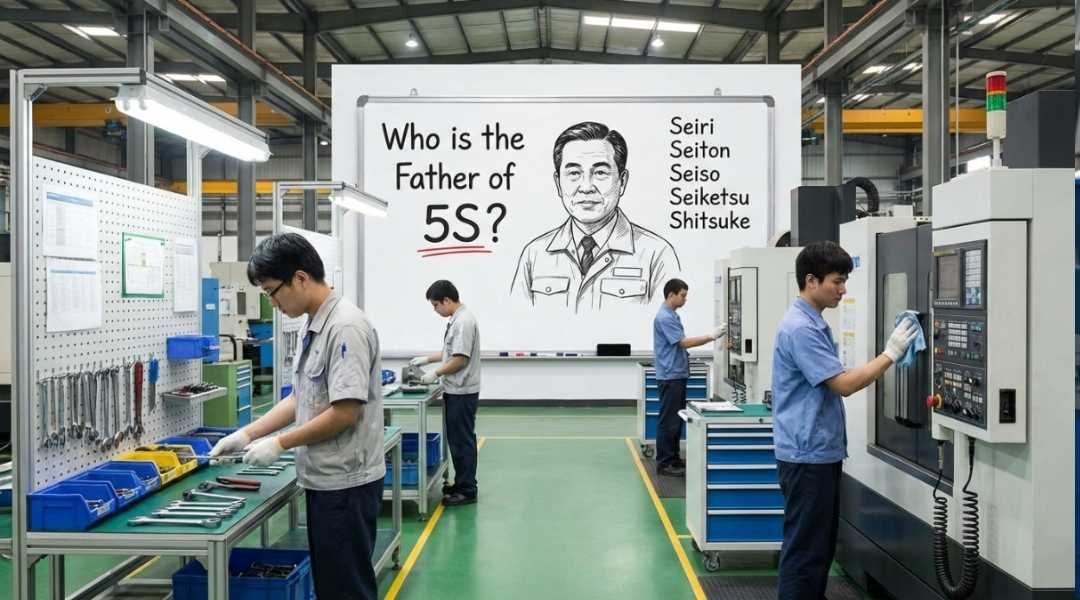
Most teams think they know the answer. But the truth is more layered than a single name on a whiteboard.
Hiroyuki Hirano is widely credited as the father of 5S. He formalized the method and gave it the structure manufacturers use today. But the discipline behind 5S? That grew from Taiichi Ohno’s work inside Toyota long before Hirano put it in writing.
Was it one man? Or a system shaped by necessity?
Both. Ohno built the discipline. Hirano built the structure. Together, their contributions gave the world a method that still runs production floors from Tokyo to Phoenix, AZ.
Who Is the Father of 5S for Phoenix, AZ Lean Manufacturing Teams
If you manage a Phoenix production floor, this history matters. It shapes how you train your team and how seriously your organization treats 5S as a system.
Phoenix is home to a fast-growing manufacturing base. Aerospace, electronics, and industrial production all run on tight margins. Lean methods like 5S are not optional extras here. They are operational survival tools.
Here is why the origin story matters locally:
- Rooted in real factory pressure, not theory
- Built for resource-constrained environments, which mirrors many Phoenix facilities
- Proven across decades, so you are not betting on an experiment
Understanding where 5S came from helps you implement it with conviction. And in Phoenix manufacturing, conviction drives results.
Don’t rebuild discipline when chaos already costs you.
Taiichi Ohno and the Creation of 5S Within the Toyota Production System
Taiichi Ohno did not set out to invent 5S. He set out to solve a problem.
Post-war Japan had no slack. Toyota had no room for waste. Ohno, working as a production engineer and later executive at Toyota, built a system around one core idea: eliminate everything that does not add value.
That thinking led directly to practices we now call 5S. Sort out what is unnecessary. Organize what remains. Keep workspaces clean enough to reveal problems. Standardize good habits. Sustain them through discipline.
Ohno’s framework became the Toyota Production System. Within it, 5S was not a housekeeping checklist. It was a foundation.
A quick timeline:
- 1940s–50s: Ohno begins developing waste-reduction methods at Toyota
- 1960s–70s: TPS takes shape as a formal system
- 1978: Ohno publishes his landmark book on the Toyota Production System
5S became the chassis. Just-in-Time became the engine. Neither worked without the other.
Hiroyuki Hirano and the Formal Development of 5S
Ohno shaped the practice. Hirano gave it a name and a playbook.
Hiroyuki Hirano is the author who took scattered principles inside Japanese manufacturing and turned them into a teachable, repeatable system. His book, 5 Pillars of the Visual Workplace, became the foundational text that trainers and consultants worldwide still reference today.
Hirano defined each of the five steps clearly. He connected workplace organization to visual management. He made 5S exportable outside Japan.
That matters because without Hirano, 5S stays inside Toyota. With him, it reaches Phoenix.
Ohno built discipline. Hirano built structure.
Hirano’s contribution was not just academic. It gave plant managers a system they could explain to a line worker in ten minutes and audit a month later. That practicality is why 5S spread so fast.
The Origins and Evolution of the 5S System in Phoenix, AZ Workplaces
But how did a Japanese recovery tool become a Phoenix standard?
The answer is simple: it worked everywhere it was tried.
5S started on Toyota’s factory floor in the 1950s. By the 1980s, Western manufacturers were watching Japan outcompete them on quality and cost. Lean thinking moved west fast. American factories adopted TPS principles, and 5S came with them.
Phoenix followed the same path. As the city grew into a regional manufacturing hub, operations leaders needed scalable systems. 5S offered exactly that.
The evolution looked like this:
- Post-war Japan: born from scarcity
- 1970s–80s: codified inside TPS
- 1990s: globalized through lean literature
- 2000s–present: standard practice in Phoenix industrial operations
Today, Phoenix manufacturers use 5S in warehouses, labs, and production lines. The tool adapted. The principles did not change.
Key Contributors to 5S Development
No single person invented 5S in isolation. That is an important truth.
Ohno and Hirano get the most credit. But lean development was a team effort built over decades. Shigeo Shingo contributed critical thinking on waste and error-proofing that reinforced 5S logic. Masaaki Imai brought the Kaizen philosophy that 5S depends on for long-term success.
Key figures at a glance:
- Taiichi Ohno: waste elimination and TPS architecture
- Hiroyuki Hirano: 5S formalization and visual workplace systems
- Shigeo Shingo: error-proofing and process discipline
- Masaaki Imai: Kaizen culture and continuous improvement philosophy
Crediting only one person creates a myth. The reality is a network of thinkers who each added a layer to what we now call 5S. That collaborative origin is actually a strength. It means the system was stress-tested from multiple angles before it reached your floor.
Post-World War II Purpose and Productivity Goals
Japan had nothing to waste after 1945. Factories were rebuilding from scratch. Resources were scarce. Workforce morale was fragile.
That environment produced urgency. And urgency produced innovation.
Discipline became fuel. Japanese manufacturers had no choice but to eliminate every form of waste. Disorganized workspaces cost time. Misplaced tools cost money. Dirty equipment caused breakdowns. All of it was unaffordable.
5S emerged as a survival response, not a productivity trend. That origin explains why the method is so durable. It was not designed in a consulting firm. It was tested under real pressure in real factories.
When Phoenix manufacturers face cost pressure today, they reach for the same solution Japan reached for in 1950. That is not a coincidence. That is proof the system works.
Popularization of 5S Through Lean Authors
You have seen 5S posters. But do you know where the global movement came from?
Two books did more than almost anything else to spread 5S worldwide.
James Womack and Daniel Jones wrote Lean Thinking in 1996. They translated Toyota’s methods into language Western executives could act on. That book gave American and European manufacturers a framework for adopting 5S without a Japanese factory tour.
Jeffrey Liker wrote The Toyota Way in 2004. He broke down Toyota’s management principles into 14 points, with 5S woven through the foundation of each one.
Both books moved lean from the shop floor into boardrooms. From Japan into Arizona. From theory into practice.
Without these authors, 5S might have stayed a Japanese tool. Instead, it became a global standard.
Manufacturing Systems That Established 5S Practices in Phoenix, AZ
What holds a Phoenix production floor together when pressure rises?
The answer is not motivation. It is not leadership speeches. It is a reliable system.
5S succeeded globally because it plugged into manufacturing systems that already existed. It did not replace those systems. It strengthened them.
Here is what makes 5S a system tool, not a cleanup campaign:
- It defines workspace logic, so every worker knows where things belong
- It creates visual standards, so problems surface before they become failures
- It builds accountability loops, so managers audit instead of guess
- It scales across facilities, from a 10-person shop to a 1,000-employee plant
Phoenix production facilities use 5S to anchor their broader operational systems. It sets the foundation for everything from quality control to safety compliance.
Without systems, tools create chaos. With systems, tools create flow.
The Toyota Production System
TPS was the engine. 5S was the chassis.
The Toyota Production System is one of the most studied management frameworks in industrial history. It gave the world Just-in-Time manufacturing, Jidoka (built-in quality), and standardized work. Each of those pillars depends on a clean, organized, disciplined workspace.
Three core TPS principles that 5S supports:
- Just-in-Time: Materials arrive when needed. No excess inventory. 5S keeps the floor clear.
- Jidoka: Workers stop the line when defects appear. 5S creates visual clarity so defects are visible.
- Standardized Work: Every task has a defined method. 5S ensures workspaces support that method every shift.
Here is the nuance most training programs miss: 5S existed before TPS had a name. Ohno’s practices were already running inside Toyota. TPS formalized and institutionalized them.
That history makes 5S even more credible. It was not invented to support TPS. It was foundational to it.
The Five Components of the 5S Methodology Used in Phoenix, AZ Operations
Order first. Speed second.
That is the logic behind 5S. Before you can run a fast production line, you need a controlled environment. The five components build that environment in sequence. Skip one and the system weakens. Skip the last one and the whole thing collapses.
Seiri (Sort)
Ever walk into a workspace and feel buried?
That feeling costs your team time every single day.
Seiri means Sort. It is the first step and the most uncomfortable one. You go through everything in the workspace and remove anything that does not belong there. Tools not used in 30 days? Removed. Inventory beyond current needs? Tagged and relocated. Broken equipment still sitting in the corner? Gone.
Red-tag campaigns work well here. Place a red tag on any questionable item. The team decides: keep it, relocate it, or eliminate it.
Sorting is not about throwing things away. It is about creating a workspace where every item has a purpose. When workers find what they need without searching, output increases and frustration drops.
Seiton (Set in Order)
Searching wastes minutes. Structure saves hours.
Seiton means Set in Order. Once you have sorted the workspace, you assign a specific location to every item that remains.
Placement principles that work:
- Frequently used tools go closest to the point of use
- Less-used items go further away
- Every location gets a label or visual marker
- Shadow boards show exactly where tools belong
The goal is zero search time. If a worker reaches for a torque wrench, it should be in the same spot every single shift. No hunting. No asking. No delays.
Set in Order also supports new employee onboarding. When everything has a designated place, training becomes visual. New hires learn through the workspace itself.
Seiso (Shine)
Clean floors reveal hidden problems.
Seiso means Shine, but cleaning is not the real goal. Inspection is. When workers clean their workspace regularly, they notice things. A small oil leak. A worn belt. A loose fitting that will fail next week.
Seiso turns routine cleaning into preventive maintenance. That mindset shift reduces breakdowns and improves safety.
Why this matters in Phoenix facilities:
- Dust and debris in dry climates accelerate equipment wear
- Clean workspaces reduce slip and trip incidents
- Regular inspection catches failures before they cause downtime
Make Seiso a daily ritual, not a monthly event. The more often workers clean, the more they learn their equipment. That knowledge prevents expensive surprises.
Seiketsu (Standardize)
What happens when standards drift?
Production slips. Safety gaps appear. Workers revert to old habits. The gains from the first three S steps disappear quietly over time.
Seiketsu means Standardize. It locks in the discipline created by Sort, Set in Order, and Shine. Standardization means the workspace always looks the same. Every shift. Every day.
Tools that support Seiketsu:
- Visual SOP boards posted at workstations
- Color-coded zones for different materials or processes
- Checklists tied to shift start and end routines
- Photo standards showing what “correct” looks like
Standardize does not restrict creativity. It protects consistency. Lock in good habits and you free up mental energy for higher-level problem solving.
Shitsuke (Sustain)
Without discipline, systems fade. With discipline, systems scale.
Shitsuke means Sustain. It is the hardest step and the one most 5S programs fail at.
Sustain is not a tool or a checklist. It is a culture decision. Leadership has to model it. Managers have to enforce it. Workers have to own it.
What sustaining 5S looks like in practice:
- Monthly 5S audits with scored results
- Team-level accountability for workspace standards
- Recognition for high-performing areas
- Fast response when standards slip
The companies that sustain 5S longest treat it like any other performance metric. They measure it. They review it. They hold people to it.
Monthly audits reinforce culture. Miss two in a row and the system starts sliding. Stay consistent and it becomes automatic.
What Are the 5 Principles of 5S?
The five principles of 5S are a sequential system for workplace organization:
- Seiri (Sort): Remove everything unnecessary from the workspace
- Seiton (Set in Order): Assign a specific location to every remaining item
- Seiso (Shine): Clean the workspace and inspect for problems
- Seiketsu (Standardize): Create consistent standards across all shifts and areas
- Shitsuke (Sustain): Build the culture and habits that keep the system running
Five steps. One system. Lasting discipline.
Each principle builds on the one before it. You cannot standardize a disorganized workspace. You cannot sustain a workspace that was never standardized. Sequence is everything.
Implementing 5S Successfully in Phoenix, AZ Work Environments
You understand the history. Now what?
Knowing where 5S came from does not improve your floor. Applying it does. But application done wrong creates more frustration than value.
The most common mistake? Launching company-wide on day one.
Start with a pilot zone instead. Choose one area. Apply all five steps. Measure the results. Refine the approach. Then scale.
What happens if you launch 5S without leadership buy-in? It stalls. Workers see it as a management project, not a team standard. And it dies quietly within 90 days.
Plan small. Execute tight. Scale smart.
Phoenix teams that take the pilot approach see faster adoption and more sustainable results. The proof builds confidence. Confidence builds momentum.
What Are the Steps in Implementing the 5S Plan?
Here is a straightforward implementation roadmap:
- Leadership kickoff: Align management before anything touches the floor
- Training: Educate all team members on 5S principles and purpose
- Pilot zone selection: Choose a visible, high-traffic area to start
- Sort phase: Conduct a red-tag event and remove unnecessary items
- Set in Order and Shine: Organize and deep-clean the pilot area
- Standardize and Sustain: Build audit schedules and accountability structures
Structure first. Speed second.
Most guides skip the leadership kickoff. That omission is why most 5S programs fail in the first quarter. Before you move a single tool, get alignment at the top.
How Can You Apply 5S in Your Workplace?
Every facility is different. So how does this fit yours?
You don’t need a new building. You need better structure.
5S adapts to your environment. Here is how it looks across common Phoenix work settings:
- Warehouse: Label storage racks, create defined pick paths, cut search time per order
- Office: Standardize filing systems, clear desk protocols, organized digital folder structure
- Production floor: Shadow boards for tools, visual SOP stations, color-coded zones for materials and waste
Track these metrics to prove ROI:
- Average search time before and after implementation
- Safety incident rate by month
- Equipment downtime frequency
Tie 5S to numbers and you make it real for leadership. When leadership sees results, sustaining the system becomes a shared priority.
Organizations That Promoted and Spread 5S in Phoenix, AZ
Why do world-class manufacturers align under the same framework?
Because the framework works. And because respected organizations have spent decades proving it.
5S did not spread through luck. It spread because credible institutions studied it, taught it, and documented results. Those organizations gave plant managers in Phoenix the confidence to invest in lean transformation.
Lean Enterprise Institute
The Lean Enterprise Institute, founded in 1997 by James Womack, became the leading research and education body for lean manufacturing in the Western world.
LEI translated Toyota’s methods into practical tools for American manufacturers. Their publications, workshops, and community forums helped bring 5S into mainstream operational thinking outside Japan.
For Phoenix manufacturers, LEI resources provide both the research foundation and the practical guides needed to run effective lean programs. Their work standardized lean education so that 5S training is consistent across industries.
Research strengthens practice. LEI proved that by building a body of work that still shapes how consultants teach 5S today.
Kaizen Institute
The Kaizen Institute was founded by Masaaki Imai in 1985. Its mission was to bring continuous improvement culture to organizations worldwide.
Kaizen and 5S are tightly linked. You cannot sustain a 5S program without a Kaizen mindset. The institute helped manufacturers understand that 5S is not a project. It is a habit. A culture. A commitment to always improving through small, consistent steps.
Small improvements build large results.
The Kaizen Institute operates globally and has supported manufacturing transformation across dozens of industries. Their influence in Phoenix reflects the city’s growing commitment to operational excellence as a competitive advantage.
Academic and Professional References on 5S Origins for Phoenix, AZ
Opinion persuades. Documentation proves.
If you are making the case internally for 5S investment, you need more than enthusiasm. You need credible sources that back the method with research, history, and documented results.
The following texts are the most cited references in lean manufacturing literature. Each one played a direct role in how 5S is understood and implemented today.
5 Pillars of the Visual Workplace
Hiroyuki Hirano’s 5 Pillars of the Visual Workplace is the book that gave 5S its global identity.
Published in 1995, it laid out the five steps clearly and tied each one to visual management principles. Hirano explained why visual cues matter in manufacturing. He showed how a properly organized workspace communicates expectations without a supervisor present.
This book gave structure to discipline.
Today it remains a core reference for 5S trainers worldwide. Many Phoenix lean consultants recommend it as required reading before any implementation begins. If you want to understand 5S the way its formalizer intended it, this is the source.
The Toyota Way
Jeffrey Liker’s The Toyota Way, published in 2004, broke Toyota’s management philosophy into 14 principles that any organization could study and apply.
5S appears throughout the book as a foundation principle, not an add-on. Liker showed how Toyota’s long-term thinking, respect for people, and commitment to process all depend on the workplace discipline that 5S creates.
Short-term cleanup fails. Long-term philosophy scales.
For Phoenix executives building sustainable lean culture, The Toyota Way bridges 5S from a floor tool to a leadership philosophy. It is required reading for any serious lean transformation.
Lean Thinking
You have seen lean charts. But do you know the philosophy behind them?
James Womack and Daniel Jones answered that question in Lean Thinking, published in 1996. The book identified five core lean principles: value, value stream, flow, pull, and perfection. 5S supports each one of them.
More importantly, Lean Thinking made lean manufacturing accessible to Western leaders who had never visited a Toyota plant. It translated decades of Japanese practice into a framework that American companies could start applying right away.
That translation drove global lean adoption. It brought 5S into Phoenix conference rooms and onto Arizona production floors. For operations leaders grounding their 5S program in proven philosophy, this book remains essential.
The Father of 5S Built Something That Lasts. So Can Your Facility.
The father of 5S is not one person. It is a lineage of necessity, discipline, and structure.
Taiichi Ohno eliminated waste because survival demanded it. Hiroyuki Hirano gave that discipline a name and a system. Lean authors spread it west. And now Phoenix manufacturers use it every day to run tighter, safer, more profitable operations.
That history is not just interesting. It is proof.
5S has outlasted trends, recessions, and entire industry shifts. It works in Toyota plants. It works in Arizona warehouses. It works on production floors right here in Phoenix.
The question is not whether 5S works. The question is whether your facility is using it.
Jay Hohel Inc works with Phoenix manufacturers who are ready to stop managing chaos and start building systems that hold. We bring hands-on lean experience to your floor, not just a slideshow.
You do not need a full overhaul. You need the right starting point.
📞 Ready to Implement 5S at Your Phoenix Facility?
Jay Hohel Inc has helped Phoenix operations teams bring structure, discipline, and measurable results to their workplaces. We know your market. We know the method. And we are ready to help you build it right.
📍 3334 W McDowell Rd Unit 17, Phoenix, AZ 85009 📧 JayHoehlinc@gmail.com 📞 (602) 272-4033 🌐 jhiescrap.com