
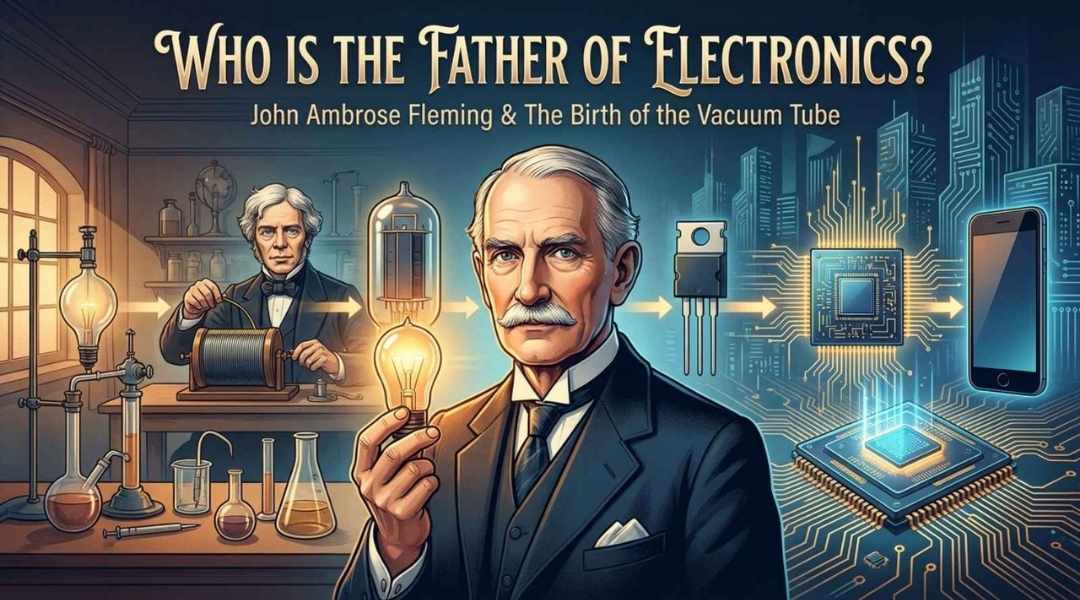
Who Is the Father of Electronics?
Introduction
Most people hear “father of electronics” and think of a single genius in a lab. But the real story is messier — and way more interesting.
Two names come up most: John Ambrose Fleming and Michael Faraday. Both changed the world. But they did very different things. Here is the twist: only one of them actually built the first electronic device. Keep reading to find out who.
Who Is the Father of Electronics?
The title belongs to John Ambrose Fleming. He invented the first true electronic device in 1904. It was called the vacuum tube, or the Fleming Valve.
That invention made modern electronics possible. Before Fleming, people could generate electricity. But no one could control it inside a device. Fleming changed that. He gave engineers a tool. And that tool started everything.
Overview of the Title “Father of Electronics”
Not every great scientist earns a “father of” title. It goes to the person who started a whole new field. Fleming did not just discover a law of nature. He built something new. Think of it like the first brick in a building. Without that brick, nothing else gets built.
John Ambrose Fleming: The Man Who Started It All
Fleming was not just a thinker. He was a builder. His work turned electrical science into a practical technology. Everything from radios to computers traces back to his one key invention.
Let’s look at who he was and what he actually built.
Early Life and Background
John Ambrose Fleming was born in England in 1849. He studied at University College London and later worked with some of the best scientists of his time. One of them was James Clerk Maxwell. That education shaped everything. Fleming learned how electricity behaved. Then he figured out how to use it.
Invention of the Vacuum Tube (Fleming Valve)
In 1904, Fleming invented the vacuum tube. Here is how it worked in simple terms. Electricity normally flows in two directions. Fleming’s tube let it flow in only one. Think of it like a one-way gate for electrical current.
That sounds small. But it was huge. For the first time, a device could detect and control electrical signals. That was the birth of electronics as we know it.
Contribution to Radio Technology
Before the vacuum tube, radio signals were hard to detect. They were weak and messy. Fleming’s device changed that. It could pick up radio waves and convert them into a usable signal.
That breakthrough helped radio communication grow fast. Suddenly, sending messages through the air became reliable. The world got a lot smaller because of it.
Impact on Modern Electronics
Fleming’s invention did not stay in the past. It laid the foundation for everything that came after. Vacuum tubes led to transistors. Transistors led to microchips. Microchips are now inside your phone, your laptop, and almost every device you use daily.
You use Fleming’s idea every single day. You just do not see it anymore.
Key Contributions of John Ambrose Fleming
Fleming did not just invent one thing. He moved an entire field forward. Here are his three biggest contributions:
- The Fleming Valve: The first device to control electrical current directionally.
- Signal detection for radio: Made wireless communication practical and reliable.
- Foundation of electronic engineering: Created the blueprint for a whole new discipline.
Development of the First Diode Tube
The diode tube was Fleming’s core invention. It had two parts: a heated wire and a metal plate inside a glass tube. Electrons moved from the wire to the plate in one direction only. That one-way current flow was the key. It let the tube detect signals that nothing else could.
Advancement of Wireless Communication
Before Fleming’s valve, wireless signals were nearly impossible to decode. His diode made it possible to receive and read those signals clearly. That pushed wireless communication forward by decades. Today’s phones and Wi-Fi networks all trace back to that same principle.
Foundation of Electronic Engineering
Fleming’s work did not just produce one device. It created an entire field. Electronic engineering grew directly from his ideas. Universities started teaching it. Companies started building on it. Strong roots build strong trees. Fleming planted the first one.
Why Is Fleming Called the Father of Electronics?
The reason is simple. Others built on existing ideas. Fleming built the first device that actually controlled electricity. That is a different thing entirely.
Others discovered how electricity behaved. Fleming figured out how to put it to work inside a controlled device. That distinction matters. That is why his title sticks.
Role of the Vacuum Tube in Early Electronics
The vacuum tube was the first device to control electrical current. Before it, you could produce electricity. But you could not guide it precisely. The tube changed that. Think of it as a gate that opens and closes for current. That simple function unlocked everything else.
Influence on Communication and Computing
Fleming’s invention touched two massive industries. First, communication. Radio systems improved because signals could now be detected reliably. Second, computing. Early computers ran on vacuum tubes before transistors took over. Both industries owe Fleming a debt they rarely mention.
Legacy in Modern Technology
Here is how the chain works. Fleming invented the vacuum tube. That led to the transistor. The transistor shrank into the microchip. The microchip now powers AI, smartphones, and satellites. Small beginnings lead to great endings. Fleming’s beginning was very, very small. And look where it went.
Michael Faraday: Father of Electricity, Not Electronics
Here is where many people get confused. Michael Faraday was brilliant. But his work was in electricity, not electronics. Faraday discovered how to generate electricity. Fleming discovered how to control it inside a device. That is the line between them. Faraday discovered energy. Fleming controlled it.
Key Contributions of Michael Faraday
Faraday changed science in three big ways:
- He discovered electromagnetic induction, proving that movement creates electricity.
- He built the first electric motor, turning electrical energy into physical motion.
- He developed core laws of electrolysis, linking chemistry and electricity.
Work in Electromagnetism and Electromagnetic Induction
Faraday’s biggest discovery was this: move a magnet near a wire, and you get electricity. That is electromagnetic induction. It sounds simple. But it was revolutionary. Think of it like turning motion into power. Every generator and power plant on Earth still uses this principle.
Development of Electric Motors and Generators
Faraday turned that discovery into machines. His electric motor converted electrical energy into motion. His generator did the reverse. You see this in daily life in every fan, washing machine, and car engine. Faraday made the physical world run on electricity.
Historical Impact of Michael Faraday
Faraday did not just make discoveries. He built the scientific foundation that everyone else stood on. Without his work on electricity, Fleming would have had nothing to build with. Faraday laid the ground for others to build on.
Foundation of Modern Electronics
Faraday’s work on electricity came first. Then engineers learned to use that electricity inside devices. That chain, from raw electricity to controlled electronics, is the path from Faraday to Fleming. One could not exist without the other.
Influence on Electromagnetic Theory
Faraday’s ideas about electromagnetic fields shaped physics for over a century. James Clerk Maxwell built his famous equations on Faraday’s observations. Those equations later helped engineers understand how signals travel. That knowledge fed directly into radio and wireless technology.
Contribution to Future Scientific Discoveries
Faraday’s work inspired generations of scientists. Maxwell. Hertz. Fleming. Tesla. All of them built on what Faraday found. One idea truly can change the future. Faraday proved that.
Other Important Figures in Electronics
Fleming started it. But others scaled it. Electronics did not grow because of one person. It grew because dozens of brilliant minds kept pushing it forward. Some names may surprise you.
Lee de Forest: Inventor of the Audion (Triode)
Lee de Forest took Fleming’s diode and added a third element. That created the triode, or audion tube. Think of it like adding a volume control to an existing radio signal. The triode could amplify weak signals. That made radios louder, clearer, and more powerful. It was a massive leap.
William Shockley: Co-Inventor of the Transistor
By the 1940s, vacuum tubes were doing great things. But they were big, hot, and fragile. William Shockley co-invented the transistor in 1947. Transistors replaced vacuum tubes. They were smaller, cooler, and far more reliable. That shift changed everything.
John Bardeen: Co-Inventor of the Transistor
John Bardeen shared the Nobel Prize for the transistor alongside Shockley and Brattain. His contribution was deep theoretical insight. He understood the physics behind how semiconductor materials behaved. That knowledge made the transistor possible. He won the Nobel Prize in Physics twice, one of only a few people ever to do so.
Walter Brattain: Co-Inventor of the Transistor
Walter Brattain was the hands-on experimentalist of the trio. He built the physical device that proved the transistor concept worked. Without his practical work, the theory might have stayed just theory. All three were essential. Electronics needed all of them.
Other Notable Figures Worth Knowing
The history of electronics runs deeper than most textbooks show. There are figures who worked behind the scenes but shaped the future just as much as the famous names.
John Ambrose Fleming: Father of Modern Electronics
Worth repeating. Fleming’s vacuum tube was not just an invention. It was a starting point. Modern electronics still traces its DNA back to that single device. No Fleming valve, no transistor. No transistor, no microchip. No microchip, no modern world.
Jan Czochralski: Father of Semiconductor Electronics
Jan Czochralski invented a method for growing pure silicon crystals in 1916. That sounds obscure. But here is why it matters. His method is still used today to produce the silicon wafers that become computer chips. Think of it like growing the base of a chip from scratch. Without Czochralski’s method, modern chip manufacturing would not exist.
Evolution of Electronics After the Early Pioneers
Electronics did not stop with vacuum tubes. It evolved fast. Each generation of inventors took what came before and made it smaller, faster, and more powerful. The path from simple tubes to powerful chips is one of the most dramatic stories in science.
Evolution After Fleming
After Fleming’s valve, engineers started asking: what else can this do? The answer was a lot. Vacuum tubes powered early radios, telephone amplifiers, and radar systems. Then came the question of whether something better was possible. It was.
From Vacuum Tubes to Transistors
Vacuum tubes worked. But they had real problems. They were the size of a light bulb. They got hot. They burned out. The transistor solved all of that. It did the same job in a fraction of the space. It used less power. And it lasted longer. That shift turbocharged the entire electronics industry.
From Analog to Digital Electronics
Analog electronics worked with continuous signals, like sound waves. Digital electronics worked with ones and zeros. That shift was like switching from handwriting to typing. Digital systems were faster, more accurate, and easier to scale. Music, phones, and computers all made that transition. The digital age was born.
Growth of Semiconductor Technology
Semiconductors were the next frontier. Materials like silicon could conduct electricity under certain conditions and not others. That made them perfect for building switches. And switches are what computers are made of. You carry billions of those switches in your pocket right now.
Evolution After Faraday
Faraday’s electromagnetic discoveries did not sit still. Hertz used them to prove radio waves existed. Marconi used radio waves to send messages across the Atlantic. Fleming used that knowledge to build his detector. Every step connected back to Faraday’s original insight.
From Electromagnetism to Electronic Devices
Faraday discovered that energy and magnetism were linked. Engineers took that link and built devices around it. Transformers, motors, and generators all came from that connection. Then came the leap from moving energy to controlling signals. That leap was Fleming’s invention.
Development of Modern Semiconductor Technology
Today’s semiconductors power AI chips, 5G networks, and quantum computing research. The materials are more refined. The processes are more precise. But the core idea traces back to those early experiments with silicon. The scale has changed. The principle has not.
Applications of Early Electronic Innovations
All this history matters because it shows up in real life. Early electronic inventions were not just lab curiosities. They changed how the world communicated, entertained itself, and computed information.
Radio Broadcasting
The vacuum tube made radio broadcasting possible. For the first time, a voice could travel hundreds of miles through the air. That was not just a technology win. It was a cultural shift. News, music, and stories reached people who had never had access to them before.
Television Development
Television came next. It used electronic tubes to scan and display images. Sound and pictures could now travel together. The entertainment industry transformed overnight. The way people experienced the world changed completely.
Computing Systems
Early computers ran on vacuum tubes. The first one used over 17,000 of them. They filled entire rooms. They generated enormous heat. But they worked. And they proved the concept. Transistors made computers smaller. Chips made them personal. Now you hold a supercomputer in your hand.
Advanced Learning Topics on Electronics History
There is always more to learn. Electronics history is a deep subject. If this topic interests you, keep going. The more you know, the better you understand the technology you use every day.
History of Electronics
Start with the full timeline. From Faraday in the 1830s to today’s AI chips. Each era builds on the one before it. Seeing the full arc makes every individual story make more sense.
Vacuum Tube Technology
Dig deeper into how vacuum tubes actually worked. Understanding the physics behind them makes the transistor story much clearer. Think of it as learning the original language before the translation.
Semiconductor Physics
Semiconductors sit at the heart of modern electronics. You do not need deep math to understand the basics. Learn how materials like silicon conduct electricity selectively. That knowledge unlocks how chips are made and why they keep getting faster.
Evolution of Communication Systems
Trace the path from Morse code to 5G. Each step was built on the one before it. That journey is one of the clearest examples of how science and engineering compound over time. It ties back directly to Fleming, Faraday, and every name in between.
Conclusion: One Invention. One Title. One Legacy.
Electronics did not appear overnight. It grew from decades of curiosity, experimentation, and bold thinking. Michael Faraday gave the world electricity. That was the raw material. John Ambrose Fleming took that material and built the first device to control it. That device changed everything. From vacuum tubes to transistors. From transistors to microchips. From microchips to the smartphone in your hand right now. Every step in that chain connects back to Fleming’s one invention in 1904.
So when someone asks who the father of electronics is, the answer is clear. John Ambrose Fleming. He did not just discover something. He built something. And the world has never been the same since. Now you know the real story. And knowing it makes every device around you a little more meaningful.
🔧 Need Electronics-Related Services in Phoenix, AZ?
At Jay Hohel Inc, we bring that same spirit of precision and reliability to everything we do. We serve the Phoenix, AZ community with trusted, professional service you can count on.
📍 3334 W McDowell Rd Unit 17, Phoenix, AZ 85009 📧 JayHoehlinc@gmail.com 📞 (602) 272-4033 🌐 jhiescrap.com