
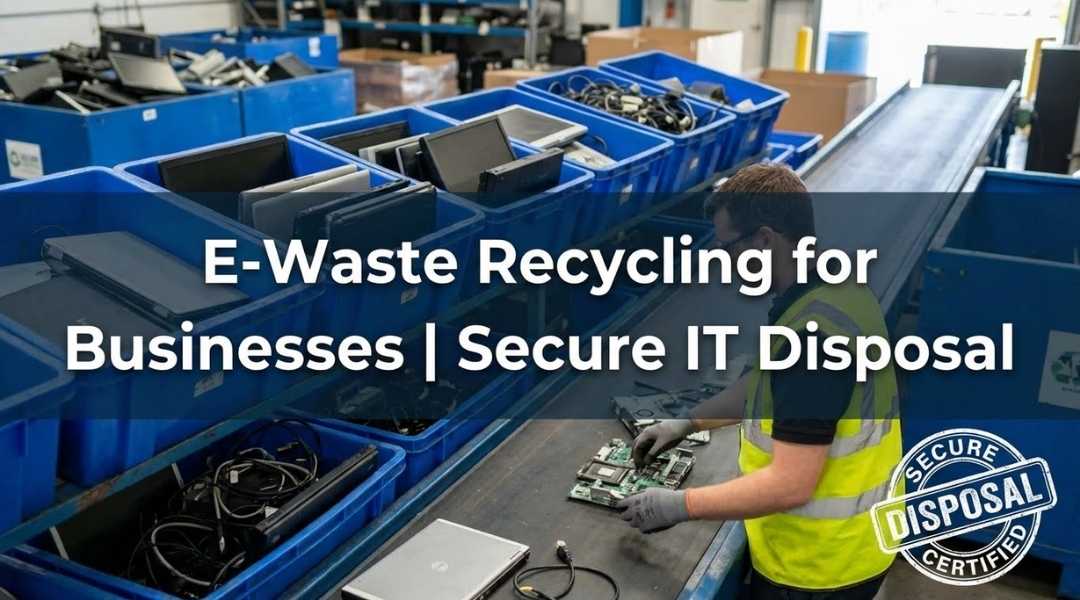
You toss coffee cups without thinking twice. But what about those old computers piling up in storage?
Business e-waste isn’t just clutter. It’s a legal liability, a data security risk, and a sustainability problem rolled into one. Every retired laptop, server, or printer holds sensitive information and toxic materials that can’t just hit the trash.
The good news? E-waste recycling for businesses turns this mess into an opportunity. You protect your data, stay compliant, recover value, and build your brand—all while keeping hazardous materials out of landfills.
Here’s everything you need to know.
E-Waste and IT Recycling for Businesses
Ever open a storage closet and get smacked by a wall of tangled cords and dead printers?
You’re not alone. Most businesses treat old electronics like junk. They stack them in corners, hoping someone eventually deals with them. But that approach creates serious problems.
E-waste is any discarded electronic device. For businesses, that means computers, servers, monitors, phones, printers, routers, and network gear. These items contain valuable materials like copper, gold, and aluminum. They also contain toxic substances like lead, mercury, and cadmium.
Here’s the reality: you can dump devices and risk fines. Or you can recycle them and protect your brand.
Traditional disposal means tossing electronics in dumpsters. They end up in landfills where toxins leak into soil and water. Modern e-waste recycling breaks devices down safely. Recyclers extract valuable materials, destroy data securely, and dispose of hazardous components properly.
The difference matters. Businesses generate massive amounts of electronic waste. Every device you replace becomes either a problem or a solution. When you recycle properly, you’re not just clearing space. You’re protecting client data, meeting legal requirements, and showing customers you care about the planet.
Small businesses and enterprise companies face the same challenge. You need a system that handles IT clutter without creating legal or security risks.
Think of IT recycling as insurance for your business. It protects you from data breaches, regulatory fines, and reputation damage. It also opens doors to cost recovery through resale and material reclamation.
The stakes are high. A single improperly disposed hard drive can expose thousands of customer records. A few dumped monitors can trigger EPA violations. But with the right recycling partner, the whole process becomes effortless and secure.
Turning E-Waste Liabilities into Sustainable Practices
One person’s trash is another person’s treasure. That old saying perfectly captures the shift happening in e-waste recycling.
Your retired electronics aren’t garbage. They’re resources waiting for a second life.
Every device holds recoverable value. Servers contain precious metals. Laptops can be refurbished and resold. Even broken equipment yields raw materials worth money. Forward-thinking companies are turning disposal costs into revenue streams.
Here’s a real example: recycling one server can save enough electricity to power a home for months. That retired desktop? It might get wiped, upgraded, and donated to a school. Your old network switches could be resold to smaller businesses at a fraction of retail price.
This is the circular economy in action. Instead of extract-use-dump, we’re moving toward use-recycle-reuse. No jargon required—just smart business.
The mindset shift is simple. Stop seeing e-waste as a burden. Start seeing it as an asset. Every device you recycle properly:
- Recovers valuable materials and reduces mining needs
- Cuts carbon emissions from manufacturing new devices
- Generates potential rebates or resale revenue
- Strengthens your sustainability credentials
Think again before tossing that laptop. That “junk” might actually pay you back.
Companies that embrace this approach don’t just save money. They build reputation capital. Clients notice. Investors notice. Employees notice. When you turn waste into value, everyone wins.
Why Businesses Recycle E-Waste
Here’s a question: do you know where your old office equipment ends up?
Most business owners don’t. And that’s a problem.
E-waste recycling isn’t optional anymore. It’s a business imperative driven by legal requirements, security threats, environmental responsibility, and bottom-line impact. Ignoring it puts your company at risk on multiple fronts.
Let’s break down why this matters.
First, the legal landscape has teeth. Federal and state regulations require proper e-waste disposal. Violations trigger fines, audits, and legal action. Compliance isn’t just about following rules—it’s about protecting your business from expensive consequences.
Second, data security. Every device stores information. Client records, financial data, employee details, proprietary strategies—it’s all sitting on hard drives, in printer memory, and on phone storage. One carelessly discarded laptop can become a data breach waiting to happen.
Third, environmental impact. Electronics contain toxic materials that poison soil and water when dumped improperly. Businesses have a responsibility to prevent pollution. Proper recycling keeps hazardous substances out of the environment.
Fourth, cost recovery. You’re already spending money on IT equipment. Why throw away value? Recycling programs offer resale opportunities, material rebates, and reduced disposal costs. You can actually make money from your “waste.”
Finally, reputation and corporate social responsibility. Today’s consumers, investors, and employees care about sustainability. They want to work with and support companies that do the right thing. Your e-waste practices become part of your brand story.
Here’s the reality: over 59 million tons of e-waste were generated globally in 2022. Most of it ended up in landfills or was illegally shipped overseas. Businesses contribute significantly to that number. But you have the power to change it.
You can ignore this and risk fines, data breaches, and reputation damage. Or you can act now and gain compliance, security, and competitive advantage.
The choice is yours. But the smart money is on recycling.
Regulatory and Legal Compliance
The EPA doesn’t mess around with e-waste violations. Neither do state and local regulators.
Here’s what you need to know: federal and state laws require businesses to dispose of electronics properly. Toss a monitor in the dumpster? That’s illegal. Dump old computers in a landfill? You’re violating environmental regulations.
Penalties are real. Companies face fines ranging from thousands to hundreds of thousands of dollars. Repeat violations trigger audits, legal action, and even criminal charges in extreme cases. Ignorance isn’t a defense.
Beyond federal EPA requirements, many states and cities have their own e-waste laws. Phoenix and Arizona enforce strict disposal regulations. Your business must follow them all.
Industry certifications matter. Look for recyclers with R2 (Responsible Recycling) or e-Stewards certification. These standards ensure proper handling, data security, and environmental responsibility. Working with certified partners protects you legally.
Here’s a simple compliance checklist:
- Partner with a certified e-waste recycler
- Document all disposal activities
- Obtain certificates of recycling
- Track chain of custody for all devices
- Train employees on proper disposal procedures
Fail to comply and face audits. Or recycle properly and rest easy.
The legal risk is avoidable. Most violations happen because businesses don’t have a system. They let old equipment pile up, then panic and dump it. That’s when trouble starts.
A Phoenix-area company recently faced fines for improper disposal of office computers. The devices ended up in a local landfill. An environmental inspection uncovered the violation. The company paid tens of thousands in penalties and cleanup costs.
Don’t let that be you. Choose certified recycling partners. Keep documentation. Stay fully EPA-compliant and legally secure.
Data Security and Secure Data Destruction
Ever wonder what’s still hiding on that “wiped” laptop?
Probably more than you think. And that’s terrifying.
Deleting files doesn’t erase data. Factory resets don’t either. Even formatting a hard drive leaves recoverable information. Criminals and competitors know this. They buy used equipment and mine it for valuable data.
Your old devices are ticking time bombs if not properly destroyed.
Here’s what most businesses miss: hard drives in tossed printers and copiers also retain data. That innocent-looking office printer? It might store copies of every document ever scanned or printed. Network routers hold configuration data and passwords. Phones contain emails, contacts, and sensitive apps.
Data destruction requires specialized methods. Professional recyclers use certified processes:
- Data wiping: Software overwrites every bit multiple times, making recovery impossible
- Degaussing: Powerful magnets scramble magnetic data on drives
- Physical destruction: Shredding hard drives into tiny pieces
Each method meets different security standards. For highly sensitive data, physical destruction is the gold standard.
Here’s the secret most businesses don’t know: always ask your recycler for a certificate of data destruction. This document proves your data was destroyed properly. It protects you during audits and demonstrates due diligence if a breach occurs.
Think of compliance standards like HIPAA, SOX, and GDPR. These laws require secure data disposal. Violations trigger massive fines and lawsuits. One leaked customer record can cost your business millions in damages and lost trust.
Your old hard drive is a vault. Never leave it cracked. Treat every device like it contains your most sensitive secrets—because it probably does.
Would you toss client files in the trash? Then why would you dump devices containing that same data?
Proper data destruction isn’t optional. It’s guaranteed data elimination and the only way to truly protect your business.
Environmental Responsibility and Pollution Prevention
Electronics don’t belong in landfills. Ever. Here’s why.
Every device contains toxic materials. Lead in screens. Mercury in backlights. Cadmium in batteries. Flame retardants in plastic casings. When these items hit landfills, toxins leak into soil and groundwater.
The damage spreads for decades. Lead poisons drinking water. Mercury accumulates in fish. Cadmium causes cancer. These aren’t theoretical risks—they’re documented environmental disasters happening right now.
Improper disposal kills ecosystems and harms communities. But businesses can prevent it.
Here’s a powerful stat: recycling one laptop saves 396 pounds of CO2 emissions. That’s equivalent to driving a car 450 miles. Multiply that by every device your business retires each year. The environmental impact adds up fast.
Responsible recycling keeps hazardous materials out of the environment. Professional recyclers extract toxic components safely. They prevent pollution while recovering valuable materials. It’s a win-win.
Your e-waste practices impact your sustainability goals. Companies tracking carbon footprints and ESG metrics need proper recycling data. Every device you recycle reduces your environmental impact and improves your scores.
Dumped electronics are like slow-leaking toxins. They poison the planet bit by bit. But when you recycle properly, you’re part of the solution.
Think about green certifications like LEED and ISO 14001. Proper e-waste management helps you qualify. These credentials open doors to contracts, partnerships, and customers who value sustainability.
You have a choice. Continue contributing to environmental damage or lead by example. Help the planet with every device you recycle.
The decision is simple. Do the right thing. Your community and your brand will benefit.
Cost Savings and Asset Value Recovery
Still throwing away money with your old laptops?
Most businesses do exactly that. They treat retired IT equipment as pure expense. But smart companies see hidden profit.
Here’s the reality: your old electronics have value. Servers contain gold, copper, and other precious metals. Laptops can be refurbished and resold. Even broken devices yield raw materials worth cash.
Asset recovery programs turn disposal costs into revenue streams. Here’s how it works:
- Resale: Working devices get wiped, tested, and resold to secondary markets
- Refurbishment: Slightly damaged equipment gets repaired and remarketed
- Material recovery: Broken devices are dismantled for valuable components and raw materials
Some recyclers offer rebates based on equipment value. Others provide free pickup services when asset value offsets their costs. A few even pay you directly for high-value items like servers and network gear.
That dusty server rack might be a goldmine. One company recovered $15,000 from retiring outdated data center equipment. Another got free recycling services for five years by leveraging their IT refresh cycle value.
Not all recyclers offer these programs. You have to ask. Many businesses miss out simply because they don’t negotiate or explore value recovery options.
The savings multiply. Lower disposal costs. Potential rebates. Reduced need for new equipment purchases through refurbishment. Better IT budget optimization.
Think of it this way: every retired device is either a cost or an opportunity. The difference is your recycling partner and your approach.
Turn waste into ROI. Stop paying to throw away value. Start recovering costs from assets you’ve already written off.
Your CFO will thank you.
Brand Reputation and Corporate Social Responsibility (CSR)
Would you trust a brand that dumps electronics in landfills?
Neither would your customers.
Your e-waste practices are visible. Clients notice. Investors check your sustainability reports. Job seekers research your environmental commitments. Every decision you make about electronic waste impacts how people perceive your company.
Corporate social responsibility isn’t just marketing fluff. It’s business strategy. Companies with strong CSR programs attract better talent, win more contracts, and retain customers longer.
Here’s the proof: studies show environmentally conscious companies outperform competitors in customer perception and loyalty. People want to work with businesses that align with their values. Proper e-waste recycling demonstrates you care about more than profit.
Think about your sustainability story. When you recycle properly, you can share concrete impacts:
- Tons of e-waste diverted from landfills
- CO2 emissions prevented
- Devices donated to schools and nonprofits
- Materials recovered and reused
These aren’t abstract metrics. They’re talking points for PR, investor relations, and client presentations. They prove your commitment to responsible business practices.
Companies that publicize their recycling programs gain competitive advantage. They appear in “best places to work” lists. They win sustainability awards. They attract clients with environmental purchasing policies.
“What you do speaks so loudly, I can’t hear what you say.” Actions matter more than promises. When you choose certified recyclers and track your impact, you’re building trust through transparency.
Your recycling program becomes part of your brand identity. It shows you’re publicly responsible and internally reliable. That reputation drives real business results.
Be a role model in your industry. Lead with sustainable practices. Watch your brand reputation grow.
Environmental Compliance
Environmental compliance sounds bureaucratic. But it’s actually your safety net.
Here’s what it means in e-waste terms: following all federal, state, and local regulations for electronic waste disposal. This includes EPA requirements, state-specific laws, and municipal ordinances like those in Phoenix and Arizona.
Non-compliance isn’t just risky. It’s expensive and damaging. Violations trigger fines, legal action, and reputation harm. One audit can uncover years of improper disposal and result in massive penalties.
Common compliance mistakes businesses make:
- Using uncertified recyclers who dump overseas
- Failing to document disposal activities
- Mixing hazardous and non-hazardous waste
- Not training employees on proper procedures
- Skipping chain-of-custody tracking
These errors happen when companies lack systems. They handle e-waste reactively instead of proactively. Then regulators show up and problems emerge.
The fix is straightforward. Implement a compliance program:
- Partner with certified recyclers only
- Maintain detailed disposal records
- Track every device from retirement to final disposition
- Train staff on what goes where
- Audit your recycling partner annually
Cut corners and risk fines. Or follow the rules and build trust.
Here’s the secret most businesses miss: compliance helps during investor audits and ESG scoring. When you demonstrate proper e-waste management, you strengthen your position with stakeholders. You prove operational excellence and risk management.
Compliance isn’t red tape. It’s your safety net against legal and financial disaster.
Think of it like insurance. You pay attention now to avoid massive costs later. You document everything so audits become routine instead of terrifying.
Stay legally compliant and environmentally conscious. The peace of mind alone is worth the effort.
Security Measures
Data breaches don’t just happen through hacking. They happen in storage closets and recycling bins.
Every discarded device is a security risk. That old laptop contains client data. That retired server holds financial records. That tossed printer remembers every document scanned.
If these items aren’t handled securely, your business data ends up in the wrong hands.
Security requires multiple layers. It’s not enough to delete files or wipe drives yourself. Professional e-waste recycling demands physical and digital protection at every stage.
Here’s what secure disposal looks like:
Chain-of-custody tracking: Every device gets logged, tagged, and monitored from pickup to destruction. You know exactly where your equipment is at all times.
Locked transport and storage: Devices move in secure vehicles and stay in locked facilities. No unsupervised access. No loose handling.
Certified destruction methods: Data wiping meets NIST standards. Physical shredding reduces drives to tiny pieces. Degaussing scrambles magnetic media beyond recovery.
Video monitoring: Top recyclers film destruction processes. You can verify your devices were actually destroyed, not resold with data intact.
Serialized tracking: Every hard drive gets a unique identifier. Certificates of destruction list serial numbers so you can match them to your inventory.
Still tossing laptops into storage rooms unlocked? That’s asking for trouble.
Many breaches happen after devices are moved but before destruction. Someone grabs a “disposed” laptop from a hallway. A contractor swipes a server during office cleanup. An employee takes home an old computer “for parts.”
These scenarios happen constantly. They’re preventable with proper security protocols.
Here’s what you should demand from your recycling vendor:
- Video-monitored destruction facilities
- Serialized tracking for all storage devices
- Locked bins and secure transportation
- Background-checked staff
- Insurance coverage for data breaches
Treat old hard drives like unlocked safes. They contain your business secrets. Secure them digitally and physically at every step.
The stakes are huge. One leaked database costs millions in fines, lawsuits, and reputation damage. One improperly handled device can expose thousands of customer records.
Don’t gamble with security. Choose recyclers who take protection seriously. Verify their methods. Demand certificates. Stay in control and confident every step of the way.
How to Set Up an E-Waste Recycling Program
Building an e-waste program sounds complicated. It’s not.
You don’t need a full department. You need a plan and a partner. Most businesses can set up effective recycling in a few simple steps.
Here’s the truth: the companies succeeding at e-waste management aren’t special. They just took action. They created systems instead of reacting to problems.
Think of your recycling program like a fire drill. Simple steps. Clear responsibilities. Regular execution. Nothing fancy, but potentially life-saving for your business.
The goal is to make proper disposal automatic. No more piles in closets. No more “what do we do with this?” moments. Just a smooth process everyone understands and follows.
Let it pile up and face chaos later. Or take five steps now and clear the mess permanently.
The benefits extend beyond compliance. Good recycling programs reduce clutter, improve security, lower costs, and enhance your reputation. They also give you leverage in vendor negotiations. Higher volumes mean better rates and terms.
Ready to build your program? Follow the steps below. Each one is manageable, practical, and proven to work.
Create an Internal E-Waste Recycling Plan
Every good program starts with a plan. Keep it simple.
Your plan should answer these questions:
- Who’s responsible for managing e-waste?
- What items are recyclable?
- When do pickups happen?
- How do we ensure data security?
Document the answers. Make them accessible to everyone who handles IT equipment.
Here’s a basic framework:
- Assign ownership: Designate one person or team to manage the program
- Define scope: List all device types that need recycling
- Set schedule: Establish pickup frequency (monthly, quarterly, or as-needed)
- Document procedures: Write step-by-step instructions for employees
- Ensure security: Require data wiping before devices leave your facility
Think of it like a playbook. One that saves you money and lawsuits.
Keep your plan digital and visible. Attach it to employee onboarding materials. Include it in IT department documentation. Update it annually or when processes change.
Here’s the secret: businesses with documented plans have better audit outcomes. They also qualify for better insurance coverage. Insurers reward companies with clear risk management procedures.
Your plan doesn’t need to be complex. One or two pages works fine. Just make sure it’s clear, actionable, and easy to follow.
Strategically planned recycling becomes automatic recycling. That’s when you know your program works.
Define Collection Points and Employee Guidelines
Clear collection points prevent confusion and mistakes.
Pick strategic locations. Place bins near IT closets, copier rooms, and equipment storage areas. Make them visible and accessible but not in the way.
Use color-coded signage. Red bins for devices with hard drives. Blue bins for accessories without storage. Clear labels prevent mix-ups and keep sensitive items separated.
Set access controls. Not everyone should dump devices in bins. Require IT approval for equipment disposal. This prevents premature disposal and ensures proper data handling.
Employee guidelines should be simple:
- Don’t throw electronics in regular trash
- Report broken or retired equipment to IT
- Never remove hard drives or components yourself
- Use designated bins only
- Ask questions if unsure
Make it effortless for your team. The easier the system, the better the compliance.
Here’s a tip: color-coded signage reduces errors by 60%. People respond to visual cues. Use them.
Here’s what businesses often miss: bin placement matters more than you think. Put bins in server rooms and you risk unintentional data exposure. Place them near exits and items walk away. Choose visible, monitored locations instead.
Think of bins as digital detox zones. Clearly labeled and easily accessed. No confusion. No mistakes. Just simple disposal that anyone can follow.
When your team participates willingly, your program succeeds. Make participation natural, not burdensome.
Choose a Certified E-Waste Recycling Partner
Your recycler is your digital janitor. Make sure they don’t sweep stuff under the rug.
Certifications matter. Look for R2 (Responsible Recycling) or e-Stewards certification. These aren’t marketing badges—they’re proof of proper processes, security standards, and environmental responsibility.
Uncertified recyclers might be cheaper. They’re also riskier. Some dump electronics overseas where labor is cheap and regulations are weak. Others resell devices without proper data destruction. A few are outright scams.
Here’s what to verify before signing anything:
- Current R2 or e-Stewards certification
- Data destruction methods and certifications
- Chain-of-custody documentation
- Insurance coverage
- Client references
- Facility location and security measures
Ask for a chain-of-custody log. Certified recyclers maintain detailed tracking. If they can’t produce one, walk away.
Compare certified vs. uncertified:
Certified recyclers provide transparency, security, and legal protection. They track every device, destroy data properly, and give you documentation for audits.
Uncertified recyclers offer lower prices but higher risks. You have no guarantee about data security, environmental compliance, or legal protection. One mistake can cost you everything you “saved” and more.
Some vendors advertise “green” services but still ship electronics overseas for cheap processing. Check certificates closely. Verify they’re current. Ask where devices actually go.
Your recycler should feel like a partner, not a vendor. They should answer questions, provide transparency, and make the process easy. If they’re dodgy about certifications or processes, find someone else.
Choose right and protect your assets. Or risk leaks, fines, and legal heat. The decision shapes your security and compliance for years.
Fully certified and fully traceable recyclers protect you. Anything less is gambling with your business.
Schedule Regular or On-Demand Collections
Still waiting until closets overflow before calling the recycler?
There’s a better way.
Regular pickups prevent stockpiling. Monthly or quarterly schedules keep e-waste flowing out instead of piling up. You avoid security risks from stored devices and free up valuable space.
On-demand collections work for businesses with irregular IT refreshes. Call when you need pickup. No commitment. No wasted service.
Compare both models:
Scheduled pickups (monthly/quarterly):
- Predictable costs and timing
- Prevents device accumulation
- Often qualifies for volume discounts
- Requires less management attention
On-demand pickups (as needed):
- Flexibility for irregular disposal needs
- Pay only when you use the service
- Good for smaller businesses
- Requires active management
Most businesses benefit from scheduled service. Set it and forget it. Devices leave regularly without anyone thinking about it.
Here’s the insider tip: ask about volume thresholds. Many recyclers offer free pickups when your load meets minimum weight or value requirements. Larger batches might qualify for rebates too.
Missed pickups are a top reason e-waste piles up. You schedule it, then forget. Devices accumulate. Security risks grow. Then you’re stuck with an emergency disposal situation.
Set calendar reminders. Better yet, use auto-scheduled pickups. Conveniently scheduled or instantly requested—either works if you actually follow through.
Hands-free and hassle-free disposal means one less thing on your plate. That’s worth the small effort to set it up.
Educate Employees and Promote Participation
Your recycling program only works if people actually use it.
Employee awareness drives success. When staff understands what to recycle, how to do it, and why it matters, participation skyrockets. When they’re confused or uninformed, devices end up in trash bins.
Here’s what to teach:
- Which items qualify for recycling
- Where collection points are located
- Basic data security steps before disposal
- Who to contact with questions
Make it visual. Color-coded bins work. So do infographics near copiers and break rooms. Quick reference guides beat long policy documents every time.
Promotion ideas that work:
- Include recycling guidelines in employee onboarding
- Send quarterly reminder emails with program updates
- Create a “Green Team” to champion sustainability
- Run contests or recognition programs for departments that recycle most
- Post impact metrics: “We recycled 500 devices last quarter!”
No, your 2007 printer is not making a comeback. Help employees let go of old equipment without guilt or confusion.
Here’s the secret: internal recognition boosts engagement. Create a “Green Team of the Month” award. Highlight departments doing it right. Make sustainability visible and celebrated.
Turn your staff into e-waste watchdogs. Give them the knowledge and tools to participate. Company-wide sustainability starts at your desk.
When recycling becomes part of your culture, it stops requiring management attention. It just happens. That’s when you know you’ve built something sustainable.
Key Services to Look for in an E-Waste Recycling Partner
Would you hire a tax accountant who can’t file forms?
Then why choose a recycler who can’t handle your needs?
Your e-waste partner should offer comprehensive services. Not just pickup and disposal. True end-to-end solutions that protect your data, maximize value, and keep you compliant.
Cheap recyclers often cut corners. They pick up devices but skip critical steps like data destruction or compliance documentation. You save money upfront but risk massive costs later.
Here are the four non-negotiable services every business needs:
- IT Asset Disposition (ITAD): Full lifecycle management from audit to final disposal
- Data destruction: Certified wiping, degaussing, or physical shredding
- Asset recovery: Resale, refurbishment, and material reclamation
- Documentation and tracking: Certificates, reports, and chain-of-custody logs
These services work together. Skip one and your program has gaps. Gaps create risk.
Go cheap and risk trouble. Or go certified and sleep well.
Ask potential partners to demo their systems. Good recyclers have client portals showing real-time tracking, reporting, and documentation. If they can’t show you how it works, they probably don’t have it.
Here’s what many businesses miss: some vendors “white-label” services. They don’t actually do the work. They broker it to third parties. That adds risk and reduces transparency.
Make sure your recycler does the work themselves or clearly discloses their partners. Ask direct questions. Demand proof of capabilities.
Full-service and fully accountable partners protect you. Anything less puts your business at risk.
IT Asset Disposition (ITAD) Services
Think of ITAD as a digital closing ceremony for your tech.
ITAD means managing IT assets from retirement through final disposition. It’s not just recycling—it’s a complete process covering audit, data security, value recovery, and compliance.
Here’s how professional ITAD works:
- Audit: Catalog all devices by type, condition, and data sensitivity
- Data destruction: Wipe, degauss, or physically destroy storage media
- Evaluation: Assess each device for resale, refurbishment, or recycling
- Processing: Route equipment to appropriate channels
- Documentation: Provide certificates and tracking reports
Every step is tracked. Nothing falls through the cracks. You get complete accountability from start to finish.
Do you know where your old devices ended up? With proper ITAD, you always do. Chain-of-custody logs track each item through every stage. Serialized tagging matches devices to disposal certificates.
If your recycler doesn’t mention “ITAD” upfront, they’re likely not structured for secure business-level disposal. They might handle simple recycling but lack the systems for corporate needs.
Good ITAD services protect you legally. Detailed audit trails prove proper disposal during regulatory reviews, client audits, and legal disputes. They demonstrate due diligence and compliance.
Zero-risk and total accountability. That’s what ITAD delivers. Anything less leaves you exposed to data breaches, compliance violations, and financial liability.
Data Wiping and Data Destruction Services
Would you toss client files in the trash?
Then why dump devices containing that same data?
Data survives long after deletion. Factory resets don’t eliminate it. Reformatting doesn’t either. Only certified destruction methods truly protect your information.
Here are the three main approaches:
Data wiping: Specialized software overwrites every bit of storage multiple times. This meets NIST standards and makes data forensically unrecoverable. Best for devices being resold or reused.
Degaussing: Powerful magnetic fields scramble data on magnetic media like hard drives and tapes. The device becomes unusable afterward but data is completely gone.
Physical destruction: Industrial shredders reduce drives to tiny fragments. This is the gold standard for highly sensitive information. Nothing survives shredding.
Each method serves different security levels. Standard business data needs wiping. Financial records and medical data often require degaussing or shredding. Highly classified information demands physical destruction every time.
Even printers, routers, and phones hold residual data. Don’t ignore them. Multifunction printers store copies of every scanned document. Routers remember network configurations and passwords. Phones contain emails, contacts, and app data.
Here’s the secret: always request visual confirmation. Top recyclers provide video documentation or certificates listing serial numbers of destroyed drives. This proof protects you during audits and proves compliance.
Treat your hard drives like vaults. Never leave them cracked. Guaranteed digital erasure isn’t optional—it’s the only responsible choice.
Asset Recovery and Remarketing
That dusty desktop might be your next rebate check.
Not all retired equipment is junk. Working devices have resale value. Broken ones contain recoverable materials. Smart businesses capture that value instead of paying disposal fees.
Here’s how asset recovery works:
Resale: Functional equipment gets data-wiped, tested, and sold to secondary markets. Servers, laptops, and monitors in good condition fetch real money.
Refurbishment: Devices needing minor repairs get fixed and remarketed. A new battery or RAM upgrade can make old equipment saleable again.
Parts harvesting: Broken devices yield valuable components. Memory modules, processors, power supplies—all have resale value.
Material reclamation: Even non-functional devices contain precious metals and recyclable materials worth cash.
Examples of recoverable items:
- Enterprise servers and storage arrays
- Desktop computers and laptops
- Smartphones and tablets
- Network switches and routers
- Monitors and displays
Ask vendors if they offer revenue share on refurbished goods. Some recyclers split resale profits with you. Others provide upfront credits based on equipment value.
Here’s what businesses miss: donation options. Some recyclers partner with nonprofits and schools. You donate equipment, get a tax write-off, and earn PR goodwill. Triple win.
Why pay to dispose when you could earn back instead? Recover value and reduce waste. Feel like a smart saver, not a wasteful spender.
Reporting, Tracking, and Compliance Documentation
Think of your recycler’s portal like a digital paper trail. One you’ll need during audits.
Detailed records protect you legally. When regulators, clients, or insurers ask about e-waste disposal, you need proof. Certificates, reports, and logs demonstrate compliance and due diligence.
Here’s what proper documentation includes:
Certificates of Recycling: Official documents listing all recycled items, quantities, and disposal methods. Required for many compliance frameworks.
Destruction Reports: Detailed records of data destruction with serial numbers, methods used, and dates. Critical for proving data security.
Asset Logs: Complete inventory tracking from pickup through final disposition. Shows chain of custody and accountability.
Compliance Summaries: Aggregate reports showing total e-waste diverted, materials recovered, and environmental impact. Perfect for ESG reporting and sustainability communications.
Ask vendors about automated reporting. Top recyclers provide client portals with real-time tracking and downloadable reports. You access everything anytime without emailing requests.
Systematically documented and easily exported data saves hours during audits. Instead of scrambling for records, you download reports instantly.
Here’s the reality: lack of tracking is a top violation in corporate IT audits. Auditors want proof of proper disposal. They want serial numbers matched to destruction certificates. They want chain-of-custody documentation.
Without tracking, you have no defense. With it, audits become routine instead of terrifying.
Total transparency equals total compliance. Demand it from your recycling partner.
Recyclable Items We Accept
If it plugs in or powers on, it likely belongs here.
Businesses generate a wide variety of electronic waste. Knowing what’s recyclable prevents confusion and ensures proper disposal. Here’s what we accept:
IT Equipment:
- Desktop computers and towers
- Laptops and notebooks
- Tablets and e-readers
- Monitors and displays
- Keyboards, mice, and peripherals
Network and Server Equipment:
- Servers
-
and server racks
- Network switches and routers
- Modems and access points
- Firewall devices
- Storage arrays and drives
Office Electronics:
- Printers and copiers
- Fax machines and scanners
- Shredders
- Phones and VoIP systems
- Conference room equipment
Warehouse and Specialized Equipment:
- Barcode scanners
- Point-of-sale systems
- Industrial computers
- Data collection devices
- Test and measurement equipment
Accessories and Components:
- Power cables and adapters
- Hard drives and SSDs
- RAM and processors
- Power supplies
- Batteries (with restrictions)
What we don’t accept: Household appliances, light bulbs, thermostats, and general trash. These require different disposal methods.
Many businesses forget phones, routers, and accessories are recyclable too. They focus on computers and miss smaller items with equal importance.
Here’s what most people don’t know: rarely-used items like barcode scanners and VoIP phones still have resale value. Don’t assume age or obscurity means worthlessness.
Everything gets carefully sorted and responsibly processed. From desktops to data centers, we handle it all.
When in doubt, ask. We’ll tell you exactly what qualifies and what doesn’t.
Supporting e-Recycling Services for Businesses
Think of it like white-glove recycling. We handle the heavy lifting.
Proper e-waste management involves more than just pickup and disposal. Supporting services make the whole process smooth, secure, and effortless for your team.
Here’s what comprehensive support looks like:
Onsite Pickups: We come to you. No boxing, loading, or transporting required. Our team handles everything from removal to vehicle loading.
Secure Packaging: We provide locked bins and tamper-proof containers for sensitive equipment. Devices stay secure from your facility to ours.
Inventory Tagging: We catalog every item with serialized tags. This tracking ensures nothing gets lost and everything is documented.
Logistics Coordination: We work around your schedule. After-hours pickups, weekend service, and rush jobs available when needed.
IT Asset Audits: Some recyclers offer free inventory assessments. We evaluate your equipment, estimate values, and recommend optimal disposal timing.
Why waste staff time when a professional can do it better? We make the process hands-free and hassle-free.
Look for recyclers offering bundled support plans. Packages combining pickup, tracking, destruction, and reporting often cost less than à la carte services.
If you need help with IT inventory audits, ask. Many vendors offer this free as an add-on. It helps them estimate pickup needs and helps you plan equipment refreshes.
The right support services transform recycling from a burden to a simple, scheduled task. No stress. No logistics headaches. Just results.
SLS Consistently Delivers
Talk is cheap. Track records aren’t.
SLS has proven reliability in business e-waste recycling. We don’t make empty promises. We deliver consistent, certified, and compliant service every single time.
Here’s what sets us apart:
R2 Certified: We meet Responsible Recycling standards for environmental responsibility and data security.
EPA Compliant: Full adherence to federal environmental regulations. Zero violations.
99% Client Retention: Our customers stay because we deliver what we promise.
Transparent Tracking: Real-time portal access shows exactly where your equipment is at all times.
Fast Response: Average pickup within 48 hours of request. Emergency service available.
Local Expertise: We understand Phoenix and Arizona regulations. We know what businesses here need.
Others promise. We prove. Your electronics, our responsibility—every time.
We’ve processed thousands of tons of business e-waste. Our facility operates with the highest security standards. Video-monitored destruction. Chain-of-custody documentation. Certified methods for every service.
Ask about our performance metrics. We share them openly because we’re proud of our results. Proven, certified, and trusted by businesses across the region.
When you need reliability, choose the company that delivers consistently.
Trust Jay Hohel Inc Electronics Recycling Services
Looking for a recycling partner you don’t have to second-guess?
Jay Hohel Inc combines local service with national-level certification. We’re your neighbors in Phoenix who happen to be experts at secure, compliant e-waste recycling.
Here’s why businesses trust us:
Locally Owned and Operated: We understand Phoenix regulations, business needs, and community standards. We’re not a faceless national chain.
Fully Certified: R2 and EPA certified. We meet the highest standards for environmental responsibility and data security.
Transparent Process: No hidden fees. No surprise charges. Clear pricing and detailed reporting every time.
Same-Day Pickup Available: When you need fast service, we deliver. Often within hours of your call.
Community Focused: We partner with local nonprofits for equipment donation programs. Your recycling supports Phoenix schools and organizations.
A good partner doesn’t need watching. We handle everything professionally while keeping you informed every step.
Our values drive everything we do:
- Transparency in pricing and processes
- Security at every stage
- Environmental responsibility
- Customer service that actually responds
Locally trusted and nationally certified. We bring big-company expertise with small-business care.
When you work with Jay Hohel Inc, you’re choosing a partner who understands your business, your community, and your responsibility. We make recycling simple, secure, and sustainable.
Frequently Asked Questions (FAQs)
Is business e-waste recycling legally required?
Yes, in most cases.
Federal EPA regulations prohibit improper disposal of electronic waste. Many states and cities, including Phoenix, enforce additional e-waste laws. Violations trigger fines and legal action.
Businesses must dispose of electronics through certified recyclers or face penalties. The legal requirement varies by location and device type, but proper recycling is always the safe choice.
How is sensitive business data securely destroyed?
Through certified destruction methods that make data forensically unrecoverable.
Professional recyclers use data wiping software that overwrites storage multiple times. For higher security needs, we degauss drives or physically shred them into tiny pieces.
You receive certificates of destruction listing serial numbers and methods used. This documentation proves compliance during audits.
What types of IT and electronic assets can businesses recycle?
Almost everything electronic.
We accept computers, laptops, servers, monitors, printers, phones, network equipment, and accessories. Basically, if it plugs in or runs on batteries, we can recycle it.
Some items have restrictions or require special handling. Contact us about specific equipment if you’re unsure.
What documentation do businesses receive after recycling?
Complete compliance documentation for your records.
You get Certificates of Recycling, data destruction reports, asset inventory logs, and chain-of-custody tracking. All documents include serial numbers, quantities, and disposal methods.
Think of these records like business receipts. Keep them for audits, insurance, and regulatory compliance.
How often should companies schedule e-waste pickups?
It depends on your disposal volume.
Most businesses benefit from quarterly pickups. High-volume companies might need monthly service. Smaller businesses can use on-demand pickup when closets fill up.
We recommend scheduled service to prevent stockpiling and security risks. Regular pickups keep your facility clear and your data secure.
Can businesses recover value from retired IT assets?
Absolutely.
Working equipment can be resold or refurbished. Even broken devices contain valuable materials and components. Many businesses offset disposal costs or earn rebates through asset recovery programs.
Ask your recycler about revenue share options. High-value equipment like servers often qualifies for credits or payments.
What certifications should an e-waste recycling partner have?
R2 (Responsible Recycling) and e-Stewards are the gold standards.
These certifications prove proper environmental handling, data security, and compliance with regulations. EPA compliance is also essential.
Uncertified recyclers might be cheaper but create legal and security risks. Always verify current certifications before signing contracts. You deserve peace of mind from choosing certified partners.
Conclusion
Still tossing laptops like trash?
You now know better. Business e-waste isn’t just clutter. It’s data waiting to leak. Toxins waiting to poison. Value waiting to recover. And liability waiting to explode.
Proper recycling solves all of it. You protect sensitive information. You stay legally compliant. You recover costs from retired equipment. You build a brand customers trust and employees admire.
The choice is simple. Keep stockpiling devices and hope nothing goes wrong. Or implement a secure, smart, and sustainable recycling program today.
The benefits are immediate:
- Legal protection through compliance documentation
- Security through certified data destruction
- Cost savings through asset recovery
- Reputation gains through environmental responsibility
Don’t dig a well when you’re already thirsty. Build your recycling program now, before you’re facing an audit, a data breach, or a closet full of outdated equipment.
Every device you recycle makes a difference. Less pollution. More recovered materials. Better security. Stronger reputation.
Take ownership of your impact. Lead your industry with sustainable practices. Show clients, employees, and communities you do business the right way.
Ready to start? Schedule your first business pickup now. Turn your e-waste liability into a competitive advantage.
Let’s make responsible recycling your new normal.