
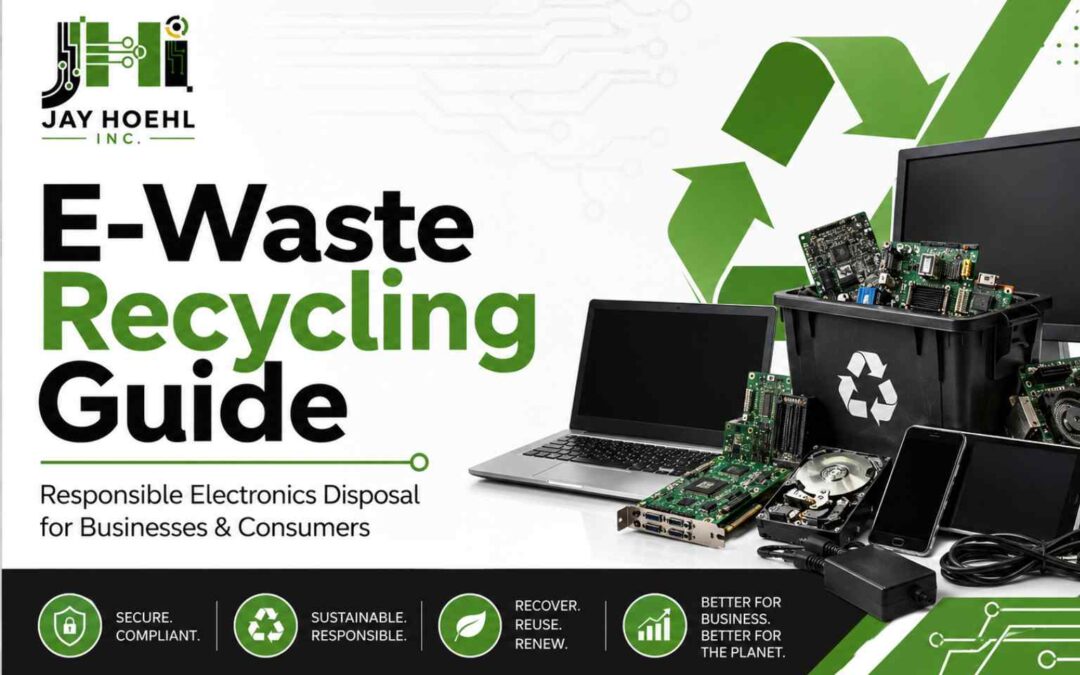
Every year, the world throws away more than 62 million metric tons of electronic waste and less than 20% of it gets recycled properly. The rest ends up in landfills, leaching lead, mercury, and cadmium into soil and groundwater, or shipped overseas to informal scrap operations where it harms workers and communities.
For businesses, the stakes are even higher. Improper e-waste disposal can mean regulatory fines, data breaches, and reputational damage that costs far more than doing it right the first time.
This guide covers everything you need to know about e-waste recycling: what counts as electronic waste, how the recycling process actually works, what regulations apply to your business, and how to choose a certified recycler you can trust. Whether you’re an IT manager decommissioning a data center or a homeowner cleaning out a closet of old phones, the principles are the same — and so are the consequences of getting it wrong.
Jay Hoehl Inc. has been recycling electronics in Phoenix, Arizona since 1980. We’ve written this guide based on four decades of hands-on experience handling everything from single laptops to multi-truckload industrial liquidations.
What is E-Waste and Why It Matters
E-waste — short for electronic waste — refers to any discarded device that runs on electricity or batteries. That includes obvious items like computers, phones, and televisions, but it also covers less obvious ones: medical equipment, industrial controls, semiconductor manufacturing tools, and even microwaves with electronic components.
The defining feature of e-waste isn’t size or type. It’s the mix of materials inside. A single laptop contains aluminum, copper, gold, silver, palladium, lithium, rare earth elements, and a handful of toxic substances like lead solder and mercury switches. When that laptop hits a landfill, the toxins leach out and the valuable materials are lost forever.
Why E-Waste is Growing Faster Than Any Other Waste Stream
Three forces are driving the explosion in e-waste volume:
Shorter device lifespans. The average smartphone is replaced every 2.5 years. Laptops last 4–5 years in business environments. Servers are typically refreshed every 3–5 years in data centers. Devices that used to last a decade now get swapped out before they break.
More devices per person. A household that owned one television and one desktop computer in 2005 now owns smartphones, tablets, smart TVs, smart speakers, wearables, gaming consoles, and connected appliances. The same multiplication has happened in offices and factories.
Cheaper electronics. When a new monitor costs less than repairing the old one, repair stops being economical. The result is a steady stream of working-but-obsolete equipment flowing into the waste stream.
Why Proper E-Waste Recycling Matters
Three reasons, in order of urgency for most businesses:
- Data security. Hard drives, SSDs, phones, and even copiers store sensitive information. Throwing them in a dumpster is a data breach waiting to happen.
- Regulatory compliance. Federal, state, and industry regulations require documented disposal for many types of electronics. Penalties for non-compliance range from thousands to millions of dollars.
- Environmental impact. The toxic materials in e-waste don’t just disappear. They contaminate soil, water, and air — affecting communities for decades.
We’ll cover each of these in depth below.
Types of Electronic Waste
E-waste isn’t a single category. Different devices require different recycling approaches, and certified recyclers handle them in different streams. Here are the main types you’ll encounter.
IT Equipment
The largest category by volume in commercial settings. Includes:
- Desktop computers and laptops
- Servers and storage arrays
- Networking equipment (switches, routers, firewalls)
- Monitors (LCD, LED, and legacy CRT)
- Printers, scanners, and copiers
- Keyboards, mice, cables, and accessories
IT equipment is where data destruction becomes critical. Every hard drive, SSD, and even some printers contain storage that must be wiped or physically destroyed before recycling.
Consumer Electronics
The category most households encounter:
- Smartphones, tablets, and e-readers
- Televisions
- Gaming consoles
- Cameras and camcorders
- Audio equipment and speakers
- Smart home devices
Industrial and Commercial Electronics
Often overlooked but extremely valuable. Includes:
- Test and measurement equipment (oscilloscopes, signal analyzers, multimeters)
- Semiconductor manufacturing equipment
- Industrial controls and PLCs
- RF components and microwave equipment
- Excess populated circuit boards
- Surface-mount device (SMD) components
- Integrated circuits and processors
This is JHI’s specialty. Industrial e-scrap often contains higher concentrations of precious metals than consumer electronics, and many recyclers won’t accept it because it requires specialized handling.
Batteries
Batteries are technically a sub-category of e-waste but require separate handling:
- Lithium-ion (phones, laptops, power tools)
- Lead-acid (UPS systems, vehicles)
- Nickel-cadmium and nickel-metal-hydride
- Alkaline (most household batteries)
Lithium batteries in particular are a fire hazard if damaged. Never throw a swollen or damaged lithium battery in regular trash or mixed e-waste.
Large Appliances with Electronic Components
The line between e-waste and general scrap blurs with appliances that contain electronic controls:
- Microwaves
- Refrigerators with smart features
- Washing machines and dryers
- HVAC equipment with controllers
These often need to be processed by appliance recyclers rather than e-waste facilities, but the electronic boards inside are recyclable through e-waste channels.
E-Waste Recycling Process Explained
What actually happens to your old electronics after they leave your facility? Here’s the process a certified recycler follows.
Step 1: Collection and Transport
Devices are collected through drop-off, scheduled pickup, or full-service decommissioning. Certified recyclers use sealed trucks with chain-of-custody documentation, so every device is tracked from your loading dock to the processing facility. For businesses with sensitive data, this tracking is non-negotiable.
Step 2: Inventory and Triage
At the recycling facility, each item is logged, photographed if needed, and triaged into one of three streams:
- Reuse: Working equipment with resale value is tested, refurbished, and resold.
- Component harvest: Devices that can’t be resold whole are stripped for valuable components like processors, memory, and circuit boards.
- Material recovery: Everything else moves to the recycling stream for metal, plastic, and glass recovery.
The reuse-first approach matters. A laptop that gets refurbished and resold has far less environmental impact than one that gets shredded for its copper. This is why “reduce, reuse, recycle” lists reuse before recycling.
Step 3: Data Destruction
Any device with storage media goes through data destruction before further processing. The two main methods:
Data wiping uses software to overwrite all data on a drive multiple times, following standards like NIST 800-88 or DoD 5220.22-M. Wiped drives can be reused or resold.
Physical destruction shreds drives into small fragments that can’t be reassembled or read. This is the gold standard for highly sensitive data — healthcare, financial, government — and produces a certificate of destruction for compliance records.
Many businesses choose physical destruction for hard drives regardless of wiping capability, simply because the documentation is easier to defend in an audit.
Step 4: Manual Disassembly
Skilled technicians manually disassemble devices, separating:
- Circuit boards (for precious metal recovery)
- Cables and wiring (for copper recovery)
- Plastic housings (for plastic recycling)
- Glass screens (for glass recycling)
- Batteries (for specialized battery recycling)
- Hazardous components (for safe disposal)
Manual disassembly is more thorough than shredding, but it’s slower and costs more. Certified recyclers balance manual and mechanical processing based on device type and material value.
Step 5: Material Recovery
The separated materials move to downstream processors:
- Precious metals (gold, silver, platinum, palladium) are recovered through smelting and chemical refining.
- Base metals (copper, aluminum, steel) are separated magnetically and through eddy current separators, then melted into ingots.
- Plastics are sorted by type and pelletized for reuse in new products.
- Glass is crushed and recycled into new glass products or used as construction aggregate.
A well-recycled laptop ends up about 98% recovered material by weight. The remaining 2% is typically composite materials that can’t currently be separated economically.
Step 6: Documentation and Reporting
For business clients, the process ends with paperwork:
- Certificates of recycling for environmental compliance
- Certificates of data destruction for data security audits
- Asset disposition reports listing every serial number processed
- Material recovery reports showing weights and downstream destinations
Without this documentation, you can’t prove proper disposal happened — which means you’re still liable if anything goes wrong.
Environmental Impact of E-Waste
The case for recycling electronics rests on what happens when you don’t.
Toxic Substances in Landfills
A typical electronic device contains a periodic table’s worth of hazardous materials:
- Lead in solder, CRT glass, and batteries. Damages nervous systems, especially in children.
- Mercury in older LCD backlights and some switches. Bioaccumulates in fish and contaminates water supplies.
- Cadmium in batteries and semiconductor chips. Linked to kidney damage and bone disease.
- Hexavalent chromium in metal coatings. A known carcinogen.
- Brominated flame retardants in plastic housings. Disrupt hormones and accumulate in the environment.
When these materials hit a landfill, they don’t stay contained. Rain leaches them into groundwater. Landfill fires release them into the air. Communities near unlined or poorly managed landfills face elevated rates of cancer, birth defects, and respiratory disease.
Resource Conservation
The other side of the environmental coin is what we lose when we don’t recycle.
Mining new metals is environmentally devastating. A single gold ring requires moving and processing roughly 20 tons of ore. Copper mining strips entire mountainsides. Rare earth element extraction in China and elsewhere has created some of the most polluted sites on Earth.
Meanwhile, the gold concentration in scrap circuit boards is roughly 40–50 times higher than in gold ore. Urban mining — recovering metals from e-waste — is dramatically more efficient than digging new metals out of the ground.
When you recycle a ton of circuit boards, you recover:
- 130 kg of copper
- 0.5 kg of gold
- 5 kg of silver
- Smaller quantities of palladium, platinum, and rare earth elements
Multiply that across the global e-waste stream and you’re looking at billions of dollars of recoverable materials lost to landfills every year.
Climate Impact
Manufacturing new electronics is energy-intensive. Recycling and reusing existing materials cuts the energy required for new production by 50–90% depending on the material. The EPA estimates that recycling a million laptops saves enough energy to power 3,500 US homes for a year.
For businesses with sustainability commitments or ESG reporting requirements, documented e-waste recycling is one of the cleanest, most measurable contributions you can make.
E-Waste Regulations & Compliance
E-waste regulation in the United States is a patchwork of federal, state, and industry rules. Here’s what businesses need to know.
Federal Regulations
There’s no single federal e-waste law in the US. Instead, several federal regulations touch e-waste indirectly:
- Resource Conservation and Recovery Act (RCRA): Governs hazardous waste, including some e-waste components like CRT glass and certain batteries.
- HIPAA: Requires healthcare organizations to protect patient data, including data stored on disposed-of devices.
- FACTA (Fair and Accurate Credit Transactions Act): Requires businesses to dispose of consumer information securely.
- Gramm-Leach-Bliley Act (GLBA): Applies similar data protection requirements to financial institutions.
- Sarbanes-Oxley: Requires public companies to maintain controls over financial data, including disposal.
The common thread: federal law cares about the data on your devices more than the devices themselves. Improper data destruction is a federal compliance issue regardless of whether the underlying e-waste rules apply.
State Regulations
Twenty-five states have passed e-waste recycling laws, and the specifics vary widely. Some highlights:
- California has the strictest rules, banning most electronics from landfills entirely.
- New York, Illinois, and Washington require manufacturer takeback programs.
- Arizona does not have a mandatory e-waste recycling law, but state agencies and Maricopa County maintain certified recycler lists and host regular collection events.
If you operate in multiple states, you need to comply with the rules in each — and the rules in the strictest state usually drive your overall policy.
Industry-Specific Requirements
Beyond general e-waste law, specific industries face additional rules:
- Healthcare: HIPAA requires documented destruction of any media containing protected health information.
- Financial services: Multiple federal and state rules require secure disposal of customer financial data.
- Government contractors: Federal contracts often require NIST 800-88 compliant data sanitization.
- Defense: DoD contractors face additional requirements under DFARS and NIST 800-171.
Recycler Certifications That Matter
Two certification programs dominate the certified-recycler landscape:
R2 (Responsible Recycling): The most widely adopted certification, covering environmental, health, safety, and data security practices. R2 certifies the recycler itself and tracks materials through the downstream chain.
e-Stewards: A stricter certification focused on preventing export of hazardous e-waste to developing countries. e-Stewards is the certification of choice for organizations with strong environmental policies.
Both certifications require independent third-party audits and meaningful compliance. Choosing a certified recycler shifts compliance risk away from your business — the recycler’s certification documents your due diligence.
Choosing an E-Waste Recycler
Not all recyclers are created equal. Here’s what to look for and what to avoid.
Green Flags
Established history. A recycler that’s been in business for decades has proven their model and their compliance record. Newer operations can be excellent — but established ones come with a track record.
Physical facility you can visit. Reputable recyclers welcome client tours. If a recycler can’t or won’t show you their facility, that’s a red flag.
Certifications. R2, e-Stewards, ISO 14001, ISO 27001 — these certifications cost money and require ongoing audits. A recycler that maintains them is investing in legitimate operations.
Clear chain of custody. From pickup to processing to material disposition, you should be able to track every device. Ask to see sample documentation.
Detailed reporting. Certificates of recycling and destruction, asset disposition reports, weight tickets — the paperwork should be thorough and timely.
Better Business Bureau rating. Not every great business has an A+ BBB rating, but it’s a useful signal alongside other due diligence.
Red Flags
Pricing that seems too good to be true. Free pickup of high-value equipment is legitimate (recyclers recover value from the materials). But offers to pay you well above market for mixed e-waste often signal exporters who plan to ship your devices overseas.
No physical address or vague location. Brokers and middlemen often have no actual processing capability.
Pressure to skip documentation. A recycler that doesn’t want to provide certificates of destruction or chain-of-custody records is hiding something.
No certifications. Uncertified recyclers may be cheaper, but they shift compliance risk back onto you.
Won’t disclose downstream processors. Reputable recyclers know where every material stream goes. If they can’t tell you, they probably don’t know — which means your devices could end up anywhere.
Questions to Ask Before Hiring
- What certifications do you hold, and can you provide current copies?
- Where is your processing facility, and can I tour it?
- What’s your chain-of-custody process?
- How do you handle data destruction, and what documentation do you provide?
- Where do your downstream materials go?
- Can you provide references from clients in my industry?
- Are you fully insured, including pollution liability?
- What’s your process if something goes wrong with a pickup?
The right recycler will answer these questions confidently and have documentation ready.
Business E-Waste Solutions
Business e-waste is fundamentally different from consumer e-waste. The volumes are larger, the data risks are higher, the regulatory exposure is greater, and the logistics are more complex.
What Business E-Waste Recycling Should Include
Scheduled pickup or full-service decommissioning. Whether you’re cycling out a few hundred laptops or shutting down a data center, your recycler should handle logistics end-to-end.
On-site or off-site data destruction. Some businesses need data destruction to happen on their premises, with witnessed shredding and immediate certificates. Others are fine with off-site processing as long as chain of custody is documented.
Asset disposition reporting. Every serial number processed, every drive destroyed, every certificate generated — all reconciled against your asset list.
Free pickup for qualifying volumes. Most certified recyclers offer free pickup for businesses with sufficient volume, because the recovered material value covers the cost.
Industrial e-scrap handling. If you generate manufacturing scrap — populated PCBs, excess inventory, test equipment — you need a recycler equipped to handle high-value industrial streams, not just consumer electronics.
IT Asset Disposition (ITAD)
ITAD is the strategic side of business e-waste. Instead of treating retired equipment as waste, ITAD treats it as an asset to be managed for maximum recovery value.
A typical ITAD engagement includes:
- Inventory and valuation of retired equipment
- Secure transport with chain of custody
- Data destruction to the standard your compliance requires
- Refurbishment and resale of equipment with remaining value
- Recycling of equipment without resale value
- Revenue share or buyback for high-value items
- Comprehensive reporting
Done right, ITAD turns a cost center into a revenue stream — or at least covers the cost of responsible disposal through recovered value.
Industrial Surplus and E-Scrap Liquidation
For manufacturers, the e-waste category extends beyond IT. Excess inventory, obsolete components, end-of-life production tooling, populated circuit boards from failed quality control — all of this has material value if handled correctly.
JHI specializes in this category. We handle one-time liquidations of obsolete inventory, ongoing disposition of production scrap, and full decommissioning of manufacturing lines. The material we recover often has significant precious metal content that delivers meaningful value back to the client.
Consumer Electronics Recycling
For households and individuals, e-waste recycling is simpler than business e-waste — but it still matters.
Before You Recycle Any Device
- Back up your data. Anything you want to keep should be moved to cloud storage or another device.
- Sign out of accounts. Remove the device from your iCloud, Google account, and any other services.
- Factory reset. This isn’t a substitute for proper data destruction on highly sensitive devices, but it’s a reasonable step for most consumer items.
- Remove batteries if possible. Lithium batteries should be recycled separately when removable.
Where to Recycle Consumer Electronics
Manufacturer takeback programs. Apple, Best Buy, Staples, Dell, and many other manufacturers and retailers accept old electronics for free recycling. Some offer trade-in credit.
Municipal household hazardous waste programs. Most cities operate periodic e-waste collection events or permanent drop-off facilities. In Phoenix, residents can use the city’s hazardous waste services with proof of residency.
Certified e-waste recyclers. Many commercial recyclers, including JHI, accept consumer drop-offs by appointment. This is the best option for items that contain sensitive data or that municipal programs won’t accept.
Charity refurbishment programs. Working computers can often be donated to programs that refurbish them for schools, low-income families, or nonprofits.
Items to Watch Out For
CRT monitors and televisions contain lead in the glass and often aren’t accepted by basic recycling programs. They require specialized handling.
Lithium batteries that are damaged, swollen, or punctured are fire hazards. Don’t ship them, don’t throw them in mixed e-waste — take them to a battery-specific drop-off.
Items with personal data — phones, laptops, tablets, even old printers — should go to a recycler that provides data destruction, not a free drop-off bin.
E-Waste Statistics & Trends
A snapshot of where we are and where things are heading.
Global Volume
The world generated approximately 62 million metric tons of e-waste in 2024 — up from 53.6 million tons in 2019. That’s roughly 8 kg per person globally, but with massive geographic variation. Wealthy countries generate 20+ kg per person; lower-income countries generate 1–2 kg.
Recycling Rate
Despite growing volume, the global e-waste recycling rate sits at just 17–22% depending on the source and definition. The remainder is split between landfill disposal, informal recycling in developing countries, and storage (the “drawer of dead phones” effect).
Value Lost
The materials in unrecycled e-waste are worth roughly $57 billion per year globally — more than the GDP of most countries. Gold, silver, copper, and rare earth elements account for most of this value.
Growth Drivers
E-waste volume is projected to reach 82 million tons annually by 2030. The drivers:
- Continued growth of consumer electronics ownership
- IoT and smart device proliferation
- Electric vehicle batteries entering end-of-life phase
- Solar panel waste (counted as e-waste in some methodologies)
- Data center expansion driving server turnover
US-Specific Trends
The United States generates approximately 7 million tons of e-waste per year — roughly 21 kg per person, among the highest rates in the world. US recycling rates lag the global leaders, with state-by-state variation that ranges from California’s strict landfill bans to states with essentially no e-waste regulation.
Future of E-Waste Management
A few trends worth watching:
Right to Repair Legislation
Multiple US states have passed or are considering right-to-repair laws that require manufacturers to make repair information, tools, and parts available. Longer device lifespans mean less e-waste. Whether the laws deliver on this promise will depend on enforcement.
Extended Producer Responsibility (EPR)
Many countries and US states are moving toward EPR models that make manufacturers financially responsible for end-of-life management of their products. This shifts the cost of recycling from taxpayers and consumers to the companies that make the products, creating incentives for more recyclable design.
Circular Economy Principles
The shift from linear (“take-make-dispose”) to circular (“design for reuse and recycling”) manufacturing is gaining traction. Apple, Dell, HP, and other major manufacturers have announced commitments to recycled-material content in new products. This creates pull-through demand for recycled materials and improves the economics of e-waste recycling.
Battery Recycling Boom
The rise of electric vehicles is creating an enormous wave of battery e-waste over the next 10–20 years. The industry is racing to build battery recycling capacity, and the technology to recover lithium, cobalt, and nickel from spent batteries is advancing rapidly.
Data Center Decommissioning at Scale
Hyperscale cloud providers and AI infrastructure buildouts are generating massive server refresh cycles. Specialized data center decommissioning is becoming a distinct service category, with strict data security, environmental, and revenue recovery requirements.
Recycle Your Electronics with JHI
Jay Hoehl Inc. has been recycling electronics in Phoenix, Arizona since 1980. Whether you’re a business decommissioning IT assets, a manufacturer with industrial e-scrap to dispose of, or an individual cleaning out old electronics, we handle the entire process responsibly.
What we accept:
- Computers, laptops, and servers
- Networking and telecom equipment
- Industrial controls and test equipment
- Excess inventory and obsolete components
- Hard drives and storage media (with documented data destruction)
- Populated circuit boards and precious-metal scrap
What you get:
- Free pickup for qualifying business volumes
- Documented chain of custody
- Certified data destruction
- Certificates of recycling and destruction
- A+ rated BBB service since 1980
Call (602) 272-4033 or email JayHoehlinc@gmail.com to schedule a pickup or discuss your e-waste needs. Visit us at 3334 W McDowell Rd Unit 17, Phoenix, AZ 85009.
Frequently Asked Questions
What is e-waste recycling? E-waste recycling is the process of collecting, processing, and recovering materials from discarded electronic devices. Certified recyclers separate devices into reusable equipment, recoverable components, and material streams (metals, plastics, glass) while safely handling toxic substances.
Is e-waste recycling free? For consumers, most municipal and manufacturer programs are free. For businesses, certified recyclers like JHI typically offer free pickup for qualifying volumes because the recovered material value covers operating costs. Smaller volumes may incur a fee.
What happens to my hard drive when I recycle my computer? A certified recycler will either wipe the drive using NIST 800-88 compliant methods or physically shred it. Either way, you should receive a certificate of destruction for your records.
Can I throw electronics in the trash? In some states, no — California and others ban most electronics from landfills. Even where it’s legal, it’s a bad idea. Toxic substances leach from landfilled electronics, and devices with data create privacy and compliance risks.
What’s the difference between R2 and e-Stewards certification? Both are independent third-party certifications for e-waste recyclers. R2 is more widely adopted and covers a broad range of environmental, health, safety, and data security practices. e-Stewards is stricter, particularly on preventing export of hazardous e-waste to developing countries.
Do you handle industrial e-scrap? Yes. JHI specializes in industrial and commercial e-waste, including excess inventory, obsolete components, test equipment, populated circuit boards, and semiconductor manufacturing equipment. Many recyclers won’t accept these categories — we do.
How long does it take to schedule a business e-waste pickup? Most pickups can be scheduled within a week. Larger decommissioning projects may require additional planning. Contact us to discuss your specific timeline.