The Complete E-Waste Recycling Process
Every year, the world tosses out 50 million tons of electronics. That’s heavier than all commercial airplanes ever built. Combined.
Where does it all go? Most of it sits in landfills, leaking toxins into soil and water. But it doesn’t have to be this way. E-waste recycling turns old gadgets into raw materials that power new devices.
This guide walks you through every method, every step, and every reason why e-waste recycling matters. Let’s dig in.
Common E-Waste Recycling Methods
E-waste recycling isn’t one-size-fits-all. Different methods work for different scales and materials.
Here are the three main approaches:
Mechanical recycling uses physical force to break down devices. Shredders tear apart phones and laptops. Magnets pull out iron. Water baths separate plastic from glass. It’s simple, clean, and works great for large volumes.
Chemical recycling uses acids and solvents to dissolve materials. This method targets precious metals like gold and silver hiding inside circuit boards. It’s precise but requires careful handling of hazardous chemicals.
Thermal recycling applies heat to melt metals and burn off plastics. Smelters reach 2,000°F to separate copper from steel. It’s powerful but energy-intensive.
Most industrial facilities combine all three. Home users stick with drop-off programs that feed into mechanical systems.
The best method depends on what you’re recycling and how much you have. A single old phone? Mechanical works fine. A warehouse of servers? You’ll need the full arsenal.
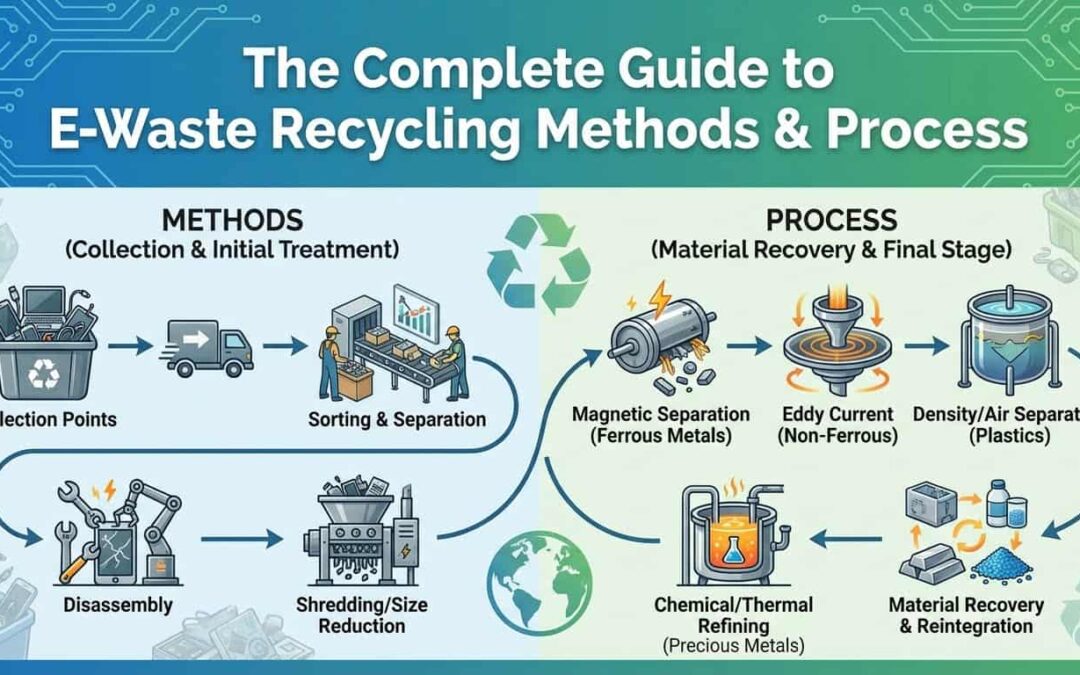
The Complete E-Waste Recycling Process
E-waste recycling follows a clear path from collection to recovery. Here’s how it works:
Step 1: Collection Drop-off centers and mail-in programs gather old electronics. Retailers like Best Buy take phones and laptops. Specialized services handle business equipment. This step keeps devices out of trash bins.
Step 2: Sorting Workers separate items by type and condition. Working devices go to refurbishment. Broken ones head to recycling. Hazardous items like batteries get special treatment. Sorting prevents contamination and maximizes recovery.
Step 3: Data Destruction Hard drives get wiped or shredded. This protects your personal info. Certified recyclers use DoD-approved methods. Never skip this step.
Step 4: Dismantling Technicians remove batteries, screens, and circuit boards by hand. This prevents explosions and makes shredding safer. Valuable components get set aside for detailed processing.
Step 5: Shredding Industrial shredders tear devices into thumbnail-sized pieces. This exposes different materials and prepares them for separation. The output looks like metallic confetti.
Step 6: Separation Magnets, water baths, and electrical currents sort materials by type. Plastics float. Metals sink. Each material gets its own bin.
Step 7: Purification Recovered materials go through final cleaning. Smelters melt metals into pure ingots. Chemical baths dissolve impurities. The result? Raw materials ready for manufacturing.
Step 8: Redistribution Clean materials head to factories. Your old phone’s aluminum becomes a new laptop case. The cycle continues.
Why is Electronic Waste Recycling Important?
E-waste isn’t just clutter. It’s a ticking environmental bomb.
Toxic materials leak into groundwater. Lead, mercury, and cadmium seep from landfills into drinking water. One CRT monitor contains 4-8 pounds of lead. That’s enough to contaminate an entire water supply.
Mining destroys ecosystems. Extracting new metals scars mountains and poisons rivers. Recycling one million laptops saves the energy equivalent of powering 3,500 homes for a year.
Rare materials become scarce. Circuit boards contain gold, silver, and palladium. These elements are finite. Recycling recovers them without digging new mines.
Health risks multiply. Workers in developing countries burn e-waste for copper. They inhale toxic fumes daily. Recycling done right protects communities.
The economy benefits. The e-waste recycling industry employs thousands and generates billions. It’s growth that doesn’t cost the planet.
Every recycled device is a small victory. Multiply that by millions and you’ve got real impact.
The Most Common Types of E-Waste
Not all e-waste is created equal. Here’s what fills recycling bins:
- Computers & laptops – Desktops, towers, monitors, keyboards, mice
- Mobile devices – Smartphones, tablets, e-readers, smartwatches
- Home appliances – Microwaves, coffee makers, vacuum cleaners, air conditioners
- Entertainment electronics – TVs, gaming consoles, DVD players, speakers
- Office equipment – Printers, scanners, copiers, fax machines
- Cables & accessories – Chargers, headphones, USB drives, power strips
- IoT devices – Smart thermostats, security cameras, voice assistants
- Batteries – Lithium-ion, alkaline, lead-acid, rechargeable packs
Surprised by some of these? Most people don’t realize their old Alexa or Fitbit counts as e-waste. If it plugs in or needs batteries, it belongs in recycling.
The Problems With Not Recycling E-Waste
Ignoring e-waste creates disasters we can’t undo.
Landfills become toxic wastelands. Electronics break down slowly and release poison. Heavy metals migrate into soil. Rain carries them into water tables. Entire regions become contaminated.
Global dumping harms developing nations. Rich countries ship e-waste to Africa and Asia. Local workers dismantle devices without protection. Children play near burning piles of circuit boards. The health toll is staggering.
Valuable resources vanish forever. Throwing away electronics wastes the materials inside. A ton of circuit boards contains more gold than a ton of gold ore. We’re literally trashing treasure.
Carbon emissions skyrocket. Manufacturing new electronics from scratch requires massive energy. Mining, refining, and shipping all burn fossil fuels. Recycling cuts emissions by 70% compared to virgin production.
Illegal dumping increases. Without proper disposal options, people toss electronics in dumpsters. Waste haulers dump them in forests and empty lots. The mess spreads.
The price of convenience is environmental collapse. But it’s a bill we can refuse to pay.
E-Waste Recycling Process Flowchart
Visual learners, this one’s for you. The e-waste journey breaks into clear stages:
Collection → Transport → Sorting → Data Wipe → Manual Dismantling → Mechanical Shredding → Material Separation → Purification → Material Recovery → Redistribution
Each arrow represents hours of work and tons of equipment. But the result is worth it.
Think of it like a factory in reverse. Instead of assembling products, we’re carefully taking them apart to save what’s inside.
Simple process. Massive impact.
Collection & Sorting
This is where your old gadgets start their second life.
Collection happens everywhere. Retail stores offer drop-off bins. Municipalities run e-waste events. Mail-in programs send prepaid boxes. Businesses hire certified haulers. The goal? Make recycling as easy as buying.
Sorting separates the useful from the hazardous. Workers inspect each item. They check for:
- Working condition (refurb vs. recycle)
- Device type (phones separate from fridges)
- Hazardous components (batteries, CRTs, mercury switches)
- Data-bearing devices (needs secure wiping)
Proper sorting prevents fires, contamination, and wasted effort. It’s the foundation of efficient recycling.
Dismantling & Shredding
Now things get physical.
Manual dismantling comes first. Trained technicians remove dangerous parts by hand. Batteries get pulled to prevent fires. Screens separate to avoid toxic dust. Circuit boards with precious metals get set aside.
Why not just shred everything? Safety and value. Batteries explode in shredders. Whole circuit boards are easier to process than mixed fragments.
Shredding follows dismantling. Industrial machines tear remaining materials into small pieces. They use:
- Hammer mills (smash brittle components)
- Cutting shredders (slice through plastic and metal)
- Granulators (reduce size further)
The output? A mixed stream of tiny metal, plastic, and glass fragments. Ready for separation.
Material Separation
This is where science takes over. Different materials need different recovery methods.
Separation techniques target specific properties. Metals respond to magnets. Plastics float in water. Conductors react to electrical fields.
The goal? Pure streams of single materials. Contamination ruins everything.
Magnetic Separation
Magnets grab ferrous metals like iron and steel.
Conveyor belts run shredded material under powerful electromagnets. Steel screws, iron brackets, and metal casings stick to the magnet. Everything else keeps moving.
It’s simple physics. And it works beautifully.
The recovered steel goes to scrap yards. From there it becomes rebar, car parts, or new electronics.
Eddy Current Separation
This trick catches non-ferrous metals like aluminum and copper.
A spinning magnetic field creates electrical currents in conductive materials. Those currents generate opposing magnetic forces. The result? Metal pieces literally jump off the conveyor belt.
Think of it as magnetic levitation. But for recycling.
Aluminum from laptop cases and copper from wiring land in separate bins. Both are highly valuable.
Water Separation
Water reveals density differences. Heavy materials sink. Light materials float.
Shredded e-waste drops into water baths. Metals plunge to the bottom. Plastics bob on the surface. Glass settles in the middle.
Screens and filters capture each layer. The water gets filtered and reused.
It’s low-tech but highly effective. No chemicals needed.
Material Recovery
Separated materials need final refinement. This step extracts pure elements from mixed fragments.
Two main methods dominate industrial recovery.
Pyrometallurgy
Heat unlocks metals trapped in complex materials.
Smelters heat shredded circuit boards to 2,000°F or higher. Plastics and organics burn away. Metals melt and separate by density. Heavy metals like lead sink. Lighter ones like aluminum float.
The molten metal pours into molds. It cools into pure ingots ready for reuse.
Downside? High energy use and air pollution. But it works for large volumes.
Hydrometallurgy (Bioleaching)
Chemical baths dissolve metals without extreme heat.
Acids or bacteria break down circuit boards. Gold, silver, and palladium dissolve into solution. Chemists then extract each metal through precipitation or electroplating.
Bioleaching uses bacteria instead of harsh acids. Microbes naturally digest metals from ore. Scientists adapted this for e-waste. It’s slower but gentler on the environment.
This method recovers trace amounts of precious metals. One ton of circuit boards yields more gold than one ton of gold ore.
What are the Challenges of Recycling E-Waste?
Recycling isn’t always smooth sailing. Real obstacles slow progress.
Legal confusion blocks action. Different states have different rules. Some ban landfill disposal. Others don’t. Businesses don’t know which laws apply.
Logistics get expensive. Transporting old electronics costs money. Rural areas lack nearby facilities. Small volumes aren’t profitable to collect.
Consumer awareness stays low. Most people don’t know where to recycle. They default to trash because it’s easier.
Technology changes fast. New devices use new materials. Recyclers need constant equipment updates. Training takes time and money.
Data security worries persist. People fear identity theft. They hold onto old phones instead of recycling them.
Solving these problems requires better laws, more facilities, and public education. We’re getting there. Slowly.
Data Destruction
Your personal info matters as much as the materials.
Certified recyclers wipe drives using DoD 5220.22-M standards. This overwrites data multiple times. Recovery becomes mathematically impossible.
Physical destruction works too. Industrial shredders turn hard drives into confetti-sized pieces. No data survives.
Look for R2 or e-Stewards certification. These programs audit recyclers to ensure proper data handling. Don’t trust your laptop to anyone else.
Peace of mind is part of responsible recycling.
Reuse & Refurbishment
Not everything needs recycling. Working devices deserve second lives.
Refurbishment programs test, clean, and repair electronics. They replace broken screens and worn batteries. The result? Affordable devices for schools, nonprofits, and low-income families.
Programs like Phoenix-area ReSupply connect working electronics with people who need them. It’s recycling’s gentler cousin.
Reuse beats recycling every time. It saves energy, extends product life, and helps communities.
If your device still works, consider donation before recycling.
Why E-Waste Recycling Matters
Let’s zoom out and see the bigger picture.
E-waste recycling protects the planet. It conserves resources. It creates jobs. It prevents pollution. It builds circular economies where nothing gets wasted.
Every phone you recycle keeps toxins out of water. Every laptop you drop off saves mining energy. Every battery you dispose of properly protects workers.
This isn’t just feel-good environmentalism. It’s practical, profitable, and necessary.
As the Chinese proverb says: “Don’t dig a well when you’re already thirsty.” We have the materials we need sitting in drawers and closets. Let’s use them.
How The Universal Recycling Process Differs Across Common Items
Different devices need different handling. Here’s how recycling changes by item type.
- Computers & laptops – Data wiping, then dismantling for circuit boards and metal frames
- CRT monitors & TVs – Lead extraction from glass, phosphor recovery from screens
- LCD screens – Mercury lamp removal, backlight separation, glass and plastic recovery
- Mobile phones – Battery removal, precious metal extraction from tiny circuit boards
- Batteries – Sorting by chemistry, then specialized recovery for each type
- Printers – Toner cartridge separation, metal frame recycling, plastic component recovery
Each type follows the universal steps. But the details matter.
The Recycling Process for Batteries
Batteries need special care. They contain reactive chemicals and can explode.
Step 1: Sort by type (lithium-ion, alkaline, lead-acid, nickel-cadmium)
Step 2: Discharge remaining energy safely
Step 3: Shred in controlled environments with fire suppression
Step 4: Separate materials (lithium, cobalt, nickel, plastic casings)
Step 5: Purify and reuse in new batteries
Lithium-ion recycling is booming. Electric vehicles use massive battery packs. Recycling them is critical for sustainable transport.
The Recycling Process for Cathode Ray Tubes
Old tube TVs and monitors are toxic nightmares.
CRTs contain 4-8 pounds of lead in the glass. The phosphor coating has heavy metals. They can’t go in standard recycling.
Step 1: Remove plastic casing and electronic components
Step 2: Separate leaded glass from non-leaded glass
Step 3: Send to specialized smelters that handle lead
Step 4: Recover phosphor for safe disposal or reuse
CRT recycling is expensive. But it prevents catastrophic pollution.
The E-Waste Recycling Process for Computers & Laptops
Computers are treasure troves of valuable materials.
Step 1: Data destruction (wipe or shred hard drives)
Step 2: Remove batteries and hazardous components
Step 3: Dismantle for motherboards, RAM, processors
Step 4: Shred metal cases and plastic housings
Step 5: Extract gold, silver, and palladium from circuit boards
Step 6: Recycle glass from monitors separately
One metric ton of circuit boards contains 40-800 times more gold than one metric ton of gold ore. Computers are literal gold mines.
The Recycling Process for Mobile Phones & Tablets
Small devices pack concentrated value.
Step 1: Battery removal (lithium-ion requires special handling)
Step 2: Screen separation (glass and LCD layers)
Step 3: Circuit board extraction (high precious metal content)
Step 4: Case and frame recycling (aluminum, plastic)
Step 5: Precious metal recovery (gold, silver, palladium)
Phones are getting harder to recycle. Glued components resist disassembly. Manufacturers need to design for recycling from day one.
Resource Recovery
Every recycled device feeds manufacturing. Here’s what gets recovered:
- Metals – Iron, aluminum, copper, gold, silver, palladium, platinum
- Plastics – ABS, polycarbonate, polystyrene, PVC
- Glass – Screen glass, CRT glass, fiber optics
- Rare earth elements – Neodymium, yttrium, europium (from screens and speakers)
These materials replace virgin resources. Mining becomes less necessary. Ecosystems stay intact.
Recovery rates keep improving. New tech extracts materials we once threw away.
Environmental Protection
Recycling blocks pollution at every stage.
Keeps toxins out of landfills. No mercury in groundwater. No lead in soil. No flame retardants in air.
Reduces mining damage. Fewer mountains destroyed. Fewer rivers poisoned. Fewer habitats lost.
Cuts carbon emissions. Recycled aluminum uses 95% less energy than new aluminum. Recycled copper uses 85% less.
Prevents ocean pollution. Less plastic waste means less ocean contamination. E-waste fragments wash into seas. Recycling stops them at the source.
The planet can’t afford our throwaway culture. Recycling buys us time to fix it.
Closed-Loop Systems
The dream? Electronics that recycle into new electronics. Forever.
Closed-loop recycling means materials circulate endlessly. Your old phone becomes a new phone. No waste. No new mining. Just continuous reuse.
Some companies are building this reality:
- Apple recovers materials from old iPhones to build new ones
- Dell uses recycled plastics in laptop cases
- Fairphone designs for easy disassembly and repair
It’s the circular economy in action. Take, make, use, return, remake. The loop never breaks.
We’re not there yet. But every recycled device moves us closer.
At the End of the Day
E-waste recycling isn’t optional anymore. It’s survival.
The world produces 50 million tons of e-waste yearly. That number doubles every decade. Landfills can’t hold it. Oceans can’t absorb it. We have to recycle.
The good news? It’s easier than ever. Drop-off locations exist everywhere. Mail-in programs pick up your devices. Many are free.
Your old phone has value. Your broken laptop contains treasure. Your dead tablet holds materials that power progress.
Don’t let them rot in a drawer or poison a landfill.
Ready to recycle your e-waste in Phoenix, AZ? Find certified local recyclers who handle everything from smartphones to servers. Protect your data. Protect the planet. Protect the future.
Don’t be a stranger. Recycle that phone.