
How Long Does E-Waste Take to Decompose?
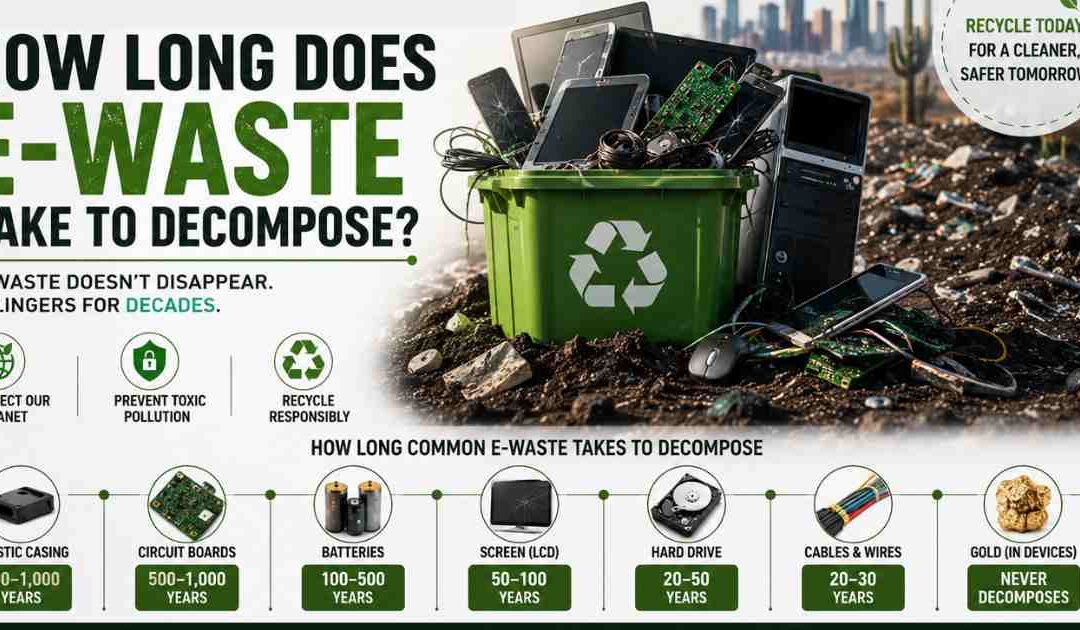
E-waste can take anywhere from a few decades to over a million years to break down. There’s no single number, because one device holds many materials. Plastics, metals, glass, and circuit boards all decompose at wildly different rates.
That’s the short version. But the real story affects your money, your data security, and your warehouse space. If you run a business in Phoenix, old electronics aren’t just clutter. They’re value sitting still. Let’s break down what actually happens to e-waste, and what smart companies do about it.
How Long Does E-Waste Take to Decompose?
E-waste doesn’t decompose on one timeline. It depends entirely on the material. Some plastics linger for hundreds of years. Glass can persist for a million or more. Metals corrode slowly instead of disappearing. Precious metals never lose their core value at all.
So when someone asks for one decomposition number, the honest answer is: there isn’t one. A single laptop can outlast several human generations in a landfill. Why does that matter to you? Because every year electronics sit unmanaged, you lose recoverable value and take on avoidable risk. The good news is simple. Most of that material can be recovered through professional electronics recycling services instead of buried forever.
| Material | Approximate persistence in landfill conditions |
|---|---|
| Plastic housings and cables | Hundreds of years |
| Glass screens and displays | Extremely long, often cited near one million years |
| Circuit boards | Many decades to centuries |
| Copper, aluminum, steel | Corrode slowly over decades, do not biodegrade |
| Gold, silver, palladium | Effectively permanent, fully recoverable |
Short answer for readers in a hurry
There’s no single decomposition time for e-waste. Different parts break down at completely different rates. Many electronics stay largely intact for hundreds or even thousands of years. Some materials, like engineered glass, can persist close to a million years. That’s exactly why proper recycling beats tossing electronics in the trash.
Why the timeline depends on the material
Electronics aren’t one thing. They’re a stack of very different materials glued into one device. Think of a laptop like a lunchbox packed with foods that spoil at different speeds. The plastic case, the glass screen, the copper wiring, and the gold-plated contacts all age on their own clock.
Plastics resist breakdown for centuries. Glass barely changes at all. Metals corrode but never truly vanish. And the tiny bits of precious metal? They hold their value no matter how old the device gets. This is what engineers call a composite product. Because these materials are bonded together, you can’t assign one honest timeline to a whole computer. You have to look at the parts. That single truth changes how you should think about disposal.
Why this matters for Phoenix businesses
For a Phoenix business, e-waste is more than an environmental footnote. It’s a line item. Old electronics quietly eat warehouse space you’re paying for. They tie up material value you could recover. And they carry data risk you can’t afford to ignore.
Here’s the part most companies miss. Obsolete gear often still holds recoverable value while it sits gathering dust.
- Storage costs: Every pallet of dead electronics is square footage you rent but don’t use.
- Recoverable value: Circuit boards, components, and metals may be worth real money.
- Compliance and security: Data-bearing devices need careful handling before anything else.
What if that back-room pile could fund part of your next upgrade instead? A quick look at excess inventory management often reveals value hiding in plain sight.
Does E-Waste Actually Decompose?
Not the way food or paper does. Electronics don’t rot. They break down through slower, messier processes that never fully return them to nature.
People use “decompose” as a catch-all word, but it hides three very different things. True decomposition means organic matter broken down by microbes into simple compounds. That’s what happens to a banana peel. Electronics don’t play by those rules. They’re built from plastics, metals, and glass that microbes can’t digest.
Instead, electronics change through degradation and corrosion. Plastics grow brittle and crack into smaller and smaller pieces. Metals oxidize and form rust or tarnish. But breaking apart isn’t the same as disappearing. A shattered plastic case is still plastic. A corroded board is still a board, just uglier and, in some cases, more dangerous.
So does e-waste decompose? Think of a plastic laptop shell like a glass bottle on a beach. Waves grind it smaller over time, but the material never leaves. It just spreads. That’s the honest picture of e-waste. It doesn’t vanish. It fragments, corrodes, and sometimes leaks, which is why responsible recycling matters so much.
Decomposition vs. degradation vs. corrosion
These three words get mixed up constantly, but they describe different things. Getting them straight helps you understand why electronics behave the way they do.
| Term | What it means | What it mostly affects |
|---|---|---|
| Decomposition | Microbes break organic matter into simple compounds | Food, paper, natural materials |
| Degradation | Material weakens and fragments over time | Plastics and polymers |
| Corrosion | Chemical reaction wears down a surface | Metals like copper and steel |
The simple takeaway: corrosion attacks metals, degradation attacks plastics, and true decomposition mostly skips electronics altogether.
Why electronics do not biodegrade like food or paper
Biodegradation needs living organisms that can actually eat the material. Electronics don’t offer them a meal.
Most electronic plastics come from petroleum. They’re engineered to resist heat, moisture, and wear, which is great for a phone and terrible for the planet. The same durability that protects your device also blocks nature from breaking it down.
Metals and synthetic materials add to the problem. Microbes can compost an apple core in weeks. They can’t touch a polycarbonate case or a copper trace. So when we say electronics are non-biodegradable, we mean nature has no working tool to recycle them. Only human systems can.
Why broken-down electronics can still create risk
Physical breakdown and detox are two very different things. An electronic device can fall apart completely and still be hazardous. Fragmentation doesn’t remove the harmful substances inside. It can actually spread them.
A cracked battery or corroded circuit board may still release heavy metals into the ground around it. The device looks “gone,” but the risk stays behind. That’s the trap of assuming decomposition equals safety.
- Cracked batteries can leak chemicals and pose fire risk.
- Corroded boards may release traces of lead or other metals.
- Shattered screens spread fine particles that are hard to contain.
This is the real reason casual disposal is dangerous. A device breaking down isn’t a device becoming harmless. Proper electronics recycling handles both the material and the hazard.
What Counts as E-Waste?
E-waste is any electronic device or component at the end of its useful life. If it plugs in, charges up, or runs on a battery, it likely counts. That covers a huge range, from a dead phone charger to an industrial control panel.
But not all e-waste is equal. A consumer’s broken tablet and a manufacturer’s pallet of obsolete circuit boards are both electronic waste. They just live in very different worlds. One is a household item. The other is a business asset with recovery value and, often, sensitive data.
So what actually qualifies? It helps to split e-waste into a few clear buckets. Consumer devices, business and industrial equipment, e-scrap and surplus, and data-bearing assets that need extra care. Each group calls for a different handling strategy, and getting that split right is where smart disposal begins.
Common consumer e-waste
This is the gear most people picture first. The stuff piling up in junk drawers and closets. It’s everyday electronics that stopped serving a purpose.
- Phones and tablets
- Laptops and desktops
- TVs and monitors
- Printers and scanners
- Chargers, cables, and small accessories
Picture the average home office cleanout. You’ll find three old phones, a dead printer, and a tangle of cables nobody can identify. All of it is e-waste, and all of it is recyclable.
Common business and industrial e-waste
Businesses generate e-waste on a completely different scale. It’s not one old laptop. It’s fleets of them, plus the heavy equipment that keeps operations running.
- Servers and data center hardware
- Networking equipment like switches and routers
- Industrial electronics and PLCs
- Telecom equipment
- Test equipment and specialized instruments
Here’s an insight most operations managers learn the hard way. Industrial electronics often hold far more recoverable value than office gear. A single rack of retired servers or a batch of test equipment can carry serious material worth. That’s value worth evaluating before it’s written off.
E-waste vs. e-scrap vs. electronic surplus
These terms get used interchangeably, but they mean different things. Knowing the difference helps you make smarter disposal calls and speak the same language as your recycler.
| Term | What it usually means |
|---|---|
| E-waste | Any end-of-life electronic device or equipment |
| E-scrap | Recoverable electronic material, often components and boards |
| Electronic surplus | Excess or obsolete inventory that may still work or sell |
Think of it this way. E-waste is what you’re done with. E-scrap is what’s worth recovering. Electronic surplus is what might still have a second life. One device can move between all three categories, which is why evaluation matters before disposal.
Data-bearing devices that need special handling
Some electronics carry more than metal and plastic. They carry your data. Hard drives, SSDs, servers, and phones all store information that can outlive the device itself. That makes them a security concern, not just a recycling one.
Here’s a hard truth. Deleting files or formatting a drive doesn’t reliably erase recoverable data. Skilled tools can pull information from a drive you thought was wiped clean. Depending on your policies and regulations, you may need certified sanitization or physical destruction.
Your customers trust you with their information. Protecting it doesn’t end when a device retires. Secure handling is the last, critical step. Professional IT asset disposition services exist precisely to close that gap safely.
E-Waste Decomposition Timeline by Material
Here’s the core truth of this whole topic. E-waste has no single decomposition timeline, because no device is made of one thing. A single computer can contain five to ten different material types. Each one ages on its own schedule, and assigning one number to the whole machine is simply misleading.
So how long does e-waste really take to break down? The honest answer lives in the parts. Plastics stretch across centuries. Glass barely moves in a million years. Metals corrode slowly. Precious metals hold value forever. Below, we break down each major material, why it behaves the way it does, and why recovery beats the landfill every time.
Think of an old server like a time capsule. Bury it, and different pieces will greet very different futures. That’s not a reason to shrug. It’s a reason to recycle, because nearly all of it can be reclaimed instead of lost.
| Material | Behavior over time | Recovery outlook |
|---|---|---|
| Plastic housings and cables | Fragment over centuries | Recyclable with proper processing |
| Glass screens | Extremely stable, near-permanent | Recyclable by display type |
| Circuit boards | Persist for decades | High recovery value |
| Mixed metals | Corrode slowly | Strong scrap value |
| Hazardous substances | Persist and can leach | Require careful handling |
| Batteries | Break down unpredictably | Recyclable, need safe handling |
| Precious metals | Effectively permanent | Fully recoverable, high value |
Plastic Casings, Keyboards, Cables, and Housings
Plastic is usually the longest-lasting visible part of any electronic device. Those casings, keys, and cable jackets can survive for hundreds of years. They don’t rot. They just crack, fade, and slowly shed into smaller fragments.
Picture a keyboard buried today. Your great-great-grandchildren could dig it up mostly intact. That’s how stubborn electronic plastic is.
There’s a catch that trips up standard recycling too. Many electronic plastics contain flame retardants. Those additives keep your devices from catching fire, but they require specialized recycling instead of standard plastic processing. Toss them in with regular plastics and you create a problem, not a solution.
Glass Screens, Monitors, and Displays
Electronic glass is nearly immortal. It stays chemically stable for extraordinarily long periods, often cited near one million years. Screens don’t degrade the way plastics do. They mostly just sit there, unchanged, for ages.
But not all display glass is the same, and that matters for recycling. Older CRT monitors and modern flat panels demand different handling.
Older CRT monitors may contain leaded glass, which makes disposal rules stricter than for a modern LCD. A flat-panel screen and an old tube monitor might look like the same “old display,” but they belong in different recycling streams. Knowing which is which protects both people and the environment.
Circuit Boards and Printed Circuit Assemblies
Circuit boards are the treasure chests of e-waste. They persist for decades in a landfill, yet they’re packed with materials worth recovering. Their fiberglass and resin bodies resist breakdown while precious metals sit quietly inside.
This is where value hides. A dull green board doesn’t look like much, but it can be one of the richest parts of any device.
High-grade circuit boards can contain recoverable gold, silver, copper, and palladium. Most businesses have no idea how much value they’re storing on those boards. That’s exactly why professional evaluation pays off. Learn how JHI handles IC chip and board recovery to see what your surplus might be worth.
Copper, Aluminum, Steel, and Mixed Metals
Metals in electronics corrode. They don’t biodegrade, and they never truly disappear. Copper wiring, aluminum housings, and steel frames slowly oxidize over decades. But corrosion changes appearance, not existence.
Here’s the good news for your bottom line. That corroded look doesn’t erase the value.
- Copper stays highly recyclable even when tarnished.
- Aluminum recovers well and holds strong market demand.
- Steel is one of the most recycled materials on earth.
So if a pile of old cables looks too far gone to bother with, ask yourself one question. Would you throw away money just because it looked dusty?
Lead, Mercury, Cadmium, and Hazardous Substances
Some older electronics carry substances you don’t want near soil or water. Lead, mercury, and cadmium can persist for a long time and cause serious harm if released. This is the part of e-waste that turns disposal into a responsibility, not a choice.
These materials don’t break down safely on their own. Left in a landfill, they can slowly leach into the ground and threaten local water. Protecting soil and water starts with keeping this material out of the trash.
There’s a hopeful trend, though. Many newer devices contain less hazardous material than older ones did. But legacy equipment often needs extra care during recycling. When in doubt, treat older gear as sensitive and let professionals handle it properly.
Lithium-Ion Batteries and UPS Batteries
Batteries deserve their own rules, and skipping them is dangerous. Lithium-ion cells and UPS batteries carry both fire risk and recycling value. They don’t break down cleanly, and they can turn hazardous when damaged.
Ever heard of a discarded phone battery sparking a landfill fire? It happens more than you’d think.
- Fire risk: Damaged cells can overheat or ignite.
- Chemical risk: Leaking electrolytes can harm people and soil.
- Handling risk: Swollen batteries are unstable and need care.
Damaged lithium-ion batteries can become unstable, so store and transport them by proper safety guidance before recycling. Handle batteries with respect, and they become a resource instead of a threat.
Gold, Silver, Palladium, and Recoverable Precious Metals
Here’s the twist nobody expects. The most valuable material in your electronics never loses its worth. Gold, silver, and palladium inside circuit boards and connectors stay valuable for good. Time doesn’t touch their intrinsic value.
Think of them as tiny gold coins scattered through your old equipment. They’re small, but they add up fast across a warehouse of surplus.
One important nuance. Not all boards are equal. Recovery value varies by board grade, component type, and application. A high-density telecom board and a basic consumer board can differ dramatically. That’s why an expert surplus electronics evaluation is worth doing before you write anything off.
What Happens When E-Waste Goes to a Landfill?
When electronics hit a landfill, nobody wins. The environment takes on a long-term burden. Your business loses recoverable value. And harmful substances get a chance to spread. Landfilling e-waste isn’t disposal. It’s a slow-motion problem you’re paying to create.
Why does this matter beyond the environment? Because every device buried is material that could have funded your next purchase. The smartest move balances two goals at once. Reduce environmental harm and recover usable value. Proper recycling delivers both.
Here’s the guiding idea for this whole section. What we bury today, our children inherit tomorrow. Let’s look at exactly what happens when electronics go to a landfill, and why there’s almost always a better path.
Electronics May Remain for Generations
A landfill is not a compost pile. It’s more like a freezer for waste. Landfill conditions slow natural breakdown even further, so electronics can stay largely intact for extremely long periods.
The tight, low-oxygen environment inside a landfill keeps materials from breaking down. A device buried today may look nearly the same decades from now. Plastics stay plastic. Glass stays glass. Metals corrode slowly at best. In practical terms, you’re not disposing of that laptop. You’re storing it underground for future generations to deal with.
Chemicals and Metals May Leach Into Soil or Water
Over time, damaged electronics can release substances into the ground around them. As casings crack and metals corrode, heavy metals and chemicals can slowly leach out. That’s how landfill contamination reaches soil and, sometimes, groundwater.
The scale depends on landfill design, weather, and the materials present. But the risk is real, and it’s cumulative. Every device adds to the load.
This is the quiet cost of casual disposal. You can’t see it happening, but the ground can. Proper recycling keeps these substances contained and out of the environment entirely, which is the safer long-term choice for everyone downstream.
Batteries May Create Fire or Chemical Hazards
Batteries in landfills are a hazard waiting to happen. Improperly discarded lithium-ion cells can spark fires or leak chemicals. And these aren’t rare freak events. Landfill and recycling facility fires from batteries are a growing problem nationwide.
What makes a battery you threw away weeks ago still dangerous?
- Stored energy: Even a “dead” battery can hold enough charge to ignite.
- Physical damage: Crushing or puncturing can trigger a reaction.
- Chemical leaks: Damaged cells release corrosive material.
Even batteries that seem discharged can retain enough energy to cause harm if damaged. Keeping batteries out of the trash isn’t optional. It’s basic safety.
Valuable Materials Are Lost Instead of Recovered
Every landfilled device is a small financial loss. The gold, silver, copper, and palladium inside don’t disappear. They just become unreachable. Bury the board, and you bury the value with it.
This is the part that stings for business owners. That “worthless” old equipment often wasn’t worthless at all.
Some obsolete electronics still retain recoverable material or resale value, depending on condition, component mix, and market demand. Once it’s buried, that value is gone for good. Recovering it first, through a qualified electronic surplus buyer, turns a disposal cost into a return.
Landfilled Electronics Can Increase Long-Term Environmental Burden
Landfilling e-waste doesn’t end the problem. It postpones it and grows it. Buried electronics add a lasting load to the environment that future generations inherit. The alternative isn’t just cleaner. It’s smarter.
Here’s a reframe worth keeping. Recycling isn’t only a waste decision. It’s part of good asset management.
When you treat e-waste as an asset strategy instead of a trash problem, everything shifts. You reduce environmental impact and support a cleaner future while recovering value. That mindset connects sustainability with operational efficiency, and it leads naturally into the next question. Can this material actually be recycled instead?
Can E-Waste Be Recycled Instead of Thrown Away?
Yes. Most e-waste can be recycled, and a surprising amount can be recovered or resold. Recycling electronics keeps valuable materials in use and toxic ones out of the ground. It’s better for the planet and, very often, better for your budget.
Why does recycling win over the landfill so consistently? Because electronics are packed with materials that still have value. Metals, plastics, glass, and circuit boards can all enter specialized recycling streams. Instead of losing everything, you recover much of it.
Waste is only waste when we waste it. Before you recycle anything, one habit pays off. Check whether the equipment can be reused or resold first. Extending useful life protects value even more than recycling does. Let’s break down what can be recycled, what can be recovered, and what needs special care.
What Parts of Electronics Can Be Recycled?
Far more of your device is recyclable than you’d guess. Modern facilities can separate and process most of what’s inside a typical electronic product. Very little truly has to become landfill waste.
- Plastic housings and casings
- Metals like copper, aluminum, and steel
- Glass from screens and displays
- Circuit boards and components
- Wiring and cables
Modern recycling facilities often split plastics, metals, glass, and boards into separate streams to improve recovery. So when you send a device to a proper recycler, you’re not throwing it away. You’re feeding it back into the supply chain. Isn’t that a better ending than a landfill?
What Materials Can Be Recovered?
Recycling electronics isn’t just disposal. It’s resource recovery. Inside those devices sit metals worth reclaiming, some of them genuinely precious. Recovery turns old gear into raw value.
Here’s what commonly comes back out of the process:
- Copper from wiring and connectors
- Aluminum from housings and frames
- Gold, silver, and palladium from boards and contacts
Recovery rates and value vary by device type, component quality, and recycling technology. A professional evaluation helps identify the best recovery option for each load. Working with an experienced e-scrap buyer means that value doesn’t slip through the cracks.
What Items Need Special Handling?
Some electronics can’t just go into the general recycling pile. They carry hazardous materials or sensitive data, and both demand extra care. Handling them right protects people, the environment, and your business.
- Batteries of all types, especially lithium-ion and UPS units
- Hard drives and SSDs that store recoverable data
- Mercury-containing devices like some older lamps and switches
- CRT monitors with leaded glass
A simple habit makes this easier. Create separate collection containers for batteries, data-bearing devices, and hazardous electronics before pickup. Good segregation improves safety and speeds processing. Not sure how to sort it all? A quick call to a secure electronics recycling partner clears it up fast.
Why Recycling Is Better Than Landfill Disposal
Recycling beats the landfill on every measure that matters. It recovers value, protects the environment, and keeps hazardous material contained. The comparison isn’t close.
| Factor | Recycling | Landfill |
|---|---|---|
| Material value | Recovered and reused | Buried and lost |
| Environmental impact | Reduced | Long-term burden |
| Hazardous substances | Contained safely | Risk of leaching |
| Business benefit | Value recovery and clean disposal | Storage cost with no return |
One path buries value. The other recovers it. When you recycle, you protect future generations and recover resources at the same time. For any business weighing the two, the smarter, more sustainable choice is clear. Choose commercial electronics recycling and turn a cost center into a value stream.
Reuse, Resell, Recycle, or Recover: Which Option Is Best?
E-waste management isn’t one-size-fits-all. The best option depends on the device. Some gear should be reused. Some should be resold. Some belongs in recycling, and some is worth recovering for materials. Knowing the order saves money and reduces waste.
There’s a simple hierarchy that expert recyclers follow. Reuse first, resell next, recycle when needed, recover materials last. Extending a product’s life usually creates more value than sending it straight to recycling.
Old equipment isn’t automatically trash. Sometimes it’s inventory. Sometimes it’s raw value. And sometimes it really is end-of-life. The trick is telling them apart. Work through each option below, and you’ll always land on the choice that protects the most value.
Reuse Working Electronics
If it still works, reuse usually wins. Extending the life of functional equipment is the highest-value, most sustainable option available. Nothing beats a device that keeps earning its keep.
Say a department upgrades its laptops. The old ones might still be perfect for a different team or a lighter workload. That’s value you already own.
Before redeploying, test and document each device’s condition. Good records improve asset tracking and lifecycle management. Why buy new when working gear can serve a second role? Reuse is the easiest money most businesses leave on the table.
Resell Surplus Equipment and Components
Surplus electronics often hold real market value. Equipment you no longer need might be exactly what another buyer wants. Reselling turns dead inventory into recovered cash.
This applies to more than whole machines. Individual components, boards, and parts can carry strong demand.
- Retired servers and networking gear
- Surplus components and modules
- Discontinued but functional equipment
One practical tip. Keep original packaging, documentation, and part numbers when you can. Complete inventory attracts stronger resale interest. A trusted electronic surplus buyer can tell you fast what your stock is worth.
Recycle True End-of-Life Electronics
When reuse and resale are off the table, recycling steps in. Some equipment really is at the end of its life. For that gear, responsible recycling is the right and practical call.
The key is sequence. Don’t recycle first and ask questions later.
Separate reusable assets before sending mixed loads for recycling. Otherwise you risk losing recoverable value in the pile. Recycling is the finish line, not the starting point. Reach it only after you’ve captured every bit of reuse and resale value first. Then choose a proven partner for commercial electronics recycling.
Recover Precious Metals From E-Scrap
Material recovery is where old electronics reveal their hidden gold. Literally. Recovering precious metals from e-scrap is a core part of modern recycling. It reclaims value that would otherwise vanish.
Think of a circuit board as a mine you already own. The ore is small but real.
- Gold from connectors and contacts
- Silver from solder and components
- Palladium from certain capacitors and boards
Recovery potential depends on board grade, component density, and metal concentration, not physical size. A tiny high-grade board can outvalue a big low-grade one. That’s why expert precious metal recovery is worth pursuing.
Sanitize or Destroy Data-Bearing Devices
Before anything else happens, protect your data. Reuse, resale, or recycling all come second to security when a device stores information. This step isn’t optional for any business that values trust.
The stakes are high. A single overlooked drive can expose sensitive records.
- Identify every data-bearing device first
- Choose sanitization or destruction based on sensitivity
- Keep records of completed data destruction
Match the method to the device type, data sensitivity, and your regulatory requirements. Peace of mind comes from doing this right the first time. Professional ITAD services handle secure destruction and give you the documentation to prove it.
Common E-Waste Items People Are Unsure About
A lot of hesitation around recycling comes from simple uncertainty. Is this thing even e-waste? Is it safe? Is it worth anything? Let’s clear up the questions that stop people from doing the right thing.
Most of these doubts have quick, confident answers. And once you know them, recycling becomes an easy habit instead of a guessing game.
Here’s the payoff. Answering these small questions helps you recycle with confidence and avoid unnecessary waste. Below are the items people ask about most, with straight answers you can act on today.
Are Cables, Chargers, and Wires E-Waste?
Yes, cables, chargers, and wires are absolutely e-waste. They may look minor, but they contain recyclable metals worth recovering. That tangle of cords in your drawer counts.
Copper wiring often has real recovery value, which makes proper sorting worthwhile. Don’t toss them in the trash. Bundle them up and recycle them with your other electronics. Small items add up across a whole office.
Are Circuit Boards Recyclable?
Yes, and they’re among the most valuable items to recycle. Circuit boards are prime candidates for specialized recycling because of what’s inside them.
Those boards can hold gold, silver, copper, and palladium in tiny amounts. Circuit boards are typically graded by material composition, which shapes their recovery potential. So before you write off a stack of old boards, remember. You might be holding a small pile of precious metal.
Are Old Hard Drives Safe to Recycle?
Yes, as long as your data is handled properly first. The device is safe to recycle. The information on it is what needs protecting.
Before recycling any drive, confirm the process covers data security.
- Confirm the recycler offers documented sanitization or destruction
- Keep certificates of destruction for your records
- Include SSDs, which need their own destruction methods
Choose a recycler that provides documented data destruction suited to your needs. Your data deserves that protection, and reputable ITAD services deliver it.
Are Batteries Considered E-Waste?
Yes, and they need extra care compared to other e-waste. Batteries qualify as electronic waste, but their safety and environmental risks set them apart. Why treat them differently? Because they can leak or ignite if mishandled.
Store batteries separately from general electronic waste before pickup to reduce handling risks. Never crush or puncture them. Keep them cool, dry, and isolated until they reach a proper battery recycling stream.
Are Old Electronics Worth Money?
Sometimes, yes. It depends on condition, demand, and recoverable materials. Old doesn’t always mean worthless. Some gear still sells, and some holds real material value.
The smart move is to check before you toss. Evaluate both resale potential and material recovery value before deciding how to dispose of older electronics. That old server in the corner might surprise you. A quick look could turn “junk” into recovered cash.
What Phoenix Businesses Should Know About E-Waste Recycling
If you run a business in Phoenix, e-waste recycling works a little differently for you. You’ve got more volume, more compliance concerns, and more value on the line than a typical household. The good news? Local commercial options make it simple.
Why does choosing the right local partner matter so much? Because your business assets deserve secure, capable handling, not a public drop-off bin. The right provider protects your data, recovers your value, and simplifies the whole process.
Here’s what Phoenix businesses should understand before scheduling anything. How commercial pickup differs from consumer drop-off, what Arizona handling looks like, and how to vet a provider. Get these right, and electronics disposal stops being a headache. Ready to make it easy? Let’s dig in.
Commercial E-Waste Pickup vs. Household Drop-Off
Business recycling and consumer recycling aren’t the same service. One is built for volume and security. The other is built for a single old TV. Knowing the difference saves you time and hassle.
| Feature | Commercial pickup | Household drop-off |
|---|---|---|
| Volume | Pallets and bulk loads | A few items at a time |
| Data security | Documented handling available | Usually none |
| Logistics | Scheduled on-site pickup | You transport it yourself |
| Value recovery | Evaluated for resale and recovery | Rarely offered |
Businesses with larger volumes or specialized equipment usually benefit from scheduled, inventory-based pickup instead of public drop-off. It’s simply the right tool for the job.
Arizona E-Waste Recycling Considerations
Recycling e-waste in Arizona comes with its own practical considerations. Local capabilities and handling procedures vary, so it pays to check before you commit. Responsible recycling looks the same everywhere, but the logistics are local.
The desert climate and regional infrastructure shape how providers operate here. What matters most is finding a partner who knows the local landscape.
Verify local service capabilities and handling procedures for batteries, data-bearing devices, and specialized electronics. A provider familiar with Arizona businesses can navigate all of that smoothly, so you don’t have to.
What to Ask a Phoenix E-Waste Provider
Not all recyclers are created equal, so ask the right questions upfront. A few smart questions reveal whether a provider can truly protect your business and recover your value.
- How do you handle and document data destruction?
- What reporting or certificates do you provide?
- What are your downstream recycling practices?
- How do pickup and logistics work?
- What’s your experience with commercial or industrial electronics?
Would you hand your sensitive data to a provider who can’t explain their process? Of course not. Ask these questions, compare the answers, and choose with confidence. When you’re ready, reach out to JHI and get straight answers to every one.
When Phoenix Manufacturers Should Call an E-Scrap Buyer
Manufacturers face a different challenge than office-based businesses. Production scrap, obsolete components, and surplus inventory pile up fast. Knowing when to call an e-scrap buyer keeps that material from becoming dead weight.
So when’s the right time to pick up the phone?
- Production scrap accumulates on a regular basis
- Obsolete components fill valuable storage space
- Surplus inventory sits unused for months
If any of these sound familiar, periodic evaluations can uncover resale opportunities, recovery value, and smarter inventory management. Don’t let profit gather dust in the back warehouse. A Phoenix e-scrap buyer can turn that surplus into recovered value.
Business E-Waste Checklist Before Pickup
A little prep before pickup goes a long way. A quick checklist helps you avoid errors, speed up processing, and get the most value from your e-waste. It also makes the whole day run smoother.
Why bother preparing at all? Because a few minutes of sorting can save hours later and protect real value. Identifying what’s reusable, resalable, and recyclable in advance improves both efficiency and returns.
Consider this your pre-pickup game plan. Work through each step, and you’ll hand off a clean, organized load that’s ready to process. Let’s make pickup day easy. Here’s exactly what to do.
Separate IT Assets From Production Scrap
Start by splitting your electronics into clear categories. IT assets and production scrap need different handling and carry different value. Mixing them slows everything down.
- IT assets: computers, servers, networking gear
- Production scrap: failed assemblies, offcuts, surplus components
Separating reusable IT assets from manufacturing scrap speeds evaluation and prevents good equipment from being processed as low-value material. Why let a working server get lost in a scrap pile? Sort first, and protect the value.
Separate Data-Bearing Devices
Pull out anything that stores data before pickup. These devices need secure handling, and they should never blend into the general pile. Your customers’ trust depends on getting this step right.
Which devices count? More than you might think.
- Servers, desktops, and laptops
- Network storage and backup drives
- Smartphones and tablets
- Removable media like USB drives
Review all of these before pickup so nothing slips through. Protecting sensitive data isn’t just good practice. It’s your responsibility, and a good ITAD partner helps you honor it.
Identify Batteries and Hazardous Items
Set aside batteries and hazardous materials for safe handling. These items carry safety and regulatory concerns, so they can’t ride along with everything else.
- Lithium-ion and UPS batteries
- Mercury-containing devices
- Any leaking or swollen components
Isolate damaged or swollen batteries and follow proper storage guidance before transport. Would you want an unstable battery packed against your other electronics? Handle these separately, and everyone stays safer.
Sort Circuit Boards, Processors, Connectors, and Components
Sorting components boosts recovery value and speeds evaluation. High-value parts deserve to be kept apart from mixed scrap. It’s a small effort with a real payoff.
- Circuit boards by grade when possible
- Processors and chips
- Connectors and gold-bearing parts
Keeping higher-value components separate from mixed scrap improves identification and recovery opportunities. A little sorting now means a better return later. Your component recovery value depends on it.
Take Photos and Estimate Quantity
Document what you’ve got before the truck arrives. A few photos and a rough count help your recycler prepare the right equipment and transport.
- Snap wide-angle photos of the full load
- Estimate counts or pallet quantities
- Note any oversized or unusual items
Wide-angle photos plus approximate counts or pallet estimates help recyclers show up ready. It’s a two-minute task that makes pickup faster for everyone.
Ask Whether the Material Has Resale or Precious Metal Value
Before recycling, ask one more question. Is this worth selling or recovering? Some assets should be sold or reused instead of recycled outright. It pays to check.
Get two separate evaluations. One for resale value, one for material recovery value. The best option depends on condition, demand, and recoverable content. That single question can turn a disposal cost into a payout. Now let’s look at how JHI handles all of it for you.
How JHI Helps Phoenix Businesses With E-Waste, E-Scrap, and Surplus Electronics
At JHI, we help Phoenix businesses turn electronic waste into recovered value. We handle IT asset disposition, surplus inventory, e-scrap buying, precious metal recovery, and commercial recycling. One local partner, the whole lifecycle covered.
Why does that matter to you? Because juggling multiple vendors for data security, resale, and recycling is exhausting. We bring it all under one roof, so you get efficiency, security, and value in a single relationship. What could your team do with that back-room clutter finally gone?
We don’t just list services. We solve business problems. Less storage cost. Stronger data security. Real value recovered from gear you thought was dead. A stitch in time saves nine, and a smart disposition plan today saves headaches tomorrow. Here’s how we help, step by step. When you’re ready, let’s talk about your electronics.
IT Asset Disposition for Obsolete Business Equipment
We manage your outdated technology from evaluation to final outcome. Our IT asset disposition covers secure data handling, reuse, resale, recycling, and recovery. Every device gets the right ending.
Think of ITAD as lifecycle management, not just disposal. We assess each asset, protect any data it holds, and route it to its highest-value path. Your obsolete equipment becomes an opportunity instead of a liability. Explore our full IT asset disposition services to see the whole process.
Excess Inventory Management for Manufacturers
We help manufacturers clear space and reclaim value from obsolete inventory. Surplus electronics and dead stock clog warehouses and drain budgets. We take that weight off your floor.
Picture your warehouse as a parking lot. Every space filled with obsolete inventory is a space that can’t work for you. We open those spaces back up.
Regular inventory reviews help you catch surplus assets before storage costs climb or resale value drops. Our excess inventory management keeps your operation lean and your value recovered.
Electronic Surplus Buying and Resale Evaluation
We buy surplus electronics and evaluate them for resale before recommending recycling. Not everything belongs in the shredder. Some of it belongs back on the market.
Our approach is simple and honest. We assess condition and current demand to find the best outcome for your gear. Age alone doesn’t decide value. Condition and market demand often tell a very different story. See what your stock is worth through our surplus electronics program.
Precious Metal Recovery From Circuit Boards and Components
We recover real value from the precious metals hiding in your electronics. Gold, silver, palladium, and copper sit inside circuit boards and components. We know how to find them.
A single pallet of boards can hold more value than most businesses expect. The trick is knowing what’s there.
Recovery potential depends on material composition and component quality, which makes professional evaluation an essential first step. Our IC chip and board recovery service turns overlooked scrap into recovered value.
Local Phoenix Support for Businesses and Industrial Facilities
We’re your local Phoenix partner for e-waste, and that closeness matters. We serve businesses and industrial facilities across the Phoenix area with responsive, hands-on support. When you call, you reach people who know your region.
Good electronics management isn’t only about processing. It’s about communication, reliability, and showing up. We coordinate pickups, manage inventory, and help you plan ongoing programs.
Local roots run deep, and so does local service. Whether you need a one-time cleanout or a recurring plan, we make it simple. Schedule your e-waste pickup in Phoenix and work with a partner who’s genuinely nearby.
FAQs About E-Waste Decomposition and Recycling
Still have questions? You’re not alone. Here are clear, quick answers to the things people ask most about e-waste decomposition and recycling. Each one stands on its own, so you can jump straight to what you need.
How Long Does E-Waste Take to Decompose?
It varies by material. Plastics can last centuries, glass close to a million years, and metals corrode slowly. There’s no single timeline, which is exactly why recycling makes far more sense than tossing it.
Does E-Waste Ever Fully Decompose?
Not really. Electronics degrade and corrode rather than biodegrade. Many materials persist for extremely long periods. Physical breakdown isn’t the same as disappearing, so most of the material simply lingers unless it’s recycled.
What Is the Difference Between Decomposing and Degrading?
Decomposition is microbes breaking down organic matter, like a banana peel. Degradation is material weakening and fragmenting over time, like plastic cracking. Electronics degrade and corrode. They don’t truly decompose.
Why Does E-Waste Take So Long to Break Down?
Because it’s built to last. Electronics use engineered plastics, stable glass, and durable metals designed for durability, not disposal. Those same qualities that protect your device also stop nature from breaking it down. Is it any wonder it lingers?
What Happens If Electronics Are Thrown in the Trash?
They sit in landfills for generations and can leach harmful substances. You also lose recoverable value like gold, copper, and silver. Recycling protects both the environment and your wallet.
Why Is E-Waste Bad for Landfills?
It introduces hazardous materials and wastes recoverable resources. Chemicals can leach into soil and water over time. Recycling keeps toxins contained and value in circulation, which benefits both the planet and your business.
Can E-Waste Be Recycled?
Yes. Most electronic materials can be recycled or recovered. Plastics, metals, glass, and circuit boards all have recycling streams. Evaluate equipment for reuse or resale first, then recycle what’s truly end-of-life.
What Electronics Can Businesses Recycle?
Nearly all of them. That includes servers, networking equipment, monitors, laptops, industrial electronics, and test instruments. Commercial recyclers handle both office technology and heavy industrial gear.
Are Old Electronics Worth Money?
Often, yes. Value depends on condition, demand, and material composition. Some gear resells, and some holds precious metal recovery value. Always evaluate before you dispose, because that pile could be worth more than it looks.
Should I Sell, Donate, or Recycle Old Electronics?
Check functionality first. Sell or reuse working equipment, donate what others can use, and recycle true end-of-life gear. Working devices deserve a second life. Dead devices deserve responsible recycling. The order protects the most value.
What Is the Difference Between E-Waste and E-Scrap?
E-waste is any end-of-life electronic device. E-scrap usually refers to recoverable electronic materials, like components and boards. In short, e-waste is what you’re done with, and e-scrap is what’s worth reclaiming.
What Is the Difference Between E-Waste Recycling and ITAD?
Recycling processes end-of-life materials for recovery. IT asset disposition is broader. ITAD may include reuse, resale, secure data destruction, and recycling. Think of ITAD as full lifecycle management, not just disposal.
Do Hard Drives and SSDs Need Special Handling?
Yes. They store data that formatting won’t fully erase. Use documented sanitization or physical destruction before recycling. Your data deserves that protection, and certified destruction gives you proof it was done right.
How Long Do Circuit Boards Take to Decompose?
Decades, and often much longer. Their fiberglass and resin construction resists breakdown while precious metals stay intact inside. That durability is exactly why boards are valuable to recycle rather than bury.
How Long Do Batteries Take to Decompose?
They break down slowly and unpredictably. The bigger issue is safety, since damaged batteries can leak or ignite. Recycle them through proper channels, and the exact timeline stops mattering.
Can E-Waste Contain Gold or Precious Metals?
Yes. Circuit boards and connectors can hold gold, silver, and palladium in small amounts. Recovery value varies by device and component quality. Those tiny traces add up fast across a warehouse of surplus.
Why Do Businesses Store Old Electronics for Years?
Usually uncertainty. Companies hold gear over unclear disposal plans, data security worries, or hopes of future resale. The problem is that stored electronics lose value and take up space while they wait.
What Should Manufacturers Do With Obsolete Electronic Components?
Evaluate before disposal. Work through the hierarchy: reuse, resell, recover, then recycle. Obsolete components and production scrap often retain resale or material value, so a quick evaluation can pay for itself.
Where Can Phoenix Businesses Recycle E-Waste?
Choose a provider experienced with commercial electronics and secure handling. JHI serves Phoenix-area businesses with pickup, data security, and value recovery. Contact us to get started.
Can Phoenix Businesses Schedule E-Waste Pickup?
Yes. Commercial e-waste pickup is scheduled based on your volume and business needs. It’s far simpler than public drop-off, especially for pallets or specialized equipment.
What Should I Ask an E-Waste Recycler Before Hiring Them?
Ask about data handling, reporting, pickup capabilities, downstream recycling practices, and experience with commercial electronics. Would you trust your data to a provider who can’t explain their process? Ask first, then choose the partner who answers with confidence.
Key Takeaway: E-Waste Lasts Too Long to Ignore
E-waste doesn’t just fade away. It sticks around for generations. Plastics last centuries. Glass lasts far longer. Metals corrode but never truly vanish. That single reality reframes disposal from an afterthought into a real business decision.
Here’s the encouraging part. Almost everything in your old electronics can be reused, resold, recycled, or recovered. What we bury today, our children inherit tomorrow, but what we recover today pays us back now. Responsible e-waste management protects your business and the environment at the same time. Why settle for one when you can have both?
The Practical Answer
There’s no single decomposition timeline, and that’s the whole point. Different materials break down at wildly different rates, but the smart response is always the same. Don’t delay management. Act while the value is still recoverable.
Follow the hierarchy that protects the most value. Reuse first, resell when possible, recycle end-of-life gear, and recover valuable materials whenever practical. Buried electronics are lost value. Recovered electronics are returned value. One path costs you. The other pays you back while protecting the environment.
The Next Step for Phoenix Businesses
Ready to turn old electronics into recovered value? JHI helps Phoenix businesses evaluate, recover, recycle, and securely manage obsolete electronics and surplus assets. We’re your trusted local partner for the entire lifecycle.
Don’t recycle everything blindly. Start with a professional evaluation. A structured assessment can uncover reuse, resale, IT asset disposition, precious metal recovery, or responsible recycling opportunities based on each asset’s real value. The best time to manage e-waste was yesterday. The second best time is now. Contact JHI today and make a smart, confident decision about your electronic assets.