
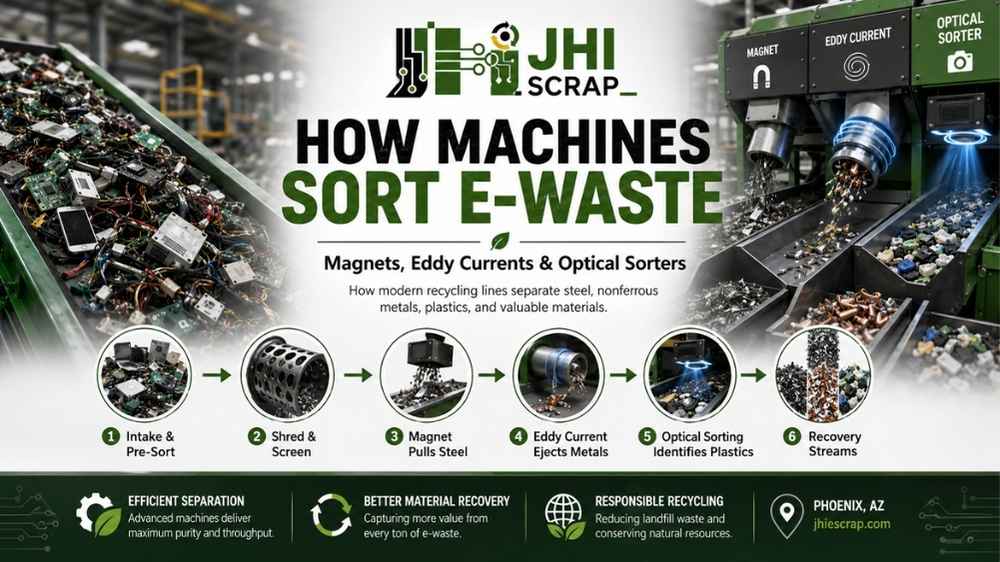
Machines sort e-waste by exposing different material traits in a planned sequence.
Magnets pull steel. Eddy currents eject conductive metals. Optical sensors identify selected plastics and objects. That short answer sounds tidy. Real electronics are anything but tidy. A laptop mixes steel, aluminum, copper, glass, plastics, batteries, and data-bearing parts. In Phoenix, the heat is no joke. Devices may sit inside garages, warehouses, or trailers for months. Good intake practices matter before any machine starts.
Why should a Phoenix business care about the details? The process affects data risk, recovery value, safety, and downstream accountability. Sorting machinery does not make every decision. People inspect loads, remove hazards, and route reusable equipment first. Machines take over when volume and consistency demand speed. The best way to picture the line uses one simple metaphor. The line acts like a relay team. Each machine hands a cleaner stream forward. One stage cannot replace another. A magnet cannot identify plastic resin. An optical sorter cannot certify data destruction. An eddy separator cannot safely manage a battery.
For a broader overview, see how e-waste recycling works from intake through recovery. This article goes deeper into the sorting machinery. Phoenix organizations also need a practical takeaway. Better preparation creates cleaner loads, clearer pricing, and fewer surprises during pickup or drop-off. By the end, you will know what each machine does. You will also know what it misses. That knowledge makes vendor questions much easier.
How Does the E-Waste Sorting Process Work?
The e-waste sorting process moves from inspection toward increasingly precise separation. Around the Valley, a good route saves time. Loads first enter an intake area. Staff record the source, weight, equipment type, and handling needs. Business loads may need asset records or special security controls. Working devices may leave the recycling path entirely. Reuse often preserves more value than immediate destruction. Resale also avoids unnecessary material processing.
Data-bearing equipment follows a separate security decision. Drives may be sanitized, physically destroyed, or held under controlled custody. Sorting machines cannot prove that work happened. Next, staff remove batteries, lamps, toner, and other problem items. Large metal frames may also come off early. This protects workers and downstream equipment. Selected devices then enter dismantling or size-reduction steps. Shredders open cases and free attached materials. Screens separate pieces into useful size ranges. Ferrous separation usually follows. Magnets pull iron and steel from the moving stream. Cleaner remaining material then reaches nonferrous separation.
An eddy current unit ejects conductive nonferrous pieces. Aluminum, copper, and some brass can take a different path. Results depend on size, shape, and feed control. Optical or sensor-based equipment can refine remaining streams. Cameras and spectral sensors classify chosen targets. Timed air jets push identified pieces into another chute. Air, density, and electrostatic systems may add more cleanup. The exact line depends on equipment mix and final buyer requirements. Every stage creates at least two outputs. One stream contains the target. Another stream continues for more sorting or responsible downstream processing.
That sequence explains why no single machine deserves all the credit. Good recovery comes from coordinated preparation, separation, testing, and quality checks.
Why Does Sorting Start Before the Shredder?
Sorting starts before shredding because some items need protection, security, or special handling. Looking before leaping pays off. A complete server may hold resale value. Shredding it first destroys that option. A trained evaluator can identify reusable units, parts, and components. Storage devices also carry a different kind of value. They may contain payroll files, client records, medical data, or design documents. Material sorting does not remove those obligations.
A formal IT asset disposition plan connects inventory, data handling, reuse, recycling, and reporting. That plan should begin before equipment leaves the site. Batteries deserve early attention. Damaged lithium batteries can create heat and fire risks. They should not travel loosely inside a mixed load. Workers also remove mercury lamps, toner cartridges, and certain displays when needed. Each item follows a route suited to its material and hazard profile. The U.S. EPA maintains guidance on sustainable management of electronics and batteries. That guidance supports careful collection, storage, and recycling decisions.
Pre-sorting also improves machine performance. A tangled cable bundle can wrap around shafts. Large steel frames can overload smaller processing stages. Clean categories often produce clearer value. Sorted circuit boards differ from power supplies, aluminum housings, and mixed peripherals. Buyers price these streams differently. The guide to what happens to your electronics explains reuse, donation, recycling, and data safety choices.
Phoenix businesses can help before pickup. Build an asset list. Separate loose batteries. Flag swollen packs. Keep damaged items away from heat. Useful intake details include device type, count, condition, and storage location. Photos may help a recycler plan labor, containers, and transportation. Do not open battery packs or puncture cells. Do not smash drives for convenience. Ask the recycler for a safe preparation plan. Pre-sorting protects value while reducing avoidable risk. It also creates a cleaner starting point for every machine downstream.
What Do Shredders and Screens Do First?
Shredders and screens expose materials and control particle size before precise sorting begins. Small steps cross big desert country. Electronics hide valuable material inside cases and assemblies. Copper may sit inside motors or cables. Steel screws may hold plastic shells together. A shredder applies cutting, tearing, or impact forces. The goal is liberation. Materials must separate enough for later machines to recognize their traits. More shredding is not always better. Tiny mixed particles can become harder to sort. Excess dust can also reduce value and increase housekeeping needs.
Operators balance opening force against over-grinding. That balance changes across computers, printers, telecom gear, and industrial controls. After size reduction, screens divide material by dimension. Small pieces fall through openings. Larger pieces continue toward another screen or pass. Size control improves separation. A uniform layer moves more predictably across belts. Similar pieces also respond more consistently to magnetic and air forces. Feed depth matters too. Overlapping pieces can hide targets from sensors. Thick material beds can also block magnetic access.
A steady feeder spreads material before the next machine. Vibration may loosen clusters. Belt speed then establishes a controlled presentation. Dust collection supports worker safety and equipment care. Enclosures and extraction systems can capture fine particles. Good housekeeping also protects optical lenses. Shredding does not finish recycling. It prepares a mixed stream for targeted separation. Think of it as opening the package before sorting the contents. Processors may use manual dismantling instead of broad shredding for selected equipment. High-value boards and parts can be removed with less contamination. The right preparation depends on the incoming mix. A business recycler may handle whole assets differently from a large commodity processor.
Good liberation creates recoverable pieces without turning everything into dust. Screens then give later machines a fair chance.
How Do Magnets Separate Steel and Iron?
Magnets remove ferrous metals because iron and most steels respond strongly to magnetic fields. This is no flash in the pan. An overband magnet can hang above a conveyor. It lifts magnetic pieces from the moving stream. A separate belt carries those pieces away. A magnetic drum uses another arrangement. Material passes near a rotating magnetic surface. Ferrous pieces follow the drum longer than other material.
Pulley magnets can sit inside a conveyor head. Steel follows the belt around the pulley. Nonmagnetic material falls along a different path. These systems recover chassis parts, screws, brackets, and steel shielding. They may also capture iron-rich fragments from motors and transformers. Magnets work best when material is spread evenly. Deep piles can bury small steel pieces. Moisture, tangles, and clumps can also reduce access.
Magnetic strength and distance both matter. A wide gap weakens the pull. Belt speed changes how long a target feels that force. Ferrous removal protects later equipment. Steel can heat near an eddy current rotor. It can also contaminate nonferrous products. Not every shiny metal responds to a magnet. Aluminum and copper usually pass this stage. That fact sets up the next separation step.
Stainless steel behavior varies by alloy and processing history. Some grades respond weakly. Others show stronger attraction after cold working.
Operators check the recovered steel stream for unwanted material. They also inspect the remaining stream for missed ferrous pieces.
Phoenix dust can coat equipment surfaces. Routine cleaning helps maintain stable performance. Inspection schedules matter during busy warehouse cleanouts.
Magnets handle the obvious magnetic fraction quickly and without chemical treatment. Their simplicity makes them valuable early in the line.
How Do Eddy Currents Push Out Nonferrous Metals?
Eddy current separators repel conductive nonferrous metals using a rapidly changing magnetic field. One person’s trash can hold real material value.
The machine usually sits after ferrous removal. A conveyor carries mixed pieces toward a fast magnetic rotor. The rotor turns inside the head pulley.
As aluminum enters the changing field, circulating electrical currents form inside it. Those currents create their own magnetic field.
The new field opposes the source field. The conductive piece receives a brief push. Its path extends farther from the conveyor.
Plastic, glass, and many other nonconductive pieces receive no comparable push. They fall closer to the belt. A splitter divides the paths.
The splitter creates a fork in the road. One bin collects the ejected fraction. Another bin collects the material that falls normally.
A basic eddy current separator can recover aluminum, copper, brass, and other conductive metals. Results still vary.
Particle size affects the force. Very small pieces carry less mass and weaker induced currents. Irregular shapes also change flight paths.
Conductivity and density influence separation. Aluminum often responds strongly for its weight. Dense copper may travel differently under the same settings.
Feed rate matters. A crowded belt creates collisions. Those collisions can knock targets into the wrong chute.
Rotor speed, belt speed, splitter position, and particle spacing require tuning. Operators watch purity and recovery together.
High purity means the target bin contains little contamination. High recovery means few targets escaped. Improving one measure can sometimes reduce the other.
Repeat passes may improve results. The first pass removes easy targets. A second pass can clean the concentrate or recover misses.
Could one machine sort everything? No. Eddy currents cannot identify every alloy or remove every precious metal.
Printed circuit boards contain metals inside complex laminates. Eddy systems may concentrate certain fractions. Refiners still need later metallurgical steps.
Ferrous removal must happen first. Steel near the rotor can heat or behave unpredictably. Upstream magnets protect both quality and equipment.
Eddy current separation is fast, dry, and contact-light. It turns conductivity into a useful sorting signal.
How Do Optical Sorters Recognize E-Waste?
Optical sorters identify selected objects or materials by reading light and image signals. In Arizona sunshine, looks can still fool you.
An optical unit usually starts with controlled lighting. A camera or spectral sensor scans a thin material layer. Software compares each reading with trained targets.
Visible cameras can detect color, shape, edges, labels, and surface features. They may recognize whole objects or selected component classes.
Near-infrared sensors read reflected wavelengths beyond human vision. Different polymers can produce different spectral patterns. Those patterns support resin classification.
Short-wave infrared systems extend that idea across another wavelength range. Their usefulness depends on sensor design, target material, and surface condition.
A spectral signature works like a fingerprint. The machine compares measured patterns with known examples. It then assigns a likely class.
After identification, the controller tracks the target across the belt. Air valves open at a precise moment. A jet moves the piece into another chute.
Timing must match belt speed and object position. Late air misses the piece. Early air can strike nearby material.
Spacing helps accuracy. Overlapping flakes can hide surfaces. A thick layer can make one object look like several.
Clean lenses and stable lighting also matter. Dust changes readings. Shadows, glare, labels, and coatings can confuse visible systems.
Standard near-infrared tools may struggle with black plastics. Carbon-rich pigments absorb much of the useful light. Alternative sensors or manual checks may help.
Flame-retardant plastics create another challenge. Resin type alone does not prove additive content. Specialized testing may be required.
Some systems combine visible and spectral data. The software can use appearance and chemistry together. This may improve classification for selected streams.
Machine learning can support object recognition. Models need representative training data. A model trained on bottles will not automatically understand circuit boards.
Optical sorters do not judge business value alone. A clean housing may look recyclable. Reuse technicians may still prefer the whole device.
They also do not erase data. A camera may identify a hard drive. It cannot certify sanitization or physical destruction.
Quality teams sample output bins. They measure contamination and missed targets. Results guide lighting, belt, air, and model adjustments.
Optical sorting adds flexible recognition after mechanical separation creates visible targets. It works best with clean presentation and clear goals.
What Other Machines Support the Sorting Line?
Air, density, and electrostatic systems separate traits that magnets and cameras cannot fully handle. It takes all kinds across the Valley.
Air classifiers use airflow to separate lighter pieces from heavier ones. Foams, films, and thin plastics move differently from dense metal fragments.
A zigzag classifier sends material through a rising air stream. Light pieces travel upward. Heavy pieces fall against the flow.
Gravity tables combine vibration and air. Pieces settle by density and movement. Operators can create heavy and light fractions.
Electrostatic separators use differences in electrical behavior. Conductive and nonconductive particles charge or discharge differently. Their paths can then diverge.
These systems often need tight particle sizes. Mixed shapes create noisy results. Dry, clean material usually behaves more predictably.
Sensor-based X-ray tools can read density or elemental clues. They support selected metal and plastic tasks. Not every electronics recycler uses them.
Robotic pickers may remove larger known objects. A vision system locates the target. A mechanical arm places it into a chosen bin.
Manual picking remains useful near automated stages. People can remove tangles, hazards, and unusual items. They also catch problems machines were never trained to see.
The larger guide to e-waste recycling methods explains how mechanical and downstream methods connect.
Equipment choices depend on volume and buyers. A local collector may dismantle and consolidate material. A specialized processor may run advanced separation lines.
That difference is normal. Responsible recycling depends on controlled downstream partners, not ownership of every machine.
Supporting machines fill specific gaps rather than replacing the core sequence. Their value comes from clean inputs and clear output standards.
What Do Sorting Machines Miss?
Sorting machines miss hidden hazards, mixed materials, unusual devices, and unclear business context. No machine rides alone on this range.
A battery can hide inside a small gadget. A shredder sees only resistance. A trained worker recognizes the device and removes it first.
A camera sees surfaces. It may not detect an embedded metal insert. It may also misread dirt, paint, or a printed label.
Magnets respond to magnetic behavior. They do not know whether a piece belongs with reusable equipment. They also cannot identify confidential assets.
Eddy separators respond to conductivity. They may miss tiny copper wires or dense pieces. They can also eject unwanted conductive contamination.
Optical models reflect their training data. New product designs can surprise them. Rare industrial parts may look unlike common consumer devices.
People provide context. They can read asset tags, recognize damaged batteries, and route specialized equipment. They also verify machine output.
Sampling supports that verification. Staff pull material from finished bins. They compare target content against contamination.
Mass-balance checks add another view. Incoming weight should relate sensibly to outgoing fractions. Large unexplained gaps deserve review.
Maintenance changes quality too. Worn belts alter trajectories. Blocked air nozzles weaken ejection. Dirty sensors produce unstable readings.
Operators track purity, recovery, throughput, downtime, and reject rates. These measures expose different problems. One number never tells the whole story.
Human review is not a failure of automation. It is part of controlled processing. The best lines combine repeatable machines with informed judgment.
Data destruction needs its own evidence. An output bin cannot prove which drive was sanitized. Businesses should request records that match their policy.
Downstream accountability also remains essential. A clean metal fraction still needs a qualified buyer. Mixed residues need documented, responsible handling.
Machines create consistency at scale. People protect the exceptions that carry the greatest risk. Both roles matter.
Where Do the Sorted Materials Go Next?
Sorted materials move to reuse markets, commodity processors, smelters, refiners, or specialized downstream facilities. Every drop counts in the desert.
Ferrous metal can move to steel recycling markets. Clean aluminum may enter nonferrous recovery channels. Copper-rich fractions often receive separate valuation.
Printed circuit boards usually require specialized processing. Smelters or refiners can recover copper and precious metals. Mechanical sorting mainly prepares a concentrated feed.
Plastic fractions need resin and additive control. Clean, known polymers offer better recycling options. Mixed or contaminated plastics may need other responsible routes.
Glass treatment depends on type and contamination. Display glass can differ from ordinary container glass. Specialized processing may be necessary.
Reusable equipment follows a different path. Technicians test condition, function, and market demand. Data controls must be complete before resale.
Parts harvesting can preserve value from damaged equipment. Memory, power supplies, processors, and boards may find secondary use. Testing protects buyers.
Residues deserve attention too. No mechanical line captures every useful gram. Responsible processors document how remaining material is handled.
Good downstream management includes vendor review, shipping records, and acceptance terms. Certification may help, but documents must match actual practice.
Businesses should ask what reports they receive. Asset lists, weight tickets, data records, and settlement details serve different purposes.
Environmental claims should stay specific. Phrases like responsible recycling need supporting controls. Clear material routes build stronger trust.
Local consolidation can reduce unnecessary transport. Larger commodity loads may also improve processing economics. Routing depends on material, volume, and buyer access.
Sorting creates cleaner streams that downstream specialists can process more effectively. The final value comes from the entire chain.
How Does Phoenix Heat Change E-Waste Preparation?
Phoenix heat makes cool storage, battery isolation, and quick scheduling more important. The Valley sun gives no free passes.
Do not leave damaged electronics inside a parked vehicle. Interior temperatures can climb quickly. Batteries and displays deserve extra care.
Store e-waste indoors when possible. Choose a dry area away from direct sunlight. Keep exits, sprinklers, and electrical panels clear.
Place loose batteries in suitable, separate containers. Protect terminals when the recycler directs. Never pile swollen packs with ordinary equipment.
Flag devices with heat damage, punctures, odors, or swelling. Tell the recycler before arrival. That notice supports safer planning.
Dust also matters. Open warehouse doors can coat devices and labels. Covered pallets help preserve asset identification and reduce cleanup.
Large office refreshes need staging space. Separate reusable equipment from scrap. Keep data-bearing assets in a controlled area.
Apartment and property cleanouts bring mixed conditions. Electronics may share boxes with lamps, chemicals, or trash. Separate those categories before transport.
Schools may have carts of laptops and chargers. Offices may have servers, monitors, and networking gear. Each group needs different packing.
Call before visiting JHI. Public access is by appointment. JHI operates weekdays from 8:00 a.m. through 4:30 p.m.
The Phoenix facility is at 3334 W McDowell Road, Unit 17. Confirm acceptance, timing, and unloading needs before travel.
Nearby sites in Tempe, Mesa, Scottsdale, Glendale, and other Valley cities can plan consolidated pickups. Volume and equipment type affect logistics.
A short storage plan can prevent a hot mess. It also helps the recycler quote and schedule correctly.
What Should a Phoenix Business Ask an E-Waste Recycler?
A Phoenix business should ask about data, pricing, logistics, downstream routes, and proof. Trust is good, but secure the load.
Start with accepted items. List computers, servers, drives, monitors, printers, batteries, cables, and industrial equipment. Ask about exclusions or fees.
Next, explain the volume and location. Pallet counts, stairs, docks, and loading access affect labor. Photos can prevent surprises.
Ask how reuse decisions are made. Working equipment may hold value. The recycler should explain testing, resale, and data controls.
Data handling needs exact language. Ask whether drives are wiped, destroyed, or returned. Request the method and available documentation.
Pricing should be clear before the truck moves. Some material has value. Other items create labor, freight, or treatment costs.
A fair quote should explain assumptions. Weight, condition, market value, contamination, and pickup distance can change the result.
Ask who receives separated materials. You may not get every vendor name. You should still understand the downstream control process.
Request documentation that fits your needs. A household cleanout differs from a healthcare facility. A manufacturer differs from a school.
Use this checklist during calls:
- Which items do you accept, and which require special handling?
- How do you protect data-bearing assets during transport and storage?
- What data destruction options and records are available?
- How do you decide between reuse, parts recovery, and recycling?
- Which costs could change after inspection?
- How are weights, settlements, and recovered values reported?
- How do you review downstream processors?
- Can you handle a one-time project or recurring pickups?
- Is an appointment required for drop-off?
- Who should receive the final project records?
Listen for concrete answers. Vague promises create risk. Clear scope, written pricing, and named records build confidence.
Do not choose solely by the word free. A free pickup can still hide poor reporting. A high-value load may even deserve payment.
Service fit matters more than slogans. A homeowner, office manager, and factory buyer have different loads. The plan should reflect that.
The best recycler makes the process understandable before pickup day. That clarity protects budgets, schedules, data, and reputation.
How Can JHI Scrap Help With a Phoenix Electronics Project?
JHI can evaluate electronics, industrial surplus, IT assets, and recovery options before processing begins. Good Valley neighbors keep their word.
JHI Scrap has managed industrial electronic surplus in Phoenix since 1980. Its focus includes recycling, ITAD, excess inventory, test equipment, and components.
That mix matters because not every device belongs in a shredder. Some equipment may support resale, parts recovery, or surplus liquidation.
JHI can review the material type and expected volume. The team can also discuss pickup, appointment-based drop-off, and available evaluation options.
Business equipment may need inventory and data planning. Industrial items may need market review. Mixed e-scrap may need sorting before final settlement.
Upfront photos and lists help. Include model types, counts, condition, and pallet details. Mention batteries, displays, and data-bearing media.
JHI’s Phoenix address supports local coordination across Maricopa County. Weekday hours help offices schedule around normal operations.
Pricing depends on the actual load. Marketable components can hold value. Freight, labor, contamination, and special handling can affect the quote.
Clear planning reduces surprises on pickup day. It also protects reusable value before material recovery begins.
Ready for a simple next step? Request a free evaluation or schedule a pickup. Call (602) 272-4033 before visiting.
JHI is open to the public by appointment only. Confirm current acceptance details and unloading instructions during the call.
Frequently Asked Questions About E-Waste Sorting Machines
These answers cover the most common machine questions in plain language. When the dust settles, clear answers matter.
Can a magnet remove copper from e-waste? No. Copper is not strongly ferromagnetic. It usually passes toward nonferrous or density separation.
Does an eddy current separator attract aluminum? It usually repels aluminum from the normal falling path. The changing field induces currents inside conductive metal.
Can optical sorters identify every plastic? No. Dark color, dirt, coatings, additives, and mixed layers can reduce accuracy.
Can standard near-infrared sensors see black plastic? They often struggle because black pigments absorb useful reflected light. Other sensors may help.
Do sorting machines erase data from drives? No. Data sanitization or physical destruction needs a separate controlled process and record.
Are lithium batteries shredded with other electronics? Responsible intake aims to remove them first. Damaged batteries need separate, careful handling.
Does every recycler operate every machine described here? No. Many recyclers consolidate material for specialized downstream processors.
Can a machine recover gold from a circuit board? Mechanical machines can concentrate board fractions. Specialized refiners recover metals through later processes.
Why are screens important before magnets? Screens create useful size ranges. Similar pieces respond more consistently to magnetic and physical forces.
What is the main optical sorting signal? The signal depends on the system. Cameras read appearance, while spectral sensors read reflected wavelengths.
How accurate are e-waste sorting machines? Accuracy varies by feed, target, equipment, tuning, and maintenance. Ask for quality controls, not one universal percentage.
What should a Phoenix business do first? Inventory the equipment. Isolate problem batteries. Then request an evaluation before moving the load.
Can working equipment skip mechanical processing? Yes. Testing, reuse, resale, or parts harvesting may preserve more value.
Why does human sorting remain necessary? People recognize unusual items, hidden hazards, and business context. They also verify machine output.
What documents should a business request? Ask for records matching the project. Common needs include inventories, weights, settlements, and data records.
The Smartest E-Waste Sorting Starts With a Better Intake
Machines sort e-waste well when people give them safe, visible, and consistent material. Around here, we finish what we start.
Magnets remove ferrous metals. Eddy current separators eject conductive nonferrous pieces. Optical systems identify chosen objects or material classes.
Shredders and screens prepare the stream. Air and density tools refine it. People remove hazards, protect data, and check results.
That sequence protects more than metal value. It supports safer work, clearer reporting, and better downstream decisions.
Phoenix businesses can improve the process before pickup. Keep equipment indoors. Separate batteries. Build an inventory. Flag data-bearing devices.
A strong recycler should explain the route in plain language. You should understand services, pricing factors, security steps, and documentation.
Need help with a Phoenix load? Request a free evaluation or schedule a pickup with JHI. Call (602) 272-4033 before visiting.
JHI’s public access is appointment only. A short call can confirm acceptance, timing, and the easiest handoff.