
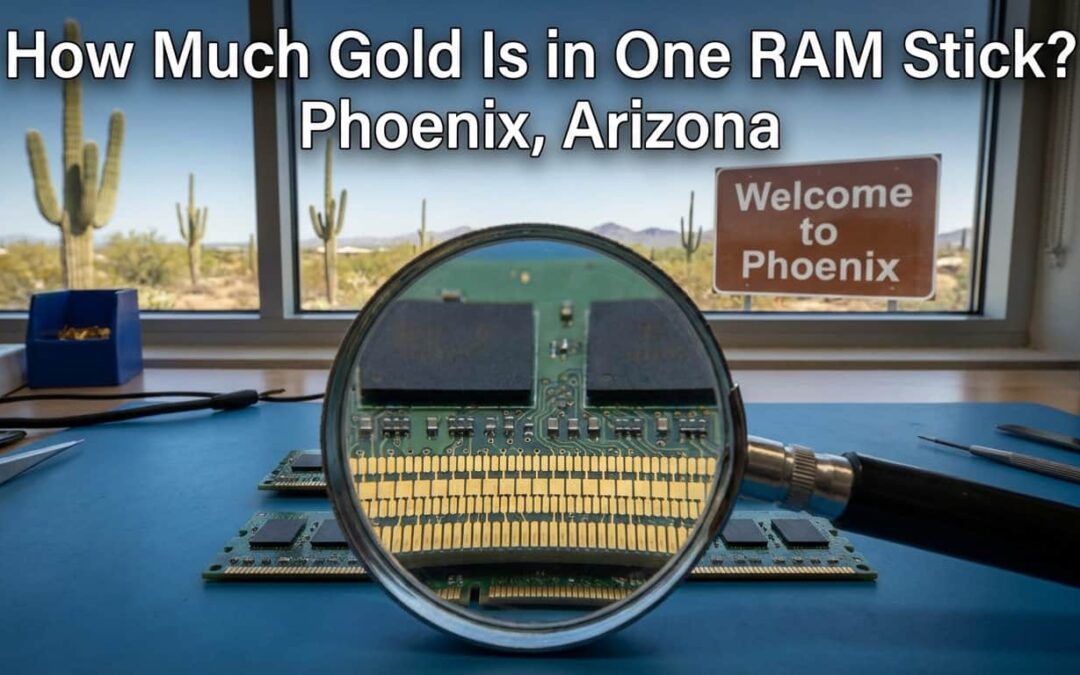
How Much Gold Is in One RAM Stick in Phoenix, Arizona
Ever looked at an old RAM stick and thought, “Is this worth anything?”
You’re not alone.
Hidden inside your junk drawer could be real gold. Not much but enough to matter, especially if you’ve got a pile of old electronics gathering dust.
Phoenix has a growing e-waste recycling scene. Locals are waking up to the fact that scrapped tech isn’t garbage. It’s raw material. And RAM sticks? They’re quietly holding precious metal that recyclers are happy to buy.
Even tiny gold traces add up and Phoenix recyclers know it.
Phoenix, AZ Gold Content Estimates in a Single RAM Stick
Here’s the truth: RAM sticks contain gold. But we’re talking flakes, not nuggets.
Most RAM modules hold between 0.04 to 0.2 grams of gold per stick. Server-grade or vintage RAM tends to land on the higher end. Consumer DDR3 or DDR4? Usually closer to 0.04–0.1 grams.
Why so little? Manufacturers use ultra-thin gold plating on contact points. Gold conducts electricity well and resists corrosion. But it’s expensive, so they use just enough to do the job.
In milligrams, that’s roughly 40–200mg per module. At current gold prices (around $2,000 per troy ounce), a single stick might hold $2.50 to $12.80 worth of gold — depending on type, age, and plating thickness.
That doesn’t sound like much. But if you’ve got 50 old sticks? Suddenly you’re looking at real money.
Phoenix e-waste facilities process RAM in bulk. They’re not chasing individual modules. They’re buying by the pound, refining in batches, and recovering gold at scale.
You don’t dig a well when you’re already thirsty — know your RAM’s value before tossing it.
Typical Gold Amount per RAM Module
Most RAM modules contain 0.04 to 0.2 grams of recoverable gold. Server sticks and older DDR2 memory tend to have more. Modern DDR4 and DDR5? Less.
It’s not a gold mine but it’s not worthless either.
The gold is visible on the contacts (those shiny edge strips). The rest hides inside the chips themselves, in microscopic wiring you can’t see without magnification.
Why Gold Content Is Very Small per Stick
Gold’s expensive — and manufacturers hate waste.
RAM designers use the thinnest possible gold plating to save costs. Modern manufacturing standards aim for 10–15 microinches of gold on contact surfaces. Vintage sticks from the 1990s and early 2000s? Those used 30–50 microinches.
Thinner plating equals cost savings. It also means less recoverable gold per module.
That’s why bulk recycling matters. One stick won’t make you rich. A hundred might cover lunch.
Average Milligram Estimates per Module
Think flakes, not nuggets.
Most RAM sticks contain between 40mg and 200mg of gold. Server RAM and ECC modules tend toward the higher end. Consumer-grade DDR3 and DDR4 sit closer to 40–80mg.
A milligram is tiny. But when you’re processing pounds of RAM, those milligrams stack up fast.
Gold Content by Weight and Market Value
Let’s do the math.
At $2,000 per troy ounce, one gram of gold is worth roughly $64. If your RAM stick has 0.2 grams, that’s $12.80 in gold.
Here’s a quick breakdown:
- 0.04g gold = ~$2.56
- 0.1g gold = ~$6.40
- 0.2g gold = ~$12.80
Would you throw away $12 without blinking?
Now multiply that by however many sticks you’ve got in storage. Gold prices fluctuate, but the metal doesn’t disappear. If gold hits $2,200/oz, your 0.2g stick jumps to $14.08.
Gold per RAM Module (Average)
Not all sticks shine equally.
On average, consumer RAM yields 0.05–0.1 grams of gold. Server modules? Closer to 0.15–0.2 grams. Vintage DDR and SDRAM? Sometimes even more.
The thicker the plating, the higher the yield. Industrial and military-grade components can surprise you with extra layers of gold.
Gold per RAM Module (Academic Analysis)
According to a 2022 study from the University of New South Wales, urban mining — recovering metals from e-waste — yields far more gold per ton than traditional ore mining. Researchers found that one ton of circuit boards (including RAM) contains approximately 300 grams of gold. Compare that to mined ore, which averages 5 grams per ton. RAM alone doesn’t hit those numbers, but it’s part of a larger recovery ecosystem. Academic data backs what scrappers already know: electronics are gold mines in disguise.
Value of Gold per RAM Stick
How much is your drawer full of RAM worth? If you’ve got 10 sticks averaging 0.1g each, that’s 1 gram total — roughly $64 in gold at current prices. Bulk pricing is different. Scrap buyers won’t pay spot price. They’ll offer 40–60% of melt value to cover refining costs. So your $64 in gold might fetch $25–$40 cash. Still better than nothing. And if you’re sitting on 100+ sticks, the numbers get more interesting.
RAM Gold Content vs Gold Ore
Why dig a mountain when your old laptop’s got gold? Traditional gold ore yields about 5 grams per ton. E-waste? Closer to 300 grams per ton when you factor in circuit boards, RAM, and connectors. RAM isn’t the richest source in that mix. But it’s part of the equation. And it’s a lot easier to collect old RAM than to dig a mine. Urban mining is real. And Phoenix recyclers are proof.
Gold Value at Different Market Prices
Gold’s rising so is the value in your junk drawer.
Here’s how gold price swings affect your RAM stash:
| Gold Price per Oz | 0.1g RAM Value | 0.2g RAM Value |
| $1,600 | $5.14 | $10.28 |
| $1,800 | $5.78 | $11.57 |
| $2,000 | $6.43 | $12.86 |
| $2,200 | $7.07 | $14.14 |
The higher gold climbs, the more your old tech is worth. Timing your scrap sale around price spikes can boost returns.
Where Gold Is Found in RAM Sticks in Phoenix, AZ Electronics
It’s like finding gold thread woven through plastic small, but there. Gold in RAM isn’t randomly scattered. It’s concentrated in specific spots, all designed to improve electrical performance and prevent corrosion. If you’re looking to scrap RAM or just curious here’s where the gold hides.
Gold Fingers (Contacts)
Like teeth at the edge of RAM and just as valuable to scrappers. The gold fingers are the shiny contact strips along the bottom edge of every RAM stick. They plug into your motherboard and carry electrical signals. You can see the gold plating with your naked eye. It’s usually a yellowish sheen, though some sticks look more silver due to nickel undercoating. These edges are what recyclers chase. They’re easy to clip off, stack, and process in bulk batches.
Edge Connectors (“Gold Fingers”)
Same part, different name. In the recycling industry, people call them edge connectors. In tech circles, they’re gold fingers. Either way, they’re the most accessible gold on a RAM stick. Heavily plated in vintage and server sticks. Thinner in modern consumer RAM.
Gold in RAM Chips (Integrated Circuits)
You can’t see it but inside every chip hides another layer of value. RAM chips use gold bonding wires to connect internal circuits. These wires are microscopic, finer than a human hair, but they’re pure gold. Most DIY scrappers ignore this part. It’s too hard to extract without industrial equipment. But professional recyclers crush and refine the chips to recover the internal gold.
Internal Bonding and Contacts
Gold veins thinner than hair, hidden deep in silicon caves. Inside each integrated circuit, tiny gold wires bond the chip die to its external pins. You won’t see these unless you crack open the chip under a microscope. These wires account for a small but real portion of the total gold content. Professional refiners recover it. Home scrappers usually don’t bother.
Variability by Type
Not all RAM is built the same and neither is its gold content. Server RAM uses thicker plating and more complex contact designs. More layers, more gold. Consumer DDR3/DDR4 uses minimal plating to cut costs. Less gold, but still worth scrapping in bulk. Vintage SDRAM and SIMM modules from the 1990s? Those were built like tanks. Heavier plating, higher yields. Phoenix, AZ Factors That Influence Gold Content in RAM Modern RAM is lean and fast. Old RAM? Heavy and full of gold. Not all RAM sticks are equal when it comes to scrap value. Age, design, and manufacturing standards all play a role. If you’re scrapping RAM in Phoenix, knowing these factors helps you separate the winners from the duds.
Age and RAM Type (DDR2, DDR3, Server RAM)
The older the stick, the shinier the story. DDR and DDR2 modules from the early 2000s tend to have thicker gold plating than modern DDR4 or DDR5. Manufacturers were less cost-conscious back then. Server RAM (ECC, registered modules) also uses more gold. These sticks are built for reliability, not cheapness. Modern consumer RAM (DDR4, DDR5) uses minimal plating. Faster, cheaper, lighter — but lower scrap value.
| RAM Type | Typical Gold Content |
| DDR/DDR2 | 0.1–0.2g |
| DDR3 | 0.05–0.1g |
| DDR4/DDR5 | 0.04–0.08g |
| Server/ECC | 0.15–0.25g |
Manufacturing and Gold Plating Thickness
More microns = more money. Gold plating is measured in microinches (millionths of an inch). Vintage RAM used 30–50 microinches. Modern sticks? Closer to 10–15 microinches. Thicker plating doesn’t just mean more gold. It also means better corrosion resistance and longer lifespan. Industrial and military-grade components sometimes use even heavier plating. If you find old server or aerospace RAM, hold onto it.
Impact of Age and Manufacturing Standards
Built like a tank and priced like treasure. Older manufacturing standards prioritized durability over cost efficiency. That meant more raw materials, including gold. Modern standards are all about lean production. Less waste, less gold, lower manufacturing costs. For scrappers, that means vintage RAM is often more valuable than newer modules — even if the newer ones are faster.
Server-Grade vs. Consumer-Grade Components
One server stick can beat five home-use modules in gold yield. Server RAM is designed for 24/7 operation in data centers. It needs to resist corrosion, handle high loads, and last years without failure. That means thicker plating, more layers, and extra components like ECC chips. All of that adds recoverable material. Consumer RAM is built for budget buyers. Thin plating, minimal layers, just enough gold to function. If you’re buying RAM to scrap, prioritize server pulls over desktop upgrades.
Differences Between Modern, Vintage, and Server RAM
Know what you hold not all sticks are created equally (or profitably).
Here’s a quick comparison:
- Vintage (1990s–early 2000s): Heavy plating, SIMM/SDRAM modules, high yield per stick.
- Server (ECC, registered): Thick contacts, multiple chips, built for reliability, great scrap value.
- Modern consumer (DDR4/DDR5): Thin plating, lightweight design, lower yield but still worth scrapping in bulk.
If you’re sorting a pile of old RAM, separate by type. Sell server and vintage separately for better pricing.
Phoenix, AZ Bulk Gold Recovery Yields From RAM Recycling
One RAM stick’s trash is ten RAM sticks’ treasure. Gold recovery isn’t a one-stick game. It’s about volume. Phoenix recyclers don’t chase individual modules. They buy by the pound, refine in batches, and recover gold at scale. Here’s what that looks like.
Estimated Gold Yield per Pound of RAM
1 pound may not feel heavy but the profit sure does. A pound of mixed consumer RAM (DDR2/DDR3/DDR4) typically yields 0.8 to 1.2 grams of gold. Server RAM? Closer to 1.5 grams per pound. At $2,000/oz, that’s $51–$77 per pound in raw gold value. Scrap buyers will offer $20–$40/lb after factoring in refining costs. Still, if you’ve got 10 pounds of old RAM, you’re looking at $200–$400 cash.
Estimated Gold Yield per Kilogram of RAM
For metric minds: 1 kg = 2.2x the value of 1 lb RAM. A kilogram of RAM yields roughly 1.8 to 2.6 grams of gold (depending on type). That’s $115–$167 in raw gold at current prices. Bulk scrap pricing? Expect $45–$85/kg from buyers. Phoenix facilities that process tons of e-waste work in kilograms. If you’re serious about scrapping, weigh your haul and do the math.
Value per Stick at Current Gold Prices
Each stick is a dollar bill hiding in a drawer.
At $2,000/oz gold, here’s what individual sticks are worth in raw gold:
- Consumer DDR3/DDR4: $2–$6
- Server ECC RAM: $8–$12
- Vintage SDRAM: $10–$15
Scrap buyers pay less than melt value. Figure 40–60% of the numbers above for actual cash offers.
Still, that beats throwing them away.
Why RAM Is More Valuable in Bulk Recycling
Like aluminum cans, the magic’s in the masses. Extracting gold from a single RAM stick costs more than the gold is worth. You’d lose money on chemicals, tools, and time. But 100 sticks? That’s when the math flips. Bulk recyclers process thousands of pounds at once. They use industrial-scale refining methods. Their cost per gram drops. Their profit margins rise. That’s why they’re willing to buy your old RAM by the pound. Individual recovery is a loss. Bulk recovery is profitable.
Gold Recovery as Part of E-Waste Recycling Streams
RAM rides shotgun in a gold-laced convoy of circuit boards. Recyclers don’t just process RAM. They handle motherboards, CPUs, hard drives, connectors, and power supplies — all of which contain gold, silver, copper, and palladium.RAM is part of a larger precious metal recovery stream. It gets sorted, crushed, and refined alongside other PCBs (printed circuit boards). The combined yield is where the real money lives.
Individual Yield Is Small
Expecting gold bricks from a chip? Think again. A single RAM stick won’t make you rich. Even a high-yield server module only holds $10–$15 in gold. Home extraction isn’t practical. The chemicals cost more than the gold you’d recover. If you’ve got one or two sticks, reselling working RAM is a better bet. If you’ve got dozens, bulk scrap is the move.
Recycling Economics
Scrap value lives at the intersection of quantity and timing.
Here’s the break-even logic:
- 1–10 sticks: Sell on eBay if they work. If broken, donate or toss.
- 10–50 sticks: Check scrap pricing. Might be worth a trip to a Phoenix recycler.
- 50+ sticks: Definitely worth scrapping. Weigh them, get quotes, time your sale with gold price spikes.
Professional recyclers make money because they operate at scale. They’re buying tons, not pounds. You won’t match their margins. But you can still profit if you’ve got enough volume.
Is Extracting Gold From RAM Profitable in Phoenix, AZ?
It’s not fool’s gold but the fool might chase it solo. Can you extract gold from RAM at home? Yes.
Should you? Probably not.
The gold is real. But the costs chemicals, safety gear, time, disposal fees usually outweigh the payoff. Unless you’re processing serious volume, DIY gold recovery is a money pit.
Here’s the reality check.
Chemical Costs vs. Recovered Gold Value
The gold is real, but so is the price tag. To extract gold from RAM, you need acids (nitric, hydrochloric), neutralizers, filters, and safety equipment. You’re looking at $30–$60 in chemicals for a batch of 20–30 sticks. If that batch yields 1.5 grams of gold (worth ~$96), and you sell it at 60% of melt value (~$58), you’re left with almost no profit after costs. And that’s assuming you don’t mess up. Mistakes waste chemicals and destroy yields. Professional refiners buy in bulk and reuse chemicals. They make margins you can’t match.
The Importance of Scale for Recyclers
You don’t pan for gold in a puddle. Phoenix e-waste facilities process hundreds of pounds of RAM per day. Their cost per gram plummets at that scale. For a home scrapper? You’d need 100+ sticks just to break even on chemical costs. Unless you’re running a side business and processing weekly batches, it’s not worth the hassle.
Better move: sell your scrap RAM by the pound to a local recycler and let them handle the chemistry.
Phoenix, AZ Selling and Monetizing Old RAM
Why trash what someone might treasure? Before you scrap RAM for gold, ask yourself: does it still work? Working RAM sells for way more than its scrap value. Even older DDR2 and DDR3 modules have buyers retro PC builders, hobbyists, and budget upgraders. Here’s how to squeeze the most value out of your old sticks.
Selling Working RAM vs. Scrapping for Gold
Working RAM is a $30 bill disguised as scrap. A working 8GB DDR3 stick sells for $10–$30 on eBay or Facebook Marketplace. The same stick scrapped for gold? Maybe $3–$5. Even old DDR2 modules have buyers. Retro gamers and server admins need them for legacy builds. Test your RAM first. If it boots and passes MemTest86, sell it as functional. If it’s dead or you’ve got dozens of mixed, untested sticks, bulk scrap is easier.
Where to Sell Scrap RAM by the Pound
Got a drawer full? Phoenix has buyers.
Phoenix-area e-waste recyclers that buy scrap RAM by the pound:
- ERI (Electronic Recyclers International) – Tempe location
- Total Asset Recovery – Phoenix industrial area
- Cash for Laptops Phoenix – buys bulk scrap electronics
Call ahead and ask for current pricing. Rates fluctuate with gold prices. Some buyers require minimum weights (5–10 lbs). If you’re under that, team up with a friend or wait until you’ve accumulated more.
Phoenix, AZ Environmental and Practical Perspectives on RAM Recycling
Recycling RAM saves more than money it saves rivers, too. Gold mining is brutal. It uses cyanide, mercury, and massive amounts of water. It scars landscapes and pollutes waterways. Urban mining recovering gold from e-waste skips all that. You’re pulling gold that’s already been refined. No new mines. No toxic runoff. RAM recycling is a tiny piece of that equation. But every stick you scrap instead of toss is one less bit of electronics in a landfill. Phoenix has a solid e-waste infrastructure. Use it.
Environmental Note
It’s gold without guilt. Mining one ton of gold ore produces about 5 grams of gold and leaves behind mountains of toxic waste. Processing one ton of e-waste yields 300+ grams of gold and keeps hazardous materials out of landfills. RAM is part of that cleaner equation. It’s not just smart economics. It’s responsible disposal. Phoenix, AZ Industry and Educational Use Cases for RAM Gold Data Data isn’t just useful it’s profitable when you know how to use it. You’re not the only one curious about gold in RAM. This info fuels SEO content, buyer guides, educational explainers, and industry reports. Here’s how different groups use RAM gold data.
SEO Topics and Buyer Guides
Gold drives clicks even in tech. Content marketers and affiliate bloggers use RAM scrap data to build local SEO pages and e-waste buyer guides. Keywords like “how much gold in RAM Phoenix” and “sell scrap RAM Arizona” drive targeted traffic from people ready to sell or recycle. If you’re building content, this topic is evergreen and searchable.
E-Waste Recycling Revenue Summaries
Scrap math = serious money. E-waste facilities use RAM gold data for revenue forecasting and pricing models. Knowing the average yield per pound helps them set buy prices and refining schedules. Educational content on this topic also helps potential sellers understand fair pricing.
Urban Mining / Precious Metal Recovery Explainers
Why dig when you can dismantle? Environmental educators and green tech advocates use RAM gold stats to promote urban mining as a sustainable alternative to traditional mining. It’s a talking point in climate discussions and circular economy initiatives.
Industry Reporting on Gold in Electronics
The numbers speak gold. Academic researchers, industry analysts, and government reports reference gold content in electronics to track resource recovery trends and precious metal supply chains. RAM data shows up in studies on e-waste policy, recycling efficiency, and sustainable tech design.
Conclusion on RAM Gold Value and Recycling in Phoenix, AZ
Your old RAM isn’t junk it’s a golden opportunity. Here’s what you need to remember: Most RAM sticks hold $2–$12 worth of gold. Server and vintage modules are worth more. Modern consumer RAM, less. Bulk matters. One stick won’t make you rich. Fifty might cover lunch. A hundred could pay a bill. Working RAM beats scrap. If it boots, sell it. If it’s dead, weigh it and scrap it. Phoenix has buyers. Local e-waste recyclers pay by the pound. Don’t toss what you can sell. And remember: recycling RAM isn’t just about money. It’s about keeping hazardous materials out of landfills and reducing the need for destructive gold mining. Ready to recycle or resell? Clean out that drawer. Weigh your stash. Check gold prices. And make the call. Your old tech is worth more than you think.
Call Jay Hoehl Inc at (602) 272-4033 or visit jhiescrap.com.
We’re located at 3334 W McDowell Rd Ste 17, Phoenix, AZ 85009. We’ll walk you through every step and answer all your questions.