
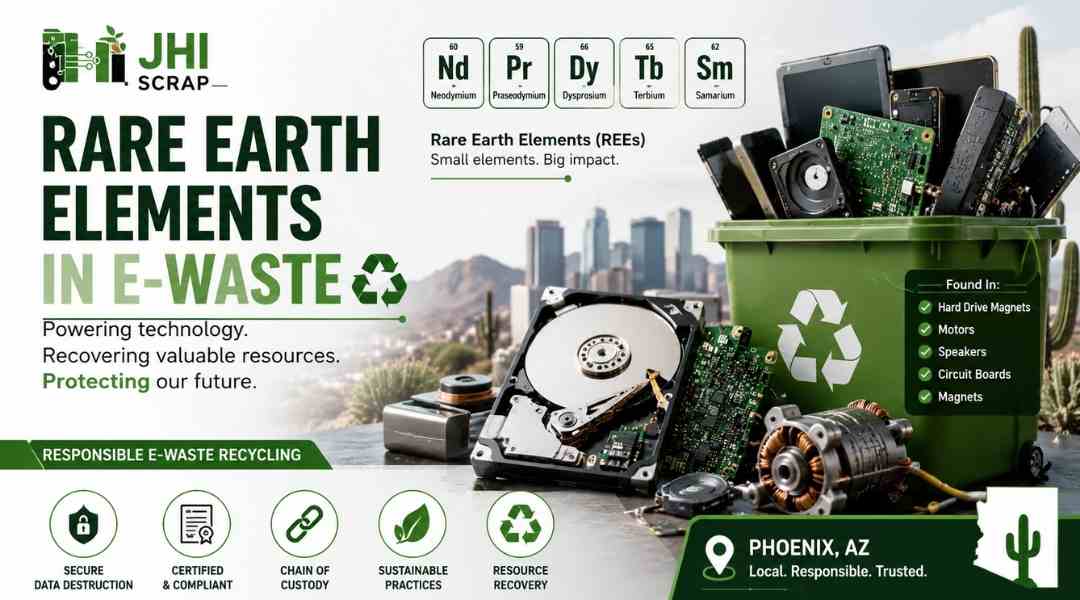
Rare Earth Elements in E-Waste Why Neodymium Matters More Than Gold
Most businesses know old electronics contain gold. Few realize a small hard drive magnet holds one of today’s most strategically important materials. That material is neodymium. It’s a rare earth element, and it powers everything from data centers to electric vehicles.
Here’s the twist. Gold gets all the attention in rare earth elements in e-waste conversations. But the hidden value inside your retired equipment often sits somewhere else entirely. For Phoenix businesses clearing out servers, drives, and industrial gear, that’s worth knowing.
So why does a magnet the size of a matchbook matter so much? Let’s dig in.
Gold Gets Attention, But Neodymium May Matter More
Quick answer: gold has financial value today, while neodymium has technology value for tomorrow. Both matter in e-waste recycling. They just matter in different ways.
Gold is easy to understand. It trades on open markets. Recyclers recover it from circuit boards, connectors, and gold-plated pins. The recovery process is mature, and the payout is predictable. That’s why gold has driven electronics recycling for decades.
Neodymium plays a different game. It doesn’t sell for gold-level prices. Instead, it earns its status through performance. Neodymium magnets make hard drives, motors, and speakers possible at the sizes we use today. No neodymium means bulkier, weaker, less efficient devices.
Governments see the difference too. The U.S. lists rare earth elements as critical minerals because supply chains are concentrated and fragile. Gold recycling is a solved problem. Rare earth supply is not.
| Factor | Gold | Neodymium |
|---|---|---|
| Value type | Financial (market price) | Strategic (technology performance) |
| Where it hides | Circuit boards, pins, connectors | Magnets in drives, motors, speakers |
| Recycling maturity | Well established | Still developing |
| Supply risk | Low | High and government-flagged |
Think of it this way. Gold pays today’s bills. Neodymium powers tomorrow’s technology. A smart e-waste strategy respects both.
What Are Rare Earth Elements in E-Waste?
Rare earth elements in e-waste are a group of 17 metallic elements found inside discarded electronics. They appear in magnets, screens, batteries, and specialized components. Manufacturers rely on them because no other materials perform the same jobs at the same size and cost.
You won’t see rare earths sitting on a circuit board like a gold pin. They hide inside finished components. A hard drive magnet. A speaker assembly. A cooling fan motor. Each one carries a small amount of rare earth material doing a very big job.
Finding rare earths inside electronics is a bit like finding spices in a finished meal. They’re present in small amounts, but they make the whole product work.
Here’s where rare earths typically show up in business equipment:
- Permanent magnets in hard drives, motors, and actuators
- Speakers and audio components in monitors, laptops, and AV gear
- Displays and lighting using phosphor coatings
- Specialized industrial sensors and equipment
One expert note: businesses often overlook these components because recycling conversations focus only on precious metals. The parts with the highest strategic importance rarely look valuable at first glance.
Rare Earth Elements Explained Simply
Rare earth elements (REEs) are 17 metals with unique magnetic, optical, and electronic properties. They include the 15 lanthanides plus scandium and yttrium. Modern electronics depend on them for strength, precision, and miniaturization. Without REEs, your phone, laptop, and server room would look very different. They’re classified as critical minerals because so much of modern technology can’t function without them.
Why “Rare Earth” Does Not Always Mean Rare
Rare earth elements aren’t actually rare in the Earth’s crust. Some are more common than copper or lead. The name comes from how hard they are to find in concentrated, economically minable deposits. Mining them is difficult. Separating them from each other is even harder. That’s the real bottleneck. So “rare” refers to economically recoverable concentrations, not simple abundance. This is also why recycling rare earths from e-waste matters so much for future supply.
Common Rare Earth Elements Found in Electronics
Four rare earth elements do most of the heavy lifting in business electronics:
- Neodymium — the star of high-strength permanent magnets in drives and motors
- Dysprosium — added to magnets so they hold strength at high temperatures
- Praseodymium — often blended with neodymium in magnet alloys
- Terbium — used in magnets, displays, and specialized lighting
If your equipment has a motor, a fan, or a hard drive, it almost certainly contains at least one of these.
Why Phoenix Businesses Should Care
Phoenix has one of the densest concentrations of rare-earth-bearing e-waste in the Southwest. The metro area runs on semiconductors, aerospace, data centers, healthcare, and manufacturing. All of these industries retire equipment loaded with magnets and specialized components. Every server rack, motor bank, and drive array that leaves a Phoenix facility carries materials worth keeping in the recovery stream. Business electronics recycling done right keeps that value local and accounted for.
What Is Neodymium and Why Is It Important?
Neodymium is a rare earth metal used to make the strongest permanent magnets available today. It’s element 60 on the periodic table. Alone, it looks like an unremarkable silvery metal. Combined with iron and boron, it becomes the backbone of modern electronics.
What keeps a tiny hard drive spinning thousands of times every minute without losing precision? A neodymium magnet, guiding the read-write arm with incredible accuracy.
That’s the pattern with neodymium everywhere. It doesn’t shine like gold. It works behind the scenes, making devices smaller, faster, and more efficient. Engineers choose it because nothing else delivers the same magnetic force in the same tiny package.
And here’s the key point. Neodymium is valuable because of performance, not because it’s a precious metal. Its importance comes from what it does, not what it trades for.
Neodymium in Plain English
Neodymium is a metal that makes super-strong magnets possible. A neodymium magnet the size of a coin can lift objects hundreds of times its own weight. That strength lets engineers shrink motors, drives, and speakers without losing power. Every time technology gets smaller but stays powerful, there’s a good chance neodymium made it happen. It’s the quiet workhorse of the digital age.
What Are NdFeB Magnets?
NdFeB magnets are neodymium-iron-boron magnets, the strongest commercially available permanent magnets in the world. Invented in the early 1980s, they changed electronics forever. Before NdFeB, strong magnets were big and heavy. After NdFeB, engineers could pack serious magnetic force into components smaller than a fingernail.
These magnets hold their strength for decades without any power input. That’s what “permanent” means here. Once magnetized, they just keep working. It’s why they’re everywhere in business equipment, usually hidden inside sealed assemblies where you’d never notice them.
Why Neodymium Magnets Are Used in Electronics
Manufacturers choose neodymium magnets for one reason: maximum strength in minimum space. A smaller magnet means a smaller motor. A smaller motor means a thinner laptop, a denser server, a lighter drone. Compact electronics simply don’t exist without high-strength magnets. There’s real hidden engineering in every device on your desk. The magnet you’ll never see is often the part doing the hardest work.
Where Neodymium Is Used
Neodymium magnets show up across nearly every category of business and industrial equipment:
- Hard disk drives — actuator magnets position the read-write arm with microscopic precision
- Servers and enterprise storage — every spinning drive in a rack carries magnets
- Electric motors — from cooling fans to industrial drives, magnets deliver the torque
- Speakers and audio equipment — magnets turn electrical signals into sound
- Wind turbines — large NdFeB magnets generate power in direct-drive turbines
- Electric vehicles — traction motors depend on rare earth magnets
- Industrial electronics — sensors, actuators, and automation gear use them throughout
If your business retires any of this equipment, you’re sitting on rare earth material. The question is what happens to it next.
Gold vs. Neodymium: Which Matters More in E-Waste?
Gold matters more for today’s recycling revenue. Neodymium matters more for tomorrow’s technology supply. Neither one “wins.” A smart e-waste program recovers both.
The confusion starts when people equate value with price. Gold is worth far more per gram than neodymium. That’s not in dispute. But price is only one lens. Strategic importance is another, and through that lens, neodymium carries weight that gold never will.
Is a fire extinguisher valuable? Not by weight. But when you need it, nothing else will do. Neodymium works the same way for technology manufacturers. Supply disruptions can stall entire product lines, which is why governments track rare earths so closely.
| Question | Gold | Neodymium |
|---|---|---|
| Higher market price? | Yes, by far | No |
| Mature recycling market? | Yes | Developing |
| Supply chain risk? | Low | High |
| Critical to future tech? | Limited | Essential |
Expert takeaway: gold generates today’s recycling value. Neodymium supports tomorrow’s manufacturing supply chain. Treat both as recoverable assets, not trash.
Gold Has Obvious Scrap Value
Gold has driven e-waste recycling for decades because it’s easy to value and recover. Manufacturers use it in circuit boards, connectors, and pins because it resists corrosion and conducts electricity beautifully. A contact that never tarnishes is a contact that never fails. Recyclers know exactly what gold-bearing scrap is worth, and established refining processes recover it efficiently. That predictability made circuit board and IC chip recycling the backbone of the industry.
Neodymium Has Strategic Technology Value
Governments and manufacturers prioritize rare earth supply because concentration creates risk. A large share of global rare earth mining and nearly all separation capacity sits in a handful of countries. When supply tightens, prices spike and production lines stall. That’s why the U.S. classifies neodymium among its critical materials. Demand keeps climbing too, driven by electric vehicles, wind power, and data infrastructure. Every magnet recovered from e-waste reduces pressure on that fragile supply chain.
Neodymium Is Not More Expensive Than Gold — It Matters Differently
Let’s clear this up: neodymium costs a tiny fraction of gold’s price per gram. Anyone claiming otherwise is spreading misinformation. Strategic importance and market price are separate things. Neodymium’s importance comes from three factors: supply risk, manufacturing dependence, and irreplaceable performance. Gold has none of those pressures. You can substitute gold in many applications. You can’t easily substitute neodymium in a high-performance magnet. Different value. Different reasons. Both real.
The Best E-Waste Strategy Recovers Both
The smartest recycling approach treats every retired device as a bundle of recoverable materials. Circuit boards go toward precious metal recovery. Magnet-bearing components stay in streams where rare earth recovery is possible. Nothing valuable ends up buried in a landfill. This balanced approach maximizes financial return today while supporting material supply for tomorrow. It’s the difference between scrapping equipment and actually managing it.
Where Neodymium Hides in Business E-Waste
Neodymium hides inside the equipment most businesses retire every single year: hard drives, servers, motors, fans, and audio gear. You’ve probably recycled dozens of these devices without knowing each one carried powerful permanent magnets.
Some of the smallest parts inside your equipment may be the hardest materials to replace globally. Knowing where they hide helps you make better decisions before disposal. Here’s your field guide.
Hard Disk Drives
Every traditional hard drive contains two or more neodymium magnets. The largest sits in the voice coil actuator, the mechanism that swings the read-write arm across the platters. That magnet delivers the force and precision needed to position the arm thousands of times per second. Older and enterprise-grade drives often carry larger magnets than consumer models. A business retiring hundreds of drives is retiring a meaningful quantity of rare earth material, all in one pile.
Servers and Data Center Equipment
Enterprise hardware is one of the richest sources of rare earth material in business e-waste. A single server can hold multiple hard drives, plus cooling fans with magnet-driven motors. Multiply that across a rack, then across a server room, and the numbers add up fast. Data center refreshes happen every three to five years in most organizations. Each refresh cycle releases a wave of magnet-bearing equipment that deserves proper handling, not a dumpster.
Motors, Fans, and Industrial Electronics
Electric motors are the biggest consumers of neodymium magnets worldwide. In a business setting, that means cooling fans, HVAC components, pumps, conveyor drives, robotics, and automation equipment. Industrial facilities around Phoenix retire this gear constantly during upgrades and line changes. Most of it goes out the door labeled as generic scrap. Inside, though, sits some of the most strategically important material in the whole waste stream. Surplus industrial electronics deserve a closer look before they’re written off.
Speakers, Audio Equipment, and Small Electronics
Every speaker uses a magnet, and modern speakers overwhelmingly use neodymium. That covers conference room audio systems, monitors with built-in speakers, headsets, paging systems, and AV equipment. Individually, these magnets are small. Collectively, across an office cleanout or facility upgrade, they add up. This is where consumer and commercial e-waste overlap. The same magnet technology in your earbuds sits inside your office’s ceiling speakers, just at different scales.
Manufacturing Scrap and Obsolete Components
Production scrap is the most overlooked source of rare earth material in Phoenix. Manufacturers accumulate obsolete motors, failed assemblies, rejected components, and discontinued inventory. This material often sits in storage for years before someone finally clears it out. Hidden opportunity lives in those bins and pallets. Excess inventory management turns that forgotten material into recovered value instead of warehouse clutter. Before you scrap it blind, know what’s actually in it.
Why Phoenix Businesses Should Not Treat E-Waste Like Trash
E-waste isn’t trash. It’s a mix of recoverable value, sensitive data, and compliance obligations, all in one pallet. Treating it like garbage means losing money on one end and taking on risk at the other.
“Don’t wait until the roof leaks to fix it.” Managing e-waste before it piles up is far easier than dealing with a data breach or compliance problem later. Phoenix businesses generate enough retired electronics that this deserves a real process, not an afterthought.
E-Waste Can Contain Valuable Materials
Retired electronics hold gold, silver, copper, palladium, and rare earth elements. Circuit boards carry the precious metals. Magnets, motors, and drives carry the rare earths. Working equipment often holds resale value that beats scrap value entirely. Businesses that toss electronics into a general waste bin walk away from all of it. Recovery starts with recognizing that “old” doesn’t mean “worthless.” Most retired equipment is worth more than it looks.
E-Waste Can Also Create Business Risk
The data on your retired devices is usually worth far more than the materials inside them. Hard drives, servers, and even printers store customer records, financial data, and proprietary information. Improper disposal can trigger data breaches, regulatory penalties, and reputation damage. That’s why secure IT asset disposition matters so much. Compliance isn’t optional either. Businesses in healthcare, finance, and defense face strict rules about how devices leave their control.
Phoenix Businesses Often Generate Bulk E-Waste
The Phoenix metro produces bulk e-waste across nearly every major industry. Semiconductor manufacturers retire test and production equipment. Aerospace and defense firms cycle out industrial electronics. Data centers refresh entire server fleets. Hospitals replace networked medical and office equipment. Corporate offices retire laptops and drives by the hundreds. When e-waste arrives in pallets instead of pieces, ad-hoc disposal stops working. Bulk generators need a recycling partner built for volume.
Local Recycling Helps With Accountability
A local recycling partner gives you documentation, chain of custody, and someone you can actually visit. Certificates of recycling prove your equipment was handled responsibly. Chain-of-custody records show exactly where data-bearing devices went. That paper trail protects you during audits and gives leadership peace of mind. With a Phoenix-based recycler, logistics get simpler too. Shorter hauls, faster pickups, and a real relationship instead of a shipping label. Accountability is easier when your recycler is twenty minutes away, not two states over.
Rare Earth Recycling Is Valuable, But It Is Not Simple
Recovering rare earth elements from e-waste is possible, but it’s genuinely hard. Anyone who tells you it’s as simple as melting down gold jewelry is selling you something. Honest expectations matter here, so let’s walk through how this actually works.
Recovering rare earth elements isn’t like melting down gold jewelry. It’s more like separating dozens of ingredients after a cake has already been baked. The materials are there. Getting them back out cleanly takes specialized technology and coordination across an entire recycling chain.
The chain has three distinct stages. Collection companies gather and sort equipment. Processors dismantle it and separate materials into streams. Refiners perform the final chemical recovery. Very few companies do all three, and that’s normal. What matters is that your material enters the right stream at the start.
Rare Earths Are Often Difficult to Separate
Rare earth elements almost always occur together, and separating them is a serious technical challenge. Their chemical properties are nearly identical, which makes clean separation slow and expensive. It requires specialized processing facilities that exist in only a few places worldwide. This is the same challenge that makes rare earth mining hard, repeated at the recycling stage. Progress is happening. New recovery technologies keep improving. But it’s a developing field, not a solved one.
Not Every Recycler Directly Refines Rare Earths
Most electronics recyclers don’t refine rare earths in-house, and honest recyclers say so. The recycling chain works through specialization. A collection and processing company recovers magnet-bearing components and routes them downstream to partners with refining capability. That’s how the industry is supposed to function. Be cautious with any recycler claiming to do everything under one roof. Transparency about roles in the chain is a sign of a trustworthy partner, not a limitation.
Collection Is a Major Bottleneck
The biggest obstacle in rare earth recycling isn’t chemistry. It’s collection. Refiners can’t recover material that never reaches them. Magnets buried in landfills are gone for good. Every hard drive, motor, and server that enters a proper recycling stream expands the pool of recoverable material. That makes business e-waste programs a genuine part of the solution. Your retired equipment, gathered and routed correctly, feeds the supply chain of the future.
Responsible Recycling Keeps Materials in the Right Recovery Stream
Responsible recycling means routing each material toward its best recovery path. Circuit boards go to precious metal refiners. Magnet-bearing assemblies stay intact and move toward rare earth recovery channels. Reusable equipment gets a second life instead of a shredder. This is the circular economy working as intended. Materials keep circulating instead of disappearing into landfills. Your job as a business is simple: choose a partner who understands the streams. The partner handles the rest.
Should Businesses Remove Hard Drive Magnets Themselves?
No. Businesses should not dismantle hard drives to harvest magnets. The magnets aren’t worth enough to justify the data security risk, the labor, or the safety hazards. Protect the information first. Recover the materials second.
This question comes up because magnet salvage is a popular hobbyist project. Videos make it look easy and rewarding. For a business, though, the math and the risk profile are completely different.
| Factor | Hobbyist | Business |
|---|---|---|
| Drives involved | One or two personal drives | Dozens to hundreds of company drives |
| Data at stake | Personal files | Customer, financial, and proprietary data |
| Compliance exposure | None | Regulatory and contractual obligations |
| Right approach | Have fun, be careful | Certified ITAD with documentation |
Hobbyist Salvage Is Different From Business ITAD
A hobbyist opening a personal drive risks nothing but a stripped screw. A business dismantling company drives creates an untracked pile of data-bearing platters with no chain of custody. That’s the core difference. Business IT asset disposition is a documented process designed to protect the organization at every step. Component harvesting breaks that process. What’s a fun weekend project at home becomes a liability at work. Keep the two worlds separate.
Data Security Comes First
Every hard drive leaving your business should go through certified data destruction with full chain of custody. That means documented handling from your facility to final destruction, with a certificate proving it happened. Dismantled drives skip that trail entirely. Loose platters in a bin are unaccounted-for copies of your company’s data. One misplaced platter can cost more than every magnet in the building is worth. Secure destruction first. Everything else second. No exceptions.
Worker Safety Matters
Neodymium magnets are strong enough to cause real injuries. Large drive magnets snap together with surprising force, pinching fingers and shattering into sharp fragments. Dismantling electronics also exposes workers to sharp edges and components not designed for disassembly. Employees doing this without training or proper tools create a workplace safety issue on top of everything else. It’s one more reason component harvesting doesn’t belong in a business environment.
Best Practice for Businesses
The best practice is simple: leave drives intact and hand them to a certified electronics recycler. Intact drives flow through secure data destruction with documentation. The magnets stay with the drives and enter the proper recovery stream afterward. You get security, compliance, and responsible material recovery in one process, with zero dismantling labor on your side. ITAD services exist precisely so your team never has to touch a screwdriver.
Step-by-Step: What Phoenix Businesses Should Do With Rare-Earth-Bearing E-Waste
Here’s the complete workflow for handling e-waste that contains rare earth materials. Seven steps, start to finish. Follow them in order and you’ll protect your data, maximize recovered value, and keep every material in its best stream.
A little planning today can prevent expensive problems tomorrow. Let’s walk through it.
Step 1 — Identify What You Have
Start with a simple inventory of everything you’re retiring. List equipment types, quantities, and locations. Note hard drives, servers, motors, fans, audio gear, and industrial electronics, since these carry rare earth magnets. You don’t need serial-level detail at this stage. A pallet-level count works fine. This inventory drives every decision that follows, so don’t skip it.
Step 2 — Separate Data-Bearing Devices
Pull out anything that stores data and track it separately. That means hard drives, servers, laptops, phones, copiers, and networked equipment with internal storage. These devices need secure handling and documented destruction. Keep them physically separated and logged until they transfer to your recycling partner. Data-bearing devices are your highest-risk category. Treat them that way from minute one.
Step 3 — Decide Whether Equipment Has Reuse or Resale Value
Before anything gets recycled, ask if it still works. Functional servers, test equipment, and industrial gear often carry real resale value. Reuse typically delivers greater financial and environmental return than immediate recycling, because a working device is worth more whole than as materials. A good recycling partner will evaluate this for you. Don’t scrap what you could sell.
Step 4 — Sort Precious-Metal-Bearing Material
Group circuit boards, connectors, gold-plated components, and electronic scrap together. This material heads toward precious metal recovery, where established refining processes extract gold, silver, copper, and palladium. Populated circuit cards and processors are the richest sources. Keeping this stream clean and separate helps your recycler route it efficiently and value it accurately.
Step 5 — Keep Magnet-Containing Equipment in the Recycling Stream
Hard drives, motors, fans, and speakers should stay intact and enter the recycling stream whole. Intact equipment lets processors recover neodymium magnets cleanly and route them toward rare earth recovery channels. Dismantled or shredded-at-random equipment scatters that material and often loses it. This one step is your business’s direct contribution to future rare earth supply. Keep it whole. Keep it in the stream.
Step 6 — Request Documentation
Ask your recycler for certificates of recycling and chain-of-custody records. Documentation proves your equipment was handled responsibly and your data was destroyed securely. It protects you during audits, satisfies compliance requirements, and closes the loop on asset tracking. A professional recycler provides this without being asked twice. If yours won’t, find one who will.
Step 7 — Work With a Local Phoenix Partner
A local partner makes every step above easier. Phoenix-based pickup means faster scheduling, simpler logistics, and a recycler who knows the local industrial landscape. You get a real relationship with people who can evaluate your material in person and route each stream correctly. Reach out to JHI to schedule an evaluation. One conversation usually answers most of the questions on this list.
Reuse, Resale, Recycling, or Scrap? How to Choose the Right Path
Not every retired device should become scrap. The right path depends on condition, data, and material content. Businesses that follow a value hierarchy consistently recover more and waste less.
Here’s the order that maximizes return:
- Reuse — redeploy working equipment internally
- Resale — sell functional equipment on the secondary market
- Parts recovery — harvest valuable working components
- Material recycling — recover metals and rare earths from the rest
- Disposal — the last resort, for the small fraction with no other path
Recover what still works. Recycle what doesn’t. Landfill almost nothing.
Reuse or Resale
Working equipment is almost always worth more whole than as materials. A functioning server, test instrument, or industrial controller can sell for many times its scrap value. Reuse also carries the best environmental outcome, since it avoids manufacturing a replacement entirely. Before writing off retired gear, get it evaluated. Refurbished electronics markets are bigger and hungrier than most businesses realize. Value recovery starts here, at the top of the hierarchy.
IT Asset Disposition
ITAD is the structured, secure retirement of IT equipment. It wraps everything into one managed process: inventory, data destruction, resale evaluation, recycling, and documentation. Instead of juggling five vendors and a spreadsheet, you hand off assets through a single accountable channel. For businesses retiring computers, servers, and drives regularly, IT asset disposition is the difference between managed retirement and hopeful disposal.
Precious Metal Recovery
Circuit boards and connectors carry gold, silver, copper, and palladium worth recovering. Precious metal recovery routes this material through established refining processes that extract each metal efficiently. Populated circuit cards, gold-contact connectors, and processors deliver the strongest returns. For manufacturers generating this scrap continuously, an ongoing recovery arrangement turns a waste line into a small revenue line. It’s the most mature and predictable recovery path in electronics recycling.
Rare Earth-Aware Recycling
Rare earth-aware recycling keeps magnet-bearing equipment intact and routed toward recovery channels. Hard drives, motors, and speakers hold neodymium that only survives the process if handled deliberately. Choosing a recycler who understands this is an act of resource stewardship. Every magnet kept in the stream reduces demand on a strained global supply chain. Your retired equipment becomes part of the solution instead of buried potential.
Responsible End-of-Life Recycling
For equipment with no reuse or recovery value, responsible recycling is the final step. A certified electronics recycler processes end-of-life material safely, keeps hazardous components out of landfills, and documents the outcome. This closes the loop on your asset lifecycle with a clean paper trail. The goal across the whole hierarchy is simple: landfill as close to nothing as possible, and prove it with documentation.
How JHI Helps Phoenix Businesses With E-Waste and Surplus Electronics
JHI (Jay Hoehl Inc.) has helped Phoenix businesses manage electronics and industrial surplus since 1980. We’re a local, BBB A+ rated company based on West McDowell Road, and we’ve spent four decades figuring out the highest-value path for retired equipment.
Our approach matches everything this article covers. We don’t treat every item as scrap. We evaluate each asset for reuse, resale, recovery, or recycling, then route it accordingly. The right partner helps you recover value while reducing risk. Here’s what that looks like in practice.
E-Waste Recycling
We handle commercial electronics recycling for businesses across the Phoenix metro. One-time cleanouts, ongoing scheduled pickups, or bulk liquidations. Your retired equipment gets sorted, processed, and routed into the correct recovery streams, with rare-earth-bearing components handled the way this article describes. Browse our full service lineup to see how it fits your operation.
IT Asset Disposition
Our ITAD service retires your IT equipment securely and profitably. Data-bearing devices get documented handling and secure destruction. Equipment with resale value gets recovered instead of scrapped. You receive the paperwork that proves it all happened correctly. It’s end-of-life IT management built for businesses that can’t afford loose ends.
Excess Inventory Management
Overstocked components and obsolete inventory don’t have to sit in your warehouse forever. Our excess inventory management service evaluates surplus ICs, semiconductors, processors, and equipment for resale before anything gets recycled. Clearing that space recovers value twice: once from the material, once from the floor space you get back.
Precious-Metal-Bearing Scrap
We process precious-metal-rich electronic scrap in an efficient, environmentally safe manner. Populated circuit cards, gold-contact connectors, processors, and gold wire bonding all qualify. If your company produces this scrap continuously, we can set up recurring pickups so it never piles up. Our IC chip recycling service covers the component side of that stream too.
Surplus Electronics and Test Equipment
Specialized equipment deserves specialized handling. We buy and process surplus electronics and test equipment, including gear that generic recyclers won’t touch. We also handle SMD capacitors and components. With a large partner network across every surplus category, we can route even unusual material into the right hands.
Local Phoenix Pickup and Evaluation
We’re at 3334 W McDowell Rd in Phoenix, and we come to you. Local pickup means fast scheduling, simple logistics, and in-person evaluation of your material. You talk to people who’ve served this market since 1980, not a call center. Whether it’s one pallet or an ongoing program, contact us or call (602) 272-4033 to get started. One conversation, and your e-waste problem becomes a managed process.
Key Takeaways for Phoenix Manufacturers and Businesses
Every retired device is a decision. Make the one that protects your business and preserves valuable resources. Here’s everything this guide covered, boiled down to what matters.
- Gold has market value, but it’s not the only value in your e-waste
- Neodymium magnets in drives, motors, and speakers carry strategic importance
- Data security always comes before material recovery
- Follow the hierarchy: reuse first, recover value, protect data, recycle responsibly
- A local, documented recycling partner turns risk into recovered value
Gold Is Valuable, But It Is Not the Whole Story
Precious metals are just one layer of value in electronic scrap. Gold recovery pays well and works reliably. But focusing only on gold means ignoring the rare earth materials, reusable equipment, and resale opportunities sitting in the same pile. Look at the whole picture, and your retired electronics are worth more than you thought.
Neodymium Matters Because It Powers Critical Technology
Neodymium earns its “critical mineral” status through performance and supply risk, not price. It makes the strongest permanent magnets in existence, and modern technology depends on those magnets. With supply chains concentrated and demand rising, every gram recovered from e-waste matters. Your old hard drives are part of tomorrow’s supply chain.
Hard Drives, Motors, and Industrial Electronics Deserve Careful Handling
These three equipment categories carry the most rare earth material in business e-waste. Keep them intact. Keep them out of general waste. Route them through a recycler who understands recovery streams. Servers and enterprise storage belong on this list too. Careful handling here is where responsible e-waste management actually happens.
Data Security Comes Before Material Recovery
The confidential data on your devices is worth more than the hardware materials, every time. Secure data destruction with chain-of-custody documentation is non-negotiable for business e-waste. IT asset disposition exists to guarantee it. Never let material recovery, magnet salvage, or convenience jump ahead of information security. Protect the data first. Always.
The Best Strategy Is Reuse First, Recycling Second, Landfill Never
This framework is your whole e-waste strategy in one line. Reuse working equipment for maximum value. Recycle everything else through proper recovery streams. Send almost nothing to landfill, and document the whole journey. It’s better for your bottom line, your compliance posture, and the resource supply chains your own business depends on. Sustainable electronics management isn’t complicated. It just needs a decision, and a partner.
Frequently Asked Questions
Still have questions about the rare earth materials hiding in your equipment? These are the answers Phoenix businesses ask us for most. And if your question isn’t here, we’re one phone call away.
What are rare earth elements in e-waste?
Rare earth elements in e-waste are 17 metals found inside discarded electronics, mainly in magnets, screens, and specialized components. The most important is neodymium, used in high-strength permanent magnets. For businesses, retired hard drives, motors, and servers are the biggest sources of rare earth material heading out the door.
What electronics contain neodymium?
Hard drives, electric motors, cooling fans, speakers, servers, and industrial automation equipment all contain neodymium magnets. Wind turbines and electric vehicles use large amounts too. In a typical business, the biggest concentration sits in your server room and anywhere motors run. Most equipment with moving parts or sound has neodymium inside.
Why is neodymium used in hard drives?
Neodymium magnets position the hard drive’s read-write arm with extreme speed and precision. The voice coil actuator uses these magnets to move the arm thousands of times per second without error. No other magnet material delivers that force in such a small space. It’s the reason drives got smaller while capacity kept growing.
Is neodymium more valuable than gold?
No. Gold costs far more per gram than neodymium. Neodymium’s importance is strategic, not financial. It’s classified as a critical mineral because technology manufacturing depends on it and supply chains carry real risk. Gold matters for scrap value today. Neodymium matters for technology supply tomorrow. Both belong in a smart recycling program.
Are hard drive magnets worth anything?
Individually, a hard drive magnet is worth very little. The value appears in bulk, when hundreds of drives move through proper recycling streams together. For a business, the smarter play is recycling drives intact through a certified partner. You get secure data destruction, documentation, and the magnets still reach the right recovery channel.
Should my business remove magnets from hard drives before recycling?
No. Keep drives intact and send them through secure IT asset disposition. Dismantling drives destroys your chain of custody and creates loose, untracked copies of company data. The data on those drives is worth far more than any magnet. Certified ITAD protects the information first and recovers the materials second.
Can rare earth elements be recycled from e-waste?
Yes, but with limits. Rare earth recovery from e-waste is real and growing, though the technology is still developing. Recovery works best when magnet-bearing equipment stays intact and enters the correct recycling stream. Collection is the biggest bottleneck, which means business recycling programs directly expand what’s recoverable. Every intact drive helps.
Why is rare earth recycling so difficult?
Two reasons: separation and collection. Rare earth elements have nearly identical chemical properties, so separating them requires specialized facilities that few regions have. And most rare-earth-bearing devices never reach recyclers at all. Solving the collection problem is something every business can contribute to, simply by recycling equipment through proper channels.
Do circuit boards contain neodymium?
Generally no. Circuit boards carry gold, silver, copper, and palladium, while neodymium lives in magnets. The two material streams are separate. Boards go toward precious metal recovery. Magnets in drives, motors, and speakers go toward rare earth recovery. A good recycler routes each stream to its correct destination.
Do hard drive platters contain valuable metals?
Platters are mostly aluminum or glass with extremely thin magnetic coatings. Some coatings contain trace amounts of valuable metals like platinum, but quantities per drive are tiny. The recoverable value sits in bulk processing, not individual platters. For businesses, platters matter most as data carriers. Secure destruction comes before any material consideration.
Is it better to resell or recycle old electronics?
Resell working equipment first. Recycle what can’t be reused. Functional servers, test equipment, and industrial gear usually sell for far more than their scrap value. Reuse also delivers the best environmental outcome. A qualified recycling partner evaluates resale potential before anything gets processed, so you never scrap value by accident.
What is ITAD?
ITAD stands for IT asset disposition: the secure, documented retirement of IT equipment. It covers inventory, data destruction, resale evaluation, recycling, and certification in one managed process. Businesses use ITAD to retire computers, servers, and drives without data risk or compliance gaps. It’s disposal upgraded into asset management.
What Phoenix businesses generate rare-earth-bearing e-waste?
Semiconductor manufacturers, aerospace and defense firms, data centers, hospitals, and corporate offices generate the most. Any operation retiring servers, hard drives, motors, or industrial electronics produces rare-earth-bearing material. The Phoenix metro’s manufacturing and technology base makes it one of the richest sources of this material in the Southwest.
Can JHI recycle rare earth elements directly?
JHI collects and processes rare-earth-bearing equipment and routes it into the correct downstream recovery channels. Like most electronics recyclers, we don’t refine rare earth elements in-house. Refining requires specialized facilities, and the industry works through a chain of partners. Our role is making sure your material enters that chain correctly, with full documentation.
What should I do before scheduling an e-waste pickup?
Do three things: inventory your equipment, separate data-bearing devices, and flag anything that might still work. A rough count by equipment type is enough. Keep hard drives and servers logged and separated for secure handling. Note working equipment for resale evaluation. Then contact JHI and we’ll handle the rest.
Ready to see what your retired equipment is really worth? Schedule a pickup or request an evaluation — or call (602) 272-4033. We’ve been Phoenix’s electronics recycling partner since 1980.