
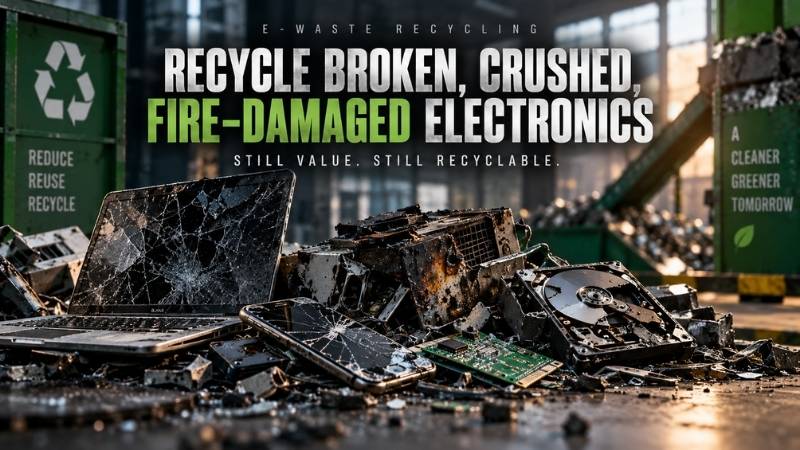
Can You Recycle Broken, Crushed, or Fire-Damaged Electronics?
A cracked laptop. A crushed monitor. A server rack that sat through a small fire. Most people look at that pile and see garbage. That guess costs money, and it creates risk you cannot see.
Damaged electronics stack up fast in Phoenix. Garages bake all summer. Offices get cleaned out. Old gear slides behind a pallet and waits. Around the Valley, folks say the desert keeps whatever you leave behind.
So here is the short version. Yes, you can recycle broken, crushed and fire-damaged electronics. Damage changes the handling. It almost never changes the answer.
This guide walks through what counts as damaged and what still holds real value. It also covers Arizona rules, battery safety, data risk and real cost. Handoff comes last.
The Short Answer: Damaged Electronics Are Still Recyclable
Broken, crushed and fire-damaged electronics can be recycled almost every time. Recyclers want materials, not working machines. A dead board still holds copper, gold, palladium and steel. Those metals do not care that the screen is shattered.
Think of a dead laptop as a locked safe. The money still sits inside. The lock just stopped turning. Recycling is how somebody opens it the right way.
A few items do need special handling. Swollen batteries, cracked CRT tubes and soot-covered boards each follow their own path. That does not make them trash. It makes them a phone call before a drop-off.
Old Phoenix wisdom says you call ahead before you drive across town. The same rule applies here. One quick call saves a wasted trip across the Valley in July heat.
Broken gear is not the problem. Guessing what to do with it is.
What Counts as “Damaged” Electronics?
Damaged electronics are devices that no longer work, hold shape, or feel safe. Recyclers sort damage into a few clear buckets. Each bucket changes the intake process. Knowing your bucket speeds the whole thing up.
Most people lump everything into one word: broken. Intake crews do not. They look at heat exposure, water exposure, glass, and batteries. Those four things decide how your load moves through a facility.
Broken and Non-Working Devices
This is the biggest group by far. The device fails but the housing stays closed. Nothing leaks, nothing sparks, nothing sheds glass. Examples show up in every office cleanout.
- Laptops that will not power on at all
- Desktops with dead boards or fried power supplies
- Printers and copiers with seized or jammed parts
- Phones and tablets with batteries that no longer charge
- Servers and switches pulled during a rushed refresh
These are the easiest items to move. The casing stays intact. The battery stays sealed. Most recyclers take them with no fuss and no extra prep on your end.
Crushed and Physically Wrecked Gear
Crushed means the housing broke open. Screens shatter. Frames bend. Boards snap. Loose glass and sharp metal now enter the picture. So does a safety risk for whoever lifts it.
Warehouse racking failures cause a lot of this. So do forklifts, roof collapses and moving trucks. A pallet that shifted in transit can wreck twenty units in one second.
Around here, people say the dust finds every open seam. Crushed devices open a lot of seams. Bag them so nothing spills across a truck bed or a parking lot.
Water and Monsoon Damage
Water damage shows up every August in the Valley. A flat roof leaks. A pipe bursts. A storm drain backs up into a warehouse floor. The gear looks fine for a week and then quietly corrodes.
Rust and mineral buildup do not block recycling. They lower resale value and raise teardown time. Dry the item out in shade. Do not run power through it again to “test” it.
Fire and Smoke Damage
Fire damage covers scorched plastic, melted cases, heat-warped frames and soot coating. Smoke alone counts too. Residue creeps into vents and coats every internal surface, even on units that never touched flame.
A server that sat two rooms away from a fire is still a fire-damaged asset. Insurance treats it that way. A good recycler treats it that way too.
Valley folks say a rising bird still needs clean ashes. Fire-damaged electronics need the same thing, which is careful handling and an honest description up front.
Why Broken Electronics Still Hold Real Value
Broken electronics hold value because their materials survive the damage. Circuit boards carry gold on connectors and pins. Power supplies carry heavy copper. Chassis carry steel and aluminum. Cables carry more copper than most people expect.
This is why electronic waste often gets called urban mining. A ton of scrap circuit boards can hold more gold than a ton of mined ore. That math holds up even when the device is smashed flat.
Value does drop with damage. It rarely drops to zero. Three quick examples show the range you can expect from a wrecked load.
- A crushed laptop still yields board metals, an aluminum shell and a copper heat pipe
- A fire-damaged server still yields steel rails, gold-plated pins and dense power supplies
- A water-damaged network switch still yields board metals and a solid copper transformer
Businesses often stack a bad assumption on top of the damage. They see wreckage and assume a disposal bill. Sometimes the load actually pays. Sometimes it breaks even. Nobody knows until it gets weighed.
There is a second kind of value too. A documented recycling record supports sustainability reporting and audit files. That paperwork has real worth for a company that answers to a board or a client.
Fire-Damaged Electronics: What Actually Changes
Fire changes three things. Safety, sorting and paperwork. The materials stay recoverable. The handling gets stricter, and intake usually slows down a step or two.
Soot is the first issue. Burned plastic leaves residue that irritates skin, eyes and lungs. Crews need gloves and masks. Loads often get bagged and staged away from clean material.
Heat is the second issue. Melted plastic fuses parts together. Boards warp. Solder joints fail. Batteries inside may look untouched and still be compromised. That last point matters most of all.
Insurance is the third issue. Fire-damaged business equipment usually sits inside an open claim. Adjusters want inventory lists, serial numbers and photos. Do not haul anything off before the claim clears.
Ask your recycler for a written, itemized receipt. Claims move faster with one in hand.
There is also a chain-of-custody angle people forget. If a fire hit a server room, those drives still hold client data. Damage does not release you from a breach notification duty.
Around Phoenix, people say the smoke leaves long after the flame. Document everything while the details are still fresh in everybody’s memory.
Crushed Screens, Cracked Glass and Old CRT Risk
Crushed screens fall into two very different groups. Modern flat panels are mostly safe glass, plastic and a thin backlight assembly. Old CRT tubes are a different animal, and they need real care.
CRT monitors and tube televisions hold leaded glass. A single large tube can carry several pounds of lead. A cracked tube can release fine dust. That is why nearly every recycler charges a fee to take CRTs.
Older LCD panels can contain small mercury backlight lamps. Newer LED-backlit panels do not. Either way, do not snap a panel in half to save room in the truck. That move creates a hazard for the next person.
- Keep cracked panels flat and face up when you can
- Run tape across the crack so the glass stays put
- Slide cardboard between stacked screens
- Wear cut-resistant gloves when lifting shattered units
- Never stack anything heavy on a broken display
Old-timers around the Valley say you handle broken glass like a sleeping rattlesnake. Slow hands, full attention, no shortcuts. That advice has saved a lot of stitches on loading docks.
Water-Damaged Electronics After a Phoenix Monsoon
Water-damaged electronics stay recyclable, but wet gear creates two separate problems. Corrosion spreads inside where you cannot see it. Trapped moisture can short a battery days after the water is gone.
Monsoon season hits the Valley between June and September. Flat commercial roofs pool water. Ground-floor suites in Tolleson, Glendale and South Phoenix take on water first. Server closets somehow always sit in the worst corner.
Dust storms make it worse. A haboob drives grit into vents, then rain turns that grit into a paste. That paste holds moisture against a board for weeks.
Do these things before pickup day:
- Unplug everything and leave it unplugged
- Let units drain and air dry in shade, not in direct sun
- Do not test-power a soaked device to see if it survived
- Keep wet gear off cardboard, because it collapses under load
- Photograph the damage for insurance before anything moves
Locals say the monsoon never knocks first. Store spare gear above floor level and you will lose a lot less next season.
Swollen or Burned Batteries: Deal With These First
Damaged lithium batteries are the one genuine danger in this whole conversation. A swollen battery is a shaken soda can. Pressure builds inside, and the wrong squeeze sets the whole thing off.
The warning signs are easy to spot once somebody points them out. Train your team on this list and you will catch problems early.
- A laptop that no longer sits flat on a table
- A phone with a lifting or bulging screen
- A puffy pouch cell inside a tablet, drone or power bank
- A device that runs hot while sitting idle
- A burnt, sweet or chemical smell near the battery
Federal guidance on used lithium-ion batteries is blunt about this. Damaged cells should never go in household trash or curbside recycling bins. They belong with a recycler or a hazardous waste program.
Phoenix heat raises the stakes. A closed car trunk in July can pass 140 degrees. That is a terrible place to park a swollen cell. Around here we say the sun charges rent, and batteries pay in full.
Never puncture, crush, or try to “deflate” a swollen battery. Not once, not ever.
Move a suspect cell into a non-flammable container. A metal bucket with sand works well. Keep it outdoors, in shade, away from walls and vehicles. Then call your recycler and describe the condition honestly.
If a battery has already vented or burned, treat the whole device as hazardous. Bag it separately. Label it clearly. Tell the driver before the load goes anywhere near a truck.
What Most Recyclers Will Not Accept
Most electronics recyclers accept damaged gear without blinking. A few categories still fall outside their permits or their insurance. Knowing the list saves you a rejected load and a second trip.
- Devices that are still hot, smoking or actively venting
- Leaking batteries in open or torn packaging
- Items soaked in fuel, solvent or chemical waste
- Appliances with refrigerants, at many facilities
- Smoke detectors containing radioactive sources
- Loose fluorescent tubes and old lighting ballasts, at many facilities
- Anything contaminated with biohazard material or sharps
Fire scenes mix categories constantly. A burned office pile can hold electronics, cleaning chemicals and building debris all together. Sort before you load, and flag anything you are unsure about.
Valley wisdom says a mixed load is a slow load. Clean separation gets you in, weighed and out fast. Arguing at the scale never does.
Is It Illegal to Throw Away Damaged Electronics in Arizona?
Arizona has no statewide ban on putting consumer electronics in household trash. That surprises a lot of people who moved here from California or Washington. It does not mean the dumpster is the right call.
Business rules run tighter than household rules. Companies that generate hazardous waste face federal obligations under RCRA. Damaged lithium batteries and CRT glass often land inside that scope. A landfill receipt will not protect you later.
Local rules add another layer. Many Maricopa County transfer stations refuse electronics outright. Some cities run separate collection events only a few times a year. Haulers can and do reject bins that hold batteries.
There is also a liability angle. Say a battery in your dumpster starts a truck fire. The hauler will trace the source. That conversation gets expensive fast.
Our complete guide to e-waste recycling in Phoenix breaks down Valley options in more detail.
Around here, people say legal and smart are not always the same road. Recycling is clearly the smart road, whatever the statute happens to say this year.
Your Data Does Not Die When the Device Does
A dead device still holds live data. This is the part that keeps IT managers awake, and it should. A drive that will not spin inside a laptop can still spin inside a recovery lab.
Fire and water rarely wipe a drive clean. Forensic labs pull data off flood-damaged and burned drives all the time. Smashing a laptop with a hammer proves nothing about the platters sealed inside.
Would you hand a locked filing cabinet to a stranger and walk away with no receipt? Most people would not. A hard drive holds far more than that cabinet ever did.
Real protection means data destruction that gets documented instead of assumed. Shredding, degaussing and verified wiping each fit different situations. Damaged drives almost always take the physical route.
For business loads, this belongs inside a broader IT asset disposition process. Every serial gets logged. Every drive gets tracked from pickup to destruction. You end up with paperwork an auditor will accept.
Ask one question before you hand anything over: will I get a written certificate of destruction?
Three examples make the stakes concrete. A burned clinic workstation may hold patient records. A flooded law office desktop may hold case files. A crushed retail server may hold card data.
How Damaged Electronics Actually Get Recycled
Damaged electronics move through the same core process as working gear. Extra safety steps come first. Here is the honest version, without the marketing gloss.
Step 1: Evaluation and Intake
Someone looks at the load and sorts it by risk before anything else happens. Batteries come out first. CRTs get flagged. Fire debris gets staged separately. Weight and material mix get recorded for the quote.
Step 2: Battery and Hazard Removal
Cells get pulled, taped and stored in fire-rated containers. Toner cartridges, mercury lamps and large capacitors get handled on their own tracks. This one step protects every worker downstream.
Step 3: Data Media Handling
Hard drives, SSDs, tapes and memory modules get pulled and tracked by serial. They move to destruction or verified wiping. Certificates follow those serial numbers back to you.
Step 4: Manual Teardown
Workers open cases and separate parts by material type. Power supplies, boards, heat sinks, fans and wiring all split apart. Damaged units nearly always get torn down by hand instead of by machine.
Step 5: Shredding and Separation
Remaining material goes through shredders and separators. Magnets pull out steel. Eddy current systems push out aluminum. Density and screening steps handle plastics and fines.
Step 6: Refining and Downstream Partners
Boards head to smelters for precious metal recovery. Plastics head to processors. Steel and aluminum head to mills. A good recycler can name where each stream ends up.
As they say around the Valley, the truck is the easy part. Everything that happens after the truck is where trust actually gets earned.
Damage by Device Type: A Quick Reference
Different devices behave differently once they break. This section covers the ones Phoenix businesses ask about most. Use it as a gut check before you call for a quote.
Laptops and Tablets
Battery risk sits at the top of the list here. Check for swelling and a case that will not close. Aluminum bodies carry decent scrap value even when the board is dead.
Desktops and Servers
These are the best loads in most damaged piles. Steel chassis, copper heat sinks and dense boards all recover well. Fire and water hurt resale value but leave scrap value largely intact.
Monitors and Televisions
Flat panels are routine. CRT tubes carry a fee nearly everywhere. Cracked screens need tape, flat stacking and gloves. Never break a tube on purpose to make it fit.
Printers and Copiers
Bulky, low value, and full of toner. Burned toner makes a mess that spreads through a facility. Bag toner cartridges separately and mention them when you call.
Test Equipment and Lab Instruments
Even damaged, these can hold surprising value. Scopes, analyzers and power supplies contain high-grade boards. Some units get repaired instead of shredded, so ask before you scrap them.
Networking and Telecom Gear
Switches, routers and racks recover well. Copper transformers and gold-plated ports carry value. Configuration data can live on these devices, so treat them like data-bearing assets.
Three Phoenix Situations We See Every Year
Real situations explain this better than any checklist. These three come up again and again across Maricopa County. Chances are one of them sounds a lot like yours.
The Office Fire on the West Side
A small electrical fire hits a suite off McDowell. Nobody gets hurt. Twenty workstations and a rack come out coated in soot. The claim opens, and the gear sits for six weeks.
The right move is a documented inventory, then a scheduled pickup once the adjuster clears it. Drives get destroyed with certificates. The rest gets weighed and processed.
The Monsoon Flood in a Warehouse
An August storm pushes water under a roll-up door. Pallets of returned electronics sit in two inches of runoff overnight. By Monday, everything smells like a wet penny.
Wet units get dried in shade and kept unplugged. Nothing gets test-powered. The whole lot moves as a corroded-material load, which still recovers metals fine.
The Racking Collapse
A shelf gives out in a storage room. Forty monitors and a stack of old CRTs land on concrete. Now there is glass everywhere and a real safety problem.
Broken glass gets bagged and taped. CRTs get counted, since they carry a fee. Everything gets palletized instead of loose-loaded, which protects the crew doing the lift.
How to Pack Damaged Electronics for a Phoenix Pickup
Packing damaged electronics well protects your team, your driver and your load value. It also gets you scheduled faster. Nobody wants to wrestle a loose pile of broken glass in the sun.
- Bag anything shattered in heavy contractor bags
- Tape battery terminals with electrical tape
- Bag swollen batteries separately, one cell per bag
- Stack flat panels upright, like records in a crate
- Keep fire-damaged items in their own labeled pile
- Pull drives ahead of time if your policy requires it
- Store everything in shade, never inside a hot vehicle
- Label pallets by category, not just by which room they came from
Heat is the quiet villain in this city. A closed shipping container in June turns into an oven. Damaged batteries and warped plastic both hate ovens.
Around here we say you check the shade before you park. The same logic applies to a pallet of broken tech waiting on a Tuesday pickup.
What Does It Cost, and Can You Get Paid?
Cost depends on what sits in the load, not on how ugly it looks. Three factors drive the number every single time. Material value, hazard content and labor.
- Material value: boards, copper and aluminum push the number up
- Hazard content: CRTs, batteries and fire residue push it down
- Labor: heavy teardown, sorting and bagging add real time
Some loads earn money. A pallet of dead servers usually carries genuine board value. A pile of crushed tube televisions usually carries a fee. Mixed loads land somewhere in the middle.
Fire-damaged loads often cost more to process. Soot slows every step. Sorting takes longer. Some material gets rejected downstream. Honest recyclers tell you that up front instead of on pickup day.
A free evaluation beats a phone guess every single time.
One more thing worth saying plainly. A company quotes sight unseen. Then the number jumps when the truck arrives. That is a red flag. Valley folks say a shifting quote hides a shifting story.
What Happens If You Just Let the Pile Sit
Doing nothing feels free. It is not. A pile of damaged electronics costs you in ways no invoice shows. That bill grows quietly.
- Square footage you are paying rent on every month
- Growing fire risk from aging lithium cells in summer heat
- Data exposure that sits unresolved and undocumented
- Scrap value that drops as metals corrode and markets move
- A bigger, uglier project when you finally have to move
Storage rooms are where accountability goes to nap. Three years later, nobody remembers which drives held what. That is the moment a cleanout turns into a compliance problem.
Old Arizona line: the load never gets lighter while you think about it. Clearing it early is almost always cheaper than clearing it late.
The Environmental Side Nobody Brings Up
Damaged electronics in a landfill do not just sit there quietly. Lead, mercury, cadmium and brominated flame retardants leach out over time. Desert soil and groundwater are not immune to that.
Recovery also cuts mining demand. Every pound of recovered copper is a pound nobody has to dig out of the ground. That trade is a good one even when the device is a total loss.
Fire adds another wrinkle. Burned plastics and coatings leave residues behind. You do not want those in an open dumpster. Spring wind spreads them across a lot.
Around the Valley people say what you bury today, you drink tomorrow. It sounds dramatic until you look at how groundwater moves under Maricopa County.
How to Choose a Damaged-Electronics Recycler You Can Trust
Choosing a recycler comes down to what they can show you. Homepage claims do not count. Damaged loads test a company harder than clean ones do. Ask sharper questions when the gear is wrecked.
- Will you take fire-damaged and water-damaged items?
- How exactly do you handle swollen lithium batteries?
- Do you provide a written certificate of destruction?
- Can you give me an itemized receipt for an insurance claim?
- Where do materials go after they leave your facility?
- Do you charge for CRTs, and what is the rate?
- Do I need an appointment before I show up with a load?
Vague answers are still answers. Say nobody can explain the downstream path in plain words. Assume there is not a good one.
Local knowledge matters more than people think. A Phoenix processor understands monsoon corrosion, summer storage risk and county intake rules. An out-of-state broker usually does not.
Our breakdown of what is considered e-waste clears up most category confusion fast.
Why Phoenix Businesses Bring Damaged Loads to JHI
Jay Hoehl Inc. has handled Phoenix electronics scrap since 1980. That is more than forty years in the same industry, in the same city. Jake Hoehl stepped in as CEO in 2016 and kept the same approach.
The team works out of 3334 W McDowell Rd, Unit 17, in Phoenix. Visits run by appointment, Monday through Friday, 8:00 a.m. to 4:30 p.m. One call sets the whole thing up.
For a damaged load, that means a few specific things:
- A real evaluation before anybody throws out a number
- Straight talk about what carries value and what carries a fee
- Data-bearing media handled with documentation, not promises
- Pickup scheduling for offices, warehouses, labs and property managers
- A long BBB record with an A+ rating standing behind the work
Call (602) 272-4033 or request a free evaluation. Just describe what got damaged and how.
Around here, people say forty years in one valley leaves a reputation behind it. For a family-run scrap operation, that reputation is basically the entire business model.
Frequently Asked Questions
Can you recycle a laptop that will not turn on?
Yes. A dead laptop is standard intake at any electronics recycler. Pull the drive first if your policy requires it. Mention any battery swelling when you call to schedule.
Do recyclers take fire-damaged computers?
Many do, with conditions. Items must be fully cooled and free of active hazards. Call ahead and describe the fire, the soot level and roughly how many units you have.
What do I do with a swollen phone battery?
Stop using the device right away. Put it in a non-flammable container away from anything that burns. Do not press it, charge it or puncture it. Then contact a recycler or hazardous waste program.
Is a crushed television worth anything?
Usually not. Crushed CRT televisions typically carry a recycling fee because of leaded glass. Flat panels cost less to process. Value comes from boards and metals, not from the screen itself.
Can water-damaged servers still be recycled?
Yes. Corrosion lowers resale value but leaves scrap value mostly alone. Dry them out, keep them unplugged, and photograph the damage before anything moves.
Should I remove hard drives before recycling damaged gear?
If you handle sensitive data, either remove them yourself or use a recycler who documents destruction. Removing drives adds a control step. Either way, insist on a certificate.
Does Arizona require electronics recycling?
There is no statewide consumer mandate. Businesses still face federal hazardous waste rules covering batteries and CRT glass. Landfilling damaged electronics stays a poor risk decision regardless.
Do I need an appointment to drop off in Phoenix?
At JHI, yes. Call (602) 272-4033 first. Appointments keep intake organized and keep damaged loads handled safely for everyone on site.
How fast can a damaged load get picked up?
That depends on volume, location and what is in it. Small loads move quickly. Fire and insurance loads usually wait on the adjuster, not on the recycler.
The Bottom Line on Broken, Crushed and Fire-Damaged Electronics
Broken, crushed and fire-damaged electronics belong in a recycling stream, not a dumpster. The metals survive the damage. The data survives too, which is exactly why the handling matters so much.
Do three things and you are covered. Isolate any swollen batteries. Photograph the damage before anything moves. Call a real processor and describe the condition honestly.
Damage is a detail, not a dead end. Around the Valley, folks say the desert takes what you leave behind. It gives back what you handle right. Old electronics work the same way.
Ready to clear the pile? Call (602) 272-4033 or request your free evaluation from JHI.
Bring the broken stuff. Bring the smoke-damaged stuff. Bring the pallet nobody in the building wants to touch. That is honestly the job, and it has been for over forty years.