
JHI Scrap • Surplus Components
Selling Excess SMD Capacitors: A Practical Guide
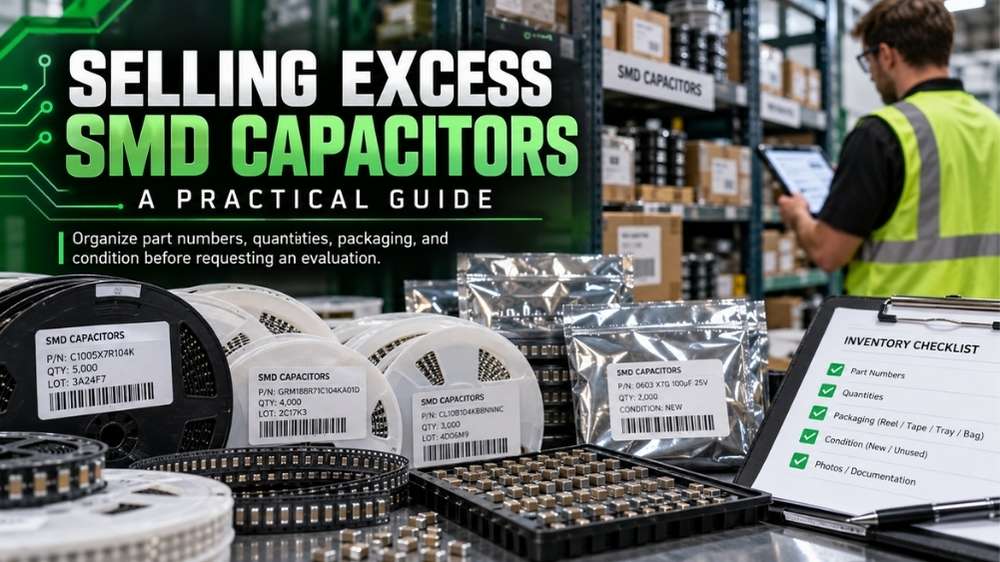
Organize part numbers, quantities, packaging, and condition before requesting an evaluation.
Quick answer
To sell excess SMD capacitors, prepare an accurate list by manufacturer part number, quantity, packaging type, condition, date or lot code, and available traceability. Keep distinct lots separate. Photograph labels and packaging, identify opened or damaged containers honestly, and share what your records can support. A clear inventory helps a buyer review the material and ask focused questions.
Why SMD capacitor surplus builds up
Electronic manufacturers often purchase components to support production forecasts, repair programs, and customer commitments. Plans change. A project may end, a design may be revised, or actual demand may fall below the forecast. The remaining capacitors can occupy valuable shelf space even when they remain clearly identified and packaged.
Surplus does not automatically mean unusable. It means the stock exceeds the seller’s present need. A buyer still needs enough information to understand exactly what is available. A bin labeled “capacitors” does not answer whether the lot contains one part number or several, a single date code or many, sealed reels or mixed loose pieces.
Start by separating material that your organization owns from customer-owned or supplier-controlled stock. Confirm that your company has authority to sell or otherwise disposition every lot. If the stock is subject to a customer agreement, consignment arrangement, return authorization, or quality hold, resolve that status first.
SMD capacitors may include ceramic, tantalum, aluminum electrolytic, and other types. Do not combine different technologies under one generic line. The component type, package size, value, voltage rating, tolerance, temperature characteristics, manufacturer, and exact part number can all affect how a buyer evaluates a lot.
JHI has a service page covering SMD capacitors and SMD components. Use the page to understand the relevant material category, then prepare your own inventory details for review.
Build a useful capacitor inventory
A good list makes it easier to compare the physical stock with your records. It also reduces follow-up questions. A spreadsheet is usually enough to start. Keep one row for each distinct combination of part number, package condition, lot identity, and quantity basis.
| Inventory field | What to record |
|---|---|
| Manufacturer | The name shown on the original label or supported by your records. |
| Part number | The complete number, including suffixes that distinguish specifications or packaging. |
| Quantity | The recorded count and whether it was verified, estimated, or taken from a label. |
| Packaging | Full reel, partial reel, tray, tube, cut tape, bag, or another format. |
| Lot information | Date code, lot code, supplier reference, or “not available” when unknown. |
| Condition | Sealed, opened, relabeled, damaged, mixed, or otherwise observed. |
| Storage notes | Location, packaging state, and any known handling history. |
Include a photo reference for each line or group. A useful photo shows the whole package and a readable label. Avoid covering markings with handwritten notes. If a label is faded, take a close image and transcribe only what you can read. Mark unclear characters instead of guessing.
Count quantities using a method your team can explain. For a sealed package, record the labeled count and preserve the label image. For opened containers, describe the counting method. If the count is an estimate, call it an estimate. Do not silently convert a visual estimate into a precise quantity.
JHI’s surplus component inventory template for OEM and EMS sellers offers a useful starting point for structuring component records. Adapt fields to your own stock and recordkeeping needs.
Separate lots before you combine anything
Do not merge capacitors just because they share a broad description. Preserve separate lines when the manufacturer, part number, date code, lot code, packaging, or condition differs. Separation protects the information attached to each group.
For example, two reels may display the same part number but have different lot codes. Record them separately unless your buyer specifically agrees to evaluate them together. A third reel might have a damaged label. Keep it separate and describe the missing information.
Separate stock that passed your receiving process from material that is rejected, returned, unverified, or on quality hold. A buyer should not have to infer quality status from the location of a box. Use clear labels such as “released surplus,” “customer return,” “inspection pending,” or “quality hold,” when those terms match your records.
Never relabel components to make the lot look more uniform. Do not remove original labels or combine packaging from different sources. If your team repacks material for safe storage, retain the original label information and document the repackaging.
Packaging and condition affect the review
Packaging helps explain how a component lot has been handled. It does not, by itself, prove that every component is suitable for a particular application. Describe what you can observe without making unsupported claims about electrical performance.
Record whether bags or reels are sealed. Note broken seals, torn moisture barrier bags, missing labels, damaged trays, contamination, or loose material. Keep accessories and paperwork with the related stock when possible. Do not call packaging “factory sealed” unless the evidence supports that description.
Storage history can also matter. If you know where and how stock was stored, include that information. If you do not know, say so. Avoid stating that parts meet a storage or handling standard unless the records actually show it.
Some SMD components have moisture sensitivity considerations. For exact handling requirements, consult the component manufacturer’s documentation and your organization’s process. JHI’s article about the shelf life of SMD components is a related resource. Use manufacturer guidance for the specific part, packaging, and application.
When stock has been opened, exposed, or moved between containers, describe the event as accurately as possible. Do not assume that a new outer bag restores the original packaging status. Keep any available receiving records, supplier labels, and internal handling notes together.
A helpful rule
State what your team knows, separate what it does not know, and preserve the original package information. Clear limits make an inventory more trustworthy.
Review the business status of the inventory
Before sharing a list externally, confirm ownership and disposition authority. Check whether the stock belongs to your organization, a customer, a supplier, or another party. Verify that no purchase agreement or program requirement restricts its transfer.
Ask the right internal teams to review the material. Purchasing may know whether supplier return options remain. Quality may need to release a hold. Engineering may want to retain approved spares. Finance may need the correct asset or inventory treatment. Sales or program teams may know whether a customer still requires the parts.
Set a clear cutoff for internal claims. If one department may need the stock, give that team a defined review window. Record the decision and the person responsible. This avoids a late request after the lot has been evaluated or removed from storage.
For a broader approach to aging stock, see JHI’s guide to excess inventory management in Phoenix. The core principle is simple: identify excess early, keep records current, and choose a disposition path with the right stakeholders involved.
Prepare for an evaluation
Once your list is ready, send a concise summary with representative photos. Include the total number of inventory lines, approximate package count, and any special access or handling considerations. You do not need to write a long explanation before asking whether the material is suitable for review.
Make the scope clear. State whether you are presenting only SMD capacitors or a mixed component inventory. Identify parts that are released for disposition and flag anything still subject to approval. If there are additional electronics or production equipment, list them separately.
A buyer may ask for label images, quantity confirmation, condition details, or other records. Have those materials available. Keep your original spreadsheet as the working source of truth and update it when quantities or status change.
JHI’s surface mount components buyer page describes the company’s interest in surplus SMT and surface mount material. Contact JHI to discuss the inventory and the information needed for a review.
Do not assume that every listed part will receive the same disposition. Different quantities, identities, conditions, and packaging can lead to different evaluation questions. Ask what is included in any offer and confirm the scope before approving a transaction.
Common mistakes to avoid
- Combining unlike stock: Keep distinct manufacturers, part numbers, and lots on separate lines.
- Guessing label details: Mark unreadable information as unknown instead of filling gaps from memory.
- Overstating condition: Describe visible packaging and records; avoid unsupported performance claims.
- Using one quantity for mixed packages: Explain whether counts are verified, labeled, or estimated.
- Ignoring ownership restrictions: Confirm your organization can sell or disposition the material.
- Discarding original labels: Preserve identifiers, photos, and supporting paperwork.
- Waiting until a move or audit: Review aging component stock regularly so it remains identifiable.
JHI’s broader excess inventory management service covers surplus industrial and electronic inventory. Ask about your specific material rather than assuming every component category follows the same process.
Frequently asked questions
What information should I provide when selling excess SMD capacitors?
Share manufacturer, complete part number, quantity, packaging, lot or date code when available, visible condition, and photos. Identify unknown details clearly.
Can I combine several capacitor part numbers in one inventory line?
List each distinct part number separately. Preserve separate lines for different lots, package conditions, or quantity bases.
What if I do not know the exact quantity?
State whether the count is estimated, label-based, or physically verified. Do not report an estimate as a confirmed count.
Should opened reels or bags be listed separately?
Yes. Describe opened or repackaged material separately and retain any readable original labels and records.
Do I need to test capacitors before requesting an evaluation?
Ask the buyer what information is useful. Do not claim electrical performance unless your organization has reliable test results supporting that claim.
What should I do with stock under a quality hold?
Keep it segregated and disclose the hold. Obtain release or disposition approval from the responsible quality authority before treating it as ordinary surplus.
Can I include other surplus electronics with the capacitors?
You can mention other material, but list each category separately. Separate records help avoid confusion about what is included.
Conclusion
Selling excess SMD capacitors starts with an honest, organized inventory. Separate exact part numbers and lots, record quantity and packaging, preserve labels, and disclose uncertainty. Confirm your organization has disposition authority before sharing the stock for evaluation. These steps help buyers understand what you have and help your team manage the transaction clearly.
Have surplus SMD capacitors to review?
Share your inventory details with JHI Scrap and request an evaluation.