
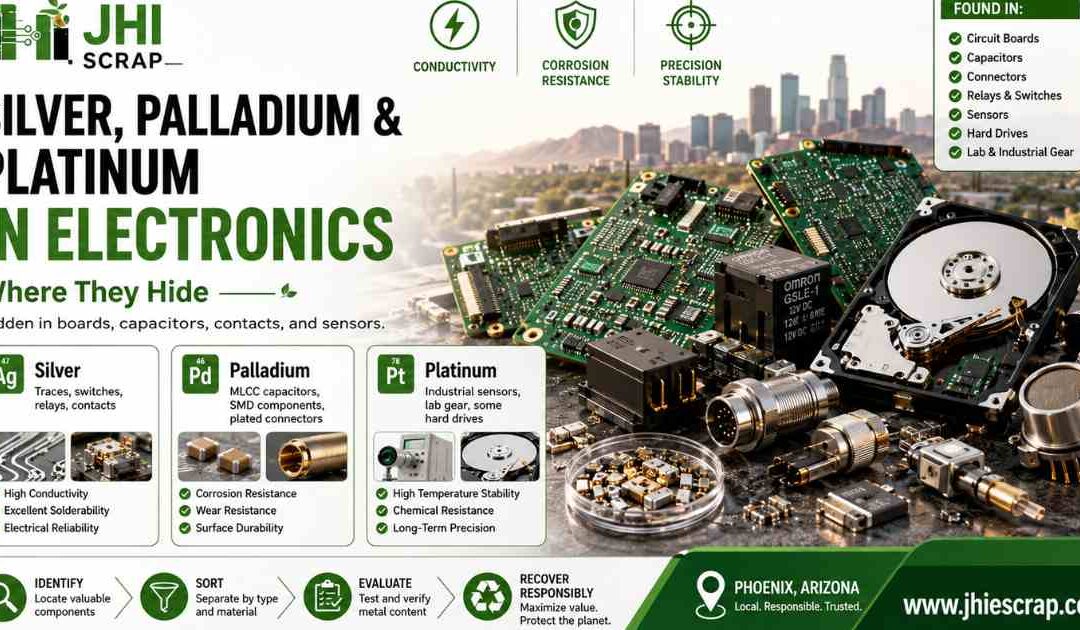
Silver, Palladium and Platinum in Electronics: Where They Hide
Most electronics hide precious metals in plain sight. Silver, palladium, and platinum sit quietly inside circuit boards, capacitors, contacts, and sensors. You rarely see them. But they’re there, doing real work. This guide focuses on business electronic scrap, not DIY recovery. Curious where the hidden value lives? Let’s open the box.
A quick note before we dig in. These metals usually exist in tiny amounts per device. That changes fast when your business generates material in bulk. Small numbers add up across pallets, production runs, and obsolete inventory. That’s where the story gets interesting for Phoenix-area operations. Learn more about JHI E-Scrap as we go.
Quick Answer: Where Do Silver, Palladium and Platinum Hide in Electronics?
These three metals live inside components, not on the surface. Silver shows up in circuit board traces, switches, and relays. Palladium hides in MLCC capacitors and plated connectors. Platinum appears in industrial sensors, lab gear, and some hard drives. You often can’t spot them by looking. Their value comes from where they sit and what they do.
Here’s the fast version, broken down by metal. One important truth first. Visible appearance alone can’t confirm precious metal content. Two identical-looking boards can hold very different materials inside. That’s why smart businesses lean on professional electronic scrap evaluation instead of guesswork.
Silver in Electronics
Silver hides in the parts that carry current. Think circuit board traces, switch contacts, relay points, and connectors. Manufacturers pick silver for conductivity, not looks. It moves electricity with very little loss. So it ends up inside the working parts of a device, tucked away where you’d never notice it. Hidden inside, not always visible.
Palladium in Electronics
Palladium tends to live inside tiny capacitors. The most common home is the MLCC, or multilayer ceramic capacitor. You’ll also find it in some SMD capacitors and plated components. Ever wonder why such small parts get so much attention? Because palladium sits packed inside them. Older MLCCs may differ a lot from newer versions.
Platinum in Electronics
Platinum shows up in specialized gear. Its main homes are industrial sensors, laboratory equipment, and certain hard drive components. Compared to silver, platinum is far less common in everyday electronics. It usually appears where stability and precision really matter. So platinum tends to signal higher-end industrial or scientific equipment rather than consumer devices.
Why These Metals Are Used in Electronics
Engineers choose these metals for performance, not resale value. Silver conducts electricity beautifully. Palladium resists heat, wear, and corrosion. Platinum stays stable under demanding conditions. It’s like choosing the right tool for the job. Each metal solves a specific problem inside the device. The recovery value is a happy side effect that shows up later, in bulk.
Let’s break down why each metal earns its spot. Understanding the “why” helps you spot the “where.” And it helps you make smarter calls about your e-waste before disposal.
Silver Conducts Electricity Extremely Well
Silver is the best electrical conductor we know of. That’s the whole reason it’s inside your electronics. It moves current with almost no resistance. Less resistance means less signal loss and less wasted heat. Silver acts like a smooth highway for electricity. So designers use it in contacts, traces, and switches where clean, reliable current flow really counts.
Palladium Resists Wear, Heat, and Corrosion
Palladium holds up when parts take a beating. It resists corrosion, tolerates heat, and survives repeated switching cycles. Unlike softer metals, it keeps performing after thousands of on-off actions. That durability makes it a favorite for high-reliability electronics. When a contact needs to work the same on day one and day ten thousand, palladium earns its place inside the component.
Platinum Supports Stability in Specialized Equipment
Platinum stays steady when accuracy can’t drift. That’s its superpower in electronics. It delivers stable, predictable performance under demanding conditions. So where do you find it? In precision sensors, probes, and lab instruments that measure the world exactly. When a reading has to stay accurate for years, platinum’s stability makes it the metal of choice for the job.
Why Small Amounts Matter in Bulk Business Scrap
Tiny per-device amounts turn meaningful at scale. Don’t judge a book by its cover. One old board looks like nothing. A pallet of them tells a different story. Businesses generate material in volume through production scrap, obsolete inventory, and equipment cleanouts. Evaluating the whole stream often paints a clearer picture than staring at a single device. That’s how you recover hidden value. A focused look at excess inventory management often surprises people.
Common Misconceptions About Precious Metals in Electronics
Most myths about e-scrap come from judging by appearance. People assume every board is gold-rich, or that shiny means valuable. Reality is more nuanced. Ever bought something that looked expensive but wasn’t? Electronics work the same way. Value depends on composition, part numbers, and application, not looks. So lean on material facts and professional evaluation before you decide what your scrap is really worth.
Let’s clear up the biggest misunderstandings one by one. Getting these right saves you from costly mistakes and helps you make informed decisions.
Not Every Circuit Board Is High-Value
Boards vary wildly in what they contain. A cheap consumer board and an industrial control board can look similar yet differ hugely inside. Design, components, and application all shape the value. Low-cost boards often use minimal precious metals. Industrial and telecom boards tend to carry richer component mixes. So set realistic expectations, and let the board’s job guide your thinking.
Not Every Capacitor Contains Palladium
Capacitor type, age, and maker all matter. Not every capacitor holds palladium, and many hold none. Composition shifts by manufacturer and production era. So does that little part actually contain anything valuable? Visual inspection alone rarely confirms palladium content. That’s why part numbers and professional review beat assumptions. Treat every capacitor claim you read online with healthy caution.
Gold-Colored Parts Are Not Always Gold
Gold color does not mean gold content. Many finishes just look golden. Plenty of parts use brass, coated alloys, or thin platings that mimic the shade. It’s a bit like fool’s gold in a river. So don’t assume a golden connector is a jackpot. Prevent costly mistakes by confirming material through identification, not by trusting the color your eyes report.
Silver, Palladium, and Platinum Are Often Hidden From View
The valuable stuff usually sits inside. Internal contacts, coatings, and specialized components hold most of the interest. Surfaces rarely tell the full story. So what looks plain on the outside may carry meaningful material within. That’s the discovery most people miss. To recover hidden value, focus on what’s inside the component, not the shell you can see.
Bulk Quantity Matters More Than One Device
Judge the stream, not the single unit. A river carves the canyon, not one drop. One device rarely justifies a full evaluation. A steady flow of material does. Production scrap, obsolete inventory, and recurring manufacturing waste often deliver more consistent recovery opportunities than isolated consumer gear.
Picture a manufacturer that scraps trays of rejected boards every month. Alone, each board seems trivial. Together, across a quarter, they become a real material stream worth evaluating. That shift in mindset, from single item to bulk stream, changes the whole conversation. It’s exactly how businesses recover hidden value.
Where Silver Hides in Electronics
Silver hides wherever current needs to flow cleanly. That means circuit board traces, switches, relays, contacts, membranes, and specialty wire. Manufacturers choose it for electrical performance, not appearance. Ever notice how the working guts of a device carry the value, not the case? Silver proves it. Think of it as the quiet conductor behind reliable connections. Here’s where to look, part by part.
Printed Circuit Boards
Silver can appear in board traces and finishes. Not every board uses it the same way. Construction varies by design and purpose. So does silver content. Curious which boards matter most? Application often beats size as a signal. A small industrial control board can outrank a large consumer board. That’s why smart handling of boards and IC chips starts with knowing the board’s job.
Switches and Relays
Switches and relays love silver contacts. Silver handles repeated switching without wearing out fast. That makes it a natural pick for contact points. Think of relays as tiny gatekeepers that open and close all day. Industrial relays often differ a lot from residential parts inside. So a heavy-duty control relay can hold more interest than a basic household switch.
Electrical Contacts and Contact Points
Silver keeps connections reliable over time. Contact points carry current through countless cycles. Silver’s conductivity and durability work together here. It’s like a handshake that stays firm after years of use. Engineers pick contact materials for both toughness and clean current flow. So the humble contact point often carries more value than its size suggests. Worth a closer look during sorting.
Keyboard Membranes and Control Panels
Some interfaces use silver conductive ink. Surprised? Many membrane switches and control panels print silver ink to carry signals. It’s applied as ink, not solid metal. So the value hides in a thin printed layer you’d never guess held anything. Curious what else looks ordinary but isn’t? Control interfaces are a classic example of hidden materials in plain sight.
Silver-Coated Wire and Specialized Wire
Specialty wire sometimes carries a silver coating. Demanding applications call for it. Aerospace and high-performance systems use silver-coated wire for better conductivity and heat handling. Compared to everyday household wiring, this is a different world. So a spool of specialty wire deserves a second look. Recognizing valuable materials like this helps you avoid tossing something worth evaluating with common cable.
Industrial Sensors and Solder Alloys
Silver also appears in industrial parts and solder. Some solder alloys include silver for stronger, more reliable joints. Certain industrial sensors use it too. Think of solder as the glue holding electronics together, sometimes with silver mixed in. Composition varies widely by application and manufacturing standard. So building better material knowledge helps you spot these quieter sources during a proper sort.
Where Palladium Hides in Electronics
Palladium hides inside small, easy-to-miss components. Its main homes are MLCC capacitors, SMD capacitors, plated connectors, and certain assemblies. Most of it sits packed inside tiny parts rather than large visible pieces. So the value isn’t in the big obvious hardware. It’s in the little components soldered across the board. Want to uncover hidden value? Start with the small stuff. Here’s where palladium likes to hide.
MLCCs and SMD Capacitors
MLCCs are the headline act for palladium. Multilayer ceramic capacitors get the most attention in recycling talk. Many older ones used palladium in their internal layers. You’ll also find SMD capacitors in the same conversation. So which generation are you holding? Older manufacturing eras may differ a lot from current production. That’s why SMD capacitors and components deserve careful, separate handling.
Printed Circuit Boards and Component Assemblies
Palladium can live within full assemblies too. It’s not only in loose capacitors. Populated boards and electronic modules may carry it inside their mounted components. So resist the urge to strip everything down. Assemblies should generally stay intact before professional evaluation. Keeping modules whole preserves context and improves evaluation decisions. It’s the safer default for most business scrap streams.
Connectors and Plated Contacts
Some connectors use palladium in their plating. Plating protects contacts and boosts reliability. Palladium sometimes plays that role. Think of it as a thin protective coat on the parts that mate together. Plating choices vary by manufacturer and operating environment. So don’t assume every connector matches the last one. Careful handling of plated connectors helps you avoid incorrect assumptions during sorting.
Hard Drives and Data Storage Components
Storage devices mix material value with data risk. Some hard drive components sit near precious metal discussions. But there’s a catch. These devices may hold sensitive information. So protect your data first, then think about material recovery. Treat every drive as a security item until verified clean. Pair recovery planning with secure IT asset disposition to protect valuable assets.
Older Electronics and High-Reliability Equipment
Legacy and mission-critical gear can differ inside. Aerospace, military, and industrial electronics often followed different material choices. Reliability came first, cost came second. So an old industrial unit may hold more interest than its age suggests. Curious how to read it? Application usually beats age as a clue to composition. That’s how you recognize hidden opportunities others overlook in a pile of dated equipment.
Why MLCCs and SMD Capacitors Deserve Special Attention
MLCCs get special attention for good reason. These tiny capacitors sit at the center of most palladium conversations in recycling. But attention doesn’t mean automatic value. Ever seen a rule that has too many exceptions? MLCCs are like that. Generation, manufacturer, and application all shape the outcome. So treat them as worth evaluating, not worth assuming. Let’s look closer at why they matter and how to handle them.
What MLCCs Are
An MLCC is a multilayer ceramic capacitor. It stores and releases small amounts of electrical energy. Picture a stack of thin ceramic and metal layers pressed together. That’s the basic idea. MLCCs are among the most common passive parts on any circuit board. So if you’ve handled electronics, you’ve handled thousands of them without knowing it. Understanding the basics helps everything else click.
Why Older MLCCs May Be More Valuable
Older MLCCs sometimes draw more interest. Manufacturing practices changed over the years. Some earlier parts used different internal materials than today’s versions. So age can be a clue, but not a guarantee. Don’t treat “old” as a magic word. Composition still depends on the maker and the era. Careful evaluation, not blanket claims, is how you recover hidden value from vintage components.
Why Appearance Alone Is Not Enough
You can’t judge an MLCC by sight. Two capacitors can look identical yet differ inside. So does the little brown chip actually hold anything? Visual inspection rarely answers that. Part numbers and manufacturer information usually give better guidance than appearance. Relying on your eyes alone leads to costly mistakes. Trust identification over first impressions every time.
Should Businesses Save MLCCs Separately?
Often, yes, when parts are already loose. A stitch in time saves nine. If components came off through legitimate manufacturing or repair, keeping similar parts together helps. So group them, label them, and hold original packaging when you can. This simple step can improve recovery potential and speed up evaluation. It’s low effort with a real upside for organized businesses.
Why Professional Evaluation Matters
Professional review beats internet guesswork. Would you diagnose an engine from a photo? Component value works the same way. Good evaluations combine visual inspection, component identification, manufacturer information, and material history. No single indicator tells the whole story. So a proper review protects you from bad assumptions and helps you make informed decisions with real confidence. Request a material evaluation when you’re ready.
Where Platinum Hides in Electronics
Platinum hides in specialized, high-end equipment. Its homes are industrial sensors, lab instruments, hybrid circuits, and certain hard drives. It’s far less common than silver or palladium in everyday devices. Think of platinum as the specialist that shows up only where precision demands it. So if you’re sorting scientific or industrial gear, pay attention. Here’s where platinum tends to appear, and why it lands there.
Hard Drives
Some drive components touch platinum-related materials. But data comes first. Certain hard drive parts appear in precious metal discussions, yet these devices store information. So always weigh secure handling alongside material recovery. Treat drives as sensitive until proven otherwise. Protecting valuable assets means protecting the data on them too. That mindset keeps both your material value and your records safe.
Sensors and Probes
Platinum brings stability to precise sensors. Many industrial probes and lab sensors rely on it for accurate, steady readings. Picture a thermometer that can’t afford to drift. That’s the job. Most of these sensors are chosen for accuracy and stability, not for their metal content. So understanding these specialized applications helps you recognize which sensors deserve a closer, more careful evaluation.
Hybrid Integrated Circuits
Hybrid circuits show up in demanding gear. These modules combine several functions in one rugged package. Compared to standard chips, they’re built for tougher environments. So where do you find them? Often in long-life, high-performance systems that can’t fail easily. Recognizing specialized materials like these helps you separate ordinary electronics from the units that genuinely warrant electronic scrap evaluation.
High-Reliability Industrial Electronics
Mission-critical gear plays by different rules. Consumer products chase low cost. Aerospace and defense electronics chase reliability above all. That difference shapes material choices inside. So a rugged industrial unit may hold higher-interest materials than a similar-looking consumer device. Curious how to tell? Reliability requirements, not price, often drove the design. That single clue helps you identify equipment worth a proper industrial recycling review.
Laboratory and Test Equipment
Lab and calibration gear can hold specialized materials. Precision instruments demand stable, high-quality components. Would you scrap a calibration unit without a look inside? Better not. Scientific equipment should be evaluated as complete assemblies whenever practical. Keeping instruments whole preserves context and value. So recognizing hidden opportunities in lab and test equipment starts with resisting the urge to take it apart.
Old Electronics vs. Modern Electronics: Which May Contain More Precious Metals?
Neither age alone wins this contest. Older gear sometimes used richer material mixes. Newer gear often uses lower-cost alternatives. But the rule breaks constantly. Ever met an exception that proves nothing? Age is like that here. Material composition varies by manufacturer, product category, and application, not simply by production year. So which contains more? It depends. Let’s compare fairly, then explain why guessing by age is risky.
Older Components May Use More Precious-Metal-Rich Materials
Some legacy parts used richer materials. There’s gold in them hills, sometimes. Older manufacturing methods occasionally leaned on different metal combinations than today’s parts. That’s why certain vintage electronics draw recycler attention. But this isn’t a blanket rule. It applies to specific parts and eras. So treat older components as worth a look, and let evaluation confirm whether there’s real hidden value to recover.
Newer Components May Use Lower-Cost Alternatives
Modern parts often chase lower cost. As prices and supply shifted, makers found cheaper material options. Think of it like a recipe that swaps expensive ingredients for affordable ones. Performance still had to hold up. So manufacturers balance performance, availability, and cost when choosing materials. That’s why newer electronics can differ from older ones. Understanding these industry changes keeps your expectations grounded and realistic.
Industrial and High-Reliability Electronics Can Be Different From Consumer Electronics
Industrial gear and consumer gear aren’t the same. One is built to survive. The other is built to sell cheap. Equipment designed for demanding environments often follows different engineering priorities than consumer products. So the materials inside can differ too. A rugged industrial controller and a budget gadget may look related but aren’t. Knowing this difference helps you make informed decisions about industrial electronics before disposal.
Why Businesses Should Not Guess Based on Age Alone
Age is only one data point. Would you value a house by its build year alone? Same logic here. Product category, manufacturer, component type, and application often tell you more than age. So resist the urge to sort by “old equals valuable.” That shortcut leads to costly mistakes. A proper evaluation weighs several factors together and gives you a far more reliable answer.
Phoenix Businesses Most Likely to Generate Precious-Metal-Bearing E-Scrap
Certain Phoenix industries produce richer scrap streams. Manufacturers, semiconductor suppliers, aerospace vendors, data centers, and labs top the list. Why does this matter to you? Because recurring production scrap often creates more predictable recovery opportunities than one-time cleanouts. So if your business runs in these fields, your material stream may hold real interest. Let’s walk through the local sectors that most often generate precious-metal-bearing electronics.
Electronics Manufacturers
Manufacturers generate steady production scrap. Rejected boards, prototype runs, and quality-control failures pile up fast. That recurring flow often deserves evaluation. Prototype runs and QC rejects may even need separate workflows. So a Phoenix electronics manufacturer can recover hidden value from material that would otherwise hit the dumpster.
Semiconductor Suppliers
Semiconductor work creates specialized scrap. Chip manufacturing and handling produce distinct electronic material streams. Compared to general e-waste, these can be very different. Documented part numbers help streamline evaluation. So semiconductor suppliers around Phoenix are strong candidates for organized, ongoing material management rather than random disposal.
Aerospace and Defense Vendors
Aerospace and defense use high-reliability electronics. These parts were built for demanding conditions, not low cost. That changes what’s inside. Maintain traceability and documentation whenever possible. So aerospace and defense vendors often hold specialized materials worth recognizing before any equipment leaves the building.
Data Centers and IT Departments
Data centers retire servers, networking, and storage constantly. That hardware carries both material value and data risk. So secure disposition matters as much as recovery. Coordinate asset evaluation with documented data destruction procedures. Protecting business data and recovering value can happen together through proper ITAD in Phoenix.
Test Labs and Calibration Labs
Labs accumulate specialized instruments over time. Testing and calibration environments collect precision equipment that eventually ages out. Would you scrap it blind? Better to evaluate. Keep equipment complete whenever possible to simplify the review. So test and calibration labs often sit on hidden opportunities inside their retired gear.
Medical, Telecom, and Industrial Equipment Operators
These operators manage specialized electronics daily. Medical devices, telecom hardware, and industrial systems all use purpose-built components. Different categories may benefit from different recycling or resale pathways. So the right move varies by equipment type. Matching each category to the best pathway helps you maximize asset value across a mixed fleet of hardware.
Businesses With Obsolete or Excess Inventory
Surplus inventory deserves a look before disposal. Obsolete stock and excess components often hold more value than expected. Original packaging, labels, and documented quantities can improve evaluation efficiency. So before you clear the warehouse, pause. A quick review of surplus electronics can help you recover hidden value you almost threw away.
Is Your Electronics Scrap Worth Evaluating?
Most business scrap streams are worth a professional look. Is yours? The honest answer depends on material type, quantity, and condition. Recurring production waste usually gives a clearer picture of recovery potential than isolated items. So evaluate the whole stream, not one gadget. A quick, informed review beats guessing every time. Let’s sort out which materials tend to attract interest and how preparation shapes your results.
Higher-Interest Scrap Streams
Some scrap streams reliably draw more interest. These are the ones worth evaluating before disposal. Production scrap, obsolete inventory, and specialized industrial electronics often lead the pack. That’s where recovery potential concentrates.
- Industrial and telecom circuit boards
- Loose MLCCs and SMD components
- Relays, switches, and plated connectors
- Servers, storage, and networking hardware
- Lab, test, and calibration equipment
If your material lands on this list, don’t rush it to the trash. Recover hidden value with a proper review first.
Lower-Interest or Mixed Scrap Streams
Some materials carry lower recovery interest. That’s just honest. Low-grade consumer boards and heavily mixed loads often sit here. But don’t write them off. Professional sorting can still help. Grouping mixed material into similar categories makes it far easier to evaluate. So even a modest stream benefits from organization. Realistic expectations plus smart sorting help you avoid disappointment and still capture what’s there.
Why Quantity, Sorting, and Condition Matter
Preparation shapes your entire evaluation. Three things move the needle most. Keeping similar materials together speeds review and improves handling.
- Quantity: Bulk streams paint a clearer, more reliable picture.
- Sorting: Grouped, labeled material evaluates faster.
- Condition: Intact, organized scrap keeps more options open.
A little prep goes a long way. Better organization often means smoother handling and better outcomes for your business.
Why Part Numbers and Packaging Can Increase Value
Identification unlocks more options. A labeled reel beats a loose handful every time. Original part numbers and packaging help determine resale, reuse, and evaluation paths. Sealed reels, trays, tubes, and manufacturer labels simplify component verification. So preserve that information whenever you can. Keeping identity intact helps you preserve value that plain, unlabeled material simply can’t match during evaluation.
Should You Remove Components From Circuit Boards?
Usually, no, leave boards intact. Tempted to strip parts off before evaluation? Resist it. Unless materials are already separated through manufacturing or repair, complete assemblies preserve the most options. Depopulating boards yourself often adds labor while cutting reuse and resale potential. So the safest default is simple. Keep boards whole, ask for guidance, and let a proper process decide. Here’s how to handle it right.
Usually, Do Not Remove Components Before Evaluation
Keep assemblies whole until you get guidance. Why gamble on removal before anyone’s looked? Complete boards give more context for material identification. They let evaluators read the full picture. So leave populated boards as they are. Intact assemblies prevent mistakes and support a stronger, more accurate professional evaluation of your electronic scrap. It’s the low-risk move nearly every time.
Depopulating Boards Can Reduce Value or Create Extra Labor
Stripping boards often backfires. Removing components without a plan is like unbuilding a puzzle for no reason. It eats time and can erase reuse or resale options. Compared to leaving boards intact, DIY depopulation usually adds handling and limits pathways. So avoid unnecessary work. Unless a clear plan calls for it, keep the parts where the maker put them.
Keep Usable Components in Original Packaging When Possible
Loose but usable parts belong in their packaging. If components are already off the board and still good, protect them. Sealed packaging, lot codes, and labels improve traceability. That traceability helps preserve value. So store usable parts carefully instead of dumping them in a bin. Original reels and trays keep your surplus electronics organized and ready for a smoother evaluation.
Ask for Evaluation Instructions First
Ask before you sort or dismantle. Why guess when a quick question saves hours? A brief consultation before sorting can prevent unnecessary labor and improve evaluation efficiency. So reach out first, describe your material, and get handling guidance. That one step keeps you from doing work that hurts your outcome. When you’re set, contact JHI for pickup guidance.
Reuse vs. Resale vs. Recycling vs. Refining
Four pathways exist, and the best one depends on your material. Reuse keeps working gear in service. Resale moves parts with market demand. Recycling recovers material once items are done. Refining targets precious metal recovery. Right tool, right job. Checking resale potential before recycling can help you recover extra value from usable equipment. So let’s compare all four and match each to the right situation.
Reuse – When Equipment Still Works
Reuse wins when gear still functions. Working equipment can keep serving its original purpose, in your operation or someone else’s. That extends equipment life and cuts waste. Functional testing and documentation improve reuse opportunities. So before you scrap something that still powers on, ask whether reuse makes more sense. It’s often the highest-value path for gear that isn’t truly finished.
Resale – When Components or Equipment Still Have Market Demand
Resale fits parts the market still wants. Surplus components and excess inventory can hold real commercial value. Complete documentation and original packaging often strengthen resale potential. So identify what buyers still need before recycling everything. Turning usable surplus into resale can increase your returns. It’s a smart middle path between full reuse and final recycling for the right material.
Recycling – When Material Is No Longer Usable
Recycling steps in when reuse and resale run out. Once items can’t serve or sell, recycling recovers what’s inside responsibly. Compared to landfill, it keeps material in the loop and reduces waste. Proper sorting before recycling often improves processing efficiency. So when equipment reaches the end, recycling becomes the responsible, confident choice for handling your electronic waste the right way.
Refining – When Precious Metal Recovery Is the Best Path
Refining targets the metals themselves. When material is set for precious metal recovery, refining becomes the goal. Is your stream heavy in silver, palladium, or platinum content? Then refining may be the preferred route. Refining decisions should weigh material composition, quantity, and the most appropriate recovery pathway. So it fits high-interest streams, not every random box of scrap.
Why the Best Option Depends on Material Type and Quantity
No single path fits every material stream. Different problems, different tools. A structured evaluation often finds reuse, resale, recycling, or refining options that aren’t obvious at first glance. So resist forcing everything down one route. Weighing material type and quantity together leads to smarter outcomes. That thoughtful approach helps you make informed decisions and get the most from your electronics.
What Not to Do With Precious-Metal-Bearing Electronics
A few common mistakes destroy value and create risk. Burning, DIY chemical recovery, mixing with trash, stripping labels, and ignoring data-bearing devices top the list. Why does this matter? Proper handling before evaluation preserves more options for reuse, resale, recycling, or refining than DIY processing ever will. So protect your material, your people, and your data. Here’s what to avoid before your electronics get evaluated.
Do Not Burn Electronics
Never burn electronics. It’s unsafe and it wastes value. Burning releases hazardous materials and damages recoverable components. Heat can permanently ruin parts that might have qualified for reuse or professional recovery. So keep fire far away from your scrap. Protecting people and property matters more than any shortcut, and it keeps recovery options open instead of turning them to ash.
Do Not Use Acids or DIY Chemical Recovery
Skip acids and homemade chemical recovery. Would you run an industrial chemical process in your garage? Please don’t. DIY acid recovery is dangerous and unpredictable. Professional recovery follows controlled industrial processes that differ hugely from informal methods. So avoid the fumes, burns, and hazards entirely. Leave precious metal recovery to controlled refining. It protects your safety and your material at the same time.
Do Not Mix Valuable Components With General Trash
Don’t toss valuable components in the trash. Waste not, want not. Mixing precious-metal-bearing parts with general garbage buries recoverable value. Even basic sorting improves evaluation efficiency and reduces unnecessary handling. So separate electronics from ordinary waste before pickup. That small habit helps you recover hidden value and keeps material out of the landfill where it does no one any good.
Do Not Remove Labels From Components
Leave labels on your components. A label often tells you what your eyes can’t. Part numbers and manufacturer details identify materials and handling pathways. Removing them erases information you can’t confirm by sight alone. So keep labels intact through sorting and storage. Preserving that identity protects evaluation accuracy and keeps your electronic scrap easier to assess correctly.
Do Not Ignore Data-Bearing Devices
Never ignore devices that store data. Material value means nothing if you leak sensitive information. Would you hand over an unwiped drive? Treat every storage device as if it holds confidential data until verified otherwise. So separate and secure data-bearing devices early. Pairing recovery with secure handling protects your business through proper ITAD in Phoenix.
Data Security for Hard Drives, Servers, and IT Equipment
Secure data handling and recycling go together. Hard drives, servers, and storage arrays carry both material value and real data risk. Would you retire IT gear without protecting the data first? Better not. Create a documented chain of custody for storage devices before transportation. So plan security and recovery as one process. Here’s how to protect your business while you handle the hardware responsibly.
Hard Drives May Have Material Value and Data Risk
Drives carry value and risk at once. That combination makes them special. Storage devices may hold recoverable material and sensitive information together. So handle both sides with care. Separate storage devices from general electronics before transport whenever practical. Protecting sensitive information stays the priority, and organized separation makes secure hard drive handling simpler for everyone involved.
Servers and Storage Arrays Need ITAD Handling
Enterprise hardware needs structured ITAD. Servers and storage arrays aren’t ordinary scrap. They demand documented, secure procedures. Compared to a single old laptop, enterprise gear carries far more data exposure. Document serial numbers before pickup to simplify internal asset tracking. So route this hardware through proper IT asset disposition. It reduces business risk while keeping recovery on track.
Why Certificates of Data Destruction Matter
Certificates give you proof and peace of mind. A documented certificate of data destruction supports compliance and clean recordkeeping. It shows the work was done right. Maintain certificates with your other disposal records to support future audits. So don’t skip the paperwork. That single document turns a good process into a defensible one and gives your team real assurance.
Keep Data-Bearing Devices Separate Before Pickup
Separate data devices before pickup day. A place for everything, and everything in its place. Pulling storage devices aside early keeps secure handling simple. Use clearly labeled containers or pallets for devices awaiting pickup. So organize before the truck arrives. This small step simplifies secure handling and keeps your IT asset disposition smooth and worry-free.
How to Sort E-Scrap Before Contacting JHI
A quick sort makes your evaluation faster and smoother. Ready to prep like a pro? A few organized minutes now saves real time later. Grouping material by type improves communication and speeds handling. So follow these nine simple steps before you reach out. Each one makes your material easier to evaluate and your pickup easier to plan. Let’s get your scrap organized the right way.
Step 1: Separate Circuit Boards
Group boards by type first. Keep similar board grades together whenever possible. Industrial, telecom, and consumer boards each tell a different story. Sorting them up front improves your whole evaluation and sets a strong foundation for everything that follows.
Step 2: Separate SMD Components and MLCCs
Keep loose SMD parts and MLCCs on their own. Group them separately from boards and larger hardware. Maintain labels whenever available. This simple move helps preserve value and keeps your most interesting components easy to review.
Step 3: Separate Connectors, Relays, and Switches
Pool your electromechanical parts together. Connectors, relays, and switches belong in one group. Avoid mixing unrelated component types. Keeping like with like improves efficiency and makes the whole batch far quicker to assess accurately.
Step 4: Separate Wire and Cable
Give wire its own pile. Bundle wire and cable apart from boards and components. Keep specialty wire separate from mixed cable when practical. Compared to tangled mixed loads, sorted wire is far simpler to handle and evaluate.
Step 5: Separate Hard Drives and Data-Bearing Devices
Set data devices aside safely. Pull hard drives and storage out early. Store data-bearing devices separately until transfer. This protects your information and keeps secure handling clean and organized right from the start.
Step 6: Keep Labels, Part Numbers, and Packaging
Preserve every bit of identity. Hold onto labels, part numbers, and original packaging. Photograph labels if they might become unreadable during handling. That saved information helps improve evaluation and keeps your components easy to verify.
Step 7: Take Photos of the Material
Snap a few clear photos. Wide shots and close-ups both help. Good pictures give useful context before anyone sees the material in person. This speeds the process and makes your first conversation far more productive.
Step 8: Estimate Quantity, Weight, or Pallet Count
Ballpark your volume. Note rough quantity, weight, or pallet count. Approximate numbers are usually enough for an initial discussion. A simple estimate helps simplify scheduling and gets your pickup planning moving faster.
Step 9: Contact JHI for Evaluation or Pickup
Now reach out and let’s talk material. You’ve organized, labeled, and documented. That’s the hard part done. Sharing photos, estimated quantities, and basic material descriptions before pickup helps streamline evaluation. So take the last step with confidence. Contact JHI E-Scrap to schedule your evaluation or Phoenix pickup and turn organized scrap into recovered value.
How JHI Helps Phoenix-Area Businesses
We help Phoenix businesses turn e-scrap into recovered value. Wondering where to start with messy, mixed material? That’s exactly what we handle. JHI E-Scrap has served the Phoenix area since 1980 with electronics recycling, precious-metal-bearing material handling, ITAD, and recurring pickup. We lead with consultation and evaluation, not pressure. So you get honest guidance first. Here’s how our services support your business, step by step.
Material Evaluation
We evaluate before we recommend a pathway. Our reviews weigh material type, condition, quantity, and documentation together. That full picture guides the right handling choice. So you’re not guessing. A thorough electronic scrap evaluation helps you make informed decisions about reuse, resale, recycling, or refining.
Local Phoenix Pickup
We come to you across the Phoenix metro. Convenient local pickup saves your team time and hassle. We work with your schedule to keep things simple. So you spend less effort moving material and more time running your business. Local pickup turns a logistics headache into a quick, handled task.
Excess Inventory Management
We help surplus become recovered value. Don’t let good material gather dust. Obsolete components and excess inventory can be evaluated before disposal. Documentation and original packaging often simplify the review. So our excess inventory management helps you recover hidden value hiding in the warehouse.
E-Scrap and Precious-Metal-Bearing Material Handling
We handle precious-metal-bearing material responsibly. Electronics with recoverable materials deserve careful, appropriate handling. Our methods align with the condition and intended recovery pathway. Compared to one-size-fits-all disposal, that approach protects value. So you maximize recovery while keeping the process clean and responsible from start to finish.
ITAD and Data Destruction
We secure your data while we recover value. IT assets carry information and material together. We coordinate asset tracking with data destruction documentation. So you protect business data without slowing recovery. Our IT asset disposition keeps security and value working side by side.
Recurring Pickup for Ongoing Scrap Streams
We keep steady scrap streams under control. Generating material every week? A one-time cleanout won’t cut it. Regular pickup schedules reduce storage needs and improve workflow. So instead of piles building up, you get a smooth, predictable routine. Recurring pickup simplifies operations for businesses with continuous electronics scrap generation.
Final Takeaway for Phoenix Businesses
Your electronics probably hide more value than you think. Silver, palladium, and platinum sit quietly inside boards, capacitors, contacts, and sensors. You rarely see them. But in bulk, they matter. Don’t judge a book by its cover, and don’t judge your scrap by one device. The real story shows up across pallets, production runs, and obsolete inventory.
So what’s the smart first move? An informed evaluation, not a guess. Appearance, age, and internet lists can’t tell you what your material really holds. A proper review weighs composition, part numbers, quantity, and application together. That’s how you find the best path, whether it’s reuse, resale, recycling, or refining. And it’s how you avoid costly mistakes before disposal.
Ready to see what your e-scrap is worth? Would you rather guess, or know? Sort your material, snap a few photos, and estimate your volume. Then let our team take it from there. Contact JHI E-Scrap for a professional evaluation or Phoenix-area pickup. We’ve helped local businesses recover hidden value since 1980, and we’d be glad to help you simplify recycling and get it right. You can also reach us at 602-272-4033.
FAQs About Silver, Palladium and Platinum in Electronics
Where is silver found in electronics?
Silver sits in the parts that carry current. You’ll find it in circuit board traces, switch and relay contacts, connectors, and membrane switches. Manufacturers choose silver for its conductivity, not its appearance. So it usually hides inside working components rather than on visible surfaces. In bulk business scrap, those small amounts can add up and deserve a closer look.
What electronics contain palladium?
Palladium hides mostly in small capacitors. Its main home is the MLCC, or multilayer ceramic capacitor, along with some SMD capacitors and plated connectors. Populated boards and certain assemblies can carry it too. Composition varies by manufacturer and era. So don’t assume every part contains it. Careful evaluation, not guesswork, tells you what your material really holds.
Is platinum found in electronics?
Yes, but mainly in specialized gear. Platinum appears in industrial sensors, laboratory instruments, hybrid circuits, and certain hard drive components. It’s far less common than silver or palladium in everyday devices. So platinum usually signals higher-end industrial or scientific equipment. If you’re retiring precision or lab gear, that material may be worth a professional evaluation before disposal.
Do MLCC capacitors contain palladium?
Some do, especially older ones. Many earlier MLCCs used palladium in their internal layers. Newer production may use different materials. So age and manufacturer both matter. You can’t confirm palladium content by sight alone. Part numbers and professional review give a far more reliable answer than internet lists or appearance-based assumptions ever will.
Are old MLCC capacitors worth saving?
Often, yes, if handling is easy. Older MLCCs sometimes draw more interest because manufacturing practices changed over time. But age alone isn’t a guarantee. If parts are already loose from legitimate processes, keeping them grouped and labeled helps. So saving similar MLCCs together can improve recovery potential and make later evaluation much simpler for your business.
How can you tell if an MLCC has palladium?
You can’t tell by looking. Two identical-looking capacitors can differ inside. Part numbers and manufacturer information give better guidance than appearance. Professional evaluation combines identification, material history, and testing rather than relying on one clue. So skip the guesswork. A proper review is the only dependable way to understand what an MLCC actually contains.
Are magnetic MLCCs less valuable?
Magnetism can hint at composition, not confirm it. Some people use a magnet test as a rough sorting step. But results vary by part and manufacturer. Magnetism alone doesn’t reliably determine value. So treat it as one small clue, not a verdict. Professional identification using part numbers and material history gives a far more accurate picture than any quick magnet check.
Do all circuit boards contain silver, palladium, or platinum?
No, boards vary widely. Design, components, and application shape what each board contains. Low-cost consumer boards often hold minimal precious metals. Industrial and telecom boards tend to carry richer component mixes. So a board’s job matters more than its size. Don’t assume every board is valuable. Evaluation based on type and construction tells the real story.
Which circuit boards are most valuable?
Industrial and telecom boards often lead. Boards built for demanding applications usually carry more complex, higher-interest component mixes than budget consumer boards. Application tends to matter more than size. So a small industrial control board can outrank a large consumer one. The reliable way to know is a professional evaluation that reads construction, components, and purpose together.
Should I remove components from circuit boards before selling them?
Usually not. Unless parts are already separated through manufacturing or repair, complete assemblies preserve the most options. Stripping boards yourself often adds labor while cutting reuse and resale potential. So keep boards intact and ask for handling guidance first. A quick consultation before sorting can prevent unnecessary work and protect your material’s overall value.
Do hard drives contain platinum?
Some components sit near platinum discussions. Certain hard drive parts appear in precious metal conversations. But there’s a bigger issue first. Drives store sensitive data. So always pair material recovery with secure data handling. Treat every storage device as confidential until verified clean. Protecting information and evaluating material can, and should, happen together through proper ITAD.
Do connectors contain palladium or silver?
Some do, in their plating or contacts. Connectors may use silver or palladium depending on the design and operating environment. Plating choices vary by manufacturer. So one connector won’t always match the next. You can’t confirm content by appearance alone. Careful handling and professional evaluation help you avoid incorrect assumptions about what a given connector actually contains.
Are relays and switches worth saving?
Often, yes, especially industrial ones. Relays and switches commonly use silver contacts built for repeated switching. Industrial versions frequently differ from basic residential parts inside. So heavy-duty control relays can hold more interest than household switches. Keeping them grouped and labeled improves evaluation. It’s a simple step that helps you capture value you might otherwise overlook.
Can I recover silver or palladium from electronics myself?
Please don’t attempt DIY recovery. Home acid and chemical methods are dangerous, unpredictable, and often illegal to run improperly. Professional recovery follows controlled industrial processes that differ hugely from informal methods. So skip the fumes and hazards. Leave precious metal recovery to controlled refining. It protects your safety, your property, and the value of your material.
Is electronic scrap worth money in small quantities?
Small amounts add up in bulk. A single device rarely justifies a full evaluation. A steady stream does. Production scrap, obsolete inventory, and recurring waste often deliver more consistent recovery opportunities than isolated items. So evaluate the whole stream, not one gadget. Bulk quantity, sorting, and condition together shape whether your scrap is worth reviewing.
What should Phoenix businesses do before scheduling e-scrap pickup?
Sort, document, and estimate first. Separate boards, components, wire, and data-bearing devices. Keep labels and packaging intact. Snap a few photos and note rough quantity or pallet count. Then reach out. Sharing this before pickup helps streamline evaluation. Contact JHI E-Scrap to schedule a Phoenix-area evaluation or pickup once your material is organized.