Smelting vs Hydrometallurgy vs Bioleaching 3 Ways Metals Get Extracted
Your old laptop is holding real gold. Not a lot, sure. But it adds up fast when you’ve got a whole pallet. The bigger question is how that gold, copper, and silver actually get pulled back out.
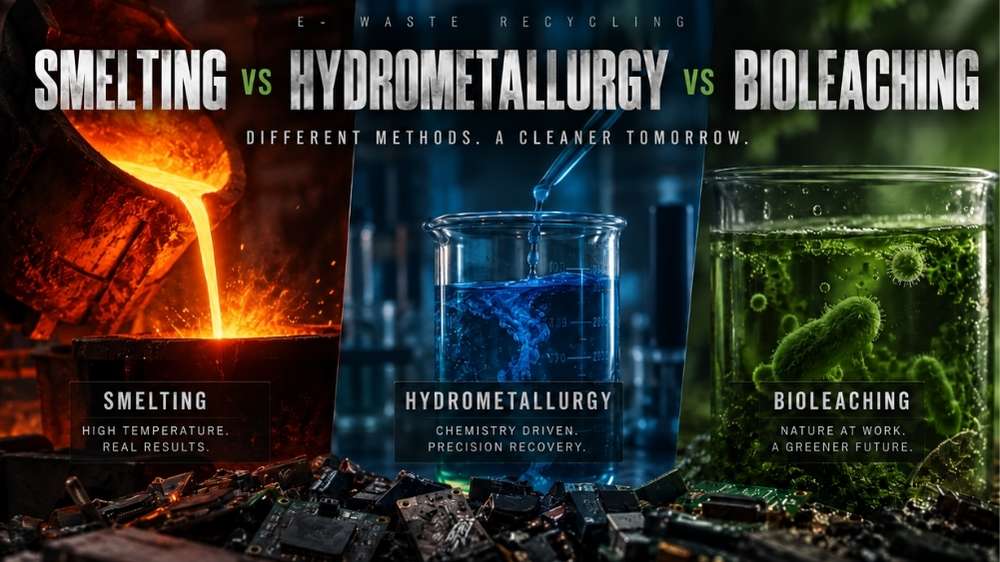
There are three main ways to do it. Smelting melts everything down with heat. Hydrometallurgy dissolves metals in liquid. Bioleaching lets tiny microbes do the digging for you. Each one has its own speed, cost, and mess to clean up afterward.
Folks in Phoenix love to say, “But it’s a dry heat.” Well, a copper smelter runs above 2,000°F. Next to that, July on the I-10 feels mild. Don’t worry. You won’t need a chemistry degree to follow along here.
This guide breaks down all three methods in plain English. You’ll see how each one works, where it shines, and where it stumbles. You’ll also see what it means for your old gear in the Valley. Plus, you’ll learn how to pick a recycler that gets it right.
Quick Answer: How Smelting, Hydrometallurgy, and Bioleaching Compare
Smelting uses heat, hydrometallurgy uses liquid chemistry, and bioleaching uses microbes to free metals. That’s the short version. All three can start with the same crushed circuit boards. Each one just takes a very different road to pure metal.
Here’s the 30-second breakdown:
- Smelting (pyrometallurgy): Melts shredded electronics in a furnace. It’s fast and proven. It’s also heavy on energy and needs strong smoke control.
- Hydrometallurgy: Soaks crushed material in acids or other solutions. It’s precise and runs at low heat. It leaves chemical waste that must be treated.
- Bioleaching: Uses bacteria or fungi to dissolve metals. It’s gentle and low-energy. It’s also slow and still mostly in labs for e-waste.
In the real world, big refiners often combine these methods. A smelter might do the rough work first. Then a chemical step cleans up the gold, silver, and palladium at the end. That combo gets the most value out of every ton.
So don’t bet the ranch on one “best” method. The best choice depends on what’s in the pile. Volume matters, and so does the metal you’re chasing. Keep that idea in your back pocket. It’ll come up again and again below.
Why Old Electronics Are Worth Mining in the First Place
Old electronics are worth mining because they pack more metal per ton than most natural ore. The U.S. EPA put it plainly. Per metric ton, circuit boards can hold 40 to 800 times more gold than U.S. ore. They can also hold 30 to 40 times more copper.
Wild, right? Think of a circuit board as a tiny gold mine that fits in a shoebox. The metal is spread thin across chips, pins, and connectors. Stack enough boards together, though, and the numbers get serious in a hurry.
The global picture is even bigger. The Global E-waste Monitor 2024 found the world made 62 million tonnes of e-waste in 2022. Only 22.3% of it was documented as properly collected and recycled. The metals inside that pile were worth about $91 billion.
Here’s what’s hiding in a typical pile of old gear:
- Gold on connector pins, edge fingers, and inside chips
- Copper in board traces, wiring, and cables
- Silver in solder, contacts, and switches
- Palladium in capacitors and some connectors
- Aluminum and steel in cases, frames, and heat sinks
Old prospectors used to say, “There’s gold in them thar hills.” Around Phoenix, those hills might be a storage unit full of dead servers. Pulling metal back out of old electronics is called urban mining, and it keeps growing. The only real question is how the metal actually gets extracted.
What Happens Before Any Metal Gets Extracted
Before any smelting, soaking, or microbe work, electronics go through prep called pre-processing. This step decides a lot about how much metal gets recovered later. Skip it, and even the best refinery leaves money on the table.
Anyone who hikes the Superstitions knows you never head out without water. Metal recovery has its own version of that rule. Nothing goes into a furnace or a tank until it’s been sorted first.
Pre-processing usually looks like this:
- Collection and check-in. Devices get logged, counted, and tracked from the start.
- Data destruction. Hard drives and SSDs get wiped or physically shredded.
- Reuse check. Working computers, test equipment, and good parts get pulled for resale.
- Manual dismantling. Batteries, CRT glass, and mercury lamps come out by hand.
- Sorting and grading. Boards get sorted by grade, from high-gold to low-gold.
- Shredding and separation. Magnets pull steel. Eddy currents kick out aluminum. Plastics get split off.
Think of it like sorting laundry before a wash. Whites, darks, and delicates each need their own cycle. Circuit boards, cables, and batteries work the same way. Our guide to e-waste recycling methods walks through that full chain step by step.
Here’s the part most people miss. The extraction method gets picked after this stage, not before. A bag of high-grade chips and a pallet of old keyboards head down totally different roads. Getting the sorting right is half the battle.
Method 1: Smelting (Pyrometallurgy)
Smelting pulls metals out of e-waste by melting it in a very hot furnace. The pros call it pyrometallurgy, which basically means “metal work with fire.” It’s the oldest and most common way to recover metals from scrap electronics at scale.
How Smelting Works on E-Waste
Shredded boards and scrap go into a furnace running above 2,000°F. At that heat, copper melts into a heavy liquid pool. Gold, silver, and palladium dissolve right into that molten copper, like sugar into hot coffee.
Lighter junk floats to the top and forms a glassy crust called slag. The plastics burn off and actually help fuel the fire. The copper mix then gets cast and sent on for refining.
A later electrical step, called electrorefining, splits out the pure copper. The gold and other precious metals collect in a leftover sludge. That sludge then gets refined on its own into bars and powders.
Out here we say something is hotter than a Phoenix parking lot in July. A smelter would laugh at that. It runs about as hot as flowing lava. The whole building is designed to keep that heat in check.
What Smelting Does Well
Smelting shines when you need volume and reliability. Big plants chew through huge tonnage every single day. They can also take mixed, messy material that other methods struggle with.
- Handles complex feed. Boards, chips, connectors, and mixed scrap can all go in together.
- Strong recovery. A 2025 research review put typical recovery at 85 to 98% for base and precious metals.
- Proven at industrial scale. Umicore’s plant in Hoboken, Belgium recovers 17 different metals.
- Plastics become fuel. The resins in circuit boards help power the furnace.
The U.S. finally has a big player of its own, too. Aurubis opened a secondary smelter in Augusta, Georgia in 2024. It’s built to take about 180,000 tons of recycling material a year. That includes circuit boards and copper cable.
Where Smelting Falls Short
Smelting has real costs, and they don’t stop at the power bill. That same 2025 review ranked it as the most energy-hungry of the three methods. It also estimated costs of roughly $800 to $1,500 per ton of e-waste.
- Smoke and gas control. Burning plastics can form dioxins and furans without strong gas cleaning.
- Lost metals. Aluminum and iron mostly end up in the slag instead of being recovered.
- High startup costs. Only a small number of these plants exist around the world.
- Needs big volumes. A smelter can’t run on one office cleanout.
So is smelting bad? Nope. It’s the workhorse of metal recovery. But like any workhorse, it eats a lot and needs a strong fence around it. Treat it right, and it recovers more metal than anything else out there.
Method 2: Hydrometallurgy (Chemical Leaching)
Hydrometallurgy recovers metals by dissolving them in a liquid and then pulling them back out. “Hydro” means water, so think wet chemistry instead of fire. It runs at much lower temperatures than smelting. That makes it a favorite for high-purity gold and copper.
How Hydrometallurgy Pulls Metals Out
Ever made sun tea on an Arizona porch? You drop tea bags in a jar, and the sun slowly pulls out the flavor. Hydrometallurgy works kinda like that. Only here, the tea bags are crushed circuit boards. The water is a chemical solution.
The process usually runs in three steps:
- Leaching. Crushed material soaks in acids, cyanide, thiourea, or thiosulfate. The metals dissolve into the liquid.
- Cleanup and concentration. Solvent extraction or ion exchange separates the target metal from everything else.
- Recovery. Electrowinning uses electric current to plate pure metal back out. Some plants use chemical precipitation instead.
Arizona knows this method better than most places. In 1968, the Bluebird Mine ran the first big copper plant using solvent extraction and electrowinning. That mine sits near Miami, Arizona, about 90 miles east of Phoenix.
What Hydrometallurgy Does Well
Hydrometallurgy wins on precision. It can target one metal at a time and deliver very pure results. It also works at a smaller scale than a smelter, which makes it more flexible.
- Lower heat. Most steps run near room temperature or just a bit warm.
- High purity. Gold and copper can come out at very high grades.
- Selective recovery. Chemists can tune the solution to grab specific metals.
- Smaller plants. A hydromet line doesn’t need a smelter-size footprint or budget.
The same 2025 review pegged precious metal recovery at around 80 to 95%. It estimated costs of about $500 to $1,200 per ton. It also rated hydrometallurgy as using less energy than smelting. That’s a solid middle ground on cost and energy.
Where Hydrometallurgy Falls Short
Here’s the catch. All that liquid chemistry leaves liquid waste behind. Acids and cyanide need careful handling. The leftover solution has to be treated before it goes anywhere. Cutting corners here can turn a clean process into a toxic one.
- Chemical waste. Spent solutions need treatment before disposal.
- Needs good prep. Material must be crushed fine so the liquid can reach the metal.
- Slower than smelting. Leaching can take hours or even days.
- Water use. That matters a lot in a desert city like ours.
Arizona has a famous monsoon slogan: “Turn around, don’t drown.” In hydromet, drowning the metal is the whole point. You just need to be really careful where that water goes when you’re done. Good plants treat and reuse their solutions instead of dumping them.
Method 3: Bioleaching (Metal-Eating Microbes)
Bioleaching uses living microbes to dissolve metals out of ore or waste. Tiny bacteria and fungi do the chemical work that acids or furnaces would normally do. It sounds like science fiction, but mines have used it for decades.
How Bioleaching Works
Some bacteria “eat” iron and sulfur for energy. As they feed, they make acid and other chemicals that dissolve nearby metals. The metal ends up in the liquid, just like in hydrometallurgy. From there, it gets recovered with the same cleanup and electrowinning steps.
A few key microbes do most of the heavy lifting:
- Acidithiobacillus ferrooxidans turns iron into a strong metal-dissolving agent.
- Acidithiobacillus thiooxidans makes sulfuric acid out of sulfur.
- Chromobacterium violaceum makes small amounts of cyanide that can dissolve gold.
- Aspergillus niger, a common mold, makes organic acids that free metals.
Picture a crew of tiny miners that never clock out. They don’t need hard hats, overtime, or a lunch break. They just need warm, acidic water and plenty of time. Give them the right conditions, and they’ll keep working for weeks.
Why Bioleaching Is Promising
Bioleaching is the gentlest of the three methods. It runs at normal temperatures and normal pressure. A 2025 review rated it the lowest-energy option of the bunch. That makes it the lightest touch on the planet, at least on paper.
- Low energy. No furnace and no big heaters.
- Fewer harsh chemicals. The microbes make their own mild acids.
- Lower cost per ton. Early estimates run about $300 to $700 per ton.
- Good for low-grade scrap. It can pull value from material too poor to smelt.
Lab results can look impressive, too. One study review reported up to 98.4% copper removal from circuit boards in seven days. That result came from a mix of Acidithiobacillus bacteria working together. Gold results vary a lot more, from low to very high.
Why Bioleaching Isn’t Mainstream Yet
Here in the desert, we say you can’t rush a saguaro. Bioleaching is a lot like that. Copper can take days, and full test runs can stretch for weeks or even months. Patience is the price you pay for the gentle approach.
- Slow. Days to weeks, compared with hours in a smelter.
- Low loading. Studies found about 1% solids works best. At 10%, gold recovery in one test fell from 69.3% to about 20%.
- Picky microbes. Toxic metals and plastics in e-waste can slow them down or kill them.
- Not industrial for e-waste yet. Most e-waste bioleaching still happens in labs and pilot plants.
That said, bioleaching isn’t new to mining at all. One review estimates 15 to 25% of the world’s copper comes from bacteria-assisted leaching. The tech is proven on ore. It just hasn’t cracked the messy mix inside a laptop at scale yet.
Smelting vs Hydrometallurgy vs Bioleaching: Side-by-Side Comparison
Smelting is the fastest and biggest, hydrometallurgy is the most precise, and bioleaching is the gentlest. That’s the headline. The table below lays out the details. The numbers are estimates from a 2025 review in RSC Sustainability.
| Factor | Smelting | Hydrometallurgy | Bioleaching |
| How it works | Heat melts the metals | Chemicals dissolve the metals | Microbes dissolve the metals |
| Temperature | Above 2,000°F | Room temp to warm | Room temp |
| Speed | Hours | Hours to days | Days to weeks |
| Typical recovery | 85 to 98% | 80 to 95% | 50 to 85% |
| Est. cost per ton | $800 to $1,500 | $500 to $1,200 | $300 to $700 |
| Energy use | Highest | Medium | Lowest |
| Main downside | Emissions and slag | Chemical waste | Slow and hard to scale |
| Scale today | Full industrial | Full industrial | Mostly labs and pilots |
| Best for | Mixed, high-volume scrap | High-purity refining | Low-grade material |
Ranchers have an old saying: “Horses for courses.” Every horse has a track it runs best on. Every method has a job it does best, too. That’s why the smartest refiners rarely stick to just one.
Why Refiners Mix Methods
Most modern plants run a hybrid system. They smelt first to concentrate the metals into copper. Then they use chemistry to split out gold, silver, platinum, and palladium at high purity. Each step picks up where the last one left off.
Bioleaching may join that team as it gets faster. It could handle the low-grade leftovers that aren’t worth firing up a furnace for. Think of it as a relay race, where each runner takes the leg they’re best at.
Which Extraction Method Fits Which Device?
Different devices head to different recovery paths based on what’s inside them. A gold-heavy chip and a steel server rack don’t belong in the same pot. That’s why good sorting matters so much at the very start.
On a ranch, you cull the herd before the cattle drive. You split them up first, so each group heads to the right pasture. E-waste works the same way. Here’s how common items usually get routed:
- High-grade circuit boards: think servers, telecom gear, and older PCs. These usually get smelted, then refined for gold and palladium.
- IC chips and processors: very high gold content per pound. These are prime feed for precious metal refiners.
- Gold-plated connectors and pins: often go to chemical stripping or other hydromet steps.
- Copper cable and wire: chopped, separated from insulation, and sent to copper refiners.
- Lithium-ion batteries: pulled out early. Many battery recyclers use hydromet to recover lithium, cobalt, and nickel.
- Steel and aluminum cases: go to regular scrap metal buyers and mills.
- CRT glass: leaded glass needs special handling and stays out of the regular stream.
Chips deserve a special mention. Our team handles recycling IC chips from surplus, obsolete, and industrial systems. Those little black squares carry some of the richest metal in the whole device. Handled right, they’re some of the most valuable scrap you own.
A Real-World Example: One Office, Three Paths
Picture an engineering office in Tempe clearing out after an upgrade. They’ve got 60 old desktops and two server racks. There’s also a box of spare chips and a closet of tangled cables. It looks like one big pile of junk.
It isn’t. The hard drives get destroyed first. The server boards and chips head toward smelting and chemical refining. The cables go to a copper refiner. The steel cases go to scrap. The batteries get pulled and sent to a battery recycler that likely uses hydromet.
That’s one pickup with at least four or five different endings. Would you want all of that thrown in one dumpster? Didn’t think so. Good sorting is what turns a junk pile into recovered metal.
Arizona’s Copper Country Already Uses All Three Methods
Arizona already uses all three methods on a huge scale, just on ore instead of laptops. The state produced about 70% of U.S. mined copper in 2025, according to the USGS. So this isn’t abstract science around here.
Arizona kids still learn the Five Cs: copper, cattle, cotton, citrus, and climate. Copper made the list for a reason. It built towns like Miami, Globe, Bisbee, and Morenci. Mining still shapes jobs, water use, and the economy across the state.
Here’s how the three methods show up across the state:
- Smelting: Freeport-McMoRan, headquartered right here in Phoenix, runs a copper smelter in Miami, Arizona.
- Hydrometallurgy: Several Arizona mines run solvent extraction and electrowinning plants. The method’s big debut came at the Bluebird Mine in 1968.
- Bioleaching: Natural bacteria help break down low-grade ore piles during heap leaching.
Why does this matter for your old electronics? The same science that runs Arizona’s mines now runs e-waste refining. Pulling copper from a server is easier on the land than digging a new pit.
It’s the same metal, just with a much shorter trip. The copper in a retired Scottsdale server may have come from an Arizona hill. Recycling it just closes the loop. Every pound recycled is a pound that doesn’t need to be dug up.
Common Myths About Getting Metal Out of E-Waste
Most myths about e-waste metal recovery come from half-true headlines. Some make it sound like free money. Others make it sound like pure pollution. The truth usually sits somewhere in the middle. Clearing them up makes it easier to judge any recycler you talk to.
There’s an old Western line for an argument that doesn’t hold up: “That dog won’t hunt.” Here are a few ideas that just won’t hunt. You’ve probably heard at least one of these from a friend or coworker.
- Myth: Every old phone is basically a gold bar. A single phone holds only a fraction of a gram of gold. The value shows up in bulk.
- Myth: Recycling just means shipping junk overseas. Some outfits do that. Real refiners also operate in the U.S. and Europe.
- Myth: Smelting is always dirty. Modern smelters run heavy gas cleaning systems. The risk is real only when those controls are weak or missing.
- Myth: Bioleaching will replace smelting any day now. It’s growing, but it’s still too slow for most e-waste at scale.
- Myth: Wiping a drive once is always enough. It depends on the drive and the data. Physical destruction is the safest route for sensitive files.
Once you drop the myths, the picture gets simpler. Metal recovery is real, it’s valuable, and it’s only as clean as the people running it. That’s why your choice of recycler matters so much.
How to Tell If a Recycler Sends Metals to the Right Place
A good recycler can tell you exactly where your material goes after it leaves your building. If they can’t, that’s a red flag. You don’t need to know smelting chemistry. You just need to ask the right questions.
Out West, there’s a saying for folks who talk big and deliver little. They’re “all hat and no cattle.” Plenty of outfits say “recycling” but really just export or dump. Here’s how to spot the real deal.
Questions to ask any Phoenix e-waste recycler:
- Where do my circuit boards go after pickup? A solid answer names the type of downstream processor.
- How do you handle data? Ask about wiping, shredding, and written proof.
- Do you separate batteries and CRTs? These need their own special paths.
- How do you price things? Some items pay and some cost. You should know which before pickup day.
- Do you pull reusable gear first? Reuse beats extraction every single time.
- How long have you been doing this? Track record matters in a business built on trust.
Data security deserves its own note. Smelting will destroy a drive eventually, but your data is exposed long before that. Make sure drives get handled at the very start. Our guide to securely destroying old hard drives walks through the safest options.
Red flags to watch for:
- Vague answers about “overseas partners”
- No paperwork, receipts, or certificates
- Prices that seem way too good for mixed junk
- Pickup windows that keep sliding week after week
Where JHI Fits in the Metal Recovery Chain
JHI works the front end of the metal recovery chain, where value gets protected or lost. We don’t run a smelter. We make sure your electronics reach the right recovery path. Everything gets sorted and graded, with your data handled first.
Phoenix got its name from rising out of old ruins, like the bird from the ashes. Your retired gear can do something similar. With the right sorting, dead boards come back as copper, gold, and palladium.
Jay Hoehl Inc. has been doing this work in Phoenix since 1980. Jay Hoehl founded the company, and Jake Hoehl stepped in as CEO in 2016. We’re a long-time BBB member with an A+ rating. That’s decades of learning which boards pay and which ones don’t.
Here’s what that looks like for you:
- Pickups across Phoenix and Maricopa County. We work with offices, labs, schools, and manufacturers.
- Data handled up front. Drives get dealt with before anything else happens.
- Sorting that protects value. Gold-bearing boards, chips, and connectors get graded, not dumped in one pile.
- We buy surplus. Test equipment, ICs, semiconductors, and excess inventory can turn into cash.
- Straight answers. Ask us where your material goes. We’ll tell you, plainly.
It’s a real relief to hand off a messy cleanout to people who’ve seen it all. You get your space back. You also know your data and your metals landed in the right hands.
Ready to find out what your old electronics are worth? Schedule a pickup or request a free evaluation with JHI. Call (602) 272-4033, Monday through Friday, 8:00 a.m. to 4:30 p.m. We’ll tell you what pays, what costs, and where it all goes. No surprises on pickup day.
What Metal Extraction Means for Your Wallet
The extraction method behind the scenes shapes what your old electronics are worth. Refiners pay based on how much metal they recover and what it costs. That value flows back to the recycler, and sometimes back to you.
What usually carries value:
- Server and telecom boards
- CPUs, IC chips, and memory modules
- Gold-plated connectors and edge fingers
- Working test equipment and surplus parts
- Clean copper wire and cable
What often costs money to handle:
- CRT TVs and monitors, because of the leaded glass
- Some types of batteries
- Low-grade consumer plastics
- Items with little metal worth recovering
Every cloud has a silver lining, and in e-waste, that lining is sometimes actual silver. A big office cleanout often balances itself out. The high-grade boards can offset the cost of handling the low-grade stuff.
Metal prices move every day, so no reputable recycler quotes gold value off the cuff. Would you sell your car without knowing what it’s worth? Ask for a real evaluation of your load instead. It’s the only way to get a number you can trust.
The Future of Metal Recovery From E-Waste
Metal recovery is heading toward hybrid systems that mix all three methods. Smelters will keep doing the heavy lifting. Chemical and biological steps will handle the fine cleanup and the low-grade scrap. The goal is simple. Recover more metal with less energy and less waste.
Here in the Valley, smart folks prep before monsoon season hits. The e-waste world is prepping too. The UN projects global e-waste will reach 82 million tonnes by 2030. That’s a lot more gear headed for recovery, and it’s coming fast.
Trends worth watching:
- More U.S. refining. Aurubis in Georgia shows domestic capacity is finally growing.
- Greener chemistry. Researchers are testing thiosulfate and other options to replace cyanide for gold.
- Better bioleaching. Mixed microbe cultures beat single strains by about 10% in some copper tests.
- Critical minerals push. E-waste recycling meets no more than 1% of rare earth demand today.
For Phoenix businesses, that adds up to one simple takeaway. Material that gets sorted well today will only get more valuable. Material that gets dumped is gone for good, along with the metal inside it.
FAQs About Smelting, Hydrometallurgy, and Bioleaching
What is the main difference between smelting and hydrometallurgy?
Smelting uses extreme heat to melt metals out of scrap. Hydrometallurgy uses liquid chemicals to dissolve them instead. Smelting handles more volume, while hydrometallurgy offers more control and purity. Many refiners use both, one after the other.
Is bioleaching better for the environment?
Usually, yes. It uses less energy and fewer harsh chemicals than the other two methods. But it’s slow and still mostly stuck in labs for e-waste. For now, it’s a promising helper. Watch this space, because the research moves fast.
Which method recovers the most gold from e-waste?
Smelting followed by chemical refining is the most common path for gold today. Reviews put smelting recovery around 85 to 98%. Hydrometallurgy comes close behind and often finishes the job. The winning combo is usually heat first, then chemistry.
Can I extract gold from electronics at home?
Please don’t try it. Home methods use acids and cyanide that can seriously hurt you. They also create toxic waste and recover very little. Keep your powder dry and let licensed pros handle the chemistry.
Is pyrometallurgy the same thing as smelting?
Pretty much. Pyrometallurgy is the technical name for any heat-based metal recovery. Smelting is the most common type, so most people use the two words the same way. Roasting and refining with heat also fall under the pyro umbrella.
Does my data get destroyed during smelting?
Eventually, yes, but you shouldn’t wait that long. Drives can sit in warehouses for weeks before processing. Always get your data destroyed at the start, and ask for written proof. A certificate of destruction gives you a paper trail if anyone asks.
How do I know my electronics won’t end up in a landfill?
Ask your recycler where each type of material goes. Get paperwork for data destruction and pickup. A trustworthy company will answer plainly and won’t dodge the question. If the answers get fuzzy, keep shopping around.
Does JHI pick up electronics in Phoenix?
Yes. JHI serves Phoenix and Maricopa County from 3334 W McDowell Rd, Unit 17. Visits are by appointment only, so call (602) 272-4033 before stopping by. Hours are Monday through Friday, 8:00 a.m. to 4:30 p.m.
The Right Extraction Method Starts With the Right Recycler
Smelting, hydrometallurgy, and bioleaching all get metal back, just in different ways. Smelting brings the heat and the volume. Hydrometallurgy brings precision. Bioleaching brings patience and a lighter footprint. Each has a place, and the smartest refiners use them together.
None of them work well without good sorting up front, though. That’s the part you actually control. Pick a recycler who protects your data, grades your material, and explains where it goes. The rest happens behind the scenes at the refinery.
As the old saying goes, strike while the iron is hot. Metal prices shift, and old gear loses value sitting in a closet. Why let it bake in a Phoenix storage unit for another summer?
You’ll feel a little pride knowing your old gear became something useful again. And you’ll feel real relief knowing it was handled right. That’s the whole goal. Your old stuff gets a second life, and you get your space back.
Let’s get your old electronics headed down the right road. Schedule a pickup or request a free evaluation from JHI today. Call (602) 272-4033, or visit 3334 W McDowell Rd, Unit 17, Phoenix, by appointment. You’ll get straight answers, fair numbers, and zero surprises. Happy trails.