
What Percentage of E-Waste Actually Gets Recycled?
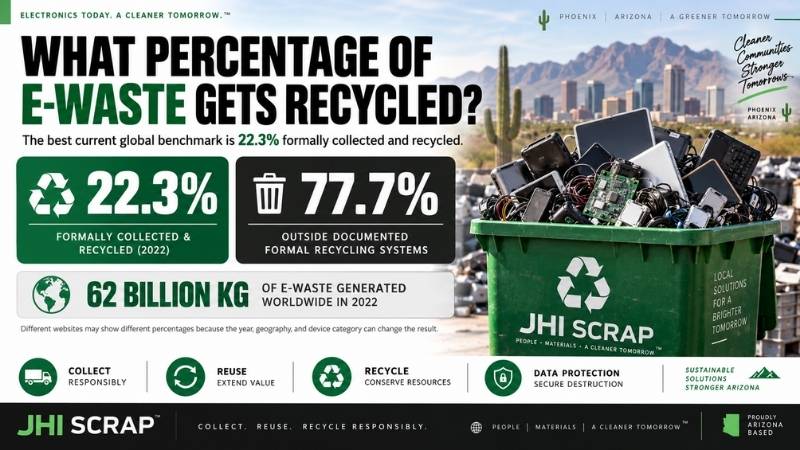
Only 22.3% of global e-waste was formally collected and recycled in 2022.
That is the clearest current global benchmark from the Global E-waste Monitor 2024. It means more than three quarters escaped documented formal recycling systems.
That number surprises people. Phones, laptops, monitors, servers, printers, cables, and appliances look recyclable. Many contain copper, aluminum, steel, gold, plastics, and glass.
Still, owning recyclable material does not guarantee recycling. Collection, sorting, data security, transport, labor, and downstream processing all matter.
For Phoenix households and businesses, that gap matters. Electronics often sit in closets, storage rooms, warehouses, or back offices for years.
Some devices get reused. Some get sold. Some get donated. Some enter formal recycling. Others disappear into mixed waste or undocumented channels.
So, what percentage of e-waste actually gets recycled? The honest answer depends on the dataset.
The best current global figure is 22.3%. Older U.S. estimates can show higher rates for narrower categories and different years.
Apples and oranges should not share the same basket. The denominator, device category, geography, and reporting method change the result.
This guide explains those differences. It also shows what happens after collection and how Phoenix can improve outcomes.
The Short Answer: About 22.3% Globally
About 22.3% of global e-waste was formally collected and recycled during 2022.
The Global E-waste Monitor 2024 reported 62 billion kilograms of e-waste generated worldwide that year. Only 22.3% was documented as formally collected and recycled in an environmentally sound way.
That leaves roughly 77.7% outside the documented formal recycling stream. That does not mean every missing device went directly to landfill.
Some equipment may have been stored, reused, repaired, exported, traded, dismantled informally, or discarded outside formal systems.
The key word is documented. Formal reporting measures material that enters recognized collection and recycling channels.
That distinction matters. It is the difference between “recyclable” and “actually recycled.”
Think of a recyclable laptop like a ticket to a flight. Having the ticket does not mean you boarded.
The device must still reach a qualified collection point. Then it must move through the recycling chain.
That is where the rubber meets the road. Collection is usually the biggest first hurdle.
Why Do Different Websites Give Different E-Waste Recycling Percentages?
Different websites give different percentages because they often measure different things.
One source may measure global e-waste. Another may measure U.S. consumer electronics. Another may count only selected devices.
For example, the U.S. Environmental Protection Agency cites an older 2018 estimate. It says about 38.5% of consumer electronics were recycled.
That figure is useful, but it is not interchangeable with the 22.3% global figure. The years and scopes differ.
A statistic can be accurate and still answer a different question. That is why context matters.
Before trusting a recycling percentage, check five details:
Geography. Is the number global, national, state-level, or local?
Year. E-waste volumes and collection systems change over time.
Device scope. Does the dataset include all e-waste or only consumer electronics?
Measurement method. Is the figure documented formal recycling or estimated material recovery?
Denominator. Is the percentage based on units, weight, or generated waste volume?
A good rule is simple. Compare like with like.
The Bigger Problem: E-Waste Is Growing Faster Than Formal Recycling
E-waste generation is growing faster than documented recycling systems can capture it.
The world generated 62 billion kilograms of e-waste in 2022. The formal recycling rate did not keep pace.
That creates a widening gap. More devices enter homes, offices, schools, hospitals, warehouses, and data systems every year.
Product cycles also move quickly. Phones get replaced. Computers age. Servers refresh. Displays break. Network equipment becomes obsolete.
Businesses face the same pressure at larger scale. One office refresh can retire hundreds of devices at once.
A warehouse cleanout can uncover years of forgotten equipment. A school district may have rooms full of old monitors.
In Phoenix, storage has another wrinkle. Desert heat can be hard on batteries and aging electronics.
That does not make every stored device dangerous. It does make long-term neglect a poor plan.
Out of sight can become out of mind. Eventually, the pile gets harder to manage.
What Counts as E-Waste?
E-waste includes unwanted electrical or electronic equipment that has reached reuse, repair, resale, or disposal decisions.
Common examples include laptops, desktops, tablets, phones, televisions, monitors, printers, servers, routers, switches, cables, and circuit boards.
It can also include industrial electronics, test equipment, control systems, electronic components, and communications hardware.
Some products contain batteries. Others contain data-bearing storage. Some contain valuable metals or hazardous materials.
The category is broad because electronics are built into almost everything now.
For a plain-language overview, the Wikipedia entity electronic waste can help readers understand the broader category.
The better question is often not “Is this e-waste?” The better question is “What is the best next use?”
A working laptop may be better reused. A repairable unit may be refurbished. A dead device may need recycling.
Waste is not always the first stop. Sometimes the best recycling decision is extending product life.
What Happens to the Other 77.7%?
The remaining 77.7% does not follow one single path.
Some devices stay in drawers, closets, garages, storage rooms, and warehouse racks. Many people keep old electronics “just in case.”
Some equipment enters secondhand markets. It may be sold, donated, refurbished, or exported for continued use.
Some material moves through undocumented or informal recycling. That can include dismantling without strong environmental controls.
Some devices enter mixed municipal waste. Others may be dumped, burned, or handled through unsafe downstream channels.
The exact split is difficult to measure. That is one reason formal recycling rates focus on documented collection.
The missing share is a map with blank areas. We know it exists, but not every route is visible.
That uncertainty should not be read as harmless. Electronics can contain materials that need controlled handling.
Older displays can contain lead. Some components contain heavy metals. Lithium-ion batteries can create fire hazards.
The City of Phoenix specifically warns residents not to place lithium-ion batteries in trash or recycling carts.
For Phoenix households, proper collection reduces risk. For businesses, documented disposition also improves accountability.
Why So Much E-Waste Never Reaches Formal Recycling
Most e-waste misses formal recycling because the collection decision breaks before processing begins.
People may not know where to take devices. Businesses may delay cleanouts. Some recyclers charge for difficult items.
Data security also slows decisions. A company may keep old drives because nobody owns the disposal process.
Convenience matters too. A recycling option across town can feel harder than leaving equipment in storage.
Small barriers add up. A missing cable, unknown password, heavy CRT monitor, or dead battery can delay action.
Then there is value confusion. People may assume old electronics are worthless.
Others expect every device to have resale value. Both assumptions can create disappointment.
The truth sits in the middle. Some electronics have recoverable value. Others cost more to process safely.
No two piles are exactly alike. That is why a clear evaluation helps.
Collection Is the First Real Recycling Step
Collection is the first real recycling step because material cannot be recovered until it enters the system.
Formal recycling starts with getting equipment from the owner to a qualified handler.
That can happen through drop-off, scheduled pickup, mail-back, retailer programs, manufacturer programs, or business collection services.
For Phoenix residents, local programs may accept electronics through designated channels. Rules can vary by item and customer type.
For businesses, a planned pickup can be easier. It can reduce staff handling and clear larger volumes faster.
The best choice depends on quantity, device type, security needs, timing, and whether equipment may have resale value.
Measure twice, cut once. A quick inventory before pickup can save confusion later.
List the major items. Note batteries. Flag data-bearing devices. Separate obvious resale candidates when practical.
A little preparation makes the handoff smoother.
How Formal E-Waste Recycling Works
Formal e-waste recycling usually follows a chain of collection, evaluation, data handling, sorting, dismantling, separation, and material recovery.
First, equipment is received and recorded. Businesses may require asset lists, counts, or other documentation.
Next, reusable equipment may be separated. Working devices can sometimes be tested, repaired, or remarketed.
Data-bearing devices need special attention. Hard drives, solid-state drives, phones, and servers may hold sensitive information.
After reuse decisions, non-reusable electronics move toward dismantling and material separation.
Workers or machines separate batteries, boards, metals, plastics, wiring, displays, and other fractions.
Mechanical systems may shred selected material. Magnets, eddy currents, density methods, and optical systems can support separation.
Recovered materials move to downstream processors. Metals may go to refiners. Plastics and glass may follow other routes.
Nothing happens by magic. Recycling is a chain, and every link affects the result.
If you want a deeper process breakdown, JHI’s e-waste recycling methods and process guide explains these stages in more detail.
Reuse Can Be Better Than Immediate Recycling
Reuse can be better than immediate recycling when equipment still has safe, practical life.
A working computer already contains the energy, labor, and materials used to make it.
Keeping that device in service can delay the need for a replacement. That can reduce demand for new manufacturing.
Refurbishment also supports value recovery. A business may recover more from a functional device than from raw materials.
That is why good disposition starts with evaluation. The goal is not to shred everything.
A hammer sees every problem as a nail. A smart asset program does not.
Some items should be reused. Some should be sold. Some should be harvested for parts. Some should be recycled.
The right path depends on condition, age, market demand, security requirements, and processing cost.
Data Security Changes the Recycling Decision
Data security can determine when and how electronics leave a business.
Old hardware often carries more than metal and plastic. It may contain customer records, employee files, financial data, credentials, or proprietary information.
That makes storage devices different from ordinary scrap. A hard drive cannot be judged only by its weight.
Before recycling, data should be handled through a defined process. The method depends on risk and device condition.
Some drives can be sanitized through approved logical methods. Others may require physical destruction.
Documentation matters for many organizations. It helps show that assets followed an approved disposition process.
For businesses with larger inventories, IT asset disposition can combine inventory control, data handling, reuse, and recycling decisions.
Better safe than sorry fits here. A rushed disposal decision can create a bigger problem than the old device itself.
Why Businesses Often Have Better Opportunities to Improve Recycling Rates
Businesses can improve recycling rates because they control larger, more organized equipment streams.
A household may retire one laptop and two phones. A business refresh may retire hundreds of assets.
That scale can make pickup, tracking, sorting, and value recovery more practical.
Companies can also build rules into procurement and IT operations. Equipment retirement does not need to be an afterthought.
A strong process can define when assets retire, who approves disposal, how data is handled, and where equipment goes.
That turns a cleanup event into a repeatable system.
There is another advantage. Business electronics may include servers, networking gear, test equipment, industrial electronics, and components.
Some of those assets can retain secondary-market value. Others contain concentrated material value.
The early bird gets the worm. Waiting too long can reduce resale value as equipment ages.
Why E-Waste Recycling Costs Money Even When Electronics Contain Valuable Metals
E-waste recycling can cost money because valuable materials are only one part of the economics.
Electronics must be collected, transported, sorted, tested, dismantled, processed, documented, and sent downstream.
Labor costs money. Trucks cost money. Compliance costs money. Data handling costs money.
Some devices contain valuable boards or metals. Others contain mostly low-value material and expensive handling requirements.
A flat-screen television and a server rack do not carry the same economics.
Battery-bearing equipment can add complexity. Older display technologies can add special handling needs.
Market prices also move. Copper, aluminum, precious metals, and secondary equipment values change.
There is no free lunch. Material value can offset costs, but it does not erase every processing expense.
That is why honest recyclers evaluate the actual mix instead of promising that every load pays.
What Materials Can Be Recovered From E-Waste?
E-waste can yield metals, plastics, glass, and reusable components when processing is appropriate.
Common recovered metals include copper, aluminum, steel, gold, silver, palladium, and other specialty materials.
Circuit boards are often valuable because they concentrate metals into relatively small volumes.
Cables can contain copper or aluminum. Computer cases often contain steel. Heat sinks may contain aluminum.
Some hard drives contain aluminum, steel, magnets, boards, and other recoverable parts.
Plastics are more complicated. Different resin types, additives, and contamination levels affect downstream options.
Glass also varies by device. Modern display glass differs from older cathode-ray tube glass.
The EPA notes that electronics contain valuable resources and materials. Recycling can reduce demand for virgin extraction.
Every little bit helps, but recovery quality matters more than simply moving material somewhere.
Why Precious Metals Do Not Make Every Device Profitable
Precious metals add value, but most devices contain them in small concentrations.
Gold may appear in contacts, connectors, chips, and circuit boards. Palladium and silver can appear in electronic components.
The device still needs processing before those materials become useful commodities.
That requires aggregation. One phone may contain interesting metals, but a recycler handles material by volume.
Processing efficiency matters. So do recovery yields and refinery terms.
People sometimes imagine an old laptop as a tiny gold mine. That is only half the story.
The gold is real. So are the costs required to reach it.
A penny saved is a penny earned. In recycling, efficient sorting often determines whether value is preserved.
Why Batteries Make E-Waste Collection More Important
Batteries make e-waste collection more important because damaged cells can create serious fire risks.
Lithium-ion batteries power phones, laptops, tablets, tools, wearables, and many other devices.
They can remain inside products after those products stop working. That makes casual disposal risky.
The City of Phoenix warns that lithium-ion batteries should never enter residential trash or recycling bins.
Collection trucks and sorting facilities are not designed for hidden battery fires.
A crushed or damaged battery can short-circuit. Heat and impact can increase the danger.
This is one reason “just throw it away” is a bad default for electronics.
An ounce of prevention is worth a pound of cure. Separate battery-bearing devices before disposal decisions.
Ask the receiving recycler how batteries and battery-containing products should be prepared.
How E-Waste Affects the Environment
Improper e-waste handling can affect soil, water, air, workers, and nearby communities.
Electronics can contain lead, cadmium, mercury, chromium, nickel, flame retardants, and other controlled materials.
Those materials are useful inside products. They become problems when devices are broken or burned carelessly.
Open burning is especially harmful. It can release smoke and contaminated residues while destroying recoverable value.
Landfilling also wastes metals and components that could return to productive use.
Formal recycling helps keep more material in managed systems. It also creates better visibility into downstream handling.
For a broader look at these risks, JHI’s environmental impact of e-waste guide explains the issue further.
The long game matters here. Responsible recovery protects resources while reducing avoidable hazards.
Does Recycling E-Waste Really Save Resources?
Yes. Recycling electronics can conserve resources by recovering materials already above ground.
Mining and refining virgin materials require energy, equipment, water, land, and transportation.
Recovered copper, aluminum, steel, precious metals, and selected plastics can reduce some virgin demand.
The benefit grows when equipment is reused first. Reuse keeps the entire manufactured product working longer.
Then recycling can recover materials after useful life truly ends.
That sequence supports a simple hierarchy. Use longer. Reuse when practical. Recycle what cannot stay in service.
You cannot have your cake and eat it too. Endless consumption still creates pressure, even with recycling.
Better product design, repairability, reuse, and collection all need to work together.
Why Phoenix Needs Better E-Waste Collection
Phoenix needs better e-waste collection because the city combines rapid growth with heavy electronics use.
Homes accumulate phones, laptops, televisions, gaming devices, printers, routers, and battery-powered products.
Businesses accumulate much larger streams. Offices, schools, manufacturers, healthcare facilities, and warehouses all retire electronics.
The Phoenix metro area also spreads across a large footprint. Distance can make drop-off inconvenient.
That makes pickup and planned collection especially useful for larger quantities.
Local climate adds another practical concern. Electronics may sit in garages, sheds, or hot storage rooms.
Heat can accelerate battery aging. Dust can also make long-stored equipment less attractive for reuse.
A stitch in time saves nine. Moving obsolete assets sooner can preserve value and reduce storage headaches.
Phoenix residents and businesses should treat electronics as a separate material stream, not ordinary trash.
What Phoenix Residents Should Do With Old Electronics
Phoenix residents should first decide whether an old device can be reused, donated, repaired, or recycled.
Start by checking whether the device still works. A functional product may have a second life.
Next, protect personal information. Sign out of accounts and remove sensitive data before transfer.
Then check batteries. Do not place loose lithium-ion batteries in curbside recycling.
Use a qualified local collection option that accepts the specific device type.
City programs and private recyclers may have different rules. Always confirm accepted items before traveling.
For larger home cleanouts, group similar devices. Keep phones together. Keep computers together. Separate batteries when instructed.
Do not dismantle devices unless you know the safe process. Screens and batteries can create hazards.
When in doubt, ask first. A two-minute call can prevent a wasted trip.
What Phoenix Businesses Should Do With Retired Electronics
Phoenix businesses should manage retired electronics through a documented asset disposition process.
Start with an inventory. Record asset type, quantity, condition, storage location, and data risk.
Separate equipment into likely reuse, resale, recycling, and special-handling groups.
Identify data-bearing devices. Decide how data sanitization or destruction will be verified.
Schedule collection around business operations. Keep equipment secure until the handoff is complete.
Ask what documentation is available. Needs vary by industry, contract, and internal policy.
Businesses should also ask how downstream material is managed. A low quote means little if accountability disappears.
If your organization has recurring refresh cycles, build disposition into the refresh plan.
Slow and steady wins the race. A repeatable quarterly process is easier than a five-year cleanup.
JHI Scrap works with Phoenix-area businesses that need electronics, surplus, and IT assets evaluated for responsible disposition.
How to Choose an E-Waste Recycler in Phoenix
Choose an e-waste recycler by checking transparency, security practices, accepted materials, downstream handling, and pricing.
Do not judge only by the words “green” or “responsible.” Ask what those claims mean in practice.
A strong recycler should explain what happens to reusable equipment. They should also explain non-reusable material routes.
Ask how data-bearing devices are handled. Get clear answers before equipment leaves your control.
Pricing should also be understandable. Some materials may carry value. Others may require processing fees.
Pickup terms matter. Confirm minimums, scheduling, loading expectations, and any excluded items.
For businesses, documentation can be just as important as price. Internal teams may need records after disposition.
Trust, but verify. Clear questions help separate a real process from a vague promise.
The goal is not finding the loudest recycler. It is finding a recycler whose process fits your risk.
What Questions Should You Ask Before Booking E-Waste Pickup?
Ask practical questions before booking so there are no surprises on pickup day.
- What electronics do you accept?
- Do you accept batteries or devices with built-in batteries?
- Are there items that carry a processing fee?
- Can working equipment be evaluated for reuse or resale?
- How are hard drives and other data-bearing devices handled?
- Do you provide pickup for businesses in Phoenix or Maricopa County?
- What quantity makes a pickup practical?
- What documentation can you provide after collection?
- How do you manage downstream processors?
- Do you buy selected surplus electronics or industrial equipment?
There is no such thing as a dumb question. Good answers make the decision easier.
CTA: Get a Clear Evaluation Before You Move the Equipment
If you have retired electronics in Phoenix, start with a clear evaluation.
JHI can review the material mix, quantity, condition, and pickup needs before you commit.
That helps identify potential value, likely processing needs, and any special-handling concerns.
You do not need to guess what belongs in which pile.
Schedule a pickup or request a free evaluation with JHI before moving large quantities.
A clear plan saves time. It also reduces surprises when equipment leaves your facility.
How Can We Increase the Percentage of E-Waste That Gets Recycled?
We can increase recycling rates by making collection easier, reuse more attractive, and disposition more accountable.
The first improvement is access. People need convenient places and services for electronics collection.
The second is awareness. Residents need clear instructions about batteries, data, accepted items, and fees.
The third is business discipline. Organizations should not let retired assets disappear into long-term storage.
The fourth is product design. Devices that are repairable and easier to dismantle support better recovery.
The fifth is traceability. Documented downstream processing helps strengthen trust in formal recycling systems.
The sixth is value recovery. Reuse and resale can motivate owners to act sooner.
Many hands make light work. Manufacturers, cities, recyclers, businesses, and households all affect the final rate.
No single program fixes the whole gap. Small improvements across the chain can create large gains.
What Role Do Certified Recyclers Play?
Certified recyclers can provide independent assurance around environmental, worker-safety, and data-security practices.
In the United States, recognized standards include R2 and e-Stewards.
Certification does not make every recycler identical. Services, accepted materials, pricing, and downstream partners still vary.
It does create a framework that buyers can use during vendor evaluation.
Businesses with compliance needs may weigh certification more heavily than a household with one old phone.
The right level of diligence depends on the risk. A server farm and a broken keyboard are different problems.
Different strokes for different folks. Match the recycler’s controls to the material and your obligations.
Can E-Waste Ever Be 100% Recycled?
No practical recycling system recovers 100% of every electronic device into equal-quality new material.
Electronics combine many materials. Adhesives, coatings, composites, tiny components, contamination, and mixed plastics complicate recovery.
Some fractions can be recovered efficiently. Others lose quality or need specialized downstream treatment.
Even strong recycling systems create residual material. The goal is maximizing safe reuse and recovery.
Design improvements can raise future recovery rates. Better disassembly and material labeling can help.
Still, “100% recyclable” should not be confused with “100% recycled.”
If it sounds too good to be true, ask for details. Absolute claims deserve careful scrutiny.
Is E-Waste Recycling Profitable?
E-waste recycling can be profitable for certain material streams, but profitability varies widely.
High-value boards, reusable equipment, test gear, servers, and selected components can support stronger economics.
Low-value plastics, damaged displays, mixed accessories, and difficult batteries may cost more to handle.
Scale also matters. A truckload can be processed differently from three household devices.
Labor and logistics matter. So do commodity markets, resale demand, and downstream refinery terms.
The better question is not “Is e-waste profitable?” Ask whether this specific material mix has recoverable value.
Cash is king, but risk still matters. Responsible handling should not disappear to improve a short-term margin.
How Much E-Waste Can Be Recycled From One Device?
The recyclable share of one device depends on its design, condition, and available downstream markets.
A desktop computer may contain a steel case, aluminum parts, copper wiring, circuit boards, plastics, and drives.
A phone contains less total mass. It can still contain valuable metals and reusable components.
A television has a different material mix. Display technology can strongly affect handling options.
Industrial electronics may contain heavy housings, boards, power supplies, and specialized components.
There is no honest universal percentage for every device type.
Do not put the cart before the horse. First identify the device, then evaluate recovery options.
A qualified recycler should avoid promising a single recovery rate for every product without evidence.
E-Waste Recycling Checklist for Phoenix Households and Businesses
Use this checklist before electronics leave your home, office, school, warehouse, or facility.
- Identify what you have. Count major device categories and note unusual equipment.
- Separate working items. Reuse or resale may beat immediate material recovery.
- Protect data. Remove accounts and follow your organization’s data policy.
- Check batteries. Flag swollen, damaged, loose, or built-in lithium batteries.
- Keep equipment dry. Avoid unnecessary damage before collection.
- Confirm accepted materials. Do not assume every recycler accepts every device.
- Ask about fees. Difficult items may have processing costs.
- Ask about value. Selected equipment or components may be worth evaluating.
- Confirm pickup details. Know timing, loading needs, and access requirements.
- Keep records when needed. Businesses may need inventory and disposition documentation.
- Finish what you start. Do not let a labeled recycling pile sit for another year.
For a broader local roadmap, use JHI’s complete e-waste recycling guide for Phoenix before planning a larger cleanout.
Frequently Asked Questions About E-Waste Recycling Rates
What percentage of e-waste is recycled globally?
About 22.3% was formally collected and recycled in 2022, according to the Global E-waste Monitor 2024.
That is a global documented formal recycling rate. It should not be mixed with narrower national estimates.
Why is the e-waste recycling rate so low?
The rate stays low because collection, convenience, cost, data security, informal handling, and storage create barriers.
Many devices never reach formal collection points. Without collection, material recovery cannot begin.
Is most e-waste thrown in landfills?
Not necessarily. The untracked share can include storage, reuse, informal recycling, export, mixed waste, and dumping.
Formal datasets cannot assign every undocumented device to one destination.
What is the U.S. e-waste recycling rate?
There is no single current U.S. percentage that perfectly matches the global 22.3% measure.
The EPA cites an older 2018 estimate showing 38.5% of consumer electronics recycled.
That figure uses a different scope and year. Use it carefully when making comparisons.
Can I put electronics in my Phoenix recycling bin?
Do not assume curbside recycling accepts electronics. Electronics need designated collection or recycling channels.
Lithium-ion batteries should never go into household trash or curbside recycling bins in Phoenix.
What electronics usually have the most recycling value?
Value often comes from reusable equipment, circuit boards, servers, test equipment, components, and copper-rich material.
Condition, quantity, model, age, and market demand can change the result.
Should I wipe a computer before recycling it?
Yes. Personal or business data should be addressed before a computer changes hands.
Businesses may need a documented sanitization or destruction process based on their risk.
Is reuse counted as recycling?
Reuse and recycling are different outcomes. Reuse keeps equipment in service without breaking it into raw materials.
Both can support better electronics management. Reuse is often preferred when the device remains useful.
Can businesses get paid for old electronics?
Sometimes. Certain surplus electronics, components, test equipment, servers, and reusable assets may retain value.
Other material may have processing costs. An evaluation is the best way to know.
What should I do with a swollen lithium battery?
Do not place it in household trash or curbside recycling. Avoid crushing, puncturing, or casually shipping it.
Contact a qualified local program for handling instructions suited to damaged batteries.
How often should a business clear retired electronics?
A regular schedule works better than waiting for storage rooms to overflow.
Quarterly, semiannual, or refresh-cycle reviews can keep asset disposition manageable.
The best cadence depends on device volume, security needs, and company operations.
Final Answer: The Recycling Gap Is Mostly a Collection Gap
Only 22.3% of global e-waste was formally collected and recycled in 2022.
That is the most useful current answer to the headline question. It is also a warning sign.
Most electronics are not impossible to recycle. The bigger challenge is getting them into accountable systems.
Collection, reuse, data security, sorting, logistics, economics, and downstream processing all shape the final outcome.
Phoenix households can help by keeping electronics and batteries out of ordinary waste streams.
Businesses can do more. They can inventory assets, protect data, recover value, and schedule regular disposition.
Every device handled correctly closes a small part of the gap. Enough small decisions can move the larger number.
The ball is in our court. Better recycling starts before a device reaches a shredder.
If your Phoenix organization has retired electronics, surplus equipment, or IT assets, JHI can help evaluate the next step.
Request a free evaluation or schedule a pickup. Keep the process clear, secure, and practical from the start.