
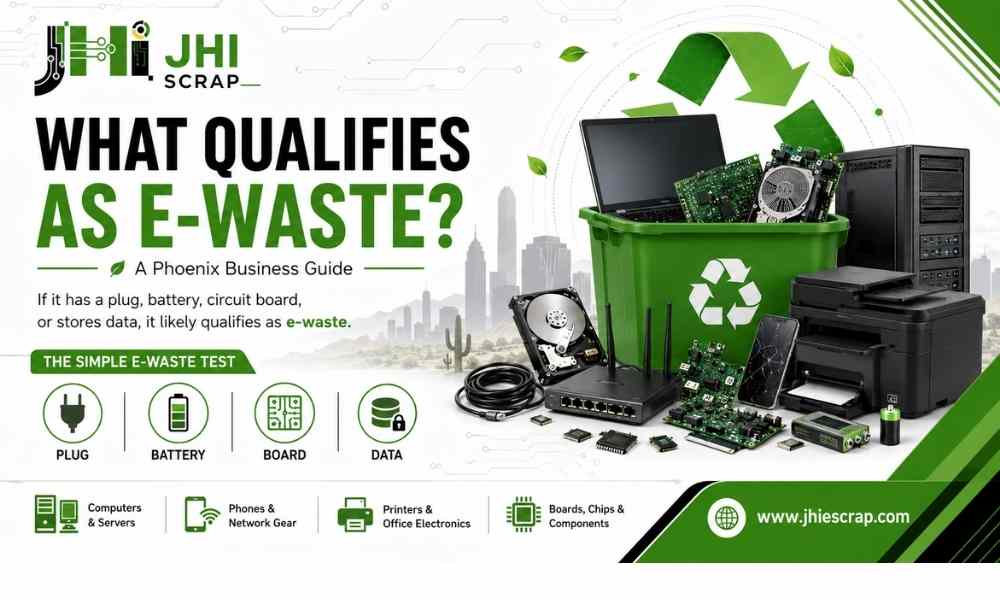
What Qualifies as E-Waste? A Phoenix Business Guide
Ever look around a warehouse, office, or server room and wonder what can actually be recycled and what needs special handling? You’re not alone. Most Phoenix businesses know they have electronics piling up. Few know which items count as e-waste and which ones still hold value.
Here’s the short version. E-waste is any electronic equipment you no longer use. That includes a lot more than old computers. It covers networking gear, industrial electronics, loose components, and the scrap that builds up in storage.
Some electronics create liability. Others create value. The hard part is knowing which is which. This guide makes that simple. We’ll walk through what qualifies, what’s worth money, what needs secure data handling, and how to get it picked up. If you want the fast track, you can always contact our Phoenix team for a quick evaluation.
Quick Answer: What Qualifies as E-Waste?
E-waste is any device or part that runs on power, stores data, or contains electronic components and is no longer needed. If it has a plug, a battery, a circuit board, or a chip, it likely belongs in an e-waste program, not the trash.
Here are the basics most Phoenix businesses deal with:
- Computers and servers that are retired or replaced
- Networking gear like routers, switches, and access points
- Office electronics like printers, copiers, and phones
- Industrial and test equipment from labs and production floors
- Loose components and scrap like boards, chips, and connectors
If it stores data, powers operations, or holds electronic components, it likely belongs in an e-waste program rather than a dumpster.
The Simple E-Waste Test
Want a rule you can use in ten seconds? Use the Plug-Battery-Board-Data test. Walk up to any item and ask if it has one of these:
- A plug or power cord
- A battery of any size
- A circuit board inside
- A way to store data
If you check even one box, it qualifies as e-waste. That covers almost everything in a modern office or facility. If it contains a circuit board, should it really end up in the trash? Most of the time, no.
When Electronics Become E-Waste
Devices don’t have to be broken to count. Electronics become e-waste the moment they leave active use. That happens for a lot of reasons.
Watch for these common triggers:
- Broken or failing gear that no longer works
- Obsolete equipment that’s been replaced by newer models
- Excess inventory that never shipped or sold
- Technology refresh projects that swap out fleets at once
- Office moves that leave gear behind
The biggest mistake many companies make? Waiting until equipment completely fails. A lot of devices become e-waste long before they break, and that’s often when they’re worth the most.
Why Businesses Should Identify E-Waste Correctly
Getting this right is more than housekeeping. Correct identification protects three things at once: your risk, your value, and your compliance.
Think of it in three parts:
- Risk. Old drives and devices can hold sensitive data. Toss them wrong and you expose your business.
- Value. Plenty of “junk” still has resale or scrap value. Trash it and that money is gone.
- Compliance. Business electronics often follow stricter rules than household items. Proper handling keeps you covered.
The cost of guessing is real. Some companies pay to dispose of assets. Others recover value from the same material. The difference usually comes down to whether someone classified it correctly first. When in doubt, our team can sort it for you through our full e-scrap services.
Common Business Items That Qualify as E-Waste
Once you know the test, you start seeing e-waste everywhere. Most Phoenix businesses hold far more than they think. The goal here is simple recognition. As you read, you’ll probably think, “We have those.”
You may already have thousands of dollars of electronic assets sitting in storage without realizing it. Below are the categories we see most, including industrial items that standard recyclers tend to skip.
IT Equipment
This is the category most people picture first, and for good reason. It shows up in every office.
- Desktops, laptops, and tablets
- Servers and rack hardware
- Monitors and docking stations
- Keyboards, mice, and accessories
- Hard drives and storage arrays
Old servers may look obsolete, yet many still hold resale or component value. Before you write them off, it’s worth a look. Our IT asset disposition process is built for exactly this kind of retired gear.
Network and Telecom Hardware
Network closets are quiet, so they’re easy to forget. They’re also full of e-waste.
- Routers and switches
- Firewalls and load balancers
- Wireless access points
- VoIP phones and PBX systems
- Patch panels and cabling
When was the last time anyone checked the retired switches sitting in storage? A lot of this gear holds configuration data too, so it deserves secure handling along with recycling.
Manufacturing and Electronic Component Scrap
This is where Phoenix manufacturers find hidden value. Production runs leave behind a steady stream of electronic material that most recyclers don’t fully understand.
Common examples include:
- Bare and populated circuit boards
- Excess or obsolete components
- Reels of capacitors, resistors, and ICs
- Connectors, pins, and contacts
- Test failures and production overruns
What looks like scrap may contain recoverable value. We handle this material every day, including SMD capacitors and components and IC chip recycling.
Office and Facility Electronics
Look past the IT room and you’ll find even more. Almost every office has a forgotten electronics closet.
- Printers, copiers, and scanners
- Conference room displays and projectors
- Security cameras and access systems
- UPS battery backups
- Shredders, label makers, and small devices
Almost every office has a forgotten electronics closet. Many of these items, especially copiers, store data on internal drives, so don’t treat them as plain hardware.
Test Equipment and Industrial Electronics
Labs and shop floors run on specialized gear. When it retires, it qualifies as e-waste, and it often holds more value than people expect.
- Oscilloscopes and signal generators
- Power supplies and meters
- Programmable controllers and drives
- Lab and measurement instruments
- Calibration and diagnostic tools
Many of these devices contain reusable parts or precious metals. Some equipment belongs in recycling. Some belongs in asset recovery. Knowing the difference can change the outcome. See how we handle test equipment for Phoenix businesses.
How to Tell Whether Your E-Waste Has Resale, Recycling, or Scrap Value
Not all e-waste ends the same way. Some assets get resold. Some get recycled for materials. Some only carry scrap value. Knowing the difference helps you avoid throwing away money.
A quick myth to drop: age is not the whole story. Many companies assume old means worthless. In reality, market demand often matters more than age. You may be paying to dispose of equipment that another company would gladly buy.
Here’s a simple way to think about it:
| Outcome | Typical Items | Best For |
|---|---|---|
| Resale | Recent IT gear, working equipment, in-demand models | Recovering the most value |
| Scrap recovery | Boards, chips, connectors, precious-metal parts | Material value from older or broken gear |
| Special handling | Batteries, CRTs, regulated items | Safe, compliant disposal |
Items More Likely to Have Resale Value
Some gear belongs back in the marketplace, not the recycling bin. These items usually qualify for remarketing.
- Servers and storage under five years old
- Recent laptops and desktops
- Current-generation networking gear
- Working specialty and test equipment
Equipment under five years old often deserves a look before it goes to recycling. Some assets belong in recycling bins. Others belong back in the marketplace.
Items More Likely to Have Scrap Value
When resale isn’t an option, the value moves inside the device. This is material recovery.
- Circuit boards of all kinds
- CPUs, gold pins, and connectors
- Wire and cable for copper
- Components with precious-metal content
Many electronic devices are like old mines. The value sits inside, not on the surface. Circuit boards often carry more worth than the case around them.
Items More Likely to Need Paid or Special Handling
A few items cost money to handle the right way. That’s normal, and knowing it upfront prevents surprises.
- Batteries, especially lithium
- CRT monitors and televisions
- Lamps and items with regulated materials
- Mixed loads that need sorting
Often the transport drives the cost more than the processing. Knowing this upfront prevents costly surprises later.
When Surplus Liquidation May Be Better Than Recycling
If the gear still works, recycling might be the wrong first move. Liquidation can return more.
Consider liquidation when you have:
- Functional equipment in good condition
- Bulk lots of the same model
- Surplus or never-deployed inventory
- Items with active market demand
Why recycle a working asset if the market still wants it? Our surplus electronics program is built to capture that value first.
Data-Bearing Electronics That Need Secure Handling
Here’s the part many businesses miss. A lot of e-waste still holds your data. That turns a simple cleanup into a security decision.
Most businesses worry about hackers. Few worry about the hard drives sitting in storage. Data often survives a basic delete, so retired devices need real handling, not just a wipe and a wish.
Common Data-Bearing E-Waste
You’d be surprised how many devices store information. The list goes well past laptops.
- Hard drives and solid-state drives
- Servers and storage arrays
- Laptops, desktops, and phones
- Networking gear with saved configs
- Copiers and multifunction printers
Would you know which devices in your building still contain data? Most copiers and printers have internal drives, and most teams forget that.
Why Old IT Assets Can Still Contain Sensitive Data
Deleting a file doesn’t erase it. The data usually stays on the drive until something overwrites it. That gap is where breaches happen.
Old assets can still hold:
- Customer and client records
- Financial and payroll files
- Saved passwords and credentials
- Internal documents and emails
The equipment may be obsolete. The data may not be. Treat every retired drive as a live risk until it’s verified clean.
What to Request from a Recycling or ITAD Provider
Good vendors make data safety easy to confirm. Ask before you hand anything over.
Request these basics:
- A documented data destruction method
- Clear chain of custody from pickup to processing
- A certificate of destruction
- An asset report listing what was handled
Trust should be documented, not assumed. Our ITAD service includes secure data destruction with full paperwork.
Certificates, Chain of Custody, and Asset Reports
Documentation is what protects you during an audit. It turns “we recycled it” into proof.
- Certificate of destruction confirms data was destroyed
- Chain of custody tracks each device through the process
- Asset report lists serial numbers and outcomes
What gets tracked gets protected. What gets documented gets verified. Keep these records on file and your compliance reviews get a lot easier.
E-Waste for Phoenix Manufacturers and Industrial Businesses
Manufacturers sit on a different kind of e-waste, and most recyclers aren’t built for it. Production creates electronic scrap that keeps building up while everyone focuses on finished goods.
Manufacturers often focus on finished products while valuable electronic scrap quietly accumulates in the background. That scrap can be a real revenue stream when it’s handled by people who know it.
Excess Electronic Components
Unused parts add up fast. Overbuys, canceled runs, and design changes all leave components behind.
- Surplus capacitors, resistors, and ICs
- Full and partial reels
- Connectors and hardware
Many of these parts still carry secondary-market demand. Some of the most valuable material never reaches production. See our excess inventory management options.
Obsolete Inventory and Overstock Parts
Aging stock isn’t dead stock. Obsolete to you can be useful to someone else.
- End-of-life part numbers
- Overstock from old projects
- Discontinued boards and modules
One company’s excess can become another company’s solution. Obsolete does not always mean worthless, so it’s worth an evaluation before disposal.
Circuit Boards, CPUs, Connectors, and Precious-Metal-Bearing Scrap
This is the high-value heart of electronic scrap. The worth is in the materials.
- Populated circuit boards
- CPUs and processors
- Gold-plated pins and connectors
- Precious-metal-bearing parts
Circuit boards are the ore deposits of the electronics world. Precious-metal content often drives the recovery value, which is why proper sorting matters so much.
Ongoing E-Scrap and Production Scrap Streams
If scrap comes in every week, treat it like a process, not a cleanup. That’s where efficiency lives.
- Recurring production scrap
- Regular component rejects
- Scheduled material pickups
Manage it once and it becomes clutter. Manage it consistently and it becomes a process. Recurring pickups also tend to lower your handling costs over time.
How Phoenix Businesses Should Prepare E-Waste for Pickup
A little prep makes pickup faster, safer, and more accurate. It also helps us value your material correctly. Why make pickup harder than it needs to be?
Here’s a simple five-step workflow.
Step 1: Separate Data-Bearing Devices
Pull anything that stores data into its own group first. Think servers, drives, laptops, and storage devices.
Protect data first, recycle second. This one step lowers your risk before the truck even arrives.
Step 2: Sort Electronics by Category
Group like with like. Put IT gear, networking, components, and office electronics in their own piles.
Order creates efficiency. Grouping assets speeds up valuation and keeps the pickup clean.
Step 3: Create a Basic Inventory
You don’t need a spreadsheet masterpiece. A simple count works.
- Rough quantities by type
- Model numbers where you can
- Anything unusual or high value
What gets counted gets managed. Model numbers especially help us give you accurate numbers.
Step 4: Take Photos of the Material
A few quick photos save everyone time. Snap the piles, the labels, and anything bulky.
Pictures answer questions before they’re asked. Photos cut down the back-and-forth and speed up your quote.
Step 5: Ask About Pallets, Gaylords, or Dock Pickup
Big loads need a plan. Let us know how the material is stored and how we’ll reach it.
- Palletized or loose
- Gaylord boxes or bins
- Loading dock or ground level access
Good logistics prevent expensive delays. Large loads often need different transport planning, so a heads-up helps.
Phoenix, AZ E-Waste Recycling Options for Businesses
Phoenix businesses have more options than the city drop-off. The right one depends on what you have and what you need from it.
When electronics begin piling up, businesses want answers quickly, not weeks later. Here’s how the main paths compare.
Business Recycling and ITAD Pickup
These two sound similar but solve different problems. Knowing which you need saves time and money.
- Recycling handles end-of-life gear for material recovery
- ITAD adds secure data destruction and reporting for IT assets
Not every electronics project requires the same solution. If your gear held data, ITAD is usually the safer call.
Residential HHW Is Not the Same as Business E-Waste Disposal
City household hazardous waste programs are great for homes. They’re not built for businesses.
- Many municipal programs exclude business material
- Volume limits make them impractical for offices
- They rarely offer data destruction or reporting
Business waste follows different rules than household waste. Commercial loads need a commercial partner.
Why Work With a Local Phoenix E-Waste Partner
Local matters more than people expect. It shows up in speed and logistics.
- Faster scheduling and pickups
- Knowledge of Phoenix-area facilities and routes
- Easier communication and follow-up
Local partners understand local challenges. You can learn more about our Phoenix operation and how we work.
What to Ask Before Scheduling a Pickup
A few good questions set up a clean project. Ask these before you book.
- How do you handle data destruction?
- What documentation will I receive?
- How do you handle large or palletized loads?
- Do you evaluate items for resale value?
Good questions lead to better outcomes. Browse more answers and tips on our e-scrap blog.
Why Choose JHI for Business E-Waste in Phoenix?
At this point you’re not just learning. You’re choosing a partner. Here’s what sets us apart for Phoenix businesses.
Some vendors simply remove equipment. Others help recover value, protect data, and simplify compliance. We aim for the second group.
Phoenix-Based Electronics Recycling and Surplus Experience
We’re local, and that shapes everything we do. We know the area’s manufacturers, offices, and logistics.
When electronics begin taking over storage space, businesses want a local solution that understands their timelines. That’s the role we fill across the Phoenix metro.
Business-Focused Material Handling
We’re built for commercial loads, not curbside drop-offs. That means docks, pallets, and bulk material.
Business recycling is not household recycling. Business logistics require business solutions. We plan pickups around your warehouse, not the other way around.
ITAD and Secure Data Destruction
Data security sits at the center of our IT work. We destroy data and document it.
The device may leave your building, but your responsibility for the data should not. Our ITAD process gives you certificates and chain-of-custody records you can hand to an auditor.
Precious-Metal-Bearing E-Scrap
We know where the value hides. Boards, chips, and connectors get the attention they deserve.
Hidden inside many electronic assemblies are small deposits of recoverable value. We process IC chips and SMD components with that value in mind.
Surplus Electronics and Excess Inventory Support
Working gear should earn its keep before it gets recycled. We check for resale first.
Why recycle working equipment if it can still generate value? Our surplus electronics and excess inventory programs put that value back in your hands.
Frequently Asked Questions About E-Waste
What qualifies as e-waste?
E-waste is any electronic device or part you no longer use. That includes anything with a plug, battery, circuit board, or chip. It covers computers, servers, networking gear, office electronics, industrial equipment, and loose components. If it powers on or stores data, it qualifies.
What are common examples of e-waste?
Common examples include laptops, desktops, servers, monitors, routers, switches, printers, copiers, and phones. For businesses, it also covers test equipment, industrial controllers, circuit boards, and surplus components. Both office and factory electronics count.
Do servers qualify as e-waste?
Yes. Retired or replaced servers qualify as e-waste. They also store data, so they usually need ITAD with secure data destruction rather than basic recycling. Many servers still hold resale or component value too.
Do routers and switches count as e-waste?
Yes. Routers, switches, firewalls, and access points all count as e-waste. They often store configuration data, so they deserve secure handling along with recycling. Don’t leave them sitting in a forgotten network closet.
Are circuit boards considered e-waste?
Yes. Circuit boards are e-waste, and they’re often the most valuable part. Many boards contain gold, silver, and other recoverable metals. That’s why they belong in proper e-scrap recovery, not the trash.
Are electronic components considered e-waste?
Yes. Loose components like capacitors, resistors, ICs, and connectors qualify as e-waste. Excess and obsolete inventory counts too. Some of these parts still carry secondary-market demand, so an evaluation can pay off.
Are cables and power supplies e-waste?
Yes. Cables, cords, and power supplies are e-waste. Cable holds recoverable copper, and power supplies contain useful components. Bundle them with the rest of your material for pickup.
Are batteries considered e-waste?
Yes, and they need special handling. Batteries, especially lithium, require safe transport and disposal. Never toss them in regular trash or mix them loosely with other gear. Always confirm your provider accepts and handles them properly.
Does e-waste have value?
Often, yes. E-waste can carry resale value, scrap value, or both. Recent working gear may sell as-is, while older devices hold material value in their boards and components. What if yesterday’s equipment still has value today?
What is the difference between e-waste and ITAD?
E-waste recycling focuses on material recovery. ITAD, or IT asset disposition, adds secure data destruction, asset tracking, and reporting for data-bearing IT gear. If your priority is data security, you need ITAD, not just recycling.
What is the difference between e-waste and e-scrap?
E-waste is the broad term for retired electronic equipment. E-scrap usually means the material recovered from those electronics, like circuit boards, chips, and metals. In short, e-scrap is what’s worth recovering inside your e-waste.
Can businesses recycle e-waste for free?
Sometimes. When material holds enough resale or scrap value, recycling can be free or even pay you. Other loads, like batteries or CRTs, may carry handling fees. An evaluation tells you which side you’re on.
Can old electronics be resold instead of recycled?
Yes. Working equipment, especially gear under five years old, can often be resold or liquidated for more than its scrap value. We evaluate items for resale before recycling so you capture the most return.
Does JHI accept CRT monitors?
CRT monitors and televisions need special handling because of the materials inside. Acceptance and any fees depend on volume and condition. Reach out with details and we’ll confirm how to handle them.
How should a Phoenix business prepare e-waste for pickup?
Separate data-bearing devices first, then sort the rest by category. Make a basic inventory with model numbers where possible, snap a few photos, and note how the material is stored. That prep speeds up both valuation and pickup.
What documentation should a business request?
Ask for a certificate of destruction, a clear chain of custody, and an asset report listing what was handled. These records prove your data was destroyed and your material was processed responsibly. Keep them on file for audits.
How do I know if my business needs ITAD or simple e-waste recycling?
Look at the data. If your priority is material recovery and the gear never held sensitive information, recycling may be enough. If the priority is data security, ITAD often becomes essential. When in doubt, treat data-bearing assets as ITAD.
Final Checklist: Does Your Material Qualify as E-Waste?
Let’s make this easy. Run your material through these four checkpoints. If it clears any one of them, it qualifies.
Some equipment belongs in the trash. Some belongs in recycling. Some belongs in asset recovery. Knowing the difference protects both value and compliance.
It Has a Plug, Battery, Board, Chip, Cable, or Storage Device
Start with the physical test. Look for any of these:
- A plug or power cord
- A battery
- A circuit board or chip
- A hard drive or storage media
- A power supply or cable assembly
Check one box and you’re done. This is the Plug-Battery-Board-Data rule again. If it contains electronics, why treat it like ordinary trash?
It Is Obsolete, Damaged, Excess, or No Longer Needed
Next, check the lifecycle. Material qualifies when it’s:
- Obsolete or replaced
- Broken or failing
- Excess or surplus
- Decommissioned after a move or merger
Most companies don’t realize how much obsolete equipment they have until storage space starts disappearing. Upgrades, relocations, and mergers all create it fast.
It Contains Data, Components, or Recoverable Materials
Now check what’s inside. This is where security and value meet.
- Data. Drives, servers, and even copiers may hold sensitive info.
- Components. Boards, chips, and connectors may be reusable.
- Materials. Precious metals and copper may be recoverable.
Some electronics hold data. Some hold recoverable materials. Some hold both. A single device can need both ITAD and recycling.
It Should Be Recycled, Liquidated, or Handled Through ITAD
Finally, pick the path. The right one depends on condition, data risk, and market value.
- Recycle end-of-life gear for material recovery
- Liquidate working equipment with market demand
- Use ITAD for data-bearing IT assets
Don’t throw away tomorrow’s value because it looks like yesterday’s equipment. When you’re not sure, we’ll help you decide.
Request a Phoenix E-Waste Evaluation
You’ve got the framework. Now the next step is simple. Send us your material details and we’ll tell you what qualifies, what’s worth money, and what needs secure handling.
The fastest way to understand your options is to let an expert review the material.
Send Photos or an Inventory List
You don’t need anything formal. A few photos or a rough list gets us started.
- Snapshots of the piles and labels
- A basic count by item type
- Model numbers if you have them
A few photos can answer questions that dozens of emails cannot. Photos often speed up the evaluation dramatically.
Ask About Pickup, Recycling, ITAD, or Surplus Liquidation
Tell us your goal and we’ll match the service. Most projects use more than one.
- Pickup for bulk and palletized loads
- Recycling for end-of-life material
- ITAD for data-bearing assets
- Surplus liquidation for working gear
Why settle for recycling alone if part of the material may still have value? Explore the full lineup on our services page.
Contact JHI for Business E-Waste Recycling in Phoenix, AZ
Ready to clear the clutter and recover value? We make it secure and simple from the first message.
Here’s what you get when you work with us:
- Secure handling with documented data destruction
- Value recovery through resale and scrap
- Compliance support with full reporting
- Local convenience across the Phoenix metro
Whether your goal is recycling, liquidation, or secure ITAD, the right process turns uncertainty into action and unused electronics into a clear next step. Contact JHI E-Scrap today to schedule a pickup or request an evaluation.