Why E-Waste Is the World’s Fastest-Growing Waste Stream
E-waste is growing faster than almost any other major waste stream because we buy more electronic products, replace them sooner, and struggle to recover them at the same speed. Phones, laptops, servers, monitors, printers, smart devices, appliances, tools, and batteries all add to the flow.
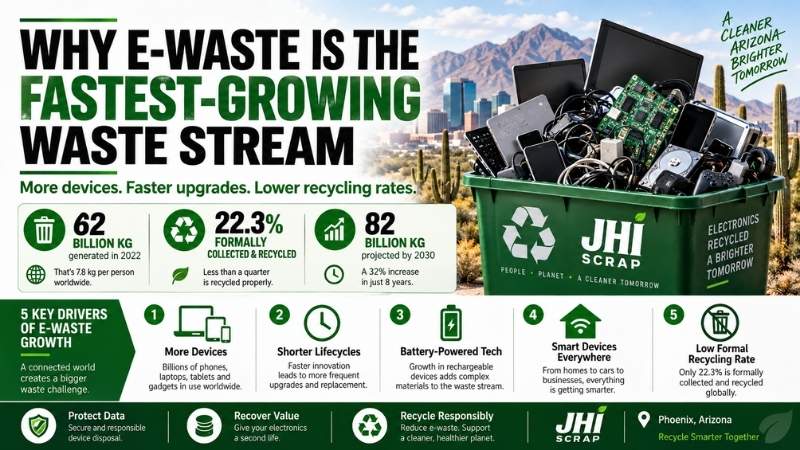
The scale is hard to picture. The Global E-waste Monitor 2024 reports that the world generated 62 billion kilograms of e-waste in 2022. That equals about 7.8 kilograms per person. Only 22.3% was documented as formally collected and recycled through environmentally sound systems. The report projects global e-waste could reach 82 billion kilograms by 2030.
That gap matters. Modern electronics hold copper, aluminum, steel, gold, silver, palladium, plastics, glass, rare earth elements, and other useful materials. They can also contain batteries, mercury, lead, flame retardants, and other substances that need controlled handling.
For Phoenix residents and businesses, this is not a distant global problem. Old electronics pile up in closets, garages, storage rooms, school cabinets, warehouses, server rooms, and office cleanouts across the Valley. As the saying goes, out of sight can become out of mind.
The good news is that e-waste is not just a waste problem. It is also a resource, security, and management problem. Once you understand why the stream keeps growing, better choices become much easier.
What Exactly Counts as E-Waste?
E-waste is discarded electrical or electronic equipment that has reached the end of its useful life for the current owner. The term covers far more than broken computers. It can include working devices that are retired, replaced, stored, resold, donated, refurbished, dismantled, or recycled.
Common examples include desktop computers, laptops, tablets, servers, networking gear, printers, monitors, TVs, phones, scanners, keyboards, cables, circuit boards, test equipment, power supplies, batteries, small appliances, and industrial electronics.
Some items are obvious. A dead laptop with a cracked screen feels like e-waste right away. Other items are less clear. A three-year-old server may still work perfectly, but a company may retire it after a hardware refresh. A school may replace hundreds of Chromebooks at once. A manufacturer may hold trays of unused components that no longer match production needs.
That is why the broader concept of electronic waste is useful. It includes the many routes electronics can take after their first use. Some products deserve repair. Some should be reused. Some have resale value. Others need secure data destruction before recycling.
The rule of thumb is simple. If an electronic item has left its normal use cycle, it needs a deliberate next step. Do not let it drift into a trash stream by accident.
Why E-Waste Is Growing Faster Than Other Waste Streams
E-waste grows so quickly because electronics sit at the center of modern life. More people use more devices for work, school, health, communication, entertainment, transportation, security, and commerce. Each new use creates more equipment entering the market. Eventually, that equipment also exits the market.
This growth is different from many traditional waste categories. A glass bottle may remain a glass bottle for years. A desk can serve for decades. Electronics change faster because software, battery performance, storage capacity, network standards, repairability, security needs, and consumer expectations all move together.
Think of the electronics market like a moving walkway. New products keep entering from one end. Older products keep falling off the other. If recycling capacity cannot keep up, the pile grows.
The Global E-waste Monitor describes digital transformation and increasing device ownership as major drivers. It also shows a widening gap between e-waste generation and documented formal recycling. The writing is on the wall. Better collection alone will not solve the problem unless product design, reuse, repair, business planning, and responsible recycling improve too.
Several forces drive this growth at the same time. Understanding each one shows why the issue is so hard to fix with one policy or one recycling campaign.
1. We Own More Electronic Devices Than Ever
The first driver is simple. There are more electronic products in daily life. One person may use a phone, laptop, tablet, smartwatch, earbuds, router, streaming device, smart speaker, game console, camera, power bank, and several chargers.
Homes now contain connected thermostats, doorbells, security cameras, robot vacuums, smart appliances, solar controls, medical devices, and home office equipment. Businesses add desktops, monitors, servers, switches, scanners, printers, point-of-sale systems, access controls, phones, backup power units, and specialized machines.
That device count multiplies the future waste stream. Even when each product lasts several years, millions of purchases eventually become millions of retirements.
This is a classic numbers game. A small replacement rate across a huge installed base creates a massive flow of used electronics. Phoenix adds another layer because the metro area has a large and growing mix of homes, schools, healthcare sites, warehouses, offices, technology operations, and light industry.
More equipment is not automatically bad. Electronics improve productivity and quality of life. The problem comes when buying growth is not matched by repair, reuse, resale, collection, and material recovery. You cannot pour water into a bucket forever without thinking about the drain.
2. Product Replacement Cycles Keep Moving Faster
Replacement cycles are another major reason e-waste rises so quickly. Many electronics are replaced before they physically stop working. Performance demands, software support, security requirements, battery decline, warranty schedules, lease terms, and changing business needs can all push equipment into retirement.
A company may replace computers every three to five years. A data center may refresh servers on a planned schedule. A school district may rotate student devices by class year. A consumer may upgrade a phone because the battery feels weak or the camera no longer meets expectations.
None of those choices alone creates a crisis. Together, they produce a steady wave of equipment leaving service.
For businesses, short replacement cycles also create a management challenge. Devices may still hold sensitive files, customer records, login credentials, intellectual property, or regulated information. That means disposal cannot be treated like taking out office trash.
This is where IT asset disposition becomes important. A structured ITAD process can inventory devices, separate reusable equipment, handle data securely, document outcomes, and direct non-reusable material into responsible recycling channels.
A stitch in time saves nine. Planning the retirement route before a refresh starts is much easier than dealing with hundreds of unidentified devices afterward.
3. Software and Security Can Retire Hardware Early
Hardware can become practically obsolete even when it still turns on. Software requirements may outgrow older processors. Operating systems may stop receiving support. Security teams may reject equipment that cannot meet current controls. Applications may require newer graphics, memory, encryption, or networking standards.
This is especially important for organizations. A computer that still works for basic tasks may no longer fit company security rules. A network appliance may function but lack supported firmware. A medical or industrial device may need an operating environment that has reached end of support.
The hardware is not necessarily useless. It may still be suitable for refurbishment, parts recovery, resale, or a lower-demand use. But it has left its first job sooner than its physical condition suggests.
This shows why e-waste is partly a systems problem. Hardware, software, cybersecurity, procurement, and support policies are connected. Pull one thread and the whole sweater can move.
Organizations can reduce unnecessary waste by checking upgrade options, repair paths, component replacements, secure reuse, and resale value before choosing destruction. When retirement is necessary, a documented process should follow.
4. Batteries Have Become a Hidden Replacement Trigger
Battery performance is one of the most common reasons people replace portable electronics. Phones, tablets, laptops, earbuds, smartwatches, power tools, e-bikes, and many connected devices depend on rechargeable batteries.
Over time, battery capacity drops. A device that once lasted all day may need constant charging. Some products make battery replacement easy. Others make it difficult, expensive, or unattractive compared with buying a new model.
This matters for two reasons. First, battery decline can shorten the practical life of an otherwise useful device. Second, lithium-ion batteries create handling and fire risks when damaged, crushed, overheated, or placed in the wrong waste stream.
The City of Phoenix specifically warns residents not to put lithium-ion batteries into residential trash or recycling bins. That warning reflects a real operational risk for collection vehicles and waste facilities.
An ounce of prevention is worth a pound of cure. Keep battery-powered electronics out of ordinary trash and choose a proper reuse or recycling path instead.
5. Repair Can Be Harder Than Replacement
Repair should slow e-waste growth, but the real-world economics do not always cooperate. Parts may be unavailable. Devices may use glued assemblies. Repair manuals may be limited. Labor can cost more than the product seems worth. A new device may come with financing, a warranty, or a trade-in offer.
This creates a strong replacement bias. Consumers and companies can end up choosing new hardware even when a repair is technically possible.
The best answer is not to repair everything at any cost. It is to make a better decision before discarding something. Ask whether the item can be repaired, upgraded, reused internally, donated, sold, harvested for parts, or recycled.
For businesses, the decision should also include labor cost, data risk, downtime, resale value, shipping, storage, and compliance needs. A cheap repair is not really cheap if it creates repeated downtime. A fast replacement is not really fast if old devices sit in a storage room for two years.
Measure twice and cut once. A short disposition review can prevent both wasted value and unsafe disposal.
6. Low-Cost Electronics Add Up Fast
Not all e-waste is a laptop or server. Small and inexpensive electronics are a huge part of the waste stream. Think cables, adapters, toys, LED products, remotes, small speakers, smart plugs, sensors, kitchen devices, personal care electronics, and low-cost accessories.
One item may weigh almost nothing. Millions of items weigh a lot.
Low purchase price can also change behavior. People are less likely to pay for repair when replacement costs only a little more. Small devices can sit forgotten in drawers because they do not feel important enough to manage.
This is a blind spot in many recycling programs. Large equipment gets attention because it is visible. Small electronics disappear into junk drawers, bins, closets, and mixed trash.
Do not miss the forest for the trees. The e-waste problem is built from both big assets and tiny devices.
7. Businesses Generate E-Waste in Large Waves
Households often retire electronics one or two items at a time. Businesses can generate hundreds or thousands of units during a single project. Office moves, mergers, closures, refresh cycles, warehouse cleanouts, school upgrades, lab changes, and data center projects can create sudden surges.
A business wave may include laptops, monitors, servers, printers, phones, cables, racks, network equipment, test gear, components, and surplus inventory. Some devices may have resale value. Others may require secure data handling. Some may be obsolete or damaged.
This makes business e-waste different from household cleanout. It needs logistics, sorting, chain-of-custody thinking, documentation, and often scheduled pickup.
The environmental impact of e-waste also becomes easier to understand at this scale. One discarded computer may seem small. Hundreds of systems contain a meaningful amount of metal, plastic, glass, circuit boards, batteries, and embedded manufacturing energy.
Many hands make light work, but only when the process is organized. A recycler or ITAD partner should know what is coming before pickup day.
8. The Internet of Things Keeps Expanding the Definition of Electronics
The Internet of Things has pushed electronics into objects that were once simple and mechanical. Thermostats, light bulbs, locks, appliances, fitness trackers, industrial sensors, cameras, speakers, meters, vehicles, and building controls now contain circuit boards, chips, radios, batteries, and software.
This creates new waste categories. A broken object may now contain both conventional materials and electronic components. Collection systems must decide how to separate, handle, reuse, and recycle those mixed products.
It also makes obsolescence more complicated. A smart device can lose cloud support or app compatibility while its physical hardware still works. When the digital service ends, the product may lose much of its value.
That is another reason e-waste grows faster than older waste streams. Electronics are spreading into more product categories at the same time that existing electronic categories keep expanding.
As the old saying goes, the more moving parts, the more places something can fail. In connected devices, some of those moving parts are digital.
What Happens When E-Waste Is Not Managed Properly?
Poor e-waste handling wastes valuable material and can expose people and the environment to avoidable risks. Electronics may contain recoverable metals beside substances that should not enter uncontrolled burning, dumping, shredding, or landfill routes.
The risk depends on the product and how it is handled. Older CRT displays can contain leaded glass. Some lamps contain mercury. Batteries can create fire hazards. Circuit boards and components contain metals and compounds that require appropriate processing.
Informal recycling is especially risky when workers burn cables, use uncontrolled chemical methods, or dismantle equipment without proper protection. Those methods may recover a little value while spreading pollution into air, soil, and water.
The other loss is economic. When electronics are dumped, materials that took energy, mining, manufacturing, and global supply chains to produce are lost after one use cycle.
Responsible e-waste recycling methods and process steps usually focus on safe collection, sorting, data handling, reuse where practical, controlled dismantling, material separation, and delivery to appropriate downstream processors.
You reap what you sow. A clean downstream process begins with a clean decision at the point where a device leaves use.
Why the Recycling Rate Still Falls Behind
The global recycling gap exists because collection is difficult, products are complex, economics vary, and rules differ across countries and regions. The 22.3% documented formal collection and recycling rate reported for 2022 shows how much material still moves through undocumented, informal, stored, exported, dumped, or otherwise untracked routes.
One challenge is convenience. People may know electronics should be recycled but not know where to take them. Businesses may postpone cleanouts because they expect the project to be disruptive. Small devices may be stored for years.
Another challenge is value. Some electronics contain enough recoverable material or resale value to support collection. Others cost money to process. Large screens, damaged batteries, mixed low-grade devices, and certain legacy equipment may need special handling.
Data security adds another layer. People hold onto old phones and computers because they worry someone can recover personal information. Businesses have the same concern at a larger scale.
The answer is not one magic recycling bin. It is a system that makes reuse, secure retirement, collection, and recycling easier than neglect. Where there is a will, there still needs to be a workable route.
Why E-Waste Contains So Much Hidden Value
Electronics are miniature material banks. Circuit boards, wires, processors, connectors, frames, heat sinks, batteries, drives, and power supplies contain materials that can return to supply chains when recovery is done correctly.
Copper is common in wiring and circuit paths. Aluminum appears in frames and heat sinks. Steel is used in chassis and structures. Precious metals can appear in connectors and electronic components. Plastics and glass make up other large portions of many devices.
The concentration of valuable materials is one reason people describe e-waste recycling as urban mining. Instead of extracting every material from virgin ore, society can recover part of what is already sitting in products.
Recovery is not perfect. Products are complex. Materials may be glued, coated, mixed, tiny, or difficult to separate. Some recovery processes require specialized equipment. Still, throwing devices away destroys the chance to recover anything.
One person’s trash can literally become another supply chain’s feedstock. That is not just a metaphor. It is the economic logic behind responsible electronics recovery.
Why Reuse Usually Comes Before Recycling
The best environmental outcome is often to keep a useful device working. Reuse can preserve far more of the energy, materials, labor, and manufacturing already invested in a product than breaking it down immediately for raw materials.
That may mean internal redeployment, repair, refurbishment, resale, donation, parts harvesting, or secondary-market use. A company laptop that no longer meets engineering needs may still work for basic office tasks. Test equipment may have value to another buyer. Components may be usable even when a finished product line changes.
Reuse also has limits. Data must be handled securely. Equipment must be safe and functional. Shipping a dead or dangerous device around the world is not meaningful reuse. Neither is selling equipment without considering whether the next owner can support it.
The hierarchy should be practical. Extend life where it makes sense. Recover value when possible. Recycle what cannot be reused. Document sensitive steps.
Waste not, want not still applies in a digital economy.
Why Data Security Is Part of E-Waste Management
E-waste is unusual because discarded items can hold information as well as materials. Hard drives, solid-state drives, phones, tablets, servers, copiers, networking equipment, and some embedded devices may contain data.
That data can include employee information, customer files, passwords, financial records, healthcare information, intellectual property, system logs, email, and cached credentials. For a business, the risk can be more expensive than the value of the hardware itself.
That is why secure disposition should be planned before equipment leaves your control. The appropriate method depends on the device, media type, risk level, reuse plan, and organization requirements.
Some devices can be securely sanitized and reused. Others may require physical destruction of storage media. The important part is that data handling is intentional and documented.
Loose lips sink ships, and loose storage devices can create the modern version of the same problem. Treat data-bearing equipment as information assets until the data risk is closed.
The Phoenix, Arizona Angle: Why Local Handling Matters
Phoenix has its own practical e-waste challenges. Heat, long storage periods, rapid business growth, office moves, school technology cycles, warehouse operations, healthcare facilities, industrial sites, and a large metro population all create steady electronics turnover.
Arizona’s Department of Environmental Quality encourages responsible electronics recycling and points businesses toward certified recycling programs such as R2 and e-Stewards. ADEQ also notes that many municipal recycling services focus on residents, so businesses often need dedicated recycler options.
For Phoenix households, city programs and partner options can handle certain electronics and related waste streams. The City of Phoenix warns that lithium-ion batteries should never go into residential trash or recycling bins. It also provides information on appliance and CRT handling through transfer stations and pickup services.
The practical lesson is simple. Do not assume every electronic item belongs in the same bin or the same program. Check the item, battery type, data risk, quantity, and whether you are using a residential or business service.
When in Rome, follow the local rules. In Phoenix, that means checking current city and state guidance before moving a large or unusual load.
How Phoenix Businesses Can Reduce E-Waste Before It Starts
Businesses have more control over e-waste than they may think. The best time to plan disposition is during procurement, not after equipment becomes obsolete. Start with asset tracking. Know what you own, where it is, who uses it, when support ends, and whether it holds sensitive data. This makes refresh planning easier and reduces the mystery boxes that appear during office moves.
Next, standardize replacement rules. Do not replace hardware only because a calendar says so. Consider performance, security, warranty, repair cost, energy use, resale value, and business need. A good policy creates consistency without forcing waste.
Build reuse into your process. Devices can move from high-demand users to lower-demand roles. Spare units can support temporary staff. Working equipment can be resold or donated when appropriate.
Finally, choose the downstream path before the project starts. A Phoenix e-waste recycling guide can help teams understand common options, but large business projects usually need a more specific plan for inventory, pickup, data handling, reusable assets, and residual recycling.
Slow and steady wins the race. A mature program reduces last-minute disposal decisions and spreads work across the full asset lifecycle.
How to Choose a Responsible E-Waste Recycler
A responsible recycler should be able to explain what happens to your equipment after pickup. Vague promises are not enough, especially for business devices or data-bearing assets.
Ask what items they accept. Confirm whether there are fees for certain categories. Discuss pickup minimums, packaging, loading, and appointment requirements. For data-bearing devices, ask how sanitization or destruction is handled and what documentation is available.
For business loads, ask how equipment is sorted for reuse versus recycling. If resale or surplus recovery matters, discuss how value is assessed. If your organization has internal compliance requirements, make those clear before scheduling.
Certification can also help. ADEQ recognizes R2 and e-Stewards as voluntary certification programs for electronics recyclers and encourages responsible recycling practices. Certification does not replace due diligence, but it gives buyers another framework for evaluating environmental, worker-safety, security, and downstream practices.
The proof is in the pudding. A credible provider should answer direct questions with direct answers.
What JHI Can Help With in Phoenix
JHI Scrap works with electronics, e-scrap, industrial surplus, IT assets, components, test equipment, and related material in Phoenix and Maricopa County. The right route depends on the equipment, condition, quantity, data risk, and potential reuse or recovery value.
For a business cleanout or planned refresh, the first step is usually to identify what you have. Photos, model numbers, quantities, pallet counts, and a short description can make evaluation much easier.
JHI Scrap can help businesses think through electronics recycling, surplus recovery, and asset disposition instead of treating every item as generic trash. That matters because working equipment, components, test gear, and recyclable electronics can have very different downstream paths.
The company is located at 3334 W McDowell Rd, Unit 17, Phoenix, AZ 85009-2414. Public access is by appointment, so calling before visiting is the practical move.
JHI Scrap is the natural next step when your electronics have moved from useful asset to disposal question. A bird in the hand is worth two in the bush. An organized evaluation now is better than another year of boxes in storage.
What You Can Do Today
You do not need a global policy plan to make a useful change today. Start with the electronics you already control. At home, gather unused phones, laptops, chargers, tablets, batteries, and small electronics. Separate items that still work from items that are damaged. Back up anything you need. Remove account access where appropriate. Then check a suitable reuse, donation, or recycling option.
At work, create a simple retirement list. Record asset type, quantity, condition, data-bearing status, and location. Flag equipment with batteries. Separate obvious reuse candidates. Avoid mixing electronics into general trash or scrap streams before the data and safety questions are answered.
If the volume is large, get an evaluation before moving everything. That can save labor and reveal items with resale, reuse, component, or scrap value. Rome was not built in a day. A better e-waste program starts with one clean process, then gets easier every time you repeat it.
Frequently Asked Questions About the Fast Growth of E-Waste
Why is e-waste called the fastest-growing waste stream?
E-waste grows rapidly because global device ownership keeps increasing while replacement cycles remain short. Electronics are also spreading into more product categories. Formal collection and recycling have not grown fast enough to match generation.
How much e-waste does the world produce?
The Global E-waste Monitor 2024 reports 62 billion kilograms of e-waste generated globally in 2022. That equals 62 million metric tons. The report projects 82 billion kilograms by 2030 under current trends.
How much e-waste is actually recycled?
The same report says 22.3% of global e-waste generated in 2022 was documented as formally collected and recycled in an environmentally sound manner. The rest may be stored, informally processed, exported, discarded, or otherwise untracked.
What electronics create the most e-waste?
Global e-waste includes several categories, including small equipment, large equipment, temperature-exchange equipment, screens and monitors, small IT and telecom equipment, lamps, and photovoltaic panels. Small equipment is especially important because so many products fall into that group.
Are old computers considered e-waste if they still work?
They can be. E-waste includes used electronics that leave their current use cycle. A working computer may be reused, resold, donated, refurbished, or recycled. Working condition should affect the next step, not whether the item needs a disposition decision.
Why do companies generate so much e-waste at once?
Companies often replace technology in planned cycles. A single refresh can retire hundreds of computers, monitors, phones, servers, or network devices. Office moves, mergers, closures, and infrastructure upgrades can create similar waves.
Is recycling always better than reuse?
No. Reuse is often preferable when a device is safe, functional, supportable, and appropriate for another user. Recycling makes more sense when the item is broken, obsolete, unsafe, uneconomic to repair, or unsuitable for reuse.
What should happen to data before a computer is recycled?
Data should be handled according to the device, storage media, sensitivity, reuse plan, and organization policy. Some media can be securely sanitized for reuse. Other situations may call for physical destruction. Businesses should document the process.
Can lithium-ion batteries go in Phoenix trash or recycling bins?
No. The City of Phoenix warns that lithium-ion batteries should never be placed in residential trash or recycling bins. Use a suitable battery or electronics handling option instead.
Do Phoenix businesses use the same programs as residents?
Not always. ADEQ notes that many municipal recycling services are designed mainly for residents. Businesses may need to use dedicated electronics recyclers and should check current service requirements before moving a load.
What should I ask an e-waste recycler before pickup?
Ask what they accept, what they charge, how pickup works, how data-bearing devices are handled, whether reuse is considered, what documentation is available, and how downstream recycling is managed. For large projects, also discuss inventory and loading logistics.
Can old electronics still have value?
Yes. Working devices, test equipment, servers, components, circuit boards, and surplus inventory may have reuse, resale, parts, or material value. Value depends on condition, age, model, quantity, demand, and processing cost.
Why should businesses avoid storing old electronics for years?
Long storage can hide data risk, tie up space, reduce resale value, create battery concerns, and make inventory harder to identify. A regular disposition schedule keeps the process smaller and more controlled.
How does e-waste recycling help reduce mining pressure?
Recycling can recover metals and other materials already embedded in products. That does not eliminate the need for mining, but it can return resources to supply chains and reduce the amount of usable material lost to disposal.
What is the best first step for a Phoenix business with a large electronics cleanout?
Create a basic inventory and request an evaluation. Include quantities, device types, condition, location, data concerns, and photos where useful. That gives a recycler enough context to recommend the right next step.
E-Waste Growth Is a Design and Management Problem, Not Just a Trash Problem
E-waste is the world’s fastest-growing waste stream because electronics keep multiplying, product cycles move quickly, batteries age, software changes, repair can be difficult, and connected technology keeps spreading into new products.
The numbers show the urgency. Global e-waste reached 62 million metric tons in 2022, while only 22.3% was documented as formally collected and recycled. If current trends continue, generation could reach 82 million metric tons by 2030.
But the answer is not simply to recycle more after the fact. We also need longer use, smarter procurement, better repair choices, secure reuse, organized ITAD, safer battery handling, and stronger collection systems.
For Phoenix homes and businesses, the next step can be much smaller. Identify what you have. Protect the data. Separate reusable items. Keep batteries and electronics out of ordinary waste streams. Then choose a responsible path.
If your business has retired electronics, IT assets, surplus components, or equipment in Phoenix, contact JHI Scrap for an evaluation before the next cleanout gets bigger. The sooner you know what you have, the easier it is to recover value and move the rest responsibly.
The early bird gets the worm. In e-waste management, early planning also gets the cleaner result.