
Why Is Gold Used in Phone Circuit Boards?
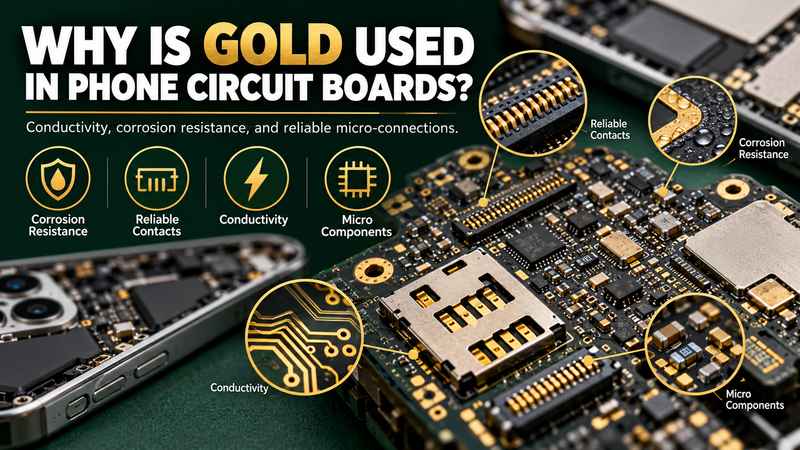
Gold is used in phone circuit boards because it keeps electrical contacts reliable over time. It conducts electricity well and resists the surface corrosion that affects other metals. Manufacturers use tiny amounts where a dependable connection matters most.
Gold is not the best electrical conductor. Copper and silver conduct electricity better. However, exposed contacts need more than good conductivity. They need surfaces that keep working after exposure to air, moisture, and repeated movement.
Think of gold as a protective jacket around selected electrical connections. The copper underneath handles much of the current. The gold surface helps keep the meeting point clean and dependable. That balance explains why phones contain gold without having solid-gold circuit boards.
Key Reasons Gold Is Used in Phone Circuit Boards
Gold combines corrosion resistance, good conductivity, easy shaping, and dependable contact performance. These qualities help manufacturers build small connections that last. Each use has different requirements, so manufacturers choose different gold finishes and thicknesses.
Resistance to Corrosion and Oxidation
Gold resists oxidation under normal operating conditions, helping exposed electrical contacts remain dependable. Copper can develop oxide films. Silver can tarnish when exposed to sulfur-containing substances. Those surface changes can interfere with electrical contact.
A phone contains many connections carrying small signals. Some contacts press against another metal surface instead of forming a permanent solder joint. A surface film can increase resistance at that meeting point. Gold helps reduce that problem.
This protection matters because a phone rarely stays in one controlled environment. It moves between pockets, desks, bags, and charging stations. Exposure varies with daily use. A stable contact surface gives the connection one less problem to manage.
Corrosion resistance does not make the whole phone waterproof. Liquid can damage nearby components, reach exposed base metals, or leave conductive residue. Gold protects selected surfaces. Seals, coatings, and the overall design provide other forms of protection.
High Electrical Conductivity
Gold carries electrical current efficiently, making it suitable for many small electronic contacts. Its main advantage appears where two surfaces meet. A clean, stable contact can matter more than choosing the metal with the highest conductivity.
Picture a doorway connecting two busy rooms. The rooms may have plenty of space, but a blocked doorway slows movement. An electrical contact acts like that doorway. Surface contamination can restrict the connection even when the underlying conductor performs well.
Copper remains useful for circuit traces because it combines strong conductivity with lower cost. Gold serves a different role at selected exposed surfaces. Manufacturers combine materials so each contributes where it works best.
AdvancedPCB explains how gold-plated contacts support reliable connections and repeated contact use. Its guide to gold in PCB fabrication also identifies copper and silver as better conductors. The practical benefit comes from the overall contact performance.
Extreme Ductility for Microscopic Bonding Wires
Gold can be drawn into very thin wires without breaking easily during manufacture. These fine wires can connect a semiconductor die to its package. The package then connects to the phone’s circuit board.
This distinction matters because chip wiring is usually hidden inside a package. Gold wires do not normally run visibly across the motherboard. Finding a gold-colored board pad does not reveal the wire material inside nearby chips.
Some devices use copper, aluminum, silver-based wires, or other connection methods. Some packages use bumps instead of fine bonding wires. Manufacturers select materials according to package design, production requirements, reliability, and cost.
Gold’s flexibility helps manufacturers form delicate connections with controlled shapes. However, flexibility alone does not determine the best material. The wire must also suit the bonding process and the surrounding package. There is no universal gold-wire requirement for smartphones.
Wear Resistance at Electrical Contact Points
Hard gold finishes can improve wear resistance at contacts designed for repeated movement. Pure gold is relatively soft. For certain applications, small additions of cobalt or nickel make the deposited gold harder.
Repeated insertion can rub a contact surface. A suitable gold finish helps the connection tolerate that wear. Contact force, surface thickness, and the underlying metal also affect performance. Gold plating cannot compensate for every mechanical weakness.
The term gold fingers describes plated edge contacts found on many electronic boards. However, not every phone uses exposed edge connectors in the same way. Phones also contain compact board connectors and spring contacts. Their finishes depend on the design.
Wear resistance is therefore a system choice, not a promise attached to anything gold-colored. A thin solderable finish serves a different purpose from a durable sliding contact. Manufacturers must match the finish to the expected use.
Where Is Gold Located in a Phone?
Gold can appear on selected board surfaces, connector contacts, SIM contacts, and some chip connections. Its location and quantity vary by model. Most of it forms thin coatings or tiny internal features rather than visible chunks.
Gold-Plated Circuit Board Pads and Contact Surfaces
Selected motherboard pads and contact surfaces may carry a thin gold finish over other metals. The board’s conductive tracks are generally copper. Gold does not replace the copper network throughout the phone.
A pad is a small conductive area where a component or contact connects. Some pads receive finishes that protect them before assembly. Other exposed pads serve testing or contact functions. Their appearance alone does not establish the finish specification.
Gold-colored surfaces can appear around connection points or beneath removed components. However, solder, shields, and coatings hide much of the board. Looking at a photograph cannot reliably establish how much gold the assembly contains.
Do not confuse a plated surface with a solid-gold part. A very thin coating can cover a noticeable area. That visual effect often makes the gold content seem larger than it is. Material testing is more useful than color.
SIM Card Contacts
A removable SIM card commonly has plated metal contacts that meet the phone’s reader contacts. These contacts provide electrical access to the SIM chip. They are not solid-gold squares.
The visible contact area belongs to the removable card itself. The reader inside the phone has its own contact surfaces. Their construction depends on the manufacturer. An embedded SIM uses a different physical arrangement.
Not every smartphone includes a removable SIM tray. Some models rely on embedded SIM technology. That difference changes where these contact surfaces appear. It also shows why one phone’s construction cannot represent every other model.
Remove a physical SIM before transferring a phone when appropriate. Follow the manufacturer’s instructions for embedded SIM profiles. These steps concern account access and personal information. They do not determine how much recoverable gold the phone contains.
Internal Connectors for Cameras, Speakers, and Batteries
Some internal connectors use gold-plated contacts to maintain dependable connections between phone assemblies. These may link camera modules, display assemblies, or other components. Battery and speaker connections also vary by model and design.
An internal connector may join a flexible cable to the main board. Others connect separate boards or modules. Manufacturers select contact materials according to space, current, movement, and reliability requirements.
Gold plating is useful at a contact interface, but it is not universal. You cannot assume every connector pin contains gold. Nor can you estimate its quantity from the number of connectors. The finish thickness also matters.
Opening a phone simply to inspect these parts can damage working equipment. It can also expose a lithium-ion battery. If the phone still works, evaluate reuse first. Keep potentially valuable devices intact until their next use is clear.
Gold Bonding Wires Inside Some Semiconductor Chips
Some semiconductor packages contain fine gold wires connecting the die to package terminals. These wires sit inside the component housing. They are different from the copper traces running across the phone’s motherboard.
Not every processor or memory package uses gold bonding wires. Copper and other wire materials are available. Some packages use different connection structures entirely. The package specification determines what is present.
This hidden construction makes visual sorting imperfect. Two similar-looking chips can have different internal materials. Their age, function, and manufacturer may also differ. A recycler needs more than a quick glance to estimate precious-metal content.
For a broader look at component recovery, explore our information about recycling IC chips. It explains why integrated circuits belong in a managed recycling stream. Avoid assuming every chip has the same recoverable-metal value.
How Much Gold Is in a Smartphone?
A smartphone generally contains a small amount of gold, but there is no universal figure. Public estimates often describe particular devices or mixed collections. They should not be presented as laboratory measurements for every modern phone.
The EPA cites a 2006 USGS estimate covering one million recycled cell phones. That estimate includes about 75 pounds of recoverable gold. Dividing the estimate gives approximately 34 milligrams per phone.
This is a historical batch estimate, not a confirmed measurement for today’s smartphones. It does not establish a guaranteed yield for your device. A mixed collection can differ substantially from the phones behind that estimate.
The distinction matters when comparing online claims. A figure may describe total content, potential recovery, or a processed batch average. Those are different measurements. Check what was measured before applying the number to your own equipment.
Why Gold Content Varies by Phone Model and Design
Gold content varies because phones use different boards, connectors, finishes, and semiconductor packages. Production choices can change between models. A newer phone does not automatically contain more gold than an older phone.
Board size alone is not enough to estimate gold content. A larger board may contain more copper or more unused space. A smaller assembly may use different finishes. Component layout does not reveal the coating thickness.
Package construction also changes the result. Gold wire, copper wire, and bump connections contribute different material profiles. Visible connectors represent only part of the assembly. Hidden components can affect the total.
For comparison, keep the measurement basis consistent. Gold per whole phone differs from gold per board weight. Removing batteries, screens, and housings changes the denominator. A higher concentration in stripped boards does not mean the original phone contained more gold.
A credible estimate needs a clear sample and measurement method. Ask whether the result covers whole phones, stripped boards, or selected components. Those categories cannot be compared directly without accounting for their different weights and contents.
For business inventories, group similar models before requesting an evaluation. Record quantities and whether devices are complete. That information makes the discussion more useful. It still does not replace testing when precise gold content matters.
Why Use Gold Instead of Copper or Silver in Phone Contacts?
Manufacturers use gold on selected contacts because it combines good conductivity with surface stability. Copper and silver remain valuable engineering materials. The right choice depends on where the metal sits and what the connection must withstand.
Reliable Connections for Tiny, Low-Voltage Signals
Gold helps low-voltage contacts stay dependable by resisting surface films that increase contact resistance. Small signal connections need consistent electrical contact. A seemingly minor surface change can interfere with that consistency.
The metal inside a wire and the metal at its contact surface serve different needs. The wire carries current along its length. The contact transfers current between touching parts. Each location creates its own design challenge.
This explains why a copper-based conductor can have a gold-plated contact. Manufacturers keep copper’s conductivity and cost advantages. They add gold where stable surface behavior is valuable. Using both materials can be more practical than choosing only one.
Gold does not eliminate every source of signal trouble. Loose connectors, cracked joints, contamination, and damaged cables still cause failures. Reliable electronics require sound mechanical design and careful assembly alongside suitable contact materials.
Corrosion Resistance Compared With Copper and Silver
Gold resists ordinary oxidation and tarnishing more effectively than exposed copper and silver. Copper can form oxide layers. Silver tarnish often involves sulfur compounds. Both changes can affect exposed contact surfaces.
The word rust specifically describes iron corrosion products. Copper and silver do not rust in that sense. Calling every surface change rust hides the actual chemistry. Corrosion and tarnishing are clearer terms for this comparison.
Gold’s resistance has practical limits within a complete connector. Scratches can expose underlying metals. Thin coatings can contain pores. Contaminants can sit on top of the surface. The entire contact still needs appropriate design and handling.
This is why gold plating should not be treated as a cure for moisture damage. A phone includes many other materials and components. Protective design must address the whole device. One stable metal cannot protect every neighboring part.
Thin Gold Plating to Balance Performance and Cost
Thin gold plating lets manufacturers protect selected surfaces while limiting expensive material use. Building whole traces or connectors from solid gold would usually add unnecessary cost. A coating can provide the needed surface properties.
Thickness matters because different jobs require different finishes. A frequently moved contact may need greater wear resistance. A soldering pad has different priorities. The correct specification depends on the actual application.
More gold does not automatically mean a better phone. Excess material can raise manufacturing costs without improving the intended connection. Too little can reduce performance for a demanding contact. Engineers balance these factors rather than maximizing gold everywhere.
For recyclers, this same efficiency limits the gold available in each device. A bright surface can contain very little metal. Recovery decisions need measured material value and processing costs. Appearance alone is a poor guide to profitability.
Gold-Plated Contacts and ENIG Board Finishes Are Different
A durable contact finish and a solderable board finish can both involve gold. However, they perform different jobs. Treating them as identical can lead to inaccurate claims about wear, soldering, and gold quantity.
What an ENIG Finish Does
ENIG means electroless nickel immersion gold. It places a nickel layer beneath a thin gold finish on selected copper surfaces. The finish helps protect pads before assembly and supports a solderable surface.
During soldering, the thin gold layer normally dissolves into the solder. The resulting joint is not simply a gold contact pressed against another surface. That distinction matters when describing where gold remains after assembly.
You should not identify ENIG solely by a board’s yellow appearance. Other finishes can look similar. The manufacturing specification provides the better answer. Without that information, describe the surface cautiously.
Why Hard Gold Serves a Different Purpose
Hard gold is selected where contact wear is an important requirement. Its composition and application differ from a thin immersion-gold finish. Repeated sliding or insertion creates demands that a soldering pad may never face.
A finish suited to one job may be unsuitable for another. Engineers consider thickness, hardness, underlying layers, and connection geometry. The useful question is whether the finish matches its purpose. Gold content alone does not answer it.
This distinction also improves recycling discussions. Contact-rich scrap and assembled phone boards are different material categories. Their appearance does not justify identical pricing. Ask the buyer how each category should be sorted.
Can Gold From Old Phones Be Recycled?
Gold-bearing phone components can enter professional recycling processes that recover valuable metals. The practical route depends on the material and facility. Collection, sorting, and downstream processing all affect what happens next.
Why Professional Recovery Uses Sorted Material
Professional recovery starts with understanding the incoming material. Whole phones, populated boards, connectors, and loose chips have different compositions. Keeping those categories clear helps processors plan evaluation and treatment.
A working phone may have more value as a usable device than as scrap. Repairable equipment may also justify a separate assessment. Breaking everything apart too early can remove those options. Check reuse potential before focusing only on metals.
For large inventories, keep a basic record of models, quantities, condition, and ownership. Identify devices holding sensitive information. Ask the receiving company what preparation it requires. Clear records reduce confusion during transfer and evaluation.
Our guide to the importance of recycling phones explains the wider resource benefit. Gold is only one part of that story. Copper, other recoverable materials, and potential reuse also influence the best handling decision.
Why Gold Content Does Not Equal Your Payment
A device’s theoretical metal value is different from a recycler’s offer. Processing has costs. Transport, sorting, testing, and refining can affect the final result. A quote may also depend on the buyer’s minimum lot requirements.
Current metal prices matter, but they are not the only factor. Recovery efficiency and material quality also influence value. A mixed box of incomplete devices differs from a documented batch. Ask what the offer includes before comparing buyers.
Avoid using an online gold-per-phone figure as a promised payout. That shortcut ignores the equipment’s actual contents and recovery costs. It can also overlook reuse value. A material evaluation provides a more useful starting point.
You do not need to extract the gold yourself to recycle it. Keeping devices in an appropriate collection stream supports professional recovery. It also avoids creating an extra waste-handling problem at home.
What Phoenix Businesses Should Do With Old Phones and Circuit Boards
Phoenix businesses should assess reuse, protect stored information, and confirm recycling arrangements before transfer. A small amount of gold does not change those priorities. The device may still hold sensitive data or a damaged battery.
Protect Information Before Material Recovery
An unpowered phone may still contain stored information. Removing its SIM does not erase internal storage. A broken screen does not establish that the data is inaccessible. Decide how each device’s information will be handled before recycling.
Use the manufacturer’s transfer instructions for working devices. Business equipment may also require your organization’s approved sanitization process. Ask the provider which methods suit the device. Confirm what records it can supply.
Our article about the importance of data destruction explains the risks of unmanaged retirement. Material recovery and information protection are related tasks. Neither should be assumed complete because the other has started.
Do not destroy a usable phone merely to expose gold-colored parts. That can remove resale options without completing proper data handling. Let the device’s condition and information requirements guide the next step.
Confirm Acceptance, Battery Handling, and Collection Details
Confirm accepted items and preparation requirements before arranging delivery or pickup. Tell the receiving company whether you have whole phones, loose boards, or mixed equipment. Mention damaged batteries separately. Do not assume every recycler handles every condition.
The EPA says lithium-ion devices do not belong in household garbage or recycling bins. Its electronics donation and recycling guidance also recommends removing personal information before transfer. Use specialist collection arrangements that suit the equipment.
Do not pry out a glued-in battery simply to prepare a phone. Ask the receiving provider for instructions. A swollen or damaged battery needs specific handling guidance. Keep the equipment away from activities that could crush or puncture it.
For local planning, our guide to disposing of electronics in Phoenix outlines useful starting questions. Confirm current acceptance, fees, and appointment requirements directly. Those details can depend on your material and quantity.
JHI eScrap describes services for gold-bearing electronic scrap, populated boards, connectors, and processors. Request an evaluation for your specific material. Confirm whether collection, reuse assessment, and information handling meet your needs before scheduling.
Questions and Answers About Gold in Phone Circuit Boards
Is Gold Used Because It Conducts Better Than Copper?
No. Copper conducts electricity better than gold under comparable conditions. Gold’s main benefit at exposed contacts is its resistance to corrosion. Manufacturers often use copper conductors with gold-coated surfaces to combine those advantages.
Why Not Use Silver If It Conducts Electricity Better?
Silver conducts extremely well, but its surface can tarnish. That matters at small exposed contacts. Gold offers a more stable surface in many contact applications. Engineers still use silver where its properties suit the design.
Do Vintage Gold-Plated Electronics Last Longer Because of the Gold?
Gold-plated contacts can improve reliability where corrosion would otherwise affect the connection. However, gold does not determine the lifespan of an entire device. Components, assembly quality, storage, heat, and maintenance also influence the outcome.
Is the Gold-Colored Square on a SIM Card Solid Gold?
No. It is a contact structure with a surface finish over other materials. Its color does not establish how much gold it contains. A visible contact area can have a very small precious-metal mass.
Does Every Smartphone Chip Contain Gold Wire?
No. Semiconductor packages can use gold, copper, aluminum, other wire materials, or different connection methods. External appearance does not reveal the internal design. Avoid treating every processor or memory chip as a gold-wire component.
Does Gold Plating Prevent All Water Damage?
No. Gold protects selected contact surfaces from ordinary corrosion. Water can still damage nearby metals, components, and connections. Residue and contamination can also interfere with operation. Gold plating does not make a phone waterproof.
How Many Phones Do You Need to Recover One Gram of Gold?
There is no dependable universal phone count. Models differ, and the recovery process affects yield. A historical average cannot establish the result for an unknown batch. Use tested material data before estimating a production yield.
Are Older Phones Always Better for Gold Recovery?
No. Age alone does not establish gold content or recovery value. Board design, finishes, package construction, and condition all matter. Some older equipment may contain different materials. Evaluate the actual lot rather than assuming older means better.
Can You Tell Gold Purity by Looking at a Phone Board?
No. Color cannot reliably identify coating thickness, composition, or total gold content. Gold-colored surfaces may have different finishes. A suitable analytical method is needed for a defensible material assessment.
Should You Remove Gold-Plated Connectors Before Selling Phones?
Ask the buyer before removing anything. Dismantling can reduce reuse value or change the material category. It also adds handling time. Keep potentially usable phones intact until the receiving company explains its preparation requirements.
Can You Recover Phone Gold at Home?
Home extraction can involve corrosive chemicals, hazardous fumes, and contaminated residues. Tiny gold quantities do not remove those handling problems. Professional collection is the more practical route for most households and small businesses.
Is a Broken Phone Safe to Recycle Without Erasing It?
A broken phone can still store personal or business information. Ask how the provider handles inaccessible devices. Select a suitable sanitization or destruction route before material recovery. Physical damage alone does not confirm that information is unrecoverable.
Is One Phone Worth Recycling If Its Gold Content Is Tiny?
Yes. Recycling considers more than gold alone. The device contains other materials, and working parts may have reuse potential. Responsible collection also keeps lithium-ion devices out of unsuitable waste streams.
Will a Recycler Pay the Full Market Value of the Gold?
Not necessarily. Metal content is only one input to a commercial offer. Sorting, transport, testing, and processing have costs. Ask how the quote is calculated and whether any service charges apply.
Does Removing the SIM Card Remove All Personal Data?
No. A phone can hold photos, messages, account information, and other files in internal storage. The SIM is separate from that storage. Follow the device maker’s transfer instructions and your organization’s retirement process.
Can Gold Plating Wear Off a Connector?
Yes. Contact movement can gradually wear a coating, depending on its thickness and operating conditions. Hard gold can help in suitable applications. The connector still needs an appropriate mechanical design and a finish matched to its expected use.
Should a Business Mix Phone Boards With General Metal Scrap?
Ask the receiving company how it wants materials separated. A phone board contains multiple materials and may retain data-bearing components. A dedicated electronics stream makes evaluation and handling clearer. Avoid mixing equipment before its condition and information requirements are understood.
Keep the Value, Handle the Device Responsibly
Gold helps phone contacts stay dependable because its surface resists ordinary corrosion. Copper still handles much of the board’s electrical work. Thin finishes and tiny internal connections make gold useful without requiring large amounts.
When a phone reaches retirement, evaluate the whole device before focusing on precious metals. Protect its information and check reuse potential. Then arrange an appropriate recovery route. That approach makes better use of the equipment and its materials.
Have old phones, populated boards, or gold-bearing electronic scrap in Phoenix? Call JHI at (602) 272-4033 to discuss your material. Request an evaluation and confirm acceptance, preparation requirements, and available pickup arrangements.