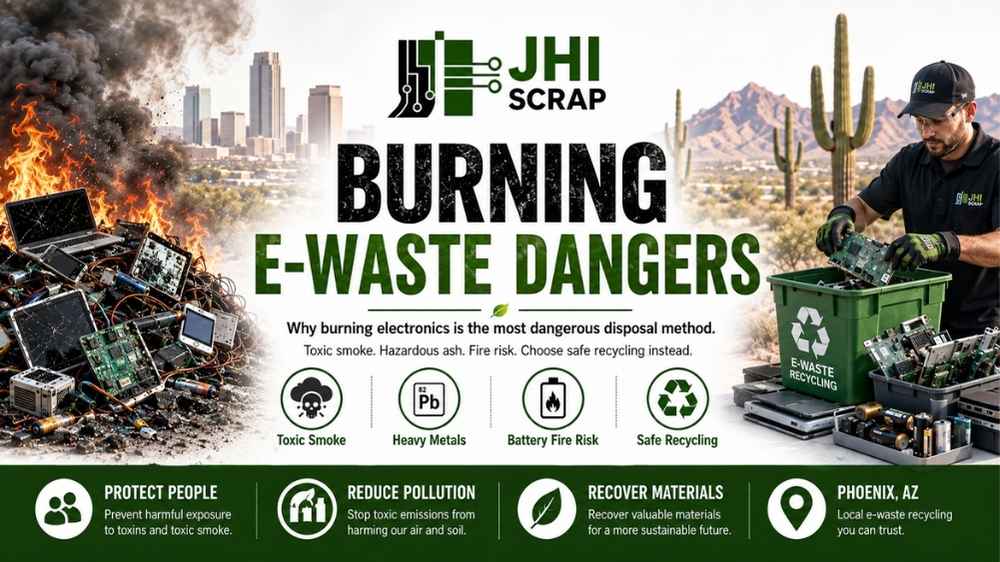
Burning E-Waste Why It’s the Most Dangerous Disposal Method


Burning e-waste is dangerous because heat turns complex electronics into toxic smoke, ash, and contaminated dust. That pollution can reach lungs, soil, water, homes, and nearby workplaces.


The danger does not end when the flame goes out. Metals, plastics, circuit boards, batteries, coatings, and flame-retardant materials can leave harmful residues behind. Smoke can move beyond the burn site. Fine particles can settle on cars, roofs, yards, and indoor surfaces.


That is why open burning is one of the worst ways to handle unwanted electronics. It destroys useful materials while creating new exposure risks. A broken laptop may look like junk. Inside, however, it is more like a small warehouse of metals, plastics, glass, chemicals, and stored energy.


For Phoenix residents and businesses, the safer approach is simple. Keep electronics out of fires, trash piles, and informal burn areas. Use a responsible electronics recycler that can sort, process, recover, and route materials correctly.


What Does “Burning E-Waste” Mean?


Burning e-waste means setting discarded electronics on fire or heating them to strip away plastics and expose valuable materials. The practice may involve computers, cables, televisions, printers, phones, power supplies, circuit boards, batteries, and mixed electronic scrap.


People may burn wire to recover copper. Others may burn circuit boards to reduce bulk. Some fires start accidentally when damaged batteries, old devices, or mixed waste ignite. In every case, electronics behave differently from clean wood or ordinary paper.


Electronic products contain many engineered materials. These include copper, aluminum, steel, solder, glass, resins, plastic housings, adhesives, coatings, battery chemicals, and flame retardants. When those materials burn together, the smoke becomes a chemical mix rather than simple combustion exhaust.


The broader category is called electronic waste, or e-waste. An external link to the Wikipedia entity “electronic waste” is included here because it helps readers understand the full category and its global context.


Why Is Burning E-Waste So Dangerous?


Burning e-waste is dangerous because combustion can release toxic metals, irritating gases, fine particles, and persistent organic pollutants. The exact mix depends on what is burning and how hot the fire becomes.


A computer cable may contain copper and plastic insulation. A circuit board may contain solder, fiberglass, resin, and small amounts of many metals. A battery may contain reactive chemicals and stored electrical energy. A monitor or older display may contain glass and specialized components.


Put those items into one uncontrolled fire, and the result becomes unpredictable. Think of it like throwing an entire hardware store into a campfire. You would not expect one clean, simple type of smoke.


Open fires are especially concerning because they do not use controlled temperatures, filtration systems, capture devices, or professional material separation. The smoke can rise directly into surrounding air. Ash and melted residues can remain on the ground.


This is where the phrase “out of sight, out of mind” becomes dangerous. The device may disappear. The contamination does not.


What Toxic Substances Can E-Waste Burning Release?


Burned electronics can release or mobilize several harmful substances. Common concerns include lead, cadmium, mercury, chromium compounds, brominated flame retardants, acidic gases, particulate matter, and combustion byproducts.


Lead may be present in older electronics, solder, glass, and components. Cadmium has been used in some batteries and electronic parts. Mercury may appear in switches, lamps, displays, and older equipment. These materials do not become harmless because a device burns.


Heating can move some contaminants into smoke or fine airborne particles. Other contaminants remain concentrated in ash. That ash may later spread through wind, shoes, tires, tools, rainwater, or cleanup activity.


Plastics create another problem. Electronics use many types of plastic for housings, connectors, cable insulation, and structural parts. When plastics burn under uncontrolled conditions, they can generate irritating gases and complex organic pollutants.


Some electronics also contain brominated flame retardants. These materials were designed to reduce fire risk during normal product use. When products are burned improperly, however, heat can create unwanted combustion byproducts.


The World Health Organization has warned that informal e-waste recycling practices, including open burning and heating, can expose people to hazardous substances. This is especially serious for workers, children, and nearby communities.


Why Smoke From Burning Electronics Is Not “Just Smoke”


Smoke from burning electronics can contain particles small enough to travel deep into the respiratory system. Those particles may also carry chemicals and metals on their surfaces.


Visible black smoke gets attention, but invisible particles matter too. A fire can look finished while airborne dust remains. People may breathe polluted air during the fire, during cleanup, or while handling the remaining ash.


Smoke exposure can cause immediate irritation. Eyes may sting. Throats may burn. Breathing may feel uncomfortable. People with asthma, lung disease, heart disease, or other health conditions may be more sensitive.


The long-term concern comes from repeated or significant exposure to hazardous substances. Risk depends on the materials burned, amount of smoke, exposure time, ventilation, distance, and individual health factors.


No single blog post can tell a person exactly what their exposure level was. If someone develops serious breathing trouble, chest pain, confusion, or another urgent symptom after smoke exposure, they should seek medical help.


What Happens to Lead and Other Heavy Metals During Burning?


Heavy metals do not simply vanish in fire. Burning can redistribute them between smoke, dust, melted residue, and ash.


This matters because contaminated ash is easy to underestimate. It may look like ordinary gray or black debris. Yet it can contain residues from solder, components, coatings, batteries, and glass.


Once that ash is disturbed, particles can become airborne again. Sweeping, blowing, shoveling, or driving over contaminated debris can spread dust across a larger area.


For a business, this creates a second problem. A small disposal shortcut can become a workplace cleanup issue. It can also create questions about environmental responsibility, employee exposure, data handling, and waste documentation.


For a household, the safest rule is straightforward. Do not touch burned electronic residue with bare hands. Keep children and pets away. Avoid dry sweeping. If the burn involved batteries or a large quantity of electronics, professional guidance may be appropriate.


Can Burning E-Waste Create Dioxins and Other Persistent Pollutants?


Uncontrolled burning of plastic-containing waste can create persistent organic pollutants under certain conditions. That is one reason open burning receives so much attention from public-health and environmental organizations.


Electronics are especially complex because their plastics may include additives, pigments, stabilizers, and flame-retardant compounds. Fire conditions also vary. Temperature, oxygen supply, material mix, and burn duration can change what forms.


The key point is not that every electronic fire creates the exact same chemical profile. The key point is that uncontrolled burning removes the safeguards used in professional material recovery and regulated thermal treatment.


A backyard fire has no scrubber. A burn barrel has no engineered emissions control. A pile fire beside a warehouse has no filter collecting fine particulates.


That makes uncontrolled burning a bad bargain. You may recover a little metal while spreading contaminants that are far harder to collect afterward.


Why Burning Wires for Copper Is a Bad Idea


Burning insulated wire is often done to expose copper quickly. The copper may remain, but the insulation becomes smoke, soot, melted plastic, and ash.


That tradeoff makes little sense for responsible recycling. Modern recyclers can use mechanical stripping, granulation, sorting, and other processes to recover metal without open burning.


Wire burning can also reduce material quality. Soot, oxidation, mixed residues, and contamination may lower the value of recovered material. What looks like a shortcut can become wasted value.


There is also a neighborhood impact. Cable smoke can be thick and unpleasant. Odor can travel. Residue can settle beyond the immediate burn area.


If the goal is metal recovery, mechanical processing is the cleaner road. As people say, there is more than one way to skin a cat, but some ways create problems nobody needs.


Why Circuit Boards Should Never Be Burned


Circuit boards should not be burned because they contain layered materials, resins, fiberglass, solder, metals, and components. Burning them destroys the organized structure that professional recyclers use for recovery.


Printed circuit boards may contain copper and smaller concentrations of valuable metals. That value is one reason informal burning happens. Yet professional recovery relies on controlled processing, separation, refining, and downstream management.


When a circuit board burns, its resin system can char. Solder and metals may redistribute into dust and ash. Small components can crack, pop, or release additional residues.


The result is not a clean pile of valuable metal. It is a dirty, mixed material that may be more hazardous to handle.


At JHI Scrap, electronics can be routed through responsible e-waste and IT asset disposition channels instead of being destroyed through open burning. Businesses with retired computers, servers, networking gear, and related equipment can start with the IT asset disposition service for a more controlled process.


Lithium-Ion Batteries Make E-Waste Fires More Dangerous


Lithium-ion batteries add stored energy to the e-waste problem. Phones, laptops, tablets, power tools, e-bikes, battery backups, and many modern devices can contain rechargeable lithium-ion cells.


A damaged battery can enter thermal runaway. Heat builds faster than the cell can release it safely. That can lead to venting, fire, or rapid re-ignition.


This means some e-waste fires do not start because someone intentionally lit them. They begin after batteries are crushed, punctured, shorted, overheated, or damaged during handling.


Phoenix heat adds another reason for care. Electronics stored in vehicles, outdoor bins, trailers, sheds, or unconditioned areas can experience high temperatures. Heat alone does not mean every battery will ignite. Still, damaged batteries should not be treated casually.


Do not burn, crush, puncture, or disassemble swollen batteries. Keep questionable batteries away from ordinary trash and combustible materials. Ask a qualified recycler how they accept damaged or battery-containing devices.


Why E-Waste Fires Can Restart After They Seem Extinguished


Battery fires can be deceptive because damaged cells may retain energy. A device that stops flaming may still contain hot or unstable cells.


This is one reason burned electronics deserve caution after the visible fire ends. Re-ignition can occur. Hidden hot spots may remain inside battery packs, cases, or piles of mixed equipment.


If an active battery fire is occurring, personal safety comes first. Move away from smoke and call emergency services when appropriate. Do not rely on improvised handling if you are unsure what is burning.


Afterward, do not toss burned battery devices into a normal recycling bin. A compromised pack may create risks during transport, sorting, compaction, or storage.


The safer path is to identify the material and ask the receiving recycler for instructions before moving it.


How Burning E-Waste Pollutes Soil


Burning electronics can contaminate soil when ash, melted plastics, metal residues, and soot settle on the ground. The contamination may stay near the burn area or spread with dust and runoff.


Soil acts like a memory card. It can hold evidence of what happened long after smoke disappears. That is why cleanup matters.


Rain or irrigation can move soluble contaminants through surface soil. Wind can carry lighter ash. Foot traffic can track dust toward buildings or vehicles.


In dry climates, loose dust deserves special attention. Phoenix often experiences dry conditions and strong winds. A contaminated burn area should not be treated like ordinary yard ash.


For a small accidental device fire, local fire or environmental guidance may be enough. For a larger pile, business incident, or repeated burn area, professional assessment may be appropriate.


How Burning E-Waste Can Affect Water


E-waste burning can affect water indirectly when contaminated ash and residues wash into storm drains, washes, soil, or drainage areas.


The fire itself may happen on dry ground. The water problem can arrive later. Rain, hose water, cleanup water, or irrigation can move residues beyond the original location.


That matters in a desert city because stormwater systems are designed to move water quickly during rain events. Pollutants left on paved surfaces can travel with that flow.


Do not hose electronic ash into a gutter. Do not wash burned battery residue into a drain. Avoid moving contamination from one place to another.


If cleanup involves a commercial property, large quantity, or unknown chemical mixture, the safest approach is to get site-specific guidance.


What Are the Health Effects of E-Waste Burning?


Health effects from e-waste burning depend on what burned, how much smoke formed, and how a person was exposed. Possible concerns include respiratory irritation, eye irritation, skin contact with contaminated dust, and exposure to hazardous metals or combustion byproducts.


Children can be more vulnerable to some environmental contaminants because their bodies are still developing. They also play closer to the ground and may put dusty hands or objects near their mouths.


Workers involved in informal dismantling or burning can face repeated exposures. Repetition changes the risk picture. One brief odor event is different from working beside smoke and contaminated dust every day.


Pregnant people and people with existing respiratory or cardiovascular conditions may also have reasons to reduce exposure carefully.


This is not about panic. It is about avoiding an unnecessary pathway. There is no benefit in creating toxic smoke when safer recycling options exist.


Why Children Are Especially Vulnerable


Children can receive a larger dose of some contaminants relative to their body size. Their developing nervous, respiratory, and immune systems may also be more sensitive to certain toxic exposures.


They touch floors, soil, toys, pets, and outdoor surfaces. If e-waste ash settles nearby, hand-to-mouth behavior can become another exposure route.


That is why children should stay away from burn sites, ash piles, damaged batteries, and dismantled electronic scrap.


The World Health Organization has highlighted child-health concerns connected with informal e-waste recycling and open burning. The issue is not only smoke inhalation. Dust, food contamination, soil contact, and take-home exposure can matter too.


A parent does not need to identify every chemical in a burned device. The practical rule is easier. Keep children away, prevent dust spread, and use proper recycling in the first place.


Why Burning E-Waste Wastes Valuable Materials


Burning e-waste does more than create pollution. It also destroys value.


Electronics contain recoverable copper, aluminum, steel, precious-metal-bearing components, circuit boards, cables, power supplies, and reusable equipment. Good recycling tries to preserve or recover that value.


Open burning takes a mixed asset and converts it into a dirtier mixed residue. Plastics are destroyed. Reusable parts are lost. Metal surfaces may oxidize. Components that could be sorted become fused or contaminated.


This is the opposite of the circular-economy idea. Responsible recycling tries to keep materials in productive use for as long as possible.


If you want a deeper explanation of why electronics deserve specialized handling, the JHI Scrap guide on what e-waste is and why e-waste is dangerous explains the material and environmental side in more detail.


Is It Legal to Burn Electronics in Phoenix, Arizona?


People should not assume that burning electronics is legal just because a fire is small or happens on private property. Arizona and local jurisdictions regulate open burning, air quality, waste handling, and fire safety.


Rules can depend on location, material, purpose, permitting, fire restrictions, and current conditions. Electronics can contain materials that create additional environmental concerns beyond ordinary vegetation burning.


Because regulations change and individual situations differ, this article does not replace official guidance. Before any open burn, residents and businesses should check current Arizona Department of Environmental Quality, Maricopa County, city, and fire-authority requirements.


The practical point is simpler. Electronics are poor fuel and valuable recyclables. There is rarely a good reason to burn them.


For Phoenix businesses, using a documented electronics recycling or ITAD process also creates a clearer record of what happened to retired equipment.


What Should Phoenix Residents Do With Old Electronics Instead?


Phoenix residents should separate unwanted electronics from household trash and move them toward reuse, donation, manufacturer takeback, or responsible recycling.


Start by checking whether the device still works. A working monitor, computer, phone, or audio product may have more value through reuse than recycling.


If the device no longer works, identify whether it contains a battery. Keep swollen, damaged, or overheating devices apart from ordinary items. Do not tape over obvious damage and pretend it is normal.


Next, contact a recycler and confirm acceptance rules. Ask whether an appointment is required. Ask about batteries, televisions, monitors, printers, data-bearing devices, and any fees.


For Phoenix-specific guidance, JHI Scrap’s e-waste recycling in Phoenix guide explains local disposal considerations and responsible recycling options.


What Should Businesses Do With Retired IT Equipment?


Businesses should treat retired electronics as an asset-management and risk-management process, not a dumpster task.


Start with an inventory. List computers, servers, drives, network gear, printers, phones, UPS units, lab electronics, test equipment, and other technology leaving service.


Next, separate data-bearing equipment from simple scrap. Hard drives, solid-state drives, phones, servers, and storage appliances may hold customer, employee, financial, health, or operational information.


Then choose a documented disposition path. Depending on the equipment, that may include reuse, resale, data destruction, component recovery, or recycling.


JHI Scrap’s IT asset disposition service is the main internal resource for businesses that need a structured way to retire technology while considering data security and material recovery.


How Data Security Connects to E-Waste Disposal


Data security is a separate issue from smoke and pollution, but it belongs in the same disposal decision. A laptop can be environmentally recycled and still be mishandled from a data perspective.


Deleting files is not always the same as securely sanitizing a storage device. Businesses should use a documented process that matches their security requirements.


That may include logical data sanitization, physical destruction, chain-of-custody controls, asset tracking, and certificates or records when needed.


Open burning is especially bad for this purpose. It is not a reliable data-destruction method. A partially burned drive can remain physically recognizable while creating toxic residue and an uncontrolled security situation.


For deeper context, JHI Scrap’s article on the importance of data destruction explains why secure handling should be planned before equipment leaves your control.


Why Responsible Recycling Is Better Than Burning


Responsible recycling is better because it separates materials before recovery instead of mixing them in a fire.


A professional recycler can sort whole equipment, remove batteries, separate reusable devices, identify data-bearing assets, group circuit boards, process cables, and route downstream materials appropriately.


That improves safety and material value. It also reduces the chance that a business employee, resident, hauler, or informal worker will create toxic smoke trying to recover metals by hand.


Recycling is not magic. It still requires transportation, labor, equipment, downstream markets, and proper management. Some materials are easier to recover than others.


But compared with open burning, it keeps the problem inside a controlled chain. That is the whole ball game.


How Professional E-Waste Recycling Works


Professional e-waste recycling usually begins with collection, receiving, identification, and sorting. Equipment may be evaluated for reuse, resale, parts harvesting, recycling, or secure destruction.


Batteries and hazardous components may require separate handling. Data-bearing equipment may follow an ITAD workflow. Circuit boards, metals, wires, plastics, and other fractions can move to specialized downstream processors.


The exact process depends on the recycler and the material. A pallet of servers will not follow the same path as a box of mixed cables.


JHI Scrap describes its broader electronics and surplus capabilities on the company homepage, including electronics recycling, excess inventory, components, and related material recovery services.


For readers who want a process overview, the company’s guide to e-waste recycling methods explains how modern recycling can recover value without relying on open burning.


What Items Should Never Go Into a Fire?


No electronic device belongs in an open fire. Certain items deserve extra caution because of batteries, pressurized parts, glass, stored energy, or hazardous components.


Examples include laptops, phones, tablets, power banks, rechargeable tools, UPS units, battery backups, circuit boards, televisions, monitors, printers, cables, chargers, servers, networking equipment, and electronic test devices.


Do not assume a device is safe because it is small. A pocket-sized power bank can contain significant stored energy.


Do not assume an old device is safe because it no longer turns on. A failed battery or capacitor may still hold energy.


When in doubt, keep the item intact and ask the recycler how to prepare it.


What If Electronics Have Already Been Burned?


If electronics have already burned, avoid unnecessary contact with the ash and residue. Do not dry sweep the area. Keep children and pets away.


If batteries were involved, watch for heat, smoke, odor, swelling, hissing, or re-ignition. Do not pack hot or damaged batteries into a closed box with other electronics.


For a large fire, commercial incident, or unknown material mix, contact the appropriate fire, environmental, or hazardous-material authority for site-specific guidance.


If the material is cool and stable, call the intended recycler before transporting it. Burned electronics may require different packaging or may not be accepted through a standard drop-off process.


The cleanup stage is not the time for guesswork. A small amount of caution can prevent a second exposure or fire.


Can You Recycle Electronics After a Fire?


Sometimes burned electronics can still enter specialized recycling streams, but acceptance depends on condition, contamination, battery damage, and the recycler’s capabilities.


Light smoke damage is different from a pile of melted devices. A recycler may accept one and reject the other.


Do not hide fire damage. Tell the recycler exactly what happened. Mention batteries, water exposure, extinguishing agents, melted plastics, and whether the items are still warm.


That information helps the recycler plan safer receiving and storage.


If the equipment came from a business fire, keep records of what was removed and where it went. Insurance, environmental, security, or asset records may matter later.


Does E-Waste Burning Contribute to Air Pollution?


Yes. Burning electronics can contribute to local air pollution through smoke, gases, soot, fine particles, and chemical-laden dust.


The impact depends on the amount burned, weather, material type, burn temperature, and distance to people.


A small wire fire and a warehouse full of electronics are not equal events. Yet both create avoidable pollution.


In the Phoenix area, stagnant air, heat, and dense urban development can make local smoke events especially unpleasant. Smoke from a backyard or industrial lot may affect neighbors quickly.


The simplest prevention is to keep recoverable electronic materials out of fires entirely.


Is Burning E-Waste Worse Than Sending It to a Landfill?


Both choices can create environmental problems, but they create different exposure pathways. Open burning can release pollutants rapidly into air and leave contaminated ash. Landfilling can create longer-term concerns about wasted materials and potential leaching.


The better comparison is not “Which bad option is less bad?” The better question is “Can this equipment be reused, recovered, or recycled?”


That is where proper e-waste management changes the outcome. Reuse can extend product life. Recycling can recover metals and components. Secure ITAD can combine data protection with responsible disposition.


So, should you burn electronics because landfill is also imperfect? No. Two wrong turns do not make a right.


Choose the path designed for electronics.


Why Informal E-Waste Burning Happens


Informal burning often happens because people want quick access to copper and other valuable metals. It can also happen where formal recycling services are unavailable, expensive, poorly understood, or inconvenient.


That economic reality matters. People do not always burn electronics because they ignore danger. Sometimes they are trying to recover value with the tools available.


Still, the health and environmental costs can be pushed onto workers, families, neighbors, and communities.


Better systems make safe recovery easier. That means convenient collection, transparent pricing, education, responsible downstream markets, and clear rules for batteries and data-bearing devices.


In other words, the solution is not only “tell people not to burn.” The solution is to make responsible recycling the obvious option.


How to Choose a Responsible Electronics Recycler in Phoenix


Choose a recycler that can explain what it accepts, how materials are handled, what happens to data-bearing devices, and what fees may apply.


Ask direct questions. Do they accept your exact item type? Do you need an appointment? How are batteries handled? What happens to hard drives? Can they support business pickups? Do they buy certain surplus electronics or components?


Look for a real business identity and a physical operating location. Review the company’s service pages, contact details, and process information.


Be cautious with anyone who will not explain downstream handling or who suggests burning, dumping, or stripping materials in an unsafe way.


The goal is not to find the loudest marketing claim. It is to find a recycler whose process makes sense.


A Safer Phoenix E-Waste Disposal Checklist


Use this checklist before moving old electronics:


  1. Separate working equipment from broken equipment.
  2. Identify devices with lithium-ion or other batteries.
  3. Keep damaged or swollen batteries isolated from ordinary items.
  4. Back up needed files before disposal.
  5. Decide how data-bearing drives should be sanitized or destroyed.
  6. Create an inventory for business equipment.
  7. Confirm recycler acceptance and appointment requirements.
  8. Ask about fees before arriving.
  9. Keep electronics dry and stable during transport.
  10. Never burn, crush, or puncture devices to recover metal.


This process takes a little planning. It is still far easier than dealing with a fire, contaminated ash, or a data problem afterward.


When to Call JHI Scrap


JHI Scrap serves Phoenix and Maricopa County with electronics recycling, IT asset disposition, surplus electronics, components, test equipment, and related material recovery services.


The company’s listed Phoenix address is 3334 W McDowell Rd, Unit 17, Phoenix, AZ 85009-2414. Public access is by appointment, so calling before a visit is the smart move.


If you have retired business electronics, old computers, circuit boards, cables, surplus inventory, or data-bearing equipment, you can ask JHI Scrap which disposition route fits the material.


For a straightforward next step, request a free evaluation or schedule a pickup when applicable. The goal is to move electronics into a controlled recovery process before they become a storage, fire, security, or disposal problem.


Frequently Asked Questions About Burning E-Waste


Is burning e-waste dangerous?

Yes. Burning electronics can release toxic smoke, fine particles, metals, and other hazardous combustion products. It can also leave contaminated ash behind.

Can I burn old computer wires to get the copper?

You should not. Burning insulation can create harmful smoke and dirty the recovered copper. Mechanical wire processing is a safer recovery method.

What happens if a lithium battery burns?

A damaged lithium-ion battery can enter thermal runaway. It may release heat, gas, flame, and potentially re-ignite after the visible fire stops.

Can burned electronics go in the trash?

Do not assume they can. Burned devices may contain damaged batteries, sharp materials, contaminated ash, and hazardous residues. Ask the local waste authority or recycler how to handle them.

Can burned electronics still be recycled?

Sometimes. Acceptance depends on the level of fire damage, battery condition, contamination, and the recycler’s capabilities. Call before transporting them.

Why does burning e-waste smell so bad?

Electronics contain many plastics, resins, coatings, adhesives, and components. When these burn, they can create strong, irritating odors and complex smoke.

Does burning e-waste release lead?

Lead and other metals can be redistributed into smoke, dust, and ash during burning. The amount depends on the materials and fire conditions.

Is e-waste burning bad for children?

Children can be especially vulnerable to environmental contaminants. They should be kept away from e-waste smoke, ash, burn sites, and dismantled scrap.

Is it safe to sweep up e-waste ash?

Dry sweeping can put fine dust back into the air. For significant contamination, get site-specific cleanup guidance rather than treating the ash like ordinary fireplace residue.

What is the safest way to dispose of old electronics in Phoenix?

Use a responsible electronics recycler or appropriate reuse program. Confirm accepted items, battery rules, data-security needs, fees, and appointment requirements before arriving.


Final Takeaway: Do Not Turn an Electronics Problem Into an Air-Pollution Problem

Burning e-waste is a shortcut that creates a longer list of problems. It can pollute air, contaminate soil, spread toxic dust, waste recoverable materials, damage batteries, and create unsafe cleanup conditions.

The alternative is straightforward. Keep electronics intact. Separate damaged batteries. Protect data. Use a responsible recycler. Document business assets when needed.

For Phoenix households, that means fewer risky disposal choices. For businesses, it also means better control over security, compliance, asset records, and material recovery.

If you have electronics ready for disposal, JHI Scrap can help evaluate the material and identify an appropriate recycling or ITAD path. Call before visiting because public access is listed by appointment.


3334 W McDowell Rd Ste 17, Phoenix, AZ 85009

X
Call Now Button