
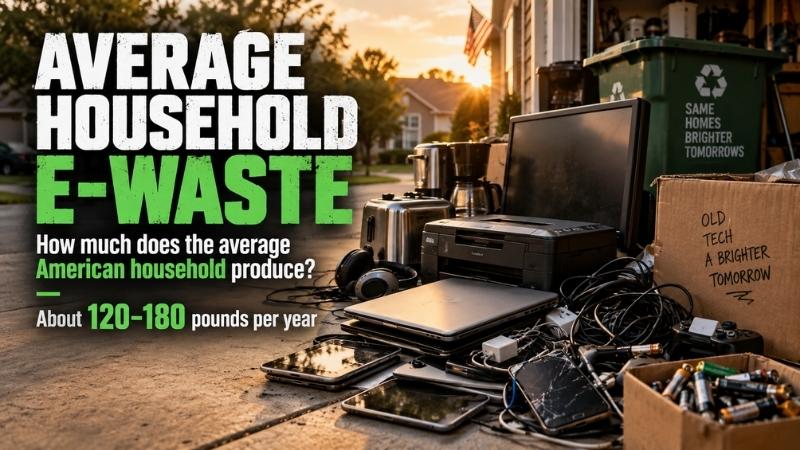
How Much E-Waste Does the Average American Household Produce?
The average American household throws out roughly 120 to 180 pounds of electronics every year. A family of four sits near the top of that range. That is about the weight of a full-grown person, made of plastic, glass, copper, and glue.
Most people never see the pile. It leaves in small pieces. A dead phone here. A cracked tablet there. An old printer that jams once too often.
Here in Phoenix, we watch that pile arrive on our dock all week. Some of it comes from offices. A lot of it comes from regular homes in Maricopa County.
Old timers around the Valley say the desert keeps whatever you leave behind. Garages prove it. So do junk drawers.
This guide breaks down the real numbers. You will see where the pounds come from, what they are worth, and what to do with them.
The Short Answer: How Much E-Waste One Household Makes Each Year
Americans generate about 46 to 48 pounds of e-waste per person each year. Multiply that by the people under your roof. That is your household total.
Here is the quick math most people want:
- One person living alone: about 45 to 50 pounds a year
- A couple: about 90 to 100 pounds a year
- A family of four: about 176 pounds a year, or 80 kilograms
- A busy household with a home office: often 200 pounds or more
Those numbers count everything with a plug or a battery. Not just laptops and phones.
The United States produces close to 6.9 million tons of e-waste a year. Only about 15 percent of it gets recycled the right way. The rest goes to landfills, storage units, or overseas scrapyards.
Ask yourself this. If someone dropped 176 pounds of broken plastic on your driveway once a year, would you leave it there?
Most of us do. We just spread it out over twelve months so it never feels heavy.
What Counts as E-Waste in a Normal Home
E-waste is any item with a cord, a plug, a battery, or a circuit board that you no longer want. That definition is wider than most people expect.
The formal term is electronic waste. It covers six main groups. Screens. Small IT gear. Large appliances. Temperature exchange units. Lamps. Small household equipment.
In a typical Phoenix home, that looks like:
- Phones, tablets, laptops, and desktop towers
- TVs, monitors, and streaming boxes
- Printers, scanners, routers, and modems
- Microwaves, toasters, blenders, and air fryers
- Vacuums, hair dryers, electric razors, and toothbrushes
- Game consoles, controllers, drones, and smart speakers
- Power tools, string lights, and cords with no known owner
- Smoke alarms, thermostats, and doorbell cameras
Toys and small appliances alone make up about a third of the world’s e-waste. Only 12 percent of that group gets recycled.
People skip these items because they feel like normal trash. A dead toaster does not look dangerous. Inside, it still holds metal, wiring, and sometimes a small battery.
If you want a deeper list before you sort your pile, our guide on what is considered e-waste walks through every category.
Around here folks say dust settles fastest on the things you forget. That is exactly how a junk drawer becomes a landfill with a nicer lid.
Room by Room: Where All Those Pounds Actually Come From
The weight builds up in four places: the office nook, the living room, the kitchen, and the garage. Most homes hold about 21 electronic devices at once.
Let me break the typical household down.
The home office nook. One laptop every four years. One printer every five. A monitor, a router, a surge strip, and a mess of cables. That is 40 to 60 pounds on its own cycle.
The living room. A flat screen TV weighs 25 to 60 pounds. Add a soundbar, a console, and two streaming sticks. Old tube TVs ran 80 to 200 pounds each.
The kitchen. Small appliances die fast. A microwave runs 30 to 40 pounds. Air fryers, coffee makers, and blenders add 20 more pounds every couple of years.
The garage and closets. This is the graveyard. Old power tools, dead batteries, holiday lights, spare cables, and a box marked “electronics” that nobody opens.
Here is a rough weight chart you can use for your own count.
| Item | Typical weight |
|---|---|
| Smartphone | 0.4 lb |
| Tablet | 1 lb |
| Laptop | 4 to 6 lb |
| Desktop tower | 15 to 25 lb |
| Flat panel monitor | 8 to 12 lb |
| Flat screen TV | 25 to 60 lb |
| CRT tube TV | 80 to 200 lb |
| Printer | 15 to 30 lb |
| Microwave | 30 to 40 lb |
| Box of mixed cables | 10 to 20 lb |
Count what you own. Then count what you have replaced in the last five years. The second number usually shocks people more.
Valley wisdom says a full garage makes for a full mind. Clearing one box is lighter work than clearing a whole wall.
The Hidden Pile: What Sits in Drawers Right Now
Most households are not throwing e-waste away. They are storing it. That stored pile is the real story behind the yearly number.
Americans hold onto dead devices for years. The phone still turns on. The laptop might work for a guest. The cable might match something later.
So the box goes on a shelf. Then another box joins it. Then the shelf becomes a corner.
That corner is a second mortgage made of metal. You already paid for the gold, copper, and silver inside. Right now it earns you nothing.
Three reasons the pile keeps growing:
- Fear about data. People worry about photos, taxes, and passwords still sitting on the drive.
- No clear plan. Curbside bins do not take electronics, so the item goes back in the closet.
- Guilt about waste. Tossing a $1,200 laptop in the trash feels wrong, so nobody decides.
All three problems have easy fixes. We will get to each one below.
There is a saying in Maricopa County. If it sat through one summer, it will sit through five. Storage is not a decision. It is a delay.
Why Phoenix Households Produce More E-Waste Than They Realize
Phoenix homes face three local pressures that push the number higher. Heat, growth, and constant moving.
Heat kills electronics faster. Garage temperatures here pass 120 degrees in July. Batteries swell. Adhesives soften. Capacitors dry out and fail early.
A laptop stored in a hot garage for two summers often will not boot again. That turns a donation into a recycling job.
The Valley keeps growing. New builds in Buckeye, Queen Creek, and Surprise mean new appliances and new tech. Old units leave the house all at once.
People move a lot here. Apartment turnover in Tempe and downtown Phoenix runs high. Moves force cleanouts. Cleanouts create sudden piles by the dumpster.
We also see a lot of home office gear. Many Valley workers went remote and bought their own setups. Those setups are now five or six years old.
Snowbird season adds another wave. Seasonal homes in Sun City and Scottsdale get cleared out every spring.
Out here people say the sun finds everything you forget outside. Your old gear is no exception.
How Your Household Compares to the National and Global Numbers
The average American makes about six times more e-waste than the average person worldwide. That gap is huge.
The world produced 62 million tonnes of electronic waste in 2022. That works out to roughly 7.8 kilograms per person. The Global E-waste Monitor tracks these figures every two years.
By comparison, the Americas averaged 14.1 kilograms per person. The United States sits well above that regional average.
A few numbers worth holding onto:
- 62 million tonnes: global e-waste generated in 2022
- 82 million tonnes: the projected total for 2030
- 22.3 percent: the share formally recycled worldwide
- About 15 percent: the recycling rate in the United States
- 151 million: cell phones tossed by Americans in a single year
That last number breaks down to roughly 416,000 phones a day. Every one of them holds copper, gold, and a lithium battery.
Global e-waste is rising about five times faster than recycling capacity. The gap widens each year.
Folks here say you cannot fill a bucket with a hole in it. The world keeps pouring in devices and recycling only a fifth of them.
How Much E-Waste Will Your Household Make Over Ten Years?
Run the yearly number out a decade and it stops feeling small. A family of four hits about 1,760 pounds in ten years.
That is close to a ton of electronics from one address. Roughly the weight of a small car.
Spread across ten years, here is what that looks like for a typical Valley family:
- 3 to 4 televisions, counting bedrooms and upgrades
- 6 to 10 smartphones, since most people swap every two to three years
- 4 to 6 laptops or tablets across school, work, and hand me downs
- 2 printers, because printers rarely last five years
- 15 to 25 small appliances, from microwaves to hair dryers
- A bin of cables that nobody can trace to a device
Now picture that stack in your driveway all at once. Would you call it trash, or would you call somebody?
Ten years is also about the span of one home renovation, one job change, and one kid going off to school. Each of those events dumps a batch at once.
The good news is simple. Handling it in small batches is easy. Handling a ton at once takes a truck.
As people say around the Valley, a wash fills one storm at a time. Your garage does too.
The Real Cost: What You Throw Away With Your Electronics
The materials inside global e-waste were worth about $91 billion in 2022. Only $19 billion of that value came back through proper recycling.
Your household pile carries a small slice of that value. Not enough to retire on. Enough to matter.
Here is what hides inside common devices:
- Gold in circuit board contacts and connector pins
- Copper in wiring, motors, and heat sinks
- Silver in solder and switch contacts
- Palladium in capacitors and board plating
- Aluminum and steel in frames, cases, and racks
- Lithium and cobalt in rechargeable batteries
Recycling a million cell phones recovers about 75 pounds of gold and 35,000 pounds of copper. That is from phones alone.
Circuit boards hold 40 to 800 times more gold per pound than mined ore. A scrap board is richer than most rock pulled out of the ground.
There is a second cost too. Every device you replace early costs you retail dollars up front. Buying less often saves more than recycling ever will.
For homeowners, the payout is usually small. For a business clearing 40 workstations, the value is real. That is where a proper IT asset disposition program pays for itself.
Around the Valley people say scrap looks like junk until somebody weighs it. That has been true on our scale since 1980.
What Happens When E-Waste Ends Up in the Trash
Electronics make up a small part of landfill volume but a huge part of landfill toxicity. Discarded electronics account for an estimated 70 percent of the heavy metals found in American landfills.
That is a bad trade. Two percent of the pile, most of the poison.
The main hazards inside your old gear:
- Lead in solder, older circuit boards, and CRT glass
- Mercury in backlights, switches, and some lamps
- Cadmium in batteries and certain semiconductors
- Brominated flame retardants in plastic housings
- Lithium in batteries that can ignite when crushed
Lithium batteries are the sharpest problem right now. Compactors crush them. Crushed cells start fires in trucks and transfer stations.
Arizona heat makes this worse. A swollen battery in a hot bin is a fire waiting for pressure.
There is also the water angle. Landfill liners fail over long spans. Heavy metals do not break down. They wait.
Arizona rules differ from California rules, so many people guess wrong. Local disposal rules and fees in Maricopa County are worth a quick check before you load the truck.
As people say out here, what you bury in the desert does not disappear. It just gets quiet for a while.
Your Old Devices Still Hold Your Data
A hard drive is a photocopy of your life, and deleting files does not erase it. This is the single biggest reason households stall.
Think about what lives on an eight year old laptop. Tax returns. Bank logins. Medical PDFs. Photos of your kids. Saved passwords in a browser.
Phones and tablets hold even more. Texts, location history, and app tokens stay behind after a quick reset.
What actually removes your data:
- Factory reset with encryption enabled works for most modern phones
- Certified wiping software overwrites a working drive to a verified standard
- Degaussing scrambles the magnetic field on older spinning drives
- Physical shredding turns the drive into metal confetti
What does not work:
- Dragging files to the trash
- Formatting a drive in Windows
- Removing the drive and tossing it in a drawer
- Hitting it with a hammer once and calling it done
A partial hit on a platter still leaves readable tracks. Recovery shops do this work every day.
If you are handing devices to any recycler, ask for a certificate of destruction. A good shop gives you one without being asked twice.
Our guide on the importance of data destruction explains what a proper chain of custody looks like from pickup to shred.
People around here say trust runs on paper, not on promises. Ask for the paperwork.
How to Cut Your Household E-Waste Down
The fastest way to shrink the yearly number is to buy less and keep devices longer. Recycling comes second.
Here is a practical order of operations.
- Repair before you replace. A battery swap gives most phones two more years. Screen repairs cost a fraction of a new device.
- Buy for durability. Choose models with replaceable batteries and available parts. Check repair scores before you order.
- Resist the yearly upgrade. Most phones hold up fine for four or five years. The camera bump is rarely worth 60 pounds of packaging and parts.
- Pass working gear down. A five year old laptop is plenty for homework and email. Schools and nonprofits often take working machines.
- Store gear indoors, not in the garage. Phoenix heat will kill a device you planned to donate. Keep it in a closet instead.
- Buy refurbished when you can. A certified refurb keeps a device in service and costs less.
- Do one cleanout a year. Pick a month. March works well, before the heat arrives. Clear the drawer and be done.
- Skip novelty tech. Single purpose gadgets rarely last a year. They land in the pile fast.
If you want more tactics, our guides on reducing e-waste go deeper on the buying side.
As the saying goes here, the cheapest gallon of water is the one you never spill. The cheapest device is the one you did not need to buy.
What to Do With the Pile Right Now in Phoenix
You have four real options in the Valley: sell, donate, drop off, or schedule a pickup. Pick based on the condition and the volume.
Sell it if the device is under four years old and still works. Phones, current model laptops, and test equipment hold value.
Donate it if it works but has little resale value. Local schools, churches, and nonprofits can often use it. Wipe it first.
Drop it off if you have one or two loads and a free afternoon. Call ahead. Many Phoenix facilities run by appointment only.
Schedule a pickup if the pile is heavy, awkward, or full of sensitive drives. This is the right call for offices, property managers, and big cleanouts.
Before you load the truck, do these four things:
- Back up anything you want to keep. Photos first. People forget photos.
- Sign out of accounts. Apple ID, Google, and Microsoft locks cause problems later.
- Pull the batteries you can safely remove. Tape the terminals on loose lithium cells.
- Keep drives with the machine. A good recycler will handle them and document it.
We have run this process in Phoenix for more than forty years. Our team started in 1980 and still works out of the same neighborhood off West McDowell Road.
If you want the full local rundown on drop-off rules, fees, and accepted items, read our guide to e-waste recycling in Phoenix, AZ.
Ready to clear it out? Call JHI at (602) 272-4033 or request a free evaluation. We will tell you what has value, what does not, and how we handle the rest. No pressure, no surprise fees.
Around the Valley people say the shade you plant today cools somebody later. Same with a clean, honest recycling chain.
What Actually Happens to Your Electronics After Drop-Off
A proper recycler sorts your load into three paths: reuse, recovery, and refining. Nothing useful should reach a landfill.
Path one is reuse. Working laptops, monitors, test gear, and surplus parts get tested and cleared. Reuse beats recycling every time because it skips new manufacturing.
Path two is recovery. Devices get dismantled by hand. Steel frames, aluminum housings, power supplies, and copper wiring all separate into their own bins.
Path three is refining. Circuit boards, chips, and connectors go to smelters that pull out gold, silver, palladium, and copper.
Hazardous parts split off along the way. Batteries, CRT glass, mercury lamps, and toner get handled under their own rules.
Your drives should never ride along quietly. They get wiped or destroyed, logged, and documented.
Ask any recycler to walk you through those four steps. If the answer is short and vague, keep shopping.
Folks here say you can tell a good yard by how it sorts, not by how it advertises. Watch what leaves the building, not what is painted on the wall.
How to Spot a Trustworthy Electronics Recycler
A good recycler answers hard questions without dodging. A bad one talks about being green and changes the subject.
Run through this checklist before you hand over anything.
Ask where the material actually goes. A real recycler names the downstream path. Smelters, refiners, and processors should not be a secret.
Ask about data handling. Find out who touches the drives, where they are stored, and whether you get documentation.
Ask for pricing in writing. Some items carry a fee. CRT glass and certain TVs cost money to process. That is normal. Hidden fees on pickup day are not.
Check how long they have been around. Longevity in this business means real permits, real buyers, and a real reputation.
Look for local operations. A local yard in Phoenix beats a broker who ships your gear to an address nobody visits.
Watch for red flags:
- No physical address or a vague one
- Cash only with no receipt
- Vague answers about export
- “We recycle everything” with no detail on how
- Pressure to hand over drives without paperwork
Companies like Jay Hoehl Inc. have been buying and processing electronic scrap in Phoenix since 1980. Longevity is not a marketing line. It is a track record you can check.
If you are still comparing vendors, call two of them and ask the same five questions. The answers sort themselves out fast.
Locals say you judge a well by the water, not by the sign on the bucket. Judge a recycler the same way.
Common Mistakes Households Make
Most e-waste problems come from a few repeat mistakes. They are easy to avoid once you see them.
Mistake 1: Tossing electronics in the curbside bin. Most Valley programs do not accept them. Your item gets pulled, landfilled, or fouls the line.
Mistake 2: Leaving a laptop in the garage all summer. The heat destroys the battery and the board. A working donation becomes scrap.
Mistake 3: Assuming a factory reset is enough. On older machines, it often is not. Encryption matters here.
Mistake 4: Storing loose lithium batteries in a box. Terminals touch. Heat builds. Fires start in garages this way.
Mistake 5: Waiting for the “right” time. The right time is the next cleanout. The pile only grows.
Mistake 6: Trusting the word recycling with no proof. Anybody can print it on a truck. Ask for the documentation.
Mistake 7: Throwing away cords and small parts. Copper wiring has value. So do circuit boards and connectors.
Old timers here say the second haul is always heavier than the first. Handle it now while it fits in the trunk.
What About Offices, Rentals, and Small Businesses?
Business e-waste follows different rules and carries more risk. If you manage a property, an office, or a school, your exposure is larger.
A single retired workstation can hold customer records. A dozen of them create a compliance problem.
Watch for these situations:
- Office refreshes. Twenty laptops leaving at once needs a documented process.
- Tenant turnover. Property managers inherit abandoned electronics regularly.
- School and clinic cleanouts. Student and patient data raises the stakes.
- Warehouse and lab shutdowns. Test equipment and surplus stock often hold resale value.
In those cases, you want serialized tracking, certificates of destruction, and a written pickup schedule. You also want somebody who will tell you honestly what the load is worth.
Some loads pay you. Some cost a little. A straight answer up front beats a surprise invoice later.
Around here people say a handshake is only as good as the second visit. We plan on second visits.
Quick FAQ
How much e-waste does the average American household produce each year?
About 120 to 180 pounds, depending on household size. A family of four averages roughly 176 pounds annually.
How much e-waste does one American produce?
Roughly 46 to 48 pounds per person each year. Some estimates run higher when large appliances are included.
Is the United States the biggest producer of e-waste?
No. China produces more in total volume. The United States ranks second and leads on a per person basis among large countries.
What percentage of e-waste actually gets recycled?
About 15 percent in the United States. Worldwide the documented rate is 22.3 percent.
Is it illegal to throw electronics in the trash in Arizona?
Rules vary by item and by municipality. Some items are restricted, and businesses face stricter requirements than households. Check local guidance before you toss anything with a battery or a screen.
Do I have to remove the hard drive before recycling my computer?
You do not have to if your recycler handles data destruction and gives you documentation. Many people prefer to pull the drive anyway. Both paths work.
Does e-waste recycling cost money?
It depends on the item. Many devices are accepted at no charge. CRT televisions and certain screens carry a processing fee because of leaded glass.
Can I get paid for my old electronics?
Sometimes. Volume, condition, and material mix decide it. Single household loads rarely pay much. Business loads, surplus inventory, and test equipment often do.
What happens to my devices after drop-off?
Working units get tested and resold. The rest gets sorted, dismantled, and separated into metal, plastic, and board streams for refining.
How do I know a recycler is legitimate?
Ask about downstream partners, data handling, and pricing in writing. Check how long they have been operating and whether they have a real local facility.
What is the fastest way to clear out a garage full of electronics?
Schedule a pickup. One appointment beats six trips in your own car, especially in summer.
The Bottom Line
The average American household produces 120 to 180 pounds of e-waste a year, and most of it never gets recycled properly. That is the honest number.
You cannot fix the national total. You can fix your garage.
Start with one shelf. Sort what works from what does not. Wipe what holds data. Then move the rest to somebody who will handle it the right way.
That last step is where trust matters. Your devices hold your information and real material value. Both deserve a straight answer about where they go.
Here is the easy next step. Call Jay Hoehl Inc. at (602) 272-4033 or request a free evaluation. Tell us what you have. We will tell you what it is worth, what it costs, and when we can pick it up.
We are at 3334 W McDowell Rd, Unit 17, Phoenix, AZ 85009. Visits are by appointment, Monday through Friday, 8:00 a.m. to 4:30 p.m. Give us a call first and we will get you directions.
Forty plus years in Phoenix. A+ rating with the BBB. No surprise fees on pickup day.
As they say in the Valley, the best time to plant a tree was twenty years ago. The second best time is this weekend.