
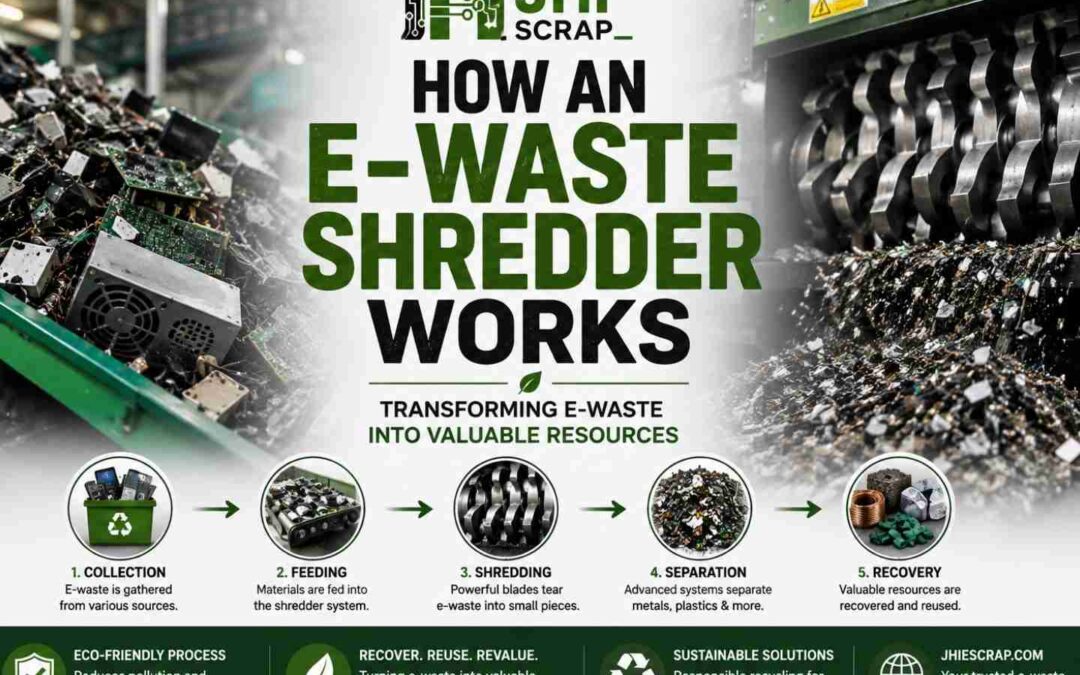
How an E-Waste Shredder Works (With What Comes Out the Other End)
An e-waste shredder tears electronics into small pieces. Machines then sort those pieces by magnetism, conductivity, density, and color. That’s the whole idea in one sentence. The rest is detail. That detail decides whether your old servers become clean copper or a dirty mess.
Most people picture a giant blender. Toss in a laptop, get out silver dust. That’s not it.
A real shred line is more like a kitchen than a blender. Things get prepped, cut, sifted, and plated. Each step has a job. Skip one and the whole batch gets ruined.
Here in Phoenix, this matters more than folks think. Old gear sits in hot storage units and garages for years. Batteries swell. Plastics get brittle. By the time it reaches a yard, the stuff is fragile and touchy.
So let’s walk the line together. Front door to finished pile. You’ll see what a shredder does, what it can’t do, and what actually comes out the far end.
What an E-Waste Shredder Actually Is
An e-waste shredder is a heavy steel machine. Rotating shafts and hardened blades cut electronics into uniform fragments. It doesn’t grind things into powder. It liberates materials so they can be separated.
That word “liberate” is the key. Inside a laptop, copper is glued to plastic, screwed to steel, and soldered to a board. No magnet can pull that copper out while it’s still stuck to everything else.
Shredding breaks the bond. Once copper travels alone, physics can grab it.
Most industrial shredders fall into three families:
- Low-speed, high-torque shredders. Two slow shafts with big hooked teeth. Great for bulky, tough gear. They pull items in and rip them apart.
- Hammer mills. Swinging steel hammers smash brittle items against a grate. Good for boards and small parts.
- Granulators. Fast rotating knives that cut pieces down to a small, even size. This is the fine-cut stage.
A serious plant runs more than one. You don’t chop onions with a bread knife, and you don’t granulate a server rack in one pass.
Screen size controls everything downstream. A screen is a perforated plate under the cutting chamber. Material stays in the machine until it’s small enough to drop through the holes.
Want thumbnail-sized chunks? Use a 40mm screen. Want rice-sized bits for precious metal recovery? Drop to 6mm. The screen is the dial that sets the whole recipe.
Nothing Goes In Whole: The Prep Work Before the Shredder
Before anything touches a blade, people take it apart by hand. This step is where a good recycler earns their money, and where a bad one cuts corners.
Why bother? Because a shredder is dumb. It has no idea it just bit into a lithium battery.
Manual prep usually pulls out:
- Batteries of every chemistry, especially lithium-ion pouches inside laptops and tablets
- Toner and ink cartridges that explode into fine powder
- Mercury lamps hiding in older LCD backlights
- Whole hard drives and SSDs that need their own secure path
- Capacitors, ballasts, and anything that might hold PCBs
- High-value boards worth processing separately
- Working units worth reselling instead of shredding
That last one gets overlooked. A tested, wiped, working server is worth far more alive than dead. Any recycler who shreds resalable gear is burning your money to save their labor.
Good shops also sort by material type here. Steel chassis go one way. Plastic housings go another. Boards go to a third bin.
Clean input makes clean output. Garbage in, garbage out is not just a computing joke. It’s the whole economics of a shred line.
Step One: The Primary Shred
The primary shredder is the first cut, and it’s brutal on purpose. A loader or conveyor drops prepped material into a hopper. Two counter-rotating shafts grab it and pull it down.
These shafts turn slowly. Maybe 20 to 40 rotations per minute. Slow is good here.
Slow means torque. Torque means the machine can chew a steel server chassis without stalling. It also means less heat, less dust, and fewer sparks.
Output from a primary shred is chunky. Think palm-sized pieces, ragged at the edges, mixed together in a pile that looks like a metal salad.
What the primary shred accomplishes:
- Destroys the original form of the device, so nothing is reusable or identifiable
- Breaks welds, screws, and snap fits that hold materials together
- Creates a consistent feed size for the next machine
- Frees loose steel and aluminum for early magnetic pickup
Operators watch the amp draw on the motor like a hawk. A spike means something hard went in. The machine will auto-reverse, back the material out, and try again.
Ever seen a shredder jam on a forgotten forklift battery? It’s an expensive afternoon. That’s why prep matters so much.
Step Two: The Secondary Shred and the Granulator
The second pass makes the pieces small and even. Even matters more than small. Sorting machines need a predictable particle size to work at all.
Secondary shredders run faster than primaries. Granulators run faster still, sometimes several hundred RPM, with sharp rotating knives cutting against fixed bed knives.
Picture a paper shredder that eats aluminum. That’s roughly the energy involved.
At this stage, most copper wire finally separates from its plastic jacket. Aluminum heat sinks break off boards. Solder flakes loose. The stream becomes a true mixed fraction.
Typical particle sizes by goal:
- 20mm to 40mm. General metals recovery from mixed e-scrap
- 6mm to 12mm. Copper and aluminum liberation from wire and boards
- Under 4mm. Precious metal concentration from high-grade board scrap
Smaller is not automatically better. Grind too fine and you make dust that’s hard to capture and easy to lose. You also burn a lot more electricity.
There’s an old shop saying that fits here. Measure twice, cut once. A plant that dials in the right screen the first time recovers more and spends less.
Step Three: Screening the Pieces by Size
Screening sorts fragments by size before any material sorting happens. It sounds boring. It’s actually the step that makes everything else work.
A trommel is a big rotating drum with holes in the wall. Material tumbles inside. Small pieces fall through. Big pieces exit the far end.
Vibrating deck screens do the same thing on flat, shaking trays stacked in layers. Each layer has smaller holes than the one above it.
Screening gives the plant three useful things:
- Oversize. Pieces that didn’t shred properly get sent back for another pass
- Midsize. The main fraction that feeds magnets and eddy currents
- Fines. Dust and tiny particles rich in solder and precious metal, handled separately
Those fines are sneaky valuable. A lot of gold ends up there as microscopic flakes. Plants that throw fines away are literally sweeping money into a dumpster.
Why does size matter so much for sorting? A magnet, an air knife, and a sensor each behave differently on a big chunk. Mixed sizes confuse every machine downstream.
Uniform feed is the quiet secret of high recovery rates. Nobody puts it on a brochure. Everyone in the industry knows it.
Step Four: Magnets Take the Steel
Magnetic separation pulls ferrous metals like steel and iron out of the shredded stream. It’s the simplest step in the whole plant and one of the most effective.
An overband magnet hangs above a moving conveyor. Steel jumps up, sticks to a belt, rides sideways, and drops into its own bin. Everything nonmagnetic keeps traveling.
Some lines use magnetic drums instead. Material falls over a rotating drum with magnets inside. Steel clings and drops late. Everything else falls early.
What ends up in the ferrous pile:
- Server and desktop chassis panels
- Screws, brackets, and standoffs
- Transformer laminations
- Hard drive bodies and platter clamps, when drives are shredded in-line
- Steel shielding cans from boards
Steel is the low-value workhorse of e-scrap. It doesn’t pay much per pound. It does show up in huge volume.
Pulling it early protects the machines ahead. Steel heats up badly in an eddy current field and can damage the rotor. You pull the steel first for the same reason you bone a chicken before the stock.
Recovered steel heads to a mill. It comes back as rebar, car parts, or the frame of somebody’s next appliance.
Step Five: Eddy Currents Make Aluminum Jump
Eddy current separation recovers nonferrous metals like aluminum and copper. It makes them launch off the conveyor belt. Yes, really. The metal jumps.
Here’s the trick. A rotor packed with strong permanent magnets spins very fast inside a drum at the belt’s discharge end. That spinning field induces swirling electrical currents inside any conductive piece passing over it.
Those induced currents create their own magnetic field. That field opposes the rotor’s field. The two push each other apart and the metal fragment gets flung forward.
Nonconductive material feels nothing. Plastic and glass just drop straight down off the belt. A splitter plate sits in the gap and catches each stream in a different bin. If you want the physics in more depth, the eddy current separator is well documented and worth a read.
Common eddy current output:
- Aluminum from laptop shells, heat sinks, and drive housings
- Copper from wire, windings, and bus bars
- Brass and die-cast zinc from connectors and hardware
- A “middlings” fraction of half-liberated pieces that goes back for another shred
That middlings loop is a mark of a serious plant. Cheap operations skip it and lose metal every single hour they run.
Seeing an eddy current line for the first time is a little unsettling. Metal leaps off a belt for no visible reason. It looks like a magic trick, but it’s just good old physics doing honest work.
Step Six: Air and Water Sort the Rest
Density separation splits the remaining stream using air, water, or vibrating tables. After the magnets and eddy currents, what’s left is mostly plastic, glass, board fragments, and stubborn mixed pieces.
Air classifiers blow a controlled stream of air across falling material. Light stuff like film plastic and foam gets carried sideways. Heavy stuff drops straight down.
Water tables work on the same logic with buoyancy instead of wind. Plastics float. Metals and board fragments sink. Glass settles in between.
Shaking tables use a tilted, vibrating deck with riffles cut into it. Heavy particles walk one direction. Light ones slide another. It’s the same technique gold panners used a century ago, scaled up and motorized.
Density separation typically yields:
- Mixed plastic fractions, sorted further by polymer type
- Glass fines from screens and displays
- Heavy metal concentrate rich in solder and precious metals
- Residual foam, film, and label material
Arizona plants think hard about water use here. Dry systems cost more upfront and use more power. They also don’t need a water treatment loop in a place where water is never cheap.
Does dry always beat wet in the desert? Not always. It depends on the material mix and the volume. But it’s a real design decision, not a marketing line.
Step Seven: Sensors Catch What Physics Missed
Sensor-based sorting uses cameras, X-rays, and lasers to identify materials that magnets and airflow can’t tell apart. This is the finishing pass.
An optical sorter photographs each particle as it flies past. Software identifies it by color and shape. A row of precision air jets fires and knocks the target piece into a separate chute.
X-ray transmission sorters go deeper. They read atomic density, not surface color. That lets them separate a piece by what it’s made of, even under paint or a coating.
Near-infrared sorters read the chemical signature of plastics. That’s how a plant separates ABS from polycarbonate from polystyrene. Mixed plastic is nearly worthless. Sorted plastic has a buyer.
Sensor sorting usually handles:
- Separating polymer types for resale
- Pulling stray circuit board fragments out of plastic streams
- Catching stainless steel, which magnets often miss
- Removing brominated flame retardant plastics, which need special routing
These machines are expensive. Not every yard has them, and that’s fine. Smaller shops send their concentrate to a partner who does.
What matters is that somebody in the chain does this work. Don’t judge a book by its cover, and don’t judge a recycler by their front office. Ask where the material actually goes.
So What Comes Out the Other End?
A well-run e-waste shred line produces roughly six to ten clean material streams from what went in as mixed electronics. Here’s what fills the bins at the end of a shift.
Ferrous metal. Steel and iron, the biggest pile by weight. Low value per pound, high volume. Goes straight to a steel mill.
Aluminum. From housings, heat sinks, and drive bodies. Recycling it uses about 95 percent less energy than making it from bauxite. That energy math is why aluminum always has a buyer.
Copper. From wire, windings, transformers, and bus bars. One of the most valuable bulk fractions in the plant.
Mixed nonferrous. Brass, zinc, and small amounts of stainless. Sold as a blend or refined further.
Circuit board fragments. The precious metal carrier. Sorted by grade and sent to a refinery.
Sorted plastics. ABS, polycarbonate, and polystyrene, each with its own market. Contaminated plastic goes to energy recovery instead.
Glass. From displays and older tubes. Leaded glass needs a specialized outlet.
Fines and dust. Captured by the dust system, often rich enough in solder and gold to be worth refining.
A ton of mixed office e-scrap breaks down roughly like this. Several hundred pounds of steel. A hundred or so pounds of aluminum. A smaller copper fraction. A meaningful board fraction. A large plastic share. The exact split swings wildly with what you feed in.
Old CRT televisions are mostly glass and lead. Modern servers are dense with copper and boards. Same machine, completely different output.
Circuit Boards: Where the Real Money Hides
Circuit boards carry the precious metals, and their concentration beats natural ore by a wide margin. This is the part that surprises people most.
The EPA puts the gold comparison in stark terms. One metric ton of circuit boards can hold 40 to 800 times the gold in a ton of U.S. ore. It can also hold 30 to 40 times the copper.
Read that again. A pallet of old motherboards is a richer gold deposit than most working mines.
What’s actually in a board:
- Gold. Connector plating, edge fingers, bond wires, and IC pins
- Silver. Solder, contacts, and conductive paste
- Palladium. Multilayer ceramic capacitors and plating layers
- Copper. The traces and inner layers, by far the biggest metal share by weight
- Tin and lead. Solder joints throughout
Not all boards are equal. A telecom backplane or a server motherboard is high grade. A power supply board is low grade. A good buyer sorts by grade before shipping, because mixing grades means getting paid at the lowest one.
This is exactly why board scrap and surplus components rarely get shredded blind. Sorting first, then processing, recovers far more value than tossing everything in the hopper. The same logic drives smart IT asset disposition programs, where value recovery is the point, not just disposal.
Refining that concentrate takes chemistry, not blades. Smelting, leaching, and electrowinning finish the job at facilities built for it. Want the full picture of how those stages connect? The complete e-waste recycling process lays out each method side by side.
Hard Drive Shredding Is Its Own Job
Hard drive shredding is a security process first and a recycling process second. It runs on separate equipment, under separate rules, with separate paperwork.
A general e-waste shredder cuts to whatever size the screen allows. That might be fine for a laptop chassis. It’s not automatically enough for a drive holding patient records.
Media destruction standards care about particle size. Smaller fragments mean less chance of recovering readable data. Modern drives pack so much data per square inch that a big fragment can still hold usable sectors.
How drives usually get handled:
- Software overwrite. Multiple passes, verified, with a report per serial number. Good for drives being resold.
- Degaussing. A strong magnetic field wipes spinning platters. Does nothing to SSDs.
- Crushing or punching. Deforms the platter so it can’t spin. Fast, but it’s damage, not destruction.
- Shredding. Physical reduction to small fragments. The most final option.
SSDs are the tricky one. There are no platters to degauss. Data lives in flash chips soldered to a small board. The chips need destroying, not just the housing.
Ask any recycler what they do differently for SSDs. If they give you the same answer as spinning drives, keep shopping. You can’t unring a bell, and you can’t unleak a database.
Handling this yourself before drop-off? There’s a right way to destroy a hard drive before recycling a laptop. And the reasons data destruction matters go well past privacy. For a lot of Phoenix businesses, it’s a compliance requirement with real penalties attached.
What Should Never Go In a Shredder
Some items will damage the machine, start a fire, or release something toxic. These come out during prep, always, no exceptions.
Lithium-ion batteries. The number one fire risk in the entire recycling industry. A punctured cell can go into thermal runaway in seconds. Recycling facility fires from hidden batteries are a well-known and expensive problem.
Pressurized cylinders and aerosols. Anything sealed under pressure can turn into shrapnel.
Mercury-containing lamps. Older LCD backlights use thin mercury tubes. Shred one and you’ve contaminated the whole batch plus the air in the building.
Refrigerant units. Mini fridges and AC gear must be professionally degassed first. Venting refrigerant is illegal and environmentally serious.
Toner cartridges. Fine carbon powder is combustible when airborne. It also coats every surface in the plant.
Smoke detectors. Many contain a small radioactive source and need a dedicated return program.
Anything visibly swollen or leaking. If a battery looks puffy, treat it as live. Arizona heat makes this more common than in cooler states, since gear stored in a hot garage ages badly.
Here’s the honest version. Every recycler has a story about something that went in and shouldn’t have. The good ones built their prep process around those stories.
Dust, Sparks, and Fire: Building a Shred Line That Doesn’t Blow Up
A shred line makes dust, heat, and sparks by design. Fire and air controls get built in, not bolted on later. This is the part nobody films for the marketing video.
Shredding creates fine particles. Fine particles suspended in air are combustible. Add a spark from steel hitting steel and you have a real hazard.
Standard protections on a well-built line:
- Dust extraction hoods at every transfer point and cutting chamber
- Cyclones and baghouse filters to capture particulate before it hits the air
- Spark detection with automatic water or inert gas suppression
- Thermal cameras watching the discharge and storage piles
- Explosion venting on enclosed conveyors and ducts
- Amp monitoring and auto-reverse on the shredder shafts
Those baghouse fines are not just a safety item. They often contain enough solder and precious metal to be worth refining. Safety equipment that pays for itself is rare, but this one does.
Noise and worker exposure matter too. Operators wear respirators and hearing protection. Air monitoring is routine at any plant that takes its permits seriously.
An ounce of prevention beats a pound of cure. Here a fire costs more than equipment. It costs the permit, the insurance, and sometimes the whole company.
Shredding vs. Hand Dismantling: Which Recovers More?
Hand dismantling recovers more value per unit. Shredding recovers more value per hour. Both are correct, and the right answer depends entirely on what’s on the pallet.
A skilled technician pulling a server apart can isolate high-grade boards, processors, memory, and gold-plated connectors cleanly. Nothing gets mixed. Nothing gets lost as dust.
That same technician might spend twenty minutes on one machine. Multiply by three hundred units and the labor cost eats the recovery gain.
Hand dismantling wins when:
- The equipment is high grade, like telecom gear, servers, or lab instruments
- Components have resale value on their own
- Volume is low and value density is high
- The item contains hazards that must come out anyway
Shredding wins when:
- Volume is large and grade is mixed
- Security requires total physical destruction
- Labor cost per unit would exceed the recovery
- The material is already stripped of hazards and high-value parts
Almost every real facility runs a hybrid. Hands first, machine second. The judgment call happens on the sorting floor, item by item.
Ask a recycler how they make that call. If they can explain it clearly, they’ve done it a lot. If they wave it off, that tells you something too.
What This Means for a Phoenix Business
Understanding the shred line changes what a Phoenix business should ask for. It also changes what you expect to be paid. It shifts the conversation from “haul this away” to “what’s actually in it.”
Phoenix has a specific mix. Semiconductor and aerospace suppliers along the tech corridor. Data centers spreading across the West Valley. Big healthcare systems. School districts refreshing hundreds of Chromebooks at a time.
That means the local scrap stream skews toward high-grade board material and test equipment. It is not the same mix as a residential drop-off day.
Practical takeaways for a local operation:
- Separate data-bearing devices before pickup. It simplifies your paperwork and theirs.
- Don’t let old gear bake in an uncooled storage room. Heat kills batteries and warps plastics.
- Keep high-grade boards and test gear off the general e-waste pallet. They’re worth more sorted.
- Ask for a written weight breakdown by material, not just a total tonnage number.
- Get the destruction documentation before the truck leaves, not weeks later.
Arizona summers create a real storage problem. Gear stacked in a warehouse without cooling degrades fast. A swollen battery in June is a different animal than a swollen battery in January.
If it’s been sitting since your last refresh, move it. Procrastination is the thief of time, and around here it’s also the thief of scrap value.
How to Spot a Real Shred Line From a Sales Pitch
You can judge a recycler by how specifically they answer process questions. Vague answers usually mean the work happens somewhere else, under somebody else’s rules.
Everybody’s website says “certified” and “responsible.” Those words cost nothing. What separates a real operator is detail.
Questions worth asking before you book:
- What do you shred on site, and what goes to a downstream partner?
- What particle size do you shred data-bearing media to?
- How do you handle SSDs differently from spinning drives?
- Do I get a serialized destruction record, and how fast?
- Where does the plastic fraction end up?
- What do you pull out before shredding, and who trains that crew?
- Can I see the material breakdown from a past job like mine?
Pay attention to how they price. A quote that’s suspiciously free for high-grade material sometimes means they plan to keep all the recovery value.
Watch for the opposite too. Big fees on material that clearly has metal value deserve an explanation.
The EPA maintains helpful guidance on electronics donation and recycling, including what to check before you hand anything over. It’s a good sanity check against a slick sales pitch.
Trust your gut on the walkthrough. If a yard won’t let you see the floor, ask yourself why.
What Happens to Your Equipment at JHI
At Jay Hoehl Inc., material gets sorted and evaluated before anything gets destroyed. Value recovery and disposal are two different goals. The company has been working Phoenix e-scrap since 1980, out of the McDowell Road facility.
That’s more than four decades of watching this industry change. CRTs to flat panels. Lead solder to lead-free. Desktops to data centers.
How a typical job runs:
- You call or send a list of what you have
- You get a free evaluation, so you know what’s worth money before you commit
- Pickup gets scheduled, or you bring it in by appointment
- Material is sorted by type and grade on arrival
- Resalable equipment and components are separated from scrap
- Data-bearing media follows the secure destruction path
- The rest is processed for material recovery
Surplus inventory, test equipment, SMD components, and IC chips get evaluated as assets, not as trash. Sometimes the check goes the other direction, and you get paid.
Ready to find out what your old equipment is actually worth? Call (602) 272-4033 or request a free evaluation. No obligation, no pressure, and you’ll know where you stand before anything leaves your building.
Frequently Asked Questions
How small does an e-waste shredder cut things?
It depends on the screen, usually somewhere between 4mm and 40mm. General e-scrap often gets cut to around 20mm to 40mm. Material headed for precious metal recovery gets cut much finer, sometimes under 6mm.
Can data be recovered from a shredded hard drive?
Not from properly shredded fragments. The risk comes from fragments that are too large. Modern drives store enormous data per square inch. Oversized pieces can still hold readable sectors. That’s why destruction standards specify particle size.
What is the most valuable thing that comes out of an e-waste shredder?
By concentration, circuit board fragments carrying gold, silver, and palladium. By total weight and revenue, copper usually leads on most mixed loads. Steel is the biggest pile but the lowest value per pound.
Do all recyclers shred everything?
No, and the good ones don’t. Working equipment is worth more resold. High-grade boards are worth more sorted. Shredding is one tool in the process, not the whole process.
Why do batteries have to come out first?
Lithium cells can enter thermal runaway when punctured or crushed. Hidden batteries are a leading cause of fires at recycling facilities. Removing them by hand during prep is standard practice at any serious operation.
Is it illegal to throw electronics in the trash in Arizona?
Rules vary by jurisdiction and by material type, and businesses face different requirements than households. Hazardous components like batteries and certain displays carry their own restrictions. Check current local requirements before you assume a dumpster is fine.
What happens to the plastic from shredded electronics?
Sorted polymer streams go to plastics reprocessors and get pelletized for reuse. Mixed or contaminated plastic usually goes to energy recovery. Plastics with brominated flame retardants need a separate, controlled route.
How long does a business e-waste pickup take?
A single pallet is usually quick. A full office or data center decommission takes planning, inventory, and staged loads. The paperwork side, especially serialized destruction records, is often what sets the timeline.
The Short Version
An e-waste shredder tears electronics into uniform pieces. Then magnets, eddy currents, air, water, and sensors pull each material into its own clean stream. Steel goes one way. Aluminum and copper another. Boards head to a refinery. Plastics get sorted by polymer.
The machine is the loud part. The judgment around it is the important part.
What gets pulled out before the blades. What gets resold instead of destroyed. How data-bearing media is handled. Whether the fines get refined or swept away. That’s where a recycler earns your trust or loses it.
You now know enough to ask better questions than most buyers ever do. Use them. A little knowledge saves a lot of regret. Here the regret shows up as a breach or a surprise invoice.
Got old equipment in a Phoenix warehouse, office closet, or storage room? It isn’t getting more valuable while it waits. Heat, dust, and time all work against you.
Get a free evaluation before you decide anything. Call Jay Hoehl Inc. at (602) 272-4033, or reach out to schedule a pickup. Find out what you actually have, what it’s worth, and how it gets handled. Then decide. No pressure either way.