
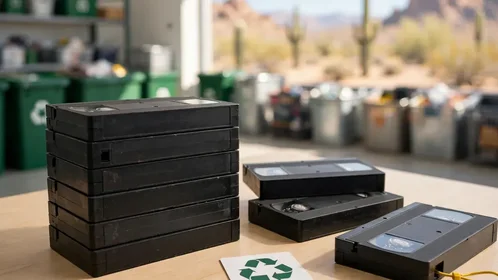
How to Dispose of Old VHS Tapes: Recycling, Donation, and Resale Options
You opened a closet in Phoenix and found a box of old VHS tapes. Now what? You cannot toss them in your blue bin. You should not just dump them in the trash either. This guide shows you the three good paths: recycle, donate, or sell.
Short answer: Sort your tapes first. Digitize any home movies you want to keep. Donate or sell the good commercial tapes. Recycle the rest through a specialty program. Keep the VCR out of the trash too. It counts as e-waste.
In this guide:
- What’s Inside a VHS Tape, Anyway?
- Can You Throw VHS Tapes in the Trash?
- Why Your Blue Bin Says No
- Step 1: Sort the Pile Before You Do Anything
- Step 2: Save the Home Movies First
- Option 1: Donate the Tapes Someone Else Can Still Watch
- Option 2: Sell the Ones Collectors Actually Want
- Option 3: Recycle the Rest the Right Way
- What About the VCR?
- How to Pack and Ship VHS Tapes for Recycling
- What Does VHS Tape Recycling Cost in Phoenix?
- How to Pick a Trustworthy Electronics Recycler in Phoenix
- What Happens to Your Electronics at JHI
- Your Simple Phoenix Checklist
- Frequently Asked Questions
Most Phoenix homes have a tape graveyard somewhere. It hides in a garage, an attic, or a spare closet. The tapes sat there for years. Out of sight, out of mind. Then moving day comes. Or a remodel. Or a parent downsizes. Suddenly the box is in your hands, and you need a plan.
Here is the good news. You have real options. Some tapes still have value. Some can find a new home. The rest can be recycled the right way. None of that needs a whole weekend. It needs one clear plan and about an hour of sorting.
This guide gives you that plan. It is written for Phoenix and Maricopa County. It covers local drop-off spots, mail-in programs, donation rules, resale truth, and costs. It also tells you what to do with the VCR that came with the tapes. By the end, the box will be gone, and your conscience will be clear.
What’s Inside a VHS Tape, Anyway?
A VHS tape is a small box with a big secret. It looks like plain black plastic. It is not. It holds five different materials in one shell. That mix is why disposal gets tricky.
VHS stands for Video Home System. JVC released the format in Japan in 1976. It reached the United States in 1977. It ruled home video through the 1980s and 1990s. The last major studio releases on VHS shipped in 2006. Funai built the last VCR in July 2016. You can read the full history of VHS on Wikipedia.
Each cassette measures about 18.7 by 10.2 by 2.5 centimeters. That is roughly 7 by 4 by 1 inches. Inside, a half-inch ribbon of magnetic tape winds between two spools. A standard tape holds about two hours of video. Some long-play tapes hold four hours or more.
So what is the tape made of? Think of it like a sandwich with too many layers. The outer shell is polypropylene plastic, marked as number 5 plastic. The ribbon is Mylar film, a form of PET plastic. The ribbon wears a thin coat of iron oxide and chromium dioxide. Those metal oxides store the picture and sound. Small metal screws and springs hold the shell together. A paper label sits on the outside.
Why does this matter? Each layer needs a different recycling path. Plastic recyclers want clean plastic. Metal recyclers want clean metal. A VHS tape gives them both at once, glued together. That is the core problem. No single machine can split the sandwich cleanly.
Here is a simple way to picture it. A VHS tape is like a burrito. The tortilla is plastic. The filling is metal-coated film. You cannot unroll it and sort it at a normal plant. The plant would need to open every tape by hand. That costs too much time and money.
Does the tape hold anything dangerous? It holds small amounts of chromium and other metals. Those metals can leach into soil and water over time. That is why experts call VHS tapes e-waste. They are not as toxic as a battery. But they are not harmless plastic either.
The tapes also age badly in Phoenix heat. A garage in July can top 120 degrees. Attics run hotter. Heat warps the shell. It dries out the ribbon. It feeds mold in monsoon humidity. Tapes kept in a cool closet can last 20 to 30 years. Tapes baked in a garage can fail in 5 to 10 years.
Can You Throw VHS Tapes in the Trash?
Yes, you can put VHS tapes in your household trash in Arizona. No statewide law bans them from landfills. No city in the Valley fines you for it. But legal does not mean smart. Trash should be your last resort, not your first move.
Think about what happens next. The tape rides a truck to a landfill. It sits there for hundreds of years. Plastic does not rot. The metal coating slowly breaks down. Rain pushes tiny bits toward the soil. That is a poor ending for something you can recycle or donate.
Ask yourself two questions before you bin a tape. First, could someone still watch it? Second, could a recycler take it apart? If either answer is yes, the trash can wait. Most tapes get a yes on at least one count.
There is one more reason to pause. Your trash is a one-way door. Once the tape leaves, the memories leave with it. Home movies cannot be re-shot. Your kid’s first steps happened once. Your grandma’s laugh lives on one ribbon. Toss the tape, and that door closes for good.
So here is the rule we use. Trash is the final stop for tapes with no value, no donor, and no recycler. It is never the starting point. Sort first. Save the memories. Give away the good movies. Recycle the rest. Then, and only then, bin what is left.
When in doubt, throw it out? Not here. When in doubt, set it aside. A five-minute check can save a memory or a few dollars. That is a fair trade.
Why Your Blue Bin Says No
Your blue recycling bin takes bottles, cans, and cardboard. It does not take VHS tapes. The reason is simple. The tape jams the machines.
Picture a sorting plant. Conveyor belts move fast. Optical sorters scan each item. Workers pull out trash by hand. A VHS tape looks like a brick of plastic. The sorter sends it down the plastic line. Then the magnetic ribbon unwinds. It wraps around rollers like fishing line around a reel. The line stops. Workers cut the mess out by hand. That costs time and money.
So Phoenix and most Valley cities list tapes as a no. The rule covers VHS tapes, audio cassettes, and 8-track tapes. It also covers CDs and DVDs. The bin is for clean, single-material items. A tape is the opposite of that.
What about the plastic shell alone? The shell is number 5 polypropylene. That plastic is recyclable on its own. But the shell arrives glued to metal and film. The plant cannot split it at speed. So the whole tape gets rejected.
Some people try to outsmart the bin. They crack the shell open at home. They pull out the ribbon. They toss the shell in the bin. That sounds clever. It is not worth it. Loose ribbon still tangles machines. And the shell often carries glue, labels, and metal bits. The plant may reject it anyway.
A square peg does not fit a round hole. Your blue bin is a round hole. The tape is a square peg. Use the right channel instead. That channel is a specialty recycler or a mail-in program. We cover both below.
One quick note on what counts as e-waste in Phoenix. VHS tapes sit in a gray zone. They are electronic media, not a device with a plug. Many e-waste programs still take them. But not every program does. Always call first. A two-minute call beats a wasted drive across town.
Step 1: Sort the Pile Before You Do Anything
Sorting is the whole game. Ten minutes of sorting saves hours of guessing. It also saves money. You will not pay to recycle a tape someone would have bought.
Clear a table. Lay out every tape. Make four piles. Label them with sticky notes. The piles are: keep and digitize, donate or sell, recycle, and trash.
Pile 1: Keep and digitize. These are home movies. Look for handwritten labels. Family trips. Birthdays. Weddings. School plays. Baby’s first steps. If the label names a person you love, it goes here. No label? Play the tape once before you decide. A light, worn tape may hold a memory.
Pile 2: Donate or sell. These are commercial movies in good shape. The case is whole. The label is clear. The tape rewinds smoothly. Disney classics, cult films, and rare titles live here. So do complete box sets.
Pile 3: Recycle. These are tapes with no buyer and no donor. Common movies in rough shape. Blank tapes. Tapes with broken cases. Tapes you recorded over five times. They still have value as material. They just need the right recycler.
Pile 4: Trash. This pile stays small. Moldy tapes that crumble in your hands. Tapes soaked in water. Tapes with no shell left. If a tape is a health risk, bag it and bin it.
How do you spot mold? Look for white or green spots on the ribbon. Smell the tape. A musty, damp smell means mold. Do not play a moldy tape. Mold can damage a VCR and spread spores in your home. Bag it. Gloves help.
How do you spot a tape worth money? Check three things. First, is it sealed in its original wrap? Second, is it a first edition or a rare title? Third, does it carry original commercials? Collectors pay for all three. Common Disney tapes in worn cases are worth a few dollars at most. Do not believe the viral posts about ten-thousand-dollar tapes. Those sales are rare. Most are myths.
A place for everything, and everything in its place. That old saying fits this job perfectly. Four piles. One table. Ten minutes. The rest of the guide walks each pile to its finish line.
Step 2: Save the Home Movies First
Digitize home movies before you do anything else. This step comes first for one reason. Once a tape is gone, the memory is gone too. You cannot buy back your dad’s voice. You cannot re-record your wedding day.
Why the rush? Magnetic tape fades like an old photograph. Each year in Phoenix heat steals a little color and sound. Playback wears the ribbon thin. One day the picture rolls. The next day it is snow. The tape does not warn you. It just quits.
What should you digitize? Anything with people you love. Family events. Childhood birthdays. Old interviews. Your parents’ wedding. Your kid’s first school play. If the moment matters, save it now. A tape you skip today may be unreadable next summer.
How much does it cost? A professional transfer often runs about 12 to 25 dollars per tape. Some services charge more for moldy or damaged tapes. A mail-in kit can run about 36 dollars for two tapes. Prices vary by shop. Call two or three places. Ask what the price covers. Ask if you get the original tape back.
Can you do it yourself? Yes, if you have a working VCR. You need a USB capture device. It plugs into your computer. It costs about 20 to 60 dollars. The software records the video as a digital file. It takes real time. A two-hour tape takes two hours to copy. But it works, and you keep control of the tapes.
What file should you ask for? Ask for MP4. It plays on phones, TVs, and computers. Ask for a USB drive or a cloud link. Keep two copies. One copy lives on your computer. One copy lives in the cloud. That is your backup plan.
Should you digitize commercial movies too? No. You can stream those films today. Save your money for the home movies. Those are the only tapes that are truly one of a kind.
A picture is worth a thousand words. A home movie is worth a thousand pictures. Treat it that way. Digitize first. Decide later. The tapes can wait. The memories cannot.
Phoenix tip: Never leave tapes in a hot car while you run errands. A car in August can hit 160 degrees. That heat can warp a shell in one afternoon. Carry the tapes inside. Keep them cool and dry until transfer day.
Option 1: Donate the Tapes Someone Else Can Still Watch
Donation is the kindest option. It keeps a good tape in play. It costs you nothing. It helps someone who still owns a VCR.
Who still wants VHS tapes? More people than you think. Some families keep an old VCR for the kids. Some schools use tapes for lessons. Some nursing homes run movie nights on donated players. Some art programs cut tapes into craft projects. One man’s trash is another man’s treasure, and nowhere is that truer than with VHS.
Where can you donate in Phoenix? Start with thrift stores. Goodwill and Salvation Army take media donations at many locations. But rules change by store. Many Goodwill shops stopped taking VHS years ago. Demand fell. Storage costs money. Call the store first. Ask if they take VHS today.
Try your local library next. Some Phoenix-area libraries accept tapes for resale fundraisers. Others lend tapes to patrons who still use VHS players. Most libraries have moved to digital media. Still, a quick call costs nothing. Ask for the donations desk.
Consider community groups too. Retirement homes. Shelters. After-school programs. Churches. Community centers. These places often say yes when big stores say no. A box of kids’ movies can light up a rainy afternoon. A stack of classics can fill a movie night.
What about rare or historic tapes? Donate those to a preservation group. The Internet Archive in San Francisco takes rare media. So does the VHS Preservation Society. These groups save films that may exist nowhere else. Your odd tape could be the last copy on Earth. That sounds dramatic. It happens more than you think.
What should you never donate? Home movies. Nobody wants unlabeled footage of strangers. It feels strange to give away. It is strange to receive. Keep home movies in your own family. Digitize them, then store them or recycle them.
How do you prep tapes for donation? Wipe the cases. Rewind each tape fully. Check that the label is readable. Pack them upright in a sturdy box. Add a short note listing the titles. The staff will thank you. A tidy box moves fast. A messy box sits in the back room.
Can you claim a tax deduction? Sometimes. If you donate to a registered charity, ask for a receipt. List the titles and their fair value. Most common tapes are worth a dollar or two each. Keep the receipt with your tax papers. Ask your tax pro if you are unsure.
Donation works best when the tapes are clean, complete, and playable. If a tape is broken, moldy, or missing its case, skip donation. Send it to recycling instead. That is kinder to the charity and to the planet.
Option 2: Sell the Ones Collectors Actually Want
Can old VHS tapes make money? Sometimes. Most tapes are worth a few dollars. A small number are worth real money. The trick is knowing which pile you hold.
Let’s start with the truth. The internet lies about VHS values. You have seen the posts. A Disney tape sold for ten thousand dollars. A sealed classic sold for fifty thousand. Those sales exist. They are rare. They involve sealed first editions in perfect shape. Your worn copy of a common film is not that tape.
So what actually sells? Sealed tapes in original shrink wrap. First editions with the original box art. Cult classics with a loyal fan base. Horror films from small studios. Tapes with original commercials recorded on them. Complete box sets in good shape. Those are the winners.
Disney tapes deserve a special note. The famous Black Diamond editions get the most hype. Most Black Diamond tapes sell for a few dollars. A sealed first print can sell for much more. Check the exact edition. Check recent sold prices, not asking prices. Asking prices mean nothing. Sold prices tell the truth.
Where should you sell? eBay reaches the most buyers. Facebook Marketplace works for local sales. Mercari and Etsy work for niche titles. Nextdoor works for a quick bundle sale in your neighborhood. Local vintage shops may buy tapes too. Half Price Books buys used media at some locations. Call first. Policies vary by store.
How do you list a tape well? Take clear photos of the front, back, and spine. Note the edition and the year. State the condition honestly. Say if the tape plays well. Say if the case has cracks. Price it from sold listings, not from hope. Bundle common tapes in lots of five or ten. Lots sell faster than single common titles.
How much can you expect? Most common tapes sell for 1 to 5 dollars each. Bundles of ten often sell for 10 to 20 dollars. Rare titles can sell for 20 to 100 dollars. Sealed gems can sell for far more. Set your hopes low. Let a surprise sale feel like a bonus.
What about your time? Selling takes time. Photos, listings, packing, shipping. A box of fifty common tapes might earn thirty dollars after fees. Is that worth your Saturday? For some people, yes. For others, donation is faster and kinder. Be honest with yourself.
Don’t count your chickens before they hatch. Check sold prices first. List only the tapes with real demand. Donate or recycle the rest. That is how you turn a dusty box into a little cash without wasting a weekend.
Option 3: Recycle the Rest the Right Way
Recycling is the right ending for tapes nobody will watch or buy. It keeps plastic and metal out of the landfill. It takes a little effort. It is worth it.
Your first move is local. Search for an e-waste recycler near you. Call and ask one question. Do you accept VHS tapes? Some recyclers say yes. Some say no. Policies change often. A call saves a drive. Earth911’s guide to the VHS and cassette tape recycling dilemma explains the problem well. Its recycling search can point you to nearby options by ZIP code.
Your second move is retail drop-off. Staples accepts VHS tapes at select locations. The service is free. You can drop off up to seven items per visit. Call your nearest Staples first. Not every store takes tapes. Best Buy does not accept VHS tapes. Do not drive there with a box. You will drive home with the same box.
Your third move is mail-in recycling. Two national programs lead the field. GreenDisk and TerraCycle both take VHS tapes by mail. They are paid services. They work well for big collections or for homes with no local option.
GreenDisk runs a Technotrash mail-in program. It has taken magnetic media since the 1990s. A small kit runs about 35 dollars for up to 25 pounds. A larger prepaid bin runs about 120 dollars for up to 100 pounds. The kit includes a box and a shipping label. You fill it, seal it, and ship it.
TerraCycle runs a Media Storage Zero Waste Box. You buy the box. You fill it with tapes. You ship it back with the included label. Boxes run roughly 90 to 200 dollars, based on size. TerraCycle boxes take tapes only. They do not take VCRs or large electronics.
Which mail-in option fits you? Count your tapes first. A single VHS tape weighs about half a pound. Twenty tapes weigh about ten pounds. Fifty tapes weigh about twenty-five pounds. A small GreenDisk kit covers fifty tapes. A big collection needs a bigger box. Do the math before you order.
What about Phoenix city programs? The City of Phoenix offers free e-waste drop-off for residents. It takes computers, laptops, TVs, monitors, and anything with a power cord. Bring proof of residency. A small fee applies to CRT monitors and TVs. Check the city’s site for current hours and sites. Event days fill fast. Arrive early.
What about community e-waste events? Scottsdale, Mesa, Tempe, and other Valley cities run collection events through the year. These events often take VHS tapes, VCRs, and other old electronics. Watch city calendars. Mark the dates. Bring your box.
Is there a right tool for every job? Yes. And for VHS tapes, the right tool is a specialty recycler. Not the blue bin. Not the trash can. Not the back of the garage. The right tool costs a little money or a little time. It buys a clean ending.
Before you mail anything: Check the program’s current price and accepted list online. Prices change. So do rules. A five-minute check beats a returned box and a wasted shipping fee.
What About the VCR?
The VCR is a different story from the tapes. The tapes are media. The VCR is a device. It has a plug, a circuit board, and a motor. That makes it e-waste, full stop. It never belongs in the trash.
Can you donate a working VCR? Sometimes. Some thrift stores still take them. Some community theaters use them. Most big charities stopped taking VCRs years ago. Demand is low. Testing takes time. Call first. Ask if they take VCRs today.
Can you sell a VCR? Yes, if it works well. Good brands hold value. JVC, Panasonic, and Sony models sell best. A VCR with a remote sells faster than one without. A combo VCR-DVD player sells faster still. Check sold prices on eBay before you list. Most working VCRs sell for 20 to 80 dollars.
What if the VCR is dead? Recycle it as e-waste. Do not strip it for parts at home. The inside holds capacitors and small motors. A recycler handles those safely. You do not need the risk.
Where can you recycle a VCR in Phoenix? Any certified e-waste recycler takes it. The City of Phoenix drop-off takes it too. So do many retail programs. JHI takes VCRs and other audio and video gear as part of its electronics recycling work. Call ahead to confirm the visit. JHI is open by appointment only.
Do not throw the baby out with the bathwater. The VCR may look like junk. It still holds copper, steel, and circuit boards. A recycler recovers those materials. The tapes inside the box get their own path. The player gets its own path. Both stay out of the landfill.
One last note. Check inside the VCR before you let it go. People leave tapes inside players for years. A family tape stuck in a dead VCR is a sad find. Open the tray. Look inside. Save what matters.
How to Pack and Ship VHS Tapes for Recycling
Packing tapes for mail-in recycling is simple. A little care keeps the box safe and the cost low. Follow these steps.
First, rewind every tape. A fully rewound tape ships tighter. It also tells the recycler the tape is complete. Loose ribbon can snag and tear in transit. Rewind first.
Second, remove paper sleeves and inserts. Paper goes in your paper recycling. It adds weight to a mail-in box. It adds nothing to the tape recycling. Pull it out.
Third, stack the tapes flat. Do not stand them on edge. Flat stacks ride better in a box. They spread weight evenly. They resist crushing.
Fourth, pick a sturdy box. Use a box rated for the weight. Fifty tapes weigh about twenty-five pounds. A flimsy box will split. Tape the bottom twice. Use real packing tape, not masking tape.
Fifth, fill the gaps. Use crumpled paper or bubble wrap. Gaps let tapes shift and crack. A full box rides like a brick. A half-empty box rides like a rattle. Fill it.
Sixth, weigh the box. A bathroom scale works fine. Compare the weight to the program limit. GreenDisk kits cap at about 25 pounds. TerraCycle boxes cap by size. Do not overload. An overweight box may come back to you.
Seventh, label the box clearly. Write the program name on the outside. Attach the prepaid label flat. Cover it with clear tape. Rain and rough handling can smear a loose label.
Measure twice, cut once. That saying fits packing perfectly. Measure the weight. Measure the box. Then seal it. A well-packed box arrives whole. A rushed box arrives in pieces.
What Does VHS Tape Recycling Cost in Phoenix?
Cost depends on the path you pick. Donation is free. Resale pays you. Recycling costs a little. Here is a clear comparison.
| Option | Typical cost | Best for | Watch out for |
|---|---|---|---|
| Donate to a thrift store or library | Free | Good commercial tapes in playable shape | Many stores no longer take VHS. Call first. |
| Donate to a school or community group | Free | Kids’ movies and classics | Ask about their current needs first. |
| Sell on eBay or Marketplace | Listing is free. Fees take about 13 percent of the sale. | Rare, sealed, or cult tapes | Shipping and packing eat into profit. |
| Staples drop-off | Free, up to 7 items per visit | Small batches of tapes | Only select locations take VHS tapes. |
| City of Phoenix e-waste drop-off | Free for residents | VCRs and other e-waste | Check hours and proof of residency rules. |
| GreenDisk mail-in kit | About $35 for up to 25 pounds | About 50 tapes at once | Price can change. Check before you order. |
| GreenDisk large prepaid bin | About $120 for up to 100 pounds | Big collections, about 200 tapes | You pay for the bin up front. |
| TerraCycle Zero Waste Box | Roughly $90 to $200 by size | Tapes only, no players | Box price is the whole cost. No refunds. |
| Local e-waste recycler | Often free for small loads. Some charge by weight. | Mixed loads with a VCR and tapes | Ask about fees before you drive over. |
What is the cheapest path? Donation costs nothing. A local recycler often costs nothing for a small load. Mail-in programs cost the most. They make sense for large collections or rural homes with no local option.
You get what you pay for. A free drop-off works when the recycler is close. A paid mail-in kit works when no recycler is close. Both beat the landfill. Pick the path that fits your box and your budget.
How many tapes do you have? Count them. Multiply by half a pound. That is your shipping weight. Fifty tapes weigh about 25 pounds. One hundred tapes weigh about 50 pounds. Two hundred tapes weigh about 100 pounds. The math guides the choice.
Want more Phoenix costs and rules? Read our guide on how to dispose of electronics in Phoenix. It covers local drop-off options and what to expect at each one.
How to Pick a Trustworthy Electronics Recycler in Phoenix
Not every recycler is equal. Some do the job right. Some cut corners. Your tapes deserve a recycler you can trust. Here is how to tell them apart.
Start with the basics. How long has the company worked in Phoenix? A recycler with decades in the Valley has roots. It has a real address. It has a team you can meet. JHI has worked in Phoenix since 1980. That is 46 years of local history. Roots like that are hard to fake.
Ask what happens to your material. A good recycler explains its process. It sorts, dismantles, and sends material to audited downstream partners. It keeps e-waste out of landfills. It never exports junk to unregulated sites. If a recycler cannot explain its process, walk away.
Ask about data. VHS tapes rarely hold sensitive data. But your VCR came with other devices. Hard drives, phones, and laptops hold real secrets. A good recycler offers data destruction. It wipes or shreds drives. It gives you proof. Ask for a certificate of destruction when data is involved.
Ask about pricing up front. A good recycler quotes before pickup. It lists any fees in writing. It never adds surprise charges at the dock. If the price changes on arrival, ask why. A fair recycler answers plainly.
Check the company’s reputation. Read recent Google reviews. Look for patterns, not single complaints. Do customers praise pickup times? Do they mention fair prices? Do they come back twice? A steady stream of good reviews tells a true story.
Watch for red flags. No physical address is a red flag. No phone number is a red flag. Cash-only deals with no paperwork are a red flag. Prices far below every other quote are a red flag. If it sounds too good to be true, it probably is. Trust your gut.
Ask if the recycler is certified. Look for R2 or e-Stewards certification. These programs audit recyclers. They check downstream partners. They check worker safety. Certification is not the only sign of trust. It is a strong one.
How does the recycler treat small loads? Some recyclers only serve businesses. Some welcome households by appointment. JHI serves both. Homes can book a drop-off. Businesses can book a pickup. One call sets it up.
Compare two or three recyclers before you choose. Ask the same questions each time. Compare the answers. The best recycler is the one with clear answers, fair prices, and a real Phoenix address. That is how you pick with confidence.
Ready to Clear Out the Tape Box?
Get a free evaluation from JHI. We will tell you what your electronics are worth and the best way to handle them. No pressure. No surprises.
What Happens to Your Electronics at JHI
JHI is Jay Hoehl Inc. We have recycled electronics in Phoenix since 1980. Our founder, Jay Hoehl, started the company after years in electronics. Our CEO, Jake Hoehl, leads the team today. We are a family business with deep Valley roots.
Our work starts with a free evaluation. You call or email. You tell us what you have. We tell you what it is worth and how we can handle it. There is no fee for the evaluation. There is no pressure to proceed. You decide with clear facts.
What do we accept? Computers, laptops, and servers. Networking and telecom gear. Industrial controls and test equipment. Excess inventory and obsolete parts. Hard drives and storage media, with documented data destruction. Populated circuit boards and precious-metal scrap. VCRs and audio and video gear. We handle one box or a full truckload.
How do we process material? We sort it by type. We dismantle what needs dismantling. We recover metals and parts that hold value. We send the rest to audited downstream partners. We keep material out of landfills. We follow the same rule we have followed since 1980. Handle it right, or do not handle it at all.
What about data security? Every hard drive and storage device gets wiped or destroyed. We document the destruction. Businesses get a certificate for their records. Your data never leaves our chain of custody. That is a promise we keep on every job.
How do you visit us? We are open Monday through Friday, 8:00 a.m. to 4:30 p.m. Visits are by appointment only. Call before you drive over. We will confirm your time and your items. That way, your visit takes minutes, not hours.
Do we buy surplus electronics? Yes. If your business holds excess inventory, we may buy it at fair market value. We buy network gear, servers, test equipment, and industrial parts. One call starts the process. One evaluation tells you the value.
For businesses with larger loads, our IT asset disposition service covers the big jobs. It handles full office cleanouts, data-center refreshes, and ongoing disposal programs. We handle pickup, tracking, data destruction, and reporting in one service.
Actions speak louder than words. Our BBB A+ rating speaks for us. So do our customers. They include Valley manufacturers, hospitals, schools, and small businesses. Many have worked with us for years. Some have worked with us for decades. That is the trust we aim to earn from every caller.
To see how Phoenix e-waste recycling works across the Valley, start with our local guide. It covers what the city accepts, what recyclers accept, and how to plan a drop-off. Then call us when you are ready. We will take it from there.
Your Simple Phoenix Checklist
Use this checklist on sorting day. Print it or keep it on your phone. Check each box as you go.
- ✓ Clear a table and lay out every tape.
- ✓ Make four piles: digitize, donate or sell, recycle, trash.
- ✓ Bag any moldy or crumbling tapes. Wear gloves.
- ✓ Set home movies aside for digitizing. Do this first.
- ✓ Check rare tapes against recent sold prices online.
- ✓ Call your thrift store or library before you donate.
- ✓ Call your recycler before you drive over. Ask if they take VHS tapes.
- ✓ Rewind tapes. Remove paper sleeves. Pack flat in a sturdy box.
- ✓ Check the VCR for a forgotten tape inside.
- ✓ Book your JHI appointment at (602) 272-4033.
- ✓ Keep your receipts and any certificates of destruction.
- ✓ Enjoy the empty shelf.
Slow and steady wins the race. You do not need to finish in one hour. Sort today. Digitize this week. Donate or recycle next week. The box waited for years. It can wait one more week while you do it right.
Frequently Asked Questions
Can I put VHS tapes in my Phoenix recycling bin?
No. Phoenix and most Valley cities do not accept VHS tapes in curbside bins. The magnetic ribbon tangles sorting machines. The mixed materials cannot be split at speed. Use a specialty recycler, a retail drop-off, or a mail-in program instead.
Are VHS tapes hazardous waste?
VHS tapes are classed as e-waste, not household hazardous waste. They hold small amounts of chromium and other metals. Those metals can leach in a landfill. No state bans tapes from landfills today. But recycling keeps those metals out of the soil. It is the better choice.
Does Goodwill still take VHS tapes in Phoenix?
Some Goodwill locations take them. Many stopped years ago. Demand fell, and storage costs money. Always call the store first. Ask if they take VHS tapes today. If they say no, try a library, a school, or a community group.
Are any old VHS tapes worth money?
A few are. Sealed first editions, rare cult films, and tapes with original commercials can sell well. Most common tapes sell for 1 to 5 dollars each. Check recent sold prices on eBay before you list. Sold prices tell the truth. Asking prices do not.
Should I digitize VHS tapes before I throw them away?
Yes, if the tape holds home movies. Digitize anything with family, friends, or events you cannot re-shoot. A professional transfer often runs about 12 to 25 dollars per tape. Once the tape is gone, the memory is gone too.
Where can I recycle VHS tapes near Phoenix?
Start with a local e-waste recycler and call to confirm VHS acceptance. Staples takes tapes at select locations, free, up to seven items per visit. The City of Phoenix offers free e-waste drop-off for residents. GreenDisk and TerraCycle take tapes by mail for a fee. JHI takes VCRs and other electronics by appointment at (602) 272-4033.
What should I do with a moldy VHS tape?
Do not play it. Mold can damage a VCR and spread spores. Bag the tape and wear gloves. If the content matters, ask a transfer service if it can be cleaned and saved. If not, dispose of it in household trash. Moldy tapes do not belong in donation boxes.
Can JHI take my VHS tapes?
JHI takes VCRs, computers, servers, network gear, and other electronics by appointment. VHS tape acceptance can vary by load. Call (602) 272-4033 before you visit. We will confirm what we can take and the best way to bring it in.
Knowledge is power. You now know what is inside a tape. You know why the blue bin says no. You know the three good paths. That knowledge turns a dusty box into a solved problem.
Conclusion: The Box Does Not Need to Win
That box sat in your garage for years. It held birthdays, movie nights, and a format the world moved past. It does not need to sit there for one more summer. You have the plan now. Sort the tapes. Save the home movies. Donate the good ones. Sell the rare ones. Recycle the rest.
Each path is simple. Each path is honest. None of them needs a whole weekend. One hour of sorting. One call to a recycler. One trip across town. That is the whole job.
Think about what you gain. You gain shelf space. You gain peace of mind. You keep memories safe in digital form. You keep plastic and metal out of the landfill. You may even make a few dollars. That is a good return on one hour of work.
A journey of a thousand miles begins with a single step. Your journey starts with one box and one table. Open the box. Make the piles. The rest follows.
Did the box come with a VCR? Bring it too. Old computers or cables? Bring those too. JHI has handled Valley electronics since 1980. We will give you a free evaluation. We will tell you what your items are worth. We will handle them the right way.
Get Your Free Evaluation Today
Schedule a pickup or request a free evaluation. Call us, email us, or visit us by appointment. We make it simple.
Jay Hoehl Inc. (JHI)
3334 W McDowell Rd, Unit 17, Phoenix, AZ 85009-2414
Phone: (602) 272-4033 | Email: JayHoehlinc@gmail.com
Hours: Monday–Friday, 8:00 a.m.–4:30 p.m. | Visits by appointment only. Please call before visiting.
Serving Phoenix and Maricopa County, Arizona since 1980. BBB A+ rated.
About the author: This guide was prepared by the team at Jay Hoehl Inc. (JHI), a Phoenix electronics recycler and IT asset disposition provider. JHI has served Valley businesses and residents since 1980. The team handles e-waste recycling, excess inventory, and secure data destruction from its Phoenix facility.